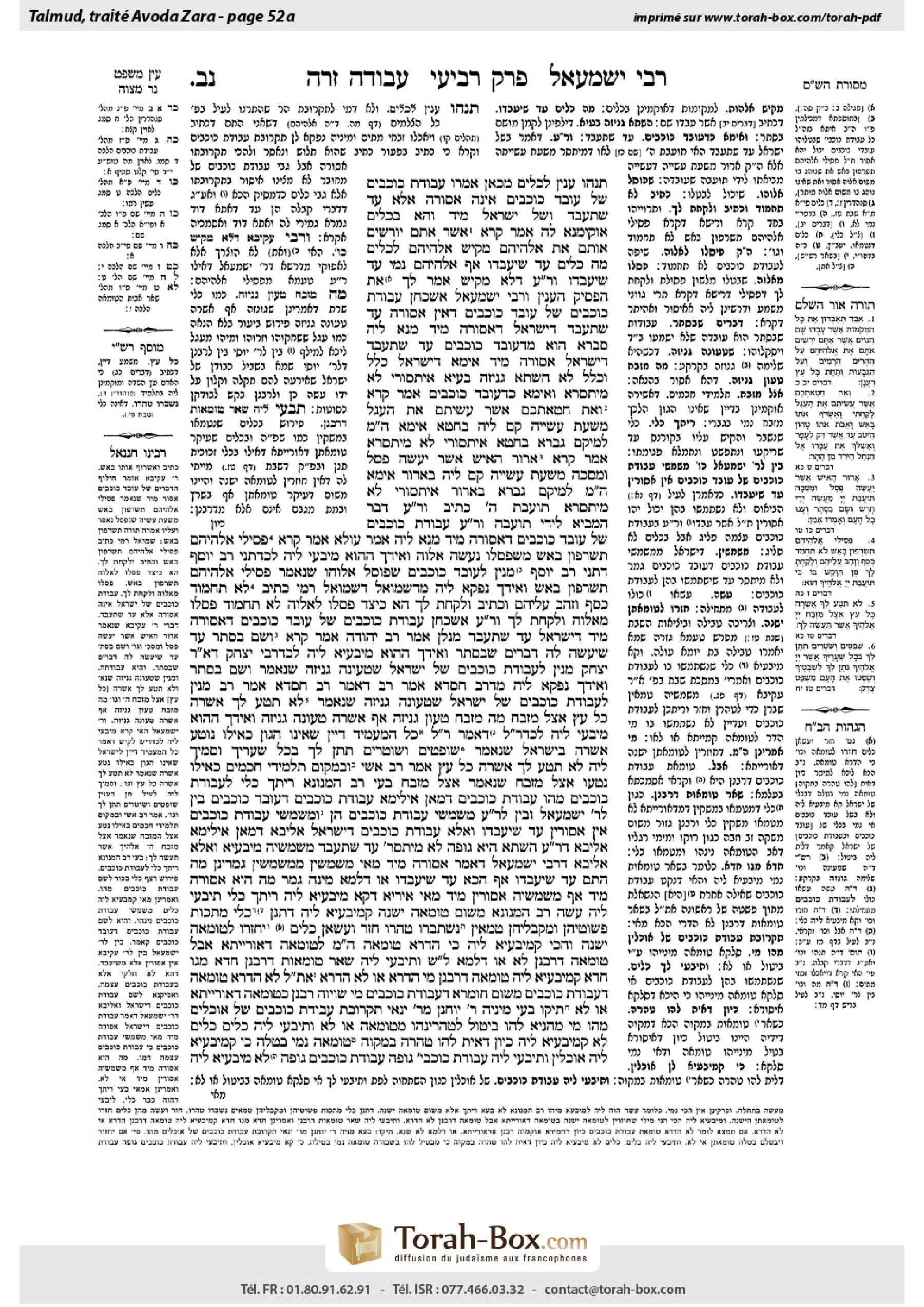
Avodah Zarah 52a: Talmud study for Daf Yomi
Study the Talmud for Daf Yomi with scanned pages, Hebrew text, English translations from Sefaria and AI-generated French translations.
Passage selection and English or AI-generated French translation are available where the scan has annotations. Daf Study is independent of Torah-Box and Sefaria.
Browse Avodah Zarah · עבודה זרה · All tractatesAvodah Zarah 52a text and translations
This page of Avodah Zarah includes the Aramaic text, an English translation and an AI-generated French translation, alongside the scan above.
עבודה זרה נ״ב א · Aramaic and Hebrew text
תְּנֵהוּ עִנְיָן לְכֵלִים, מִכָּאן אָמְרוּ: עֲבוֹדָה זָרָה שֶׁל נׇכְרִי אֵינָהּ אֲסוּרָה אֶלָּא עַד שֶׁתֵּעָבֵד, וְשֶׁל יִשְׂרָאֵל מִיָּד.
וְהָא בְּכֵלִים אוֹקֵימְנָא לַהּ! אָמַר קְרָא: ״אֲשֶׁר אַתֶּם יֹרְשִׁים אֹתָם אֶת אֱלֹהֵיהֶם״, מַקִּישׁ אֱלֹהֵיהֶם לְכֵלִים, מָה כֵּלִים עַד שֶׁיֵּעָבֵדוּ, אַף אֱלֹהֵיהֶם נָמֵי עַד שֶׁיֵּעָבֵדוּ. וְרַבִּי עֲקִיבָא דְּלָא מַקֵּישׁ, אָמַר לָךְ: ״אֶת״ הִפְסִיק הָעִנְיָן.
וְרַבִּי יִשְׁמָעֵאל, אַשְׁכְּחַן עֲבוֹדָה זָרָה שֶׁל נׇכְרִי דְּאֵין אֲסוּרָה עַד שֶׁתֵּעָבֵד, דְּיִשְׂרָאֵל דַּאֲסוּרָה מִיָּד מְנָא לֵיהּ? סְבָרָא הוּא, מִדְּנׇכְרִי עַד שֶׁתֵּעָבֵד, דְּיִשְׂרָאֵל אֲסוּרָה מִיָּד. אֵימָא: דְּיִשְׂרָאֵל כְּלָל וּכְלָל לָא! הַשְׁתָּא גְּנִיזָה בָּעֲיָא, אִיתְּסוֹרֵי לָא מִיתַּסְרָא?
וְאֵימָא כִּדְנׇכְרִי! אָמַר קְרָא: ״וְאֶת חַטַּאתְכֶם אֲשֶׁר עֲשִׂיתֶם אֶת הָעֵגֶל״, מִשְּׁעַת עֲשִׂיָּיה קָם לֵיהּ בְּחֵטְא.
אֵימָא: הָנֵי מִילֵּי לְמֵיקַם גַּבְרָא בְּחֵטְא, אִיתְּסוֹרֵי לָא מִיתַּסְרָא! אָמַר קְרָא: ״אָרוּר הָאִישׁ אֲשֶׁר יַעֲשֶׂה פֶסֶל וּמַסֵּכָה״, מִשְּׁעַת עֲשִׂיָּיה קָם לֵיהּ בְּאָרוּר.
אֵימָא הָנֵי מִילֵּי לְמֵיקַם גַּבְרָא בְּ״אָרוּר״, אִיתְּסוֹרֵי לָא מִיתַּסְרָא! ״תּוֹעֲבַת ה׳״ כְּתִיב.
וְרַבִּי עֲקִיבָא? דָּבָר הַמֵּבִיא לִידֵי תּוֹעֵבָה.
וְרַבִּי עֲקִיבָא, עֲבוֹדָה זָרָה שֶׁל נׇכְרִי דַּאֲסוּרָה מִיָּד מְנָא לֵיהּ? אָמַר עוּלָּא, אָמַר קְרָא: ״פְּסִילֵי אֱלֹהֵיהֶם תִּשְׂרְפוּן בָּאֵשׁ״, מִשֶּׁפִּסְּלוֹ נַעֲשֶׂה אֱלוֹהַּ.
וְאִידַּךְ, הַהוּא מִיבְּעֵי לֵיהּ לְכִדְתָנֵי רַב יוֹסֵף, דְּתָנֵי רַב יוֹסֵף: מִנַּיִן לְגוֹי שֶׁפּוֹסֵל אֱלוֹהוֹ? שֶׁנֶּאֱמַר: ״פְּסִילֵי אֱלֹהֵיהֶם תִּשְׂרְפוּן בָּאֵשׁ״.
וְאִידַּךְ, נָפְקָא לֵיהּ מִדִּשְׁמוּאֵל, דִּשְׁמוּאֵל רָמֵי: כְּתִיב ״לֹא תַחְמֹד כֶּסֶף וְזָהָב עֲלֵיהֶם״, וּכְתִיב ״וְלָקַחְתָּ לָךְ״. הָא כֵּיצַד? פִּסְּלוֹ לֶאֱלוֹהַּ — ״לֹא תַחְמֹד״, פְּסָלוֹ מֵאֱלוֹהַּ — ״וְלָקַחְתָּ לָךְ״.
וְרַבִּי עֲקִיבָא, אַשְׁכְּחַן עֲבוֹדָה זָרָה שֶׁל נׇכְרִי דַּאֲסוּרָה מִיָּד, דְּיִשְׂרָאֵל עַד שֶׁתֵּעָבֵד מְנָלַן? אָמַר רַב יְהוּדָה אָמַר קְרָא: ״וְשָׂם בַּסָּתֶר״, עַד שֶׁיַּעֲשֶׂה לָהּ דְּבָרִים שֶׁבַּסֵּתֶר.
וְאִידַּךְ? הַהוּא מִיבַּעְיָא לֵיהּ לְכִדְרַבִּי יִצְחָק, דְּאָמַר רַבִּי יִצְחָק: מִנַּיִן לַעֲבוֹדָה זָרָה שֶׁל יִשְׂרָאֵל שֶׁטְּעוּנָה גְּנִיזָה? שֶׁנֶּאֱמַר: ״וְשָׂם בַּסָּתֶר״.
וְאִידַּךְ? נָפְקָא לֵיהּ מִדְּרַב חִסְדָּא אָמַר רַב, דְּאָמַר רַב חִסְדָּא אָמַר רַב: מִנַּיִן לַעֲבוֹדָה זָרָה שֶׁל יִשְׂרָאֵל שֶׁטְּעוּנָה גְּנִיזָה? שֶׁנֶּאֱמַר: ״לֹא תִטַּע לְךָ אֲשֵׁרָה כָּל עֵץ אֵצֶל מִזְבַּח״, מָה מִזְבֵּחַ טָעוּן גְּנִיזָה, אַף אֲשֵׁרָה טְעוּנָה גְּנִיזָה.
וְאִידַּךְ? הָהוּא מִיבְּעֵי לֵיהּ לְכִדְרֵישׁ לָקִישׁ, דְּאָמַר רֵישׁ לָקִישׁ: כׇּל הַמַּעֲמִיד דַּיָּין שֶׁאֵינוֹ הָגוּן — כְּאִילּוּ נוֹטֵעַ אֲשֵׁרָה בְּיִשְׂרָאֵל, שֶׁנֶּאֱמַר: ״שֹׁפְטִים וְשֹׁטְרִים תִּתֶּן לְךָ בְּכׇל שְׁעָרֶיךָ״, וּסְמִיךְ לֵיהּ: ״לֹא תִטַּע לְךָ אֲשֵׁרָה כָּל עֵץ״.
אָמַר רַב אָשֵׁי: וּבִמְקוֹם תַּלְמִידֵי חֲכָמִים, כְּאִילּוּ נְטָעוֹ אֵצֶל מִזְבֵּחַ, שֶׁנֶּאֱמַר: ״אֵצֶל מִזְבַּח״.
בָּעֵי רַב הַמְנוּנָא: רִיתֵּךְ כְּלִי לַעֲבוֹדָה זָרָה, מַהוּ? עֲבוֹדָה זָרָה דְּמַאן? אִילֵימָא עֲבוֹדָה זָרָה דְּנׇכְרִי, בֵּין לְרַבִּי יִשְׁמָעֵאל וּבֵין לְרַבִּי עֲקִיבָא מְשַׁמְּשֵׁי עֲבוֹדָה זָרָה הֵן, וּמְשַׁמְּשֵׁי עֲבוֹדָה זָרָה אֵין אֲסוּרִין עַד שֶׁיֵּעָבֵדוּ! אֶלָּא עֲבוֹדָה זָרָה דְּיִשְׂרָאֵל.
אַלִּיבָּא דְּמַאן? אִילֵימָא אַלִּיבָּא דְּרַבִּי עֲקִיבָא, הַשְׁתָּא הִיא גּוּפַהּ לָא מִיתַּסְרָא עַד שֶׁתֵּעָבֵד, מְשַׁמְּשֶׁיהָ מִיבַּעְיָא? וְאֶלָּא אַלִּיבָּא דְּרַבִּי יִשְׁמָעֵאל, דְּאָמַר: ״אֲסוּרָה מִיָּד״.
מַאי מְשַׁמְּשִׁין? מְמַשְׁמְשִׁין גָּמְרִינַן, מָה הָתָם עַד שֶׁיֵּעָבֵדוּ, אַף הָכָא עַד שֶׁיֵּעָבֵדוּ, אוֹ דִלְמָא מִינַּהּ גָּמַר, מָה הִיא אֲסוּרָה מִיָּד, אַף מְשַׁמְּשֶׁיהָ אֲסוּרִין מִיָּד?
מַאי אִירְיָא דְּקָא מִיבַּעְיָא לֵיהּ רִיתֵּךְ כְּלִי? תִּיבְּעֵי לֵיהּ עָשָׂה!
רַב הַמְנוּנָא מִשּׁוּם טוּמְאָה יְשָׁנָה קָמִיבַּעְיָא לֵיהּ, דִּתְנַן: כְּלֵי מַתָּכוֹת, פְּשׁוּטֵיהֶן וּמְקַבְּלֵיהֶן טְמֵאִין, נִשְׁתַּבְּרוּ טָהֵרוּ, חָזַר וַעֲשָׂאָן כֵּלִים — יַחְזְרוּ לְטוּמְאָה יְשָׁנָה.
וְהָכִי קָמִיבַּעְיָא לֵיהּ: כִּי הָדְרָא טוּמְאָה — הָנֵי מִילֵּי לְטוּמְאָה דְּאוֹרָיְיתָא, אֲבָל טוּמְאָה דְּרַבָּנַן — לָא, אוֹ דִלְמָא לָא שְׁנָא? וְתִיבְּעֵי לֵיהּ שְׁאָר טוּמְאוֹת דְּרַבָּנַן.
חֲדָא מִגּוֹ חֲדָא קָמִיבַּעְיָא לֵיהּ, טוּמְאָה דְּרַבָּנַן מִי הָדְרָא אוֹ לָא הָדְרָא? וְאִם תִּימְצֵי לוֹמַר לָא הָדְרָא, טוּמְאָה דַּעֲבוֹדָה זָרָה מִשּׁוּם חוּמְרָא דַּעֲבוֹדָה זָרָה מִי שַׁוְּיוּהָ רַבָּנַן כְּטוּמְאָה דְּאוֹרָיְיתָא אוֹ לָא? תֵּיקוּ.
בָּעֵי מִינֵּיהּ רַבִּי יוֹחָנָן מֵרַבִּי יַנַּאי: תִּקְרוֹבֶת עֲבוֹדָה זָרָה שֶׁל אוֹכָלִים, מַהוּ? מִי מַהֲנֵיא לְהוּ בִּיטּוּל לְטַהוֹרִינְהוּ מִטּוּמְאָה, אוֹ לָא?
וְתִיבְּעֵי לֵיהּ כֵּלִים! כֵּלִים לָא קָמִיבַּעְיָא לֵיהּ, כֵּיוָן דְּאִית לְהוּ טׇהֳרָה בְּמִקְוֶה — טוּמְאָה נָמֵי בָּטְלָה; כִּי קָמִיבַּעְיָא לֵיהּ — אֳוכָלִין.
וְתִיבְּעֵי לֵיהּ עֲבוֹדָה זָרָה גּוּפַהּ! עֲבוֹדָה זָרָה גּוּפַהּ לָא מִיבַּעְיָא לֵיהּ,
Avodah Zarah 52a · English translation
Since the verse does not apply to places that were themselves worshipped, apply it to the matter of vessels that were used for idol worship. It is from here that the Sages stated: A gentile’s object of idol worship is not prohibited until it is worshipped, but a Jew’s object of idol worship is forbidden immediately.
The Gemara questions how the halakha with regard to an object of idol worship is derived from this verse. But didn’t we interpret this verse as being stated with regard to vessels used in idolatrous worship, and not to an object of idol worship? The Gemara answers: The verse states: “You shall destroy all the places, where the nations that you are to dispossess served their gods” (Deuteronomy 12:2). The verse juxtaposes “their gods” to “the places,” i.e., the vessels used to serve them. Just as the vessels are not forbidden until they are used for worship, so too their gods, the idols, are also not forbidden until they are worshipped. And Rabbi Akiva, who does not consider the terms juxtaposed, he could say to you that the word “et,” written in the verse before the term “their gods,” separates the matter of their gods from the matter of the vessels.
The Gemara asks: And as for the opinion of Rabbi Yishmael, we found a source for the halakha that a gentile’s object of idol worship is not prohibited until it is worshipped. From where does he derive that a Jew’s object of idol worship is prohibited immediately? The Gemara answers: It is based on logical reasoning. From the fact that a gentile’s idol is not forbidden until it is worshipped, it stands to reason that a Jew’s idol is prohibited immediately. The Gemara asks: Why not say that a Jew’s idol is not forbidden at all? The Gemara answers: Now, the status of a Jew’s idol cannot be revoked and the idol requires interment. Is it possible that it does not become prohibited?
The Gemara challenges: But one could say that a Jew’s idol is forbidden only once it is worshipped, just as a gentile’s idol is forbidden only once it is worshipped. The Gemara answers: The verse states: “And I took your sin, the calf that you had made, and I burned it with fire” (Deuteronomy 9:21), which indicates that from the time of its making its worshippers were liable for the sin.
The Gemara asks: Why not say that this matter applies only with regard to rendering the man who made the idol liable for the sin, but the object of idol worship does not become prohibited until it is worshipped? The Gemara answers: The verse states: “Cursed be the man who shall make a graven or molten image, an abomination to the Lord, the work of the hands of the craftsman, and shall set it up in a hidden place” (Deuteronomy 27:15), which indicates that from the time of its making the person who made the idol is liable to be cursed.
The Gemara asks: Why not say that this matter applies only with regard to rendering the man who made the idol liable to be cursed, but the object of idol worship does not become prohibited until it is worshipped? The Gemara answers: It is written: “An abomination to the Lord” (Deuteronomy 27:15). This indicates that the idol itself is an abomination and is therefore prohibited from the time that it is made.
The Gemara asks: And as for Rabbi Akiva, who does not maintain that a Jew’s idol is forbidden from the time that it is made, how does he interpret this verse? The Gemara answers: Rabbi Akiva explains that the term “an abomination” means an object that leads to abomination but itself is not considered an abomination before it is worshipped.
The Gemara explains the opinion of Rabbi Akiva: And as for the opinion of Rabbi Akiva, from where does he derive that a gentile’s object of idol worship is prohibited immediately? Ulla said: The verse states: “The graven images of their gods you shall burn with fire; you shall not covet the silver or the gold that is on them and take it for yourself, lest you be snared thereby, for it is an abomination to the Lord your God” (Deuteronomy 7:25). The term “graven images” indicates that from the time that the gentile engraves and carves the stone into an idol it becomes a god and is forbidden.
The Gemara asks: And the other tanna, Rabbi Yishmael, how does he interpret this verse? The Gemara answers: Rabbi Yishmael requires that verse for that which Rav Yosef teaches in a baraita, as Rav Yosef teaches: From where is it derived that a gentile may revoke [sheposel] the status of an object as his god? This is derived from a verse, as it is stated: “The graven images of [pesilei] their gods you shall burn with fire” (Deuteronomy 7:25).
The Gemara asks: And the other tanna, Rabbi Akiva, from where does he derive this halakha? The Gemara answers: Rabbi Akiva derives it from the interpretation of Shmuel, as Shmuel raises a contradiction: It is written: “The graven images of [pesilei] their gods you shall burn with fire; you shall not covet the silver or the gold that is on them” (Deuteronomy 7:25), and in the continuation of the verse it is written: “And take it for yourself,” indicating that one is permitted to take the silver and gold. How can these texts be reconciled? If the gentile engraved and carved the stone as a god, it is immediately rendered forbidden and the prohibition “you shall not covet” applies. If the gentile revoked [pesalo] the idol’s status as a god, the continuation of the verse: “And take it for yourself,” applies.
The Gemara asks: And as for the opinion of Rabbi Akiva, we found a source for the halakha that a gentile’s object of idol worship is prohibited immediately. From where do we derive that a Jew’s object of idol worship is not forbidden until it is worshipped? Rav Yehuda said that the verse states: “Cursed be the man who shall make a graven or molten image…and shall set it up in a hidden place” (Deuteronomy 27:15). This indicates that the idol is not rendered forbidden until the idolater performs in service of the idol those matters, i.e., rites, that are performed in a hidden place.
The Gemara asks: And the other tanna, Rabbi Yishmael, how does he interpret this verse? The Gemara answers: Rabbi Yishmael requires that verse for that which Rabbi Yitzḥak says, as Rabbi Yitzḥak says: From where is it derived that a Jew’s object of idol worship requires interment? This is derived from a verse, as it is stated: “And shall set it up in a hidden place” (Deuteronomy 27:15), which Rabbi Yitzḥak interprets as requiring one to inter the idol in a hidden place.
The Gemara asks: And the other tanna, Rabbi Akiva, from where does he derive this halakha? The Gemara answers: Rabbi Akiva derives it from that which Rav Ḥisda says that Rav says, as Rav Ḥisda says that Rav says: From where is it derived that a Jew’s object of idol worship requires interment? This is derived from a verse, as it is stated: “You shall not plant for yourself an ashera of any kind of tree beside the altar of the Lord your God” (Deuteronomy 16:21). The verse juxtaposes an ashera, a tree used as part of idolatrous rites, to the altar. This indicates that just as the altar requires interment, so too an ashera requires interment.
The Gemara asks: And the other tanna, Rabbi Yishmael, how does he interpret this verse? The Gemara answers: Rabbi Yishmael requires that verse for that which Reish Lakish says, as Reish Lakish says: Anyone who appoints over the community a judge who is unfit for the position, due to his lack of knowledge or wickedness, is considered as though he plants an ashera among the Jewish people, as it is stated: “Judges and officers you shall make for yourself in all of your gates” (Deuteronomy 16:18), and juxtaposed to it is the verse: “You shall not plant for yourself an ashera of any kind of tree beside the altar of the Lord your God” (Deuteronomy 16:21).
Rav Ashi says: And if one appoints an unsuitable individual as a judge in a place where there are Torah scholars, it is as though he planted an ashera next to the altar, as it is stated: “Beside the altar of the Lord your God.”
§ Rav Hamnuna raises a dilemma: If one welded [ritekh] a broken vessel for idol worship, what is the halakha? The Gemara asks: With regard to whose idol worship does Rav Hamnuna raise the dilemma? If we say that Rav Hamnuna is referring to a gentile’s idol worship, that is difficult, as both according to Rabbi Yishmael and according to Rabbi Akiva vessels used in idolatrous worship are considered accessories of idol worship, and accessories of idol worship are not prohibited until they are used for worship. Rather, Rav Hamnuna is referring to a Jews’ idol worship.
The Gemara asks: In accordance with whose opinion does Rav Hamnuna raise the dilemma? If we say that he raises the dilemma in accordance with the opinion of Rabbi Akiva, this is difficult. Now that the idol itself is not prohibited until it is worshipped, is it necessary to state that its accessories are not forbidden until they are used for idol worship? Rather, perhaps Rav Hamnuna raises the dilemma in accordance with the opinion of Rabbi Yishmael, who says that a Jew’s idol is prohibited immediately.
The Gemara suggests an explanation of the dilemma: What is the halakha with regard to a Jew’s accessories of idol worship? Do we learn the halakha with regard to a Jew’s accessories from the halakha with regard to a gentile’s accessories? Just as there, in the case of a gentile’s accessories of idol worship, they are not forbidden until they are used for idol worship, so too here, in the case of a Jew’s accessories of idol worship, they are not forbidden until they are used for idol worship. Or perhaps the halakha is learned from the halakha with regard to a Jew’s object of idol worship itself. Just as the idol itself is prohibited immediately, so too its accessories are prohibited immediately.
The Gemara rejects this explanation: If that is the explanation of Rav Hamnuna’s dilemma, why does he specifically raise the dilemma with regard to one who welded a broken vessel? Let him raise the dilemma with regard to one who fashioned a vessel for idolatrous worship.
The Gemara answers: Rav Hamnuna is referring to a vessel that was used for idol worship before it broke, and he is raising the dilemma with regard to the matter of previous ritual impurity. As we learned in a mishna (Kelim 11:1): With regard to metal vessels, both their flat vessels, which have no repositories, and their receptacles, vessels that have repositories, are all impure if they came into contact with a primary source of ritual impurity. If they broke, they thereby became purified. But if one remade the broken vessels into new vessels, they reassume their previous impurity.
And this is the dilemma that Rav Hamnuna is raising: When the mishna teaches that a vessel that is remade reassumes its impurity, does this matter apply only to impurity by Torah law, but in the case of impurity by rabbinic law, such as the impurity of an object of idol worship, it does not apply? Or perhaps there is no difference between impurity by Torah law and impurity by rabbinic law. The Gemara asks: If that is the explanation of Rav Hamnuna’s dilemma, why does he specifically discuss a vessel used for idol worship? Let him raise the dilemma with regard to any other type of impurity by rabbinic law.
The Gemara answers: Rav Hamnuna is raising two dilemmas, one of which stems from the other. Is impurity by rabbinic law reassumed, or is it not reassumed? And if you say that it is not reassumed, what is the halakha with regard to the impurity of an object of idol worship? Did the Sages render its status like that of impurity by Torah law, due to the stringency of idol worship, or not? The Gemara concludes: The dilemmas shall stand unresolved.
§ Rabbi Yoḥanan raised a dilemma to Rabbi Yannai: With regard to an offering consisting of food brought in idolatrous worship, what is the halakha? Is the revocation of their status as an object of idol worship by a gentile effective to purify them from the ritual impurity of an offering brought in idolatrous worship or is it not effective?
The Gemara suggests: And let him raise the dilemma with regard to whether revocation of vessels’ status purifies vessels used in idol worship from their impurity. The Gemara explains: Rabbi Yoḥanan does not raise the dilemma with regard to vessels, since they have the ability to attain purity by being immersed in a ritual bath, and therefore their impurity can certainly also be nullified. When he raises the dilemma, it is only with regard to food, which cannot be purified in a ritual bath.
The Gemara suggests: Let him raise the dilemma with regard to whether revoking its status purifies the object of idol worship itself in a case where it consists of food. The Gemara answers: Rabbi Yoḥanan does not raise the dilemma with regard to the object of idol worship itself,
Avodah Zarah 52a · Traduction française (IA)
Puisque la versette ne s'applique pas aux lieux eux-mêmes adorés, appliquez-la à la matière des objets utilisés pour l'idolâtrie. C'est à partir de là que les Sages ont déclaré : L'objet d'idolâtrie d'un non-Juif n'est pas interdit jusqu'à ce qu'il soit adoré, mais l'objet d'idolâtrie d'un Juif est interdit dès sa fabrication.
La Guemara questionne sur la manière dont la halakha concernant un objet d'idolâtrie est dérivée de cette versette. Mais n'avons-nous pas interprété cette versette comme étant relative aux objets utilisés dans l'idolâtrie, et non à l'objet d'idolâtrie lui-même ? La Guemara répond : La versette dit : « Vous détruirez tous les lieux où les nations que vous allez expulser adoraient leurs dieux » (Deutéronome 12:2). La versette juxtapose « leurs dieux » à « les lieux », c'est-à-dire les objets utilisés pour les adorer. Aussi longtemps que les objets ne sont pas interdits jusqu'à ce qu'ils soient utilisés pour l'adoration, de même les dieux, les idoles, ne sont pas interdits jusqu'à ce qu'ils soient adorés. Et Rabbi Akiva, qui ne considère pas les termes comme juxtaposés, pourrait dire que le mot « et » écrit avant le terme « leurs dieux » sépare la matière des dieux de celle des objets.
La Guemara pose la question : Et quant à l'opinion de Rabbi Yishmael, nous avons trouvé une source pour la halakha selon laquelle l'objet d'idolâtrie d'un non-Juif n'est pas interdit jusqu'à ce qu'il soit adoré. D'où dérive-t-il que l'objet d'idolâtrie d'un Juif est interdit dès sa fabrication ? La Guemara répond : Cela s'appuie sur un raisonnement logique. Du fait que l'idole d'un non-Juif n'est pas interdite jusqu'à ce qu'elle soit adorée, il en va de même pour l'idole d'un Juif, qui est interdite dès sa fabrication. La Guemara pose la question : Pourquoi ne pas dire que l'idole d'un Juif n'est pas interdite du tout ? La Guemara répond : Maintenant, le statut de l'idole d'un Juif ne peut être révoqué et l'idole nécessite une inhumation. Est-il possible qu'elle ne devienne pas interdite ?
La Guemara conteste : Mais on pourrait dire que l'idole d'un Juif est interdite seulement une fois qu'elle est adorée, tout comme l'idole d'un non-Juif est interdite seulement une fois qu'elle est adorée. La Guemara répond : La versette dit : « Et j'ai pris ton péché, le veau que tu as fait, et j'ai brûlé le feu sur le feu » (Deutéronome 9:21), ce qui indique que dès sa fabrication, les adorateurs de l'idole étaient tenus responsables du péché.
La Guemara pose la question : Pourquoi ne pas dire que cette matière s'applique seulement à la responsabilité de l'homme qui a fait l'idole à être maudit, mais l'objet d'idolâtrie ne devient interdit qu'une fois qu'il est adoré ? La Guemara répond : La versette dit : « Maudit soit l'homme qui fera un image gravée ou fondue, un abomination à l'Éternel, l'œuvre des mains du charpentier, et le placera dans un lieu caché » (Deutéronome 27:15), ce qui indique que dès sa fabrication, l'homme qui a fait l'idole est tenu de la malédiction.
La Guemara pose la question : Pourquoi ne pas dire que cette matière s'applique seulement à la responsabilité de l'homme qui a fait l'idole à être maudit, mais l'objet d'idolâtrie ne devient interdit qu'une fois qu'il est adoré ? La Guemara répond : Il est écrit : « Un abomination à l'Éternel » (Deutéronome 27:15). Cela indique que l'idole elle-même est un abomination et est donc interdite dès sa fabrication.
La Guemara pose la question : Et quant à l'opinion de Rabbi Akiva, qui ne considère pas que l'idole d'un Juif soit interdite dès sa fabrication, comment interprète-t-il cette versette ? La Guemara répond : Rabbi Akiva explique que le terme « un abomination » signifie un objet qui conduit à l'abomination, mais lui-même n'est pas considéré comme un abomination avant qu'il ne soit adoré.
La Guemara explique l'opinion de Rabbi Akiva : Et quant à l'opinion de Rabbi Akiva, d'où dérive-t-il que l'objet d'idolâtrie d'un non-Juif est interdit dès sa fabrication ? Ulla dit : La versette dit : « Les images gravées de leurs dieux, vous les brûlerez avec le feu ; vous ne désirerez pas l'argent ou l'or qui est sur elles et vous ne les prendrez pas pour vous, de peur d'être enlevé par là, car c'est un abomination à l'Éternel votre Dieu » (Deutéronome 7:25). Le terme « images gravées » indique que dès que le non-Juif grave et sculpte la pierre en idole, il devient un dieu et est interdit.
La Guemara pose la question : Et quant à l'autre tanna, Rabbi Yishmael, comment interprète-t-il cette versette ? La Guemara répond : Rabbi Yishmael exige cette versette pour ce que Rav Yosef enseigne dans une baraïta, comme Rav Yosef enseigne : D'où dérive-t-il que le non-Juif peut révoquer le statut d'un objet comme son dieu ? Cela est dérivé d'une versette, comme il est dit : « Les images gravées de leurs dieux, vous les brûlerez avec le feu » (Deutéronome 7:25).
La Guemara pose la question : Et quant à l'autre tanna, Rabbi Akiva, d'où dérive-t-il cette halakha ? La Guemara répond : Rabbi Akiva la dérive de l'interprétation de Shmuel, comme Shmuel soulève une contradiction : Il est écrit : « Les images gravées de [pesilei] leurs dieux, vous les brûlerez avec le feu ; vous ne désirerez pas l'argent ou l'or qui est sur elles » (Deutéronome 7:25), et dans la continuation de la versette, il est écrit : « Et vous les prendrez pour vous », indiquant que l'on est autorisé à prendre l'argent et l'or. Comment peuvent ces textes être conciliés ? Si le non-Juif a gravé et sculpté la pierre en dieu, il est immédiatement rendu interdit et la prohibition « vous ne désirerez pas » s'applique. Si le non-Juif a révoqué [pesalo] le statut de l'idole comme un dieu, la continuation de la versette : « Et vous les prendrez pour vous », s'applique.
La Guemara pose la question : Et quant à l'opinion de Rabbi Akiva, nous avons trouvé une source pour la halakha selon laquelle l'objet d'idolâtrie d'un non-Juif est interdit dès sa fabrication. D'où dérive-t-il que l'objet d'idolâtrie d'un Juif n'est pas interdit jusqu'à ce qu'il soit adoré ? Rav Yehuda dit que la versette dit : « Maudit soit l'homme qui fera une image gravée ou fondue… et le placera dans un lieu caché » (Deutéronome 27:15). Cela indique que l'idole n'est pas rendue interdite jusqu'à ce que l'idolâtre accomplisse les rites, c'est-à-dire les actes, qui sont accomplis dans un lieu caché.
La Guemara pose la question : Et l'autre tanna, Rabbi Yishmael, comment interprète-t-il cette versette ? La Guemara répond : Rabbi Yishmael exige cette versette pour ce que dit Rabbi Yitzḥak, car Rabbi Yitzḥak dit : D'où tire-t-on que l'objet d'idolâtrie d'un Juif exige d'être enterré ? Cela est tiré d'une versette, comme il est dit : « Et il le placera dans un lieu caché » (Deutéronome 27:15), que Rabbi Yitzḥak interprète comme exigeant d'enterrer l'idole dans un lieu caché.
La Guemara pose la question : Et l'autre tanna, Rabbi Akiva, d'où tire-t-il cette halakha ? La Guemara répond : Rabbi Akiva tire cela de ce que dit Rav Ḥisda, qui rapporte Rav, comme Rav Ḥisda dit que Rav dit : D'où tire-t-on que l'objet d'idolâtrie d'un Juif exige d'être enterré ? Cela est tiré d'une versette, comme il est dit : « Tu ne planteras point pour toi un ashera de toute espèce d'arbre à côté de l'autel du Seigneur ton Dieu » (Deutéronome 16:21). La versette juxtapose un ashera, un arbre utilisé dans les rites idolâtres, à l'autel. Cela indique que tout comme l'autel exige d'être enterré, ainsi l'ashera exige d'être enterré.
La Guemara pose la question : Et l'autre tanna, Rabbi Yishmael, comment interprète-t-il cette versette ? La Guemara répond : Rabbi Yishmael exige cette versette pour ce que dit Reish Lakish, comme Reish Lakish dit : Quiconque nomme un juge inadéquat pour la communauté, en raison de son manque de savoir ou de sa malice, est considéré comme s'il plantait un ashera parmi le peuple juif, comme il est dit : « Tu feras toi-même des juges et des magistrats pour toi dans toutes tes portes » (Deutéronome 16:18), et juxtaposée à cela est la versette : « Tu ne planteras point pour toi un ashera de toute espèce d'arbre à côté de l'autel du Seigneur ton Dieu » (Deutéronome 16:21).
Rav Ashi dit : Et si l'on nomme un individu inadapté comme juge dans un lieu où il y a des savants de la Torah, c'est comme s'il plantait un ashera à côté de l'autel, comme il est dit : « À côté de l'autel du Seigneur ton Dieu. »
§ Rav Hamnuna soulève un dilemme : Si l'on a soudé [ritekh] un vase brisé pour l'idolâtrie, quelle est la halakha ? La Guemara pose la question : À propos de quelle idolâtrie Rav Hamnuna soulève-t-il ce dilemme ? Si nous disons que Rav Hamnuna fait référence à l'idolâtrie d'un non-Juif, cela est difficile, car à la fois selon Rabbi Yishmael et selon Rabbi Akiva, les objets utilisés dans l'idolâtrie sont considérés comme des accessoires de l'idolâtrie, et les accessoires de l'idolâtrie ne sont pas interdits jusqu'à ce qu'ils soient utilisés pour l'idolâtrie. Plutôt, Rav Hamnuna fait référence à l'idolâtrie d'un Juif.
La Guemara pose la question : Sur quel avis Rav Hamnuna soulève-t-il ce dilemme ? Si nous disons qu'il le soulève selon l'avis de Rabbi Akiva, cela est difficile. Maintenant que l'idole elle-même n'est pas interdite jusqu'à ce qu'elle soit adorée, est-il nécessaire de dire que ses accessoires ne sont pas interdits jusqu'à ce qu'ils soient utilisés pour l'idolâtrie ? Plutôt, peut-être Rav Hamnuna soulève ce dilemme selon l'avis de Rabbi Yishmael, qui dit que l'idole d'un Juif est interdite dès le départ.
La Guemara suggère une explication du dilemme : Quelle est la halakha concernant les accessoires de l'idolâtrie d'un Juif ? Apprenons-nous la halakha concernant les accessoires d'un Juif à partir de la halakha concernant les accessoires d'un non-Juif ? Tout comme là, dans le cas des accessoires d'idolâtrie d'un non-Juif, ils ne sont pas interdits jusqu'à ce qu'ils soient utilisés pour l'idolâtrie, ainsi ici, dans le cas des accessoires d'idolâtrie d'un Juif, ils ne sont pas interdits jusqu'à ce qu'ils soient utilisés pour l'idolâtrie. Ou peut-être apprenons-nous la halakha à partir de la halakha concernant l'objet d'idolâtrie lui-même. Tout comme l'idole elle-même est interdite dès le départ, ainsi ses accessoires sont interdits dès le départ.
La Guemara rejette cette explication : Si c'est l'explication de Rav Hamnuna, pourquoi soulève-t-il spécifiquement ce dilemme concernant celui qui a soudé un vase brisé ? Laissons-le plutôt soulèver ce dilemme concernant celui qui a façonné un vase pour l'idolâtrie.
La Guemara répond : Rav Hamnuna fait référence à un vase qui a été utilisé pour l'idolâtrie avant de se briser, et il soulève ce dilemme concernant la question de l'impureté rituelle antérieure. Comme nous avons appris dans une mitsva (Kelim 11:1) : Concernant les vases métalliques, à la fois leurs vases plats, qui n'ont pas de récipients, et leurs récipients, les vases qui ont des récipients, sont tous impurs s'ils ont été en contact avec une source principale d'impureté rituelle. Si ils se brisent, ils deviennent ainsi purs. Mais si l'on remet en état les vases brisés pour en faire de nouveaux vases, ils reprendront leur impureté antérieure.
Et c'est ce dilemme que Rav Hamnuna soulève : Lorsque la mitsna enseigne que le vase remis en état reprend son impureté, cette question s'applique-t-elle uniquement à l'impureté selon la Torah, mais dans le cas de l'impureté selon la loi rabbinique, comme l'impureté de l'objet d'idolâtrie, elle ne s'applique-t-elle pas ? Ou peut-être n'y a-t-il pas de différence entre l'impureté selon la Torah et l'impureté selon la loi rabbinique. La Guemara pose la question : Si c'est l'explication du dilemme de Rav Hamnuna, pourquoi discute-t-il spécifiquement d'un vase utilisé pour l'idolâtrie ? Laissons-le plutôt soulèver ce dilemme concernant n'importe quel autre type d'impureté selon la loi rabbinique.
La Guemara répond : Rav Hamnuna soulève deux dilemmes, l'un provenant de l'autre. L'impureté selon la loi rabbinique reprend-elle, ou ne reprend-elle pas ? Et si vous dites qu'elle ne reprend pas, quelle est la halakha concernant l'impureté de l'objet d'idolâtrie ? Les Sages ont-ils rendu son statut semblable à celui de l'impureté selon la Torah, en raison de la stricteur de l'idolâtrie, ou non ? La Guemara conclut : Les dilemmes restent sans solution.
§ Rabbi Yoḥanan a posé un dilemme à Rabbi Yannai : En ce qui concerne une offrande composée de nourriture apportée dans un culte idolâtre, quelle est la halakha ? La révocation de leur statut d'objet de culte idolâtre par un non-Juif est-elle efficace pour les purifier de l'impureté rituelle d'une offrande apportée dans un culte idolâtre, ou n'est-elle pas efficace ?
La Guemara suggère : Et qu'il le pose en ce qui concerne la révocation du statut des vases, purifiant-ils les vases utilisés dans le culte idolâtre de leur impureté. La Guemara explique : Rabbi Yoḥanan ne pose pas ce dilemme en ce qui concerne les vases, car ils ont la capacité d'atteindre la pureté en étant immergés dans un mikvé, et par conséquent leur impureté peut certainement être annulée. Lorsqu'il pose ce dilemme, il s'agit uniquement de la nourriture, qui ne peut pas être purifiée dans un mikvé.
La Guemara suggère : Qu'il le pose en ce qui concerne la révocation de leur statut, purifiant-elle l'objet du culte idolâtre lui-même dans le cas où il s'agit de nourriture. La Guemara répond : Rabbi Yoḥanan ne pose pas ce dilemme en ce qui concerne l'objet du culte idolâtre lui-même,
Traduction française générée par IA à partir de l’édition anglaise de Sefaria. Vérifie toujours un passage avec le texte source.
Text from Sefaria: William Davidson Edition - Vocalized Aramaic (CC BY NC); William Davidson Edition - English (CC BY NC).