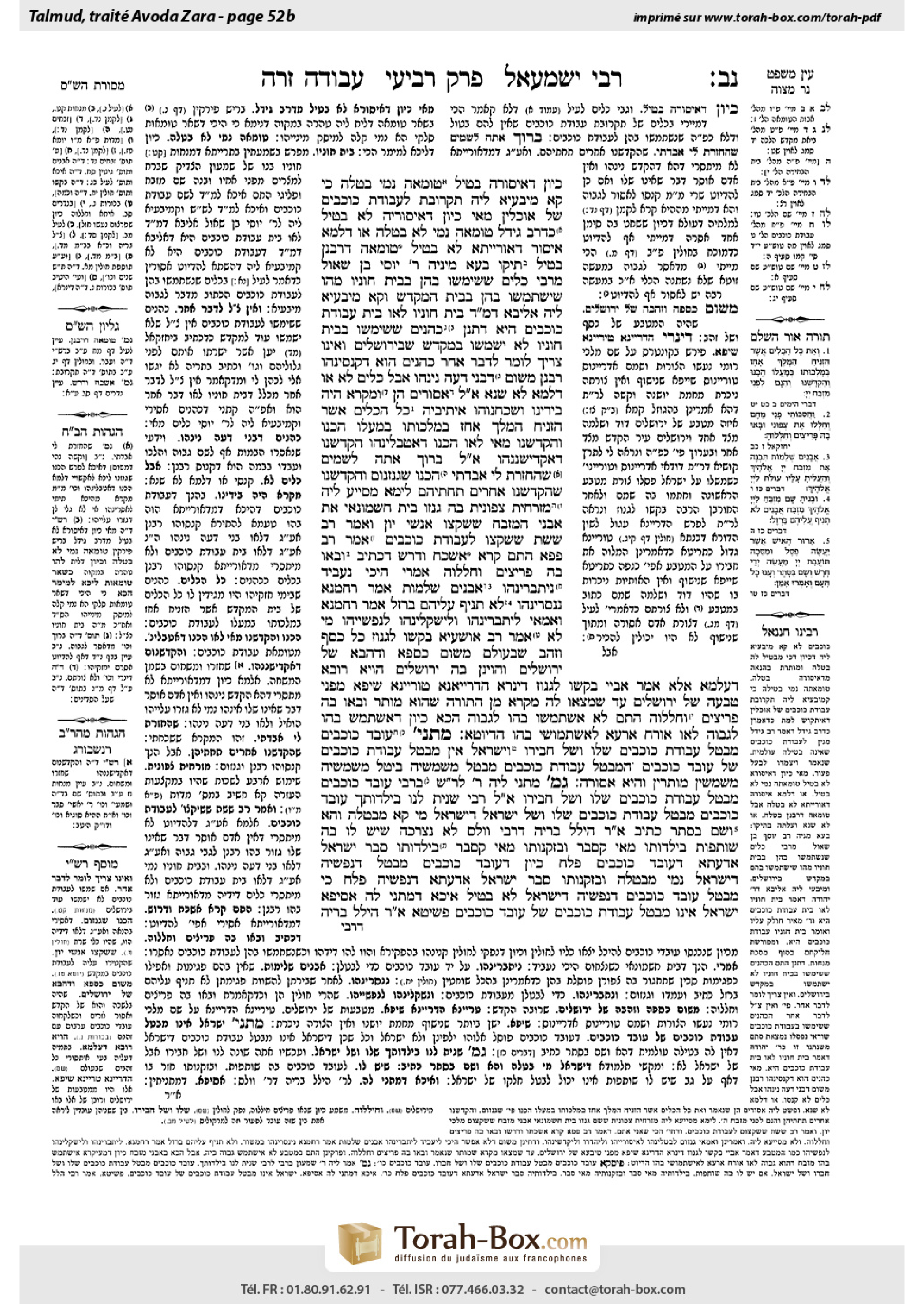
Avodah Zarah 52b: Talmud study for Daf Yomi
Study the Talmud for Daf Yomi with scanned pages, Hebrew text, English translations from Sefaria and AI-generated French translations.
Passage selection and English or AI-generated French translation are available where the scan has annotations. Daf Study is independent of Torah-Box and Sefaria.
Browse Avodah Zarah · עבודה זרה · All tractatesAvodah Zarah 52b text and translations
This page of Avodah Zarah includes the Aramaic text, an English translation and an AI-generated French translation, alongside the scan above.
עבודה זרה נ״ב ב · Aramaic and Hebrew text
כֵּיוָן דְּאִיסּוּרַהּ בָּטֵיל, טוּמְאָה נָמֵי בָּטְלָה. כִּי קָא מִיבַּעְיָא לֵיהּ תִּקְרוֹבֶת לַעֲבוֹדָה זָרָה שֶׁל אוֹכְלִין, מַאי? כֵּיוָן דְּאִיסּוּרֵיהּ לָא בָּטֵיל, כִּדְרַב גִּידֵּל, טוּמְאָה נָמֵי לָא בָּטְלָה, אוֹ דִלְמָא אִיסּוּר דְּאוֹרָיְיתָא לָא בָּטֵיל, טוּמְאָה דְּרַבָּנַן בָּטֵיל? תֵּיקוּ.
בְּעָא מִינֵּיהּ רַבִּי יוֹסֵי בֶּן שָׁאוּל מֵרַבִּי: כֵּלִים שֶׁשִּׁימְּשׁוּ בָּהֶן בְּבֵית חוֹנְיוֹ, מַהוּ שֶׁיִּשְׁתַּמְּשׁוּ בָּהֶן בְּבֵית הַמִּקְדָּשׁ?
וְקָא מִיבַּעְיָא לֵיהּ, אַלִּיבָּא דְּמַאן דְּאָמַר בֵּית חוֹנְיוֹ לָאו בֵּית עֲבוֹדָה זָרָה הִיא, דִּתְנַן: כֹּהֲנִים שֶׁשִּׁימְּשׁוּ בְּבֵית חוֹנְיוֹ לֹא יְשַׁמְּשׁוּ בַּמִּקְדָּשׁ שֶׁבִּירוּשָׁלַיִם, וְאֵינוֹ צָרִיךְ לוֹמַר לְדָבָר אַחֵר.
כֹּהֲנִים הוּא דְּקַנְסִינְהוּ רַבָּנַן, מִשּׁוּם דִּבְנֵי דֵעָה נִינְהוּ, אֲבָל כֵּלִים — לָא, אוֹ דִלְמָא לָא שְׁנָא?
אָמַר לוֹ: אֲסוּרִים הֵן, וּמִקְרָא הָיָה בְּיָדֵינוּ וּשְׁכַחְנוּהוּ.
אֵיתִיבֵיהּ: ״כׇּל הַכֵּלִים אֲשֶׁר הִזְנִיחַ הַמֶּלֶךְ אָחָז בְּמַלְכוּתוֹ בְּמַעֲלוֹ הֵכַנּוּ וְהִקְדָּשְׁנוּ״, מַאי לָאו ״הֵכַנּוּ״ — דְּאַטְבֵּלִינַּנְהוּ, ״הִקְדָּשְׁנוּ״ — דְּאַקְדֵּישִׁנַּנְהוּ?
אָמַר לוֹ: בָּרוּךְ אַתָּה לַשָּׁמַיִם שֶׁהֶחְזַרְתָּ לִי אֲבֵדָתִי. ״הֵכַנּוּ״ — שֶׁגְּנַזְנוּם, וְ״הִקְדָּשְׁנוּ״ — שֶׁהִקְדַּשְׁנוּ אֲחֵרִים תַּחְתֵּיהֶם.
לֵימָא מְסַיַּיע לֵיהּ: מִזְרָחִית צְפוֹנִית — בָּהּ גָּנְזוּ בֵּית חַשְׁמוֹנַאי אֶת אַבְנֵי הַמִּזְבֵּחַ שֶׁשִּׁקְּצוּ אַנְשֵׁי יָוָן, וְאָמַר רַב שֵׁשֶׁת: שֶׁשִּׁקְּצוּ לַעֲבוֹדָה זָרָה.
אָמַר רַב פָּפָּא: הָתָם קְרָא אַשְׁכַּח וּדְרַשׁ, דִּכְתִיב: ״וּבָאוּ בָהּ פָּרִיצִים וְחִלְּלוּהָ״.
אָמְרִי: הֵיכִי נַעֲבֵיד? נִיתְבְּרִינְהוּ? ״אֲבָנִים שְׁלֵמוֹת״ אָמַר רַחֲמָנָא! נְנַסְּרִינְהוּ? ״לֹא תָנִיף עֲלֵיהֶם בַּרְזֶל״ אָמַר רַחֲמָנָא.
וְאַמַּאי? לִיתְבְּרִינְהוּ וְלִישְׁקְלִינְהוּ לְנַפְשַׁיְיהוּ! מִי לָא אָמַר רַב אוֹשַׁעְיָא: ״בִּקְּשׁוּ לִגְנוֹז כׇּל כֶּסֶף וְזָהָב שֶׁבָּעוֹלָם מִשּׁוּם כַּסְפָּא וְדַהֲבָא שֶׁל יְרוּשָׁלַיִם״, וְהָוֵינַן בַּהּ: יְרוּשָׁלַיִם הָוְיָא רוּבָּא דְּעָלְמָא?
אֶלָּא אָמַר אַבָּיֵי: בִּקְּשׁוּ לִגְנוֹז דִּינָרָא הַדְרְיָיאנָא טוּרְיָינָא שִׁיפָא, מִפְּנֵי טִבְעָהּ שֶׁל יְרוּשָׁלַיִם, עַד שֶׁמָּצְאוּ לָהּ מִקְרָא מִן הַתּוֹרָה שֶׁהוּא מוּתָּר, ״וּבָאוּ בָהּ פָּרִיצִים וְחִלְּלוּהָ״!
הָתָם, לָא אִשְׁתַּמַּשׁוּ בְּהוּ לְגָבוֹהַּ; הָכָא, כֵּיוָן דְּאִשְׁתַּמַּשׁ בְּהוּ לְגָבוֹהַּ — לָאו אוֹרַח אַרְעָא לְאִשְׁתַּמּוֹשֵׁי בְּהוּ הֶדְיוֹטָא.
מַתְנִי׳ נׇכְרִי מְבַטֵּל עֲבוֹדָה זָרָה שֶׁלּוֹ, וְשֶׁל חֲבֵירוֹ, וְיִשְׂרָאֵל אֵין מְבַטֵּל עֲבוֹדָה זָרָה שֶׁל נׇכְרִי. הַמְבַטֵּל עֲבוֹדָה זָרָה — מְבַטֵּל מְשַׁמְּשֶׁיהָ, בִּיטֵּל מְשַׁמְּשֶׁיהָ — מְשַׁמְּשִׁין מוּתָּרִין, וְהִיא אֲסוּרָה.
גְּמָ׳ מַתְנֵי לֵיהּ רַבִּי לְרַבִּי שִׁמְעוֹן בְּרַבִּי: נׇכְרִי מְבַטֵּל עֲבוֹדָה זָרָה שֶׁלּוֹ וְשֶׁל חֲבֵירוֹ. אָמַר לוֹ: רַבִּי, שָׁנִיתָ לָנוּ בְּיַלְדוּתֶךָ נׇכְרִי מְבַטֵּל עֲבוֹדָה זָרָה שֶׁלּוֹ וְשֶׁל יִשְׂרָאֵל. דְּיִשְׂרָאֵל מִי קָא מְבַטְּלָהּ? וְהָא ״וְשָׂם בַּסָּתֶר״ כְּתִיב! אָמַר רַבִּי הִילֵּל בְּרֵיהּ דְּרַבִּי וָולֶס: לֹא נִצְרְכָה שֶׁיֵּשׁ לוֹ בָּהּ שׁוּתָּפוּת.
בְּיַלְדוּתוֹ מַאי קָסָבַר, וּבְזִקְנוּתוֹ מַאי קָסָבַר? בְּיַלְדוּתוֹ סָבַר: יִשְׂרָאֵל אַדַּעְתָּא דְּנׇכְרִי פָּלַח, כֵּיוָן דְּנׇכְרִי מְבַטֵּל דְּנַפְשֵׁיהּ, דְּיִשְׂרָאֵל נָמֵי מְבַטְּלָהּ. וּבְזִקְנוּתוֹ סָבַר: יִשְׂרָאֵל אַדַּעְתָּא דְּנַפְשֵׁיהּ פָּלַח, כִּי מְבַטֵּל נׇכְרִי דְּנַפְשֵׁיהּ, דְּיִשְׂרָאֵל לָא בָּטֵיל.
אִיכָּא דְּמַתְנֵי לַהּ אַסֵּיפָא: יִשְׂרָאֵל אֵינוֹ מְבַטֵּל עֲבוֹדָה זָרָה שֶׁל נׇכְרִי. פְּשִׁיטָא! אָמַר רַבִּי הִילֵּל בְּרֵיהּ
Avodah Zarah 52b · English translation
as, since its prohibition is nullified, its impurity is also nullified. When he raises the dilemma, it is only with regard to an offering consisting of food brought in idolatrous worship. What is the halakha? Does one say that since its prohibition is not nullified, in accordance with the statement of Rav Giddel, who teaches that the prohibition that takes effect with regard to offerings brought in idolatrous worship is never nullified, therefore the impurity is also not nullified? Or perhaps only their prohibition, which is by Torah law, is not nullified, but their impurity, which is by rabbinic law, is nullified. The Gemara concludes: The dilemma shall stand unresolved.
§ Rabbi Yosei ben Shaul asked Rabbi Yehuda HaNasi: With regard to vessels that were used in the temple of Onias, what is the halakha with regard to using them in the Temple?
And he raised this dilemma according to the opinion of the one who says that the temple of Onias was not a temple of idol worship. As we learned in a mishna (Menaḥot 109a): Priests who served in the temple of Onias may not serve in the Temple that is in Jerusalem, and needless to say, those priests who served in a temple of something else, i.e., idol worship, may not serve in the Temple in Jerusalem. This distinction indicates that the temple of Onias was not a temple of idol worship. It was used for the service of God, but it violated the prohibition against sacrificing offerings outside of the Temple in Jerusalem.
The Gemara explains the dilemma: Does one say that it is only the priests that the Sages penalized by preventing them from serving in the Temple, as they possess awareness and are responsible for their actions, but they did not institute a similar decree with regard to vessels, as they are inanimate? Or perhaps there is no difference, and the decree also applies to the vessels.
Rabbi Yehuda HaNasi said to Rabbi Yosei ben Shaul: The vessels that were used in the temple of Onias are prohibited, and we possessed knowledge of a verse from which this halakha was derived, but we forgot which verse it is.
Rabbi Yosei ben Shaul raised an objection to this ruling from a verse referring to vessels of the Temple that Ahaz had used for idol worship: “All the vessels, which King Ahaz in his reign did cast away when he acted treacherously, we have prepared and sanctified, and, behold, they are before the altar of the Lord” (II Chronicles 29:19). What, is it not the case that the term “we have prepared” means that we immersed them in a ritual bath, and the term “sanctified” means that we sanctified them to be used again in the Temple? This would indicate that the vessels may be used in the Temple even though they were used in idolatrous worship.
Rabbi Yehuda HaNasi said to Rabbi Yosei ben Shaul: Blessed are you to Heaven, as you have returned my lost verse to me. That verse is the forgotten source of the halakha that Rabbi Yehuda HaNasi stated, and it should be interpreted as follows: “We have prepared” means that we interred them; “and sanctified” means that we sanctified other vessels in their stead, as the vessels used by Ahaz were forbidden, and the same applies to the vessels from the temple of Onias.
The Gemara suggests: Let us say that the mishna supports Rabbi Yehuda HaNasi’s opinion (Middot 1:6): The northeast chamber of the Chamber of the Hearth was the chamber in which the Hasmoneans sequestered the altar stones that the people of Greece desecrated. And Rav Sheshet says: This means that they desecrated the stones by using them for idol worship. This indicates that Temple vessels that were used in idolatrous worship can no longer be used and must be sequestered.
Rav Pappa said: That case of the altar’s stones is different, because there a Sage found a verse and interpreted it homiletically, as it is written: “And they shall profane My secret place, and robbers shall enter into it and profane it” (Ezekiel 7:22). The verse indicates that when the gentiles entered the Temple and desecrated it, the altar was desacralized and acquired non-sacred status. Consequently, when the stones were subsequently used for idolatrous worship they were rendered forbidden even for non-sacred use.
The Gemara explains why the altar’s stones were sequestered: The Hasmoneans said: What should we do to revoke the stone’s forbidden status? Shall we break them? That is not possible, as the Merciful One states in the Torah: “You shall build the altar of the Lord your God of unhewn stones” (Deuteronomy 27:6). Shall we saw them without breaking them? That is also not a viable option, as the Merciful One states in the Torah: “You shall lift up no iron tool upon them” (Deuteronomy 27:5). There was therefore no alternative to sequestering the stones.
The Gemara asks: But why did the Hasmoneans have no alternative? Let them break the stones and take them for themselves. Didn’t Rav Oshaya say: The Sages wished to sequester all of the silver and gold in the world because of the silver and gold of Jerusalem, most of which was consecrated to the Temple treasury and became mixed with other silver and gold. And we discussed it and asked: Is Jerusalem the majority of the world that all of the silver and gold of the world should be forbidden as perhaps it came from Jerusalem?
Rather, Abaye said: The Sages wished to sequester all of the worn-out dinars of Hadrian and Trajan because of the coins of Jerusalem, as it was known that these coins contained a large quantity of the Temple treasury’s gold and silver. They did not permit the use of these coins until they found a verse in the Torah indicating that it is permitted: “And robbers shall enter into it, and profane it” (Ezekiel 7:22).
The Gemara answers: The two cases are not comparable. There, the coins of Jerusalem had not been used in service of the Most High; they were only consecrated. Here, since the stones of the altar had been used in service of the Most High, it is not proper conduct for an ordinary person to make use of them, and therefore the Hasmoneans sequestered the stones.
MISHNA: A gentile can revoke the status of his object of idol worship and the status of the idol of another gentile, but a Jew cannot revoke the status of the object of idol worship of a gentile. One who revokes the status of an object of idol worship thereby revokes the status of its accessories. But if he revokes the status of its accessories, its accessories alone are rendered permitted, but the object of idol worship itself remains prohibited.
GEMARA: Rabbi Yehuda HaNasi taught Rabbi Shimon, son of Rabbi Yehuda HaNasi, the following version of the mishna: A gentile can revoke the status of his object of idol worship and the status of the idol of another gentile. Rabbi Shimon said to him: My teacher, in your youth, i.e., when you were younger, you taught us a different version of the mishna: A gentile can revoke the status of his object of idol worship and the status of the object of idol worship of a Jew. The Gemara asks: Can the status of a Jew’s idol be revoked? But isn’t it written: “And shall set it up in a hidden place” (Deuteronomy 27:15), from which the Sages derived that a Jew’s idol requires interment? Rabbi Hillel, son of Rabbi Volas, said: No, this halakha is necessary in a case where the gentile has partnership in the idol, and therefore it is possible to say that its status can be revoked.
The Gemara asks: What did Rabbi Yehuda HaNasi hold in his youth, and what did he hold in his old age? The Gemara answers: In his youth he held that the Jew worships the idol based on the intention of the gentile. Once the gentile revokes the status of his share in the idol, the status of the share of the Jew is also revoked. But in his old age Rabbi Yehuda HaNasi held that the Jew worships the idol based on his own intentions. Therefore, when the gentile revokes the status of the object of idol worship, he revokes the status of only his own share, but the status of the share of the Jew is not revoked.
There are those who teach Rabbi Hillel’s statement with regard to the latter clause of the mishna: A Jew cannot revoke the status of the object of idol worship of a gentile. The Gemara asks: Isn’t that obvious? Said Rabbi Hillel, son
Avodah Zarah 52b · Traduction française (IA)
car, puisque son interdiction est annulée, son impureté est également annulée. Lorsqu'il soulève ce dilemme, il s'agit uniquement d'un sacrifice composé de nourriture apporté dans un culte idolâtre. Quelle est la halakha ? Dit-on que puisque son interdiction n'est pas annulée, conformément à la déclaration de Rav Giddel, qui enseigne que l'interdiction qui s'applique aux sacrifices apportés dans un culte idolâtre n'est jamais annulée, donc l'impureté est également annulée ? Ou peut-être que seule leur interdiction, qui est selon la loi divine, n'est pas annulée, mais leur impureté, qui est selon la loi rabbinique, est annulée. La Guemara conclut : Ce dilemme restera sans solution.
§ Rabbi Yosei ben Shaul demande à Rabbi Yehuda HaNasi : Concernant les ustensiles utilisés dans le temple d'Onias, quelle est la halakha concernant leur utilisation dans le Temple ?
Et il soulève ce dilemme selon l'opinion de celui qui dit que le temple d'Onias n'était pas un temple de culte idolâtre. Comme nous l'avons appris dans une mitsva (Menaḥot 109a) : Les prêtres qui ont servi dans le temple d'Onias ne peuvent pas servir dans le Temple à Jérusalem, et encore moins ceux qui ont servi dans un temple d'autre chose, c'est-à-dire un culte idolâtre, peuvent servir dans le Temple à Jérusalem. Cette distinction indique que le temple d'Onias n'était pas un temple de culte idolâtre. Il était utilisé pour le service de Dieu, mais il violait l'interdiction de sacrifier des offrandes en dehors du Temple à Jérusalem.
La Guemara explique ce dilemme : Dit-on que c'est uniquement les prêtres que les Sages ont pénalisés en les empêchant de servir dans le Temple, car ils possèdent la connaissance et sont responsables de leurs actions, mais ils n'ont pas institué un tel décret concernant les ustensiles, car ils sont inanimés ? Ou peut-être qu'il n'y a pas de différence, et le décret s'applique également aux ustensiles.
Rabbi Yehuda HaNasi dit à Rabbi Yosei ben Shaul : Les ustensiles utilisés dans le temple d'Onias sont interdits, et nous avions connaissance d'un verset d'où cette halakha était dérivée, mais nous avions oublié quel verset il était.
Rabbi Yosei ben Shaul soulève un objection contre cette décision à partir d'un verset concernant les ustensiles du Temple utilisés par Ahaz pour le culte idolâtre : « Tous les ustensiles, que le roi Ahaz, durant son règne, avait jetés lorsqu'il agissait perfidement, nous avons préparés et sanctifiés, et voici, ils sont devant l'autel du Seigneur » (II Chroniques 29:19). Qu'est-ce que cela ne signifie pas que le terme « nous avons préparés » signifie que nous les avons immergés dans un bain rituel, et le terme « sanctifiés » signifie que nous les avons sanctifiés pour les utiliser à nouveau dans le Temple ? Cela indiquerait que les ustensiles peuvent être utilisés dans le Temple même s'ils avaient été utilisés dans un culte idolâtre.
Rabbi Yehuda HaNasi dit à Rabbi Yosei ben Shaul : Bienheureux es-tu, ô Ciel, car tu as ramené mon verset perdu à moi. Ce verset est la source oubliée de la halakha que Rabbi Yehuda HaNasi a déclarée, et il doit être interprété ainsi : « Nous avons préparés » signifie que nous les avons enterrés ; « et sanctifiés » signifie que nous avons sanctifiés d'autres ustensiles à leur place, car les ustensiles utilisés par Ahaz étaient interdits, et la même chose s'applique aux ustensiles du temple d'Onias.
La Guemara suggère : Disons que la mitsna soutient l'opinion de Rabbi Yehuda HaNasi (Middot 1:6) : La chambre nord-est de la Chambre du Feu était la chambre dans laquelle les Hasmoneens ont séquestré les pierres de l'autel que le peuple grec avait profané. Et Rav Sheshet dit : Cela signifie qu'ils ont profané les pierres en les utilisant pour le culte idolâtre. Cela indique que les ustensiles du Temple utilisés dans un culte idolâtre ne peuvent plus être utilisés et doivent être séquestrés.
Rav Pappa dit : Ce cas des pierres de l'autel est différent, car là un Sage a trouvé un verset et l'a interprété de manière allégorique, comme il est écrit : « Et ils profaneront mon lieu secret, et les voleurs entreront en lui et le profaneront » (Ezéchiel 7:22). Le verset indique que lorsque les gentils sont entrés dans le Temple et l'ont profané, l'autel a été désacralisé et a acquis un statut non sacré. Par conséquent, lorsque les pierres ont été ultérieurement utilisées pour un culte idolâtre, elles ont été rendues interdites même pour un usage non sacré.
La Guemara explique pourquoi les pierres de l'autel ont été séquestrées : Les Hasmoneens dirent : Que devons-nous faire pour révoquer le statut interdit de la pierre ? Devons-nous les briser ? Cela n'est pas possible, car le Merciieux dit dans la Torah : « Tu construiras l'autel du Seigneur ton Dieu de pierres non taillées » (Deutéronome 27:6). Devons-nous les tailler sans les briser ? Cela n'est pas une option viable non plus, car le Merciieux dit dans la Torah : « Tu ne poseras pas d'outil d'acier sur eux » (Deutéronome 27:5). Il n'y avait donc aucun autre choix que de séquestrer les pierres.
La Guemara pose la question : Mais pourquoi les Hasmoneens n'avaient-ils aucun autre choix ? Laissons-les briser les pierres et les prendre pour eux-mêmes. N'a-t-il pas dit Rav Oshaya : Les Sages souhaitaient séquestrer toutes les pièces d'argent du monde à cause de l'argent de Jérusalem, dont la plupart était consacrée au trésor du Temple et était mélangée avec d'autres pièces d'argent ? Et nous avons discuté et demandé : Jérusalem est-elle la majorité du monde que toutes les pièces d'argent du monde devraient être interdites, car peut-être elles viennent de Jérusalem ?
Plutôt, Abaye dit : Les Sages souhaitaient séquestrer toutes les monnaies usagées de Hadrien et de Trajan à cause des pièces de Jérusalem, car on savait que ces pièces contenaient une grande quantité d'or et d'argent du trésor du Temple. Ils n'ont pas permis l'utilisation de ces pièces jusqu'à ce qu'ils trouvent un verset dans la Torah indiquant qu'il est permis : « Et les voleurs entreront en lui, et le profaneront » (Ezéchiel 7:22).
La Guemara répond : Ces deux cas ne sont pas comparables. Là, les monnaies de Jérusalem n'avaient pas été utilisées dans le service du Très-Haut ; elles étaient seulement consacrées. Ici, puisque les pierres de l'autel avaient été utilisées dans le service du Très-Haut, il n'est pas convenable qu'un homme ordinaire en fasse usage, et c'est pourquoi les Hasmoneens ont mis les pierres en quarantaine.
MICHNA : Un non-Juif peut révoquer le statut de son objet d'idolâtrie et le statut de l'idole d'un autre non-Juif, mais un Juif ne peut pas révoquer le statut de l'objet d'idolâtrie d'un non-Juif. Celui qui révoque le statut d'un objet d'idolâtrie révoque également le statut de ses accessoires. Mais si l'on révoque le statut de ses accessoires, ces accessoires deviennent permis, mais l'objet d'idolâtrie lui-même reste interdit.
GUEMARA : Rabbi Yehuda HaNasi a enseigné à Rabbi Shimon, fils de Rabbi Yehuda HaNasi, la version suivante de la mishna : Un non-Juif peut révoquer le statut de son objet d'idolâtrie et le statut de l'idole d'un autre non-Juif. Rabbi Shimon lui a dit : Mon maître, lors de ton jeune âge, c'est-à-dire quand tu étais jeune, tu nous as enseigné une autre version de la mishna : Un non-Juif peut révoquer le statut de son objet d'idolâtrie et le statut de l'objet d'idolâtrie d'un Juif. La Guemara demande : Peut-on révoquer le statut de l'idole d'un Juif ? Mais n'est-il pas écrit : « Et il le dressera dans un lieu caché » (Deutéronome 27:15), d'où les Sages ont déduit que l'idole d'un Juif exige une inhumation ? Rabbi Hillel, fils de Rabbi Volas, a dit : Non, cette halakha est nécessaire dans le cas où le non-Juif a une part dans l'idole, et donc il est possible de dire que son statut peut être révoqué.
La Guemara demande : Quel était l'opinion de Rabbi Yehuda HaNasi lorsqu'il était jeune, et quelle était son opinion lorsqu'il était âgé ? La Guemara répond : Lorsqu'il était jeune, il pensait que le Juif adorait l'idole en vertu de l'intention du non-Juif. Une fois que le non-Juif révoque le statut de sa part dans l'idole, le statut de la part du Juif est également révoqué. Mais lorsqu'il était âgé, Rabbi Yehuda HaNasi pensait que le Juif adorait l'idole en vertu de ses propres intentions. Par conséquent, lorsque le non-Juif révoque le statut de l'objet d'idolâtrie, il révoque seulement le statut de sa propre part, mais le statut de la part du Juif n'est pas révoqué.
Certains enseignent la déclaration de Rabbi Hillel concernant la seconde partie de la mishna : Un Juif ne peut pas révoquer le statut de l'objet d'idolâtrie d'un non-Juif. La Guemara demande : N'est-ce pas évident ? A dit Rabbi Hillel, fils de
Traduction française générée par IA à partir de l’édition anglaise de Sefaria. Vérifie toujours un passage avec le texte source.
Text from Sefaria: William Davidson Edition - Vocalized Aramaic (CC BY NC); William Davidson Edition - English (CC BY NC).