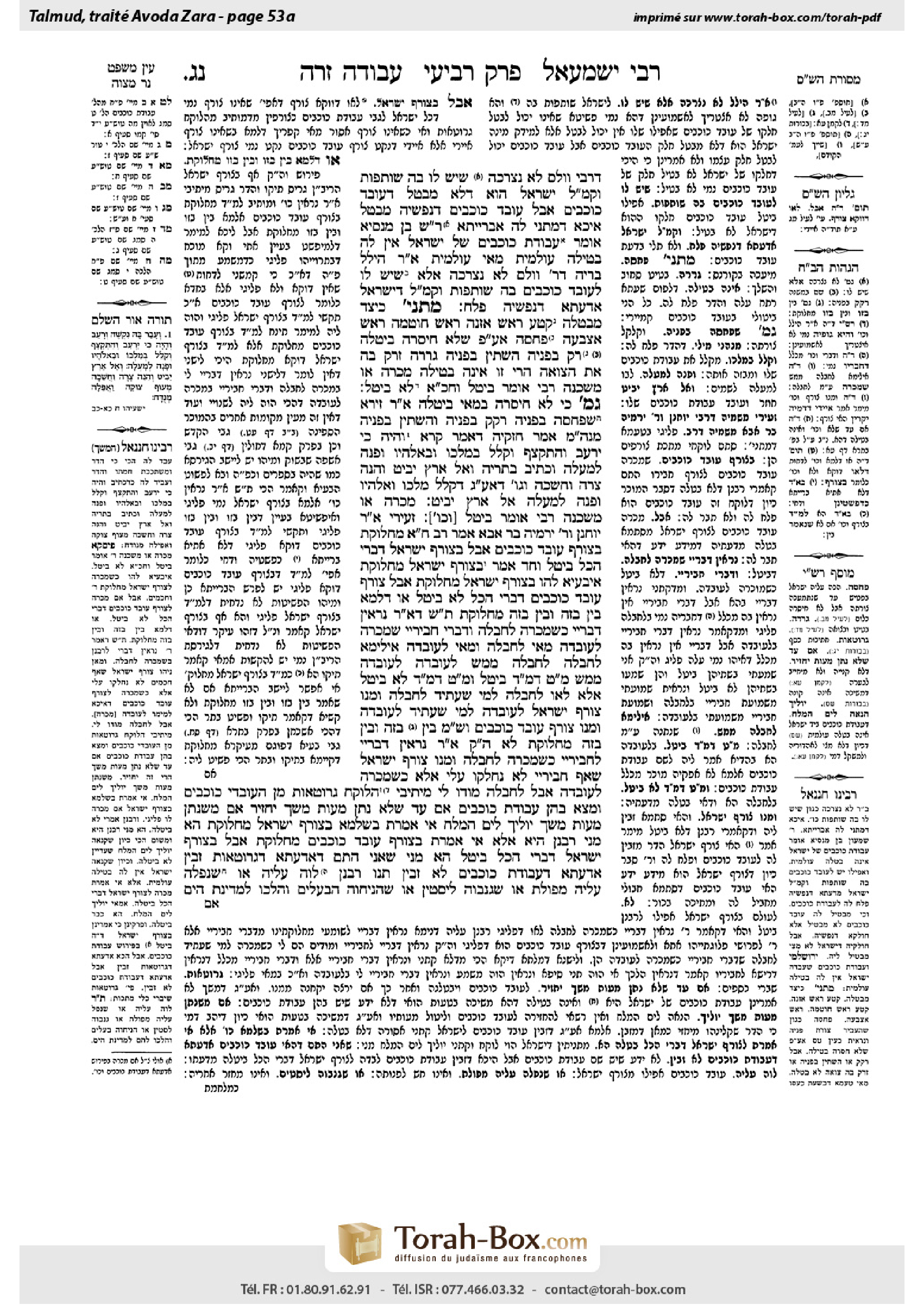
Avodah Zarah 53a: Talmud study for Daf Yomi
Study the Talmud for Daf Yomi with scanned pages, Hebrew text, English translations from Sefaria and AI-generated French translations.
Passage selection and English or AI-generated French translation are available where the scan has annotations. Daf Study is independent of Torah-Box and Sefaria.
Browse Avodah Zarah · עבודה זרה · All tractatesAvodah Zarah 53a text and translations
This page of Avodah Zarah includes the Aramaic text, an English translation and an AI-generated French translation, alongside the scan above.
עבודה זרה נ״ג א · Aramaic and Hebrew text
דְּרַבִּי וָולֶס: לֹא נִצְרְכָה שֶׁיֵּשׁ לוֹ בָּהּ שׁוּתָּפוּת, וְקָא מַשְׁמַע לַן יִשְׂרָאֵל הוּא דְּלָא מְבַטֵּל דְּנׇכְרִי, אֲבָל נׇכְרִי דְּנַפְשֵׁיהּ מְבַטֵּל.
אִיכָּא דְּמַתְנֵי לַהּ אַבָּרַיְיתָא, רַבִּי שִׁמְעוֹן בֶּן מְנַסְיָא אוֹמֵר: עֲבוֹדָה זָרָה שֶׁל יִשְׂרָאֵל אֵין לָהּ בְּטִילָה עוֹלָמִית. מַאי ״עוֹלָמִית״? אָמַר רַבִּי הִילֵּל בְּרֵיהּ דְּרַבִּי וָולֶס: לֹא נִצְרְכָה, אֶלָּא שֶׁיֵּשׁ לוֹ לְגוֹי בָּהּ שׁוּתָּפוּת, וְקָא מַשְׁמַע לַן דְּיִשְׂרָאֵל אַדַּעְתָּא דְּנַפְשֵׁיהּ פָּלַח.
מַתְנִי׳ כֵּיצַד מְבַטְּלָהּ? קָטַע רֹאשׁ אׇזְנָהּ, רֹאשׁ חוֹטְמָהּ, רֹאשׁ אֶצְבָּעָהּ, פְּחָסָהּ — אַף עַל פִּי שֶׁלֹּא חִיסְּרָהּ — בִּיטְּלָהּ; רָק בְּפָנֶיהָ, הִשְׁתִּין בְּפָנֶיהָ, גֵּרְרָהּ, זָרַק בָּהּ אֶת הַצּוֹאָה — הֲרֵי זוֹ אֵינָהּ בְּטֵילָה; מְכָרָהּ אוֹ מִשְׁכְּנָהּ — רַבִּי אוֹמֵר: בִּיטֵּל, וַחֲכָמִים אוֹמְרִים: לֹא בִּיטֵּל.
גְּמָ׳ כִּי לֹא חִיסְּרָהּ, בְּמַאי בִּיטְּלָהּ? אָמַר רַב זֵירָא: שֶׁפְּחָסָהּ בְּפָנֶיהָ.
רָקַק בְּפָנֶיהָ, וְהִשְׁתִּין בְּפָנֶיהָ. מְנָהָנֵי מִילֵּי?
אָמַר חִזְקִיָּה, דְּאָמַר קְרָא: ״וְהָיָה כִי יִרְעַב וְהִתְקַצַּף וְקִלֵּל בְּמַלְכּוֹ וּבֵאלֹהָיו וּפָנָה לְמַעְלָה״, וּכְתִיב בָּתְרֵיהּ: ״וְאֶל אֶרֶץ יַבִּיט וְהִנֵּה צָרָה וַחֲשֵׁכָה וְגוֹ׳״, דְּאַף עַל גַּב דְּקִלֵּל מַלְכּוֹ וֵאלֹהָיו וּפָנָה לְמַעְלָה, אֶל אֶרֶץ יַבִּיט.
מְכָרָהּ אוֹ מִשְׁכְּנָהּ, רַבִּי אוֹמֵר: בִּיטֵּל וְכוּ׳. זְעֵירִי אָמַר רַבִּי יוֹחָנָן, וְרַבִּי יִרְמְיָה בַּר אַבָּא אָמַר רַב, חַד אָמַר: מַחְלוֹקֶת בְּצוֹרֵף גּוֹי, אֲבָל בְּצוֹרֵף יִשְׂרָאֵל — דִּבְרֵי הַכֹּל בִּיטֵּל, וְחַד אָמַר: בְּצוֹרֵף יִשְׂרָאֵל מַחְלוֹקֶת.
אִיבַּעְיָא לְהוּ: בְּצוֹרֵף יִשְׂרָאֵל מַחְלוֹקֶת, אֲבָל צוֹרֵף גּוֹי דִּבְרֵי הַכֹּל לֹא בִּיטֵּל, אוֹ דִלְמָא בֵּין בָּזֶה וּבֵין בָּזֶה מַחְלוֹקֶת?
תָּא שְׁמַע, דְּאָמַר רַבִּי: נִרְאִין דְּבָרַיי כְּשֶׁמְּכָרָהּ לְחַבְּלָהּ, וְדִבְרֵי חֲבֵירַיי שֶׁמְּכָרָהּ לְעוֹבְדָהּ.
מַאי ״לְחַבְּלָהּ״ וּמַאי ״לְעוֹבְדָהּ״? אִילֵּימָא לְחַבְּלָהּ — לְחַבְּלָהּ מַמָּשׁ, לְעוֹבְדָהּ — לְעוֹבְדָהּ מַמָּשׁ, מַאי טַעְמָא דְּמַאן דְּאָמַר בִּיטֵּל, וּמַאי טַעְמָא דְּמַאן דְּאָמַר לֹא בִּיטֵּל?
אֶלָּא לָאו לְחַבְּלָהּ — לְמִי שֶׁעָתִיד לְחַבְּלָהּ, וּמַנּוּ? צוֹרֵף יִשְׂרָאֵל. לְעוֹבְדָהּ — לְמִי שֶׁעָתִיד לְעוֹבְדָהּ, וּמַנּוּ? צוֹרֵף גּוֹי. וּשְׁמַע מִינַּהּ: בֵּין בָּזֶה וּבֵין בָּזֶה מַחְלוֹקֶת.
לָא, הָכִי קָאָמַר: אָמַר רַבִּי: נִרְאִין דְּבָרַיי לַחֲבֵירַיי כְּשֶׁמְּכָרָהּ לְחַבְּלָהּ. וּמַנּוּ? צוֹרֵף יִשְׂרָאֵל, שֶׁאַף חֲבֵירַיי לֹא נֶחְלְקוּ עָלַי אֶלָּא כְּשֶׁמְּכָרָהּ לְעוֹבְדָהּ, אֲבָל לְחַבְּלָהּ — מוֹדוּ לִי.
מֵיתִיבִי: הַלּוֹקֵחַ גְּרוּטָאוֹת מִן הַגּוֹיִם וּמָצָא בָּהֶן עֲבוֹדָה זָרָה, אִם עַד שֶׁלֹּא נָתַן מָעוֹת מָשַׁךְ — יַחֲזִיר, אִם מִשֶּׁנָּתַן מָעוֹת מָשַׁךְ — יוֹלִיךְ לְיָם הַמֶּלַח.
אִי אָמְרַתְּ בִּשְׁלָמָא בְּצוֹרֵף יִשְׂרָאֵל מַחְלוֹקֶת, הָא מַנִּי? רַבָּנַן הִיא. אֶלָּא אִי אָמְרַתְּ בְּצוֹרֵף גּוֹי מַחְלוֹקֶת, אֲבָל בְּצוֹרֵף יִשְׂרָאֵל דִּבְרֵי הַכֹּל בִּיטֵּל, הָא מַנִּי?
שָׁאנֵי הָתָם, דְּאַדַּעְתָּא דִּגְרוּטָאוֹת זַבֵּין, אַדַּעְתָּא דַּעֲבוֹדָה זָרָה לָא זַבֵּין.
תָּנוּ רַבָּנַן: לָוָה עָלֶיהָ, אוֹ שֶׁנָּפְלָה עָלֶיהָ מַפּוֹלֶת, אוֹ שֶׁגְּנָבוּהָ לִיסְטִין, אוֹ שֶׁהִנִּיחוּהָ הַבְּעָלִים וְהָלְכוּ לִמְדִינַת הַיָּם,
Avodah Zarah 53a · English translation
of Rabbi Volas: No, this halakha is necessary in a case where the gentile has partnership in the idol, and it teaches us that it is only a Jew who cannot revoke the status of a gentile’s object of idol worship. But a gentile can revoke the status of his own object of idol worship.
There are those who teach Rabbi Hillel’s statement with regard to a baraita: Rabbi Shimon ben Menasya says: The status of a Jew’s object of idol worship can never be revoked. What is the reason for the additional emphasis of the term never? Rabbi Hillel, son of Rabbi Volas, says: The emphasis is necessary only for a case where the gentile has partnership in the idol, and it teaches us that the Jew worships the idol based on his own intentions, and therefore although the gentile revokes the status of his share, the Jew’s share remains forbidden.
MISHNA: How does a gentile revoke the status of an object of idol worship? If he cut off the tip of its ear, or the tip of its nose, or its fingertip; or if he crushed it, even though he did not remove any part of it, in all these cases he thereby revoked its status as an object of idol worship. If he spat before the idol, urinated before it, dragged it on the ground, or threw excrement at it, the status of this idol is not revoked, as this is only a temporary display of scorn, and afterward the gentile might continue to worship the idol. If the gentile sold it or mortgaged it, Rabbi Yehuda HaNasi says: He thereby revoked its status. And the Rabbis say that he did not revoke its status.
GEMARA: The mishna teaches that if the gentile crushed the idol without removing any part of it, the status of the idol is revoked. The Gemara asks: In a case where he did not remove any part of it, by what action did he revoke its status? Rav Zeira says: The mishna is referring to a case where he crushed its face with a hammer, destroying its form, even though none of its stone was removed.
§ The mishna teaches: If he spat before the idol or urinated before it, the status of this idol is not revoked, as this is only a temporary display of scorn. The Gemara asks: From where are these matters derived?
Ḥizkiyya says: This is derived from a verse, as the verse states: “And it shall come to pass that, when he shall be hungry, he shall fret, and curse his king and his god, and turn his face upward” (Isaiah 8:21). And it is written after this verse: “And he shall look to the earth, and behold distress and darkness, the gloom of anguish, and outspread thick darkness” (Isaiah 8:22). This indicates that even though he cursed his king and his idolatrous god, and he turned his face upward to God, nevertheless, he subsequently looks to the earth and beholds distress and darkness, since he returns to his idol worship.
§ The mishna teaches: If the gentile sold it or mortgaged it, Rabbi Yehuda HaNasi says: He thereby revoked its status. And the Rabbis say that he did not revoke its status. The Gemara cites a dispute between that which Ze’eiri says that Rabbi Yoḥanan says, and that which Rabbi Yirmeya bar Abba says that Rav says. One says: The dispute between Rabbi Yehuda HaNasi and the Rabbis applies only when the gentile sold his idol to a gentile smith. But when he sold it to a Jewish smith everyone agrees that by selling the idol the gentile revoked its status, as he knows that the Jewish smith will certainly melt it down. And one says: The dispute applies to the case where he sold the idol to a Jewish smith.
A dilemma was raised before the Sages: According to the second opinion, does the dispute apply only to the case where he sold the idol to a Jewish smith; but if he sold it to a gentile smith everyone agrees that he did not revoke its status by selling it? Or perhaps both in this case and in that case there is a dispute.
The Gemara replies: Come and hear a baraita, as Rabbi Yehuda HaNasi said: My statement that by selling the idol the gentile revokes its status appears correct in a case where he sold it for the purpose of destruction, and the statement of my colleagues that its status is not revoked appears correct in a case where he sold it for the purpose of worship.
The Gemara explains the baraita: What is the meaning of selling the idol for destruction, and what is the meaning of selling it for worship? If we say that selling it for destruction means literally that he knew that it was being bought for the purpose of destruction, and that selling it for worship means literally that it was bought for the purpose of worship, this is difficult. What is the reasoning of the one who says that the gentile revoked the idol’s status even though he knew that the buyer intended to worship it, and what is the reasoning of the one who says that he did not revoke its status even though he knew that the buyer intended to destroy it?
Rather, is it not referring to a case where the buyer’s intentions were not known with certainty? And accordingly, selling the idol for destruction means selling it to one who will presumably destroy it in the future. And who is that buyer? This is referring to a Jewish smith. Similarly, selling the idol for worship means selling it to one who will presumably worship it in the future. And who is that buyer? This is referring to a gentile smith. Since Rabbi Yehuda HaNasi states that his opinion appears correct in the case of a Jewish smith and the opinion of his colleagues appears correct in the case of a gentile smith, one may conclude from the baraita that there is a dispute both in this case and in that case.
The Gemara rejects this suggestion: No, this is what the baraita is saying: Rabbi Yehuda HaNasi said: My statement that the idol’s status is revoked appears to my colleagues correct in a case where he sold it for the purpose of destruction. And who is it who buys the idol with the intent of destroying it? This is referring to a Jewish smith. This is because even my colleagues disagreed with me only in a case where he sold it for the purpose of worship; but when he sold it to a Jewish smith for the purpose of destruction, they concede to my opinion.
The Gemara raises an objection from a baraita: With regard to one who buys broken vessels made from gold or silver from the gentiles and finds among them an object of idol worship, if he pulled the object of idol worship, thereby performing an act of acquisition, before he gave the money to the gentile, he may return the object of idol worship to the gentile. But if he pulled it after he gave the money to the gentile he may not return it. Since the idol’s status was not revoked, he must take it and cast it into the Dead Sea.
The Gemara explains the objection: Granted, if you say that in the case of a gentile who sells an object of idol worship to a Jewish smith there is a dispute between Rabbi Yehuda HaNasi and the Rabbis, the baraita is not difficult. In accordance with whose opinion is this baraita? It is in accordance with the opinion of the Rabbis, who hold that when a gentile sells an idol to a Jewish smith he does not thereby revoke its status. But if you say that the dispute between Rabbi Yehuda HaNasi and the Rabbis applies only when the idol is sold to a gentile smith, but in the case of a Jewish smith everyone agrees that the gentile revoked the idol’s status, then in accordance with whose opinion is this baraita?
The Gemara answers: It is different there, as the gentile sold the metal with the understanding that he was selling broken vessels, and he did not sell the metal with the understanding that he was selling an object of idol worship. He therefore had no intention of revoking its status.
§ The Sages taught: If a gentile borrowed money against an object of idol worship, using it as collateral, or with regard to another case where a rockslide fell on it, or a case where robbers stole it, or a case where the owners abandoned it and went overseas, the following halakha applies:
Avodah Zarah 53a · Traduction française (IA)
Du Rabbi Volas : Non, cette halakha est nécessaire dans le cas où le gentil a un partenaire dans l'idolâtrie, et elle nous apprend que seul un Juif ne peut pas révoquer le statut d'un objet d'idolâtrie du gentil. Mais un gentil peut révoquer le statut de son propre objet d'idolâtrie.
Certains enseignent la déclaration du Rabbi Hillel concernant une baraïta : Rabbi Shim'on ben Menasya dit : Le statut d'un objet d'idolâtrie d'un Juif ne peut jamais être révoqué. Pourquoi l'accent est-il mis sur le terme « jamais » ? Rabbi Hillel, fils du Rabbi Volas, dit : L'accent est nécessaire uniquement dans le cas où le gentil a un partenaire dans l'idolâtrie, et cela nous apprend que le Juif adore l'idolâtrie selon ses propres intentions, et donc même si le gentil révoque le statut de sa part, la part du Juif reste interdite.
MICHNA : Comment un gentil révoque-t-il le statut d'un objet d'idolâtrie ? S'il coupe le bout de son oreille, ou le bout de son nez, ou le bout de ses doigts ; ou s'il le brise, même s'il n'a pas retiré aucune partie de lui, dans tous ces cas il révoque ainsi le statut de l'objet d'idolâtrie. S'il l'expulse devant l'idole, s'il urine devant lui, s'il le traîne par terre, ou s'il jette des déjections devant lui, le statut de cette idole n'est pas révoqué, car cela n'est qu'une démonstration temporaire de mépris, et ensuite le gentil pourrait continuer à adorer l'idole. Si le gentil le vend ou le remporte, Rabbi Yehuda HaNasi dit : Il révoque ainsi son statut. Et les Rabbins disent qu'il ne le révoque pas.
GUEMARA : La mishna enseigne que si le gentil brise l'idole sans en retirer aucune partie, le statut de l'idole est révoqué. La Guemara pose la question : Dans le cas où il n'a pas retiré aucune partie, par quel acte a-t-il révoqué son statut ? Rav Zeira dit : La mishna fait référence à un cas où il a brisé son visage avec un marteau, détruisant sa forme, même si aucune de ses pierres n'a été retirée.
§ La mishna enseigne : S'il crache devant l'idole ou s'il urine devant elle, le statut de cette idole n'est pas révoqué, car cela n'est qu'une démonstration temporaire de mépris. La Guemara pose la question : D'où sont-ils dérivés ces points ?
Chizkiyya dit : Cela est dérivé d'un verset, car il est écrit : « Et il arrivera que, lorsqu'il sera affamé, il s'agitera, et maudira son roi et son dieu idolâtre, et tournera son visage vers le ciel » (Lévitique 8:21). Et il est écrit après ce verset : « Et il regardera la terre, et verra la détresse et l'obscurité, l'ombre de l'angoisse, et l'obscurité épaisse » (Lévitique 8:22). Cela indique que même s'il a maudisé son roi et son dieu idolâtre, et qu'il a tourné son visage vers Dieu, il observe ensuite la terre et voit la détresse et l'obscurité, car il retourne à son adoration idolâtre.
§ La mishna enseigne : Si le gentil le vend ou le remporte, Rabbi Yehuda HaNasi dit : Il révoque ainsi son statut. Et les Rabbins disent qu'il ne le révoque pas. La Guemara cite un débat entre ce que Ze’eiri dit que Rabbi Yoḥanan dit, et ce que Rabbi Yirmeya bar Abba dit que Rav dit. L'un dit : Ce débat entre Rabbi Yehuda HaNasi et les Rabbins s'applique uniquement dans le cas où le gentil vend son idole à un artisan gentil. Mais lorsqu'il le vend à un artisan juif, tout le monde convient que par la vente de l'idole, le gentil révoque son statut, car il sait que l'artisan juif le fondra certainement. Et l'autre dit : Ce débat s'applique au cas où il a vendu l'idole à un artisan juif.
Un dilemme a été soulevé devant les Sages : Selon l'opinion secondaire, ce débat s'applique-t-il uniquement au cas où il a vendu l'idole à un artisan juif ; mais si il l'a vendu à un artisan gentil, tout le monde convient qu'il n'a pas révoqué le statut de l'idole par la vente ? Ou peut-être que dans ce cas et dans celui-là, il y a un débat.
La Guemara répond : Viens écouter une baraïta, car Rabbi Yehuda HaNasi a dit : Mon affirmation que par la vente de l'idole le gentil révoque son statut semble correcte dans le cas où il l'a vendu à des fins de destruction, et l'affirmation de mes collègues que son statut n'est pas révoqué semble correcte dans le cas où il l'a vendu à des fins de culte.
La Guemara explique la baraïta : Qu'entend-on par vendre l'idole à des fins de destruction et par vendre l'idole à des fins de culte ? Si on dit que vendre à des fins de destruction signifie littéralement qu'il savait qu'il était acheté à des fins de destruction, et que vendre à des fins de culte signifie littéralement qu'il était acheté à des fins de culte, cela est difficile. Quel est le raisonnement de celui qui dit que le gentil a révoqué le statut de l'idole même s'il savait que l'acheteur avait l'intention de le cultiver, et quel est le raisonnement de celui qui dit qu'il n'a pas révoqué le statut de l'idole même s'il savait que l'acheteur avait l'intention de le détruire ?
Plutôt, n'est-ce pas un cas où les intentions de l'acheteur n'étaient pas connues avec certitude ? Et ainsi, vendre l'idole à des fins de destruction signifie vendre à celui qui détruirait probablement l'idole à l'avenir. Et qui est cet acheteur ? Cela fait référence à un artisan juif. De même, vendre l'idole à des fins de culte signifie vendre à celui qui cultiverait probablement l'idole à l'avenir. Et qui est cet acheteur ? Cela fait référence à un artisan gentil. Puisque Rabbi Yehuda HaNasi affirme que son opinion semble correcte dans le cas d'un artisan juif et l'opinion de ses collègues semble correcte dans le cas d'un artisan gentil, on peut conclure de la baraïta que le débat s'applique à la fois dans ce cas et dans celui-là.
La Guemara rejette cette suggestion : Non, c'est ce que dit la baraïta : Rabbi Yéhuda HaNasi a dit : Mon affirmation selon laquelle le statut de l'idole est révoqué semble correcte à mes collègues dans le cas où il l'a vendu à des fins de destruction. Et qui est-ce qui achète l'idole avec l'intention de la détruire ? C'est un forgeron juif. Cela est ainsi parce que mes collègues n'ont pas contesté mon opinion qu'en cas où il l'a vendu à des fins de culte ; mais lorsqu'il l'a vendu à un forgeron juif à des fins de destruction, ils acceptent mon opinion.
La Guemara évoque un objet d'opposition tiré d'une baraïta : En ce qui concerne celui qui achète des objets brisés en or ou en argent des non-Juifs et découvre parmi eux un objet d'idolatrye, si il tire l'objet d'idolatrye, accomplissant ainsi un acte d'acquisition, avant de donner l'argent au non-Juif, il peut rendre l'objet d'idolatrye au non-Juif. Mais si il le tire après avoir donné l'argent au non-Juif, il ne peut pas le rendre. Puisque le statut de l'idole n'a pas été révoqué, il doit le prendre et le jeter dans la Mer Morte.
La Guemara explique l'objection : Cela est évident, si vous dites que dans le cas d'un non-Juif qui vend un objet d'idolatrye à un forgeron juif il y a un désaccord entre Rabbi Yéhuda HaNasi et les Rabbins, la baraïta ne pose pas de difficulté. Selon quel avis est-ce que cette baraïta ? C'est selon l'avis des Rabbins, qui pensent que lorsqu'un non-Juif vend un idole à un forgeron juif, il ne révoque pas ainsi son statut. Mais si vous dites que le désaccord entre Rabbi Yéhuda HaNasi et les Rabbins s'applique uniquement lorsque l'idole est vendue à un forgeron non-Juif, mais dans le cas d'un forgeron juif tout le monde s'accorde sur le fait que le non-Juif a révoqué le statut de l'idole, alors selon quel avis est-ce que cette baraïta ?
La Guemara répond : C'est différent dans ce cas, car le non-Juif a vendu le métal en sachant qu'il vendait des objets brisés, et il n'avait pas l'intention de vendre un objet d'idolatrye. Il n'avait donc pas l'intention de révoquer son statut.
§ Les Sages ont enseigné : Si un non-Juif emprunte de l'argent en garantie d'un objet d'idolatrye, en le servant de caution, ou en ce qui concerne un autre cas où un glissement de terrain s'est produit sur l'objet, ou un cas où des voleurs l'ont volé, ou un cas où les propriétaires l'ont abandonné et sont partis à l'étranger, la halakha suivante s'applique :
Traduction française générée par IA à partir de l’édition anglaise de Sefaria. Vérifie toujours un passage avec le texte source.
Text from Sefaria: William Davidson Edition - Vocalized Aramaic (CC BY NC); William Davidson Edition - English (CC BY NC).