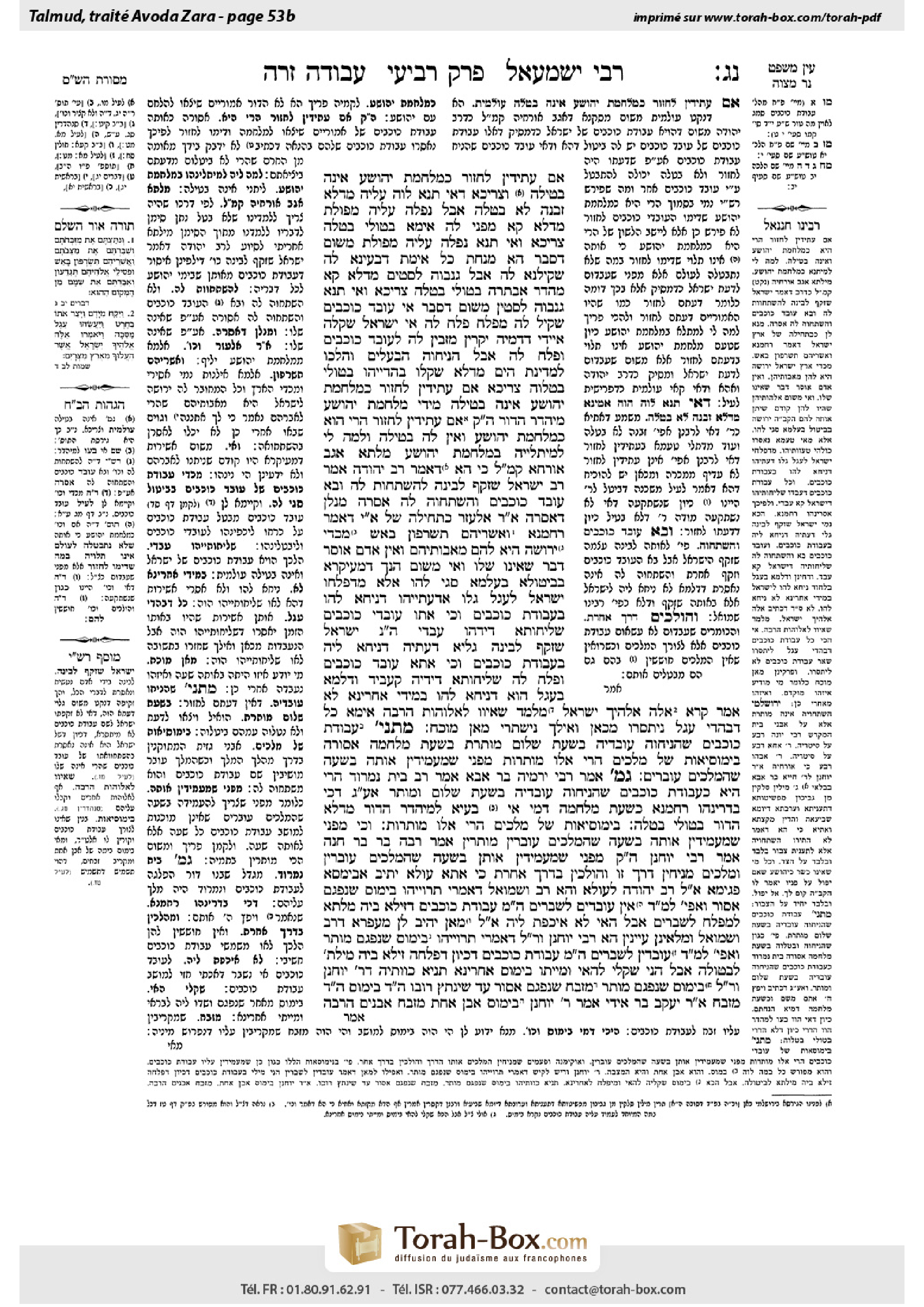
Avodah Zarah 53b: Talmud study for Daf Yomi
Study the Talmud for Daf Yomi with scanned pages, Hebrew text, English translations from Sefaria and AI-generated French translations.
Passage selection and English or AI-generated French translation are available where the scan has annotations. Daf Study is independent of Torah-Box and Sefaria.
Browse Avodah Zarah · עבודה זרה · All tractatesAvodah Zarah 53b text and translations
This page of Avodah Zarah includes the Aramaic text, an English translation and an AI-generated French translation, alongside the scan above.
עבודה זרה נ״ג ב · Aramaic and Hebrew text
אִם עֲתִידִין לַחְזוֹר כְּמִלְחֶמֶת יְהוֹשֻׁעַ — אֵינָהּ בְּטֵילָה.
וּצְרִיכָא, דְּאִי תְּנָא לָוָה עָלֶיהָ — מִדְּלָא זַבְּנַהּ, לָא בַּטְּלַהּ; אֲבָל נָפְלָה עָלֶיהָ מַפּוֹלֶת — מִדְּלָא קָא מְפַנֵּי לַהּ, אֵימָא בַּטּוֹלֵי בַּטְּלַהּ, צְרִיכָא.
וְאִי תְּנָא נָפְלָה עָלֶיהָ מַפּוֹלֶת, מִשּׁוּם דְּסָבַר: הָא מַנְּחָה, כֹּל אֵימַת דְּבָעֵינָא לַהּ שָׁקֵילְנָא לַהּ, אֲבָל גְּנָבוּהָ לִסְטִים, מִדְּלָא קָא מַהְדַּר אַבָּתְרַהּ — בַּטּוֹלֵי בַּטְּלַהּ, צְרִיכָא.
וְאִי תְּנָא גְּנָבוּהָ לִסְטִין, מִשּׁוּם דְּסָבַר: אִי גּוֹי שָׁקֵיל לַהּ — מִפְלָח פָּלַח לַהּ, אִי יִשְׂרָאֵל שָׁקְלָה — אַיְּידֵי דְּדָמֶיהָ יְקָרִין מְזַבֵּין לַהּ לְגוֹי וּפָלַח לַהּ, אֲבָל הִנִּיחוּהָ הַבְּעָלִים וְהָלְכוּ לִמְדִינַת הַיָּם, מִדְּלָא שָׁקְלוּ בַּהֲדַיְיהוּ — בַּטּוֹלֵי בַּטְּלוּהָ, צְרִיכָא.
אִם עֲתִידִין לַחְזוֹר כְּמִלְחֶמֶת יְהוֹשֻׁעַ — אֵינָהּ בְּטֵילָה. מִידֵּי מִלְחֶמֶת יְהוֹשֻׁעַ מִיהְדָּר הֲדוּר? הָכִי קָאָמַר: אִם עֲתִידִין לַחְזוֹר — הֲרֵי הוּא כְּמִלְחֶמֶת יְהוֹשֻׁעַ, וְאֵין לָהּ בְּטִילָה.
וּלְמָה לִי לְמִיתְלְיַיהּ בְּמִלְחֶמֶת יְהוֹשֻׁעַ? מִלְּתָא אַגַּב אוֹרְחֵאּ קָא מַשְׁמַע לַן, כִּי הָא דְּאָמַר רַב יְהוּדָה אָמַר רַב: יִשְׂרָאֵל שֶׁזָּקַף לְבֵינָה לְהִשְׁתַּחֲוֹת לָהּ, וּבָא גּוֹי וְהִשְׁתַּחֲוָה לָהּ — אֲסָרָהּ.
מְנָלַן דַּאֲסָרָהּ? אָמַר רַבִּי אֶלְעָזָר: כַּתְּחִילָּה שֶׁל אֶרֶץ יִשְׂרָאֵל, דְּאָמַר רַחֲמָנָא ״וַאֲשֵׁרֵיהֶם תִּשְׂרְפוּן בָּאֵשׁ״, מִכְּדֵי יְרוּשָּׁה הִיא לָהֶם מֵאֲבוֹתֵיהֶם, וְאֵין אָדָם אוֹסֵר דָּבָר שֶׁאֵינוֹ שֶׁלּוֹ!
וְאִי מִשּׁוּם הָנָךְ דְּמֵעִיקָּרָא, בְּבִיטּוּלָא בְּעָלְמָא סַגִּי לְהוּ!
אֶלָּא, מִדִּפְלַחוּ יִשְׂרָאֵל לְעֵגֶל, גַּלּוֹ אַדַּעְתַּיְיהוּ דְּנִיחָא לְהוּ בַּעֲבוֹדָה זָרָה, וְכִי אֲתוֹ גּוֹיִם, שְׁלִיחוּתָא דִּידְהוּ עָבְדִי. הָכִי נָמֵי, יִשְׂרָאֵל שֶׁזָּקַף לְבֵינָה, גַּלִּיא דַּעְתֵּיהּ דְּנִיחָא לֵיהּ בַּעֲבוֹדָה זָרָה, וְכִי אֲתָא גּוֹי וּפְלַח לַהּ, שְׁלִיחוּתָא דִּידֵיהּ קָעָבֵיד.
וְדִלְמָא בְּעֵגֶל הוּא דְּנִיחָא לְהוּ, בְּמִידֵּי אַחֲרִינָא לָא? אָמַר קְרָא: ״אֵלֶּה אֱלֹהֶיךָ יִשְׂרָאֵל״, מְלַמֵּד שֶׁאִיוּוּ לֶאֱלוֹהוֹת הַרְבֵּה.
אֵימָא: כֹּל דְּבַהֲדֵי עֵגֶל נִיתַּסְרוּ, מִכָּאן וְאֵילָךְ נִישְׁתְּרֵי? מַאן מוֹכַח?
מַתְנִי׳ עֲבוֹדָה זָרָה שֶׁהִנִּיחוּהָ עוֹבְדֶיהָ — בִּשְׁעַת שָׁלוֹם מוּתֶּרֶת, בִּשְׁעַת מִלְחָמָה אֲסוּרָה. בִּימוֹסְיָאוֹת שֶׁל מְלָכִים — הֲרֵי אֵלּוּ מוּתָּרוֹת, מִפְּנֵי שֶׁמַּעֲמִידִין אוֹתָהּ בְּשָׁעָה שֶׁהַמְּלָכִים עוֹבְרִים.
גְּמָ׳ אָמַר רַבִּי יִרְמְיָה בַּר אַבָּא אָמַר רַב: בֵּית נִמְרוֹד הֲרֵי הִיא כַּעֲבוֹדָה זָרָה שֶׁהִנִּיחוּהָ עוֹבְדֶיהָ בִּשְׁעַת שָׁלוֹם, וּמוּתָּר. אַף עַל גַּב דְּכִי בַּדְּרִינְהוּ רַחֲמָנָא כִּשְׁעַת מִלְחָמָה דָּמֵי, אִי (בָּעֲיָא) [בְּעוֹ] לְמִיהְדָּר הֲדוּר, מִדְּלָא הֲדוּר בַּטּוֹלֵי בַּטְּלֻהָ.
בִּימוֹסְיָאוֹת שֶׁל מְלָכִים — הֲרֵי אֵלּוּ מוּתָּרוֹת. וְכִי מִפְּנֵי שֶׁמַּעֲמִידִין אוֹתָהּ בְּשָׁעָה שֶׁהַמְּלָכִים עוֹבְרִין מוּתָּרִין?
אָמַר רַבָּה בַּר בַּר חָנָה אָמַר רַבִּי יוֹחָנָן, הָכִי קָאָמַר: מִפְּנֵי שֶׁמַּעֲמִידִין אוֹתָן בְּשָׁעָה שֶׁהַמְּלָכִים עוֹבְרִין, וּמְלָכִים מַנִּיחִין דֶּרֶךְ זוֹ וְהוֹלְכִין בְּדֶרֶךְ אַחֶרֶת.
כִּי אֲתָא עוּלָּא, יָתֵיב אַבִּימְסָא פְּגִימָא. אֲמַר לֵיהּ רַב יְהוּדָה לְעוּלָּא: וְהָא רַב וּשְׁמוּאֵל דְּאָמְרִי תַּרְוַיְיהוּ: בִּימוֹס שֶׁנִּפְגַּם אָסוּר! וַאֲפִילּוּ לְמַאן דְּאָמַר: אֵין עוֹבְדִים לִשְׁבָרִים — הָנֵי מִילֵּי עֲבוֹדָה זָרָה, דְּזִילָא בֵּיהּ מִלְּתָא לְמִפְלַח לִשְׁבָרִים, אֲבָל הַאי לָא אִיכְפַּת לֵיהּ!
אֲמַר לֵיהּ: מַאן יָהֵיב לַן מֵעַפְרָא דְּרַב וּשְׁמוּאֵל וּמָלִינַן עַיְינִין? הָא רַבִּי יוֹחָנָן וְרֵישׁ לָקִישׁ דְּאָמְרִי תַּרְוַיְיהוּ: בִּימוֹס שֶׁנִּפְגַּם — מוּתָּר, וַאֲפִילּוּ לְמַאן דְּאָמַר עוֹבְדִין לִשְׁבָרִים, הָנֵי מִילֵּי עֲבוֹדָה זָרָה, דְּכֵיוָן דְּפַלְחַהּ — זִילָא בֵּיהּ מִילְּתָא לְבַטּוֹלַהּ, אֲבָל הָנֵי שָׁקְלִי לְהַאי וּמַיְיתוּ בִּימוֹס אַחֲרִינָא.
תַּנְיָא כְּוָותֵיהּ דְּרַבִּי יוֹחָנָן וְרֵישׁ לָקִישׁ: בִּימוֹס שֶׁנִּפְגַּם — מוּתָּר, מִזְבֵּחַ שֶׁנִּפְגַּם — אָסוּר עַד שֶׁיִּנָּתֵץ רוּבּוֹ. הֵיכִי דָּמֵי בִּימוֹס, הֵיכִי דָּמֵי מִזְבֵּחַ? אָמַר רַבִּי יַעֲקֹב בַּר אִידֵּי אָמַר רַבִּי יוֹחָנָן: בִּימוֹס — אֶבֶן אַחַת, מִזְבֵּחַ — אֲבָנִים הַרְבֵּה.
Avodah Zarah 53b · English translation
In any of these cases, if the owners will return in the future, as was the case in the war of Joshua when he conquered Eretz Yisrael, then the status of the object of idol worship is not revoked.
The Gemara comments: And it is necessary for the baraita to state all of these cases. As, had the baraita taught only the case where the gentile borrowed money against the object of idol worship, one would say that in that case the gentile did not revoke its status, as he did not sell it, and he did not indicate that he intended to relinquish it. But in the case where a rockslide fell on it, since he did not clear the rocks, say that he revoked the status of the object of idol worship. It is therefore necessary to teach this case as well.
And had the baraita taught only the case where a rockslide fell on the idol, one would say that in that case its status is not revoked because the owner thinks to himself: The idol lies under the rocks safely; whenever I want it, I shall take it, and he feels no need to clear the rockslide immediately. But in the case where robbers stole it, since he is not searching after it, this indicates that he revoked its status. It is therefore necessary to teach this case as well.
And had the baraita taught only the case where robbers stole the idol, one would say that in that case its status is not revoked because the owner thinks to himself: If a gentile took it, he will worship it. If a Jew took it, since it is of great monetary value, he will sell it to a gentile and the buyer will worship it. There is therefore no indication that the gentile intends to revoke its status. But in the case where the owners abandoned the idol and went overseas, since they did not take it with them, this indicates that they revoked its status. It is therefore necessary to teach this case as well.
The baraita states: If the owners will return in the future, as was the case in the war of Joshua when he conquered Eretz Yisrael, then the status of the object of idol worship is not revoked. The Gemara asks: Is it so, that after the war of Joshua the gentiles returned home? They were defeated and killed and did not return home. The Gemara explains: This is what the baraita is saying: If the owners will return in the future, the idol has the same status as did the idols of the gentiles killed in the war of Joshua, who intended to return and did not revoke the status of their idols, and therefore its status is not revoked.
The Gemara asks: And why should I associate this halakha with the war of Joshua? The Gemara answers: It teaches us a matter in passing, that the halakhot of idol worship may be derived from the war of Joshua, as may be illustrated by that which Rav Yehuda says that Rav says: In the case of a Jew who set a brick upright in order to bow to it but did not actually bow to it, and a gentile then came and bowed to it, the gentile rendered it prohibited even though it was not his brick.
The Gemara explains: From where do we derive that he rendered it prohibited? Rabbi Elazar says: This halakha is like the halakha that applied at the outset of the Jewish people’s conquest of Eretz Yisrael, when the Torah commanded them to destroy any trees that were used as part of idolatrous rites [asherim], as the Merciful One states: “And you shall break down their altars…and you shall burn their asherim with fire” (Deuteronomy 12:3). Now, Eretz Yisrael is the inheritance of the Jewish people from their ancestors, and a person does not render forbidden an item that is not his. If so, how could the gentiles render the trees forbidden, as the land was not theirs?
If the trees were forbidden because some of them might have been those trees that were worshipped initially, before God gave the land to Abraham, it would not have been necessary to destroy them. Rather, the Jews could have forced the gentiles to revoke their status, and since the asherim were objects of gentiles’ idol worship, a mere revocation would be sufficient to render them permitted.
Rather, since the Jewish people worshipped the Golden Calf, they revealed their intentions and indicated that they were amenable to idol worship. And when the gentiles came and engaged in idol worship, they were, in effect, carrying out their agency on behalf of the Jewish people. The asherim were therefore considered objects of Jews’ idol worship, whose status cannot be revoked. So too, in the case of a Jew who set a brick upright in order to bow to it, he thereby revealed his intentions and indicated that he is amenable to idol worship. And when a gentile came and worshipped it, he was carrying out the agency on behalf of the Jew.
The Gemara challenges: But perhaps it is only with regard to the Golden Calf that the Jewish people were amenable to worshipping it, but not with regard to any other type of idol worship. The Gemara counters: The verse states with regard to the Golden Calf: “And they said: These are your gods, O Israel” (Exodus 32:4), in the plural. This teaches that they desired many gods, and they did not desire to worship only the Golden Calf.
The Gemara suggests: Say that whatever asherim were worshipped by the gentiles simultaneously with the Jewish people’s worship of the Golden Calf should be prohibited, because at that time they acted as agents of the Jewish people. But any ashera that was worshipped from that point forward, after the Jewish people repented and no longer engaged in idol worship, should be permitted. The Gemara answers: Who can prove when each ashera was worshipped? Since it is impossible to determine which asherim were worshipped at the time of the Golden Calf, they are all forbidden.
MISHNA: With regard to an object of idol worship that was abandoned by its worshippers, if it was abandoned in peacetime, it is permitted, as it was evidently abandoned by choice and this constitutes an implicit revocation of its status as an object of idol worship. If it was abandoned in wartime, it is prohibited, as it was not abandoned by choice. With regard to the stone platforms of kings upon which idols are placed in honor of the kings, these are permitted, due to the fact that the idol is placed on these platforms only at the time that the kings pass by.
GEMARA: Rabbi Yirmeya bar Abba says that Rav says: The temple of Nimrod, i.e., the remnants of the tower of Babel (see Genesis 11:1–9), is considered a place of idol worship whose worshippers abandoned it in peacetime, and it is therefore permitted. This is despite the fact that when the Merciful One scattered the builders of the tower, the situation resembled wartime, as they were compelled to leave. Nevertheless, if they had desired to return, they could have returned. Since they did not return, they evidently chose to abandon the place of idol worship and thereby revoked its status.
§ The mishna teaches: With regard to the stone platforms of kings, these are permitted, due to the fact that the idol is placed on these platforms only at the time that the kings pass by. The Gemara asks: But should the platforms be permitted because idols are placed on them at the time that the kings pass by?
Rabba bar bar Ḥana said that Rabbi Yoḥanan said: This is what the mishna is saying: The platforms are permitted because the idol is placed on them at the time that the kings pass by, and sometimes the kings abandon this path where the platform has been placed and choose to walk on a different path. Since the kings do not impart any importance to the platforms, they are not considered accessories of idol worship.
§ When Ulla came from Eretz Yisrael to Babylonia, he sat on a damaged platform of idol worship. Rav Yehuda said to Ulla: But don’t Rav and Shmuel both say: A platform that was damaged remains prohibited? And even according to the one who says that idol worshippers do not worship fragments of idols, that statement applies only to an object of idol worship, as it is a degrading matter to a person to worship fragments. But in this case, with regard to the platform, it does not matter to him if it is damaged, as it is still fit for use.
Ulla said to Rav Yehuda: Who shall give us of the dust of the graves covering Rav and Shmuel? We would fill our eyes with that dust, as they were great and holy men. Nevertheless, with regard to the halakha in this case, don’t Rabbi Yoḥanan and Reish Lakish both say: A platform that was damaged is permitted? And even according to the one who says that idol worshippers worship fragments of idols, that statement applies only to an object of idol worship, due to the fact that since he already worshipped it, it is a degrading matter to him to revoke its status. But in the case of these platforms, idol worshippers take this platform and throw it away and bring another platform that is not defective to replace it.
It is taught in a baraita in accordance with the opinion of Rabbi Yoḥanan and Reish Lakish: A platform that was damaged is permitted. Conversely, an altar of idol worship that was damaged remains prohibited until most of it is destroyed. What is considered a platform, and what is considered an altar? Rabbi Ya’akov bar Idi says that Rabbi Yoḥanan says: A platform consists of one stone; an altar consists of many stones.
Avodah Zarah 53b · Traduction française (IA)
Dans tous ces cas, si les propriétaires reviennent plus tard, comme c'était le cas lors de la guerre de Josué lorsqu'il a conquis la Terre d'Israël, alors le statut de l'objet d'idolâtrie n'est pas révoqué.
La Guemara commente : Il est nécessaire que la baraïta mentionne tous ces cas. En effet, si la baraïta avait enseigné seulement le cas où un non-Juif empruntait de l'argent contre l'objet d'idolâtrie, on pourrait dire que dans ce cas le statut n'est pas révoqué, car il n'a pas vendu l'objet et n'a pas indiqué qu'il voulait le renoncer. Mais dans le cas où un éboulement a recouvert l'objet, puisqu'il n'a pas enlevé les roches, on dirait qu'il a révoqué le statut de l'objet d'idolâtrie. Il est donc nécessaire d'enseigner ce cas également.
Et si la baraïta avait enseigné seulement le cas où un éboulement a recouvert l'idole, on pourrait dire que dans ce cas son statut n'est pas révoqué, car le propriétaire pense à lui-même : L'idole est en sécurité sous les roches ; quand je veux l'utiliser, je la prendrai, et il n'a pas besoin d'enlever les roches immédiatement. Mais dans le cas où des voleurs ont volé l'idole, puisqu'il ne la recherche pas, cela indique qu'il a révoqué son statut. Il est donc nécessaire d'enseigner ce cas également.
Et si la baraïta avait enseigné seulement le cas où des voleurs ont volé l'idole, on pourrait dire que dans ce cas son statut n'est pas révoqué, car le propriétaire pense à lui-même : Si un non-Juif l'a pris, il le vénérera. Si un Juif l'a pris, puisqu'il a une grande valeur marchande, il le vendra à un non-Juif et l'achèvera, et l'acheteur le vénérera. Il n'y a donc pas d'indication que le non-Juif veut révoquer son statut. Mais dans le cas où les propriétaires ont abandonné l'idole et sont partis à l'étranger, puisqu'ils ne l'ont pas emportée avec eux, cela indique qu'ils ont révoqué son statut. Il est donc nécessaire d'enseigner ce cas également.
La baraïta dit : Si les propriétaires reviennent plus tard, comme c'était le cas lors de la guerre de Josué lorsqu'il a conquis la Terre d'Israël, alors le statut de l'objet d'idolâtrie n'est pas révoqué. La Guemara pose la question : Est-ce que c'est ainsi que les non-Juifs sont revenus chez eux après la guerre de Josué ? Ils ont été battus et tués et n'ont pas retourné chez eux. La Guemara explique : C'est ce que la baraïta dit : Si les propriétaires reviennent plus tard, l'idole a le même statut que les idoles des non-Juifs tués lors de la guerre de Josué, qui avaient l'intention de revenir et n'ont pas révoqué le statut de leurs idoles, et par conséquent son statut n'est pas révoqué.
La Guemara pose la question : Et pourquoi devrais-je associer cette halakha à la guerre de Josué ? La Guemara répond : Elle nous apprend une chose en passant, que les halakhot de l'idolâtrie peuvent être dérivées de la guerre de Josué, comme on peut le voir par ce que Rav Yéhouda dit que Rav dit : Dans le cas d'un Juif qui a dressé un briquet pour se prosterner devant lui mais n'a pas effectivement prié devant lui, et qu'un non-Juif est venu ensuite et s'est prosterné devant lui, le non-Juif a rendu l'objet interdit même s'il ne s'agissait pas de son briquet.
La Guemara explique : D'où dérivons-nous que le non-Juif a rendu l'objet interdit ? Rabbi Eléazar dit : Cette halakha est comme celle qui s'appliquait au début de la conquête des Juifs de la Terre d'Israël, lorsque la Torah commandait de détruire tous les arbres utilisés dans les rites d'idolâtrie [asherim], comme le Tout-Puissant dit : « Et vous démolirez leurs autels et vous brûlerez leurs asherim avec le feu » (Deutéronome 12:3). Maintenant, la Terre d'Israël est la part des Juifs héritée de leurs ancêtres, et une personne ne rend pas interdit un objet qui n'est pas le sien. Si c'est ainsi, comment les non-Juifs ont-ils pu rendre les arbres interdits, puisque la terre n'était pas la leur ?
Si les arbres étaient interdits parce qu'ils pouvaient être ceux qui avaient été vénérés initialement, avant que Dieu ne donne la terre à Abraham, il n'aurait pas été nécessaire de les détruire. Plutôt, les Juifs pouvaient avoir forcé les non-Juifs à révoquer leur statut, et puisque les asherim étaient des objets de vénération païenne, une simple révocation aurait suffi pour les rendre permis.
Plutôt, puisque le peuple juif a vénéré le Bélier d'or, ils ont révélé leurs intentions et indiqué qu'ils étaient ouverts à l'idolâtrie. Et lorsqu'ont venu les païens et ont pratiqué l'idolâtrie, ils ont, en effet, accompli leur agence au nom du peuple juif. Les asherim étaient donc considérés comme des objets d'idolâtrie juive, dont le statut ne peut être révoqué. De même, dans le cas d'un Juif qui a dressé un briquet pour se prosterner devant lui, il a ainsi révélé ses intentions et indiqué qu'il était ouvert à l'idolâtrie. Et lorsqu'un non-Juif est venu et a vénéré ce briquet, il a accompli l'agence au nom du Juif.
La Guemara conteste : Mais peut-être est-ce seulement concernant le Bélier d'or que le peuple juif était ouvert à le vénérer, mais pas concernant toute autre forme d'idolâtrie. La Guemara répond : La Sainte Écriture mentionne concernant le Bélier d'or : « Et ils dirent : Ces sont vos dieux, ô Israël » (Exode 32:4), au pluriel. Cela enseigne qu'ils désiraient plusieurs dieux, et ils ne désiraient pas vénérer seulement le Bélier d'or.
La Guemara suggère : Disons que tout ashera vénérée par les païens en même temps que le peuple juif vénérait le Bélier d'or devrait être interdit, car à cette époque ils agissaient en tant qu'agents du peuple juif. Mais tout ashera vénérée après cela, après que le peuple juif ait repenti et ne vénère plus l'idolâtrie, devrait être permis. La Guemara répond : Qui peut prouver quand chaque ashera a été vénérée ? Puisque cela est impossible à déterminer, tous les asherim sont interdits.
MICHNA : Concernant un objet de culte païen abandonné par ses adorateurs, si l'abandon a eu lieu en temps de paix, il est permis, car il a été abandonné volontairement et cela constitue un retrait implicite de son statut d'objet de culte païen. Si l'abandon a eu lieu en temps de guerre, il est interdit, car il n'a pas été abandonné volontairement. Concernant les plateformes des rois sur lesquelles des idoles sont placées en honneur des rois, ces plateformes sont permises, car l'idole est placée sur ces plateformes uniquement lorsqu'ils passent par là.
GUEMARA : Rabbi Yirmeya bar Abba dit que Rav dit : Le temple de Nimrod, c'est-à-dire les restes de la tour de Babel (voir Genèse 11:1–9), est considéré comme un lieu de culte païen dont les adorateurs l'ont abandonné en temps de paix, et il est donc permis. Cela malgré le fait que lorsque l'Éternel a dispersé les constructeurs de la tour, la situation ressemblait à une guerre, car ils étaient contraints de partir. Cependant, s'ils avaient souhaité revenir, ils auraient pu le faire. Puisqu'ils n'ont pas revenu, ils ont évidemment choisi d'abandonner ce lieu de culte païen et ont ainsi révoqué son statut.
§ La mitsna enseigne : Concernant les plateformes des rois, ces plateformes sont permises, car l'idole est placée sur ces plateformes uniquement lorsqu'ils passent par là. La Guemara pose la question : Mais les plateformes sont-elles permises parce que des idoles y sont placées lorsqu'ils passent par là ?
Rabba bar bar Ḥana dit que Rabbi Yoḥanan dit : C'est ce que la mitsna dit : Les plateformes sont permises car l'idole est placée sur elles lorsqu'ils passent par là, et parfois les rois abandonnent ce chemin où la plateforme a été placée et choisissent de marcher sur un autre chemin. Puisque les rois n'accordent aucune importance aux plateformes, elles ne sont pas considérées comme des accessoires de culte païen.
§ Quand Ulla est venu d'Eretz Yisrael vers Babylone, il s'est assis sur une plateforme dégradée de culte païen. Rav Yehuda a dit à Ulla : Mais ne disent pas Rav et Shmuel tous les deux : Une plateforme dégradée reste interdite ? Et même selon celui qui dit que les adorateurs de culte païen ne vénèrent pas les fragments d'idoles, cette déclaration s'applique uniquement à un objet de culte païen, car il est dégradant pour une personne de vénérer des fragments. Mais dans ce cas, concernant la plateforme, cela ne fait pas de différence, car elle est encore utilisable.
Ulla a dit à Rav Yehuda : Qui nous donnera la poussière des tombes recouvrant Rav et Shmuel ? Nous remplirions nos yeux de cette poussière, car ils étaient des hommes grands et saints. Cependant, concernant la halakha dans ce cas, ne disent pas Rabbi Yoḥanan et Reish Lakish tous les deux : Une plateforme dégradée est permise ? Et même selon celui qui dit que les adorateurs de culte païen vénèrent les fragments d'idoles, cette déclaration s'applique uniquement à un objet de culte païen, car puisqu'il l'a déjà vénéré, il est dégradant pour lui de révoquer son statut. Mais dans le cas de ces plateformes, les adorateurs de culte païen prennent cette plateforme et la jettent et apportent une autre plateforme non défectueuse pour la remplacer.
Il est enseigné dans une baraïta conformément à l'opinion de Rabbi Yoḥanan et de Reish Lakish : Une plateforme endommagée est permise. À l'inverse, un autel de culte païen endommagé reste interdit jusqu'à ce qu'il soit presque détruit. Qu'est-ce qui est considéré comme une plateforme et qu'est-ce qui est considéré comme un autel ? Rabbi Ya’akov bar Idi dit que Rabbi Yoḥanan dit : Une plateforme est composée d'une seule pierre ; un autel est composé de plusieurs pierres.
Traduction française générée par IA à partir de l’édition anglaise de Sefaria. Vérifie toujours un passage avec le texte source.
Text from Sefaria: William Davidson Edition - Vocalized Aramaic (CC BY NC); William Davidson Edition - English (CC BY NC).