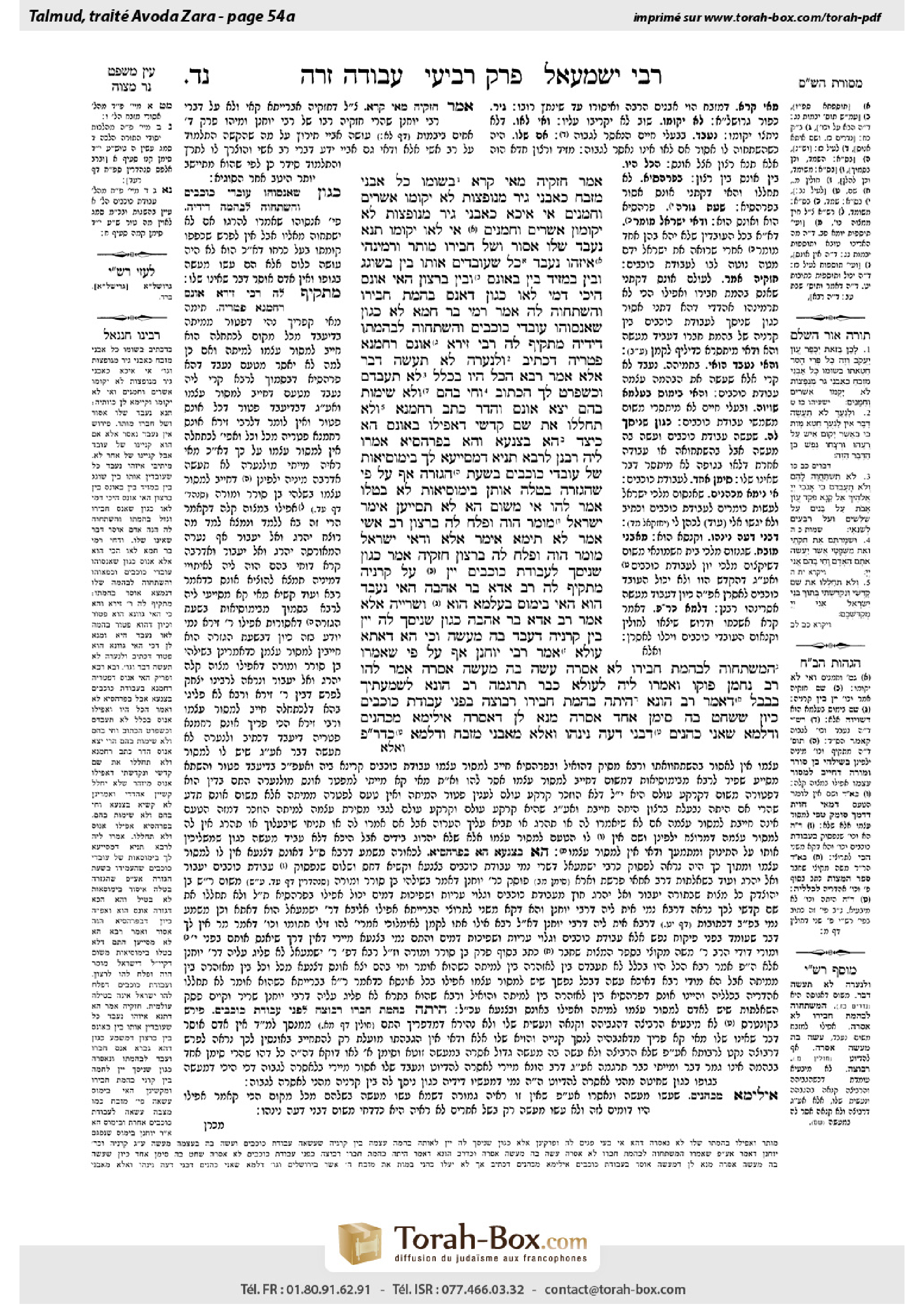
Avodah Zarah 54a: Talmud study for Daf Yomi
Study the Talmud for Daf Yomi with scanned pages, Hebrew text, English translations from Sefaria and AI-generated French translations.
Passage selection and English or AI-generated French translation are available where the scan has annotations. Daf Study is independent of Torah-Box and Sefaria.
Browse Avodah Zarah · עבודה זרה · All tractatesAvodah Zarah 54a text and translations
This page of Avodah Zarah includes the Aramaic text, an English translation and an AI-generated French translation, alongside the scan above.
עבודה זרה נ״ד א · Aramaic and Hebrew text
אָמַר חִזְקִיָּה: מַאי קְרָא ״בְּשׂוּמוֹ כׇּל אַבְנֵי מִזְבֵּחַ כְּאַבְנֵי גִר מְנֻפָּצוֹת לֹא יָקֻמוּ אֲשֵׁרִים וְחַמָּנִים״? אִי אִיכָּא ״כְּאַבְנֵי גִיר מְנוּפָּצוֹת״ — לֹא יְקוּמוּן אֲשֵׁרִים וְחַמָּנִים, אִי לָאו — יָקוּמוּ.
תָּנָא: נֶעֱבָד שֶׁלּוֹ אָסוּר, וְשֶׁל חֲבֵירוֹ מוּתָּר. וּרְמִינְהִי: אֵיזֶהוּ נֶעֱבָד? כֹּל שֶׁעוֹבְדִים אוֹתוֹ בֵּין בְּשׁוֹגֵג וּבֵין בְּמֵזִיד, בֵּין בְּאוֹנֶס וּבֵין בְּרָצוֹן. הַאי אוֹנֶס הֵיכִי דָּמֵי? לָאו כְּגוֹן דְּאָנַס בֶּהֱמַת חֲבֵירוֹ וְהִשְׁתַּחֲוָה לָהּ?
אָמַר רָמֵי בַּר חָמָא: לָא, כְּגוֹן שֶׁאֲנָסוּהוּ גּוֹיִם וְהִשְׁתַּחֲוָה לִבְהֶמְתּוֹ דִּידֵיהּ. מַתְקֵיף לַהּ רַבִּי זֵירָא: אוֹנֶס רַחֲמָנָא פַּטְרֵיהּ, דִּכְתִיב ״וְלַנַּעֲרָה לֹא תַעֲשֶׂה דָבָר״!
אֶלָּא אָמַר רָבָא: הַכֹּל הָיוּ בִּכְלָל ״לֹא תָעׇבְדֵם״, וּכְשֶׁפָּרַט לְךָ הַכָּתוּב ״וָחַי בָּהֶם״ וְלֹא שֶׁיָּמוּת בָּהֶם — יָצָא אוֹנֶס.
וַהֲדַר כְּתַב רַחֲמָנָא: ״וְלֹא תְחַלְּלוּ אֶת שֵׁם קׇדְשִׁי״, דַּאֲפִילּוּ בְּאוֹנֶס. הָא כֵּיצַד? הָא בְּצִנְעָא, וְהָא בְּפַרְהֶסְיָא.
אֲמַרוּ לֵיהּ רַבָּנַן לְרָבָא: תַּנְיָא דִּמְסַיְּיעָא לָךְ, בִּימוֹסְיָאוֹת שֶׁל גּוֹיִם בִּשְׁעַת הַשְּׁמָד — אַף עַל פִּי שֶׁהַשְּׁמָד בָּטֵל, אוֹתָן בִּימוֹסְיָאוֹת לֹא בָּטְלוּ.
אֲמַר לְהוּ: אִי מִשּׁוּם הָא לָא תְּסַיְּיעַן, אֵימַר יִשְׂרָאֵל מְשׁוּמָּד הֲוָה וּפְלַח לַהּ בְּרָצוֹן. רַב אָשֵׁי אָמַר: לָא תֵּימָא ״אֵימַר״, אֶלָּא וַדַּאי יִשְׂרָאֵל מְשׁוּמָּד הֲוָה וּפְלַח לַהּ בְּרָצוֹן.
חִזְקִיָּה אָמַר, כְּגוֹן שֶׁנִּיסֵּךְ לַעֲבוֹדָה זָרָה יַיִן עַל קַרְנֶיהָ. מַתְקֵיף לַהּ רַב אַדָּא בַּר אַהֲבָה: הַאי נֶעֱבָד הוּא? הַאי בִּימוֹס בְּעָלְמָא הוּא, וְשַׁרְיֵיהּ!
אֶלָּא אָמַר רַב אַדָּא בַּר אַהֲבָה: כְּגוֹן שֶׁנִּיסֵּךְ לָהּ יַיִן בֵּין קַרְנֶיהָ, דַּעֲבַד בַּהּ מַעֲשֶׂה, וְכִי הָא דַּאֲתָא עוּלָּא אָמַר רַבִּי יוֹחָנָן: אַף עַל פִּי שֶׁאָמְרוּ הַמִּשְׁתַּחֲוֶה לְבֶהֱמַת חֲבֵירוֹ לֹא אָסְרָה, עָשָׂה בָּהּ מַעֲשֶׂה — אֲסָרָהּ.
אֲמַר לְהוּ רַב נַחְמָן: פּוּקוּ וֶאֱמַרוּ לֵיהּ לְעוּלָּא, כְּבָר תַּרְגְּמַהּ רַב הוּנָא לִשְׁמַעְתָּיךְ בְּבָבֶל, דְּאָמַר רַב הוּנָא: הָיְתָה בֶּהֱמַת חֲבֵירוֹ רְבוּצָה בִּפְנֵי עֲבוֹדָה זָרָה, כֵּיוָן שֶׁשָּׁחַט בָּהּ סִימָן אֶחָד — אֲסָרָהּ.
מְנָא לַן דַּאֲסָרָהּ? אִילֵּימָא מִכֹּהֲנִים, וְדִלְמָא שָׁאנֵי כֹּהֲנִים דִּבְנֵי דֵעָה נִינְהוּ!
וְאֶלָּא מֵאַבְנֵי מִזְבֵּחַ, וְדִלְמָא כִּדְרַב פָּפָּא?
Avodah Zarah 54a · English translation
Ḥizkiyya said: What is the verse from which this halakha is derived? It is derived from the verse: “By this shall the iniquity of Jacob be expiated…when he makes all the stones of the altar as limestones [ke’avnei gir] that are beaten into pieces, so that the asherim and the sun images shall rise no more” (Isaiah 27:9). This indicates that if the description “as limestones that are beaten into pieces” is fulfilled, then the statement “The asherim and the sun images shall rise no more” also applies, and their status is revoked. If it is not fulfilled, then they shall rise, meaning that their status is not revoked.
§ The Sages taught in a baraita: With regard to an item, e.g., an animal, that was worshipped by a certain person, if it is his item it is prohibited, but if it is another’s, it is permitted. The Gemara raises a contradiction from another baraita: What is considered an animal that was worshipped and is disqualified from being sacrificed in the Temple? It is any animal that is worshipped, whether unwittingly or intentionally, whether under duress or willingly. What are the circumstances of this case of an animal worshipped under duress? Isn’t it referring to a case where one forcibly took another’s animal and bowed to it, indicating that one who worships the animal of another renders it forbidden?
Rami bar Ḥama says: No, the baraita is referring to a case where gentiles coerced someone and he bowed to his own animal. Rabbi Zeira objects to this: The Merciful One exempts a victim of circumstances beyond his control from punishment, as it is written with regard to a betrothed young woman who is raped: “But to the maiden you shall do nothing, the maiden has no sin worthy of death, for as when a man rises against his neighbor, and slays him, so is this matter” (Deuteronomy 22:26).
Rather, Rava says: All cases of idol worship were included in the prohibition: “You shall not bow down to them, nor shall you serve them” (Exodus 20:5), including the case of worship under duress. When the verse specified to you: “You shall keep My statutes…which a man shall do and live by them” (Leviticus 18:5), and not that he should die by them, the verse excluded the case of duress. One would conclude from the verse that one who acts under duress is not considered an idol worshipper, and he is not required to sacrifice his life to refrain from worshipping idols.
The Merciful One then wrote: “And you shall not profane My holy name” (Leviticus 22:32), indicating that the prohibition against idol worship applies even in a case of duress, as this constitutes a desecration of God’s name. How can these texts be reconciled? This verse is referring to worshipping under duress in private, and that verse is referring to worshipping under duress in public. In private one is not required to sacrifice his life in order to refrain from idol worship. In public one is required to sacrifice his life rather than engage in idol worship. Therefore, if one engaged in idol worship in public, even under duress, the object of idol worship is forbidden.
The Rabbis said to Rava: That which is taught in a baraita supports your opinion. It is taught in a baraita: The following halakha applies with regard to platforms of gentiles that were used for idol worship in a time of religious persecution, when gentiles decreed that Jews must engage in idol worship. During a time of religious persecution, one is required to sacrifice his life rather than transgress the prohibition against engaging in idolatrous worship even in private. Therefore, even though the religious persecution was canceled, the status of those platforms is not revoked and they remain forbidden, despite the fact that the idol worship was performed under duress.
Rava said to the Rabbis: If one wishes to support my opinion due to that baraita, you cannot support my opinion, as one can say that perhaps there was an apostate Jew there and he worshipped the idol willingly, and therefore the platforms are forbidden. Rav Ashi says: Do not say that one can say it is a possibility; rather, it is certain that there was an apostate Jew there and he worshipped it willingly.
Ḥizkiyya says: The contradiction between the baraitot with regard to an animal that was worshipped can be reconciled differently. The baraita that indicates that one who worships the animal of another renders it forbidden is referring to a case where in idolatrous worship one poured a libation of wine on the horns of an animal belonging to another. Since a sacrificial rite was performed upon the animal itself, it is forbidden. Rav Adda bar Ahava objects to this: Is this a case of an animal that was worshipped? This animal is a mere platform, i.e., it serves merely as an altar, and it is permitted.
Rather, Rav Adda bar Ahava says: That baraita is referring to a case where he poured a libation of wine in worship of the animal between its horns. In this case one renders another’s animal forbidden, as he performed a sacrificial rite upon the animal itself. And this is similar to that which Ulla stated, as Ulla came from Eretz Yisrael and said that Rabbi Yoḥanan says: Even though the Sages said that one who bows to the animal of another person does not render it prohibited, if he performed a sacrificial rite upon it he rendered it prohibited.
Rav Naḥman said to the Rabbis: Go out and say to Ulla: This is not a novel concept, as Rav Huna already interpreted the halakha that you stated in Babylonia. This is as Rav Huna says: In a case where the animal of another person was lying down before an object of idol worship, once one cut one of the organs that must be severed in ritual slaughter, i.e., either the windpipe or the gullet [siman], he rendered it prohibited, as he performed a sacrificial rite upon the animal.
The Gemara asks: From where do we derive that he rendered it prohibited? If we say that it is derived from the halakha that priests who engaged in idol worship are disqualified from serving in the Temple, even if they did so under duress, perhaps the case of priests is different, as they possess awareness and are responsible for their actions.
But rather, perhaps it is derived from the stones of the altar that were rendered forbidden by the Greeks, even though the stones were not theirs. The Gemara rejects this suggestion: But perhaps the reason the stones of the altar were prohibited is different, as explained by the statement of Rav Pappa (52b), that when the Greeks entered the Temple it was defiled and became theirs. One therefore cannot derive from that case that one can render the property of another person forbidden.
Avodah Zarah 54a · Traduction française (IA)
Chizkiyya dit : De quel verset cette halakha est-elle dérivée ? Elle est dérivée du verset : « Par cela l'iniquité de Jacob sera expiée... quand il fera toutes les pierres de l'autel en pierres de calcaire [ke’avnei gir] qui sont écrasées, de sorte que les asherim et les images du soleil ne se lèveront plus » (Isaïe 27:9). Cela indique que si la description « en pierres de calcaire qui sont écrasées » est accomplie, alors l'affirmation « les asherim et les images du soleil ne se lèveront plus » s'applique également, et leur statut est révoqué. Si elle n'est pas accomplie, alors ils se lèveront, ce qui signifie que leur statut n'est pas révoqué.
§ Les Sages enseignent dans une baraïta : En ce qui concerne un objet, par exemple un animal, qui a été adoré par une personne, si c'est son objet, il est interdit, mais si c'est celui d'un autre, il est permis. La Guemara soulève une contradiction à partir d'une autre baraïta : Quel est l'animal qui a été adoré et est disqualifié pour être sacrifié dans le Temple ? C'est tout animal qui est adoré, qu'il le fasse de manière involontaire ou délibérée, qu'il le fasse sous la contrainte ou volontairement. Quelles sont les circonstances de ce cas d'adoration sous la contrainte ? N'est-ce pas un cas où l'on a forcé quelqu'un à voler l'animal d'un autre et à s'incliner devant lui, indiquant que celui qui adore l'animal d'un autre le rend interdit ?
Rami bar Ḥama dit : Non, la baraïta fait référence à un cas où des gentils ont contraint quelqu'un et il s'est incliné devant son propre animal. Rabbi Zeira s'oppose à cela : L'Éternel exempt un victime de circonstances hors de son contrôle de la punition, comme il est écrit concernant une jeune fille fiancée qui a été violée : « Mais à la jeune fille tu ne feras rien, la jeune fille n'a pas de péché méritant la mort, car comme quand un homme s'élève contre son prochain et le tue, ainsi est cette affaire » (Deutéronome 22:26).
Plutôt, Rava dit : Tous les cas d'adoration païenne sont inclus dans l'interdiction : « Tu ne te prosterneras pas devant eux, ni tu ne leur serviras » (Exode 20:5), y compris le cas d'adoration sous la contrainte. Lorsque le verset spécifiait : « Tu observeras mes statuts... que l'homme fasse et vive par eux » (Lévitique 18:5), et non pas que l'homme meure par eux, le verset exclut le cas de la contrainte. On en conclut que celui qui agit sous la contrainte n'est pas considéré comme un adorateur d'idoles, et il n'est pas tenu de sacrifier sa vie pour éviter d'adorer des idoles.
L'Éternel a alors écrit : « Et tu ne profaneras pas mon nom saint » (Lévitique 22:32), indiquant que l'interdiction d'adorer des idoles s'applique même dans un cas de contrainte, car cela constitue une profanation du nom de Dieu. Comment ces textes peuvent-ils être conciliés ? Ce verset fait référence à l'adoration sous la contrainte en privé, et celui-ci fait référence à l'adoration sous la contrainte en public. En privé, on n'est pas tenu de sacrifier sa vie pour éviter d'adorer des idoles. En public, on est tenu de sacrifier sa vie plutôt que d'engager en adoration païenne. Ainsi, si l'on a participé à l'adoration païenne en public, même sous la contrainte, l'objet d'adoration est interdit.
Les Rabbins dirent à Rava : Ce qui est enseigné dans une baraïta soutient votre opinion. Il est enseigné dans une baraïta : La halakha suivante s'applique concernant les plateformes des gentils utilisées pour l'adoration païenne lors d'une persécution religieuse, lorsque les gentils ordonnèrent aux Juifs d'adopter l'adoration païenne. Lors d'une persécution religieuse, on est tenu de sacrifier sa vie plutôt que de transgresser l'interdiction d'adopter l'adoration païenne même en privé. Ainsi, même si la persécution religieuse a été annulée, le statut de ces plateformes n'est pas révoqué et elles restent interdites, malgré le fait que l'adoration païenne ait été accomplie sous la contrainte.
Rava dit aux Rabbins : Si l'on souhaite soutenir mon opinion à cause de cette baraïta, on ne peut pas soutenir mon opinion, car l'on peut dire que peut-être il y avait un Juif apostat là et il a adoré l'idole volontairement, et donc les plateformes sont interdites. Rav Ashi dit : Ne dites pas que l'on peut dire que c'est une possibilité ; plutôt, c'est certain qu'il y avait un Juif apostat là et il a adoré volontairement.
Chizkiyya dit : La contradiction entre les baraitot concernant un animal adoré peut être conciliée différemment. La baraïta qui indique que celui qui adore l'animal d'un autre le rend interdit fait référence à un cas où, dans l'adoration païenne, l'on versait un libation de vin sur les cornes d'un animal appartenant à un autre. Puisque un rite sacrificiel a été accompli sur l'animal lui-même, il est interdit. Rav Adda bar Ahava s'oppose à cela : Est-ce un cas d'un animal adoré ? Cet animal est simplement une plateforme, c'est-à-dire qu'il sert uniquement d'autel, et il est permis.
Plutôt, Rav Adda bar Ahava dit : Cette baraïta fait référence à un cas où l'on versait un libation de vin en adoration de l'animal entre ses cornes. Dans ce cas, l'on rend l'animal d'un autre interdit, car l'on a accompli un rite sacrificiel sur l'animal lui-même. Et cela est semblable à ce que Ulla a dit, car Ulla est venu d'Éretz Yisrael et a dit que Rabbi Yoḥanan dit : Même si les Sages dirent que celui qui s'incline devant l'animal d'une autre personne ne le rend pas interdit, si l'on a accompli un rite sacrificiel sur lui, il le rend interdit.
Rav Naḥman dit aux Rabbins : Sortez et dites à Ulla : Ce n'est pas une idée nouvelle, car Rav Huna a déjà interprété la halakha que vous avez énoncée en Babylone. C'est comme Rav Huna dit : Dans un cas où l'animal d'une autre personne était allongé devant un objet d'adoration païenne, une fois qu'on a coupé l'un des organes qui doit être séparé dans la boucherie rituelle, c'est-à-dire soit la trachée soit le gosier [siman], il l'a rendu interdit, car l'on a accompli un rite sacrificiel sur l'animal.
La Guemara pose la question : D'où dérivons-nous que cela l'a rendu interdit ? Si nous disons que cela découle de la halakha selon laquelle les prêtres qui se sont livrés à l'idolâtrie sont disqualifiés pour servir dans le Temple, même s'ils l'ont fait sous la contrainte, peut-être la situation des prêtres est-elle différente, car ils possèdent la conscience et sont responsables de leurs actions.
Mais plutôt, peut-être cela découle des pierres de l'autel qui ont été rendues interdites par les Grecs, même si ces pierres n'étaient pas leur propriété. La Guemara rejette cette suggestion : mais peut-être la raison pour laquelle les pierres de l'autel ont été interdites est différente, comme l'explique la déclaration de Rav Pappa (52b), selon laquelle lorsque les Grecs sont entrés dans le Temple, il a été souillé et est devenu leur propriété. On ne peut donc pas dériver de ce cas que l'on peut rendre interdit la propriété d'une autre personne.
Traduction française générée par IA à partir de l’édition anglaise de Sefaria. Vérifie toujours un passage avec le texte source.
Text from Sefaria: William Davidson Edition - Vocalized Aramaic (CC BY NC); William Davidson Edition - English (CC BY NC).