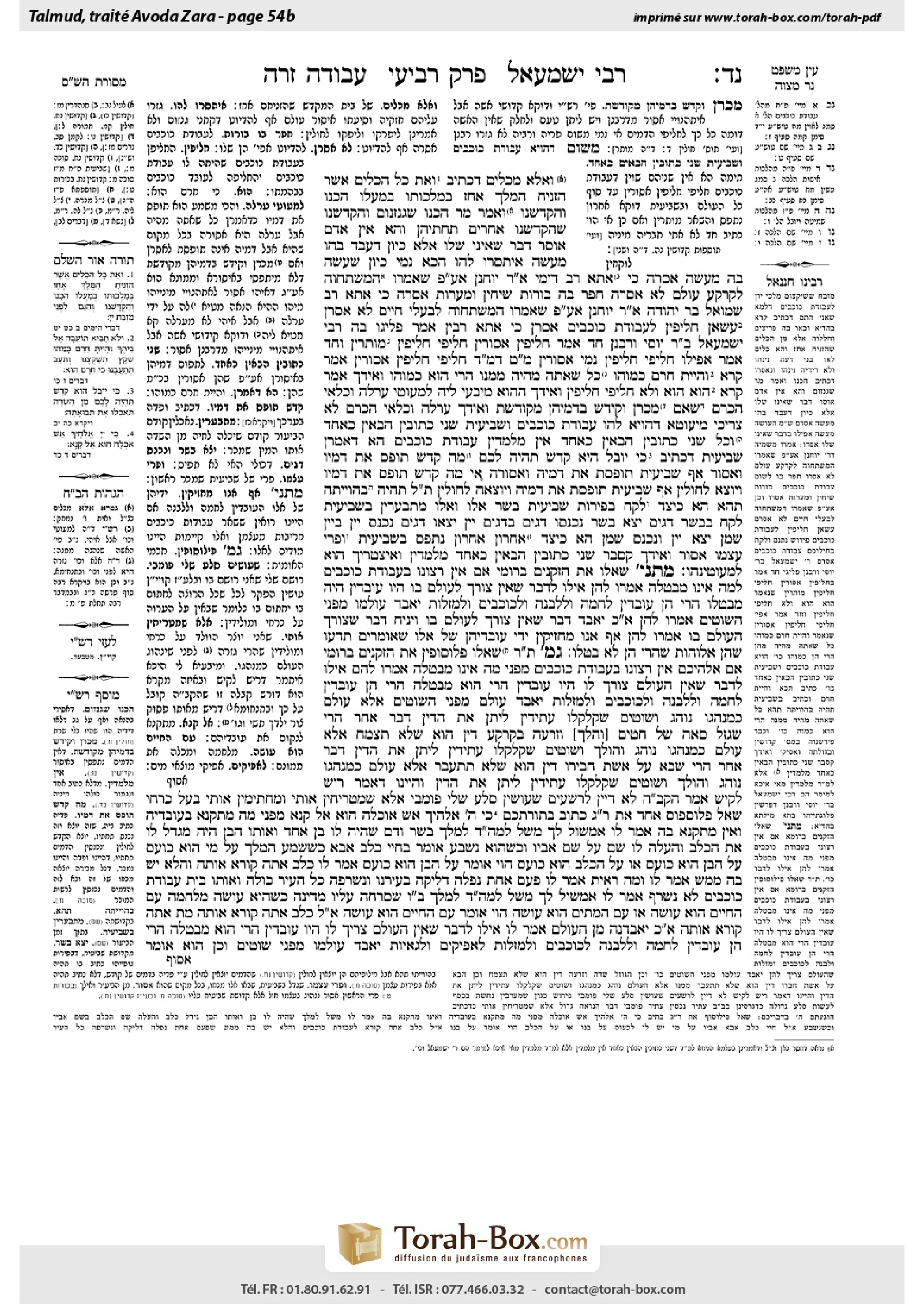
Avodah Zarah 54b: Talmud study for Daf Yomi
Study the Talmud for Daf Yomi with scanned pages, Hebrew text, English translations from Sefaria and AI-generated French translations.
Passage selection and English or AI-generated French translation are available where the scan has annotations. Daf Study is independent of Torah-Box and Sefaria.
Browse Avodah Zarah · עבודה זרה · All tractatesAvodah Zarah 54b text and translations
This page of Avodah Zarah includes the Aramaic text, an English translation and an AI-generated French translation, alongside the scan above.
עבודה זרה נ״ד ב · Aramaic and Hebrew text
וְאֶלָּא מִכֵּלִים, דִּכְתִיב: ״וְאֶת כׇּל הַכֵּלִים אֲשֶׁר הִזְנִיחַ הַמֶּלֶךְ אָחָז בְּמַלְכוּתוֹ בְּמַעֲלוֹ הֵכַנּוּ וְהִקְדָּשְׁנוּ״, וְאָמַר מָר: ״הֵכַנּוּ״ — שֶׁגְּנַזְנוּם, ״וְהִקְדָּשְׁנוּ״ — שֶׁהִקְדַּשְׁנוּ אֲחֵרִים תַּחְתֵּיהֶן, וְהָא אֵין אָדָם אוֹסֵר דָּבָר שֶׁאֵינוֹ שֶׁלּוֹ!
אֶלָּא, כֵּיוָן דַּעֲבַד בְּהוּ מַעֲשֶׂה, אִיתְּסַרוּ לְהוּ; הָכָא נָמֵי, כֵּיוָן שֶׁעָשָׂה בָּהּ מַעֲשֶׂה — אֲסָרָהּ.
כִּי אֲתָא רַב דִּימִי, אָמַר רַבִּי יוֹחָנָן: אַף עַל פִּי שֶׁאָמְרוּ הַמִּשְׁתַּחֲוֶה לְקַרְקַע עוֹלָם לֹא אֲסָרָהּ, חָפַר בָּהּ בּוֹרוֹת שִׁיחִין וּמְעָרוֹת — אֲסָרָהּ. כִּי אֲתָא רַב שְׁמוּאֵל בַּר יְהוּדָה, אָמַר רַבִּי יוֹחָנָן: אַף עַל פִּי שֶׁאָמְרוּ הַמִּשְׁתַּחֲוֶה לְבַעֲלֵי חַיִּים לֹא אֲסָרָן, עֲשָׂאָן חֲלִיפִין לַעֲבוֹדָה זָרָה — אֲסָרָן.
כִּי אֲתָא רָבִין אָמַר: פְּלִיגוּ בַּהּ רַבִּי יִשְׁמָעֵאל בַּר רַבִּי יוֹסֵי וְרַבָּנַן, חַד אָמַר: חֲלִיפִין אֲסוּרִין, חֲלִיפֵי חֲלִיפִין מוּתָּרִין, וְחַד אָמַר: אֲפִילּוּ חֲלִיפֵי חֲלִיפִין נָמֵי אֲסוּרִין.
מַאי טַעְמָא דְּמַאן דְּאָמַר חֲלִיפֵי חֲלִיפִין אֲסוּרִין? אָמַר קְרָא: ״וְהָיִיתָ חֵרֶם כָּמֹהוּ״, כֹּל שֶׁאַתָּה מְהַיֶּה מִמֶּנּוּ הֲרֵי הוּא כָּמוֹהוּ. וְאִידַּךְ, אָמַר קְרָא: ״הוּא״ — הוּא וְלֹא חֲלִיפֵי חֲלִיפִין.
וְאִידַּךְ, הָהוּא מִיבְּעֵי לֵיהּ לְמַעוֹטֵי עׇרְלָה וְכִלְאֵי הַכֶּרֶם, שֶׁאִם מְכָרָן וְקִידֵּשׁ בִּדְמֵיהֶן — מְקוּדֶּשֶׁת.
וְאִידַּךְ, עׇרְלָה וְכִלְאֵי הַכֶּרֶם לָא צְרִיכִי מִיעוּטָא, דְּהָוְיָא לְהוּ עֲבוֹדָה זָרָה וּשְׁבִיעִית שְׁנֵי כְּתוּבִין הַבָּאִין כְּאֶחָד, וְכׇל שְׁנֵי כְּתוּבִין הַבָּאִין כְּאֶחָד אֵין מְלַמְּדִין.
עֲבוֹדָה זָרָה — הָא דַּאֲמַרַן, שְׁבִיעִית — דִּכְתִיב: ״כִּי יוֹבֵל הִיא קֹדֶשׁ תִּהְיֶה לָכֶם״, מָה קֹדֶשׁ תּוֹפֵס אֶת דָּמָיו וְאָסוּר, אַף שְׁבִיעִית תּוֹפֶסֶת אֶת דָּמֶיהָ וַאֲסוּרָה.
אִי מָה קֹדֶשׁ תּוֹפֵס אֶת דָּמָיו וְיוֹצֵא לְחוּלִּין, אַף שְׁבִיעִית תּוֹפֶסֶת אֶת דָּמֶיהָ וְיוֹצְאָה לְחוּלִּין! תַּלְמוּד לוֹמַר: ״תִּהְיֶה״, בַּהֲוָיָיתָהּ תְּהֵא.
הָא כֵּיצַד? לָקַח בְּפֵירוֹת שְׁבִיעִית בָּשָׂר — אֵלּוּ וְאֵלּוּ מִתְבַּעֲרִין בַּשְּׁבִיעִית, לָקַח בַּבָּשָׂר דָּגִים — יָצָא בָּשָׂר נִכְנְסוּ דָּגִים, בַּדָּגִים יַיִן — יָצְאוּ דָּגִים נִכְנַס יַיִן, בַּיַּיִן שֶׁמֶן — יָצָא יַיִן וְנִכְנַס שֶׁמֶן, הָא כֵּיצַד? אַחֲרוֹן אַחֲרוֹן נִתְפָּס בִּשְׁבִיעִית, וּפְרִי עַצְמוֹ אָסוּר.
וְאִידַּךְ, קָסָבַר: שְׁנֵי כְתוּבִין הַבָּאִין כְּאֶחָד מְלַמְּדִין, וְאִיצְטְרִיךְ ״הוּא״ לְמַעוֹטִינְהוּ.
מַתְנִי׳ שָׁאֲלוּ אֶת הַזְּקֵנִים בְּרוֹמִי: אִם אֵין רְצוֹנוֹ בַּעֲבוֹדָה זָרָה, לָמָה אֵינוֹ מְבַטְּלָהּ? אָמְרוּ לָהֶן: אִילּוּ לְדָבָר שֶׁאֵין צוֹרֶךְ לָעוֹלָם בּוֹ הָיוּ עוֹבְדִין — הָיָה מְבַטְּלוֹ, הֲרֵי הֵן עוֹבְדִין לַחַמָּה וְלַלְּבָנָה וְלַכּוֹכָבִים וְלַמַּזָּלוֹת, יְאַבֵּד עוֹלָמוֹ מִפְּנֵי הַשּׁוֹטִים?!
אָמְרוּ לָהֶן: אִם כֵּן, יְאַבֵּד דָּבָר שֶׁאֵין צוֹרֶךְ לָעוֹלָם בּוֹ, וְיַנִּיחַ דָּבָר שֶׁצּוֹרֶךְ הָעוֹלָם בּוֹ! אָמְרוּ לָהֶן: אַף אָנוּ מַחֲזִיקִין יְדֵי עוֹבְדֵיהֶן שֶׁל אֵלּוּ, שֶׁאוֹמְרִים: תֵּדְעוּ שֶׁהֵן אֱלוֹהוֹת, שֶׁהֲרֵי הֵן לֹא בָּטְלוּ.
גְּמָ׳ תָּנוּ רַבָּנַן: שָׁאֲלוּ פִלוֹסוֹפִין אֶת הַזְּקֵנִים בְּרוֹמִי: אִם אֱלֹהֵיכֶם אֵין רְצוֹנוֹ בַּעֲבוֹדָה זָרָה, מִפְּנֵי מָה אֵינוֹ מְבַטְּלָהּ? אָמְרוּ לָהֶם: אִילּוּ לְדָבָר שֶׁאֵין הָעוֹלָם צוֹרֶךְ לוֹ הָיוּ עוֹבְדִין, הֲרֵי הוּא מְבַטְּלָהּ. הֲרֵי הֵן עוֹבְדִין לַחַמָּה וְלַלְּבָנָה וְלַכּוֹכָבִים וְלַמַּזָּלוֹת, יְאַבֵּד עוֹלָם מִפְּנֵי הַשּׁוֹטִים? אֶלָּא עוֹלָם כְּמִנְהָגוֹ נוֹהֵג, וְשׁוֹטִים שֶׁקִּלְקְלוּ עֲתִידִין לִיתֵּן אֶת הַדִּין.
דָּבָר אַחֵר: הֲרֵי שֶׁגָּזַל סְאָה שֶׁל חִטִּים [וְהָלַךְ] וּזְרָעָהּ בַּקַּרְקַע — דִּין הוּא שֶׁלֹּא תִּצְמַח, אֶלָּא עוֹלָם כְּמִנְהָגוֹ נוֹהֵג וְהוֹלֵךְ, וְשׁוֹטִים שֶׁקִּלְקְלוּ עֲתִידִין לִיתֵּן אֶת הַדִּין.
דָּבָר אַחֵר: הֲרֵי שֶׁבָּא עַל אֵשֶׁת חֲבֵירוֹ — דִּין הוּא שֶׁלֹּא תִּתְעַבֵּר, אֶלָּא עוֹלָם כְּמִנְהָגוֹ נוֹהֵג וְהוֹלֵךְ, וְשׁוֹטִים שֶׁקִּלְקְלוּ עֲתִידִין לִיתֵּן אֶת הַדִּין.
וְהַיְינוּ דְּאָמַר רֵישׁ לָקִישׁ: אָמַר הַקָּדוֹשׁ בָּרוּךְ הוּא: לֹא דַּיָּין לָרְשָׁעִים שֶׁעוֹשִׂין סֶלַע שֶׁלִּי פּוּמְבֵּי, אֶלָּא שֶׁמַּטְרִיחִין אוֹתִי וּמַחְתִּימִין אוֹתִי בְּעַל כׇּרְחִי.
שָׁאַל פִלוֹסֹפוּס אֶחָד אֶת רַבָּן גַּמְלִיאֵל: כָּתוּב בְּתוֹרַתְכֶם ״כִּי ה׳ אֱלֹהֶיךָ אֵשׁ אֹכְלָה הוּא אֵל קַנָּא״, מִפְּנֵי מָה מִתְקַנֵּא בְּעוֹבְדֶיהָ וְאֵין מִתְקַנֵּא בָּהּ?
אָמַר לוֹ: אֶמְשׁוֹל לְךָ מָשָׁל, לְמָה הַדָּבָר דּוֹמֶה? לְמֶלֶךְ בָּשָׂר וָדָם שֶׁהָיָה לוֹ בֵּן אֶחָד, וְאוֹתוֹ הַבֵּן הָיָה מְגַדֵּל לוֹ אֶת הַכֶּלֶב וְהֶעֱלָה לוֹ שֵׁם עַל שֵׁם אָבִיו, וּכְשֶׁהוּא נִשְׁבָּע אוֹמֵר: ״בְּחַיֵּי כֶּלֶב אַבָּא״, כְּשֶׁשָּׁמַע הַמֶּלֶךְ, עַל מִי הוּא כּוֹעֵס, עַל הַבֵּן הוּא כּוֹעֵס אוֹ עַל הַכֶּלֶב הוּא כּוֹעֵס? הֱוֵי אוֹמֵר: עַל הַבֵּן הוּא כּוֹעֵס.
אָמַר לוֹ: כֶּלֶב אַתָּה קוֹרֵא אוֹתָהּ? וַהֲלֹא יֵשׁ בָּהּ מַמָּשׁ! אָמַר לוֹ: וּמָה רָאִיתָ? אָמַר לוֹ: פַּעַם אַחַת נָפְלָה דְּלֵיקָה בְּעִירֵנוּ, וְנִשְׂרְפָה כׇּל הָעִיר כּוּלָּהּ, וְאוֹתוֹ בֵּית עֲבוֹדָה זָרָה לֹא נִשְׂרַף!
אָמַר לוֹ: אֶמְשׁוֹל לְךָ מָשָׁל, לְמָה הַדָּבָר דּוֹמֶה? לְמֶלֶךְ בָּשָׂר וָדָם שֶׁסָּרְחָה עָלָיו מְדִינָה, כְּשֶׁהוּא עוֹשֶׂה מִלְחָמָה, עִם הַחַיִּים הוּא עוֹשֶׂה אוֹ עִם הַמֵּתִים הוּא עוֹשֶׂה? הֱוֵי אוֹמֵר: עִם הַחַיִּים הוּא עוֹשֶׂה.
אָמַר לוֹ: כֶּלֶב אַתָּה קוֹרֵא אוֹתָהּ, מֵת אַתָּה קוֹרֵא אוֹתָהּ, אִם כֵּן יְאַבְּדֶנָּה מִן הָעוֹלָם! אָמַר לוֹ: אִילּוּ לְדָבָר שֶׁאֵין הָעוֹלָם צָרִיךְ לוֹ הָיוּ עוֹבְדִין, הֲרֵי הוּא מְבַטְּלָהּ, הֲרֵי הֵן עוֹבְדִין לַחַמָּה וְלַלְּבָנָה, לַכּוֹכָבִים וְלַמַּזָּלוֹת, לָאֲפִיקִים וְלַגֵּאָיוֹת, יְאַבֵּד עוֹלָמוֹ מִפְּנֵי שׁוֹטִים? וְכֵן הוּא אוֹמֵר:
Avodah Zarah 54b · English translation
But rather, it is derived from the case of vessels of the Temple that Ahaz used for idol worship, as it is written: “And all the vessels, which King Ahaz in his reign did cast away when he acted treacherously, we have prepared and sanctified, and behold, they are before the altar of the Lord” (II Chronicles 29:19). And the Master said: “We have prepared” means that we interred them; “and sanctified” means that we sanctified other vessels in their stead, as the original vessels were prohibited. But how could Ahaz render the vessels of the Temple forbidden, as a person does not render forbidden an item that is not his?
Rather, since Ahaz performed a sacrificial rite upon them in idolatrous worship, the vessels were prohibited. Here too, when one performed a sacrificial rite upon the animal of another person by slaughtering it in idolatrous worship, he rendered it prohibited.
§ When Rav Dimi came from Eretz Yisrael to Babylonia, he said that Rabbi Yoḥanan says: Even though the Sages said that one who bows to the ground does not render it prohibited, if one dug pits, ditches, and caves in it, he rendered it prohibited. When Rav Shmuel bar Yehuda came from Eretz Yisrael to Babylonia, he said that Rabbi Yoḥanan says: Even though the Sages said that one who bows to animals does not render them prohibited, if one rendered them an item of exchange for an object of idol worship, exchanging the animal for an object of idol worship, he rendered them prohibited.
When Ravin came from Eretz Yisrael to Babylonia, he said: Rabbi Yishmael bar Rabbi Yosei and the Rabbis disagree with regard to the halakha concerning an item exchanged for an object of idol worship. One says that the item of the exchange is prohibited, but if one then acquired another item in exchange for the item of that exchange, the exchange of the exchange is permitted. And one says that even the exchange of the exchange is also prohibited.
The Gemara asks: What is the reason of the one who says that the exchange of the exchange is prohibited? The verse states: “And you shall not bring an abomination into your house, that you should become accursed like it; you shall utterly detest it…for it is accursed” (Deuteronomy 7:26). Not only do you become accursed, but anything that you cause to become yours from the exchange of an object of idol worship is accursed like it, i.e., is forbidden like the object of idol worship itself. And as for the other tanna, from where does he derive that the exchange of the exchange is permitted? The verse states: “For it is accursed.” Infer from this that “it,” the object of idol worship, is forbidden, but not the exchange of the exchange.
The Gemara asks: And as for the other tanna, how does he interpret the term “it”? The Gemara answers: He requires that term to exclude an item acquired in exchange for orla or for diverse kinds of crops that grew in a vineyard. The verse indicates that if one sold orla or diverse kinds that grew in a vineyard and betrothed a woman with the money from the sale, she is betrothed.
The Gemara asks: And from where does the other tanna derive this halakha? He holds that orla and diverse kinds that grew in a vineyard do not require an exclusion. This is because idol worship and the Sabbatical Year are two verses that come as one, i.e., both teach the same principle, that an item acquired in exchange for a forbidden item is forbidden, and any two verses that come as one do not teach their common halakha to other cases.
The Gemara explains: The source of this halakha with regard to idol worship is that ruling which we said earlier. With regard to the Sabbatical Year, the source is as it is written: “For it is a Jubilee Year; it shall be sacred for you” (Leviticus 25:12). The verse juxtaposes the Jubilee Year, the produce of which has the same status as produce of the Sabbatical Year, and sacred items. Infer from this that just as when one buys consecrated property it transfers its sanctity to the money with which it is redeemed and the money is prohibited, so too, the produce of the Sabbatical Year transfers its sanctity to the money with which it is redeemed and the money is prohibited.
The Gemara asks: If so, one could say that just as consecrated property transfers its sanctity to the money with which it is redeemed and is transferred to non-sacred status, so too, the produce of the Sabbatical Year transfers its sanctity to the money with which it is redeemed and is transferred to non-sacred status. Therefore, the verse states: “It shall be sacred for you,” indicating that the produce shall always be as it is, and it is not desacralized.
The Gemara explains: How so? If one purchased meat with produce of the Sabbatical Year, both these and those, i.e., the meat and the produce, are eradicated in the Sabbatical Year. The sanctity of the Sabbatical Year takes effect with regard to the meat as well. It is treated like the produce, and it must be disposed of when the obligation to eradicate the produce of the Sabbatical Year goes into effect. If he then purchases fish with this meat, the meat loses its consecrated status, and the fish assume the consecrated state. If he then purchases wine with these fish, the fish lose their consecrated status and the wine assumes the consecrated state. If he then purchases oil with the wine, the wine loses its consecrated status and the oil assumes the consecrated state. How so? The final item purchased has the sanctity of the Sabbatical Year transferred to it, and the Sabbatical-Year produce itself remains forbidden.
The Gemara asks: And as for the other tanna, who maintains that the term “it” excludes an item exchanged for orla or for diverse kinds that grew in a vineyard, how does he respond to this? The Gemara answers: He holds that two verses that come as one, i.e., that teach the same principle, teach their common halakha to other cases, and one could have derived the prohibition from the cases of idol worship and the Sabbatical Year. Therefore, the term “it” was necessary in order to exclude from the prohibition an item exchanged for orla or for diverse kinds that grew in a vineyard.
MISHNA: The gentiles asked the Jewish Sages who were in Rome: If it is not God’s will that people should engage in idol worship, why does He not eliminate it? The Sages said to them: Were people worshipping only objects for which the world has no need, He would eliminate it. But they worship the sun and the moon and the stars and the constellations. Should He destroy His world because of the fools?
The gentiles said to the Sages: If so, let Him destroy those objects of idol worship for which the world has no need and leave those objects for which the world has a need. The Sages said to them: If that were to happen, we would thereby be supporting the worshippers of those objects for which the world has need, as they would say: You should know that these are truly gods, as they were not eliminated from the world, whereas the others were eliminated.
GEMARA: The Sages taught: Certain philosophers [filosofin] asked the Jewish Sages who were in Rome: If it is not your God’s will that people should engage in idol worship, for what reason does He not eliminate it? The Sages said to them: Were people worshipping only objects for which the world has no need, He would eliminate it. But they worship the sun and the moon and the stars and the constellations. Should He destroy the world because of the fools? Rather, the world follows its course, and the fools who sinned will be held to judgment in the future for their transgressions.
The baraita presents another matter that illustrates the same concept: Consider the case of one who stole a se’a of wheat and went and planted it in the ground. By right it should not grow. But the world goes along and follows its course and the fools who sinned will be held to judgment in the future for their transgressions.
The baraita presents another matter that illustrates the same concept: Consider the case of one who engaged in intercourse with the wife of another. By right she should not become pregnant. But the world goes along and follows its course and the fools who sinned will be held to judgment in the future for their transgressions.
The Gemara comments: And this is as Reish Lakish says: The Holy One, Blessed be He, said: Is it not enough for the wicked that they treat My die for a sela coin as if it were ownerless [pumbi], using it without My permission and against My will, as they impregnate women adulterously? But moreover, they also trouble Me and cause Me to sign the result of their actions against My will, as I form the fetus and give it life, even when its creation is the result of prohibited sexual intercourse.
A certain philosopher asked Rabban Gamliel: It is written in your Torah with regard to the prohibition against idol worship: “For the Lord your God is a devouring fire, a jealous God” (Deuteronomy 4:24). For what reason is He jealous and does He exact vengeance from the idol’s worshippers, but He is not jealous of the idol itself and does not destroy it?
Rabban Gamliel said to the philosopher: I will relate a parable to you. To what is this matter comparable? It may be compared to a king of flesh and blood who had one son, and that son was raising a dog. And the son gave the dog a name, naming him after his father. When the son would take an oath, he would say: I swear by the life of the dog, my father. When the king heard about this, with whom was the king angry? Is he angry with the son or is he angry with the dog? You must say that he is angry with the son. So too, God is angry with the worshippers who attribute divinity to objects of idol worship and not with the objects of idol worship themselves.
The philosopher said to Rabban Gamliel: Do you call the idol a dog? But the idol truly exists, i.e., has power. Rabban Gamliel said to the philosopher: And what did you see that caused you to believe that the idols have power? The philosopher said to Rabban Gamliel: A fire once broke out in our city, and the entire city was burned down, but that temple of idol worship was not burned down.
Rabban Gamliel said to the philosopher: I will relate a parable to you. To what is this matter comparable? It may be compared to a king of flesh and blood whose province sinned against him. When he wages war, does he wage war against the living or does he wage war against the dead? You must say that he wages war against the living. God punishes the living worshippers and not the idol, which is not alive.
The philosopher said to Rabban Gamliel: You call the idol a dog; you call the idol dead. If it is so, let God remove it from the world. Rabban Gamliel said to the philosopher: Were people worshipping only objects for which the world has no need, He would eliminate it. But they worship the sun and the moon, the stars and the constellations, and the streams and the valleys. Should He destroy His world because of fools? And so the verse states:
Avodah Zarah 54b · Traduction française (IA)
Mais plutôt, cela est tiré du cas des vases du Temple utilisés par Achaz pour l'idolâtrie, comme il est écrit : « Et tous les vases, que le roi Achaz, durant son règne, avait jetés lorsqu'il agissait perfidement, nous avons préparés et sanctifiés, et voici qu'ils sont devant l'autel du Seigneur » (II Chroniques 29:19). Et le Maître dit : « Nous avons préparés » signifie que nous les avons enterrés ; « et sanctifiés » signifie que nous avons sanctifié d'autres vases à leur place, car les vases originels étaient interdits. Mais comment Achaz pouvait-il rendre les vases du Temple interdits, puisqu'une personne ne rend pas interdit un objet qui n'est pas le sien ?
Plutôt, puisque Achaz avait accompli un rite sacrificiel sur eux dans l'idolâtrie, les vases étaient interdits. De même, lorsqu'on accomplissait un rite sacrificiel sur l'animal d'une autre personne en le tuant dans l'idolâtrie, on le rendait interdit.
§ Quand Rav Dimi est venu de la Terre d'Israël vers Babylone, il a dit que Rabbi Yochanan dit : Même si les Sages disent que celui qui s'incline sur le sol ne rend pas l'objet interdit, si l'on creuse des puits, des fossés et des grottes dans l'objet, on le rend interdit. Quand Rav Shmuel bar Yehuda est venu de la Terre d'Israël vers Babylone, il a dit que Rabbi Yochanan dit : Même si les Sages disent que celui qui s'incline sur les animaux ne les rend pas interdits, si l'on rend l'animal un objet d'échange pour un objet d'idolâtrie, en échangeant l'animal contre un objet d'idolâtrie, on le rend interdit.
Quand Rabin est venu de la Terre d'Israël vers Babylone, il a dit : Rabbi Yishmael bar Rabbi Yosei et les Rabbins s'opposent sur la halakha concernant un objet échangé contre un objet d'idolâtrie. L'un dit que l'objet de l'échange est interdit, mais si l'on acquiert un autre objet en échange de l'objet de cet échange, l'échange de l'échange est permis. L'autre dit que même l'échange de l'échange est interdit.
La Guemara demande : De quelle raison l'un qui dit que l'échange de l'échange est interdit ? La Parashah dit : « Et tu ne porteras pas l'abomination dans ta maison, afin que tu deviennes maudit comme elle ; tu la détesteras entièrement… car elle est maudite » (Deutéronome 7:26). Non seulement tu deviens maudit, mais tout ce que tu causes à appartenir à l'échange d'un objet d'idolâtrie est maudit comme lui, c'est-à-dire interdit comme l'objet d'idolâtrie lui-même. Et concernant l'autre tanna, d'où tire-t-il que l'échange de l'échange est permis ? La Parashah dit : « Car elle est maudite ». Infère-en que « elle », l'objet d'idolâtrie, est interdit, mais pas l'échange de l'échange.
La Guemara demande : Et concernant l'autre tanna, comment interprète-t-il le terme « elle » ? La Guemara répond : Il exige que ce terme exclue un objet acquis en échange d'orla ou de diverses sortes de cultures qui ont grandi dans un vignoble. La Parashah indique que si l'on vendait de l'orla ou des diverses sortes qui avaient grandi dans un vignoble et qu'on épousait une femme avec l'argent de la vente, elle était épousée.
La Guemara demande : Et d'où tire-t-il cette halakha ? Il affirme que l'orla et les diverses sortes qui ont grandi dans un vignoble n'ont pas besoin d'être exclus. Cela est dû au fait que l'idolâtrie et la année sabbatique sont deux versets qui viennent ensemble, c'est-à-dire qui enseignent la même principes, que l'objet acquis en échange d'un objet interdit est interdit, et que deux versets qui viennent ensemble ne transmettent leur halakha commune à d'autres cas.
La Guemara explique : La source de cette halakha concernant l'idolâtrie est la décision que nous avons dite plus tôt. Concernant la année sabbatique, la source est comme il est écrit : « Car c'est une année de jubilé ; elle sera sainte pour vous » (Lévitique 25:12). La Parashah juxtapose l'année de jubilé, dont les produits ont le même statut que les produits de la année sabbatique, et les objets saints. Infère-en que tout comme lorsqu'on achète une propriété consacrée, la sanctité est transférée à l'argent avec lequel elle est rachetée et l'argent est interdit, de même, les produits de la année sabbatique transfèrent leur sanctité à l'argent avec lequel ils sont rachetés et l'argent est interdit.
La Guemara demande : Si c'est ainsi, on pourrait dire que tout comme la propriété consacrée transfère sa sanctité à l'argent avec lequel elle est rachetée et est transférée à un statut non sacré, de même, les produits de la année sabbatique transfèrent leur sanctité à l'argent avec lequel ils sont rachetés et sont transférés à un statut non sacré. Ainsi, la Parashah dit : « Elle sera sainte pour vous », indiquant que les produits resteront toujours tels qu'ils sont, et ne sont pas désacrés.
La Guemara explique : Comment cela ? Si l'on achète de la viande avec les produits de la année sabbatique, les deux, c'est-à-dire la viande et les produits, sont annulés dans la année sabbatique. La sanctité de la année sabbatique s'applique également à la viande. Elle est traitée comme les produits, et elle doit être éliminée lorsque l'obligation d'annuler les produits de la année sabbatique s'applique. Si l'on achète ensuite des poissons avec cette viande, la viande perd sa sanctité, et les poissons prennent la sanctité. Si l'on achète ensuite du vin avec ces poissons, les poissons perdent leur sanctité et le vin prend la sanctité. Si l'on achète ensuite de l'huile avec ce vin, le vin perd sa sanctité et l'huile prend la sanctité. Comment cela ? L'objet final acheté a la sanctité de la année sabbatique transférée à lui, et les produits de la année sabbatique lui-même restent interdits.
La Guemara pose la question : Et quant à l'autre tanna, qui affirme que le terme « il » exclut un objet échangé contre l'orla ou contre des espèces diverses qui ont grandi dans un vignoble, comment répond-il à cela ? La Guemara répond : Il considère que deux versets qui s'expriment ensemble, c'est-à-dire qui enseignent le même principe, transmettent leur halakha commune à d'autres cas, et l'on aurait pu déduire la prohibition à partir des cas de l'idolâtrie et du sabbat. Ainsi, le terme « il » était nécessaire afin d'exclure de la prohibition un objet échangé contre l'orla ou contre des espèces diverses qui ont grandi dans un vignoble.
MICHNA : Les gentils interrogèrent les Sages juifs qui étaient à Rome : Si ce n'est pas la volonté de Dieu que les gens pratiquent l'idolâtrie, pourquoi ne l'élimine-t-il pas ? Les Sages dirent à ceux-ci : S'ils adoraient seulement des objets dont le monde n'a pas besoin, Il les éliminerait. Mais ils adorent le soleil et la lune et les étoiles et les constellations. Doit-il détruire son monde à cause des imbéciles ?
Les gentils dirent aux Sages : Si c'est ainsi, que Dieu élimine les objets d'idolâtrie dont le monde n'a pas besoin et laisse ceux dont le monde a besoin. Les Sages dirent à ceux-ci : Si cela arrivait, nous serions ainsi en train de soutenir les adorateurs de ces objets dont le monde a besoin, car ils diraient : Vous devez savoir que ces objets sont véritablement des dieux, car ils n'ont pas été éliminés du monde, tandis que les autres ont été éliminés.
GUEMARA : Les Sages enseignèrent : Certains philosophes [filosofin] interrogèrent les Sages juifs qui étaient à Rome : Si ce n'est pas la volonté de votre Dieu que les gens pratiquent l'idolâtrie, pourquoi ne l'élimine-t-il pas ? Les Sages dirent à ceux-ci : S'ils adoraient seulement des objets dont le monde n'a pas besoin, Il les éliminerait. Mais ils adorent le soleil et la lune et les étoiles et les constellations. Doit-il détruire le monde à cause des imbéciles ? Plutôt, le monde suit son cours, et les imbéciles qui ont péché seront jugés à l'avenir pour leurs transgressions.
La baraïta présente un autre cas qui illustre la même idée : Considérez le cas d'une personne qui a volé un se'a de blé et est allé le planter dans le sol. Droitement, il ne devrait pas pousser. Mais le monde suit son cours et les imbéciles qui ont péché seront jugés à l'avenir pour leurs transgressions.
La baraïta présente un autre cas qui illustre la même idée : Considérez le cas d'une personne qui a eu des relations sexuelles avec la femme d'un autre. Droitement, elle ne devrait pas devenir enceinte. Mais le monde suit son cours et les imbéciles qui ont péché seront jugés à l'avenir pour leurs transgressions.
La Guemara commente : Et c'est comme Reish Lakish dit : Le Saint, le Très Haut, a dit : N'est-ce pas suffisant pour les méchants qu'ils traitent mon die pour un sela comme s'il était sans propriétaire [pumbi], en l'utilisant sans mon autorisation et contre ma volonté, comme ils impregnent les femmes de manière adultère ? Mais en outre, ils troublent encore Moi et Me font signer le résultat de leurs actions contre ma volonté, car Je forme le fœtus et Je lui donne la vie, même lorsque sa création est le résultat d'un rapport sexuel interdit.
Un certain philosophe demanda à Rabban Gamliel : Il est écrit dans votre Torah concernant la prohibition de l'idolâtrie : « Car l'Éternel votre Dieu est un feu dévorant, un Dieu jaloux » (Deutéronome 4:24). Pour quelle raison est-il jaloux et exige-t-il la vengeance contre les adorateurs d'idoles, mais il n'est pas jaloux de l'idole elle-même et ne la détruit pas ?
Rabban Gamliel dit au philosophe : Je vais te rapporter une comparaison. À quoi est-ce comparable ? On peut le comparer à un roi de chair et de sang qui avait un fils, et ce fils élevait un chien. Et le fils donnait un nom au chien, le nommant après son père. Lorsque le fils prenait un serment, il disait : Je jure par la vie du chien, mon père. Lorsque le roi entendit cela, contre qui était-il en colère ? Est-ce contre le fils ou contre le chien ? Tu dois dire qu'il est en colère contre le fils. De même, Dieu est en colère contre les adorateurs qui attribuent une divinité aux objets d'idolâtrie et non contre les objets d'idolâtrie eux-mêmes.
Le philosophe dit à Rabban Gamliel : Tu appelles l'idole un chien ? Mais l'idole existe véritablement, c'est-à-dire qu'elle a du pouvoir. Rabban Gamliel dit au philosophe : Et qu'as-tu vu qui t'a fait croire que les idoles ont du pouvoir ? Le philosophe dit à Rabban Gamliel : Un feu s'est déclenché dans notre ville, et toute la ville a été brûlée, mais ce temple d'idolâtrie n'a pas été brûlé.
Rabban Gamliel dit au philosophe : Je vais te rapporter une comparaison. À quoi est-ce comparable ? On peut le comparer à un roi de chair et de sang dont la province a péché contre lui. Lorsqu'il mène la guerre, combat-il contre les vivants ou contre les morts ? Tu dois dire qu'il combat contre les vivants. Dieu puni les adorateurs vivants et non l'idole, qui n'est pas vivant.
Le philosophe dit à Rabban Gamliel : Tu appelles l'idole un chien ; tu appelles l'idole mort. Si c'est ainsi, que Dieu l'éloigne du monde. Rabban Gamliel dit au philosophe : S'ils adoraient seulement des objets dont le monde n'a pas besoin, Il les éliminerait. Mais ils adorent le soleil et la lune, les étoiles et les constellations, et les rivières et les vallées. Doit-il détruire son monde à cause des imbéciles ? Et ainsi la Sainte Écriture dit :
Traduction française générée par IA à partir de l’édition anglaise de Sefaria. Vérifie toujours un passage avec le texte source.
Text from Sefaria: William Davidson Edition - Vocalized Aramaic (CC BY NC); William Davidson Edition - English (CC BY NC).