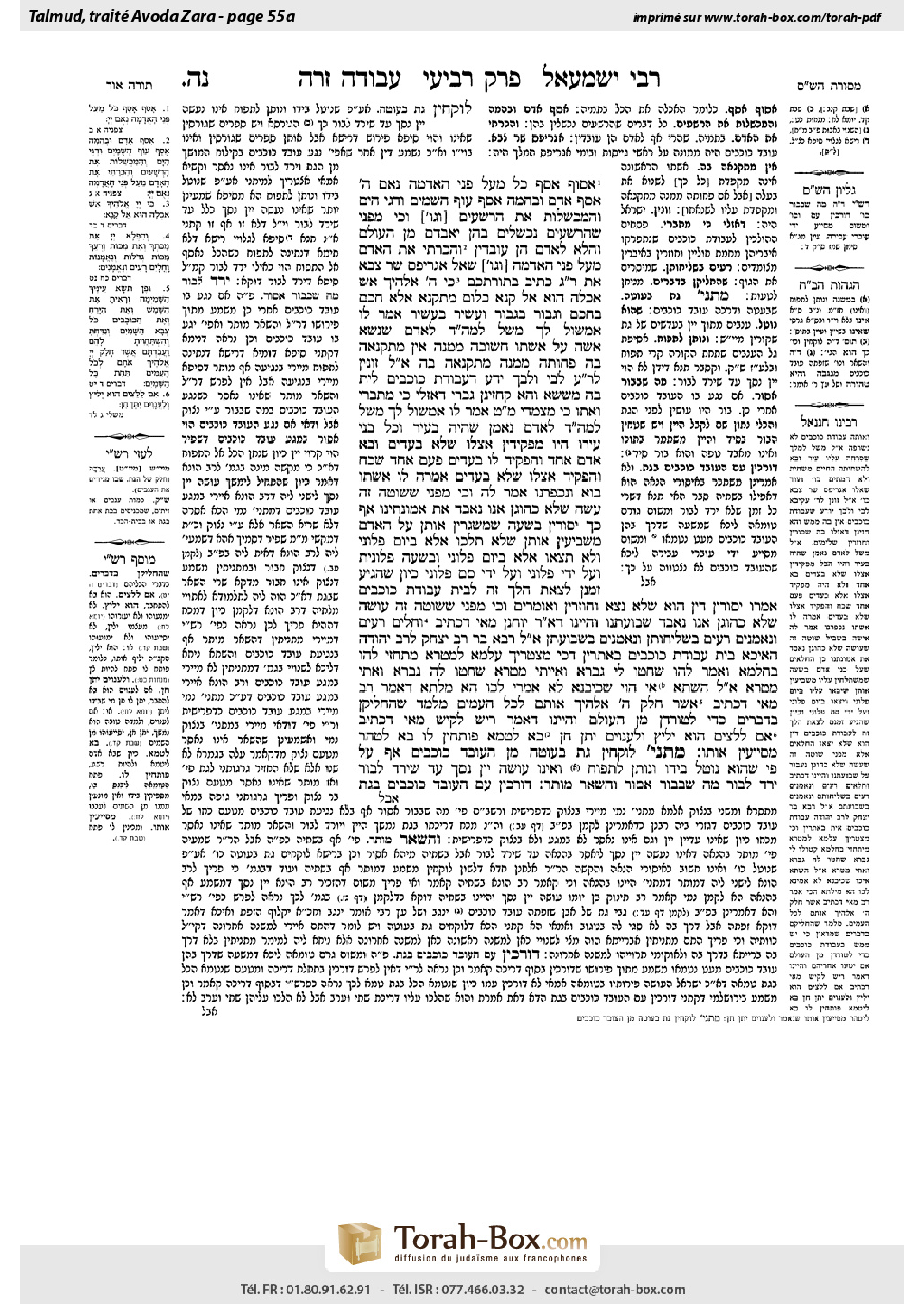
Avodah Zarah 55a: Talmud study for Daf Yomi
Study the Talmud for Daf Yomi with scanned pages, Hebrew text, English translations from Sefaria and AI-generated French translations.
Passage selection and English or AI-generated French translation are available where the scan has annotations. Daf Study is independent of Torah-Box and Sefaria.
Browse Avodah Zarah · עבודה זרה · All tractatesAvodah Zarah 55a text and translations
This page of Avodah Zarah includes the Aramaic text, an English translation and an AI-generated French translation, alongside the scan above.
עבודה זרה נ״ה א · Aramaic and Hebrew text
״אָסֹף אָסֵף כֹּל מֵעַל פְּנֵי הָאֲדָמָה נְאֻם ה׳, אָסֵף אָדָם וּבְהֵמָה אָסֵף עוֹף הַשָּׁמַיִם וּדְגֵי הַיָּם וְהַמַּכְשֵׁלוֹת אֶת הָרְשָׁעִים [וְגוֹ׳]״, וְכִי מִפְּנֵי שֶׁהָרְשָׁעִים נִכְשָׁלִים בָּהֶן יְאַבְּדֵם מִן הָעוֹלָם? וַהֲלֹא לְאָדָם הֵן עוֹבְדִין, ״וְהִכְרַתִּי אֶת הָאָדָם מֵעַל פְּנֵי הָאֲדָמָה [וְגוֹ׳]״.
שָׁאַל אַגְרִיפַּס שַׂר צָבָא אֶת רַבָּן גַּמְלִיאֵל: כְּתִיב בְּתוֹרַתְכֶם: ״כִּי ה׳ אֱלֹהֶיךָ אֵשׁ אֹכְלָה הוּא אֵל קַנָּא״, כְּלוּם מִתְקַנֵּא אֶלָּא חָכָם בְּחָכָם, וְגִבּוֹר בְּגִבּוֹר, וְעָשִׁיר בְּעָשִׁיר?
אָמַר לוֹ: אֶמְשׁוֹל לְךָ מָשָׁל, לְמָה הַדָּבָר דּוֹמֶה? לְאָדָם שֶׁנָּשָׂא אִשָּׁה עַל אִשְׁתּוֹ, חֲשׁוּבָה מִמֶּנָּה — אֵין מִתְקַנְּאָה בָּהּ, פְּחוּתָה מִמֶּנָּה — מִתְקַנְּאָה בָּהּ.
אֲמַר לֵיהּ זוּנִין לְרַבִּי עֲקִיבָא: לִבִּי וְלִבָּךְ יָדַע דַּעֲבוֹדָה זָרָה לֵית בַּהּ מְשָׁשָׁא, וְהָא קָחָזֵינַן גַּבְרֵי דְּאָזְלִי כִּי מְתַבְּרִי וְאָתוּ כִּי מְצַמְּדִי! מַאי טַעְמָא?
אָמַר לוֹ: אֶמְשׁוֹל לְךָ מָשָׁל, לְמָה הַדָּבָר דּוֹמֶה? לְאָדָם נֶאֱמָן שֶׁהָיָה בָּעִיר, וְכׇל בְּנֵי עִירוֹ הָיוּ מַפְקִידִין אֶצְלוֹ שֶׁלֹּא בְּעֵדִים, וּבָא אָדָם אֶחָד וְהִפְקִיד לוֹ בְּעֵדִים. פַּעַם אֶחָד שָׁכַח וְהִפְקִיד אֶצְלוֹ שֶׁלֹּא בְּעֵדִים, אָמְרָה לוֹ אִשְׁתּוֹ: בּוֹא וְנִכְפְּרֶנּוּ, אָמַר לָהּ: וְכִי מִפְּנֵי שֶׁשּׁוֹטֶה זֶה עָשָׂה שֶׁלֹּא כַּהוֹגֶן אָנוּ נְאַבֵּד אֶת אֱמוּנָתֵינוּ?
אַף כָּךְ יִסּוּרִין, בְּשָׁעָה שֶׁמְּשַׁגְּרִין אוֹתָן עַל הָאָדָם, מַשְׁבִּיעִין אוֹתָן: שֶׁלֹּא תֵּלְכוּ אֶלָּא בְּיוֹם פְּלוֹנִי, וְלֹא תֵּצְאוּ אֶלָּא בְּיוֹם פְּלוֹנִי וּבְשָׁעָה פְּלוֹנִית, וְעַל יְדֵי פְּלוֹנִי וְעַל יְדֵי סַם פְּלוֹנִי. כֵּיוָן שֶׁהִגִּיעַ זְמַנָּן לָצֵאת, הָלַךְ זֶה לְבֵית עֲבוֹדָה זָרָה, אָמְרוּ יִסּוּרִין: דִּין הוּא שֶׁלֹּא נֵצֵא, וְחוֹזְרִין וְאוֹמְרִים: וְכִי מִפְּנֵי שֶׁשּׁוֹטֶה זֶה עוֹשֶׂה שֶׁלֹּא כַּהוֹגֶן אָנוּ נְאַבֵּד שְׁבוּעָתֵנוּ?
וְהַיְינוּ דְּאָמַר רַבִּי יוֹחָנָן: מַאי דִּכְתִיב ״וׇחֳלָיִם רָעִים וְנֶאֱמָנִים״? רָעִים בִּשְׁלִיחוּתָן, וְנֶאֱמָנִים בִּשְׁבוּעָתָן.
אֲמַר לֵיהּ רָבָא בַּר רַב יִצְחָק לְרַב יְהוּדָה: הָאִיכָּא בֵּית עֲבוֹדָה זָרָה בְּאַתְרִין, דְּכִי מִצְטְרִיךְ עָלְמָא לְמִטְרָא, מִתְחֲזֵי לְהוּ בְּחֶלְמָא וְאָמַר לְהוּ: שַׁחֲטוּ לִי גַּבְרָא וְאַיְיתֵי מִטְרָא — שָׁחֲטוּ לַהּ גַּבְרָא וְאָתֵי מִטְרָא!
אֲמַר לֵיהּ: הַשְׁתָּא (אִי הֲוַי) [אִיכּוֹ] שָׁכֵיבְנָא, לָא אֲמַרִי לְכוּ הָא מִלְּתָא, דְּאָמַר רַב: מַאי דִּכְתִיב ״אֲשֶׁר חָלַק ה׳ אֱלֹהֶיךָ אֹתָם לְכֹל הָעַמִּים״? מְלַמֵּד שֶׁהֶחְלִיקָן בִּדְבָרִים, כְּדֵי לְטוֹרְדָן מִן הָעוֹלָם.
וְהַיְינוּ דְּאָמַר רֵישׁ לָקִישׁ: מַאי דִּכְתִיב ״אִם לַלֵּצִים הוּא יָלִיץ וְלַעֲנָוִים יִתֶּן חֵן״? בָּא לִטַּמֵּא — פּוֹתְחִין לוֹ, בָּא לִטָּהֵר — מְסַיְּיעִין אוֹתוֹ.
מַתְנִי׳ לוֹקְחִין גַּת בְּעוּטָה מִן הַנׇּכְרִי, אַף עַל פִּי שֶׁהוּא נוֹטֵל בְּיָדוֹ וְנוֹתֵן לַתַּפּוּחַ, וְאֵינוֹ עוֹשֶׂה יֵין נֶסֶךְ עַד שֶׁיֵּרֵד לַבּוֹר. יָרַד לַבּוֹר — מַה שֶּׁבַּבּוֹר אָסוּר, וְהַשְּׁאָר מוּתָּר.
דּוֹרְכִין עִם הַנׇּכְרִי בַּגַּת,
Avodah Zarah 55a · English translation
“Shall I utterly consume all things from off the face of the earth? says the Lord. Shall I consume man and beast? Shall I consume the fowls of the heavens and the fish of the sea, and the stumbling blocks of the wicked, and shall I cut off man from off the face of the earth? says the Lord” (Zephaniah 1:2–3). Should God remove objects of idol worship from the world due to the fact that the wicked stumble because of them? If so, He would have to destroy all of humanity as well, as do not idol worshippers also worship people? This is expressed in the continuation of the verse: “And shall I cut off man from off the face of the earth? says the Lord.”
§ Agrippas the general asked Rabban Gamliel: It is written in your Torah with regard to idol worship: “For the Lord your God is a devouring fire, a jealous God” (Deuteronomy 4:24). Doesn’t jealousy arise only in the following cases: A wise man might be jealous of another wise man, and a mighty man might be jealous of another mighty man, and a rich man might be jealous of another rich man? If so, why is God jealous of objects of idol worship, which are not gods?
Rabban Gamliel said to Agrippas: I will relate a parable to you. To what is this matter comparable? It can be compared to a person who married a second wife in addition to his first wife. If the second wife is more distinguished than the first wife, the first wife is not jealous of her, and she does not feel anger toward her husband. But if the second wife is less distinguished than the first wife, she is jealous of her.
Zunin said to Rabbi Akiva: Both my heart and your heart know that there is no substance to idol worship. Nevertheless, don’t we see people who go with broken limbs to worship idols and come back when they are whole? What is the reason for this?
Rabbi Akiva said to Zunin: I will relate a parable to you. To what is this matter comparable? It can be compared to a trusted person who was in a certain city, and all the residents of his city would deposit items and money with him, even not in the presence of witnesses. And there was one man who did not trust him, who came and specifically deposited money with him in the presence of witnesses. On one occasion, that person forgot and deposited money with him not in the presence of witnesses. The trusted man’s wife said to him: Come, let us deny that he deposited the money with us, as there are no witnesses. The man said to her: Should we lose our credibility and act deceitfully just because this fool acted improperly and did not require the presence of witnesses?
So too, with regard to different forms of suffering, at the time when they are sent to afflict the person, an oath is administered to them as follows: Take an oath that you shall not go and afflict the person except on such and such a day. And you shall not leave him except on such and such a day, at such and such an hour, by means of so-and-so, a specific doctor, and by means of such and such a medicine. When the time came for the suffering to leave him, this sick man went to a temple of idol worship. The forms of suffering said: By right we should not leave him. But then they say: Should we lose the fulfillment of our oath just because this fool is acting improperly?
And this is consistent with that which Rabbi Yoḥanan says: What is the meaning of that which is written: “Then the Lord will make your plagues wonderful, and the plagues of your seed, even great plagues and faithful, and evil and faithful sicknesses” (Deuteronomy 28:59)? The term “evil” does not mean that the agent of sickness is in itself evil. Rather, this is referring to its mission, which is to cause harm. The term “and faithful sicknesses” indicates that the illnesses are faithful to their oath and adhere to the times designated for the affliction.
Rava bar Rav Yitzḥak said to Rav Yehuda: Isn’t there a temple of idol worship in our locale, where, when the world is in need of rain, the idol appears to them in a dream, and it says to them: Slaughter a man as an offering to me, and I will bring rain. They then slaughter a man for it, and the rain comes.
Rav Yehuda said to Rava bar Rav Yitzḥak: Now, were I dead I would not have been able to tell you the explanation of this matter. It is therefore good that you reminded me of this matter while I am alive. The explanation is as Rav says: What is the meaning of that which is written: “And lest you lift up your eyes to the heavens, and when you see the sun and the moon and the stars, even all the host of heavens, you are drawn away and worship them, and serve them, which the Lord your God has allotted [ḥalak] to all the nations under the whole heaven” (Deuteronomy 4:19). The verse teaches that God allowed the nations to be misled [sheheḥelikan] by matters that seemingly indicate that idol worship is effective in order to expel the nations from the world due to their decision to engage in idol worship.
And this is consistent with that which Reish Lakish says: What is the meaning of that which is written: “If it concerns the scornful, He scorns them, but to the humble He gives grace” (Proverbs 3:34)? One who comes in order to become impure, i.e., to sin, they, in Heaven, provide him with an opening to do so, and he is not prevented from sinning. If one comes in order to become purified, not only is he allowed to do so, but they, in Heaven, assist him.
MISHNA: One may purchase from a gentile a winepress in which the grapes have been trodden on, despite the fact that the gentile takes grapes in his hand from the winepress and places them on the pile that remains to be trodden on. And the gentile’s touch does not render the juice of the grapes into wine used for a libation in idol worship, which is forbidden, until it descends into the collection vat, because until then it does not have the status of wine. Once the wine descended into the collection vat, that which is in the vat is prohibited, and the rest, which did not yet descend into the vat, is permitted.
One may tread on grapes together with the gentile in the winepress,
Avodah Zarah 55a · Traduction française (IA)
« Dois-je détruire entièrement toutes choses de la surface de la terre ? dit l'Éternel. Dois-je détruire l'homme et la bête ? Dois-je détruire les oiseaux du ciel et les poissons de la mer, et les obstacles des méchants, et dois-je éloigner l'homme de la surface de la terre ? dit l'Éternel » (Zephaniah 1 : 2–3). Devrait-on que l'Éternel éloigne les objets de l'idolâtrie du monde en raison du fait que les méchants trébuchent à cause d'eux ? Si c'est le cas, il faudrait détruire toute l'humanité également, car les idolâtres ne vénèrent-ils pas aussi des personnes ? Cela est exprimé dans la continuation de la parole : « Et dois-je éloigner l'homme de la surface de la terre ? dit l'Éternel. »
§ Agrippa le général demanda à Rabban Gamliel : Il est écrit dans votre Torah concernant l'idolâtrie : « L'Éternel votre Dieu est un feu dévorant, un Dieu jaloux » (Deutéronome 4 : 24). N'émerge la jalousie que dans les cas suivants : un homme sage peut être jaloux d'un autre homme sage, et un homme puissant peut être jaloux d'un autre homme puissant, et un homme riche peut être jaloux d'un autre homme riche ? Si c'est le cas, pourquoi l'Éternel est-il jaloux des objets d'idolâtrie, qui ne sont pas des dieux ?
Rabban Gamliel dit à Agrippa : Je vais te rapporter une comparaison. À quoi est-ce comparable ? Cela peut être comparé à un homme qui a épousé une deuxième femme en plus de sa première femme. Si la deuxième femme est plus distinguée que la première femme, la première femme n'est pas jalouse d'elle et ne ressent pas de colère envers son mari. Mais si la deuxième femme est moins distinguée que la première femme, elle est jalouse d'elle.
Zunin dit à Rabbi Akiva : À la fois mon cœur et votre cœur savent que l'idolâtrie n'a pas de substance. Cependant, ne voyons-nous pas des gens qui vont avec des membres cassés pour vénérer des idoles et reviennent quand ils sont guéris ? Quel est le motif de cela ?
Rabbi Akiva dit à Zunin : Je vais te rapporter une comparaison. À quoi est-ce comparable ? Cela peut être comparé à un homme de confiance qui était dans une certaine ville, et tous les habitants de sa ville déposaient des objets et de l'argent avec lui, même en l'absence de témoins. Et il y avait un homme qui ne le confiait pas, qui vint et déposa spécifiquement de l'argent avec lui en présence de témoins. Une fois, cet homme oubliant, déposa de l'argent avec lui sans la présence de témoins. La femme de l'homme de confiance dit à son mari : Viens, faisons semblant de ne pas avoir reçu l'argent, car il n'y a pas de témoins. L'homme dit à sa femme : Devons-nous perdre notre crédibilité et agir de manière trompeuse juste parce que ce fou agit de manière inappropriée et n'a pas exigé la présence de témoins ?
De même, concernant différentes formes de souffrance, lorsqu'elles sont envoyées pour affliger la personne, un serment est administré à elles comme suit : Prends un serment que tu ne vas pas affliger la personne que ce n'est pas le jour convenu. Et tu ne le laisses pas partir que ce n'est pas le jour convenu, à l'heure convenue, par le moyen de tel et tel, un médecin spécifique, et par le moyen de telle et telle médecine. Lorsque le moment est venu pour la souffrance de quitter la personne, ce malade est allé dans un temple d'idolâtrie. Les formes de souffrance dirent : D'après le droit, nous ne devons pas le laisser partir. Mais alors elles dirent : Devons-nous perdre la pleine accomplissement de notre serment juste parce que ce fou agit de manière inappropriée ?
Et cela est cohérent avec ce que Rabbi Yoḥanan dit : Quelle est la signification de ce qui est écrit : « Alors l'Éternel fera tes plaies merveilleuses, et les plaies de ta descendance, même de grandes plaies et de maladies fidèles, et de maladies et de maladies fidèles » (Deutéronome 28 : 59) ? Le terme « maladies » ne signifie pas que l'agent de la maladie est en soi mauvais. Cela fait référence à sa mission, qui est de causer des dommages. Le terme « et de maladies fidèles » indique que les maladies sont fidèles à leur serment et s'adherent aux moments désignés pour l'affliction.
Rava bar Rav Yitzḥak dit à Rav Yehuda : N'y a-t-il pas un temple d'idolâtrie dans notre région, où, lorsqu'on a besoin de pluie, l'idole apparaît à eux en rêve et dit : Sacrifie un homme en offrande à moi, et je ferai pleuvoir. Ils sacrifient un homme à cause de cela, et la pluie arrive.
Rav Yehuda dit à Rava bar Rav Yitzḥak : Maintenant, si j'étais mort, je n'aurais pas pu te dire l'explication de cette affaire. Il est donc bon que tu m'aies rappelé cette affaire pendant que je suis vivant. L'explication est comme Rav dit : Quelle est la signification de ce qui est écrit : « Et afin que tu ne lèves pas tes yeux vers les cieux, et quand tu vois le soleil et la lune et les étoiles, même toute l'armée des cieux, tu sois attiré et tu adores et tu sers, ce que l'Éternel ton Dieu a partagé [ḥalak] à toutes les nations sous tout le ciel » (Deutéronome 4 : 19). La parole enseigne que l'Éternel a permis aux nations d'être trompées [sheheḥelikan] par des choses qui semblent indiquer que l'idolâtrie est efficace afin de les expulser du monde en raison de leur décision d'engager l'idolâtrie.
Et cela est cohérent avec ce que Reish Lakish dit : Quelle est la signification de ce qui est écrit : « Si c'est à l'orgueilleux, il l'humilie, mais à l'humble il donne la grâce » (Proverbes 3 : 34) ? Celui qui vient afin de devenir impur, c'est-à-dire de pécher, ils, au Ciel, lui donnent une ouverture pour le faire, et il n'est pas empêché de pécher. Celui qui vient afin de se purifier, non seulement est-il autorisé à le faire, mais ils, au Ciel, l'aident.
MICHNA : On peut acheter à un non-Juif une presse à vin dans laquelle les raisins ont été foulés, malgré le fait que le non-Juif prend des raisins dans sa main à partir de la presse et les place sur la pile qui reste à être foulée. Et le toucher du non-Juif ne rend pas le jus des raisins en vin utilisé pour une libation dans l'idolâtrie, ce qui est interdit, jusqu'à ce qu'il descende dans le tonneau de récolte, car jusqu'à ce moment-là, il n'a pas le statut de vin. Une fois que le vin est descendu dans le tonneau de récolte, ce qui est dans le tonneau est interdit, et le reste, qui n'a pas encore descendu dans le tonneau, est permis.
On peut marcher sur des raisins avec le non-Juif dans la presse à vin,
Traduction française générée par IA à partir de l’édition anglaise de Sefaria. Vérifie toujours un passage avec le texte source.
Text from Sefaria: William Davidson Edition - Vocalized Aramaic (CC BY NC); William Davidson Edition - English (CC BY NC).