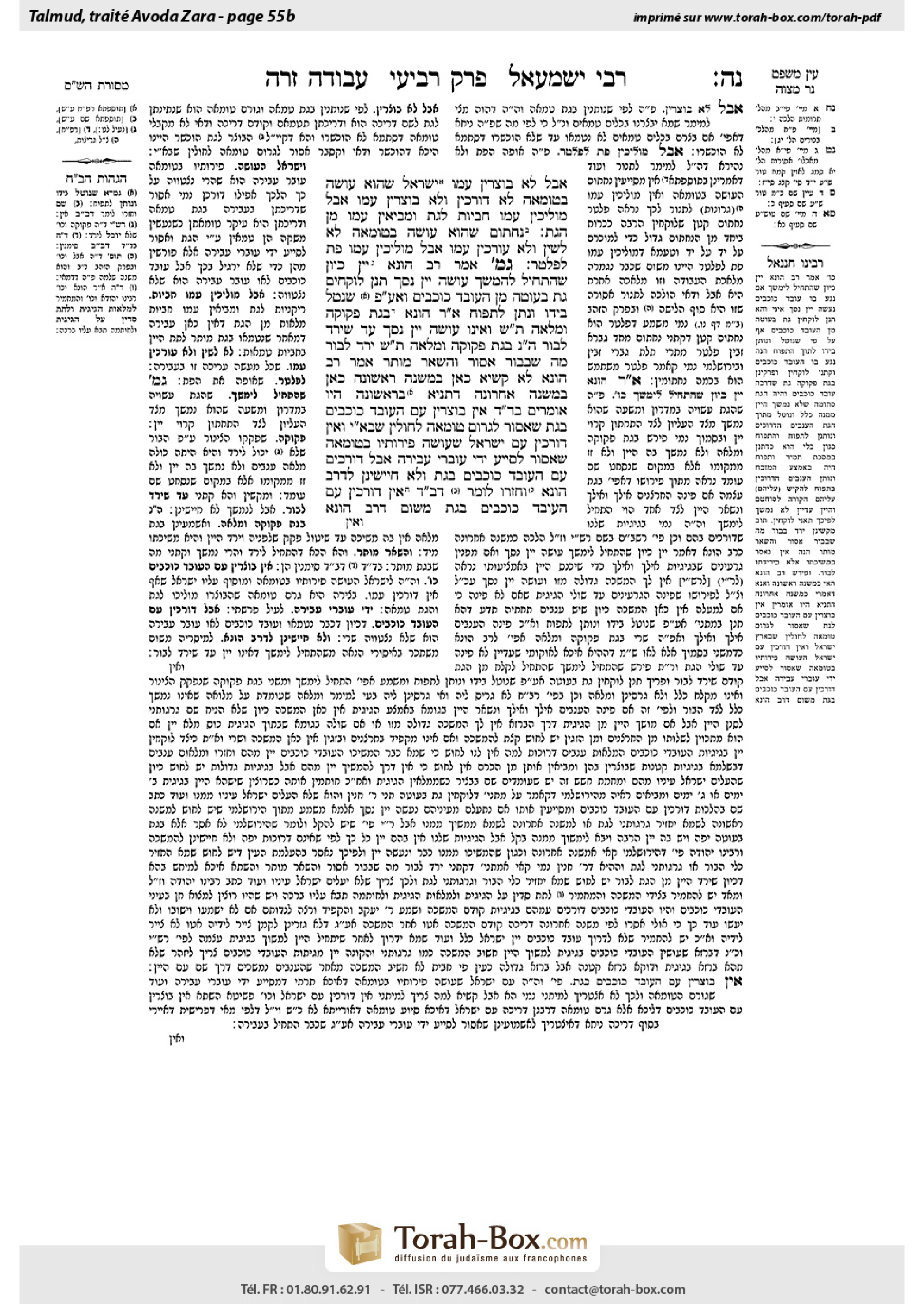
Avodah Zarah 55b: Talmud study for Daf Yomi
Study the Talmud for Daf Yomi with scanned pages, Hebrew text, English translations from Sefaria and AI-generated French translations.
Passage selection and English or AI-generated French translation are available where the scan has annotations. Daf Study is independent of Torah-Box and Sefaria.
Browse Avodah Zarah · עבודה זרה · All tractatesAvodah Zarah 55b text and translations
This page of Avodah Zarah includes the Aramaic text, an English translation and an AI-generated French translation, alongside the scan above.
עבודה זרה נ״ה ב · Aramaic and Hebrew text
אֲבָל לֹא בּוֹצְרִין עִמּוֹ. יִשְׂרָאֵל שֶׁהוּא עוֹשֶׂה בְּטוּמְאָה — לֹא דּוֹרְכִין וְלֹא בּוֹצְרִין עִמּוֹ, אֲבָל מוֹלִיכִין עִמּוֹ חָבִיּוֹת לַגַּת, וּמְבִיאִין עִמּוֹ מִן הַגַּת.
נַחְתּוֹם שֶׁהוּא עוֹשֶׂה בְּטוּמְאָה — לֹא לָשִׁין וְלֹא עוֹרְכִין עִמּוֹ, אֲבָל מוֹלִיכִין עִמּוֹ פַּת לְפַלְטֵר.
גְּמָ׳ אָמַר רַב הוּנָא: יַיִן, כֵּיוָן שֶׁהִתְחִיל לְהִמָּשֵׁךְ, עוֹשֶׂה יֵין נֶסֶךְ. תְּנַן: לוֹקְחִים גַּת בְּעוּטָה מִן הַנׇּכְרִי, וְאַף עַל פִּי שֶׁנָּטַל בְּיָדוֹ וְנָתַן לַתַּפּוּחַ! אָמַר רַב הוּנָא: בְּגַת פְּקוּקָה וּמְלֵאָה.
תָּא שְׁמַע, וְאֵינוֹ עוֹשֶׂה יֵין נֶסֶךְ עַד שֶׁיֵּרֵד לַבּוֹר! הָכָא נָמֵי בְּגַת פְּקוּקָה וּמְלֵאָה.
תָּא שְׁמַע: יָרַד לַבּוֹר — מָה שֶׁבַּבּוֹר אָסוּר, וְהַשְּׁאָר מוּתָּר. אָמַר רַב הוּנָא: לָא קַשְׁיָא — כָּאן בְּמִשְׁנָה רִאשׁוֹנָה, כָּאן בְּמִשְׁנָה אַחֲרוֹנָה.
דְּתַנְיָא: בָּרִאשׁוֹנָה הָיוּ אוֹמְרִים בד״ד — אֵין בּוֹצְרִין עִם הַנׇּכְרִי בַּגַּת, שֶׁאָסוּר לִגְרוֹם טוּמְאָה לְחוּלִּין שֶׁבְּאֶרֶץ יִשְׂרָאֵל, וְאֵין דּוֹרְכִין עִם יִשְׂרָאֵל שֶׁעוֹשֶׂה פֵּירוֹתָיו בְּטוּמְאָה, שֶׁאָסוּר לְסַיֵּיעַ יְדֵי עוֹבְרֵי עֲבֵירָה, אֲבָל דּוֹרְכִים עִם הַנׇּכְרִי בַּגַּת, וְלָא חָיְישִׁינַן לִדְרַב הוּנָא.
וְחָזְרוּ לוֹמַר דב״ב — אֵין דּוֹרְכִין עִם הַנׇּכְרִי בַּגַּת, מִשּׁוּם דְּרַב הוּנָא.
Avodah Zarah 55b · English translation
but one may not harvest grapes with him. After the harvest the grapes are brought to the winepress, which is ritually impure. This would render the grapes impure, and it is prohibited to render produce of Eretz Yisrael impure. In the case of a Jew who produces his wine in a state of ritual impurity, one may not tread on grapes nor harvest them with him, as it is prohibited to assist transgressors. But once he has produced his wine, one may take the barrels to the winepress with him, as the wine is already impure. And one may also bring the barrels from the winepress together with him.
Similarly, in the case of a baker who makes his bread in a state of ritual impurity, one may not knead or arrange the dough in the shape of bread together with him, so as not to assist in a transgression. But one may take the bread with him to the bread merchant [lapalter].
GEMARA: Rav Huna says: With regard to wine, once it begins to flow toward the exit from the winepress it can become wine used for a libation in idol worship if touched by a gentile. The Gemara asks: But we learned in the mishna: One may purchase from a gentile a winepress in which the grapes have been trodden on, despite the fact that the gentile took grapes in his hand and placed them on the pile of grapes that remained to be trodden on? Presumably the wine began to flow once the grapes were pressed, and yet the mishna states that the wine is not forbidden. Rav Huna said: The mishna is referring to a winepress that is stoppered and full, and therefore the wine does not flow.
The Gemara suggests: Come and hear a proof from the mishna: And the gentile’s touch does not render the grape juice wine used for a libation in idol worship until it descends into the collection vat. This indicates that even if the wine flows it does not become wine used for a libation before it descends into the vat. The Gemara answers: Here, too, the mishna is referring to a winepress that is stoppered and full, and the wine does not flow.
The Gemara suggests: Come and hear a proof from the mishna: Once the wine descended into the collection vat, that which is in the vat is prohibited, and the rest that did not yet descend into the vat is permitted, even though it already began to flow. Rav Huna said: This is not difficult. Here, in the mishna, the halakha is stated in accordance with the initial version of the mishna. There, in my ruling, the halakha is stated in accordance with the ultimate version of the mishna.
This is as it is taught in a baraita: Initially, the Sages would say the following halakhot whose mnemonic is bet, dalet, dalet, which stands for harvesting [botzrin], treading [dorkhin], and treading [dorkhin]: One may not harvest grapes with a gentile in order to bring them to the winepress, as this would render the grapes ritually impure and it is prohibited to impart impurity to the non-sacred produce that is in Eretz Yisrael. And one may not tread on grapes together with a Jew who produces wine from his fruit in a state of ritual impurity, as it is prohibited to assist transgressors. But one may tread on grapes in the winepress together with the gentile. The Gemara comments: And we are not concerned about the ruling of Rav Huna that from the time that it flows the wine is rendered wine used for a libation.
The baraita continues: But the Sages later revised this halakha and said the following halakhot whose mnemonic is dalet, beit, dalet, which stands for treading [dorkhin], harvesting [botzrin], and treading [dorkhin]: One may not tread on grapes in the winepress together with the gentile. The Gemara comments: This is due to the ruling of Rav Huna that from the time that it flows the wine can be rendered wine used for a libation. The gentile usually touches the flowing wine while treading on the grapes, rendering the wine forbidden. Therefore, if a Jew receives payment for treading on the grapes with the gentile, he is profiting from an item from which deriving benefit is prohibited.
Avodah Zarah 55b · Traduction française (IA)
mais on ne peut pas récolter des raisins avec lui. Après la récolte, les raisins sont amenés à la presse à vin, qui est impure rituellement. Cela rendrait les raisins impurs, et il est interdit de rendre impurs les produits de la Terre d'Israël. Dans le cas d'un Juif qui produit son vin dans un état d'impureté rituelle, on ne peut pas fouler les raisins ni les récolter avec lui, car il est interdit d'aider les transgresseurs. Mais une fois qu'il a produit son vin, on peut prendre les tonneaux avec lui vers la presse à vin, car le vin est déjà impur. Et on peut aussi amener les tonneaux de la presse à vin avec lui.
De même, dans le cas d'un boulanger qui fait son pain dans un état d'impureté rituelle, on ne peut pas pétrir ou disposer la pâte en forme de pain avec lui, afin de ne pas aider à commettre une transgression. Mais on peut prendre le pain avec lui vers le boulanger [lapalter].
GUEMARA : Rav Huna dit : En ce qui concerne le vin, dès qu'il commence à couler vers la sortie de la presse à vin, il peut devenir du vin utilisé pour une libation dans l'idolâtrie si touché par un non-Juif. La Guemara pose la question : Mais nous avons appris dans la mitsna : On peut acheter d'un non-Juif une presse à vin dans laquelle les raisins ont été foulés, malgré le fait que le non-Juif ait pris des raisins dans sa main et les ait placés sur la pile de raisins restants à fouler ? Probablement, le vin a commencé à couler dès que les raisins ont été pressés, et pourtant la mitsna indique que le vin n'est pas interdit. Rav Huna dit : La mitsna fait référence à une presse à vin bouchée et pleine, et donc le vin ne coule pas.
La Guemara suggère : Viens écouter une preuve à partir de la mitsva : Et le toucher du non-Juif ne rend pas le jus de raisin interdit pour une libation dans l'idolâtrie jusqu'à ce qu'il descende dans le récipient de collecte. Cela indique que même si le vin coule, il ne devient pas interdit pour une libation avant qu'il ne descende dans le récipient. La Guemara répond : Ici aussi, la mitsva fait référence à une presse à vin bouchée et pleine, et le vin ne coule pas.
La Guemara suggère : Viens écouter une preuve à partir de la mitsva : Une fois que le vin est descendu dans le récipient de collecte, ce qui est dans le récipient est interdit, et ce qui n'a pas encore descendu dans le récipient est permis, même s'il a déjà commencé à couler. Rav Huna dit : Ce n'est pas difficile. Ici, dans la mitsva, la halakha est énoncée selon la version initiale de la mitsva. Là, dans mon jugement, la halakha est énoncée selon la version ultime de la mitsva.
C'est ce qui est enseigné dans une baraïta : Initialement, les Sages disaient les halakhot suivantes dont le mnémonique est bét, dalet, dalet, qui signifie la récolte [botzrin], la foulée [dorkhin], et la foulée [dorkhin] : On ne peut pas récolter des raisins avec un non-Juif afin de les amener à la presse à vin, car cela rendrait les raisins impurs rituellement et il est interdit de transmettre l'impureté aux produits non sacrés de la Terre d'Israël. Et on ne peut pas fouler les raisins avec un Juif qui produit du vin à partir de ses fruits dans un état d'impureté rituelle, car il est interdit d'aider les transgresseurs. Mais on peut fouler les raisins dans la presse à vin avec le non-Juif. La Guemara commente : Et nous ne nous inquiétons pas de la décision de Rav Huna selon laquelle dès que le vin commence à couler, il devient interdit pour une libation.
La baraïta continue : Mais les Sages ont plus tard révisé cette halakha et ont dit les halakhot suivantes dont le mnémonique est dalet, bét, dalet, qui signifie la foulée [dorkhin], la récolte [botzrin], et la foulée [dorkhin] : On ne doit pas fouler les raisins dans la presse à vin avec le non-Juif. La Guemara commente : Cela est dû à la décision de Rav Huna selon laquelle dès que le vin commence à couler, il peut devenir interdit pour une libation. Le non-Juif touche généralement le vin coulant pendant la foulée, ce qui rend le vin interdit. Par conséquent, si un Juif reçoit un paiement pour fouler les raisins avec le non-Juif, il profite d'un objet dont il est interdit de tirer un bénéfice.
Traduction française générée par IA à partir de l’édition anglaise de Sefaria. Vérifie toujours un passage avec le texte source.
Text from Sefaria: William Davidson Edition - Vocalized Aramaic (CC BY NC); William Davidson Edition - English (CC BY NC).