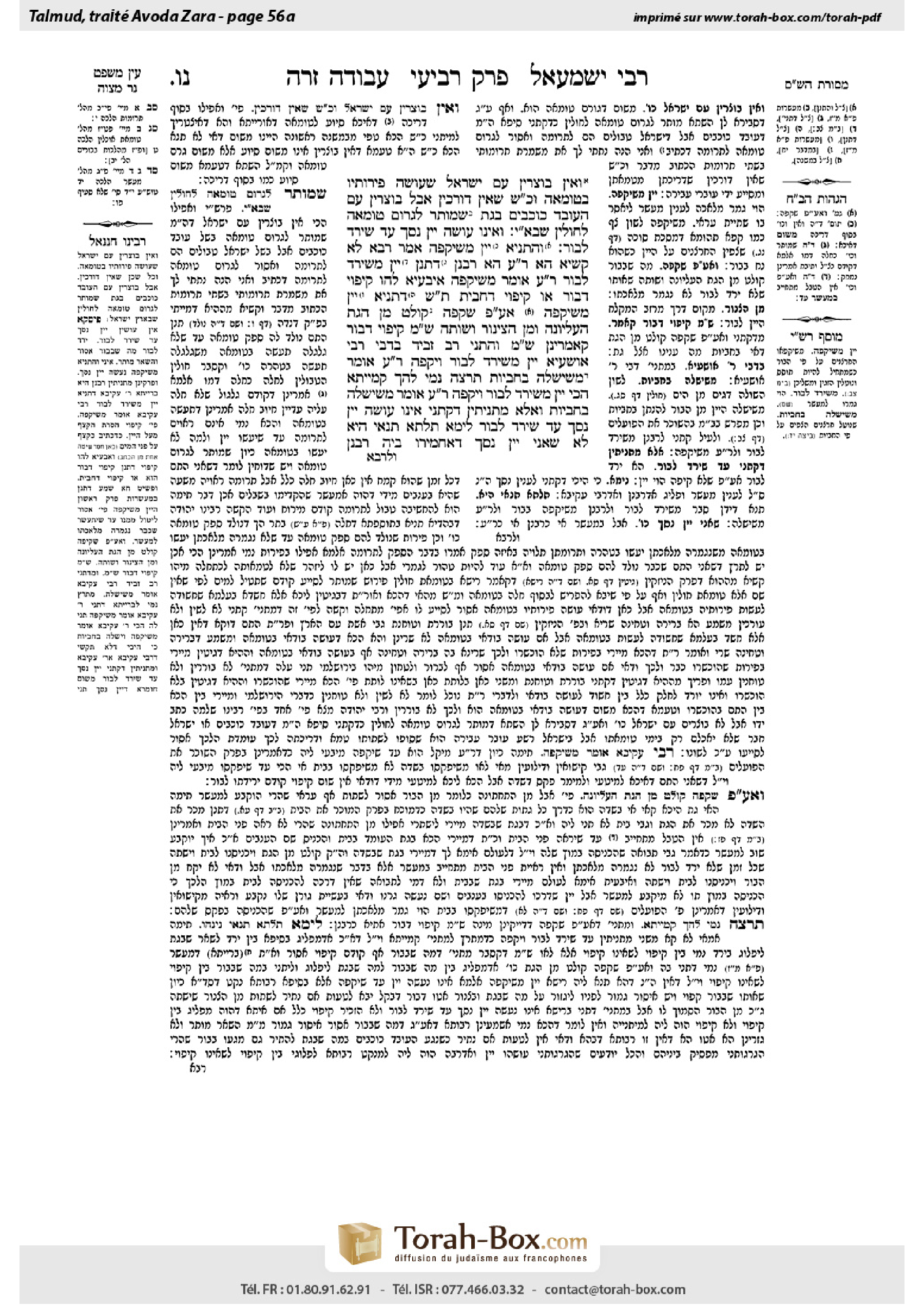
Avodah Zarah 56a: Talmud study for Daf Yomi
Study the Talmud for Daf Yomi with scanned pages, Hebrew text, English translations from Sefaria and AI-generated French translations.
Passage selection and English or AI-generated French translation are available where the scan has annotations. Daf Study is independent of Torah-Box and Sefaria.
Browse Avodah Zarah · עבודה זרה · All tractatesAvodah Zarah 56a text and translations
This page of Avodah Zarah includes the Aramaic text, an English translation and an AI-generated French translation, alongside the scan above.
עבודה זרה נ״ו א · Aramaic and Hebrew text
וְאֵין בּוֹצְרִין עִם יִשְׂרָאֵל שֶׁעוֹשֶׂה פֵּירוֹתָיו בְּטוּמְאָה, וְכׇל שֶׁכֵּן שֶׁאֵין דּוֹרְכִין, אֲבָל בּוֹצְרִין עִם הַנׇּכְרִי בַּגַּת, שֶׁמּוּתָּר לִגְרוֹם טוּמְאָה לְחוּלִּין שֶׁבְּאֶרֶץ יִשְׂרָאֵל.
וְאֵינוֹ עוֹשֶׂה יֵין נֶסֶךְ עַד שֶׁיֵּרֵד לְבוֹר. וְהָתַנְיָא: יַיִן מִשֶּׁיְּקַפֶּה!
אָמַר רָבָא: לָא קַשְׁיָא, הָא רַבִּי עֲקִיבָא, הָא רַבָּנַן, דִּתְנַן: יַיִן מִשֶּׁיֵּרֵד לַבּוֹר, רַבִּי עֲקִיבָא אוֹמֵר: מִשֶּׁיְּקַפֶּה.
אִיבַּעְיָא לְהוּ: קִיפּוּי דְּבוֹר, אוֹ קִיפּוּי דְּחָבִית?
תָּא שְׁמַע, דְּתַנְיָא: יַיִן — מִשֶּׁיְּקַפֶּה, אַף עַל פִּי שֶׁקִּפָּה, קוֹלֵט מִן הַגַּת הָעֶלְיוֹנָה וּמִן הַצִּינּוֹר וְשׁוֹתֶה. שְׁמַע מִינַּהּ קִיפּוּי דְּבוֹר קָאָמְרִינַן, שְׁמַע מִינַּהּ.
וְהָתָנֵי רַב זְבִיד בִּדְבֵי רַבִּי אוֹשַׁעְיָא: יַיִן — מִשֶּׁיֵּרֵד לַבּוֹר וִיקַפֶּה, רַבִּי עֲקִיבָא אוֹמֵר: מִשֶּׁיְּשַׁלֶּה בֶּחָבִיּוֹת! תָּרְצַהּ נָמֵי לְהָךְ קַמַּיְיתָא הָכִי: יַיִן — מִשֶּׁיֵּרֵד לַבּוֹר וִיקַפֶּה, רַבִּי עֲקִיבָא אוֹמֵר: מִשֶּׁיְּשַׁלֶּה בֶּחָבִיּוֹת.
וְאֶלָּא, מַתְנִיתִין דְּקָתָנֵי: אֵינוֹ עוֹשֶׂה יֵין נֶסֶךְ עַד שֶׁיֵּרֵד לַבּוֹר, לֵימָא תְּלָתָא תַּנָּאֵי הִיא? לָא, שָׁאנֵי יֵין נֶסֶךְ דְּאַחְמִירוּ בֵּיהּ רַבָּנַן.
Avodah Zarah 56a · English translation
And one may not harvest grapes together with a Jew who produces wine from his fruit in a state of ritual impurity, as he is thereby causing the produce to be rendered impure. And all the more so may one not tread on the grapes with him, as he is assisting the Jew who is rendering the wine impure by treading on the grapes. But one may harvest grapes into the winepress together with the gentile, as it is permitted to impart impurity to non-sacred produce that is in Eretz Yisrael.
§ The mishna teaches: And the gentile’s touch does not render the juice of the grapes into wine used for a libation until it descends into the collection vat, because until then it does not have the status of wine. The Gemara asks: But isn’t it taught in a mishna (Ma’asrot 1:7) with regard to the stage when the work of producing the wine is considered complete and one is obligated to separate tithes from the wine: With regard to wine, one is obligated to separate tithes from the time that the solid residue floats [misheyikpe] on top of the wine.
Rava said: It is not difficult. That mishna is in accordance with the opinion of Rabbi Akiva, whereas this mishna is in accordance with the opinion of the Rabbis. This is as we learned in a baraita: With regard to wine, one is obligated to separate tithes from the time that the wine descends into the collection vat. Rabbi Akiva says: One is obligated to separate tithes only from the time that the solid residue floats on top of the wine.
A dilemma was raised before the Sages: Is Rabbi Akiva referring to the floating of the seeds on top of the wine in the collection vat or to the floating of the yeast on top of the wine in the barrel?
The Gemara suggests: Come and hear a resolution of this issue, as it is taught in that mishna: With regard to wine, one is obligated to separate tithes from the time that the solid residue floats on top of the wine. Subsequently, even though the residue has floated, one may collect wine from the upper winepress and from the pipe that connects the upper winepress to the vat, and one may drink it without separating tithes. Conclude from the mishna that we are speaking about the floating of the seeds on top of the wine in the collection vat. The Gemara affirms: Conclude from it that it is so.
The Gemara asks: But didn’t Rav Zevid teach a different version of the aforementioned dispute in a baraita of the school of Rabbi Oshaya: With regard to wine, one is obligated to separate tithes from the time that the wine descends into the collection vat and the seeds float on top. Rabbi Akiva says: One is obligated to separate tithes only from the time that one siphons the wine from the vat into barrels. The Gemara replies that one can resolve the contradiction: Explain that first baraita in this manner as well: With regard to wine, one is obligated to separate tithes from the time that the wine descends into the collection vat and the seeds float on top. Rabbi Akiva says: One is obligated to separate tithes only from the time that one siphons the wine from the vat into barrels.
The Gemara asks: But whose opinion is expressed in the mishna that teaches: The gentile does not render the juice of the grapes into wine used for a libation until it descends into the collection vat? Shall we say that the stage when the work of producing the wine is considered complete is subject to a dispute between three tanna’im? The Gemara replies: No, the prohibition of wine used for a libation is different, as the Sages were stringent concerning it and render the wine forbidden even before the seeds float. By contrast, with regard to tithes, the tanna of this mishna holds in accordance with the opinion of either Rabbi Akiva or the Rabbis.
Avodah Zarah 56a · Traduction française (IA)
On ne doit pas récolter des raisins avec un Juif qui produit du vin à partir de ses fruits dans un état d'impureté rituelle, car cela rend les produits impurs. Et encore davantage, on ne doit pas fouler les raisins avec lui, car il aide le Juif qui rend le vin impur en foulant les raisins. Mais on peut récolter des raisins dans la presse à vin avec le non-Juif, car il est permis de rendre impur des produits non sacrés qui sont en Terre d'Israël.
§ La Michna enseigne : Le toucher du non-Juif ne rend pas le jus des raisins en vin utilisé pour une offrande de libation jusqu'à ce qu'il descende dans le tonneau de récolte, car jusqu'à ce moment-là, il n'a pas encore le statut de vin. La Guemara pose la question : Mais n'est-il pas enseigné dans une Michna (Ma'asrot 1:7) concernant la phase où le travail de production du vin est considéré comme achevé et où l'on est tenu de séparer les dîmes : Concernant le vin, l'on est tenu de séparer les dîmes dès que le résidu solide flotte sur le vin.
Rava dit : Ce n'est pas difficile. Cette Michna est selon l'opinion de Rabbi Akiva, tandis que celle-ci est selon l'opinion des Sages. C'est ce que nous avons appris dans une baraïta : Concernant le vin, l'on est tenu de séparer les dîmes dès que le vin descend dans le tonneau de récolte. Rabbi Akiva dit : L'on est tenu de séparer les dîmes seulement dès que le résidu solide flotte sur le vin.
Un dilemme a été soulevé devant les Sages : Rabbi Akiva fait-il référence au flottage des graines sur le vin dans le tonneau de récolte ou au flottage de la levure sur le vin dans le tonneau ?
La Guemara suggère : Venez écouter la résolution de cette question, car elle est enseignée dans cette Michna : Concernant le vin, l'on est tenu de séparer les dîmes dès que le résidu solide flotte sur le vin. Ensuite, même si le résidu a flotté, l'on peut recueillir du vin du presse-raisin supérieur et du tuyau qui relie le presse-raisin supérieur au tonneau, et l'on peut boire sans séparer les dîmes. Concluez de la Michna que nous parlons du flottage des graines sur le vin dans le tonneau de récolte. La Guemara affirme : Concluez-en qu'il en est ainsi.
La Guemara pose la question : Mais n'a-t-il pas enseigné Rav Zevid une version différente de ce débat dans une baraïta de la maison de Rabbi Oshaya : Concernant le vin, l'on est tenu de séparer les dîmes dès que le vin descend dans le tonneau de récolte et que les graines flottent sur le vin. Rabbi Akiva dit : L'on est tenu de séparer les dîmes seulement dès que l'on transfère le vin du tonneau vers les barriques. La Guemara répond que l'on peut résoudre la contradiction : Expliquez cette première baraïta de la même manière : Concernant le vin, l'on est tenu de séparer les dîmes dès que le vin descend dans le tonneau de récolte et que les graines flottent sur le vin. Rabbi Akiva dit : L'on est tenu de séparer les dîmes seulement dès que l'on transfère le vin du tonneau vers les barriques.
La Guemara pose la question : Mais quelle opinion est exprimée dans la Michna qui enseigne : Le non-Juif ne rend pas le jus des raisins en vin utilisé pour une offrande de libation jusqu'à ce qu'il descende dans le tonneau de récolte ? Devons-nous dire que la phase où le travail de production du vin est considéré comme achevé est sujette à un débat entre trois tannaïm ? La Guemara répond : Non, la prohibition du vin utilisé pour une offrande de libation est différente, car les Sages étaient stricts à son égard et rendaient le vin interdit même avant que les graines ne flottent. En revanche, concernant les dîmes, le tanna de cette Michna adopte l'opinion de Rabbi Akiva ou des Sages.
Traduction française générée par IA à partir de l’édition anglaise de Sefaria. Vérifie toujours un passage avec le texte source.
Text from Sefaria: William Davidson Edition - Vocalized Aramaic (CC BY NC); William Davidson Edition - English (CC BY NC).