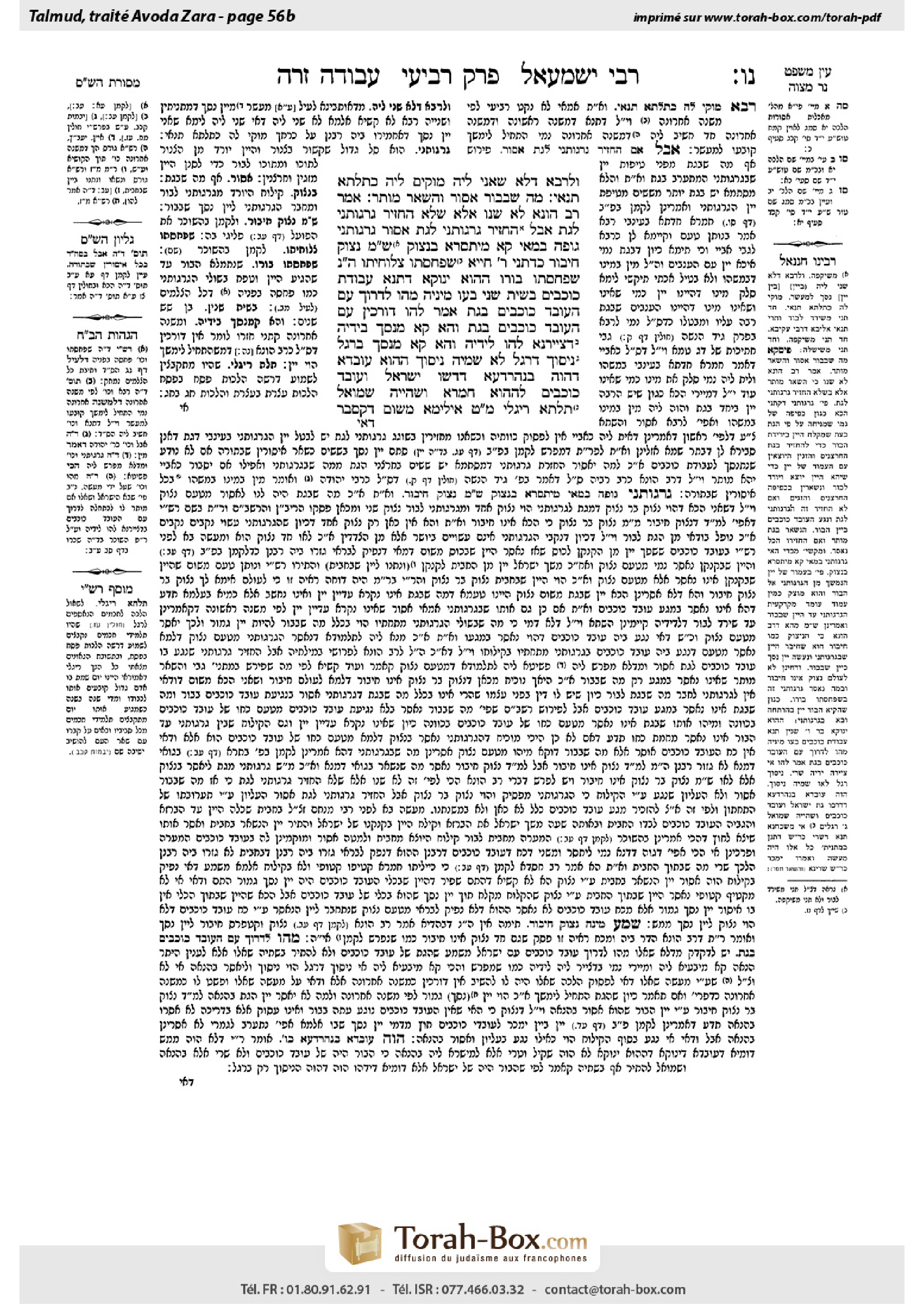
Avodah Zarah 56b: Talmud study for Daf Yomi
Study the Talmud for Daf Yomi with scanned pages, Hebrew text, English translations from Sefaria and AI-generated French translations.
Passage selection and English or AI-generated French translation are available where the scan has annotations. Daf Study is independent of Torah-Box and Sefaria.
Browse Avodah Zarah · עבודה זרה · All tractatesAvodah Zarah 56b text and translations
This page of Avodah Zarah includes the Aramaic text, an English translation and an AI-generated French translation, alongside the scan above.
עבודה זרה נ״ו ב · Aramaic and Hebrew text
וּלְרָבָא, דְּלָא שָׁאנֵי לֵיהּ, מוֹקֵים לֵיהּ כִּתְלָתָא תַּנָּאֵי.
מַה שֶּׁבַּבּוֹר אָסוּר וְהַשְּׁאָר מוּתָּר. אָמַר רַב הוּנָא: לֹא שָׁנוּ אֶלָּא שֶׁלֹּא הֶחֱזִיר גַּרְגּוּתְנִי לַגַּת, אֲבָל הֶחְזִיר גַּרְגּוּתְנִי לַגַּת — אָסוּר.
גַּרְגּוּתְנִי גּוּפַהּ, בְּמַאי קָא מִיתַּסְרָא? בְּנִצּוֹק. שְׁמַע מִינַּהּ: נִצּוֹק חִיבּוּר! כִּדְתָנֵי רַבִּי חִיָּיא: שֶׁפְּחָסַתּוּ צְלוֹחִיתוֹ. הָכָא נָמֵי: שֶׁפְּחָסַתּוּ בּוֹרוֹ.
הָהוּא יָנוֹקָא דִּתְנָא עֲבוֹדָה זָרָה בְּשֵׁית שְׁנֵי, בְּעוֹ מִינֵּיהּ: מַהוּ לִדְרוֹךְ עִם הַנׇּכְרִי בַּגַּת? אֲמַר לְהוּ: דּוֹרְכִין עִם הַנׇּכְרִי בַּגַּת. וְהָא קָא מְנַסֵּךְ בִּידֵיהּ? דְּצָיַירְנָא לְהוּ לִידֵיהּ. וְהָא קָא מְנַסֵּךְ בְּרֶגֶל? נִיסּוּךְ דְּרֶגֶל לָא שְׁמֵיהּ נִיסּוּךְ.
הָהוּא עוֹבָדָא דַּהֲוָה בִּנְהַרְדְּעָא, דְּדָשׁוּ יִשְׂרָאֵל וְגוֹי לְהָהוּא חַמְרָא, וְשַׁהֲיֵיהּ שְׁמוּאֵל תְּלָתָא רִיגְלֵי. מַאי טַעְמָא? אִילֵּימָא מִשּׁוּם דְּקָסָבַר:
Avodah Zarah 56b · English translation
The Gemara comments: And according to Rava, who explains that the mishna with regard to wine used for libations is in accordance with one opinion whereas the mishna with regard to tithes is in accordance with another opinion, and he does not hold that the case of wine used for a libation is different, he interprets it as a dispute between three tanna’im.
§ The mishna teaches: Once the wine descends into the collection vat, that which is in the collection vat is prohibited, and the rest, which did not yet descend into the collection vat, is permitted. Rav Huna says: The mishna taught that the rest of the wine is permitted only in a case where he did not return the wicker basket [gargutni], which is used to strain the wine on the way to the vat, to the winepress. But if he returned the wicker basket to the winepress, even the wine remaining in the winepress is prohibited, as the wine in the basket renders the wine in the winepress forbidden.
The Gemara asks: With regard to the wine in the wicker basket itself, in what manner is it rendered forbidden? Apparently, it is rendered forbidden by the stream of liquid that flows from the basket into the vat below, thereby connecting the wine in the basket to the forbidden wine in the vat. If so, conclude from Rav Huna’s statement that an uninterrupted stream of liquid is considered a connection. The Gemara rejects the inference: The reason for Rav Huna’s statement could be different, as Rabbi Ḥiyya teaches that if one fills a gentile’s flask through a funnel, the wine in the funnel is rendered forbidden in a case where the level of the wine in his flask rose and reached the funnel. Here too, Rav Huna is referring to a case where the level of the wine in his collection vat rose and reached the basket.
§ The Gemara relates: There was a certain outstanding child who learned the tractate of Avoda Zara when he was six years old. People raised a dilemma to him: What is the halakha? Is it permitted to tread on grapes in the winepress together with the gentile? The child said to them: One may tread on grapes in the winepress together with the gentile, in accordance with the ruling of the mishna. They asked the child: But doesn’t the gentile render the wine a libation by touching it with his hands, rendering it forbidden? If so, how may a Jew derive benefit from the wine by receiving payment for his work? The child replied: It is permitted in a case where we tie his hands so that he cannot pour the wine as a libation. The child was then asked: But doesn’t the gentile render the wine a libation by touching it with his foot? The child replied: Rendering wine a libation by touching it with one’s foot is not considered rendering it a libation.
The Gemara relates: There was a certain incident in Neharde’a in which a Jew and a gentile trod on grapes and produced a certain wine together, and Shmuel delayed ruling on the matter for three Festivals, as the Sages gathered during the Festivals and presented Shmuel with the opportunity to clarify the matter with them. The Gemara asks: What is the reason that Shmuel delayed his ruling? If we say that Shmuel delayed ruling on the matter because he thought to himself:
Avodah Zarah 56b · Traduction française (IA)
La Guemara commente : Et selon Rava, qui explique que la mitsva concernant le vin utilisé pour les libations est selon un avis, tandis que la mitsva concernant les dîmes est selon un autre avis, et il ne considère pas que le cas du vin utilisé pour une libation soit différent, il l'interprète comme un débat entre trois tannaïm.
§ La mitsva enseigne : Dès que le vin descend dans le tonneau de collecte, ce qui est dans le tonneau est interdit, et le reste, celui qui n'a pas encore descendu dans le tonneau, est permis. Rav Huna dit : La mitsva enseigne que le reste du vin est permis uniquement dans le cas où l'on n'a pas remis le panier en osier [gargutni], utilisé pour filtrer le vin en route vers le tonneau, au pressoir. Mais si l'on a remis le panier en osier au pressoir, même le vin restant dans le pressoir est interdit, car le vin dans le panier rend le vin dans le pressoir interdit.
La Guemara pose la question : En ce qui concerne le vin dans le panier en osier lui-même, dans quel sens est-il rendu interdit ? Apparemment, il est rendu interdit par le courant de liquide qui s'écoule du panier vers le tonneau en dessous, connectant ainsi le vin dans le panier au vin interdit dans le tonneau. Si c'est ainsi, concluez de la déclaration de Rav Huna que l'écoulement continu de liquide est considéré comme une connexion. La Guemara rejette cette déduction : La raison de la déclaration de Rav Huna pourrait être différente, car Rabbi Ḥiyya enseigne que si l'on remplit une outre païenne à l'aide d'un tuyau, le vin dans le tuyau est rendu interdit dans le cas où le niveau du vin dans son outre monte et atteint le tuyau. Ici aussi, Rav Huna fait référence à un cas où le niveau du vin dans son tonneau de collecte monte et atteint le panier.
§ La Guemara rapporte : Il y avait un certain enfant exceptionnel qui apprenait le traité d'Avoda Zara à l'âge de six ans. Les gens posèrent une difficulté à lui : Quelle est la halakha ? Est-il permis de tasser des raisins dans le pressoir avec le païen ? L'enfant dit à ceux-ci : On peut tasser des raisins dans le pressoir avec le païen, conformément à la décision de la mitsna. Ils demandèrent à l'enfant : Mais ne rend pas le païen le vin une libation en le touchant avec ses mains, le rendant ainsi interdit ? Si c'est le cas, comment un Juif peut-il tirer un bénéfice du vin en recevant une rémunération pour son travail ? L'enfant répondit : C'est permis dans le cas où l'on attache ses mains de sorte qu'il ne puisse pas verser le vin comme une libation. L'enfant fut ensuite interrogé : Mais ne rend pas le païen le vin une libation en le touchant avec son pied ? L'enfant répondit : Rendre le vin une libation en le touchant avec son pied n'est pas considéré comme rendre le vin une libation.
La Guemara rapporte : Il y avait un certain incident à Neharde’a, où un Juif et un païen tassèrent des raisins et produisirent un certain vin ensemble, et Shmuel reporta sa décision pendant trois fêtes, car les Sages se réunirent pendant les fêtes et offrirent à Shmuel l'occasion de clarifier la question avec eux. La Guemara pose la question : Quelle est la raison pour laquelle Shmuel reporta sa décision ? Si l'on dit que Shmuel reporta sa décision parce qu'il se disait :
Traduction française générée par IA à partir de l’édition anglaise de Sefaria. Vérifie toujours un passage avec le texte source.
Text from Sefaria: William Davidson Edition - Vocalized Aramaic (CC BY NC); William Davidson Edition - English (CC BY NC).