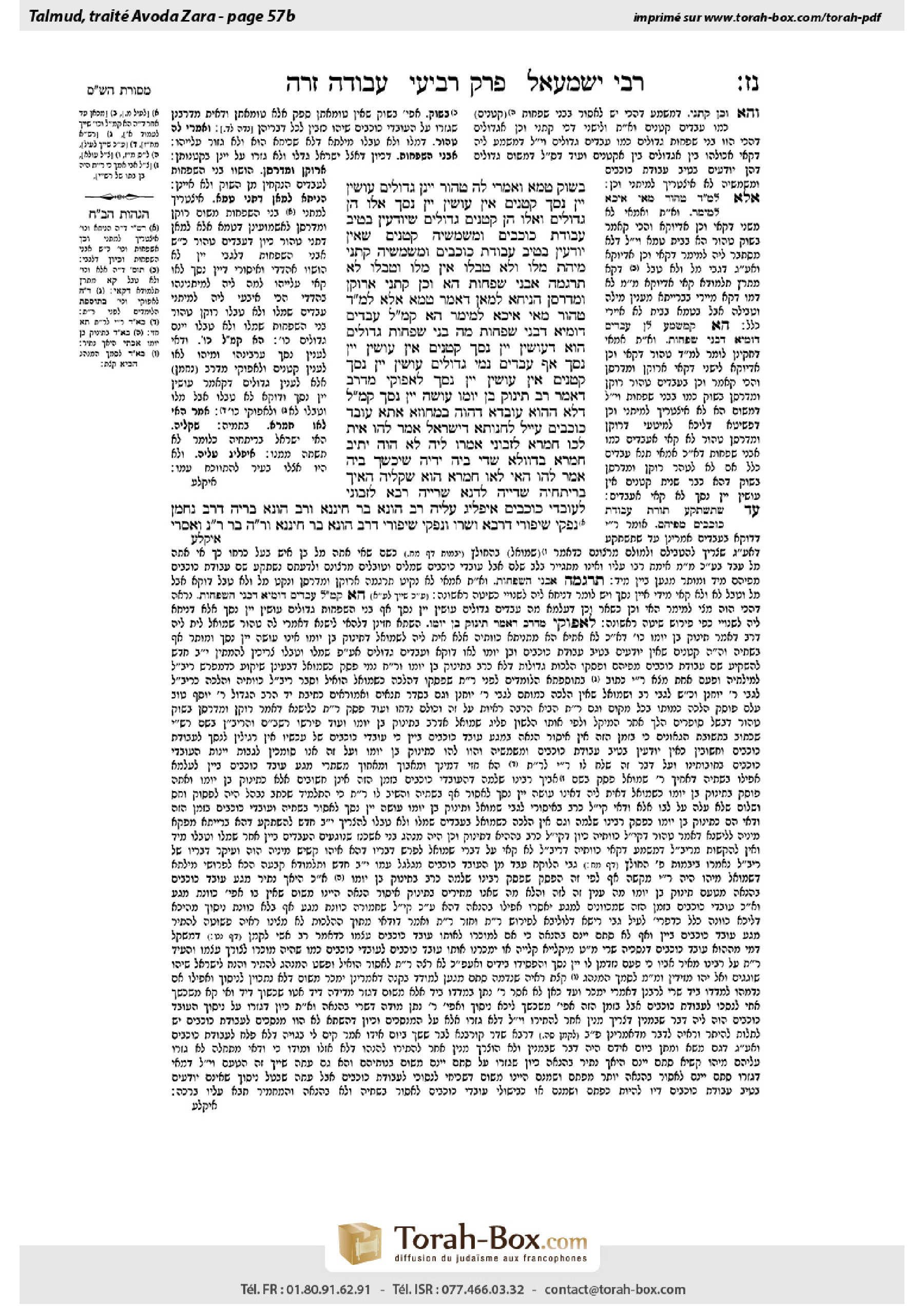
Avodah Zarah 57b: Talmud study for Daf Yomi
Study the Talmud for Daf Yomi with scanned pages, Hebrew text, English translations from Sefaria and AI-generated French translations.
Passage selection and English or AI-generated French translation are available where the scan has annotations. Daf Study is independent of Torah-Box and Sefaria.
Browse Avodah Zarah · עבודה זרה · All tractatesAvodah Zarah 57b text and translations
This page of Avodah Zarah includes the Aramaic text, an English translation and an AI-generated French translation, alongside the scan above.
עבודה זרה נ״ז ב · Aramaic and Hebrew text
בַּשּׁוּק טָמֵא, וְאָמְרִי לַהּ: טָהוֹר. יֵינָן — גְּדוֹלִים עוֹשִׂין יֵין נֶסֶךְ, קְטַנִּים אֵין עוֹשִׂין יֵין נֶסֶךְ. אֵלּוּ הֵן גְּדוֹלִים וְאֵלּוּ הֵן קְטַנִּים? גְּדוֹלִים — שֶׁיּוֹדְעִין בְּטִיב עֲבוֹדָה זָרָה וּמְשַׁמְּשֶׁיהָ, קְטַנִּים — שֶׁאֵין יוֹדְעִין בְּטִיב עֲבוֹדָה זָרָה וּמְשַׁמְּשֶׁיהָ.
קָתָנֵי מִיהַת: מָלוּ וְלֹא טָבְלוּ — אִין, מָלוּ וְטָבְלוּ — לָא! תַּרְגְּמַהּ אַבְּנֵי שְׁפָחוֹת.
הָא ״וְכֵן״ קָתָנֵי! אַרוּקָּן וּמִדְרָסָן.
הָנִיחָא לְמַאן דְּאָמַר טָמֵא, אֶלָּא לְמַאן דְּאָמַר טָהוֹר, מַאי אִיכָּא לְמֵימַר?
הָא קָא מַשְׁמַע לַן: עֲבָדִים דֻּומְיָא דִּבְנֵי שְׁפָחוֹת, מָה בְּנֵי שְׁפָחוֹת — גְּדוֹלִים הוּא דְּעוֹשִׂין יֵין נֶסֶךְ, קְטַנִּים אֵין עוֹשִׂין יֵין נֶסֶךְ, אַף עֲבָדִים נָמֵי — גְּדוֹלִים עוֹשִׂין יֵין נֶסֶךְ, קְטַנִּים אֵין עוֹשִׂין יֵין נֶסֶךְ.
לְאַפּוֹקֵי מִדְּרַב, דְּאָמַר רַב: תִּינוֹק בֶּן יוֹמוֹ עוֹשֶׂה יֵין נֶסֶךְ, קָא מַשְׁמַע לַן דְּלָא.
הָהוּא עוֹבָדָא דַּהֲוָה בְּמָחוֹזָא, אֲתָא גּוֹי עָייל לְחָנוּתָא דְּיִשְׂרָאֵל, אֲמַר לְהוּ: אִית לְכוּ חַמְרָא לְזַבּוֹנֵי? אֲמַרוּ לֵיהּ: לָא. הֲוָה יָתֵיב חַמְרָא בְּדַוְולָא, שְׁדָא בֵּיהּ יְדֵיהּ שַׁיכְשֵׁךְ בֵּיהּ, אֲמַר לְהוּ: הַאי לָאו חַמְרָא הוּא? שַׁקְלֵיהּ הַאיְךְ בְּרִיתְחֵיהּ שַׁדְיֵיהּ לְדַנָּא.
שַׁרְיֵיהּ רָבָא לְזַבּוֹנֵי לְגוֹיִם, אִיפְּלִיג עֲלֵיהּ רַב הוּנָא בַּר חִינָּנָא וְרַב הוּנָא בְּרֵיהּ דְּרַב נַחְמָן. נָפְקִי שִׁיפּוּרֵי דְּרָבָא וְשָׁרוּ, וְנָפְקִי שִׁיפּוּרֵי דְּרַב הוּנָא בַּר חִינָּנָא וְרַב הוּנָא בַּר רַב נַחְמָן וְאָסְרִי.
Avodah Zarah 57b · English translation
even if they are found in the marketplace, are ritually impure. But some say that they are ritually pure. With regard to their wine, the adults render the wine that they touch wine used for a libation, but the minors do not render the wine that they touch wine used for a libation. Which slaves are considered adults, and which slaves are considered minors? The adults are those who know the nature of idol worship and its accessories, and the minors are those who do not know the nature of idol worship and its accessories.
In any event, the baraita teaches that with regard to those slaves who were circumcised but did not immerse, yes, the wine they touch is prohibited, but with regard to those who were circumcised and immersed, no, the wine they touch is not prohibited, even if they have not yet forgotten their idolatrous worship. The Gemara replies: Interpret this halakha as referring only to the sons of maidservants who were raised in a Jewish home and never engaged in idolatrous worship, but not to slaves who were acquired from gentiles.
The Gemara asks: Doesn’t the baraita teach that the halakha applies to slaves purchased from gentiles and also to the sons of gentile maidservants, indicating that there is no differentiation between them? The Gemara replies: The baraita equates the two cases only with regard to the impurity of their spittle and of the objects upon which they tread.
The Gemara asks: This works out well according to the one who says that their spittle and the objects upon which they tread are impure. But according to the one who says that they are pure, what can be said? If the spittle of the slaves and the objects upon which they tread are pure, clearly the same halakha applies in the case of the sons of maidservants, and it is unnecessary to state this. One may therefore conclude that the baraita equated the two cases with regard to the status of the wine that they touch.
The Gemara answers: Even if the baraita equates the slaves and the sons of maidservants with regard to the status of their wine, it does not intend to compare their status once they have immersed. Rather, this teaches us that the halakha with regard to slaves is similar to the halakha with regard to the sons of maidservants. Just as in the case of the sons of maidservants, it is only the adults who render the wine that they touch wine used for a libation, but minors do not render the wine they touch wine used for a libation, so too in the case of slaves, the adults render the wine that they touch wine used for a libation, but minors do not render the wine they touch wine used for a libation.
This halakha is to the exclusion of that which Rav says, as Rav says: If a gentile baby who is one day old touches wine, he renders it wine used for a libation. The baraita teaches us that this is not the case.
§ The Gemara relates: There was a certain incident in Meḥoza in which a gentile came and entered the store of a Jew. The gentile said to the owners: Do you have any wine to sell? They said to him: No. There was wine sitting in a bucket. The gentile put his hand in it and stirred the wine around. The gentile said to them: This, is it not wine? The other person, i.e., the storeowner, took the bucket and, in his anger, threw its contents into a barrel of wine.
This incident raised a dilemma with regard to the status of the wine in the barrel. Rava permitted the owner to sell the wine to gentiles, as he held that it is permitted to derive benefit from the wine. Rav Huna bar Ḥinnana and Rav Huna, son of Rav Naḥman, disagreed with him. Blasts of shofarot went out from the court of Rava promulgating his ruling, and they permitted the sale. And blasts of shofarot went out from the court of Rav Huna bar Ḥinnana and Rav Huna, son of Rav Naḥman, promulgating their ruling, and they prohibited the sale.
Avodah Zarah 57b · Traduction française (IA)
même s'ils sont trouvés au marché, ils sont impurs rituellement. Mais certains disent qu'ils sont purs rituellement. En ce qui concerne leur vin, les adultes rendent le vin qu'ils touchent utilisé pour une libation, mais les mineurs ne rendent pas le vin qu'ils touchent utilisé pour une libation. Quels esclaves sont considérés comme des adultes et quels esclaves sont considérés comme des mineurs ? Les adultes sont ceux qui connaissent la nature du culte idolâtre et de ses accessoires, et les mineurs sont ceux qui ne connaissent pas la nature du culte idolâtre et de ses accessoires.
En tout cas, la baraïta enseigne que concernant les esclaves qui ont été circoncis mais n'ont pas été purifiés, oui, le vin qu'ils touchent est interdit, mais concernant ceux qui ont été circoncis et purifiés, non, le vin qu'ils touchent n'est pas interdit, même s'ils n'ont pas encore oublié leur culte idolâtre. La Guemara répond : Interprète cette halakha comme se référant uniquement aux fils des servantes qui ont été élevés dans une maison juive et n'ont jamais pratiqué le culte idolâtre, mais pas aux esclaves achetés chez les non-Juifs.
La Guemara pose la question : N'est-ce pas ce que la baraïta enseigne que la halakha s'applique aux esclaves achetés chez les non-Juifs ainsi qu'aux fils des servantes non-Juives, indiquant qu'il n'y a pas de différence entre eux ? La Guemara répond : La baraïta équilibre les deux cas uniquement concernant l'impureté de leur salive et des objets sur lesquels ils marchent.
La Guemara pose la question : Cela s'aligne bien selon celui qui dit que leur salive et les objets sur lesquels ils marchent sont impurs. Mais selon celui qui dit qu'ils sont purs, que peut-on dire ? Si la salive des esclaves et les objets sur lesquels ils marchent sont purs, clairement la même halakha s'applique dans le cas des fils des servantes, et il n'est pas nécessaire d'en parler. On peut donc conclure que la baraïta établit l'équivalence des deux cas concernant le statut du vin qu'ils touchent.
La Guemara répond : Même si la baraïta établit l'équivalence des esclaves et des fils des servantes concernant le statut de leur vin, elle ne vise pas à les comparer une fois qu'ils ont été purifiés. Plutôt, cela nous enseigne que la halakha concernant les esclaves est similaire à la halakha concernant les fils des servantes. Tout comme dans le cas des fils des servantes, c'est uniquement les adultes qui rendent le vin qu'ils touchent utilisé pour une libation, mais les mineurs ne rendent pas le vin qu'ils touchent utilisé pour une libation, de même dans le cas des esclaves, les adultes rendent le vin qu'ils touchent utilisé pour une libation, mais les mineurs ne rendent pas le vin qu'ils touchent utilisé pour une libation.
Cette halakha exclut ce que dit Rav, car Rav dit : Si un bébé gentil d'un jour d'âge touche du vin, il rend ce vin utilisé pour une libation. La baraïta nous enseigne que cela n'est pas le cas.
§ La Guemara relate : Il y avait un certain incident à Měḥoza où un non-Juif entra dans la boutique d'un Juif. Le non-Juif demanda aux propriétaires : Avez-vous du vin à vendre ? Ils lui répondirent : Non. Il y avait du vin dans un seau. Le non-Juif mit sa main dedans et remua le vin. Le non-Juif demanda à ceux-ci : Ce n'est-ce pas du vin ? L'autre personne, c'est-à-dire le propriétaire, prit le seau et, en colère, versa son contenu dans un tonneau de vin.
Cet incident souleva un dilemme concernant le statut du vin dans le tonneau. Rava permit au propriétaire de vendre le vin aux non-Juifs, car il considérait qu'il était permis d'en tirer un bénéfice. Rav Huna bar Ḥinnana et Rav Huna, fils de Rav Naḥman, étaient d'avis contraire. Des sons de trompettes furent émis de la cour de Rava pour promulguer sa décision, et ils permirent la vente. Des sons de trompettes furent émis de la cour de Rav Huna bar Ḥinnana et Rav Huna, fils de Rav Naḥman, pour promulguer leur décision, et ils interdirent la vente.
Traduction française générée par IA à partir de l’édition anglaise de Sefaria. Vérifie toujours un passage avec le texte source.
Text from Sefaria: William Davidson Edition - Vocalized Aramaic (CC BY NC); William Davidson Edition - English (CC BY NC).