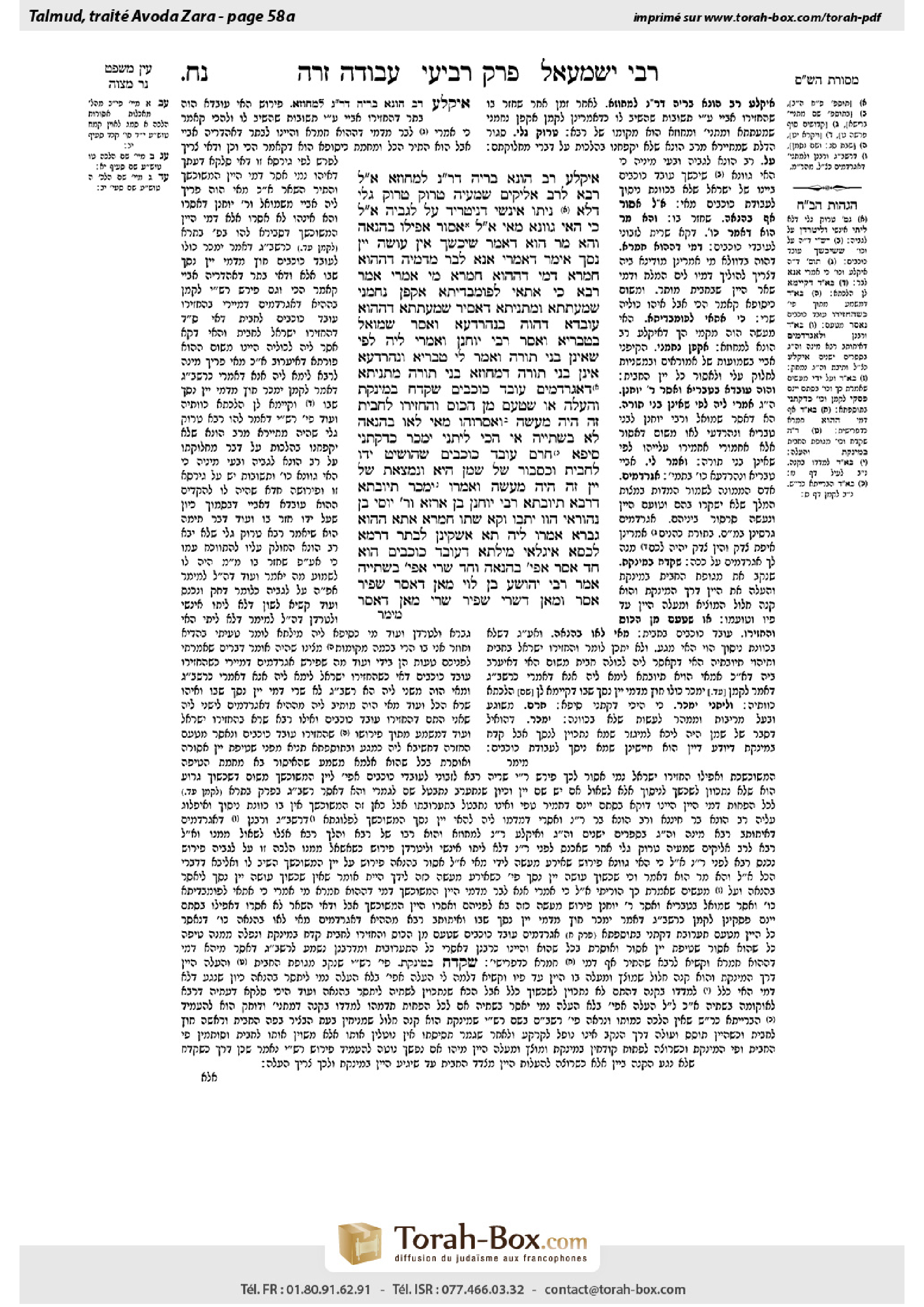
Avodah Zarah 58a: Talmud study for Daf Yomi
Study the Talmud for Daf Yomi with scanned pages, Hebrew text, English translations from Sefaria and AI-generated French translations.
Passage selection and English or AI-generated French translation are available where the scan has annotations. Daf Study is independent of Torah-Box and Sefaria.
Browse Avodah Zarah · עבודה זרה · All tractatesAvodah Zarah 58a text and translations
This page of Avodah Zarah includes the Aramaic text, an English translation and an AI-generated French translation, alongside the scan above.
עבודה זרה נ״ח א · Aramaic and Hebrew text
אִיקְּלַע רַב הוּנָא בְּרֵיהּ דְּרַב נַחְמָן לְמָחוֹזָא, אֲמַר לֵיהּ רָבָא לְרַב אֶלְיָקִים שַׁמָּעֵיהּ: טְרוֹק גַּלֵּי, דְּלָא נֵיתוֹ אִינָשֵׁי דְּנִיטְרֹיד.
עָל לְגַבֵּיהּ, אֲמַר לֵיהּ: כִּי הַאי גַּוְונָא מַאי? אֲמַר לֵיהּ: אָסוּר אֲפִילּוּ בַּהֲנָאָה. וְהָא מָר הוּא דְּאָמַר: שִׁיכְשֵׁךְ אֵין עוֹשֶׂה יֵין נֶסֶךְ! אֵימַר דַּאֲמַרִי אֲנָא – לְבַר מִדְּמֵיהּ דְּהָהוּא חַמְרָא, דְּמֵי דְּהָהוּא חַמְרָא מִי אֲמַרִי?
אָמַר רָבָא: כִּי אֲתַאי לְפוּמְבְּדִיתָא, אַקְּפַן נַחְמָנִי שְׁמַעְתָּתָא וּמַתְנְיָתָא דַּאֲסִיר.
שְׁמַעְתָּתָא: דְּהָהוּא עוֹבָדָא דַּהֲוָה בִּנְהַרְדְּעָא, וַאֲסַר שְׁמוּאֵל, בִּטְבֶרְיָא וַאֲסַר רַבִּי יוֹחָנָן, וַאֲמַרִי לֵיהּ: לְפִי שֶׁאֵינָן בְּנֵי תוֹרָה, וַאֲמַר לִי: טְבֶרְיָא וּנְהַרְדְּעָא אֵינָן בְּנֵי תוֹרָה, דְּמָחוֹזָא בְּנֵי תוֹרָה?!
מַתְנְיָתָא: דַּאֲגַרְדְּמִים גּוֹי שֶׁקָּדַח בְּמֵינֶקֶת וְהֶעֱלָה, אוֹ שֶׁטָּעַם מִן הַכּוֹס וְהֶחְזִירוֹ לְחָבִית — זֶה הָיָה מַעֲשֶׂה וַאֲסָרוּהוּ. מַאי לָאו בַּהֲנָאָה? לֹא, בִּשְׁתִיָּיה.
אִי הָכִי, לִיתְנֵי ״יִמָּכֵר״, כִּדְקָתָנֵי סֵיפָא: חָרָם גּוֹי שֶׁהוֹשִׁיט יָדוֹ לֶחָבִית, וּכְסָבוּר שֶׁל שֶׁמֶן הִיא וְנִמְצֵאת שֶׁל יַיִן — זֶה הָיָה מַעֲשֶׂה, וְאָמְרוּ: ״יִמָּכֵר״. תְּיוּבְתָּא דְרָבָא, תְּיוּבְתָּא.
רַבִּי יוֹחָנָן בֶּן אַרְזָא וְרַבִּי יוֹסֵי בֶּן נְהוֹרַאי הֲווֹ יָתְבִי וְקָא שָׁתוּ חַמְרָא, אֲתָא הָהוּא גַּבְרָא, אֲמַרוּ לֵיהּ: תָּא אַשְׁקֵינַן. לְבָתַר דִּרְמָא לְכָסָא אִיגַּלַּאי מִילְּתָא דְּגוֹי הוּא. חַד אָסַר אֲפִילּוּ בַּהֲנָאָה, וְחַד שָׁרֵי אֲפִילּוּ בִּשְׁתִיָּיה. אָמַר רַבִּי יְהוֹשֻׁעַ בֶּן לֵוִי: מַאן דְּאָסַר שַׁפִּיר אָסַר, וּמַאן דְּשָׁרֵי שַׁפִּיר שָׁרֵי. מַאן דְּאָסַר,
Avodah Zarah 58a · English translation
Rav Huna, son of Rav Naḥman, happened to come to Meḥoza. Rava said to his attendant, Rav Elyakim: Close, close the gates, so that people who might disturb us should not come, and we may focus on clarifying the matter.
Rav Huna, son of Rav Naḥman, entered into Rava’s presence. Rav Huna, son of Rav Naḥman, said to Rava: What is the halakha in a case like this where a gentile stirred the wine without intending to offer it as an idolatrous libation? Rava said to Rav Huna, son of Rav Naḥman: It is prohibited even to derive benefit from it. Rav Huna, son of Rav Naḥman, asked him: But wasn’t it you, Master, who said: If a gentile stirs the wine, he does not thereby render it wine used for a libation, as Rava permitted the sale of the wine in the barrel to gentiles? Rava answered: Say that I said that it is permitted to sell the wine that was in the barrel and benefit from all the proceeds except for the monetary value of that prohibited wine that was poured into the barrel of wine. Did I say that it is permitted to derive benefit from the monetary value of that prohibited wine?
Rava said: When I arrived at Pumbedita, Naḥmani, i.e., Abaye, surrounded us with amoraic traditions and with tannaitic sources cited in a baraita that indicate that in the case of wine that was stirred by a gentile it is prohibited even to derive benefit from the wine.
Rava explains: Abaye cited amoraic traditions, as there was a certain incident in Neharde’a in which a gentile stirred the wine, and Shmuel deemed the wine prohibited, and there was a similar incident in Tiberias and Rabbi Yoḥanan deemed the wine prohibited. Rava recounts his reply: And I said to Abaye: Shmuel and Rabbi Yoḥanan deemed the wine prohibited only because the people in those towns were not people well-versed in Torah, and it was necessary to distance them from transgression. And Abaye said to me: Are you saying that the people of Tiberias and Neharde’a are not people well-versed in Torah whereas the people of Meḥoza are people well-versed in Torah? This is obviously not the case, and therefore you should not have permitted the sale of the wine in Meḥoza, even according to your reasoning.
Abaye cited a baraita that teaches as follows: In the case of a gentile market inspector [de’agardamim] who was in charge of measures and prices in the marketplace, who drilled a hole in a barrel with a tube and drew wine from the barrel through the tube in order to taste it, or who tasted the wine from the cup that was poured for him and then returned the residue to the barrel, what is the halakha? This was an incident that occurred, and the Sages prohibited the wine. Abaye said: What does this mean? Is the baraita not prohibiting one from deriving benefit from the wine? Rava replied: No, it is prohibiting one only from drinking it.
Abaye said: If so, let the baraita teach that the wine may be sold, as the latter clause of the baraita teaches: In the case of a gentile confiscator who extended his hand into a barrel of wine, thinking it was a barrel of oil, and it was found to be a barrel of wine, what is the halakha? This was an incident that occurred, and the Sages said: It may be sold, as the gentile had no intention of touching wine. The Gemara concludes: The refutation of the opinion of Rava is indeed a conclusive refutation.
§ The Gemara relates: Rabbi Yoḥanan ben Arza and Rabbi Yosei ben Nehorai were sitting and drinking wine. A certain man came and they said to him: Come, serve us drinks. After he poured the wine into the cup, it was revealed that the person was a gentile. One of those Sages prohibited one from even deriving benefit from the wine, and one of them permitted the wine even for drinking. Rabbi Yehoshua ben Levi said: The one who prohibited the wine properly deemed it prohibited, and the one who permitted it properly deemed it permitted, as both opinions are viable. The one who prohibited the wine holds that
Avodah Zarah 58a · Traduction française (IA)
Rav Huna, fils de Rav Naḥman, arriva à Meḥoza. Rava dit à son serviteur, Rav Elyakim : Ferme, ferme les portes, afin que les gens qui pourraient nous déranger ne viennent pas, et nous puissions nous concentrer sur l'éclaircissement de la question.
Rav Huna, fils de Rav Naḥman, entra en présence de Rava. Rav Huna, fils de Rav Naḥman, dit à Rava : Quel est le halakha dans le cas où un non-Juif agite le vin sans l'intention de le présenter en libation idolâtre ? Rava dit à Rav Huna, fils de Rav Naḥman : Il est interdit même d'en tirer un bénéfice. Rav Huna, fils de Rav Naḥman, demanda : Mais n'étais-tu pas toi-même, Maître, qui disais : Si un non-Juif agite le vin, il ne rend pas le vin utilisé en libation, comme Rava permit la vente du vin dans le tonneau aux non-Juifs ? Rava répondit : Dis que j'ai dit que la vente du vin contenu dans le tonneau est permise et qu'on peut tirer un bénéfice de tous les produits sauf de la valeur monétaire du vin interdit versé dans le tonneau de vin. Ai-je dit que l'on peut tirer un bénéfice de la valeur monétaire de ce vin interdit ?
Rava dit : Lorsque je suis arrivé à Pumbedita, Naḥmani, c'est-à-dire Abaye, nous a entourés de traditions des amoraïm et de sources tannaitiques citées dans une baraïta qui indiquent que dans le cas où un non-Juif agite le vin, il est interdit même d'en tirer un bénéfice.
Rava explique : Abaye a cité des traditions des amoraïm, car il y avait un certain incident à Neharde’a où un non-Juif agitait le vin, et Shmuel considérait le vin comme interdit, et il y avait un incident similaire à Tiberias et Rabbi Yoḥanan considérait le vin comme interdit. Rava raconte sa réponse : Et j'ai dit à Abaye : Shmuel et Rabbi Yoḥanan considéraient le vin comme interdit uniquement parce que les gens de ces villes n'étaient pas des gens bien-accoutumés à la Torah, et il était nécessaire de les éloigner de la transgression. Et Abaye m'a dit : Est-ce que tu dis que les gens de Tiberias et de Neharde’a ne sont pas des gens bien-accoutumés à la Torah alors que ceux de Meḥoza sont des gens bien-accoutumés à la Torah ? Cela n'est pas du tout le cas, et donc tu ne devrais pas avoir permis la vente du vin à Meḥoza, même selon ton raisonnement.
Abaye cita une baraïta qui enseigne ainsi : Dans le cas d'un inspecteur de marché non-Juif [de’agardamim] qui était en charge des mesures et des prix dans le marché, qui perça un trou dans un tonneau avec un tube et tira du vin du tonneau par le tube afin de le goûter, ou qui goûta le vin dans la coupe que l'on lui avait versée et puis renvoya le résidu dans le tonneau, quelle est la halakha ? C'était un incident qui s'était produit, et les Sages interdirent le vin. Abaye dit : Qu'est-ce que cela signifie ? La baraïta ne prohibe-t-elle pas de tirer un bénéfice du vin ? Rava répondit : Non, elle prohibe uniquement de boire le vin.
Abaye dit : Si c'est ainsi, que la baraïta enseigne que le vin peut être vendu, car la dernière partie de la baraïta enseigne : Dans le cas d'un confisquateur non juif qui tendit la main dans un tonneau de vin, pensant qu'il s'agissait d'un tonneau d'huile, et qu'on découvrit qu'il s'agissait d'un tonneau de vin, quelle est la halakha ? C'était un incident qui s'était produit, et les Sages dirent : Il peut être vendu, car le non juif n'avait pas l'intention de toucher du vin. La Guemara conclut : La réfutation de l'opinion de Rava est effectivement une réfutation concluante.
§ La Guemara rapporte : Rabbi Yoḥanan ben Arza et Rabbi Yosei ben Nehorai étaient assis et buvaient du vin. Un certain homme entra et ils dirent à lui : Viens, sers-nous à boire. Après qu'il eut versé le vin dans la coupe, il apparut que la personne était un non juif. L'un des Sages interdit même de tirer un bénéfice du vin, et l'autre permit le vin même pour boire. Rabbi Yehoshua ben Levi dit : Celui qui interdit le vin a correctement estimé qu'il était interdit, et celui qui permit le vin a correctement estimé qu'il était permis, car les deux opinions sont viables. Celui qui interdit le vin tient que
Traduction française générée par IA à partir de l’édition anglaise de Sefaria. Vérifie toujours un passage avec le texte source.
Text from Sefaria: William Davidson Edition - Vocalized Aramaic (CC BY NC); William Davidson Edition - English (CC BY NC).