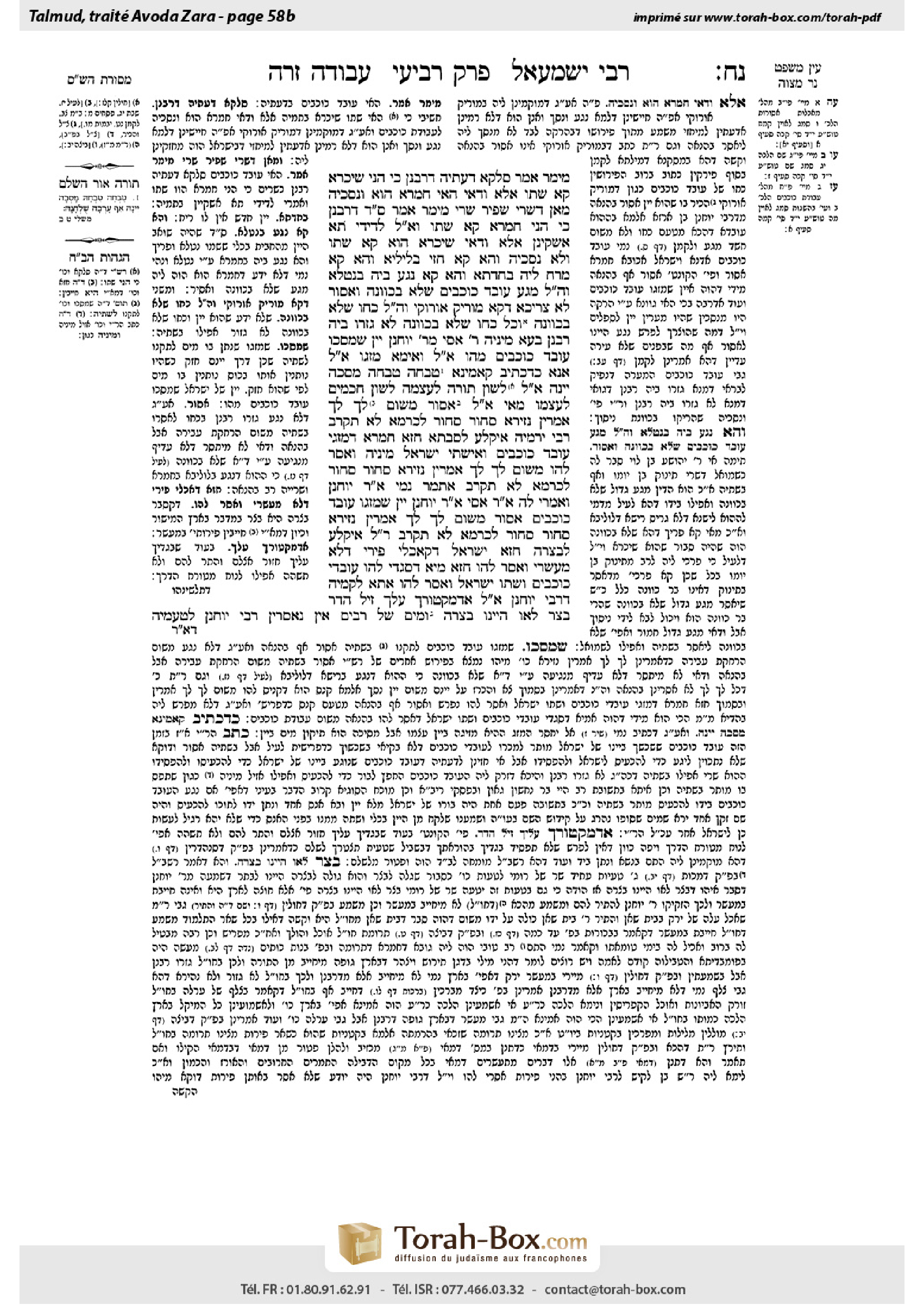
Avodah Zarah 58b: Talmud study for Daf Yomi
Study the Talmud for Daf Yomi with scanned pages, Hebrew text, English translations from Sefaria and AI-generated French translations.
Passage selection and English or AI-generated French translation are available where the scan has annotations. Daf Study is independent of Torah-Box and Sefaria.
Browse Avodah Zarah · עבודה זרה · All tractatesAvodah Zarah 58b text and translations
This page of Avodah Zarah includes the Aramaic text, an English translation and an AI-generated French translation, alongside the scan above.
עבודה זרה נ״ח ב · Aramaic and Hebrew text
מֵימָר אָמַר: סָלְקָא דַּעְתֵּיהּ דְּרַבָּנַן כִּי הָנֵי שִׁיכְרָא קָא שָׁתוּ? אֶלָּא וַדַּאי הַאי חַמְרָא הוּא, וְנַסְּכֵיהּ. מַאן דְּשָׁרֵי שַׁפִּיר שְׁרֵי, מֵימָר אָמַר: סָלְקָא דַעְתָּךְ דְּרַבָּנַן כִּי הָנֵי חַמְרָא קָא שָׁתוּ, וְאָמְרוּ לִיה לְדִידִי ״תָּא אַשְׁקֵינַן״? אֶלָּא וַדַּאי שִׁיכְרָא הוּא (קָא שָׁתוּ), וְלָא נַסְּכֵיהּ.
וְהָא קָא חָזֵי! בְּלֵילְיָא. וְהָא קָא מֹרַח לֵיהּ! בְּחַדְתָּא.
וְהָא קָא נָגַע בֵּיהּ בְּנַטְלָא, וְהָוֵה לֵיהּ מַגַּע גּוֹי שֶׁלֹּא בְּכַוָּונָה וְאָסוּר! לָא צְרִיכָא, דְּקָא מוֹרֵיק אוֹרוֹקֵי, וְהָוֵה לֵיהּ כֹּחוֹ שֶׁלֹּא בְּכַוָּונָה, וְכֹל כֹּחוֹ שֶׁלֹּא בְּכַוָּונָה לָא גְּזַרוּ בֵּיהּ רַבָּנַן.
בְּעָא מִינֵּיהּ רַבִּי אַסִּי מֵרַבִּי יוֹחָנָן: יַיִן שֶׁמְּסָכוֹ גּוֹי, מַהוּ? אֲמַר לֵיהּ: וְאֵימָא ״מְזָגוֹ״! אֲמַר לֵיהּ: אֲנָא כְּדִכְתִיב קָאָמֵינָא, ״טָבְחָה טִבְחָהּ מָסְכָה יֵינָהּ״. אֲמַר לֵיהּ: לְשׁוֹן תּוֹרָה לְעַצְמָהּ, לְשׁוֹן חֲכָמִים לְעַצְמוֹ.
מַאי? אֲמַר לֵיהּ: אָסוּר, מִשּׁוּם ״לָךְ לָךְ, אָמְרִין נְזִירָא; סְחוֹר סְחוֹר, לְכַרְמָא לָא תִּקְרַב״.
רַבִּי יִרְמְיָה אִיקְּלַע לְסִבְּתָא, חֲזָא חַמְרָא דְּמָזְגִי גּוֹיִם וְאִישְׁתִּי יִשְׂרָאֵל מִינֵּיהּ, וַאֲסַר לְהוּ מִשּׁוּם ״לָךְ לָךְ, אָמְרִין נְזִירָא; סְחוֹר סְחוֹר, לְכַרְמָא לָא תִּקְרַב״. אִתְּמַר נָמֵי: אָמַר רַבִּי יוֹחָנָן, וְאָמְרִי לַהּ אָמַר רַבִּי אַסִּי אָמַר רַבִּי יוֹחָנָן: יַיִן שֶׁמְּזָגוֹ גּוֹי אָסוּר, מִשּׁוּם ״לָךְ לָךְ, אָמְרִין נְזִירָא; סְחוֹר סְחוֹר, לְכַרְמָא לָא תִּקְרַב״.
רֵישׁ לָקִישׁ אִיקְּלַע לְבׇצְרָה, חֲזָא יִשְׂרָאֵל דְּקָאָכְלִי פֵּירֵי דְּלָא מְעַשְּׂרִי, וַאֲסַר לְהוּ. חֲזָא מַיָּא דְּסָגְדִי לְהוּ גּוֹיִם וְשָׁתוּ יִשְׂרָאֵל, וַאֲסַר לְהוּ.
אֲתָא לְקַמֵּיהּ דְּרַבִּי יוֹחָנָן, אֲמַר לֵיהּ: אַדְּמִקְטוֹרָךְ עֲלָךְ זִיל הֲדַר בֶּצֶר, לָאו הַיְינוּ בׇּצְרָה, וּמַיִם שֶׁל רַבִּים אֵין נֶאֱסָרִין.
רַבִּי יוֹחָנָן לְטַעְמֵיהּ,
Avodah Zarah 58b · English translation
the gentile says to himself: Can it enter your mind that great Sages like these are drinking liquor [shikhra]? Rather, this is certainly wine that they are drinking, and therefore the gentile may have poured it as a libation. Rabbi Yehoshua ben Levi continues to explain that the one who deemed the wine permitted properly deemed it permitted, as he holds that the gentile says to himself: Can it enter your mind that great Rabbis like these are drinking wine and they say to me, a gentile: Come, serve us drinks? Rather, it is certainly liquor that they are drinking, and therefore he did not pour it as a libation.
The Gemara asks: But doesn’t the gentile see whether it is wine or liquor? The Gemara answers: The incident occurred at night. The Gemara asks: But doesn’t the gentile smell it and recognize that it is wine? The Gemara answers: This incident occurred with new wine, whose smell does not diffuse.
The Gemara asks: But didn’t the gentile touch the wine when he drew the wine in the pail, and therefore it is a case of a gentile’s unintentional touch, which renders the wine prohibited? The Gemara replies: No, it was necessary to teach this halakha because the gentile was pouring from one vessel to another without touching the wine, and therefore it was a case where the wine was poured by the force of the gentile’s action, without any intention of offering it as a libation. And in any case where wine is poured by force of a gentile’s action, without any intention of offering it as a libation, the Sages did not issue a decree prohibiting the wine, and it is permitted to drink it.
§ Rabbi Asi asked Rabbi Yoḥanan: With regard to wine that a gentile mixed [mesakho] with water, what is the halakha? Rabbi Yoḥanan said to Rabbi Asi: And why not say: Wine that a gentile diluted [mezago] with water, as that is the term that is usually used? Rabbi Asi said to Rabbi Yoḥanan: I say wine that was mixed, as it is written: “She has prepared her meat, she has mixed [maskha] her wine” (Proverbs 9:2). Rabbi Yoḥanan said to Rabbi Asi: While it is true that this is the language of the Bible, the language of the Torah is a language in itself, and the language of the Sages is a language in itself, i.e., the terminology of the Bible is not the same as the terminology employed by the Sages.
Rabbi Asi repeated his question: What is the halakha? Rabbi Yoḥanan said to Rabbi Asi: Although the gentile did not touch the wine when diluting it, it is prohibited by rabbinic decree due to the maxim: Go, go, we say to a nazirite, who is prohibited from drinking wine and eating grapes; go around and go around, but do not come near to the vineyard. Although a nazirite is prohibited only from eating produce of the vine, he is warned not even to come into the proximity of a vineyard as a protective measure to ensure that he will not transgress this prohibition. So too, in many cases, the Sages decreed certain items and actions to be prohibited because they understood that if people would use them, they would eventually transgress Torah prohibitions.
Rabbi Yirmeya happened to come to Savta. He saw wine that a gentile diluted with water and then a Jew drank from it, and Rabbi Yirmeya then deemed the wine prohibited to them, due to the maxim: Go, go, we say to a nazirite, go around and go around, but do not come near to the vineyard. It was also stated: Rabbi Yoḥanan says, and some say that Rabbi Asi says that Rabbi Yoḥanan says: Wine that a gentile diluted is prohibited, due to the maxim Go, go, we say to a nazirite, go around and go around, but do not come near to the vineyard.
§ Reish Lakish happened to come to Bozrah, a town east of the Jordan. He saw Jews who were eating untithed produce and he deemed the produce prohibited to them. He also saw water to which gentiles bowed down and yet Jews drank the water, and he deemed the water prohibited to them.
Reish Lakish came before Rabbi Yoḥanan and told him about the incident. Rabbi Yoḥanan said to Reish Lakish: While your coat [addemiktorakh] is still on you, go and retract your rulings. This is because the town of Bezer which is mentioned among the cities of refuge (Deuteronomy 4:43) is not the same as Bozrah. Bozrah is not part of Eretz Yisrael, and one is not obligated to separate tithes from its produce. The water is also permitted as it is water that belongs to the public, and water that belongs to the public is not rendered prohibited.
The Gemara notes that Rabbi Yoḥanan conforms to his standard line of reasoning,
Avodah Zarah 58b · Traduction française (IA)
Le gentil se dit : Est-ce que cela peut entrer dans votre esprit que des grands sages comme ceux-ci boivent de l'alcool [shikhra] ? Plutôt, ce sont certainement du vin qu'ils boivent, et c'est donc pourquoi le gentil pourrait avoir versé cela en offrande. Rabbi Yéhoshua ben Levi continue d'expliquer que celui qui a jugé le vin permis l'a jugé correctement permis, car il considère que le gentil se dit : Est-ce que cela peut entrer dans votre esprit que des grands rabbins comme ceux-ci boivent du vin et qu'ils disent à moi, un gentil : Viens, sers-nous à boire ? Plutôt, ce sont certainement de l'alcool qu'ils boivent, et c'est donc pourquoi il n'a pas versé cela en offrande.
La Guemara demande : Mais ne voit-il pas le gentil s'il s'agit de vin ou d'alcool ? La Guemara répond : L'incident s'est produit la nuit. La Guemara demande : Mais ne sent-il pas le gentil l'odeur et ne reconnaît-il pas que c'est du vin ? La Guemara répond : Cet incident s'est produit avec du vin nouveau, dont l'odeur ne se diffuse pas.
La Guemara demande : Mais ne touchait-il pas le vin lorsque le gentil a tiré le vin du tonneau, et donc c'est un cas de toucher accidentel du gentil, ce qui rend le vin interdit ? La Guemara répond : Non, il était nécessaire d'enseigner cette halakha car le gentil a versé du vin d'un récipient à un autre sans toucher le vin, et donc c'était un cas où le vin a été versé par la force de l'action du gentil, sans aucune intention d'offrir cela en offrande. Et dans tout cas où du vin est versé par la force de l'action du gentil, sans aucune intention d'offrir cela en offrande, les Sages n'ont pas émis un décret interdisant le vin, et il est permis de le boire.
§ Rabbi Asi demanda à Rabbi Yoḥanan : En ce qui concerne le vin que le gentil a mélangé [mesakho] avec de l'eau, quelle est la halakha ? Rabbi Yoḥanan dit à Rabbi Asi : Et pourquoi ne pas dire : Le vin que le gentil a dilué [mezago] avec de l'eau, car c'est le terme qui est généralement utilisé ? Rabbi Asi dit à Rabbi Yoḥanan : Je dis le vin qui a été mélangé, car il est écrit : « Elle a préparé sa viande, elle a mélangé [maskha] son vin » (Lévitique 9:2). Rabbi Yoḥanan dit à Rabbi Asi : Bien que cela soit effectivement la langue de la Bible, la langue de la Torah est une langue à part, et la langue des Sages est une langue à part, c'est-à-dire que la terminologie de la Bible n'est pas la même que celle employée par les Sages.
Rabbi Asi répéta sa question : Quelle est la halakha ? Rabbi Yoḥanan dit à Rabbi Asi : Bien que le gentil n'ait pas touché le vin lorsqu'il l'a dilué, il est interdit par un décret rabbinique en vertu du principe : Allez, allez, nous disons au nazirite, qui est interdit de boire du vin et de manger des raisins ; allez autour et allez autour, mais ne vous approchez pas du vignoble. Bien qu'un nazirite soit interdit uniquement de manger les produits du vignoble, il est averti de ne pas même s'approcher du vignoble comme mesure de protection pour s'assurer qu'il ne transgressera pas cette interdiction. De même, dans de nombreux cas, les Sages ont émis des décrets interdisant certains objets et actions, car ils comprenaient que si les gens les utilisaient, ils finiraient par transgresser des interdits de la Torah.
Rabbi Yirmeya a eu l'occasion de venir à Savta. Il a vu du vin que le gentil avait dilué avec de l'eau et ensuite un Juif avait bu de ce vin, et Rabbi Yirmeya a alors jugé le vin interdit pour eux, en vertu du principe : Allez, allez, nous disons au nazirite, allez autour et allez autour, mais ne vous approchez pas du vignoble. Il a également été dit : Rabbi Yoḥanan dit, et certains disent que Rabbi Asi dit que Rabbi Yoḥanan dit : Le vin que le gentil a dilué est interdit, en vertu du principe Allez, allez, nous disons au nazirite, allez autour et allez autour, mais ne vous approchez pas du vignoble.
§ Reish Lakish a eu l'occasion de venir à Bozrah, une ville à l'est du Jourdain. Il a vu des Juifs qui mangeaient des produits non titrés et il a jugé ces produits interdits pour eux. Il a aussi vu de l'eau à laquelle les gentils se prosternaient et pourtant les Juifs buvaient cette eau, et il a jugé cette eau interdite pour eux.
Reish Lakish est venu devant Rabbi Yoḥanan et lui a raconté l'incident. Rabbi Yoḥanan a dit à Reish Lakish : Tant que votre manteau [addemiktorakh] est encore sur vous, allez et rétractez vos décisions. C'est parce que la ville de Bezer, mentionnée parmi les villes de refuge (Deutéronome 4:43), n'est pas la même que Bozrah. Bozrah n'est pas partie de la Terre d'Israël, et on n'est pas tenu de séparer des dîmes de ses produits. L'eau est également permise car c'est de l'eau publique, et l'eau publique n'est pas rendue interdite.
La Guemara observe que Rabbi Yoḥanan suit sa ligne de raisonnement habituelle,
Traduction française générée par IA à partir de l’édition anglaise de Sefaria. Vérifie toujours un passage avec le texte source.
Text from Sefaria: William Davidson Edition - Vocalized Aramaic (CC BY NC); William Davidson Edition - English (CC BY NC).