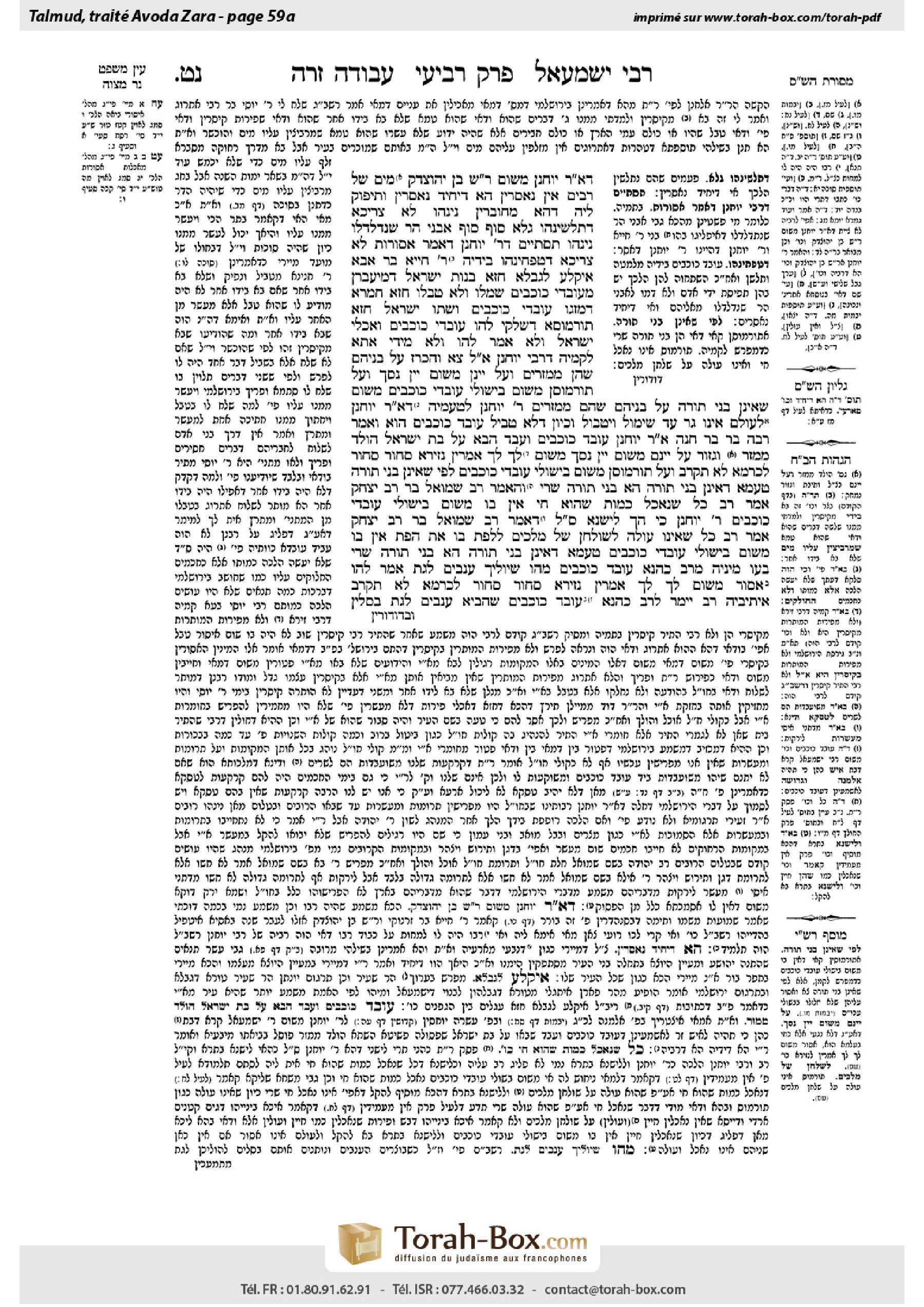
Avodah Zarah 59a: Talmud study for Daf Yomi
Study the Talmud for Daf Yomi with scanned pages, Hebrew text, English translations from Sefaria and AI-generated French translations.
Passage selection and English or AI-generated French translation are available where the scan has annotations. Daf Study is independent of Torah-Box and Sefaria.
Browse Avodah Zarah · עבודה זרה · All tractatesAvodah Zarah 59a text and translations
This page of Avodah Zarah includes the Aramaic text, an English translation and an AI-generated French translation, alongside the scan above.
עבודה זרה נ״ט א · Aramaic and Hebrew text
דְּאָמַר רַבִּי יוֹחָנָן מִשּׁוּם רַבִּי שִׁמְעוֹן בֶּן יְהוֹצָדָק: מַיִם שֶׁל רַבִּים אֵין נֶאֱסָרִין. הָא דְּיָחִיד נֶאֱסָרִין.
וְתִיפּוֹק לֵיהּ, דְּהָא מְחוּבָּרִין נִינְהוּ! לָא צְרִיכָא, דְּתַלְשִׁינְהוּ גַּלָּא.
סוֹף סוֹף, אַבְנֵי הַר שֶׁנִּדַּלְדְּלוּ נִינְהוּ, תִּסְתַּיֵּים דְּרַבִּי יוֹחָנָן דְּאָמַר אֲסוּרוֹת?
לָא צְרִיכָא, דְּטַפְחִינְהוּ בִּידֵיהּ.
רַבִּי חִיָּיא בַּר אַבָּא אִיקְּלַע לְגַבְלָא, חֲזָא בְּנוֹת יִשְׂרָאֵל דְּמִיעַבְּרָן מִגּוֹיִם שֶׁמָּלוּ וְלֹא טָבְלוּ, חֲזָא חַמְרָא דִּמְזַגוּ גּוֹיִם וְשָׁתוּ יִשְׂרָאֵל, חֲזָא תּוֹרְמוֹסָא דְּשָׁלְקִי לְהוּ גּוֹיִם וְאָכְלִי יִשְׂרָאֵל, וְלָא אֲמַר לְהוּ וְלָא מִידֵּי.
אֲתָא לְקַמֵּיהּ דְּרַבִּי יוֹחָנָן, אֲמַר לֵיהּ: צֵא וְהַכְרֵז עַל בְּנֵיהֶם שֶׁהֵן מַמְזֵרִים, וְעַל יֵינָן מִשּׁוּם יֵין נֶסֶךְ, וְעַל תּוֹרְמוֹסָן מִשּׁוּם בִּישּׁוּלֵי גוֹיִם, מִשּׁוּם שֶׁאֵינָן בְּנֵי תוֹרָה.
עַל בְּנֵיהֶם שֶׁהֵם מַמְזֵרִים — רַבִּי יוֹחָנָן לְטַעְמֵיהּ, דְּאָמַר רַבִּי יוֹחָנָן: לְעוֹלָם אֵינוֹ גֵּר עַד שֶׁיָּמוּל וְיִטְבּוֹל, וְכֵיוָן דְּלָא טְבֵיל — גּוֹי הוּא. וְאָמַר רַבָּה בַּר בַּר חָנָה אָמַר רַבִּי יוֹחָנָן: גּוֹי וְעֶבֶד הַבָּא עַל בַּת יִשְׂרָאֵל — הַוָּלָד מַמְזֵר.
וּגְזוּר עַל יֵינָם מִשּׁוּם יֵין נֶסֶךְ — מִשּׁוּם ״לָךְ לָךְ, אָמְרִין נְזִירָא; סְחוֹר סְחוֹר, לְכַרְמָא לָא תִּקְרַב״.
וְעַל תּוֹרְמוֹסָן מִשּׁוּם בִּישּׁוּלֵי גוֹיִם — לְפִי שֶׁאֵינָן בְּנֵי תוֹרָה. טַעְמָא דְּאֵינָן בְּנֵי תוֹרָה, הָא בְּנֵי תוֹרָה שְׁרֵי? וְהָאָמַר רַב שְׁמוּאֵל בַּר רַב יִצְחָק אָמַר רַב: כֹּל שֶׁנֶּאֱכָל כְּמוֹת שֶׁהוּא חַי אֵין בּוֹ מִשּׁוּם בִּישּׁוּלֵי גוֹיִם!
רַבִּי יוֹחָנָן כִּי הָךְ לִישָּׁנָא סְבִירָא לֵיהּ, דְּאָמַר רַב שְׁמוּאֵל בַּר רַב יִצְחָק אָמַר רַב: כֹּל שֶׁאֵינוֹ עוֹלֶה לְשׁוּלְחָן שֶׁל מְלָכִים לְלֶפֶת בּוֹ אֶת הַפַּת — אֵין בּוֹ מִשּׁוּם בִּישּׁוּלֵי גוֹיִם. טַעְמָא דְּאֵינָן בְּנֵי תוֹרָה, הָא בְּנֵי תוֹרָה שְׁרֵי.
בְּעוֹ מִינֵּיהּ מֵרַב כָּהֲנָא: גּוֹי מַהוּ שֶׁיּוֹלִיךְ עֲנָבִים לַגַּת? אֲמַר לְהוּ: אָסוּר, מִשּׁוּם ״לָךְ לָךְ, אָמְרִין נְזִירָא; סְחוֹר סְחוֹר, לְכַרְמָא לָא תִּקְרַב״. אֵיתִיבֵיהּ רַב יֵימַר לְרַב כָּהֲנָא: גּוֹי שֶׁהֵבִיא עֲנָבִים לַגַּת בְּסַלִּין.
Avodah Zarah 59a · English translation
as Rabbi Yoḥanan says in the name of Rabbi Shimon ben Yehotzadak: Water that belongs to the public is not rendered prohibited. The Gemara infers that since water that belongs to the public is permitted, therefore, in a case where gentiles bow to water that is owned by an individual it is rendered prohibited.
The Gemara challenges: But Rabbi Yoḥanan could derive that even water owned by an individual is permitted, as the water is connected to the ground, and worshipping an object that is connected to the ground does not render it prohibited. The Gemara explains: No, it is necessary to derive this halakha from the fact that the water belongs to the public in a case where a wave raised the water and detached it from the ground. In this case worshipping water owned by an individual would render it prohibited.
The Gemara challenges: Nevertheless, the water ultimately falls into the category of objects that were detached without human involvement, such as boulders of a mountain that dislodged on their own. The Gemara (46a) cites a dispute between Rabbi Yoḥanan and the sons of Rabbi Ḥiyya with regard to boulders that dislodged without human involvement and were then worshipped, and does not conclude who deems the boulders permitted and who deems them prohibited. May it be concluded from Rabbi Yoḥanan’s statement that it is Rabbi Yoḥanan who says that the boulders are prohibited?
The Gemara replies: No, even if Rabbi Yoḥanan deems the boulders permitted, his ruling with regard to the water is necessary in a case where one struck the water with his hand and thereby detached it. Since it was detached due to human involvement, if the water was owned by an individual it is prohibited.
§ Rabbi Ḥiyya bar Abba happened to come to Gavla. He saw Jewish women there who were impregnated by gentiles who were in the process of converting and were circumcised but had not yet immersed in a ritual bath. He also saw wine that gentiles diluted with water and Jews then drank the wine. He also saw lupines that gentiles were cooking and Jews were eating. And despite seeing all this, he did not say anything to them to correct their actions.
Later, he came before Rabbi Yoḥanan and told him what he had seen. Rabbi Yoḥanan said to him: Go and declare about their children that they have the status of children born from an incestuous or adulterous relationship [mamzerim]. And decree with regard to their wine that it is prohibited as an extension of the prohibition of wine used for a libation. And with regard to their lupines you should declare that they are forbidden due to the prohibition of food cooked by gentiles, as they are not people well-versed in Torah, and any leniency would be misunderstood and applied too extensively.
The Gemara explains that with regard to declaring about their children that they have the status of mamzerim, Rabbi Yoḥanan conforms to his standard line of reasoning concerning two halakhot. The first is as Rabbi Yoḥanan says: One is never deemed to be a convert until he has been circumcised and has immersed. And since the father has not immersed, he is still considered a gentile. And the second halakha is as Rabba bar bar Ḥana says that Rabbi Yoḥanan says: In the case of a gentile or a Canaanite slave who engaged in intercourse with a Jewish woman, the offspring is a mamzer.
The Gemara continues to explain Rabbi Yoḥanan’s second instruction to Rabbi Ḥiyya bar Abba: And decree with regard to their wine that it is prohibited as an extension of the prohibition of wine used for a libation. Although the gentile did not touch the wine when he diluted it, it is prohibited due to the maxim: Go, go, we say to a nazirite; go around and go around, but do not come near to the vineyard.
Lastly, Rabbi Yoḥanan instructed Rabbi Ḥiyya bar Abba to decree with regard to their lupines that they are forbidden due to the prohibition of food cooked by gentiles, as they are not people well-versed in Torah. The Gemara asks: The reason that the lupines are deemed prohibited is because they are not people well-versed in Torah; but in the case of people who are well-versed in Torah, one can infer that the lupines are permitted. But doesn’t Rav Shmuel bar Rav Yitzḥak say that Rav says: Anything that is eaten raw is not subject to the prohibition of food cooked by gentiles, even when cooked by them? Lupines are not eaten raw due to their bitterness, and therefore they are subject to the prohibition of food cooked by gentiles.
The Gemara answers: Rabbi Yoḥanan holds in accordance with that other version of Rav Shmuel bar Rav Yitzḥak’s statement, as Rav Shmuel bar Rav Yitzḥak says that Rav says: Anything that lacks importance and therefore does not appear on the table of kings in order to be eaten together with bread is not subject to the prohibition of food cooked by gentiles. Lupines are not sufficiently important to be served on the table of kings, and therefore they are permitted even if cooked by gentiles. Consequently, the reason for prohibiting the residents of Gavla from eating them is because they are not people well-versed in Torah. But in the case of people well-versed in Torah, the lupines are permitted.
§ The Sages asked Rav Kahana: With regard to a gentile, what is the halakha concerning the following question: May he bring grapes to the winepress without doing anything else to them? Rav Kahana said to them: It is prohibited by rabbinic decree due to the maxim: Go, go, we say to a nazirite; go around and go around, but do not come near to the vineyard. Rav Yeimar raised an objection to Rav Kahana from a baraita: With regard to a gentile who brought grapes to the winepress in baskets
Avodah Zarah 59a · Traduction française (IA)
comme Rabbi Yoḥanan le dit au nom de Rabbi Shimon ben Yehotzadak : L'eau qui appartient au public n'est pas rendue interdite. La Guemara en déduit que puisque l'eau qui appartient au public est permise, donc, dans le cas où les gentils se prosternent devant de l'eau appartenant à un individu, elle est rendue interdite.
La Guemara conteste : Mais Rabbi Yoḥanan pourrait déduire que même l'eau appartenant à un individu est permise, car l'eau est liée au sol, et l'adoration d'un objet lié au sol ne rend pas l'objet interdit. La Guemara explique : Non, il est nécessaire de déduire cette halakha du fait que l'eau appartient au public dans le cas où une vague a soulevé l'eau et l'a détachée du sol. Dans ce cas, l'adoration de l'eau appartenant à un individu rendrait l'eau interdite.
La Guemara conteste : Toutefois, l'eau finit par tomber dans la catégorie d'objets détachés sans intervention humaine, tels que les rochers d'une montagne qui se sont détachés tout seuls. La Guemara (46a) cite un débat entre Rabbi Yoḥanan et les fils de Rabbi Ḥiyya concernant les rochers qui se sont détachés sans intervention humaine et qui ont ensuite été adorés, et ne conclut pas qui considère les rochers comme permis et qui les considère comme interdits. Peut-on conclure de la déclaration de Rabbi Yoḥanan que c'est Rabbi Yoḥanan qui affirme que les rochers sont interdits ?
La Guemara répond : Non, même si Rabbi Yoḥanan considère les rochers comme permis, son avis concernant l'eau est nécessaire dans le cas où l'on a frappé l'eau avec sa main et l'a ainsi détachée. Puisque l'éloignement a été causé par une intervention humaine, si l'eau appartenait à un individu, elle est interdite.
§ Rabbi Ḥiyya bar Abba est tombé à Gavla. Il a vu des femmes juives là-bas qui étaient enceintes par des gentils en train de se convertir et qui avaient été circoncis mais n'avaient pas encore été immergées dans un bain rituel. Il a également vu du vin que les gentils avaient dilué avec de l'eau et que les Juifs avaient ensuite bu ce vin. Il a également vu des lupins que les gentils cuisinaient et que les Juifs mangeaient. Et malgré avoir vu tout cela, il n'a pas dit quoi que ce soit pour corriger leurs actions.
Plus tard, il est venu devant Rabbi Yoḥanan et lui a raconté ce qu'il avait vu. Rabbi Yoḥanan a dit à lui : Va et déclare sur leurs enfants qu'ils ont le statut d'enfants nés d'un mariage incestueux ou adultère [mamzerim]. Et décrète concernant leur vin qu'il est interdit comme une extension de l'interdiction du vin utilisé pour une libation. Et concernant leurs lupins, tu devrais déclarer qu'ils sont interdits en raison de l'interdiction des aliments cuits par des gentils, car ils ne sont pas des gens bien-accoutumés à la Torah, et toute allègement serait mal interprétée et appliquée de manière excessive.
La Guemara explique que concernant la déclaration sur leurs enfants qu'ils ont le statut de mamzerim, Rabbi Yoḥanan suit sa ligne de raisonnement standard concernant deux halakhot. La première est comme Rabbi Yoḥanan dit : On ne considère jamais un converti comme tel avant qu'il ne soit circoncis et immergé. Et puisque le père n'a pas été immergé, il est encore considéré comme un gentil. La deuxième halakha est comme Rabba bar bar Ḥana dit que Rabbi Yoḥanan dit : Dans le cas d'un gentil ou d'un esclave cananéen qui a eu des relations sexuelles avec une femme juive, l'enfant est un mamzer.
La Guemara continue d'expliquer la deuxième instruction de Rabbi Yoḥanan à Rabbi Ḥiyya bar Abba : Et décrète concernant leur vin qu'il est interdit comme une extension de l'interdiction du vin utilisé pour une libation. Bien que le gentil n'ait pas touché le vin lorsqu'il l'a dilué, il est interdit en raison du principe : Va, va, nous disons au nazirite ; tourne et tourne, mais ne viens pas près du vignoble.
Enfin, Rabbi Yoḥanan a instruit Rabbi Ḥiyya bar Abba à décréter concernant leurs lupins qu'ils sont interdits en raison de l'interdiction des aliments cuits par des gentils, car ils ne sont pas des gens bien-accoutumés à la Torah. La Guemara pose la question : La raison pour laquelle les lupins sont considérés comme interdits est qu'ils ne sont pas des gens bien-accoutumés à la Torah ; mais dans le cas de gens bien-accoutumés à la Torah, on peut déduire que les lupins sont permis. Mais ne dit pas Rav Shmuel bar Rav Yitzḥak que Rav dit : Tout ce qui est mangé cru n'est pas soumis à l'interdiction des aliments cuits par des gentils, même s'ils les cuisinent ? Les lupins ne sont pas mangés crus en raison de leur amertume, et donc ils sont soumis à l'interdiction des aliments cuits par des gentils.
La Guemara répond : Rabbi Yoḥanan suit la version de la déclaration de Rav Shmuel bar Rav Yitzḥak, comme Rav Shmuel bar Rav Yitzḥak dit que Rav dit : Tout ce qui n'a pas d'importance et ne figure donc pas sur la table des rois pour être mangé avec du pain n'est pas soumis à l'interdiction des aliments cuits par des gentils. Les lupins n'ont pas assez d'importance pour figurer sur la table des rois, et donc ils sont permis même s'ils sont cuits par des gentils. Ainsi, la raison pour interdire aux habitants de Gavla de les manger est qu'ils ne sont pas des gens bien-accoutumés à la Torah. Mais dans le cas de gens bien-accoutumés à la Torah, les lupins sont permis.
§ Les Sages ont interrogé Rav Kahana : Concernant un gentil, quelle est la halakha concernant la question suivante : Est-il permis d'apporter des raisins à la presse sans faire autre chose avec eux ? Rav Kahana a dit à eux : C'est interdit par un décret rabbinique en raison du maxim : Va, va, nous disons au nazirite ; tourne et tourne, mais ne viens pas près du vignoble. Rav Yeimar a soulevé une objection contre Rav Kahana à partir d'une baraïta : Concernant un gentil qui a apporté des raisins à la presse dans des paniers
Traduction française générée par IA à partir de l’édition anglaise de Sefaria. Vérifie toujours un passage avec le texte source.
Text from Sefaria: William Davidson Edition - Vocalized Aramaic (CC BY NC); William Davidson Edition - English (CC BY NC).