Avodah Zarah 59b: Talmud study for Daf Yomi
Study the Talmud for Daf Yomi with scanned pages, Hebrew text, English translations from Sefaria and AI-generated French translations.
Passage selection and English or AI-generated French translation are available where the scan has annotations. Daf Study is independent of Torah-Box and Sefaria.
Browse Avodah Zarah · עבודה זרה · All tractatesAvodah Zarah 59b text and translations
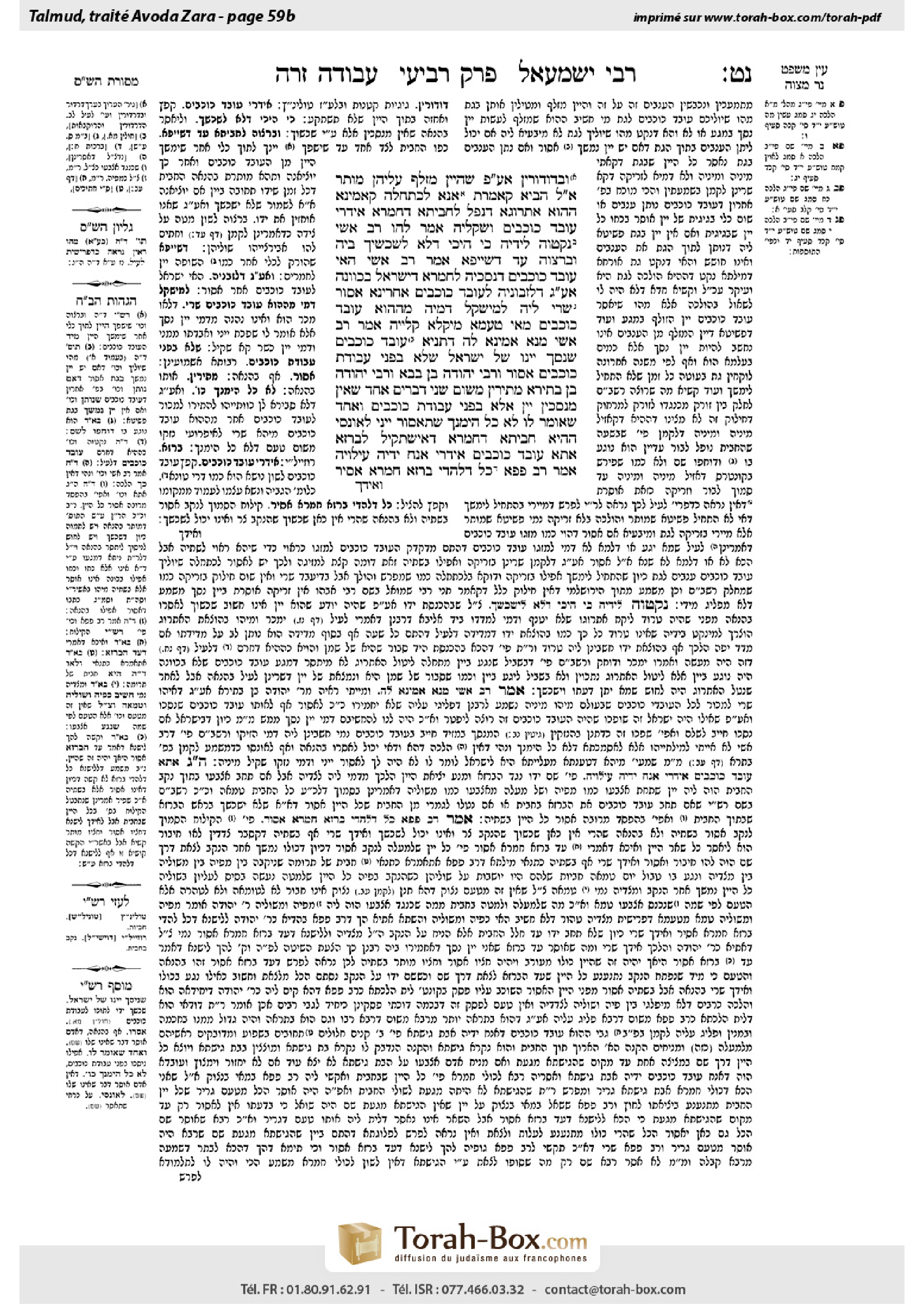
This page of Avodah Zarah includes the Aramaic text, an English translation and an AI-generated French translation, alongside the scan above.
עבודה זרה נ״ט ב · Aramaic and Hebrew text
וּבְדוּדוֹרִין, אַף עַל פִּי שֶׁהַיַּיִן מְזַלֵּף עֲלֵיהֶן — מוּתָּר. אֲמַר לֵיהּ: ״הֵבִיא״ קָאָמְרַתְּ? אֲנָא לְכַתְּחִלָּה קָאָמֵינָא!
הָהוּא אֶתְרוֹגָא דִּנְפַל לְחָבִיתָא דְּחַמְרָא, אִידְּרִי גּוֹי וְשַׁקְלֵיהּ. אֲמַר לְהוּ רַב אָשֵׁי: נַקְטוּהּ לִידֵיהּ כִּי הֵיכִי דְּלָא לְשַׁכְשֵׁיךְ בֵּיהּ, וּבָרְצוּהָ עַד דְּשָׁיְיפָא.
אָמַר רַב אָשֵׁי: הַאי גּוֹי דְּנַסְּכֵיהּ לְחַמְרָא דְּיִשְׂרָאֵל בְּכַוָּונָה, אַף עַל גַּב דִּלְזַבּוֹנֵיהּ לְגוֹי אַחֲרִינָא אָסוּר, שְׁרֵי לֵיהּ לְמִישְׁקַל דְּמֵיהּ מֵהָהוּא גּוֹי. מַאי טַעְמָא? מִיקְלָא קַלְיֵיהּ.
אָמַר רַב אָשֵׁי: מְנָא אָמֵינָא לַהּ? דְּתַנְיָא: גּוֹי שֶׁנִּסֵּךְ יֵינוֹ שֶׁל יִשְׂרָאֵל שֶׁלֹּא בִּפְנֵי עֲבוֹדָה זָרָה — אָסוּר, וְרַבִּי יְהוּדָה בֶּן בָּבָא וְרַבִּי יְהוּדָה בֶּן בְּתִירָא מַתִּירִין מִשּׁוּם שְׁנֵי דְּבָרִים: אֶחָד — שֶׁאֵין מְנַסְּכִין יַיִן אֶלָּא בִּפְנֵי עֲבוֹדָה זָרָה, וְאֶחָד — שֶׁאוֹמֵר לוֹ: לֹא כׇּל הֵימֶנְךָ שֶׁתֶּאֱסוֹר יֵינִי לְאוֹנְסִי.
הָהִיא חָבִיתָא דְּחַמְרָא דְּאִישְׁתְּקִיל לְבַרְזָא, אֲתָא גּוֹי, אִידְּרִי אַנַּח יְדֵיהּ עִילָּוֵיהּ. אָמַר רַב פָּפָּא: כֹּל דְּלַהֲדֵי בַּרְזָא — חַמְרָא אֲסִיר.
Avodah Zarah 59b · English translation
and in small barrels, even though the grapes are squashed in the process and the wine, i.e., the juice, sprays onto the grapes, nevertheless they are permitted. Rav Kahana said to Rav Yeimar: Are you saying that this is the halakha where the gentile already brought the grapes? The baraita is discussing whether the grapes are prohibited after the fact, whereas I am saying that one should not permit a gentile to bring the grapes ab initio.
The Gemara relates: There was a certain etrog that fell into a barrel of wine. A gentile jumped up to take it out of the barrel, thereby unintentionally touching the wine. Rav Ashi said to the people standing there: Hold his hand still, so that he does not stir the wine and render it prohibited, and tip the barrel until the wine is drained into another vessel, and then he may take the etrog.
§ Rav Ashi says: In the case of this gentile who intentionally poured a Jew’s wine as a libation in order to render it prohibited, even though it is prohibited to sell it to another gentile, as one may not derive benefit from it, nevertheless, it is permitted for him to collect its monetary value from that gentile. What is the reason for this? It is considered as though the gentile burned the wine and destroyed it, and he is required to pay for the damage.
Rav Ashi says: From where do I say that this is the halakha? This halakha is derived as it is taught in a baraita: In the case of a gentile who poured a Jew’s wine as an idolatrous libation but not before an object of idol worship, the wine is prohibited, but Rabbi Yehuda ben Bava and Rabbi Yehuda ben Beteira deem it permitted due to two factors: One is that idol worshippers pour wine as an idolatrous libation only before an object of idol worship. And the other one is that the Jew says to the gentile: It is not in your power to render my wine prohibited against my will. Rav Ashi rules in accordance with the opinion of the first tanna. Nevertheless, he derives from the reasoning of Rabbi Yehuda ben Bava and Rabbi Yehuda ben Beteira that one may collect compensation from the gentile, whose actions were against the will of the owner.
§ There was a certain barrel of wine from which the stopper had been removed and the wine was spilling out. A gentile came, jumped up, and placed his hand on the hole to prevent the wine from leaking. Rav Pappa said: Any wine that is adjacent to the stopper is prohibited, as it was touched by the gentile,
Avodah Zarah 59b · Traduction française (IA)
et dans des petits tonneaux, même si les raisins sont écrasés lors du processus et que le vin, c'est-à-dire le jus, saute sur les raisins, ils sont tout de même permis. Rav Kahana a dit à Rav Yeimar : Tu dis donc que c'est la halakha dans le cas où le non-Juif a déjà apporté les raisins ? La baraïta discute de savoir si les raisins sont interdits après coup, tandis que je dis que l'on ne doit pas permettre au non-Juif d'apporter les raisins dès le début.
La Guemara rapporte : Il y avait un certain citron qui était tombé dans un tonneau de vin. Un non-Juif s'est levé pour le prendre hors du tonneau, touchant ainsi accidentellement le vin. Rav Ashi a dit aux personnes présentes : Tenez sa main immobile afin qu'il ne remue pas le vin et ne le rende pas interdit, et inclinez le tonneau jusqu'à ce que le vin soit drainé dans un autre récipient, puis il pourra prendre le citron.
§ Rav Ashi dit : Dans le cas de ce non-Juif qui a volontairement versé le vin d'un Juif en offrande idolâtre afin de le rendre interdit, même si il est interdit de le vendre à un autre non-Juif, car on ne peut pas en tirer un bénéfice, néanmoins, il est permis à lui de récupérer sa valeur monétaire auprès de ce non-Juif. Pourquoi cela ? On considère que le non-Juif a brûlé le vin et l'a détruit, et il est tenu de réparer le préjudice.
Rav Ashi dit : D'où dis-je que c'est la halakha ? Cette halakha est dérivée comme il est enseigné dans une baraïta : Dans le cas d'un non-Juif qui a versé le vin d'un Juif en offrande idolâtre mais sans être devant un objet d'idolâtrie, le vin est interdit, mais Rabbi Yehuda ben Bava et Rabbi Yehuda ben Beteira le considèrent comme permis pour deux raisons : l'une est que les idolâtres versent du vin en offrande idolâtre uniquement devant un objet d'idolâtrie. Et l'autre est que le Juif dit au non-Juif : Ce n'est pas en ton pouvoir de rendre mon vin interdit contre ma volonté. Rav Ashi adopte l'opinion du premier tanna. Cependant, il tire de la raisonnement de Rabbi Yehuda ben Bava et Rabbi Yehuda ben Beteira que l'on peut récupérer une compensation auprès du non-Juif, dont les actions étaient contre la volonté du propriétaire.
§ Il y avait un certain tonneau de vin dont le bouchon avait été retiré et le vin s'échappait. Un non-Juif est venu, s'est levé, et a posé sa main sur l'ouverture pour empêcher le vin de fuir. Rav Pappa a dit : Tout vin qui est adjacent au bouchon est interdit, car il a été touché par le non-Juif,
Traduction française générée par IA à partir de l’édition anglaise de Sefaria. Vérifie toujours un passage avec le texte source.
Text from Sefaria: William Davidson Edition - Vocalized Aramaic (CC BY NC); William Davidson Edition - English (CC BY NC).