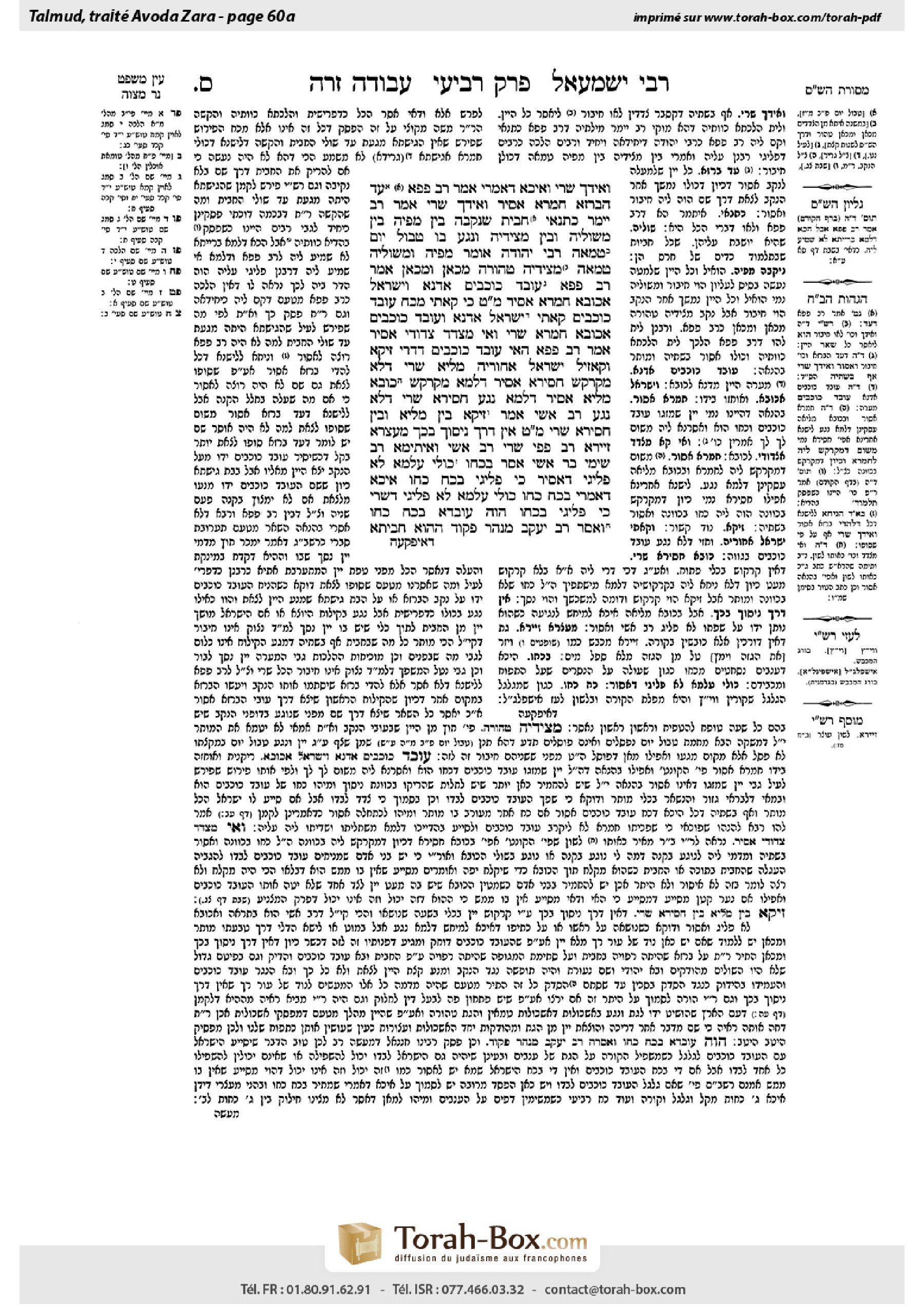
Avodah Zarah 60a: Talmud study for Daf Yomi
Study the Talmud for Daf Yomi with scanned pages, Hebrew text, English translations from Sefaria and AI-generated French translations.
Passage selection and English or AI-generated French translation are available where the scan has annotations. Daf Study is independent of Torah-Box and Sefaria.
Browse Avodah Zarah · עבודה זרה · All tractatesAvodah Zarah 60a text and translations
This page of Avodah Zarah includes the Aramaic text, an English translation and an AI-generated French translation, alongside the scan above.
עבודה זרה ס׳ א · Aramaic and Hebrew text
וְאִידָּךְ שְׁרֵי, וְאִיכָּא דְּאָמְרִי, אָמַר רַב פָּפָּא: עַד (הברזא) [בַּרְזָא] — חַמְרָא אֲסִיר, וְאִידָּךְ שְׁרֵי.
אָמַר רַב יֵימַר, כְּתַנָּאֵי: חָבִית שֶׁנִּקְּבָה, בֵּין מִפִּיהָ, בֵּין מִשּׁוּלֶיהָ, וּבֵין מִצִּידֶּיהָ, וְנָגַע בּוֹ טְבוּל יוֹם — טְמֵאָה. רַבִּי יְהוּדָה אוֹמֵר: מִפִּיהָ וּמִשּׁוּלֶיהָ — טְמֵאָה, מִצִּידֶּיהָ — טְהוֹרָה מִכָּאן וּמִכָּאן.
אָמַר רַב פָּפָּא: גּוֹי אַדַּנָּא וְיִשְׂרָאֵל אַכּוּבָּא — חַמְרָא אֲסִיר, מַאי טַעְמָא? כִּי קָאָתֵי — מִכֹּחַ גּוֹי קָאָתֵי. יִשְׂרָאֵל אַדַּנָּא וְגוֹי אַכּוּבָּא — חַמְרָא שְׁרֵי, וְאִי מְצַדֵּד צַדּוֹדֵי — אֲסִיר.
אָמַר רַב פָּפָּא: הַאי גּוֹי דְּדָרֵי זִיקָּא וְקָאָזֵיל יִשְׂרָאֵל אֲחוֹרֵיהּ, מַלְיָא — שְׁרֵי, דְּלָא מְקַרְקֵשׁ. חַסִּירָא — אֲסִיר, דִּלְמָא מְקַרְקֵשׁ. כּוּבָּא: מַלְיָא — אֲסִיר, דִּלְמָא נָגַע. חַסִּירָא — שְׁרֵי, דְּלָא נָגַע.
רַב אָשֵׁי אָמַר: זִיקָא, בֵּין מַלְיָא וּבֵין חַסִּירָא — שְׁרֵי, מַאי טַעְמָא? אֵין דֶּרֶךְ נִיסּוּךְ בְּכָךְ.
מַעְצְרָא זָיְירָא — רַב פַּפִּי שָׁרֵי, רַב אָשֵׁי, וְאִיתֵּימָא רַב שִׁימִי בַּר אָשֵׁי, אָסַר.
בְּכֹחוֹ, כּוּלֵּי עָלְמָא לָא פְּלִיגִי דַּאֲסִיר. כִּי פְּלִיגִי — בְּכֹחַ כֹּחוֹ. אִיכָּא דְּאָמְרִי: בְּכֹחַ כֹּחוֹ, כּוּלֵּי עָלְמָא לָא פְּלִיגִי דִּשְׁרֵי. כִּי פְּלִיגִי — בְּכֹחוֹ. הֲוָה עוֹבָדָא בְּכֹחַ כֹּחוֹ, וְאָסַר רַב יַעֲקֹב מִנְּהַר פְּקוֹד.
הָהִיא חָבִיתָא
Avodah Zarah 60a · English translation
but the other wine in the barrel is permitted. There are those who say that Rav Pappa said: The wine until the stopper, i.e., in the upper portion of the barrel, is prohibited, but the other wine in the barrel, below the stopper, is permitted.
Rav Yeimar says: Rav Pappa’s ruling is subject to a dispute between tanna’im, as the mishna teaches (Tevul Yom 2:7): In the case of a barrel that was pierced, whether on its top, on its bottom, or on one of its sides, if one who immersed that day touched it, it is ritually impure. Rabbi Yehuda says: If it was pierced on its top or on its bottom, it is impure. If it was pierced on one of its sides, the wine is pure, whether it was touched from here or from there, i.e., on either side. Only the wine that he touched is rendered impure. According to the first version of Rav Pappa’s statement he holds in accordance with the opinion of Rabbi Yehuda.
§ Rav Pappa says: In a case where a gentile is pouring the wine from the barrel and a Jew is holding the beaker [kuva] into which it is poured, the wine is prohibited. What is the reason? When the wine comes out of the barrel, it comes out by force of the gentile’s action. In a case where a Jew is pouring the wine from the barrel and a gentile is holding the beaker into which it is poured, the wine is permitted. But if the gentile tilts the beaker to the side, the wine is prohibited.
Rav Pappa says: In the case of this gentile who carries a sealed wineskin and a Jew is walking behind him and ensuring that the gentile does not touch the wine itself, the halakha depends on the circumstances. If the wineskin is full, the wine is permitted, as the wine in the wineskin is not shaken. If the wineskin is incompletely filled, the wine is prohibited, as perhaps the wine in the wineskin might have been shaken by the gentile, which would have the same halakha as wine poured as a libation. In the case of a beaker, which is open on top, if it is full the wine is prohibited, as perhaps the gentile might have touched the wine. If the beaker is incompletely filled, the wine is permitted, as the gentile did not touch the wine.
Rav Ashi says: In the case of a wineskin, whether it is full or incompletely filled it is permitted. What is the reason that the wine is permitted even if it is shaken within the wineskin? It is because this is not the typical manner of offering a libation.
§ With regard to a winepress where the grapes are pressed with beams, rather than trod by foot, Rav Pappi deemed permitted wine that is produced by a gentile, as the gentile does not touch the wine. Rav Ashi, and some say it was Rav Shimi bar Ashi, deemed the wine prohibited.
The Gemara comments: In a case where the wine is pressed by means of the gentile’s direct force everyone agrees that the wine is prohibited. They disagree when the wine is pressed by means of a force generated by his force. Conversely, there are those who say that in a case where the wine is pressed by means of a force generated by the gentile’s force everyone agrees that the wine is permitted. They disagree when the wine is pressed by means of the gentile’s direct force. The Gemara relates: There was an incident in which wine was pressed by means of a force generated by the gentile’s force, and Rav Yaakov from Nehar Pekod deemed the wine prohibited.
§ The Gemara relates: There was a certain barrel
Avodah Zarah 60a · Traduction française (IA)
mais le vin restant dans le tonneau est permis. Certains disent que Rav Pappa a dit : le vin jusqu'au bouchon, c'est-à-dire dans la partie supérieure du tonneau, est interdit, mais le vin restant dans le tonneau, en dessous du bouchon, est permis.
Rav Yeimar dit : la décision de Rav Pappa est sujette à un débat entre les tannaïm, comme la mitsva enseigne (Tevul Yom 2:7) : dans le cas d'un tonneau percé, que ce soit sur le haut, sur le bas ou sur l'un des côtés, si celui qui s'est purifié ce jour-là le touche, il est impur. Rabbi Yehuda dit : si le tonneau a été percé sur le haut ou sur le bas, il est impur. Si le tonneau a été percé sur l'un des côtés, le vin est pur, que ce soit touché d'ici ou d'ailleurs, c'est-à-dire de n'importe quel côté. Seul le vin qu'il a touché devient impur. Selon la première version de la déclaration de Rav Pappa, il suit l'opinion de Rabbi Yehuda.
§ Rav Pappa dit : dans le cas où un non-Juif verse le vin depuis le tonneau et un Juif tient la coupe [kuva] dans laquelle il est versé, le vin est interdit. Quelle est la raison ? Quand le vin sort du tonneau, il sort par la force de l'action du non-Juif. Dans le cas où un Juif verse le vin depuis le tonneau et un non-Juif tient la coupe dans laquelle il est versé, le vin est permis. Mais si le non-Juif penche la coupe vers le côté, le vin est interdit.
Rav Pappa dit : dans le cas d'un non-Juif qui transporte une peau de vin scellée et un Juif marche derrière lui et assure que le non-Juif ne touche pas le vin lui-même, la halakha dépend des circonstances. Si la peau de vin est pleine, le vin est permis, car le vin dans la peau de vin n'est pas secoué. Si la peau de vin est partiellement remplie, le vin est interdit, car peut-être le vin dans la peau de vin a été secoué par le non-Juif, ce qui aurait la même halakha que le vin versé en offrande. Dans le cas d'une coupe, qui est ouverte en haut, si elle est pleine le vin est interdit, car peut-être le non-Juif a touché le vin. Si la coupe est partiellement remplie, le vin est permis, car le non-Juif n'a pas touché le vin.
Rav Ashi dit : dans le cas d'une peau de vin, qu'elle soit pleine ou partiellement remplie, elle est permise. Quelle est la raison pour laquelle le vin est permis même s'il a été secoué à l'intérieur de la peau de vin ? C'est parce que cela n'est pas la manière habituelle d'offrir une offrande de vin.
§ Concernant une presse à vin où les raisins sont pressés avec des poutres, plutôt que piétinés à pied, Rav Pappi a estimé que le vin produit par un non-Juif est permis, car le non-Juif ne touche pas le vin. Rav Ashi, et certains disent que c'était Rav Shimi bar Ashi, a estimé que le vin est interdit.
La Guemara commente : dans le cas où le vin est pressé par la force directe du non-Juif, tout le monde convient que le vin est interdit. Ils divergent lorsqu'il est pressé par une force générée par la force du non-Juif. À l'inverse, certains disent que dans le cas où le vin est pressé par une force générée par la force du non-Juif, tout le monde convient que le vin est permis. Ils divergent lorsqu'il est pressé par la force directe du non-Juif. La Guemara rapporte : il y avait un cas où le vin a été pressé par une force générée par la force du non-Juif, et Rav Yaakov de Nehar Pekod a estimé que le vin était interdit.
§ La Guemara rapporte : il y avait un certain tonneau
Traduction française générée par IA à partir de l’édition anglaise de Sefaria. Vérifie toujours un passage avec le texte source.
Text from Sefaria: William Davidson Edition - Vocalized Aramaic (CC BY NC); William Davidson Edition - English (CC BY NC).