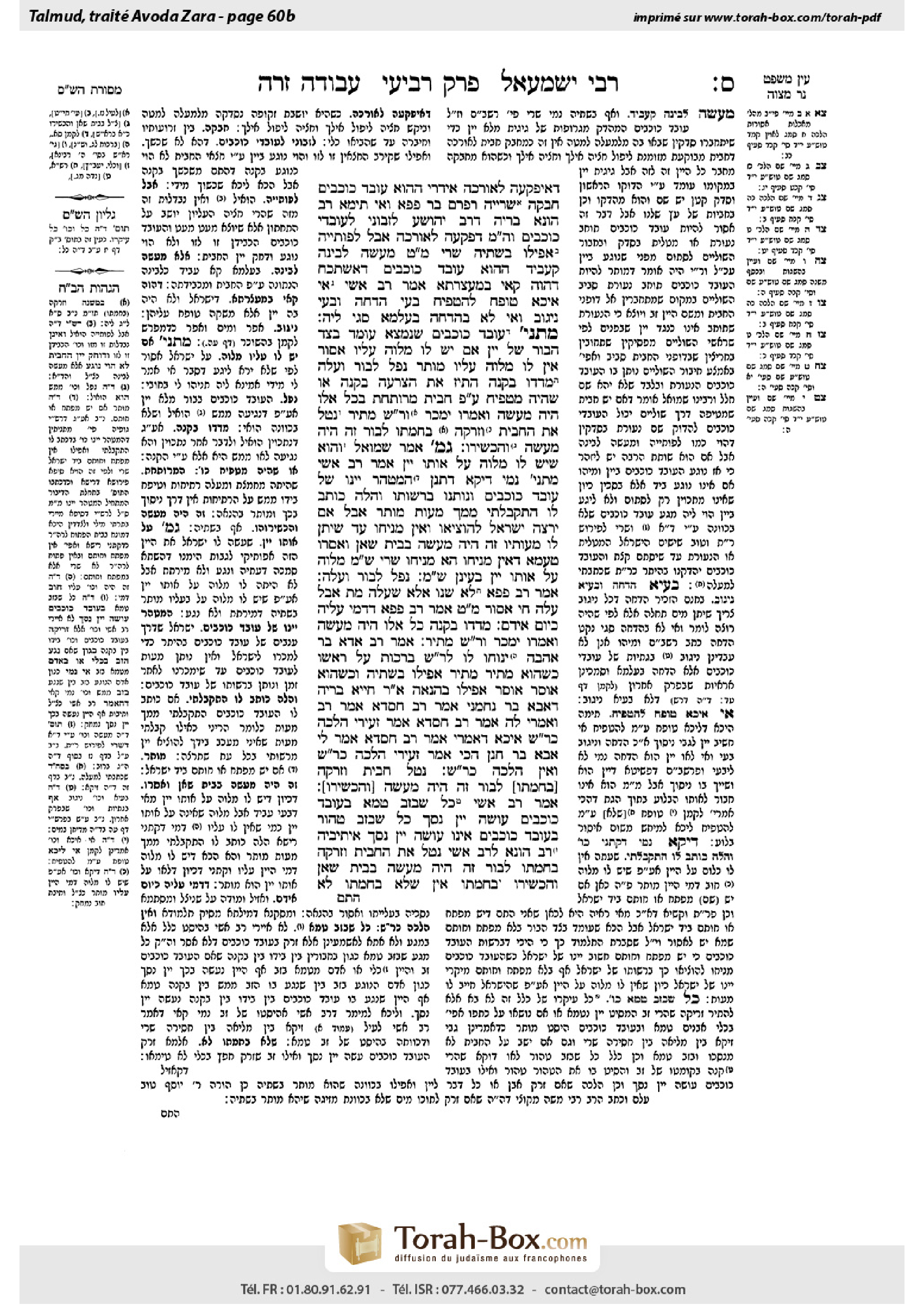
Avodah Zarah 60b: Talmud study for Daf Yomi
Study the Talmud for Daf Yomi with scanned pages, Hebrew text, English translations from Sefaria and AI-generated French translations.
Passage selection and English or AI-generated French translation are available where the scan has annotations. Daf Study is independent of Torah-Box and Sefaria.
Browse Avodah Zarah · עבודה זרה · All tractatesAvodah Zarah 60b text and translations
This page of Avodah Zarah includes the Aramaic text, an English translation and an AI-generated French translation, alongside the scan above.
עבודה זרה ס׳ ב · Aramaic and Hebrew text
דְּאִיפְּקַעָה לְאוּרְכַּהּ, אִידְּרִי הָהוּא גּוֹי חַבְּקַהּ, שַׁרְיַיהּ רַפְרָם בַּר פָּפָּא, וְאִי תֵּימָא רַב הוּנָא בְּרֵיהּ דְּרַב יְהוֹשֻׁעַ, לְזַבּוֹנֵי לְגוֹיִם. וְהָנֵי מִילֵּי דִּפְקַעָה לְאוּרְכַּהּ, אֲבָל לְפוּתְיַיהּ — אֲפִילּוּ בִּשְׁתִיָּה שְׁרֵי. מַאי טַעְמָא? מַעֲשֵׂה לְבֵינָה קָעָבֵיד.
הָהוּא גּוֹי דְּאִשְׁתְּכַח דַּהֲוָה קָאֵי בְּמַעְצַרְתָּא, אָמַר רַב אָשֵׁי: אִי אִיכָּא טוֹפֵחַ לְהַטְפִּיחַ — בָּעֵי הַדָּחָה וּבָעֵי נִיגּוּב, וְאִי לָא — בְּהַדָּחָה בְּעָלְמָא סַגִּי לֵיהּ.
מַתְנִי׳ נׇכְרִי שֶׁנִּמְצָא עוֹמֵד בְּצַד הַבּוֹר שֶׁל יַיִן, אִם יֵשׁ לוֹ מִלְוָה עָלָיו — אָסוּר, אֵין לוֹ מִלְוָה עָלָיו — מוּתָּר.
נָפַל לַבּוֹר וְעָלָה, מְדָדוֹ בְּקָנֶה, הִתִּיז אֶת הַצִּרְעָה בְּקָנֶה, אוֹ שֶׁהָיָה מְטַפֵּיחַ עַל פִּי חָבִית מְרוּתַּחַת — בְּכׇל אֵלּוּ הָיָה מַעֲשֶׂה וְאָמְרוּ: יִמָּכֵר, וְרַבִּי שִׁמְעוֹן מַתִּיר. נָטַל אֶת הֶחָבִית וּזְרָקָהּ בַּחֲמָתוֹ לַבּוֹר, זֶה הָיָה מַעֲשֶׂה וְהִכְשִׁירוּ.
גְּמָ׳ אָמַר שְׁמוּאֵל: וְהוּא שֶׁיֵּשׁ לוֹ מִלְוָה עַל אוֹתוֹ יַיִן.
אָמַר רַב אָשֵׁי: מַתְנִיתִין נָמֵי דַּיְקָא, דִּתְנַן: הַמְטַהֵר יֵינוֹ שֶׁל נׇכְרִי וְנוֹתְנוֹ בִּרְשׁוּתוֹ, וְהַלָּה כּוֹתֵב לוֹ: ״הִתְקַבַּלְתִּי מִמְּךָ מָעוֹת״ — מוּתָּר, אֲבָל אִם יִרְצֶה יִשְׂרָאֵל לְהוֹצִיאוֹ וְאֵין מַנִּיחוֹ עַד שֶׁיִּתֵּן לוֹ מְעוֹתָיו, זֶה הָיָה מַעֲשֶׂה בְּבֵית שְׁאָן וְאָסְרוּ.
טַעְמָא דְּאֵין מַנִּיחוֹ, הָא מַנִּיחוֹ שְׁרֵי, שְׁמַע מִינַּהּ: מִלְוָה עַל אוֹתוֹ יַיִן בָּעֵינַן. שְׁמַע מִינַּהּ.
נָפַל לַבּוֹר וְעָלָה. אָמַר רַב פָּפָּא: לֹא שָׁנוּ אֶלָּא שֶׁעָלָה מֵת, אֲבָל עָלָה חַי — אָסוּר. מַאי טַעְמָא? אָמַר רַב פָּפָּא: דְּדָמֵי עֲלֵיהּ כְּיוֹם אֵידָם.
מְדָדוֹ בְּקָנֶה וְכוּ׳. כׇּל אֵלּוּ הָיָה מַעֲשֶׂה וְאָמְרוּ: יִמָּכֵר, וְרַבִּי שִׁמְעוֹן מַתִּיר. אָמַר רַב אַדָּא בַּר אַהֲבָה: יָנוּחוּ לוֹ לְרַבִּי שִׁמְעוֹן בְּרָכוֹת עַל רֹאשׁוֹ, כְּשֶׁהוּא מַתִּיר — מַתִּיר אֲפִילּוּ בִּשְׁתִיָּה, וּכְשֶׁהוּא אוֹסֵר — אוֹסֵר אֲפִילּוּ בַּהֲנָאָה.
אָמַר רַב חִיָּיא בְּרֵיהּ דְּאַבָּא בַּר נַחְמָנִי, אָמַר רַב חִסְדָּא אָמַר רַב, וְאָמְרִי לַהּ אָמַר רַב חִסְדָּא אָמַר זְעֵירִי: הֲלָכָה כְּרַבִּי שִׁמְעוֹן. אִיכָּא דְּאָמְרִי, אָמַר רַב חִסְדָּא: אֲמַר לִי אַבָּא בַּר חָנָן, הָכִי אָמַר זְעֵירִי: הֲלָכָה כְּרַבִּי שִׁמְעוֹן. וְאֵין הֲלָכָה כְּרַבִּי שִׁמְעוֹן.
נָטַל חָבִית וּזְרָקָהּ [בַּחֲמָתוֹ] לַבּוֹר, זֶה הָיָה מַעֲשֶׂה [וְהִכְשִׁירוּ]. אָמַר רַב אָשֵׁי: כׇּל שֶׁבַּזָּב טָמֵא בְּגוֹי עוֹשֶׂה יֵין נֶסֶךְ, כָּל שֶׁבַּזָּב טָהוֹר בְּגוֹי אֵינוֹ עוֹשֶׂה יֵין נֶסֶךְ.
אֵיתִיבֵיהּ רַב הוּנָא לְרַב אָשֵׁי: נָטַל אֶת הֶחָבִית וּזְרָקָהּ בַּחֲמָתוֹ לַבּוֹר, זֶה הָיָה מַעֲשֶׂה בְּבֵית שְׁאָן וְהִכְשִׁירוּ. בַּחֲמָתוֹ — אִין, שֶׁלֹּא בַּחֲמָתוֹ — לָא!
Avodah Zarah 60b · English translation
that split lengthwise from top to bottom, and a certain gentile jumped up and encircled it with his arms in order to prevent the wine from spilling. Rafram bar Pappa, and some say it was Rav Huna, son of Rav Yehoshua, deemed it permitted to sell the wine to gentiles, as the wine was rendered prohibited only for drinking but not with regard to deriving benefit. The Gemara notes: This statement applies only in a case where it split lengthwise. But where the barrel split widthwise and the gentile held the top and bottom halves together, it is permitted even for drinking. What is the reason that the wine is permitted? The gentile is merely performing the action of a brick by weighing the barrel down, and he is not doing anything to the wine.
The Gemara relates: There was a certain gentile who was found standing in a winepress. Rav Ashi said: If there is enough wine in the winepress that it is moist enough to moisten other items, the winepress requires rinsing and requires a more thorough cleansing, as the Gemara will explain (74b). But if there is not enough wine to moisten other items, merely rinsing is sufficient for it.
MISHNA: In the case of a gentile who was found standing next to the wine collection vat, if there is a loan owed by the owner of the wine vat to the gentile, the wine is prohibited. Since the gentile maintains that he has a right to the owner’s property he has no compunctions about touching the wine. But if there is no loan owed by the owner of the wine vat to the gentile, the wine is permitted, as it is assumed that the gentile did not touch the wine that was not his.
If a gentile fell into the wine collection vat and emerged from it, or if he measured the wine in the winepress with a pole without touching it with his hands, or if he cast a hornet out of the wine by means of a pole and the pole touched the wine, or where the gentile was removing the foam that was on the top of a fermenting barrel of wine; with regard to all these cases there was such an incident. And the Sages said that the wine may be sold to gentiles, as it is permitted to derive benefit from the wine, but not to drink it. And Rabbi Shimon deems the wine permitted even for drinking. In a case where a gentile took the barrel of wine and threw it, in his anger, into the wine collection vat, this was an incident that occurred and the Sages deemed the wine fit for drinking.
GEMARA: The mishna teaches that in the case of a gentile who was found standing next to a wine collection vat, if the owner of the vat owes money to the gentile the wine is prohibited. Shmuel says: And this halakha applies only when the loan includes the qualification that the gentile has a lien on that wine, as only then does the gentile feel that he is entitled to touch the wine.
Rav Ashi said: The wording of the mishna is also precise according to Shmuel’s interpretation, as we learned in the following mishna (61a): In the case of a Jew who renders the wine of a gentile permitted by treading the gentile’s grapes so that the wine can be sold to Jews, and he then places the wine in the gentile’s domain until he sells it, the halakha depends on the circumstances. If that one, the gentile, writes for the Jew: I received money from you in payment for the wine, even though he did not yet receive the actual payment, the wine is permitted. This is because the wine is considered the Jew’s property and there is no reason to suppose that the gentile might touch it. But in a case where the Jew desires to remove the wine and the gentile does not allow him to do so until the Jew gives him the money due to him, this was an incident that occurred in Beit She’an and the Sages deemed the wine prohibited.
Rav Ashi explains: The reason that the wine is prohibited is that the gentile does not allow the Jew to remove the wine, and therefore the gentile is considered to have some degree of ownership of the wine. Therefore, one can infer that if the gentile allows him to remove the wine, the wine is permitted, even though the Jew still owes him money. One may conclude from the mishna that in order for the wine to be prohibited we require the loan to include the qualification that the gentile has a lien on that wine. The Gemara affirms: One may conclude Shmuel’s principle from the mishna.
§ The mishna teaches that if a gentile fell into the wine collection vat and emerged, it is not prohibited to derive benefit from the wine. Rav Pappa says: The Sages taught this halakha only in a case where the gentile emerged from the vat dead. But if he emerged alive, the wine is prohibited. The Gemara asks: What is the reason that the wine is prohibited? Rav Pappa said: Since the gentile was rescued from death, he considers that day like their festival day, and he offers the wine as an idolatrous libation in thanksgiving.
§ The mishna teaches that if a gentile measured the wine in the winepress with a pole, or if he cast a hornet out of the wine by means of a pole, or if he removed the foam on top of a fermenting barrel of wine, with regard to all these cases there was such an incident, and the Sages said that the wine may be sold to gentiles but one may not drink it. And Rabbi Shimon deems the wine permitted even for drinking. Rav Adda bar Ahava says: May blessings rest upon Rabbi Shimon’s head, as his reasoning is clear. When he deems the wine permitted, he deems it permitted even with regard to drinking, and when he deems the wine prohibited, he deems it prohibited even with regard to deriving benefit from it.
Rav Ḥiyya, son of Abba bar Naḥmani, says that Rav Ḥisda says that Rav says, and some say that Rav Ḥisda says that Ze’eiri says: The halakha is in accordance with the opinion of Rabbi Shimon. There are those who say that Rav Ḥisda says: Abba bar Ḥanan said to me: This is what Ze’eiri says: The halakha is in accordance with the opinion of Rabbi Shimon. Despite this, the Gemara concludes: But the halakha is not in accordance with the opinion of Rabbi Shimon.
§ The mishna teaches: With regard to the case where a gentile took a barrel of wine and threw it, in his anger, into the wine collection vat, this was an incident that occurred and the Sages deemed the wine fit for drinking. Rav Ashi says: With regard to any form of contact through which a zav renders an object ritually impure, in a case where a gentile has that same type of contact with wine, he renders it wine used for a libation. In the case of any form of contact through which a zav does not transmit ritual impurity, leaving an object ritually pure, a gentile does not render the wine with which he has contact wine used for a libation.
Rav Huna raised an objection to Rav Ashi from the mishna: With regard to the case where a gentile took the barrel of wine and threw it, in his anger, into the wine collection vat, this was an incident that occurred in Beit She’an and the Sages deemed the wine fit for drinking. One may infer that if the gentile threw the wine in his anger, yes, it is permitted. But if it was not in his anger the wine is not permitted, even though in the case of a zav, if he threw an object at a vessel, it does not render the vessel impure.
Avodah Zarah 60b · Traduction française (IA)
que l'on avait fendu du haut en bas, et un certain non-Jeu s'est levé et l'a entouré de ses bras afin d'empêcher le vin de s'éparpiller. Rafram bar Pappa, et certains disent que c'était Rav Huna, fils de Rav Yehoshua, considérait que l'on pouvait vendre le vin aux non-Jews, car le vin était rendu interdit uniquement pour la consommation, pas pour l'usage. La Guemara note : Cette déclaration s'applique uniquement dans le cas où il s'était fendu du haut en bas. Mais si le tonneau s'était fendu de côté et que le non-Jeu tenait les deux moitiés ensemble, il est permis même de boire. Pourquoi le vin est-il permis ? Le non-Jeu n'agit que comme un briquet en pesant le tonneau, et il ne fait rien au vin lui-même.
La Guemara rapporte : Il y avait un certain non-Jeu trouvé debout dans une presse à vin. Rav Ashi a dit : Si le vin dans la presse est suffisant pour être humide et humecter d'autres objets, la presse nécessite un nettoyage et une purification plus approfondie, comme la Guemara l'expliquera (74b). Mais si le vin n'est pas suffisant pour humecter d'autres objets, un simple rinçage suffit.
MICHNA : Dans le cas d'un non-Jeu trouvé debout à côté du réservoir de vin, si l'propriétaire du réservoir doit un prêt au non-Jeu, le vin est interdit. Puisque le non-Jeu affirme avoir un droit sur la propriété de l'propriétaire, il n'hésite pas à toucher le vin. Mais si l'propriétaire ne doit pas de prêt au non-Jeu, le vin est permis, car on suppose que le non-Jeu n'a pas touché le vin qui ne lui appartenait pas.
Si un non-Jeu tomba dans le réservoir de vin et en sortit, ou s'il mesura le vin dans la presse à vin avec une perche sans toucher le vin avec ses mains, ou s'il expulsa un frelon du vin avec une perche et que la perche toucha le vin, ou si le non-Jeu enlevait la mousse sur le sommet d'un tonneau en fermentant, dans tous ces cas il y avait eu un tel incident. Et les Sages dirent que le vin peut être vendu aux non-Jeus, car il est permis d'en tirer un bénéfice, mais pas de le boire. Rabbi Shimon considère que le vin est permis même pour la consommation. Dans le cas où un non-Jeu prit le tonneau de vin et le jeta, en colère, dans le réservoir de vin, c'était un incident qui s'était produit et les Sages jugèrent que le vin était propre à la consommation.
GUEMARA : La Michna enseigne que dans le cas d'un non-Jeu trouvé debout à côté d'un réservoir de vin, si l'owner du réservoir doit de l'argent au non-Jeu, le vin est interdit. Shmuel dit : Et cette halakha s'applique uniquement lorsque le prêt inclut la condition que le non-Jeu a un droit de gage sur ce vin, car c'est seulement alors que le non-Jeu se sent autorisé à toucher le vin.
Rav Ashi a dit : La formulation de la Michna est aussi précise selon l'interprétation de Shmuel, comme nous l'avons appris dans la Michna suivante (61a) : Dans le cas d'un Juif qui rend le vin d'un non-Juif permis en foulant les rais de ce dernier afin que le vin puisse être vendu aux Juifs, et qu'il place ensuite le vin dans le domaine du non-Juif jusqu'à ce qu'il le vende, la halakha dépend des circonstances. Si celui-ci, le non-Juif, écrit au Juif : J'ai reçu de l'argent de vous en paiement pour le vin, même s'il n'a pas encore reçu le paiement réel, le vin est permis. C'est parce que le vin est considéré comme la propriété du Juif et qu'il n'y a pas de raison de penser que le non-Juif pourrait le toucher. Mais dans le cas où le Juif désire retirer le vin et que le non-Juif ne lui permet pas de le faire jusqu'à ce que le Juif lui donne l'argent dû, c'était un incident qui s'était produit à Beit She'an et les Sages ont jugé le vin interdit.
Rav Ashi explique : La raison pour laquelle le vin est interdit est que le non-Juif ne permet pas au Juif de retirer le vin, et donc le non-Juif est considéré comme ayant une certaine propriété sur le vin. Ainsi, on peut en déduire que si le non-Juif permet au Juif de retirer le vin, le vin est permis, même si le Juif lui doit encore de l'argent. On peut conclure de la Michna que pour que le vin soit interdit, nous exigeons que le prêt inclue la condition que le non-Juif a un droit de gage sur ce vin. La Guemara confirme : On peut conclure le principe de Shmuel de la Michna.
§ La Michna enseigne que si un non-Jeu tombe dans le réservoir de vin et en sort, il n'est pas interdit de tirer un bénéfice du vin. Rav Pappa dit : Les Sages ont enseigné cette halakha uniquement dans le cas où le non-Jeu sort du réservoir mort. Mais si il sort vivant, le vin est interdit. La Guemara pose la question : Quelle est la raison pour laquelle le vin est interdit ? Rav Pappa dit : Puisque le non-Jeu a été sauvé de la mort, il considère que ce jour est comme leur jour de fête, et il offre le vin en libation idolâtre en remerciement.
§ La Michna enseigne que si un non-Jeu a mesuré le vin dans la presse à vin avec une perche, ou s'il a expulsé un frelon du vin avec une perche, ou s'il a enlevé la mousse sur le sommet d'un tonneau en fermentant, dans tous ces cas il y avait eu un tel incident, et les Sages ont dit que le vin peut être vendu aux non-Jeus mais qu'on ne peut pas le boire. Rabbi Shimon considère que le vin est permis même pour la consommation. Rav Adda bar Ahava dit : Que les bénédictions reposent sur la tête de Rabbi Shimon, car sa raisonnement est clair. Lorsqu'il considère que le vin est permis, il le considère permis même pour la consommation, et lorsqu'il considère que le vin est interdit, il le considère interdit même pour l'usage.
Rav Ḥiyya, fils d'Abba bar Naḥmani, dit que Rav Ḥisda dit que Rav dit, et certains disent que Rav Ḥisda dit que Ze’eiri dit : La halakha suit l'opinion de Rabbi Shimon. Il y a ceux qui disent que Rav Ḥisda dit : Abba bar Ḥanan m'a dit : C'est ce que Ze’eiri dit : La halakha suit l'opinion de Rabbi Shimon. Malgré cela, la Guemara conclut : Mais la halakha ne suit pas l'opinion de Rabbi Shimon.
§ La mitsna enseigne : En ce qui concerne le cas où un non-Juif a pris une barrique de vin et l'a jetée, dans sa colère, dans le réservoir de vin, c'était un incident qui s'est produit et les Sages ont estimé que le vin était propre à la consommation. Rav Ashi dit : En ce qui concerne toute forme de contact par laquelle un zav rend un objet impur rituellement, dans le cas où un non-Juif a ce même type de contact avec le vin, il rend le vin propre à l'offrande libamale. En ce qui concerne toute forme de contact par laquelle un zav ne transmet pas l'impureté rituelle, laissant un objet propre rituellement, un non-Juif ne rend pas le vin avec lequel il a contact propre à l'offrande libamale.
Rav Huna a soulevé un objet d'objection contre Rav Ashi à partir de la mitsna : En ce qui concerne le cas où un non-Juif a pris la barrique de vin et l'a jetée, dans sa colère, dans le réservoir de vin, c'était un incident qui s'est produit à Beit She’an et les Sages ont estimé que le vin était propre à la consommation. On peut en déduire que si le non-Juif a jeté le vin dans sa colère, oui, il est permis. Mais si ce n'était pas dans sa colère, le vin n'est pas permis, même si, dans le cas d'un zav, s'il a lancé un objet sur un récipient, il ne le rend pas impur rituellement.
Traduction française générée par IA à partir de l’édition anglaise de Sefaria. Vérifie toujours un passage avec le texte source.
Text from Sefaria: William Davidson Edition - Vocalized Aramaic (CC BY NC); William Davidson Edition - English (CC BY NC).