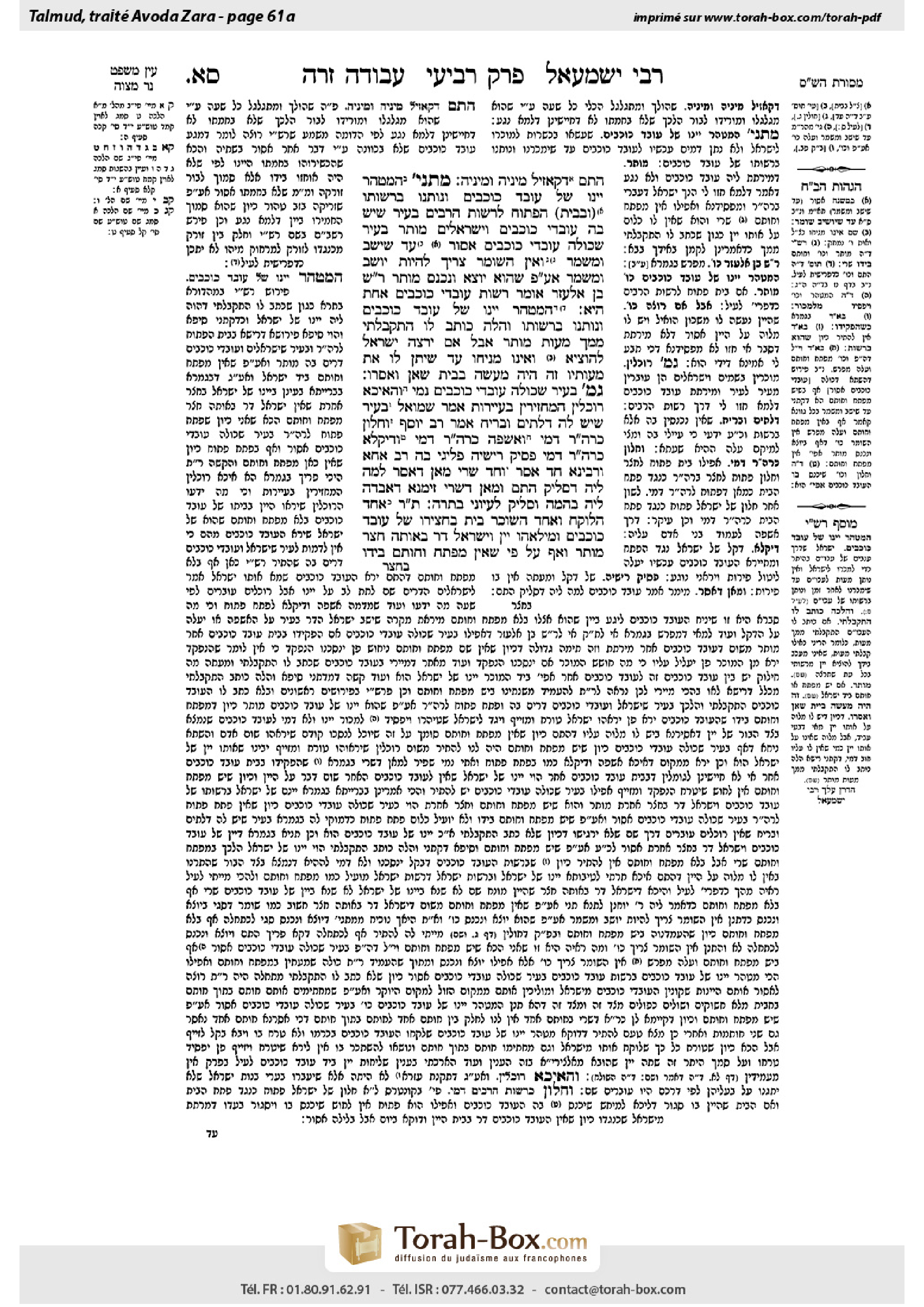
Avodah Zarah 61a: Talmud study for Daf Yomi
Study the Talmud for Daf Yomi with scanned pages, Hebrew text, English translations from Sefaria and AI-generated French translations.
Passage selection and English or AI-generated French translation are available where the scan has annotations. Daf Study is independent of Torah-Box and Sefaria.
Browse Avodah Zarah · עבודה זרה · All tractatesAvodah Zarah 61a text and translations
This page of Avodah Zarah includes the Aramaic text, an English translation and an AI-generated French translation, alongside the scan above.
עבודה זרה ס״א א · Aramaic and Hebrew text
הָתָם, דְּקָאָזֵיל מִינֵּיהּ וּמִינֵּיהּ.
מַתְנִי׳ הַמְטַהֵר יֵינוֹ שֶׁל נׇכְרִי, וְנוֹתְנוֹ בִּרְשׁוּתוֹ (ובבית) [בְּבַיִת] הַפָּתוּחַ לִרְשׁוּת הָרַבִּים, בְּעִיר שֶׁיֵּשׁ בָּהּ גּוֹיִם וְיִשְׂרְאֵלִים — מוּתָּר, בְּעִיר שֶׁכּוּלָּהּ גּוֹיִם — אָסוּר, עַד שֶׁיֵּשֵׁב וּמְשַׁמֵּר.
וְאֵין הַשּׁוֹמֵר צָרִיךְ לִהְיוֹת יוֹשֵׁב וּמְשַׁמֵּר, אַף עַל פִּי שֶׁהוּא יוֹצֵא וְנִכְנָס — מוּתָּר. רַבִּי שִׁמְעוֹן בֶּן אֶלְעָזָר אוֹמֵר: רְשׁוּת גּוֹיִם אַחַת הִיא.
הַמְטַהֵר יֵינוֹ שֶׁל נׇכְרִי וְנוֹתְנוֹ בִּרְשׁוּתוֹ, וְהַלָּה כּוֹתֵב לוֹ: ״הִתְקַבַּלְתִּי מִמְּךָ מָעוֹת״ — מוּתָּר, אֲבָל אִם יִרְצֶה יִשְׂרָאֵל לְהוֹצִיא וְאֵינוֹ מַנִּיחוֹ עַד שֶׁיִּתֵּן לוֹ אֶת מְעוֹתָיו, זֶה הָיָה מַעֲשֶׂה בְּבֵית שְׁאָן וְאָסְרוּ.
גְּמָ׳ בְּעִיר שֶׁכּוּלָּהּ גּוֹיִם נָמֵי, וְהָאִיכָּא רוֹכְלִין הַמַּחְזִירִין בָּעֲיָירוֹת! אָמַר שְׁמוּאֵל: בְּעִיר שֶׁיֵּשׁ לָהּ דְּלָתַיִם וּבְרִיחַ.
אָמַר רַב יוֹסֵף: וְחַלּוֹן כִּרְשׁוּת הָרַבִּים דָּמֵי, וְאַשְׁפָּה כִּרְשׁוּת הָרַבִּים דָּמֵי, וְדִיקְלָא כִּרְשׁוּת הָרַבִּים דָּמֵי.
פְּסִיק רֵישֵׁיהּ — פְּלִיגִי בַּהּ רַב אַחָא וְרָבִינָא: חַד אָסַר, וְחַד שָׁרֵי. מַאן דְּאָסַר — לְמָה לֵיהּ דְּסָלֵיק הָתָם? וּמַאן דְּשָׁרֵי — זִימְנִין דְּאָבְדָה לֵיהּ בְּהֵמָה, וְסָלֵיק לְעַיּוֹנֵי בָּתְרַהּ.
תָּנוּ רַבָּנַן: אֶחָד הַלּוֹקֵחַ וְאֶחָד הַשּׂוֹכֵר בַּיִת בַּחֲצֵירוֹ שֶׁל גּוֹי, וּמִילְּאָהוּ יַיִן, וְיִשְׂרָאֵל דָּר בְּאוֹתָהּ חָצֵר — מוּתָּר, וְאַף עַל פִּי שֶׁאֵין מַפְתֵּחַ וְחוֹתָם בְּיָדוֹ.
Avodah Zarah 61a · English translation
Rav Ashi replied: There, the mishna is referring to a case where the barrel is not actually thrown. Rather, it is propelled by the gentile, and again propelled by him, until it reaches the vat. Therefore, if the gentile did so not in anger, there is reason to be concerned that he might have touched the wine.
MISHNA: In the case of a Jew who renders the wine of a gentile permitted by treading the gentile’s grapes so that the wine can be sold to Jews, and although a Jew has not yet paid for the wine he then places the wine in the gentile’s domain in a house that is open to a public thoroughfare until he sells it, the halakha depends on the circumstances. If this occurs in a city in which there are both gentiles and Jews, the wine is permitted, as the gentile does not touch the wine lest the Jews see him doing so. If this occurs in a city in which all its inhabitants are gentiles, the wine is prohibited unless a Jew sits and safeguards the wine.
But the watchman is not required to sit and guard the wine constantly; even if he frequently leaves the place and comes in again later, the wine is permitted. Rabbi Shimon ben Elazar says: The domain of gentiles is all one, as the Gemara will explain.
In the case of a Jew who renders the wine of a gentile permitted by treading the gentile’s grapes so that the wine can be sold to Jews, and he then places the wine in the gentile’s domain until he sells it, the halakha depends on the circumstances. If that one, the gentile, writes for the Jew: I received money from you in payment for the wine, even though he did not yet receive the actual payment, the wine is permitted. This is because the wine is considered the Jew’s property and the gentile does not venture to touch it. But if the Jew desires to remove the wine and the gentile does not allow him to do so until the Jew gives him the money due to him, this was an incident that occurred in Beit She’an and the Sages deemed the wine prohibited. In this case the gentile believes that he has a lien upon the wine, and therefore he has no compunctions about touching it.
GEMARA: The Gemara questions the mishna’s distinction between a city with Jewish inhabitants and a city without Jewish inhabitants: The wine should also be permitted in a city in which all its inhabitants are gentiles, as aren’t there Jewish peddlers who travel around the various towns? Consequently, the gentile refrains from touching the wine, lest the Jewish peddlers see him touching it. Shmuel says: The mishna is referring to a city that has double doors and a crossbar, and the residents know when outsiders enter the city.
With regard to the mishna’s statement that the wine is permitted only if the gentile’s house is open to a public thoroughfare, Rav Yosef says: And if a Jew’s window is open to that place it is considered like a public thoroughfare. And similarly, a trash heap is considered like a public thoroughfare as many people frequent it, and a palm tree is considered like a public thoroughfare, as the gentile is concerned lest someone climbing the palm tree see him.
With regard to a case where the top of the palm tree was cut off, Rav Aḥa and Ravina disagree: One of them deems the wine prohibited and one of them deems it permitted. The Gemara explains: The one who deems the wine prohibited holds that since no fruit grows on the palm tree, why would someone climb up there? The gentile therefore has no reason for concern lest someone see him, and he has no compunctions about touching the wine. And the one who deems the wine permitted holds that it happens on occasion that someone loses an animal and he climbs up the palm tree to look for it. The gentile is therefore concerned lest someone climbing the palm tree see him, and he does not touch the wine.
§ The Sages taught: In the case of a Jew who purchases a house or one who rents a house in a gentile’s courtyard, and a Jew filled the house with barrels of wine, if another Jew dwells in the same courtyard, the wine is permitted. This halakha applies even if that Jew does not have in his possession the key to the house or a seal on the barrels of wine.
Avodah Zarah 61a · Traduction française (IA)
Rav Ashi répondit : Là, la michna fait référence à un cas où le tonneau n'est pas effectivement lancé. Plutôt, il est propulsé par le non-Juif, et à nouveau propulsé par lui, jusqu'à ce qu'il atteigne le tonneau. Ainsi, si le non-Juif l'a fait sans colère, il y a lieu de s'inquiéter qu'il ait pu toucher le vin.
MICHNA : Dans le cas d'un Juif qui rend le vin d'un non-Juif permis en foulant les raisins du non-Juif afin que le vin puisse être vendu aux Juifs, et bien qu'un Juif n'ait pas encore payé pour le vin, il place alors le vin dans le domaine du non-Juif, dans une maison ouverte à une rue publique jusqu'à ce qu'il le vende, la halakha dépend des circonstances. Si cela arrive dans une ville où habitent à la fois des non-Juifs et des Juifs, le vin est permis, car le non-Juif ne touche pas le vin de crainte que les Juifs ne le voient le faire. Si cela arrive dans une ville où tous les habitants sont des non-Juifs, le vin est interdit à moins qu'un Juif ne soit assis pour le garder.
Mais le gardien n'est pas tenu de garder le vin constamment ; même s'il part fréquemment et revient plus tard, le vin est permis. Rabbi Shimon ben Elazar dit : Le domaine des non-Juifs est un seul, comme l'expliquera la Guemara.
Dans le cas d'un Juif qui rend le vin d'un non-Juif permis en foulant les raisins du non-Juif afin que le vin puisse être vendu aux Juifs, et il place alors le vin dans le domaine du non-Juif jusqu'à ce qu'il le vende, la halakha dépend des circonstances. Si celui-ci, le non-Juif, écrit au Juif : J'ai reçu de l'argent de votre part en paiement pour le vin, même s'il n'a pas encore reçu le paiement réel, le vin est permis. Cela est dû au fait que le vin est considéré comme la propriété du Juif et que le non-Juif n'ose pas le toucher. Mais si le Juif désire retirer le vin et que le non-Juif ne lui permet pas de le faire jusqu'à ce que le Juif lui donne l'argent dû, c'était un cas qui s'est produit à Beth She'an et les Sages ont jugé le vin interdit. Dans ce cas, le non-Juif croit avoir un droit sur le vin, et donc n'a pas de remords à toucher le vin.
GUEMARA : La Guemara questionne la distinction de la michna entre une ville avec des habitants juifs et une ville sans habitants juifs : le vin devrait aussi être permis dans une ville où tous les habitants sont des non-Juifs, car ne sont-ce pas des marchands juifs qui circulent entre les diverses villes ? Ainsi, le non-Juif évite de toucher le vin, de crainte que les marchands juifs ne le voient le faire. Shmuel dit : La michna fait référence à une ville qui a deux portes et une barre transversale, et les habitants savent quand des étrangers entrent dans la ville.
Concernant la déclaration de la michna que le vin est permis uniquement si la maison du non-Juif est ouverte à une rue publique, Rav Yosef dit : Et si la fenêtre d'un Juif est ouverte vers ce lieu, cela est considéré comme une rue publique. De même, une montagne de détritus est considérée comme une rue publique, car beaucoup de personnes y passent, et un palmier est considéré comme une rue publique, car le non-Juif craint que quelqu'un montant sur le palmier ne le voie.
Concernant un cas où la partie supérieure du palmier avait été coupée, Rav Acha et Ravina sont en désaccord : l'un considère le vin comme interdit et l'autre comme permis. La Guemara explique : celui qui considère le vin comme interdit pense que puisque aucun fruit ne pousse sur le palmier, pourquoi quelqu'un monterait-il là-haut ? Le non-Juif n'a donc pas de raison de craindre que quelqu'un le voie, et n'a donc pas de remords à toucher le vin. Et celui qui considère le vin comme permis pense que cela arrive parfois que quelqu'un perde un animal et monte sur le palmier pour le chercher. Le non-Juif est donc craint que quelqu'un montant sur le palmier le voie, et ne touche donc pas le vin.
§ Les Sages enseignèrent : Dans le cas d'un Juif qui achète une maison ou qui loue une maison dans le courtil d'un non-Juif, et un Juif remplit la maison de tonneaux de vin, si un autre Juif habite dans le même courtil, le vin est permis. Cette halakha s'applique même si ce Juif ne possède pas la clé de la maison ou un sceau sur les tonneaux de vin.
Traduction française générée par IA à partir de l’édition anglaise de Sefaria. Vérifie toujours un passage avec le texte source.
Text from Sefaria: William Davidson Edition - Vocalized Aramaic (CC BY NC); William Davidson Edition - English (CC BY NC).