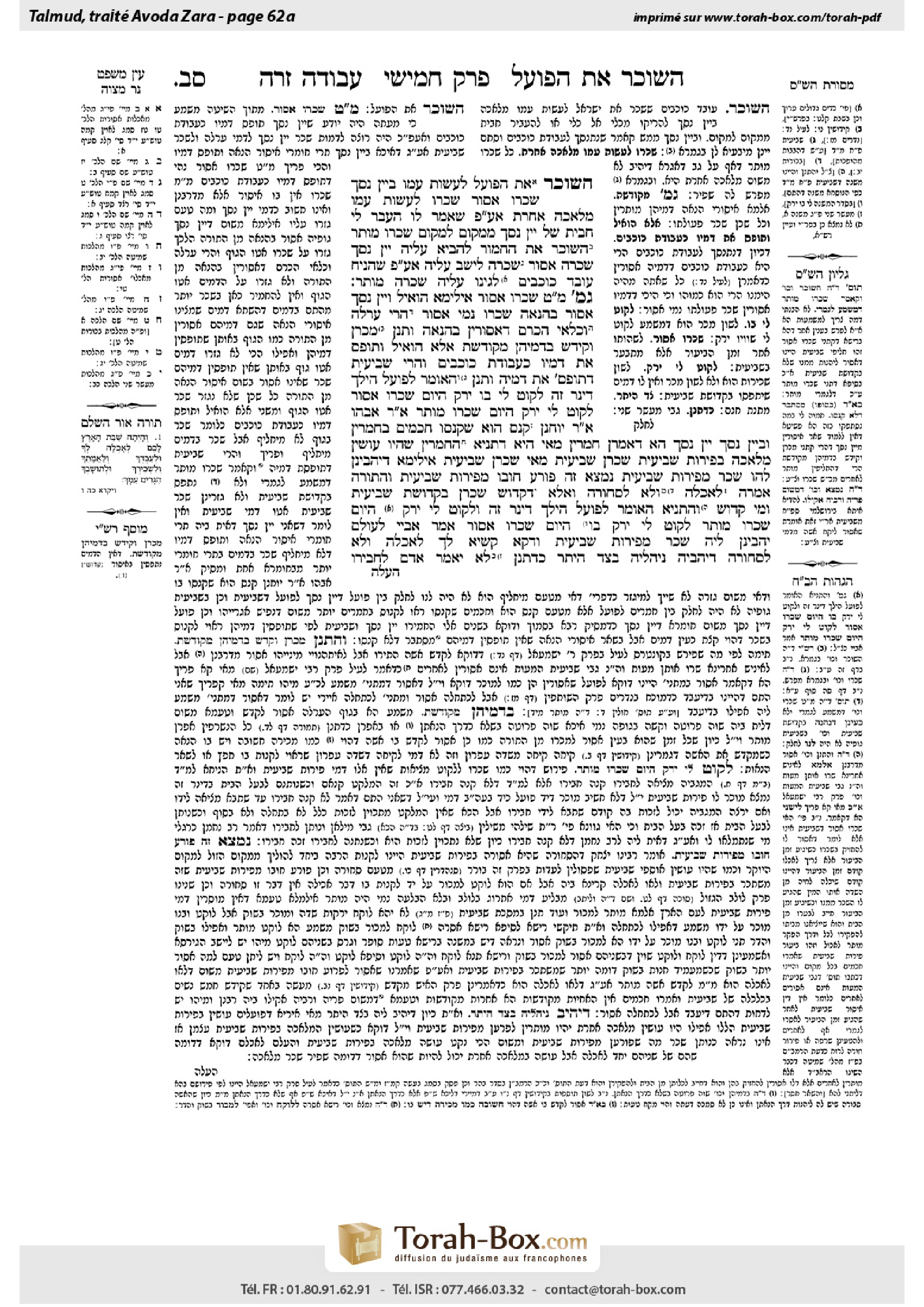
Avodah Zarah 62a: Talmud study for Daf Yomi
Study the Talmud for Daf Yomi with scanned pages, Hebrew text, English translations from Sefaria and AI-generated French translations.
Passage selection and English or AI-generated French translation are available where the scan has annotations. Daf Study is independent of Torah-Box and Sefaria.
Browse Avodah Zarah · עבודה זרה · All tractatesAvodah Zarah 62a text and translations
This page of Avodah Zarah includes the Aramaic text, an English translation and an AI-generated French translation, alongside the scan above.
עבודה זרה ס״ב א · Aramaic and Hebrew text
מַתְנִי׳ הַשּׂוֹכֵר אֶת הַפּוֹעֵל לַעֲשׂוֹת עִמּוֹ בְּיֵין נֶסֶךְ — שְׂכָרוֹ אָסוּר. שְׂכָרוֹ לַעֲשׂוֹת עִמּוֹ מְלָאכָה אַחֶרֶת, אַף עַל פִּי שֶׁאָמַר לוֹ ״הַעֲבֵר לִי חָבִית שֶׁל יַיִן נֶסֶךְ מִמָּקוֹם לְמָקוֹם״ — שְׂכָרוֹ מוּתָּר. הַשּׂוֹכֵר אֶת הַחֲמוֹר לְהָבִיא עָלֶיהָ יֵין נֶסֶךְ — שְׂכָרָהּ אָסוּר. שְׂכָרָהּ לֵישֵׁב עָלֶיהָ, אַף עַל פִּי שֶׁהִנִּיחַ גּוֹי לְגִינוֹ עָלֶיהָ — שְׂכָרָהּ מוּתָּר.
גְּמָ׳ מַאי טַעְמָא שְׂכָרוֹ אָסוּר? אִילֵּימָא, הוֹאִיל וְיֵין נֶסֶךְ אָסוּר בַּהֲנָאָה, שְׂכָרוֹ נָמֵי אָסוּר — הֲרֵי עׇרְלָה וְכִלְאֵי הַכֶּרֶם דַּאֲסוּרִין בַּהֲנָאָה, וּתְנַן: מְכָרָן וְקִידֵּשׁ בִּדְמֵיהֶן — מְקוּדֶּשֶׁת!
אֶלָּא, הוֹאִיל וְתוֹפֵס אֶת דָּמָיו כַּעֲבוֹדָה זָרָה. וַהֲרֵי שְׁבִיעִית דְּתוֹפֶסֶת אֶת דָּמֶיהָ, וּתְנַן: הָאוֹמֵר לְפוֹעֵל ״הֵילָךְ דִּינָר זֶה, לְקוֹט לִי בּוֹ יָרָק הַיּוֹם״ — שְׂכָרוֹ אָסוּר, ״לְקוֹט לִי יָרָק הַיּוֹם״ — שְׂכָרוֹ מוּתָּר!
אָמַר רַבִּי אֲבָהוּ אָמַר רַבִּי יוֹחָנָן: קְנָס הוּא שֶׁקָּנְסוּ חֲכָמִים בַּחֲמָרִין וּבְיֵין נֶסֶךְ. יֵין נֶסֶךְ — הָא דַּאֲמַרַן, חַמָּרִין מַאי הִיא? דְּתַנְיָא: הַחַמָּרִין שֶׁהָיוּ עוֹשִׂין מְלָאכָה בְּפֵירוֹת שְׁבִיעִית — שְׂכָרָן שְׁבִיעִית.
מַאי ״שְׂכָרָן שְׁבִיעִית״? אִילֵּימָא דְּיָהֲבִינַן לְהוּ שָׂכָר מִפֵּירוֹת שְׁבִיעִית, נִמְצָא זֶה פּוֹרֵעַ חוֹבוֹ מִפֵּירוֹת שְׁבִיעִית, וְהַתּוֹרָה אָמְרָה: ״לְאׇכְלָה״ וְלֹא לִסְחוֹרָה!
וְאֶלָּא דְּקָדוֹשׁ שְׂכָרָן בִּקְדוּשַּׁת שְׁבִיעִית. וּמִי קָדוֹשׁ? וְהָתַנְיָא: הָאוֹמֵר לְפוֹעֵל: ״הֵילָךְ דִּינָר זֶה וּלְקוֹט לִי יָרָק הַיּוֹם״ — שְׂכָרוֹ מוּתָּר, ״לְקוֹט לִי יָרָק בּוֹ הַיּוֹם״ — שְׂכָרוֹ אָסוּר!
אָמַר אַבָּיֵי: לְעוֹלָם יָהֲבִינַן לֵיהּ שָׂכָר מִפֵּירוֹת שְׁבִיעִית, וּדְקָא קַשְׁיָא לָךְ ״לְאׇכְלָה״ וְלֹא לִסְחוֹרָה, דְּיַהֲבֵיהּ נִיהֲלֵיהּ בְּצַד הֶיתֵּר, כְּדִתְנַן: לֹא יֹאמַר אָדָם לַחֲבֵירוֹ:
Avodah Zarah 62a · English translation
MISHNA: In the case of a gentile who hires a Jewish laborer to work with wine used for an idolatrous libation with him, his wage is forbidden, i.e., it is prohibited for the Jew to derive benefit from his wage. If the gentile hired him to do other work with him, even if he said to him while he was working with him: Transport the barrel of wine used for a libation for me from this place to that place, his wage is permitted, i.e., the Jew is permitted to derive benefit from the money. With regard to a gentile who rents a Jew’s donkey to carry wine used for a libation on it, its rental fee is forbidden. If he rented it to sit on it, even if a gentile placed his jug of wine used for a libation on it, its rental fee is permitted.
GEMARA: In the first case of the mishna, where a gentile hires a Jew to produce wine used for a libation with him, what is the reason that his wage is forbidden? If we say that since it is prohibited to derive benefit from wine used for a libation, his wage is also prohibited, that is difficult: There are the cases of orla produce, i.e., produce grown during a tree’s first three years, and diverse kinds planted in a vineyard, from which it is also prohibited to derive benefit, and yet we learned in a mishna (Kiddushin 56b) that if a man sold this produce and betrothed a woman with the money received for it, she is betrothed. Evidently, money gained from a forbidden item is not itself forbidden, as otherwise the betrothal would not take effect.
Rather, perhaps the reason that the wage is forbidden is since the wine used for a libation transfers to the money its status as an object of idol worship. The Gemara challenges: But there is the halakha of Sabbatical-Year produce, which transfers its sanctity to the money with which it is redeemed, and yet we learned in a mishna (Shevi’it 8:4): With regard to one who says to his laborer during the Sabbatical Year: Here is this dinar I give to you; gather for me vegetables for its value today, his wage is forbidden, i.e., the sanctity of the Sabbatical-Year produce is transferred to the wage, since it is as though he has purchased Sabbatical-Year produce in exchange for the dinar. But if the employer says to him: Gather for me vegetables today, without mentioning that it is for the value of the dinar, his wage is permitted, as he merely paid him for his labor. This should apply as well to the case of the wine used for a libation.
Rabbi Abbahu says that Rabbi Yoḥanan says: This is a penalty that the Sages imposed upon donkey drivers and with regard to wine used for a libation. The Gemara explains: With regard to wine used for a libation, the penalty is as we said, that the wage of one who is hired to work in the production of wine used for libation is forbidden. With regard to donkey drivers, what is this penalty? The penalty is as it is taught in a baraita: With regard to the donkey drivers who were working in the transportation of Sabbatical-Year produce, their wage is Sabbatical-Year produce.
The Gemara asks: What does it mean when it says that their wage is Sabbatical-Year produce? If we say that we give them their wage for their work from Sabbatical-Year produce, the employer consequently is paying his debt from Sabbatical-Year produce, and this violates that which the Torah states: “And the Sabbatical produce of the land shall be for food for you” (Leviticus 25:6), indicating that this produce is designated for food, but not for commerce.
And if it means that their wage is sacred with the sanctity of Sabbatical-Year produce, is that wage in fact sacred? But isn’t it taught in a mishna that with regard to one who says to a laborer: Here is this dinar I give to you and gather for me vegetables today, his wage is permitted, but if he says to him: Gather for me vegetables today for its value, his wage is forbidden? The case of the donkey drivers is clearly similar to the former case, where the value of the dinar was not mentioned.
Abaye said: Actually, Rabbi Yoḥanan’s statement should be interpreted as saying that we give him his wage from Sabbatical-Year produce. And as for that which appears to pose a difficulty for you, that the verse designates such produce “for food” but not for commerce, that can be resolved by explaining that one gives him his wage in a permitted manner, i.e., as a gift rather than as a wage. This is as we learned in a mishna (Ma’aser Sheni 3:1) that a person should not say to another:
Avodah Zarah 62a · Traduction française (IA)
MICHNA : Dans le cas d’un non-Juif qui embauche un ouvrier juif pour travailler avec du vin utilisé pour une libation idolâtre, son salaire est interdit, c’est-à-dire il est interdit au Juif de tirer un bénéfice de son salaire. Si le non-Juif l’a embauché pour faire d’autres travaux avec lui, même s’il lui a dit pendant qu’il travaillait avec lui : Transporte-moi ce tonneau de vin utilisé pour une libation de ce lieu à cet autre lieu, son salaire est permis, c’est-à-dire le Juif est autorisé à tirer un bénéfice de l’argent. En ce qui concerne un non-Juif qui loue un âne juif pour porter du vin utilisé pour une libation sur lui, son prix de location est interdit. Si il l’a loué pour s’asseoir dessus, même si un non-Juif a mis son tonneau de vin utilisé pour une libation dessus, son prix de location est permis.
GUEMARA : Dans le premier cas de la mishna, où un non-Juif embauche un Juif pour produire du vin utilisé pour une libation avec lui, quelle est la raison pour laquelle son salaire est interdit ? Si nous disons que puisque c’est interdit de tirer un bénéfice du vin utilisé pour une libation, son salaire est également interdit, cela pose un problème : Il y a les cas des fruits orla, c’est-à-dire les fruits cultivés durant les trois premières années d’un arbre, et diverses sortes plantées dans un vignoble, dont il est également interdit de tirer un bénéfice, et pourtant nous avons appris dans une mishna (Kiddushin 56b) que si un homme vendait ces fruits et épousait une femme avec l’argent reçu pour cela, elle était épousée. Évidemment, l’argent gagné à partir d’un objet interdit n’est pas lui-même interdit, car autrement le mariage ne prendrait pas effet.
Peut-être plutôt la raison pour laquelle le salaire est interdit est que le vin utilisé pour une libation transfère à l’argent son statut d’objet de culte idolâtre. La Guemara conteste : Mais il y a la halakha des fruits de l’année sabbatique, qui transfère sa sanctité à l’argent avec lequel ils sont rachetés, et pourtant nous avons appris dans une mishna (Shevi’it 8:4) : En ce qui concerne celui qui dit à son ouvrier pendant l’année sabbatique : Ici est ce dinar que je te donne ; récolte pour moi des légumes équivalents à sa valeur aujourd’hui, son salaire est interdit, c’est-à-dire la sanctité des fruits de l’année sabbatique est transférée au salaire, car c’est comme s’il avait acheté des fruits de l’année sabbatique en échange du dinar. Mais si l’employeur dit à lui : Récolte pour moi des légumes aujourd’hui, sans mentionner que c’est pour la valeur du dinar, son salaire est permis, car il lui paie simplement pour son travail. Cela devrait s’appliquer également au cas du vin utilisé pour une libation.
Rabbi Abbahu dit que Rabbi Yoḥanan dit : C’est une peine que les Sages ont imposée aux conducteurs d’ânes et concernant le vin utilisé pour une libation. La Guemara explique : Concernant le vin utilisé pour une libation, la peine est comme nous l’avons dit, que le salaire de celui qui est embauché pour travailler dans la production du vin utilisé pour une libation est interdit. Concernant les conducteurs d’ânes, quelle est cette peine ? La peine est comme il est enseigné dans une baraïta : Concernant les conducteurs d’ânes qui travaillaient dans le transport des fruits de l’année sabbatique, leur salaire est des fruits de l’année sabbatique.
La Guemara pose la question : Quel est le sens de ce qui dit que leur salaire est des fruits de l’année sabbatique ? Si nous disons que nous leur donnons leur salaire pour leur travail à partir des fruits de l’année sabbatique, l’employeur paie ainsi sa dette à partir des fruits de l’année sabbatique, et cela viole ce que la Torah stipule : « Et les fruits de l’année sabbatique du sol seront pour votre nourriture » (Lvïtique 25:6), indiquant que ces fruits sont désignés pour la nourriture, mais pas pour le commerce.
Et si cela signifie que leur salaire est sacré avec la sanctité des fruits de l’année sabbatique, ce salaire est-il effectivement sacré ? Mais n’est-il pas enseigné dans une mishna que concernant celui qui dit à un ouvrier : Ici est ce dinar que je te donne ; récolte pour moi des légumes aujourd’hui, son salaire est permis, mais si il dit à lui : Récolte pour moi des légumes aujourd’hui pour sa valeur, son salaire est interdit ? Le cas des conducteurs d’ânes est clairement similaire au premier cas, où la valeur du dinar n’a pas été mentionnée.
Abaye dit : En réalité, la déclaration de Rabbi Yoḥanan devrait être interprétée comme disant que nous lui donnons son salaire à partir des fruits de l’année sabbatique. Et concernant ce qui semble poser un problème pour vous, que la parole désigne ces fruits comme « pour la nourriture » mais pas pour le commerce, cela peut être résolu en expliquant que l’on lui donne son salaire d’une manière permise, c’est-à-dire en tant que don plutôt que comme salaire. C’est comme nous avons appris dans une mishna (Ma’aser Sheni 3:1) que personne ne doit dire à un autre :
Traduction française générée par IA à partir de l’édition anglaise de Sefaria. Vérifie toujours un passage avec le texte source.
Text from Sefaria: William Davidson Edition - Vocalized Aramaic (CC BY NC); William Davidson Edition - English (CC BY NC).