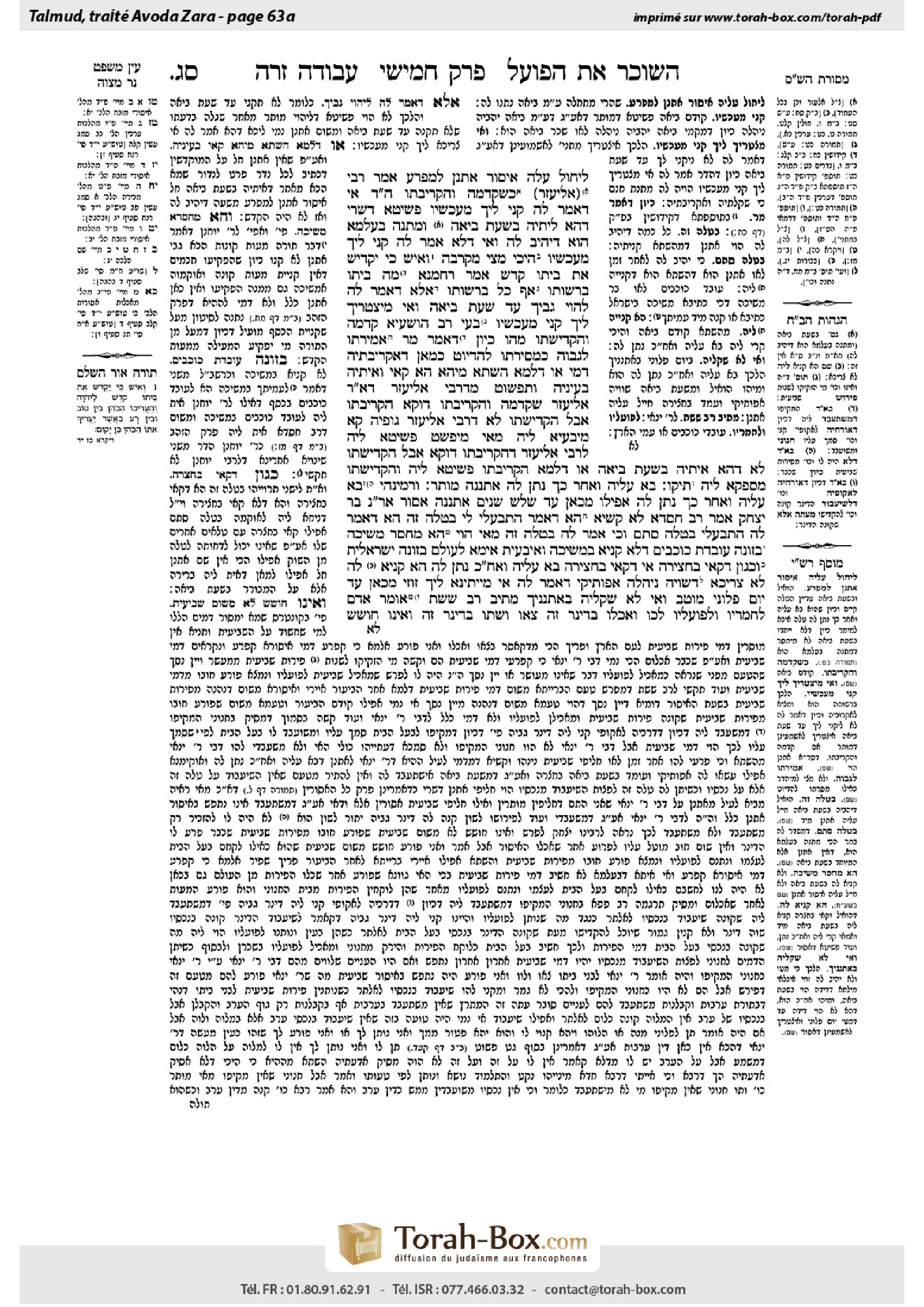
Avodah Zarah 63a: Talmud study for Daf Yomi
Study the Talmud for Daf Yomi with scanned pages, Hebrew text, English translations from Sefaria and AI-generated French translations.
Passage selection and English or AI-generated French translation are available where the scan has annotations. Daf Study is independent of Torah-Box and Sefaria.
Browse Avodah Zarah · עבודה זרה · All tractatesAvodah Zarah 63a text and translations
This page of Avodah Zarah includes the Aramaic text, an English translation and an AI-generated French translation, alongside the scan above.
עבודה זרה ס״ג א · Aramaic and Hebrew text
לֵיחוּל עֲלַהּ אִיסּוּר אֶתְנַן לְמַפְרֵעַ! אָמַר רַבִּי אֱלִיעֶזֶר: כְּשֶׁקָּדְמָה וְהִקְרִיבַתּוּ.
הֵיכִי דָמֵי? אִי דְּאָמַר לַהּ: ״קְנַי לִיךְ מֵעַכְשָׁיו״ — פְּשִׁיטָא דִּשְׁרֵי, דְּהָא לֵיתֵיהּ בִּשְׁעַת בִּיאָה, וּמַתָּנָה בְּעָלְמָא הוּא דְּיָהֵיב לַהּ!
וְאִי דְּלָא אָמַר לַהּ ״קְנַי לִיךְ מֵעַכְשָׁיו״, הֵיכִי (מצי) [מָצְיָא] מַקְרְבָה? ״וְאִישׁ כִּי יַקְדִּשׁ אֶת בֵּיתוֹ קֹדֶשׁ״ אָמַר רַחֲמָנָא, מָה בֵּיתוֹ בִּרְשׁוּתוֹ, אַף כֹּל בִּרְשׁוּתוֹ.
אֶלָּא, דְּאָמַר לַהּ: ״לֶהֱוֵי גַּבִּיךְ עַד שְׁעַת בִּיאָה, וְאִי מִיצְטְרִיךְ לִיךְ קְנַי מֵעַכְשָׁיו״.
בָּעֵי רַב הוֹשַׁעְיָא: קָדְמָה וְהִקְדִּישַׁתּוּ, מַהוּ? כֵּיוָן דְּאָמַר מָר: אֲמִירָתוֹ לְגָבוֹהַּ כִּמְסִירָתוֹ לְהֶדְיוֹט, כְּמַאן דְּאַקְרֵיבְתֵּיהּ דָּמֵי, אוֹ דִּלְמָא הַשְׁתָּא מִיהָא הָא קָאֵי וְאִיתֵיהּ בְּעֵינֵיהּ?
וְתִפְשׁוֹט מִדְּרַבִּי אֱלִיעֶזֶר, דְּאָמַר רַבִּי אֱלִיעֶזֶר: שֶׁקָּדְמָה וְהִקְרִיבַתּוּ — דַּוְקָא הִקְרִיבַתּוּ, אֲבָל הִקְדִּישַׁתּוּ — לָא.
דְּרַבִּי אֱלִיעֶזֶר גּוּפֵיהּ קָא מִיבַּעְיָא לֵיהּ, מַאי? מִיפְשָׁט פְּשִׁיטָא לֵיהּ לְרַבִּי אֱלִיעֶזֶר דְּהִקְרִיבַתּוּ דַּוְקָא, אֲבָל הִקְדִּישַׁתּוּ — לָא, דְּהָא אִיתֵיהּ בִּשְׁעַת בִּיאָה? אוֹ דִלְמָא הִקְרִיבַתּוּ פְּשִׁיטָא לֵיהּ, וְהִקְדִּישַׁתּוּ מְסַפְּקָא לֵיהּ? תֵּיקוּ.
בָּא עָלֶיהָ וְאַחַר כָּךְ נָתַן לָהּ אֶתְנַנָּהּ — מוּתָּר, וּרְמִינְהִי: בָּא עָלֶיהָ וְאַחַר כָּךְ נָתַן לָהּ, אֲפִילּוּ מִכָּאן עַד שָׁלֹשׁ שָׁנִים — אֶתְנַנָּהּ אָסוּר!
אָמַר רַב נַחְמָן בַּר יִצְחָק אָמַר רַב חִסְדָּא: לָא קַשְׁיָא, הָא דְּאָמַר ״הִתְבַּעֲלִי לִי בְּטָלֶה זֶה״, הָא דַּאֲמַר לַהּ ״הִתְבַּעֲלִי בְּטָלֶה״ סְתָם.
וְכִי אָמַר לַהּ ״בְּטָלֶה זֶה״ מַאי הָוֵי? הָא מְחַסַּר מְשִׁיכָה! בְּזוֹנָה גּוֹיָה, דְּלָא קָנְיָא בִּמְשִׁיכָה. וְאִיבָּעֵית אֵימָא: לְעוֹלָם בְּזוֹנָה יִשְׂרְאֵלִית, וּכְגוֹן דְּקָאֵי בַּחֲצֵירָהּ.
אִי דְּקָאֵי בַּחֲצֵירָהּ, בָּא עָלֶיהָ וְאַחַר כָּךְ נָתַן לָהּ, הָא קָנְיָא לֵהּ! לָא צְרִיכָא, דְּשַׁוְּיֵהּ נִיהֲלַהּ אַפּוֹתֵיקֵי, דַּאֲמַר לַהּ: ״אִי מַיְיתֵינָא לִיךְ זוּזֵי מִכָּאן עַד יוֹם פְּלוֹנִי — מוּטָב, וְאִי לָא — שִׁקְלֵיהּ בְּאֶתְנַנִּיךְ״.
מֵתִיב רַב שֵׁשֶׁת: אוֹמֵר אָדָם לַחֲמָרָיו וּלְפוֹעֲלָיו ״לְכוּ וְאִכְלוּ בְּדִינָר זֶה״, ״צְאוּ וּשְׁתוּ בְּדִינָר זֶה״, וְאֵינוֹ חוֹשֵׁשׁ
Avodah Zarah 63a · English translation
the prohibition with regard to payment to a prostitute should apply to the payment retroactively. Rabbi Eliezer says: The baraita is referring to a situation when she sacrificed the payment in the Temple first, before the intercourse took place.
The Gemara asks: What are the circumstances of such a situation? If the circumstances are that he said to her: Acquire this payment from now, it is obvious that it is permitted to sacrifice it, as it is not extant as payment at the time of the intercourse, and it is merely a gift that he gave her. It would not be necessary for the baraita to state this.
And if the circumstances are that he did not say to her: Acquire this payment from now, how can she be allowed to sacrifice it? The Merciful One states in the Torah: “And when a man shall sanctify his house to be holy to the Lord” (Leviticus 27:14), from which it is derived that just as one’s house is in his possession, so too, any item that a person wishes to consecrate must be in his possession. The prostitute cannot consecrate an animal that is not in her possession.
Rather, the baraita is referring to a situation where he said to her: Let the animal be with you until the time of intercourse, and if you need it in the meantime, acquire it from now. The baraita teaches that in this situation she may sacrifice her payment as an offering.
Rav Hoshaya raises a dilemma: If she consecrated it first, before the intercourse, what is the halakha? Since the Master said that declaration to the Most High is equivalent to transfer to an ordinary person, i.e., a spoken consecration of an item to the Temple is deemed, in terms of acquisition, like the legal transfer of an item to a person, therefore, since she consecrated it by speech, is it considered tantamount to having sacrificed it, and consequently it would be permitted to sacrifice it? Or perhaps should it be reasoned that now, at the time of the intercourse, in any event, the animal is extant, i.e., it was not actually sacrificed, and therefore it is prohibited to sacrifice it?
The Gemara suggests: Resolve the dilemma from the statement of Rabbi Eliezer, as Rabbi Eliezer says: The baraita is referring to a case where she sacrificed it first. By inference, it is referring specifically to a case where she sacrificed it; but if she merely consecrated it, then it is not permitted to sacrifice the animal, as it is considered in her possession at the time of the intercourse.
The Gemara rejects this resolution: Rav Hoshaya raises the dilemma with regard to the statement of Rabbi Eliezer itself, asking what his intent is: Is it obvious to Rabbi Eliezer that the animal is permitted specifically in a case where she sacrificed it, but in a case where she merely consecrated it, that is not the halakha, and the payment is forbidden, because it is extant as payment at the time of the intercourse? Or perhaps does he mention specifically the case where she sacrificed it because that case is obvious to him, but with regard to the case where she consecrated it, he is uncertain whether it is permitted or not, and he therefore did not rule on the matter? The Gemara comments: The dilemma shall stand unresolved.
§ The baraita teaches: If he engaged in intercourse with her and afterward, after some time elapsed, gave her payment, her payment is permitted. The Gemara raises a contradiction from another baraita: If he engaged in intercourse with her and afterward gave her payment, even from now until three years afterward, her payment is forbidden.
Rav Naḥman bar Yitzḥak said that Rav Ḥisda said: This is not difficult. This case, where it is forbidden, is where he said in advance: Engage in intercourse with me in exchange for this lamb. In this case the lamb is considered to be her property immediately, even if he actually gave it to her only after some time had elapsed. That case, where the animal is permitted, is where he said to her: Engage in intercourse with me in exchange for a lamb, without specifying a particular one. Since he did not specify a particular lamb as the fee, when he later gives her a lamb, it is not deemed payment.
The Gemara asks: But when he says to her: In exchange for this lamb, what of it? Isn’t a formal act of acquisition, such as pulling the lamb, absent from the transaction? In any case she has not acquired it. The Gemara answers: The reference is to the case of a gentile prostitute, who does not acquire by pulling; gentiles acquire an item by paying money for it. And if you wish, say instead that actually, the reference is to a Jewish prostitute, and it is a case where the lamb is already standing in her courtyard. This effected the acquisition as soon as the man stated his intent to give her the lamb, in accordance with the principle that a person acquires that which is within his property.
The Gemara challenges: If the reference is to a case where it is standing in her courtyard, that is not a case where he engaged in intercourse with her and afterward he gave her payment, since it was acquired by her before he engaged in intercourse with her. The Gemara answers: No, it is necessary to state this halakha with regard to a case where he rendered the lamb as designated payment [appoteiki] for her, i.e., a case where he said to her: If I bring you dinars from now until such and such a day, all is well, and you will return the lamb to me, but if not, take the lamb as your payment.
§ The Gemara resumes discussion of the practice of the Sages from the school of Rabbi Yannai, who would borrow produce from the poor during the Sabbatical Year and repay them after the Sabbatical Year, and Rabbi Yoḥanan’s ruling that this is permitted, as it is not considered commerce with Sabbatical-Year produce. Rav Sheshet raises an objection to this ruling from a baraita: A person may say to his donkey drivers or to his laborers: Go and eat with this dinar, or: Go and drink with this dinar, and he does not need to be concerned that his workers will transgress a prohibition with the money he has given them,
Avodah Zarah 63a · Traduction française (IA)
La prohibition concernant le paiement à une prostituée doit s'appliquer rétroactivement. Rabbi Eliezer dit : La baraïta fait référence à un cas où elle a d'abord offert le paiement dans le Temple, avant que l'acte sexuel ne se produise.
La Guemara pose la question : Quelles sont les circonstances de tels cas ? Si les circonstances sont que l'homme a dit à elle : Acquière ce paiement à partir de maintenant, il est évident qu'il est permis de le sacrifier, car il n'est pas présent comme paiement au moment de l'acte sexuel, et il s'agit simplement d'un cadeau qu'il lui a donné. Il n'aurait pas été nécessaire que la baraïta énonce cela.
Et si les circonstances sont que l'homme n'a pas dit à elle : Acquière ce paiement à partir de maintenant, comment peut-elle être autorisée à le sacrifier ? Le Tout-Puissant dit dans la Torah : « Et quand un homme sanctifiera sa maison pour être saint à l'Éternel » (Lévitique 27:14), d'où il est déduit que tout ce qui est en possession d'une personne peut être consacré. La prostituée ne peut pas consacrer un animal qui n'est pas en son possession.
Plutôt, la baraïta fait référence à un cas où l'homme a dit à elle : L'animal reste avec toi jusqu'au moment de l'acte sexuel, et si tu en as besoin avant, acquière-le maintenant. La baraïta enseigne que dans ce cas, elle peut sacrifier son paiement en offrande.
Rav Hoshaya soulève un dilemme : Si elle a consacré l'animal d'abord, avant l'acte sexuel, quelle est la halakha ? Puisque le Maître a dit que la déclaration à l'Éternel est équivalente à un transfert à un homme ordinaire, c'est-à-dire qu'une consécration verbale d'un objet au Temple est considérée, en termes d'acquisition, comme un transfert légal d'un objet à une personne, donc, puisque elle a consacré l'animal par la parole, est-ce considéré comme équivalent à l'avoir sacrifié, et par conséquent, est-il permis de le sacrifier ? Ou peut-être devrait-on raisonner que maintenant, au moment de l'acte sexuel, l'animal est présent, c'est-à-dire qu'il n'a pas été effectivement sacrifié, et par conséquent, il est interdit de le sacrifier ?
La Guemara suggère : Résolvez ce dilemme à partir de la déclaration de Rabbi Eliezer, car Rabbi Eliezer dit : La baraïta fait référence à un cas où elle a sacrifié l'animal d'abord. Par conséquent, il s'agit spécifiquement d'un cas où elle a sacrifié l'animal ; mais si elle a simplement consacré l'animal, alors il n'est pas permis de sacrifier l'animal, car il est considéré comme étant en son possession au moment de l'acte sexuel.
La Guemara rejette cette résolution : Rav Hoshaya soulève le dilemme concernant la déclaration de Rabbi Eliezer lui-même, en demandant ce que son intention est : Est-ce évident pour Rabbi Eliezer que l'animal est permis spécifiquement dans le cas où elle l'a sacrifié, mais dans le cas où elle l'a simplement consacrée, ce n'est pas la halakha, et le paiement est interdit, car il est présent comme paiement au moment de l'acte sexuel ? Ou peut-être est-ce qu'il mentionne spécifiquement le cas où elle l'a sacrifié parce que ce cas lui est évident, mais concernant le cas où elle l'a consacrée, il est incertain s'il est permis ou non, et il n'a donc pas tranché sur la question ? La Guemara commente : Ce dilemme restera sans résolution.
§ La baraïta enseigne : Si l'homme a eu des relations sexuelles avec elle et ensuite, après un certain temps, lui a donné le paiement, son paiement est permis. La Guemara soulève une contradiction avec une autre baraïta : Si l'homme a eu des relations sexuelles avec elle et ensuite lui a donné le paiement, même de maintenant jusqu'à trois ans plus tard, son paiement est interdit.
Rav Naḥman bar Yitzḥak a dit que Rav Ḥisda a dit : Ce n'est pas difficile. Ce cas, où il est interdit, est celui où il a dit à l'avance : Fais avec moi l'acte sexuel en échange de ce agneau. Dans ce cas, l'agneau est considéré comme étant à sa propriété immédiatement, même s'il a effectivement donné l'agneau à elle seulement après un certain temps. Ce cas, où l'animal est permis, est celui où il a dit à elle : Fais avec moi l'acte sexuel en échange d'un agneau, sans spécifier un agneau particulier. Puisque il n'a pas spécifié un agneau particulier comme paiement, quand il lui donne plus tard un agneau, il n'est pas considéré comme un paiement.
La Guemara pose la question : Mais quand il dit à elle : En échange de cet agneau, qu'en est-il ? N'y a-t-il pas l'absence d'un acte formel d'acquisition, comme tirer l'agneau, dans la transaction ? En tout cas, elle n'a pas acquis l'animal. La Guemara répond : La référence est au cas d'une prostituée païenne, qui ne procède pas à l'acquisition par le tirage ; les païens acquièrent un objet en payant de l'argent pour lui. Et si vous le souhaitez, dites plutôt que la référence est à une prostituée juive, et c'est un cas où l'agneau est déjà dans son courtil. Cela a effectué l'acquisition dès que l'homme a exprimé son intention de lui donner l'agneau, conformément au principe que l'homme acquiert ce qui est dans sa propriété.
La Guemara conteste : Si la référence est à un cas où il est dans son courtil, ce n'est pas un cas où il a eu des relations sexuelles avec elle et ensuite lui a donné le paiement, car il a été acquis par elle avant qu'il ne l'ait eu avec elle. La Guemara répond : Non, il est nécessaire d'énoncer cette halakha dans un cas où il a rendu l'agneau comme paiement désigné [appoteiki] pour elle, c'est-à-dire un cas où il a dit à elle : Si je t'apporte des dinars de maintenant jusqu'à un certain jour, tout va bien, et tu me rendras l'agneau, mais si non, prends l'agneau comme ton paiement.
§ La Guemara reprend la discussion sur la pratique des Sages de la maison de Rabbi Yannai, qui empruntait des produits aux pauvres pendant l'année sainte et les remboursait après l'année sainte, et la décision de Rabbi Yoḥanan selon laquelle cela est permis, car cela ne constitue pas un commerce avec les produits de l'année sainte. Rav Sheshet soulève une objection contre cette décision à partir d'une baraïta : Une personne peut dire à ses conducteurs de bêtes de trait ou à ses ouvriers : Allez manger avec ce dinar, ou : Allez boire avec ce dinar, et il n'a pas besoin de craindre que ses ouvriers transgressent une interdiction avec l'argent qu'il leur a donné,
Traduction française générée par IA à partir de l’édition anglaise de Sefaria. Vérifie toujours un passage avec le texte source.
Text from Sefaria: William Davidson Edition - Vocalized Aramaic (CC BY NC); William Davidson Edition - English (CC BY NC).