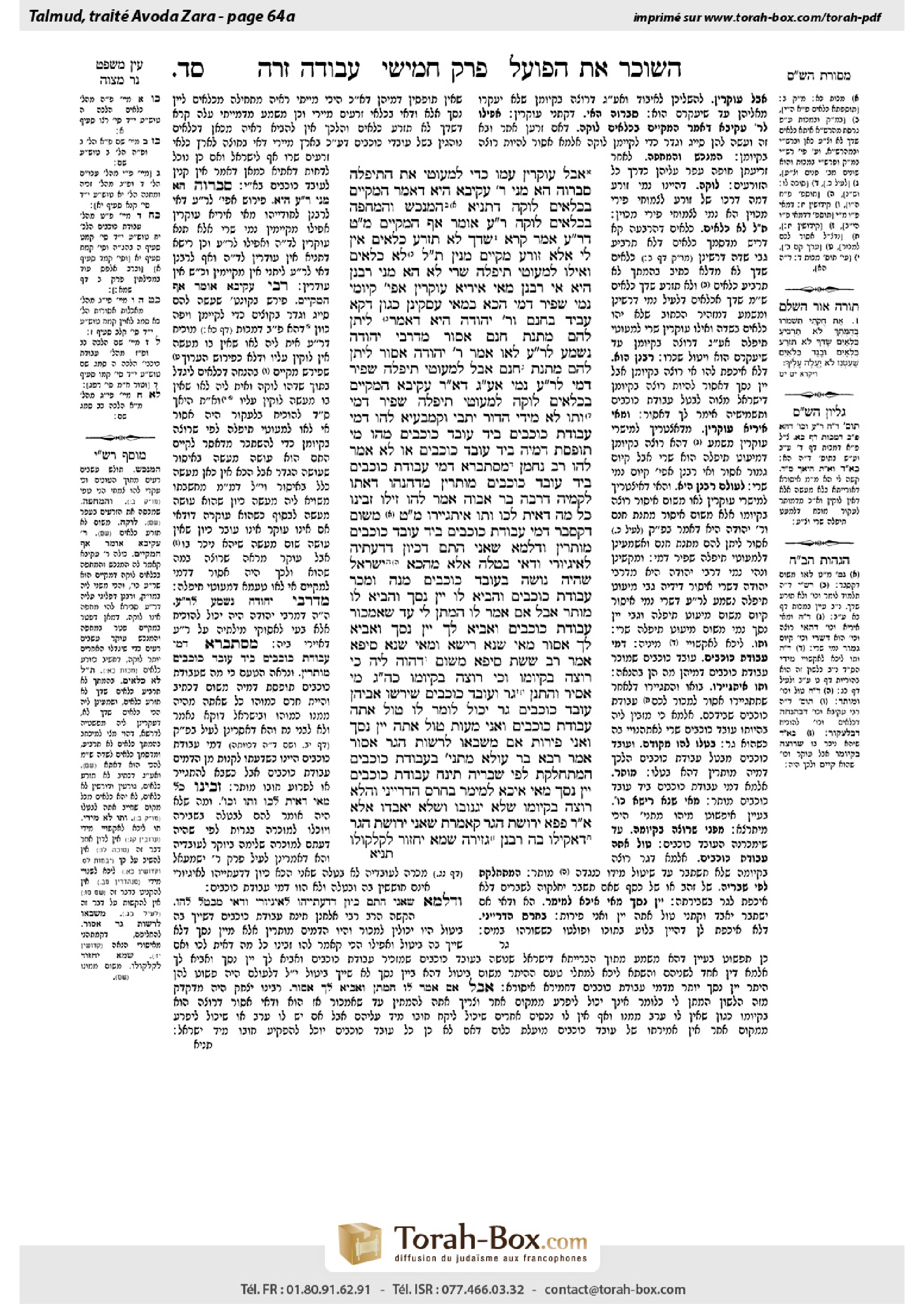
Avodah Zarah 64a: Talmud study for Daf Yomi
Study the Talmud for Daf Yomi with scanned pages, Hebrew text, English translations from Sefaria and AI-generated French translations.
Passage selection and English or AI-generated French translation are available where the scan has annotations. Daf Study is independent of Torah-Box and Sefaria.
Browse Avodah Zarah · עבודה זרה · All tractatesAvodah Zarah 64a text and translations
This page of Avodah Zarah includes the Aramaic text, an English translation and an AI-generated French translation, alongside the scan above.
עבודה זרה ס״ד א · Aramaic and Hebrew text
אֲבָל עוֹקְרִין עִמּוֹ, כְּדֵי לְמַעֵוטי אֶת הַתִּיפְלָה.
סַבְרוּהָ: הָא מַנִּי? רַבִּי עֲקִיבָא הִיא, דְּאָמַר: הַמְקַיֵּים בְּכִלְאַיִם לוֹקֶה. דְּתַנְיָא: הַמְנַכֵּשׁ וְהַמְחַפֶּה בְּכִלְאַיִם לוֹקֶה, רַבִּי עֲקִיבָא אוֹמֵר: אַף הַמְקַיֵּים.
מַאי טַעְמָא דְּרַבִּי עֲקִיבָא? אָמַר קְרָא: ״שָׂדְךָ לֹא תִזְרַע כִּלְאָיִם״, אֵין לִי אֶלָּא זוֹרֵעַ, מְקַיֵּים מִנַּיִן? תַּלְמוּד לוֹמַר: ״לֹא כִּלְאַיִם״.
וְאִילּוּ לְמַעוֹטֵי תִּיפְלָה — שְׁרֵי.
לָא, הָא מַנִּי? רַבָּנַן הִיא.
אִי רַבָּנַן, מַאי אִירְיָא עוֹקְרִין? אֲפִילּוּ קַיּוֹמֵי נָמֵי שַׁפִּיר דָּמֵי! הָכָא בְּמַאי עָסְקִינַן? כְּגוֹן דְּקָא עָבֵיד בְּחִנָּם, וְרַבִּי יְהוּדָה הִיא, דְּאָמַר: לִיתֵּן לָהֶם מַתְּנַת חִנָּם אָסוּר.
מִדְּרַבִּי יְהוּדָה נִשְׁמַע לְרַבִּי עֲקִיבָא, לָאו אָמַר רַבִּי יְהוּדָה: אָסוּר לִיתֵּן לָהֶם מַתְּנַת חִנָּם, אֲבָל לְמַעוֹטֵי תִּיפְלָה שַׁפִּיר דָּמֵי. לְרַבִּי עֲקִיבָא נָמֵי, אַף עַל גַּב דְּאָמַר רַבִּי עֲקִיבָא: הַמְקַיֵּים בְּכִלְאַיִם לוֹקֶה, לְמַעוֹטֵי תִּיפְלָה שַׁפִּיר דָּמֵי. וְתוּ לָא מִידִּי.
הֲדוּר יָתְבִי וְקָמִבַּעְיָא לְהוּ: דְּמֵי עֲבוֹדָה זָרָה בְּיַד גּוֹי, מַהוּ? מִי תּוֹפֶסֶת דָּמֶיהָ בְּיַד גּוֹי, אוֹ לָא?
אֲמַר לְהוּ רַב נַחְמָן: מִסְתַּבְּרָא דְּמֵי עֲבוֹדָה זָרָה בְּיַד גּוֹי מוּתָּרִין, מִדְּהָנְהוּ דַּאֲתוֹ לְקַמֵּיהּ דְּרַבָּה בַּר אֲבוּהּ, אֲמַר לְהוּ: זִילוּ זַבִּינוּ כֹּל מָה דְּאִית לְכוּ, וְתוּ אִיתְגַּיַּירוּ.
מַאי טַעְמָא? מִשּׁוּם דְּקָסָבַר: דְּמֵי עֲבוֹדָה זָרָה בְּיַד גּוֹי מוּתָּרִין. וְדִלְמָא שָׁאנֵי הָתָם, דְּכֵיוָן דְּדַעְתֵּיהּ לְאִיגַּיּוֹרֵי — וַדַּאי בַּטְּלַהּ!
אֶלָּא מֵהָכָא: יִשְׂרָאֵל שֶׁהָיָה נוֹשֶׁה בְּגוֹי מָנֶה, וּמָכַר עֲבוֹדָה זָרָה וְהֵבִיא לוֹ, יֵין נֶסֶךְ וְהֵבִיא לוֹ — מוּתָּר, אֲבָל אִם אָמַר לוֹ: ״הַמְתֵּן לִי עַד שֶׁאֶמְכּוֹר עֲבוֹדָה זָרָה וְאָבִיא לָךְ״, ״יֵין נֶסֶךְ וְאָבִיא לָךְ״ — אָסוּר.
מַאי שְׁנָא רֵישָׁא וּמַאי שְׁנָא סֵיפָא? אָמַר רַב שֵׁשֶׁת: סֵיפָא, מִשּׁוּם דְּהָוֵה לֵיהּ כִּי רוֹצֶה בְּקִיּוּמוֹ.
וְכִי רוֹצֶה בְּקִיּוּמוֹ כְּהַאי גַּוְונָא מִי אֲסִיר? וְהָתְנַן: גֵּר וְגוֹי שֶׁיָּרְשׁוּ אֲבִיהֶן גּוֹי, גֵּר יָכוֹל לוֹמַר לוֹ: ״טוֹל אַתָּה עֲבוֹדָה זָרָה וַאֲנִי מָעוֹת״, ״טוֹל אַתָּה יֵין נֶסֶךְ וַאֲנִי פֵּירוֹת״; אִם מִשֶּׁבָּאוּ לִרְשׁוּת הַגֵּר — אָסוּר.
אָמַר רָבָא בַּר עוּלָּא: מַתְנִיתִין בַּעֲבוֹדָה זָרָה הַמִּתְחַלֶּקֶת לְפִי שְׁבָרֶיהָ.
תִּינַח עֲבוֹדָה זָרָה, יֵין נֶסֶךְ מַאי אִיכָּא לְמֵימַר? בְּחֶרֶס הַדְרְיָינִי.
וַהֲלֹא רוֹצֶה בְּקִיּוּמוֹ, שֶׁלֹּא יִגָּנֵובוּ וְשֶׁלֹּא יֵאָבֵדוּ! אֶלָּא אָמַר רַב פָּפָּא: יְרוּשַּׁת הַגֵּר קָאָמְרַתְּ? שָׁאנֵי יְרוּשַּׁת הַגֵּר, דְּאַקִּילוּ בַּהּ רַבָּנַן, גְּזֵירָה שֶׁמָּא יַחְזוֹר לְקִלְקוּלוֹ.
Avodah Zarah 64a · English translation
but one may uproot diverse kinds with him, in order to reduce impropriety.
The Sages initially assumed that in accordance with whose opinion is this baraita? It is in accordance with the opinion of Rabbi Akiva, who says that not only one who sows or grows diverse kinds, but even one who maintains diverse kinds, is flogged. As it is taught in a baraita: One who removes the weeds interfering with the growth of the plants or who covers up the seeds of diverse kinds with earth is flogged. Rabbi Akiva says: Even one who maintains them instead of actively uprooting them is flogged.
The Gemara asks: What is the reasoning of Rabbi Akiva? The Gemara answers: The verse states: “You shall not sow your field with diverse kinds of seed” (Leviticus 19:19). I have derived only the case of one who sows. From where is it derived that one who maintains diverse kinds also receives lashes? The verse states: “Not…diverse kinds of seed,” indicating that there should not be diverse kinds in one’s field.
The Gemara concludes its support for the opinion of Rav Naḥman: It is prohibited to maintain diverse kinds, but nevertheless, if one wishes to maintain diverse kinds temporarily in order to be paid for uprooting them, thereby reducing impropriety, it is permitted. Similarly, it is permitted for one to receive payment for breaking barrels of wine used for a libation.
The Gemara rejects this explanation: No, in accordance with whose opinion is this baraita, which deems it permitted for one to uproot diverse kinds with a gentile? It is in accordance with the opinion of the Rabbis, who permit one to maintain diverse kinds, but prohibit one from maintaining wine used for a libation, so there is no proof from this baraita in support of Rav Naḥman’s opinion.
The Gemara asks: If the baraita is in accordance with the opinion of the Rabbis, why does the tanna specifically permit uprooting with a gentile? Even maintaining the diverse kinds is permitted. The Gemara answers: Here we are dealing with a case where he performed the uprooting unpaid, and it is in accordance with the opinion of Rabbi Yehuda, who says that giving an unpaid gift to a gentile is prohibited.
The Gemara reasons that Rav Naḥman’s ruling can in any event be proven from this baraita: From the opinion of Rabbi Yehuda we may understand the halakha according to the opinion of Rabbi Akiva. Doesn’t Rabbi Yehuda say that it is prohibited to give a gentile an unpaid gift, but to reduce impropriety he holds that it is permitted to work with a gentile? The same can be said according to Rabbi Akiva as well: Although Rabbi Akiva says that one who maintains diverse kinds is flogged, he presumably holds that if the purpose is to reduce impropriety, it is permitted. The Gemara concludes: And nothing more is to be said on this matter.
§ Rav Naḥman, Ulla, Avimi bar Pappi, and Rabbi Ḥiyya bar Ami were sitting again and a dilemma was raised before them: With regard to the proceeds from the sale of an object of idol worship that are in the possession of a gentile, who sold the object to another, what is the halakha? Does the object of idol worship transfer its forbidden status to the money that is in the possession of a gentile, as it would to money in the possession of a Jew, or not?
Rav Naḥman said to them: It stands to reason that the proceeds from the sale of an object of idol worship in the possession of a gentile are permitted. This may be proven from certain gentiles who came before Rabba bar Avuh to convert. Rabba bar Avuh said to them: Go sell everything that you have, including your objects of idol worship, and then come back to me to convert.
What is the reason he gave this advice? Isn’t it because he maintains that the proceeds from the sale of an object of idol worship in the possession of a gentile are permitted, and therefore he suggested they sell the objects of idol worship so they could derive benefit from the money after they converted? The Gemara rejects this proof: But perhaps it is different there, as since their intention is to convert, they certainly revoked the idolatrous status of these objects, and when they sold them they were selling permitted items.
Rather, proof may be brought from here, as it is taught in a baraita: In the case of a Jew who was a creditor to a gentile for the amount of one hundred dinars, and the gentile sold an object of idol worship and from the proceeds brought him the payment of the debt, or sold wine used for a libation and from the proceeds brought him the payment of the debt, the money is permitted. But if the gentile said to him: Wait for me until I sell an object of idol worship and from the proceeds I will bring you the payment of the debt, or: Wait until I sell wine used for a libation and from the proceeds I will bring you the payment of the debt, this money is forbidden. This proves that the proceeds of an object of idol worship in the possession of a gentile are permitted.
The Gemara asks: What is different in the first clause that it is permitted, and what is different in the latter clause that it is forbidden? Rav Sheshet said: In the latter clause the proceeds are forbidden because the Jew desires the preservation of the object of idol worship or wine used for a libation, since he knows that the gentile must sell it in order to repay the debt.
The Gemara asks: And if he desires its preservation in a case like this, is the money forbidden? But didn’t we learn in a mishna (Demai 6:10): In the case of a convert and a gentile who inherited from their gentile father, the convert can say to his gentile brother: You take the objects of idol worship and I will take the money, or: You take the wine used for a libation and I will take the produce; but if they make this exchange after the property came into the possession of the convert, it is forbidden.
Rava bar Ulla said: The ruling of the mishna is stated with regard to an object of idol worship whose value can be distributed among its shards, i.e., even if it were broken to pieces its value would remain, so the convert does not desire its preservation.
The Gemara asks: This resolution works out well in the case of objects of idol worship, but with regard to wine used for a libation, what is there to say? There is no situation in which the convert does not desire the preservation of the wine until the exchange. The Gemara answers: The ruling of the mishna is stated with regard to Hadrianic earthenware permeated with wine used for a libation. Since the wine can be extracted by soaking the earthenware in water, the convert does not desire that the vessel remain intact.
The Gemara asks: But doesn’t he desire its preservation in the sense that it should not be stolen or lost? Rather, Rav Pappa said that there is a different resolution: You say there is a difficulty from the case of the inheritance of a convert? The inheritance of a convert is different, as the Sages were lenient with regard to it, as a rabbinic decree, lest he return to his corrupted ways if it were prohibited for him to inherit property from his father. In the case of one who is not a convert and desires the preservation of an object of idol worship, it is prohibited for him to profit from it.
Avodah Zarah 64a · Traduction française (IA)
mais on peut arracher des espèces diverses avec lui, afin de réduire l'impureté.
Les Sages ont d'abord supposé que selon quel avis est ce baraïta ? C'est selon l'avis de Rabbi Akiva, qui dit que non seulement celui qui sème ou cultive des espèces diverses, mais même celui qui maintient des espèces diverses est fouetté. Comme il est enseigné dans une baraïta : celui qui retire les mauvaises herbes qui entravent la croissance des plantes ou qui recouvre les semences d'espèces diverses avec de la terre est fouetté. Rabbi Akiva dit : même celui qui les maintient plutôt que de les arracher activement est fouetté.
La Guemara demande : quelle est la raison de Rabbi Akiva ? La Guemara répond : la Parashah dit : « Tu ne semeras pas ton champ avec des espèces diverses » (Lévitique 19:19). J'ai tiré seulement le cas de celui qui sème. D'où tire-t-on que celui qui maintient des espèces diverses est fouetté ? La Parashah dit : « pas… des espèces diverses », indiquant qu'il ne doit pas y avoir d'espèces diverses dans son champ.
La Guemara conclut son soutien pour l'avis de Rav Naḥman : il est interdit de maintenir des espèces diverses, mais néanmoins, si l'on souhaite maintenir des espèces diverses temporairement afin d'être rémunéré pour les arracher, ce qui réduit l'immoralité, cela est permis. De même, il est permis à l'individu de recevoir une rémunération pour briser des barriques de vin utilisées pour une libation.
La Guemara rejette cette explication : Non, selon quel avis est ce baraïta, qui considère comme permis d'arracher des espèces diverses avec un non-Juif ? C'est selon l'avis des Rabbins, qui permettent de maintenir des espèces diverses, mais interdisent de maintenir du vin utilisé pour une libation, donc il n'y a pas de preuve à tirer de ce baraïta en faveur de l'avis de Rav Naḥman.
La Guemara demande : si le baraïta est selon l'avis des Rabbins, pourquoi le tanna permet spécifiquement d'arracher avec un non-Juif ? Même maintenir des espèces diverses est permis. La Guemara répond : ici nous sommes en présence d'un cas où l'arrachage a été fait sans rémunération, et c'est selon l'avis de Rabbi Yéhuda, qui dit que donner un cadeau gratuit à un non-Juif est interdit.
La Guemara conclut que l'avis de Rav Naḥman peut en tout cas être prouvé à partir de ce baraïta : à partir de l'avis de Rabbi Yéhuda, nous pouvons comprendre la halakha selon l'avis de Rabbi Akiva. N'est-ce pas que Rabbi Yéhuda dit qu'il est interdit de donner à un non-Juif un cadeau gratuit, mais pour réduire l'immoralité, il considère que travailler avec un non-Juif est permis ? La même chose peut être dite selon l'avis de Rabbi Akiva également : bien que Rabbi Akiva dise que celui qui maintient des espèces diverses est fouetté, il suppose probablement que si l'objectif est de réduire l'immoralité, cela est permis. La Guemara conclut : et plus rien n'est à dire sur cette matière.
§ Rav Naḥman, Ulla, Avimi bar Pappi et Rabbi Ḥiyya bar Ami étaient assis à nouveau et un dilemme fut soulevé devant eux : concernant les bénéfices provenant de la vente d'un objet d'idolâtrie qui sont en possession d'un non-Juif, qui a vendu l'objet à un autre, quelle est la halakha ? L'objet d'idolâtrie transfère-t-il son statut interdit aux bénéfices qui sont en possession d'un non-Juif, comme c'est le cas pour les bénéfices en possession d'un Juif, ou non ?
Rav Naḥman dit à eux : Il est logique que les bénéfices provenant de la vente d'un objet d'idolâtrie en possession d'un non-Juif soient permis. Cela peut être prouvé à partir de certains non-Juifs qui se sont présentés devant Rabba bar Avuh pour se convertir. Rabba bar Avuh dit à eux : Vendez tout ce que vous avez, y compris vos objets d'idolâtrie, et revenez vers moi pour vous convertir.
Quelle est la raison qu'il a donné cet avis ? N'est-ce pas parce qu'il affirme que les bénéfices provenant de la vente d'un objet d'idolâtrie en possession d'un non-Juif sont permis, et donc il a suggéré de vendre les objets d'idolâtrie afin de pouvoir tirer profit de l'argent après leur conversion ? La Guemara rejette cette preuve : mais peut-être c'est différent là, car leur intention est de se convertir, ils ont certainement révoqué le statut idolâtre de ces objets, et lorsqu'ils les ont vendus, ils vendaient des objets permis.
Plutôt, une preuve peut être apportée à partir de là, comme il est enseigné dans une baraïta : dans le cas d'un Juif qui était un créancier d'un non-Juif pour une somme de cent drachmes, et le non-Juif vendit un objet d'idolâtrie et à partir des bénéfices apporta la rémunération de la dette, ou vendit du vin utilisé pour une libation et à partir des bénéfices apporta la rémunération de la dette, l'argent est permis. Mais si le non-Juif dit à lui : attendez-moi jusqu'à ce que je vende un objet d'idolâtrie et à partir des bénéfices je vous apporterai la rémunération de la dette, ou : attendez jusqu'à ce que je vende du vin utilisé pour une libation et à partir des bénéfices je vous apporterai la rémunération de la dette, cet argent est interdit. Cela prouve que les bénéfices d'un objet d'idolâtrie en possession d'un non-Juif sont permis.
La Guemara demande : qu'est-ce qui diffère dans la première clause qui est permise, et qu'est-ce qui diffère dans la seconde clause qui est interdite ? Rav Sheshet dit : dans la seconde clause les bénéfices sont interdits parce que le Juif désire la préservation de l'objet d'idolâtrie ou du vin utilisé pour une libation, car il sait que le non-Juif doit le vendre pour régler la dette.
La Guemara demande : et si l'on désire préserver cela dans un cas comme celui-ci, l'argent est-il interdit ? Mais n'avons-nous pas appris dans une mitsva (Demai 6:10) : dans le cas d'un converti et d'un non-Juif qui héritent de leur père non-Juif, le converti peut dire à son frère non-Juif : tu prends les objets d'idolâtrie et je prends l'argent, ou : tu prends le vin utilisé pour une libation et je prends les produits ; mais si cet échange est fait après que la propriété est entrée en possession du converti, cela est interdit.
Rava bar Ulla a dit : La décision de la Michna est formulée concernant un objet d'idolâtrie dont la valeur peut être distribuée parmi ses fragments, c'est-à-dire, même s'il était écrasé en morceaux, sa valeur resterait, donc le converti ne désire pas sa conservation.
La Guemara demande : Cette résolution s'applique bien dans le cas d'objets d'idolâtrie, mais concernant le vin utilisé pour une libation, que dire ? Il n'y a pas de situation où le converti ne désire pas la conservation du vin jusqu'au moment de l'échange. La Guemara répond : La décision de la Michna est formulée concernant des céramiques de Hadrien imprégnées de vin utilisé pour une libation. Puisque le vin peut être extrait en plongeant la céramique dans l'eau, le converti ne désire pas que le vase reste intact.
La Guemara demande : Mais ne désire-t-il pas sa conservation dans le sens où il ne devrait pas être volé ou perdu ? Plutôt, Rav Pappa a dit qu'il existe une autre résolution : Tu dis qu'il y a une difficulté à partir du cas de l'héritage d'un converti ? L'héritage d'un converti est différent, car les Sages étaient indulgents à cet égard, comme un décret rabbinique, de peur qu'il ne revienne à ses mauvaises habitudes si l'héritage de la propriété de son père était interdit. Dans le cas d'une personne qui n'est pas un converti et qui désire la conservation d'un objet d'idolâtrie, il est interdit pour lui d'en tirer profit.
Traduction française générée par IA à partir de l’édition anglaise de Sefaria. Vérifie toujours un passage avec le texte source.
Text from Sefaria: William Davidson Edition - Vocalized Aramaic (CC BY NC); William Davidson Edition - English (CC BY NC).