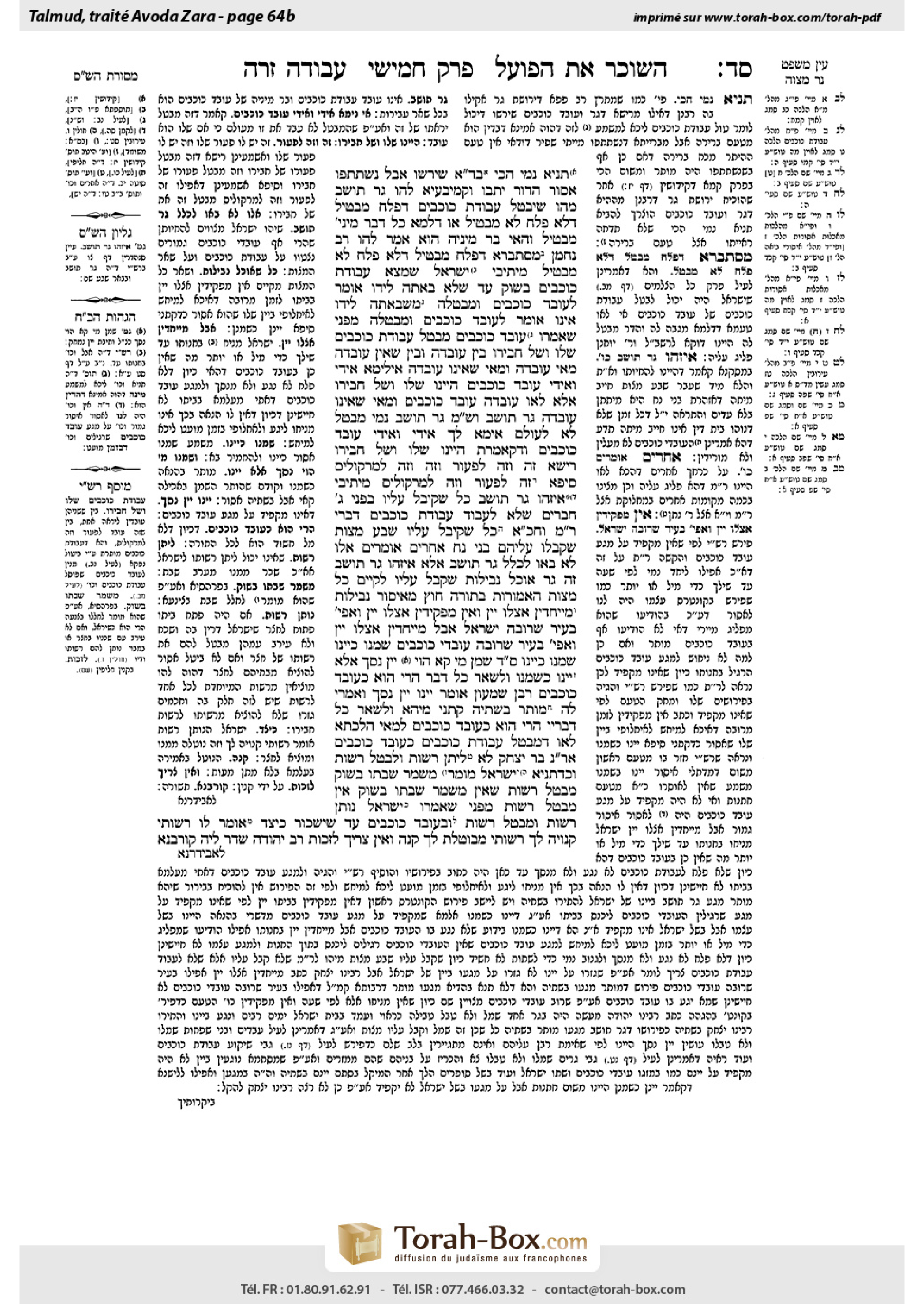
Avodah Zarah 64b: Talmud study for Daf Yomi
Study the Talmud for Daf Yomi with scanned pages, Hebrew text, English translations from Sefaria and AI-generated French translations.
Passage selection and English or AI-generated French translation are available where the scan has annotations. Daf Study is independent of Torah-Box and Sefaria.
Browse Avodah Zarah · עבודה זרה · All tractatesAvodah Zarah 64b text and translations
This page of Avodah Zarah includes the Aramaic text, an English translation and an AI-generated French translation, alongside the scan above.
עבודה זרה ס״ד ב · Aramaic and Hebrew text
תַּנְיָא נָמֵי הָכִי: בַּמֶּה דְּבָרִים אֲמוּרִים? שֶׁיָּרְשׁוּ, אֲבָל נִשְׁתַּתְּפוּ — אָסוּר.
הֲדוּר יְתַבוּ וְקָמִיבַּעְיָא לְהוּ: גֵּר תּוֹשָׁב מַהוּ שֶׁיְּבַטֵּל עֲבוֹדָה זָרָה? דְּפָלַח — מְבַטֵּיל, דְּלָא פָּלַח — לָא מְבַטֵּיל, אוֹ דִלְמָא כֹּל דְּבַר מִינֵּיהּ מְבַטֵּיל, וְהַאי בַּר מִינֵיהּ הוּא?
אֲמַר לְהוּ רַב נַחְמָן: מִסְתַּבְּרָא, דְּפָלַח — מְבַטֵּיל, דְּלָא פָּלַח — לָא מְבַטֵּיל.
מֵיתִיבִי: יִשְׂרָאֵל שֶׁמָּצָא עֲבוֹדָה זָרָה בַּשּׁוּק, עַד שֶׁלֹּא בָּאתָה לְיָדוֹ — אוֹמֵר לְגוֹי וּמְבַטְּלָהּ, מִשֶּׁבָּאתָה לְיָדוֹ — אֵינוֹ אוֹמֵר לְגוֹי וּמְבַטְּלָהּ; מִפְּנֵי שֶׁאָמְרוּ: גּוֹי מְבַטֵּל עֲבוֹדָה זָרָה שֶׁלּוֹ וְשֶׁל חֲבֵירוֹ, בֵּין עוֹבְדָהּ וּבֵין שֶׁאֵין עוֹבְדָהּ.
מַאי ״עוֹבְדָהּ״, וּמַאי ״שֶׁאֵינוֹ עוֹבְדָהּ״? אִילֵּימָא אִידֵּי וְאִידֵּי גּוֹי, הַיְינוּ שֶׁלּוֹ וְשֶׁל חֲבֵירוֹ! אֶלָּא לָאו ״עוֹבְדָהּ״ — גּוֹי, וּמַאי ״שֶׁאֵינוֹ עוֹבְדָהּ״ — גֵּר תּוֹשָׁב, וּשְׁמַע מִינַּהּ גֵּר תּוֹשָׁב נָמֵי מְבַטֵּל!
לָא, לְעוֹלָם אֵימָא לָךְ: אִידֵּי וְאִידֵּי גּוֹי, וּדְקָאָמְרַתְּ הַיְינוּ ״שֶׁלּוֹ וְשֶׁל חֲבֵירוֹ״: רֵישָׁא — זֶה וָזֶה לִפְעוֹר, וְזֶה וָזֶה לְמַרְקוּלִיס; סֵיפָא — זֶה לִפְעוֹר וְזֶה לְמַרְקוּלִיס.
מֵיתִיבִי: אֵיזֶהוּ גֵּר תּוֹשָׁב? כֹּל שֶׁקִּיבֵּל עָלָיו בִּפְנֵי שְׁלֹשָׁה חֲבֵרִים שֶׁלֹּא לַעֲבוֹד עֲבוֹדָה זָרָה, דִּבְרֵי רַבִּי מֵאִיר.
וַחֲכָמִים אוֹמְרִים: כֹּל שֶׁקִּיבֵּל עָלָיו שֶׁבַע מִצְוֹת שֶׁקִּבְּלוּ עֲלֵיהֶם בְּנֵי נֹחַ.
אֲחֵרִים אוֹמְרִים: אֵלּוּ לֹא בָּאוּ לִכְלַל גֵּר תּוֹשָׁב, אֶלָּא אֵיזֶהוּ גֵּר תּוֹשָׁב? זֶה גֵּר אוֹכֵל נְבֵילוֹת, שֶׁקִּבֵּל עָלָיו לְקַיֵּים כׇּל מִצְוֹת הָאֲמוּרוֹת בַּתּוֹרָה חוּץ מֵאִיסּוּר נְבֵילוֹת.
מְיַיחֲדִין אֶצְלוֹ יַיִן, וְאֵין מַפְקִידִין אֶצְלוֹ יַיִן, וַאֲפִילּוּ בְּעִיר שֶׁרוּבָּהּ יִשְׂרָאֵל, אֲבָל מְיַיחֲדִין אֶצְלוֹ יַיִן וַאֲפִילּוּ בְּעִיר שֶׁרוּבָּהּ גּוֹיִם, שַׁמְנוֹ כְּיֵינוֹ.
שַׁמְנוֹ כְּיֵינוֹ סָלְקָא דַּעְתָּךְ? שֶׁמֶן מִי קָא הָוֵי יֵין נֶסֶךְ? אֶלָּא, יֵינוֹ כְּשַׁמְנוֹ.
וְלִשְׁאָר כׇּל דָּבָר הֲרֵי הוּא כְּגוֹי. רַבָּן שִׁמְעוֹן אוֹמֵר: יֵינוֹ יֵין נֶסֶךְ, וְאָמְרִי לַהּ מוּתָּר בִּשְׁתִיָּה.
קָתָנֵי מִיהָא: וְלִשְׁאָר כׇּל דְּבָרָיו הֲרֵי הוּא כְּגוֹי. לְמַאי הִלְכְתָא? לָאו דִּמְבַטֵּל עֲבוֹדָה זָרָה כְּגוֹי? אָמַר רַב נַחְמָן בַּר יִצְחָק: לֹא, לִיתֵּן רְשׁוּת וּלְבַטֵּל רְשׁוּת.
וְכִדְתַנְיָא: יִשְׂרָאֵל מְשׁוּמָּד מְשַׁמֵּר שַׁבַּתּוֹ בַּשּׁוּק — מְבַטֵּל רְשׁוּת, שֶׁאֵין מְשַׁמֵּר שַׁבַּתּוֹ בַּשּׁוּק — אֵין מְבַטֵּל רְשׁוּת, מִפְּנֵי שֶׁאָמְרוּ: יִשְׂרָאֵל נוֹתֵן רְשׁוּת וּמְבַטֵּל רְשׁוּת.
וּבְגוֹי — עַד שֶׁיִּשְׂכּוֹר. כֵּיצַד? אוֹמֵר לוֹ: ״רְשׁוּתִי קְנוּיָה לָךְ״, ״רְשׁוּתִי מְבוּטֶּלֶת לָךְ״ — קָנָה, וְאֵין צָרִיךְ לִזְכּוֹת.
רַב יְהוּדָה שַׁדַּר לֵיהּ קוּרְבָּנָא
Avodah Zarah 64b · English translation
This is also taught in a baraita: In what case is this statement, that a convert and a gentile are permitted to divide up common property that includes objects of idol worship, said? This is said with regard to property that they inherited; but if they were partners, it is prohibited.
§ The Gemara mentions another discussion among Rav Naḥman, Ulla, Avimi bar Pappi, and Rav Ḥiyya bar Ami. They were sitting again and a dilemma was raised before them: With regard to a gentile who resides in Eretz Yisrael and observes the seven Noahide mitzvot [ger toshav], including the prohibition against engaging in idol worship, what is the halakha with regard to the possibility that he can revoke the status of objects of idol worship? Is it the case that one who worships idols can revoke the status of one, but one who does not worship them cannot revoke the status of one? Or perhaps should it be reasoned that anyone who is of the same kind as idol worshippers, i.e., a gentile, can revoke its status, and a ger toshav is of the same kind as idol worshippers?
Rav Naḥman said to them: It stands to reason that one who worships idols can revoke the status of one, but one who does not worship them cannot revoke the status of one.
The Gemara raises an objection to this ruling from a baraita: In the case of a Jew who found an object of idol worship in the marketplace, as long as it has not yet come into his possession, he can tell a gentile, and the gentile can revoke its idolatrous status. Once it has come into his possession, he cannot tell a gentile and have the gentile revoke its status. This applies to any gentile, because the Sages said: A gentile can revoke the status of his own object of idol worship or that of another gentile, whether he worships it or whether he does not worship it.
What is meant by the phrase: Worships it, and what is meant by the phrase: Does not worship it? If we say both this and that are referring to a gentile, this is the same as the previous statement in the baraita, that a gentile can revoke the status of his own object of idol worship or that of another gentile, i.e., an object that he worships or one that another gentile worships. Rather, isn’t it to be understood that the phrase: Worships it, is referring to a gentile? And what is the meaning of the phrase: Does not worship it? It is referring to a ger toshav, who does not worship any idols. And learn from it that a ger toshav can also revoke the status of objects of idol worship.
The Gemara rejects this explanation. No, actually, I will say to you that this phrase and that phrase are both referring to a gentile, and with regard to that which you say, that this is the same as the statement concerning his object of idol worship or that of another gentile, it can be explained as follows: The first clause is referring to a case where both gentiles worship the same idol, e.g., this one and that one both worship Peor, or this one and that one both worship Mercury, and the baraita is teaching that one can revoke the status of an idol that belongs to the other. The latter clause, which distinguishes between one who worships it and one who does not worship it, is referring to a case where this one worships Peor and that one worships Mercury, indicating that an idolater can revoke the status of an idol that he does not worship at all, but only if he is himself an idolater, as opposed to a ger toshav.
The Gemara raises an objection from a baraita: Who is a ger toshav? It is anyone who has accepted upon himself before three ḥaverim, i.e., people devoted to the meticulous observance of mitzvot, especially halakhot of ritual purity, teruma, and tithes, not to worship idols. This is the statement of Rabbi Meir.
And the Rabbis say: Anyone who has accepted upon himself observance of the seven mitzvot that the descendants of Noah accepted upon themselves is a ger toshav.
Others say: These have not entered the category of ger toshav. Rather, who is a ger toshav? This is a convert who eats unslaughtered animal carcasses, which are not kosher, but who has accepted upon himself to observe all of the mitzvot that are stated in the Torah except for the prohibition against eating unslaughtered carcasses.
The baraita continues: Whatever the definition of a ger toshav, the following halakhot apply to him: One may leave him alone with wine briefly without Jewish supervision with no concern that he might use it for a libation, thereby rendering it forbidden to Jews, as he is not an idol worshipper. But one may not deposit wine with him for an extended period of time, lest he exchange it with the wine of a gentile, which is forbidden. And this applies even in a town that has a Jewish majority. But one may leave him alone with wine briefly without Jewish supervision even in a town with a majority of gentiles. His oil is treated like his wine in terms of its permissibility.
The Gemara interjects: His oil is like his wine? Can this enter your mind? Does the oil of a gentile become, i.e., assume the status of, wine used for a libation? Rather, the baraita should be emended as follows: His wine is like his oil. It is permitted to derive benefit from it, but not to consume it.
The baraita continues: And with regard to all other matters, a ger toshav is treated like a gentile. Rabban Shimon says: His wine is treated like wine used for a libation. And some say he says: Even drinking it is permitted.
The Gemara comments on the baraita: In any event, the baraita teaches: And with regard to all other matters, a ger toshav is treated like a gentile. With regard to what halakha is this stated? Is it not teaching that he can revoke the status of an object of idol worship as a gentile can? Rav Naḥman bar Yitzḥak says: No, it is stated with regard to giving away rights in a domain or renouncing rights in a domain in the context of the halakhot of joining houses in courtyards for Shabbat.
And this is as it is taught in a baraita: An apostate Jew who nevertheless observes his Shabbat in the marketplace, i.e., in public, can renounce his rights in a shared domain so the other Jews in the domain may carry in it on Shabbat, but an apostate who does not observe his Shabbat even in the marketplace cannot renounce his rights in a domain, because the Sages said that only a Jew can give away rights in his domain or renounce his rights in his domain, and this applies in the context of joining houses in courtyards on Shabbat.
But with regard to a gentile, this is not effective unless the Jew leases his domain in the courtyard. How so? A Jew may say to another Jew: My rights in this domain are hereby acquired by you, or: My rights in this domain are hereby renounced to you, and the other Jew thereby acquires those rights, and it is not necessary for him to take possession of it through a formal act of acquisition.
The Gemara relates: Rav Yehuda sent a gift
Avodah Zarah 64b · Traduction française (IA)
C'est également enseigné dans une baraïta : Dans quel cas cette déclaration, selon laquelle un converti et un non-Juif peuvent partager les biens communs qui comprennent des objets d'idolâtrie, est-elle formulée ? Cela est dit concernant des biens hérités ; mais si ce sont des partenaires, cela est interdit.
§ La Guemara mentionne une autre discussion entre Rav Naḥman, Ulla, Avimi bar Pappi et Rav Ḥiyya bar Ami. Ils étaient assis à nouveau et un dilemme leur a été soulevé : Concernant un non-Juif résidant en Eretz Yisrael et observant les sept mitsvot de Noé [ger toshav], y compris l'interdiction de pratiquer l'idolâtrie, quelle est la halakha concernant la possibilité qu'il puisse révoquer le statut d'objet d'idolâtrie ? Est-ce que celui qui adore des idoles peut révoquer le statut d'un objet, mais celui qui ne l'adore pas ne peut pas révoquer le statut d'un objet ? Ou peut-on raisonner que toute personne ayant la même nature que les adorateurs d'idoles, c'est-à-dire un non-Juif, peut révoquer le statut, et un ger toshav est de la même nature que les adorateurs d'idoles ?
Rav Naḥman dit à eux : Il est logique que celui qui adore des idoles puisse révoquer le statut d'un objet, mais celui qui ne l'adore pas ne puisse pas révoquer le statut d'un objet.
La Guemara soulève un objection à cette décision d'une baraïta : Dans le cas d'un Juif qui trouve un objet d'idolâtrie au marché, tant qu'il n'a pas encore acquis cet objet, il peut dire à un non-Juif, et ce dernier peut révoquer son statut d'idolâtrie. Une fois que l'objet est en son possession, il ne peut pas dire à un non-Juif et lui faire révoquer son statut. Cela s'applique à tout non-Juif, car les Sages ont dit : Un non-Juif peut révoquer le statut de son propre objet d'idolâtrie ou celui d'un autre non-Juif, qu'il l'adore ou non.
Qu'entend-on par la phrase : Adore-t-il, et qu'entend-on par la phrase : Ne l'adore pas ? Si nous disons que ces deux phrases se réfèrent à un non-Juif, cela est identique à l'affirmation précédente de la baraïta, selon laquelle un non-Juif peut révoquer le statut de son propre objet d'idolâtrie ou celui d'un autre non-Juif, c'est-à-dire un objet qu'il adore ou un objet que l'autre non-Juif adore. Plutôt, n'est-ce pas à comprendre que la phrase : Adore-t-il, se réfère à un non-Juif, et que la phrase : Ne l'adore pas, se réfère à un ger toshav, qui n'adore aucun idole. Et d'après cela, on apprend que le ger toshav peut également révoquer le statut des objets d'idolâtrie.
La Guemara refuse cette explication. Non, en réalité, je vais vous dire que ces deux phrases se réfèrent toutes deux à un non-Juif, et concernant ce que vous dites, que cela est identique à l'affirmation concernant son objet d'idolâtrie ou celui d'un autre non-Juif, cela peut être expliqué ainsi : La première clause se réfère à un cas où deux non-Juifs adorent le même idole, par exemple, celui-ci et celui-là adorent Peor, ou celui-ci et celui-là adorent Mercure, et la baraïta enseigne que l'un peut révoquer le statut d'une idole appartenant à l'autre. La seconde clause, qui distingue entre celui qui l'adore et celui qui ne l'adore pas, se réfère à un cas où celui-ci adore Peor et celui-là adore Mercure, indiquant qu'un adorateur d'idoles peut révoquer le statut d'une idole qu'il ne adore pas du tout, mais seulement s'il est lui-même un adorateur d'idoles, contrairement au ger toshav.
Et la Guemara soulève un objection tirée d'une baraïta : Qui est un ger toshav ? C'est toute personne qui s'est engagé devant trois ḥaverim, c'est-à-dire des personnes dévouées à l'observation rigoureuse des mitsvot, notamment les halakhot de pureté rituelle, de terouma et des dîmes, sans adorer des idoles. C'est la déclaration de Rabbi Meir.
Et les Rabbins disent : Toute personne qui s'est engagé à l'observation des sept mitsvot que les descendants de Noé ont acceptés est un ger toshav.
D'autres disent : Ces personnes n'ont pas encore appartenu à la catégorie de ger toshav. Plutôt, qui est un ger toshav ? C'est un converti qui mange des cadavres d'animaux non sacrifiés, qui ne sont pas kasher, mais qui s'est engagé à observer toutes les mitsvot énoncées dans la Torah, sauf l'interdiction de manger des cadavres non sacrifiés.
La baraïta continue : Quelle que soit la définition du ger toshav, les halakhot suivantes s'appliquent à lui : On peut le laisser seul avec du vin pendant un court moment sans surveillance juive sans crainte qu'il ne l'utilise pour un libation, rendant ainsi le vin interdit aux Juifs, car il n'est pas un adorateur d'idoles. Mais on ne peut pas déposer du vin chez lui pendant une longue période, de peur qu'il échange le vin avec celui d'un non-Juif, ce qui est interdit. Et cela s'applique même dans une ville où la majorité est juive. Mais on peut le laisser seul avec du vin pendant un court moment sans surveillance juive même dans une ville où la majorité est non-Juive. Son huile est traitée comme son vin en termes de permissibilité.
La Guemara intercale : Son huile est comme son vin ? Est-ce que cela entre dans votre esprit ? L'huile d'un non-Juif devient, c'est-à-dire assume le statut de, un vin utilisé pour un libation ? Plutôt, la baraïta devrait être corrigée ainsi : Son vin est comme son huile. Il est permis d'en tirer un bénéfice, mais pas de le consommer.
La baraïta continue : Et concernant toutes les autres questions, le ger toshav est traité comme un non-Juif. Rabban Shimon dit : Son vin est traité comme un vin utilisé pour un libation. Et certains disent qu'il dit : Même boire est permis.
La Guemara commente la baraïta : En tout cas, la baraïta enseigne : Et concernant toutes les autres questions, le ger toshav est traité comme un non-Juif. Concernant quelle halakha est-ce dit ? N'est-ce pas enseigner qu'il peut révoquer le statut d'un objet d'idolâtrie comme un non-Juif ? Rav Naḥman bar Yitzḥak dit : Non, cela est dit concernant le transfert de droits dans un domaine ou la renonciation à des droits dans un domaine, dans le contexte des halakhot de la construction de maisons dans des courtyards pour le Shabbat.
Et cela est enseigné dans une baraïta : un Juif apostat qui observe néanmoins son sabbat dans le marché, c'est-à-dire en public, peut renoncer à ses droits dans un domaine partagé afin que les autres Juifs dans ce domaine puissent transporter des objets dedans le sabbat, mais un Juif apostat qui ne respecte même pas son sabbat dans le marché ne peut renoncer à ses droits dans un domaine, car les Sages ont dit que seul un Juif peut céder ses droits dans son domaine ou renoncer à ses droits dans son domaine, et cela s'applique dans le contexte de l'union des maisons dans les courtyards le sabbat.
Mais concernant un non-Juif, cela n'est pas efficace à moins que le Juif ne loue son domaine dans le courtil. Comment cela se passe-t-il ? Un Juif peut dire à un autre Juif : Mes droits dans ce domaine sont désormais acquis par vous, ou : Mes droits dans ce domaine sont désormais renoncés à vous, et l'autre Juif acquiert ainsi ces droits, et il n'est pas nécessaire qu'il prenne possession de celui-ci par un acte formel d'acquisition.
La Guemara rapporte : Rav Yehuda a envoyé un cadeau
Traduction française générée par IA à partir de l’édition anglaise de Sefaria. Vérifie toujours un passage avec le texte source.
Text from Sefaria: William Davidson Edition - Vocalized Aramaic (CC BY NC); William Davidson Edition - English (CC BY NC).