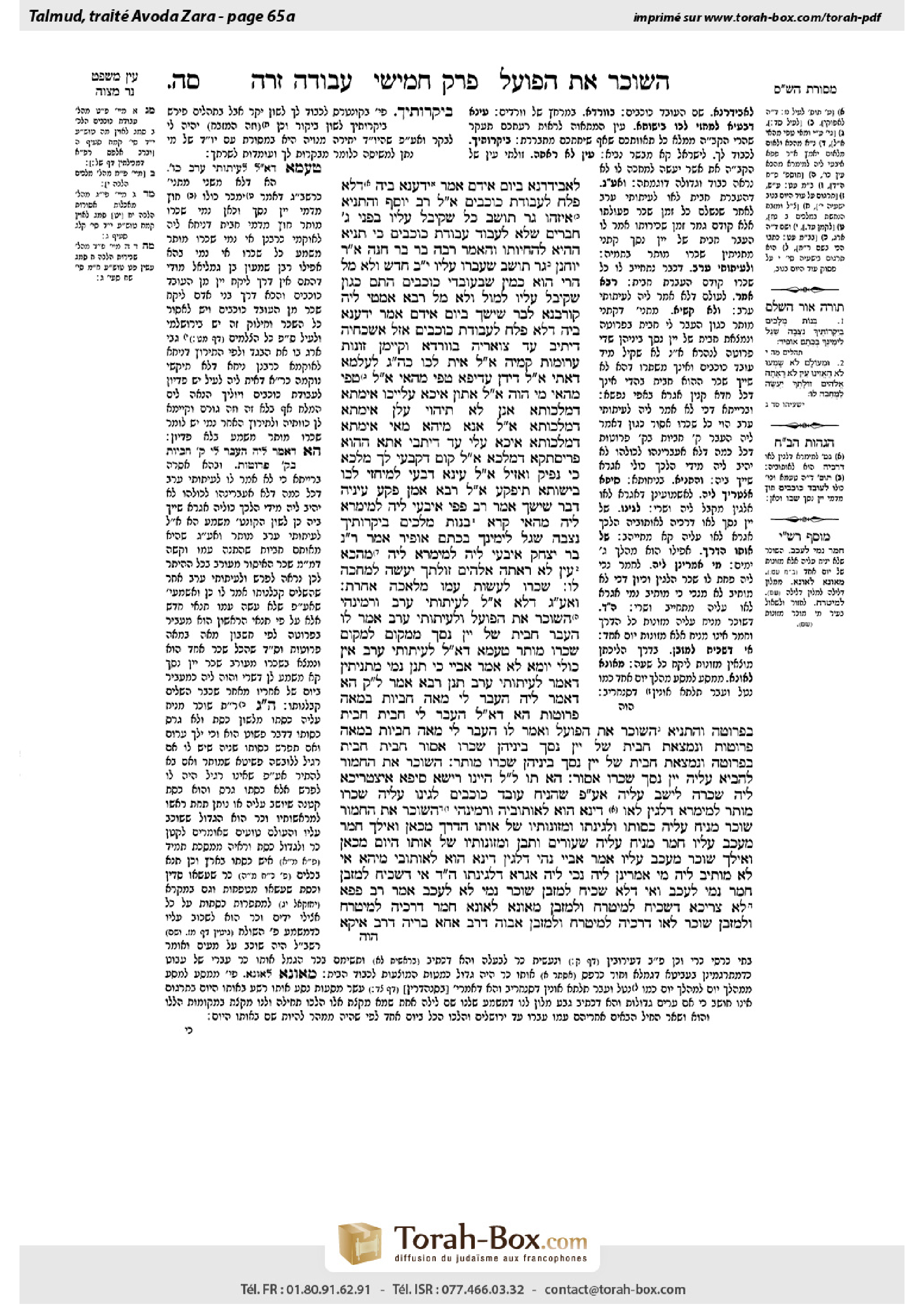
Avodah Zarah 65a: Talmud study for Daf Yomi
Study the Talmud for Daf Yomi with scanned pages, Hebrew text, English translations from Sefaria and AI-generated French translations.
Passage selection and English or AI-generated French translation are available where the scan has annotations. Daf Study is independent of Torah-Box and Sefaria.
Browse Avodah Zarah · עבודה זרה · All tractatesAvodah Zarah 65a text and translations
This page of Avodah Zarah includes the Aramaic text, an English translation and an AI-generated French translation, alongside the scan above.
עבודה זרה ס״ה א · Aramaic and Hebrew text
לַאֲבִידַרְנָא בְּיוֹם אֵידָם, אָמַר: יָדַעְנָא בֵּיהּ דְּלָא פָּלַח לַעֲבוֹדָה זָרָה. אֲמַר לֵיהּ רַב יוֹסֵף: וְהָתַנְיָא: אֵיזֶהוּ גֵּר תּוֹשָׁב? כֹּל שֶׁקִּיבֵּל עָלָיו בִּפְנֵי שְׁלֹשָׁה חֲבֵרִים שֶׁלֹּא לַעֲבוֹד עֲבוֹדָה זָרָה! כִּי תַּנְיָא הָהִיא — לְהַחְיוֹתוֹ.
וְהָאָמַר רַבָּה בַּר בַּר חָנָה אָמַר רַבִּי יוֹחָנָן: גֵּר תּוֹשָׁב שֶׁעָבְרוּ עָלָיו שְׁנֵים עָשָׂר חֹדֶשׁ וְלֹא מָל, הֲרֵי הוּא כְּמִין שֶׁבָּאוּמּוֹת! הָתָם כְּגוֹן שֶׁקִּיבֵּל עָלָיו לָמוּל וְלֹא מָל.
רָבָא אַמְטִי לֵיהּ קוּרְבָּנָא לְבַר שֵׁישַׁךְ בְּיוֹם אֵידָם. אֲמַר: יָדַעְנָא בֵּיהּ דְּלָא פָּלַח לַעֲבוֹדָה זָרָה. אֲזַל אַשְׁכְּחֵיהּ דְּיָתֵיב עַד צַוְּארֵיהּ בְּוַורְדָּא, וְקָיְימָן זוֹנוֹת עֲרוּמּוֹת קַמֵּיהּ. אֲמַר לֵיהּ: אִית לְכוּ כְּהַאי גַּוְונָא לְעָלְמָא דְּאָתֵי? אֲמַר לֵיהּ: דִּידַן עֲדִיפָא טְפֵי מֵהַאי. אֲמַר לֵיהּ: טְפֵי מֵהַאי מִי הָוֵה? אֲמַר לֵיהּ: אַתּוּן אִיכָּא עֲלַיְיכוּ אֵימְתָא דְּמַלְכוּתָא, אֲנַן לָא תֶּיהְוֵי עֲלַן אֵימְתָא דְמַלְכוּתָא. אֲמַר לֵיהּ: אֲנָא מִיהָא מַאי אֵימְתָא דְּמַלְכוּתָא אִיכָּא עֲלַי?
עַד דְּיָתְבִי, אֲתָא הָהוּא פְּרִיסְתָּקָא דְּמַלְכָּא, אֲמַר לֵיהּ: קוּם, דְּקָבָעֵי לָךְ מַלְכָּא. כִּי נָפֵיק וְאָזֵיל, אֲמַר לֵיהּ: עֵינָא דְּבָעֵי לְמִיחְזֵי לְכוּ בִּישׁוּתָא תִּיפְקַע. אֲמַר לֵיהּ רָבָא: אָמֵן. פְּקַע עֵינֵיהּ דְּבַר שֵׁישַׁךְ.
אָמַר רַב פַּפִּי: אִיבְּעִי לֵיהּ לְמֵימְרָא לֵיהּ מֵהַאי קְרָא ״בְּנוֹת מְלָכִים בְּיִקְּרוֹתֶיךָ נִצְּבָה שֵׁגַל לִימִינְךָ בְּכֶתֶם אוֹפִיר״. אָמַר רַב נַחְמָן בַּר יִצְחָק: אִיבְּעִי לֵיהּ לְמֵימְרָא לֵיהּ מֵהָכָא ״עַיִן לֹא רָאָתָה אֱלֹהִים זוּלָתְךָ יַעֲשֶׂה לִמְחַכֵּה לוֹ״.
שְׂכָרוֹ לַעֲשׂוֹת עִמּוֹ מְלָאכָה אַחֶרֶת. וְאַף עַל גַּב דְּלָא אֲמַר לֵיהּ לְעִיתּוֹתֵי עֶרֶב.
וּרְמִינְהִי: הַשּׂוֹכֵר אֶת הַפּוֹעֵל, וּלְעִיתּוֹתֵי עֶרֶב אָמַר לוֹ: ״הַעֲבֵר חָבִית שֶׁל יַיִן נֶסֶךְ מִמָּקוֹם לְמָקוֹם״ — שְׂכָרוֹ מוּתָּר. טַעְמָא דַּאֲמַר לֵיהּ לְעִיתּוֹתֵי עֶרֶב — אִין, כּוּלֵּי יוֹמָא — לָא!
אֲמַר אַבָּיֵי: כִּי תְּנַן נָמֵי מַתְנִיתִין, דְּאָמַר לְעִיתּוֹתֵי עֶרֶב תְּנַן. רָבָא אָמַר: לָא קַשְׁיָא, הָא דַּאֲמַר לֵיהּ: ״הַעֲבֵר לִי מֵאָה חָבִיּוֹת בְּמֵאָה פְּרוּטוֹת״, הָא דַּאֲמַר לֵיהּ: ״הַעֲבֵר לִי חָבִית חָבִית בִּפְרוּטָה״.
וְהָתַנְיָא: הַשּׂוֹכֵר אֶת הַפּוֹעֵל, וְאָמַר לוֹ: ״הַעֲבֵר לִי מֵאָה חָבִיּוֹת בְּמֵאָה פְּרוּטוֹת״, וְנִמְצֵאת חָבִית שֶׁל יֵין נֶסֶךְ בֵּינֵיהֶן — שְׂכָרוֹ אָסוּר. חָבִית חָבִית בִּפְרוּטָה, וְנִמְצֵאת חָבִית שֶׁל יֵין נֶסֶךְ בֵּינֵיהֶן — שְׂכָרוֹ מוּתָּר.
הַשּׂוֹכֵר אֶת הַחֲמוֹר לְהָבִיא עָלֶיהָ יֵין נֶסֶךְ — שְׂכָרוֹ אָסוּר. הָא תּוּ לְמָה לִי? הַיְינוּ רֵישָׁא! סֵיפָא אִיצְטְרִיכָא לֵיהּ: שְׂכָרָהּ לֵישֵׁב עָלֶיהָ, אַף עַל פִּי שֶׁהִנִּיחַ גּוֹי לְגִינוֹ עָלֶיהָ — שְׂכָרוֹ מוּתָּר.
לְמֵימְרָא, דְּלָגִין לָאו דִּינָא הוּא לְאוֹתוֹבֵיהּ?
וּרְמִינְהִי: הַשּׂוֹכֵר אֶת הַחֲמוֹר — שׂוֹכֵר מַנִּיחַ עָלֶיהָ כְּסוּתוֹ וּלְגִינָתוֹ וּמְזוֹנוֹתָיו שֶׁל אוֹתוֹ הַדֶּרֶךְ, מִכָּאן וְאֵילָךְ חַמָּר מְעַכֵּב עָלָיו. חַמָּר מַנִּיחַ עָלֶיהָ שְׂעוֹרִים וְתֶבֶן וּמְזוֹנוֹתָיו שֶׁל אוֹתוֹ הַיּוֹם, מִכָּאן וְאֵילָךְ שׂוֹכֵר מְעַכֵּב עָלָיו.
אָמַר אַבָּיֵי: נְהִי דְּלָגִין דִּינָא הוּא לְאוֹתוֹבֵי, מִיהָא אִי לָא מוֹתֵיב לֵיהּ, מִי אָמְרִינַן לֵיהּ: נַכִּי לֵיהּ אַגְרָא דִּלְגִינָתוֹ?
הֵיכִי דָמֵי? אִי דִּשְׁכִיחַ לְמִזְבַּן — חַמָּר נָמֵי לְעַכֵּב, וְאִי דְּלָא שְׁכִיחַ לְמִזְבַּן — שׂוֹכֵר נָמֵי לָא לְעַכֵּב.
אָמַר רַב פָּפָּא: לָא צְרִיכָא דִּשְׁכִיחַ לְמִיטְרַח וּלְמִזְבַּן מֵאַוָּנָא לְאַוָּנָא, חַמָּר דַּרְכֵּיהּ לְמִיטְרַח וּלְמִזְבַּן, שׂוֹכֵר לָאו דַּרְכֵּיהּ לְמִיטְרַח וּלְמִזְבַּן.
אֲבוּהּ דְּרַב אַחָא בְּרֵיהּ דְּרַב אִיקָא
Avodah Zarah 65a · English translation
to a gentile named Avidarna on their festival day. Rav Yehuda said: I know of him that he does not worship idols, so he is not considered a gentile with regard to the prohibition against giving a gift to a gentile on their festival. Rav Yosef said to him: But isn’t it taught in a baraita: Who is a ger toshav? It is anyone who has accepted upon himself before three ḥaverim to not worship idols. Avidarna had not accepted this upon himself before three Jews. Rav Yehuda replied to him: When that baraita is taught, it is with regard to the mitzva to sustain him.
Rav Yosef further objected: But doesn’t Rabba bar bar Ḥana say that Rabbi Yoḥanan says: A ger toshav for whom twelve months passed without him circumcising himself is considered as a heretic of the gentiles, and certainly this Avidarna is not circumcised. Rav Yehuda replied: There, Rabbi Yoḥanan is referring to a case where the gentile who desired to become a ger toshav took it upon himself to become circumcised, but he recanted and did not circumcise himself, and in such a case it is assumed that he did not circumcise himself due to apostasy. Generally, in the case of a ger toshav who did not take this upon himself, this is not required of him.
The Gemara relates: Rava brought a gift to a minister named bar Sheshakh on their festival day. Rava said: I know of him that he does not worship idols. Rava went to him and found him sitting up to his neck in rose water, and naked prostitutes were standing before him. Bar Sheshakh said to him: Do you have anything as fine as this in the World-to-Come? Rava said to him: Ours is better than this. Bar Sheshakh said to him: Is there anything finer than this? Rava said to him: You have the fear of the government upon you; we will not have the fear of the government upon us in the World-to-Come. Bar Sheshakh said to him: As for me, in any event, what fear of the government is there upon me? I am a powerful man.
While they were sitting, a certain royal officer [peristaka] came and said to bar Sheshakh: Rise, as the king requires you to appear before him. As he was going out, he said to Rava: May any eye that wishes to see evil upon you burst, as it is clear that you were correct. Rava said to him: Amen. And then bar Sheshakh’s eye burst.
Rav Pappi said: Rava should have said a response to him from this verse: “Kings’ daughters are among your favorites; at your right hand stands the queen in gold of Ophir” (Psalms 45:10), indicating that in the World-to-Come, the daughters of kings will serve the Jewish people. Rav Naḥman bar Yitzḥak said: He should have said a response to him from here: The reward of the Jewish people will be such that “no eye has seen it, God, aside from You, Who will do for those who await Him” (Isaiah 64:3).
§ The mishna teaches: If the gentile hired him to do other work with him, even if he said to him while he was working with him: Transport the barrel of wine used for a libation for me from this place to that place, his wage is permitted, i.e., it is permitted for the Jew to derive benefit from the money. The Gemara notes that this formulation of the mishna indicates that this wage is permitted even if the gentile did not say to him to transport the barrel of wine toward evening, i.e., toward the end of his workday.
And the Gemara raises a contradiction from a baraita: In the case of one who hires a laborer, and toward evening the employer said to him: Transport this barrel of wine used for a libation from this place to that place, his wage is permitted. By inference, the reason for this ruling is that the employer said it to him toward evening, and therefore yes, it is permitted, as it is clear that he has completed the labor for which he is being paid and the wage is not for moving the barrel. But if this happened during the entire day, not toward evening, this would not be permitted.
Abaye said: When we learned this in the mishna as well, we learned this with regard to the case where the employer said this toward evening. Rava said: This is not difficult. This case, where the wage is forbidden if it was not toward evening, is a case where the employer said to him: Transport one hundred barrels for me for one hundred perutot, in which case moving all of the barrels is considered a single task, and if one of the barrels was wine used for a libation, the entire wage is forbidden. That case, in which the wage is permitted in any event, is a case where the employer said to him: Transport each barrel for me for one peruta, such that each barrel is its own task.
And so it is taught in a baraita: In the case of one who hires a laborer and said to him: Transport one hundred barrels for me for one hundred perutot, and a barrel of wine used for a libation was found among them, his wage is forbidden. But if the employer said to him: Transport each barrel for one peruta, and there was a barrel of wine used for a libation among them, his wage is permitted.
§ The mishna teaches: With regard to a gentile who rents a Jew’s donkey to carry wine used for a libation on it, its rental fee is forbidden. The Gemara asks: Why do I need this additional clause? This is the same as the first clause, as the principle is the same; only the example is different. The Gemara answers: It was necessary to teach the latter clause in order to teach that if the gentile rented the donkey to sit upon it, even if the gentile placed his jug of wine used for a libation on it, its rental fee is permitted.
The Gemara asks: Is this to say that it is not the legal right of the renter to place a jug upon the donkey, and therefore placing the jug on the donkey was not included in the rental?
And the Gemara raises a contradiction to this from a baraita: With regard to one who rents a donkey to ride on, the renter may place on it his garment, his water jug, and his food for that journey. Beyond those items, the donkey driver, who would take the renter on the journey, may prevent him from placing anything on the animal by saying that he does not wish to further burden the donkey. The donkey driver may place on it barley and hay for the donkey and his food for that first day alone. Beyond those items, the renter may prevent him from placing anything on the animal, on the grounds that it will inhibit its progress.
Abaye said: Granted that it is the legal right of the renter to place a jug upon the donkey, but in any event, if he does not place it on the donkey, can we say to the driver: Deduct the fee of his jug from the rental? Since the donkey driver will not deduct any amount from the rental fee if he does not place the jug on the donkey, therefore, even if he does place it, the rental fee is not forbidden.
With regard to the main point of the baraita, the Gemara asks: What are the circumstances? If locations in which one is able to purchase provisions on the way are common, the donkey driver can also prevent the renter from putting provisions on the donkey for the entire journey, and if locations in which one is able to purchase provisions along the way are uncommon, the renter cannot prevent the driver from taking his provisions for the journey either.
Rav Pappa said: No, it is necessary to teach this halakha with regard to a case where locations in which one is able to go to the trouble of purchasing provisions are common between station and station, i.e., one can find locations to purchase provisions along the way, but only with difficulty. A donkey driver is accustomed to troubling himself to purchase provisions along the way, so it is not permitted for him to pack provisions for the entire journey on the donkey. A renter is not accustomed to troubling himself to purchase provisions along the way, so he is allowed to pack all of his provisions.
The Gemara relates: The father of Rav Aḥa, son of Rav Ika,
Avodah Zarah 65a · Traduction française (IA)
à un gentil nommé Avidarna lors de leur fête. Rav Yehuda a dit : Je sais qu'il ne rend pas culte aux idoles, donc il n'est pas considéré comme un gentil concernant l'interdiction de donner un cadeau à un gentil lors de leur fête. Rav Yosef a dit à lui : Mais n'est-ce pas enseigné dans une baraïta : Qui est un ger toshav ? C'est toute personne qui s'est engagé devant trois ḥaverim à ne pas rendre culte aux idoles. Avidarna n'avait pas accepté cela devant trois Juifs. Rav Yehuda a répondu à lui : Lorsque cette baraïta est enseignée, c'est concernant la Mitsva de le sustenter.
Rav Yosef s'est encore opposé : Mais n'est-ce pas dit par Rabba bar bar Ḥana que Rabbi Yoḥanan dit : Un ger toshav dont douze mois se sont écoulés sans qu'il ne s'ait fait circoncire est considéré comme un hérétique des gentils, et certainement Avidarna n'est pas circoncis. Rav Yehuda a répondu : Là, Rabbi Yoḥanan parle d'un cas où le gentil qui souhaitait devenir un ger toshav s'était engagé à se faire circoncire, mais il avait reculé et n'avait pas été circoncis, et dans ce cas, on suppose qu'il n'avait pas été circoncis à cause de l'apostasie. Généralement, dans le cas d'un ger toshav qui n'avait pas pris cette engagement, cela n'est pas requis.
La Guemara rapporte : Rava a offert un cadeau à un ministre nommé bar Sheshakh lors de leur fête. Rava a dit : Je sais qu'il ne rend pas culte aux idoles. Rava est allé le trouver et l'a trouvé assis jusqu'au cou dans de l'eau de rose, et des prostituées nues étaient debout devant lui. Bar Sheshakh a dit à lui : Avez-vous quelque chose de plus fin que cela dans le Monde à Venir ? Rava a dit à lui : Le nôtre est meilleur que cela. Bar Sheshakh a dit à lui : Y a-t-il quelque chose de plus fin que cela ? Rava a dit à lui : Vous avez la crainte de l'État sur vous ; nous n'aurons pas la crainte de l'État sur nous dans le Monde à Venir. Bar Sheshakh a dit à lui : En tout cas, pour moi, quelle crainte de l'État ai-je ? Je suis un homme puissant.
Tandis qu'ils étaient assis, un certain officier royal [peristaka] vint et dit à bar Sheshakh : Levez-vous, car le roi vous exige d'apparaître devant lui. En sortant, il dit à Rava : Que tout œil qui veut voir le mal en vous éclate, car il est clair que vous aviez raison. Rava dit à lui : Amen. Et puis l'œil de bar Sheshakh éclata.
Rav Pappi dit : Rava aurait dû répondre à lui à partir de cette versette : « Les filles des rois sont parmi vos favorites ; à votre droite se tient la reine en or d'Ophir » (Psaumes 45:10), indiquant que dans le Monde à Venir, les filles des rois serviront le peuple juif. Rav Naḥman bar Yitzḥak dit : Il aurait dû répondre à lui à partir de là : La récompense du peuple juif sera telle que « aucun œil n'a vu cela, Élohim, à l'exception de Toi, Qui fera pour ceux qui attendent Lui » (Isaïe 64:3).
§ La mitsna enseigne : Si le gentil l'a engagé pour faire d'autres travaux avec lui, même s'il a dit à lui pendant qu'il travaillait avec lui : Transporte le tonneau de vin utilisé pour une libation de ce lieu à celui-là, son salaire est permis, c'est-à-dire qu'il est permis au Juif de tirer un bénéfice de l'argent. La Guemara note que cette formulation de la mitsna indique que ce salaire est permis même si le gentil n'avait pas dit à lui de transporter le tonneau de vin vers le soir, c'est-à-dire vers la fin de sa journée de travail.
Et la Guemara soulève une contradiction à partir d'une baraïta : Dans le cas d'une personne qui engage un ouvrier, et vers le soir l'employeur lui dit : Transporte ce tonneau de vin utilisé pour une libation de ce lieu à celui-là, son salaire est permis. Par déduction, la raison de cette décision est que l'employeur a dit cela vers le soir, et donc oui, il est permis, car il est clair qu'il a terminé le travail pour lequel il est payé et le salaire n'est pas pour le transport du tonneau. Mais si cela s'est produit durant toute la journée, pas vers le soir, cela ne serait pas permis.
Abaye a dit : Quand nous avons appris cela dans la mitsna également, nous l'avons appris concernant le cas où l'employeur a dit cela vers le soir. Rava a dit : Ce n'est pas difficile. Ce cas, où le salaire est interdit si ce n'était pas vers le soir, est un cas où l'employeur a dit à lui : Transporte cent tonneaux pour moi pour cent perutot, dans lequel cas le transport de tous les tonneaux est considéré comme une seule tâche, et si l'un des tonneaux était un vin utilisé pour une libation, l'ensemble du salaire est interdit. Ce cas, dans lequel le salaire est permis en tout cas, est un cas où l'employeur a dit à lui : Transporte chaque tonneau pour moi pour une peruta, de sorte que chaque tonneau est sa propre tâche.
Et ainsi il est enseigné dans une baraïta : Dans le cas d'une personne qui engage un ouvrier et lui dit : Transporte cent tonneaux pour moi pour cent perutot, et un tonneau de vin utilisé pour une libation a été trouvé parmi eux, son salaire est interdit. Mais si l'employeur lui dit : Transporte chaque tonneau pour une peruta, et qu'il y avait un tonneau de vin utilisé pour une libation parmi eux, son salaire est permis.
§ La mitsna enseigne : Concernant un gentil qui loue un âne juif pour porter un vin utilisé pour une libation dessus, le loyer est interdit. La Guemara pose la question : Pourquoi ai-je besoin de cette clause supplémentaire ? C'est la même chose que la première clause, car le principe est le même ; seule l'exemple est différent. La Guemara répond : Il était nécessaire d'enseigner cette clause ultérieure afin d'enseigner que si le gentil louait l'âne pour s'asseoir dessus, même si le gentil avait mis son tonneau de vin utilisé pour une libation dessus, son loyer est permis.
La Guemara pose la question : Est-ce pour dire que ce n'est pas le droit légal du locataire de placer un tonneau sur l'âne, et donc placer le tonneau sur l'âne n'était pas inclus dans le loyer ?
Et la Guemara soulève une contradiction à cet égard à partir d'une baraïta : En ce qui concerne celui qui loue un âne pour monter, le locataire peut placer sur lui son vêtement, son bidon d'eau et sa nourriture pour ce voyage. Au-delà de ces objets, le conducteur d'âne, qui accompagnerait le locataire sur le trajet, peut l'empêcher de placer quelque chose d'autre sur l'animal en disant qu'il ne souhaite pas encharger davantage l'âne. Le conducteur d'âne peut placer sur l'animal du grain et de l'herbe pour l'âne et sa nourriture pour la première journée seulement. Au-delà de ces objets, le locataire peut l'empêcher de placer quelque chose d'autre sur l'animal, sur le fondement qu'il entraverait son avancement.
Abaye dit : C'est vrai que c'est le droit légal du locataire de placer un bidon sur l'âne, mais en tout cas, si celui-ci ne le place pas sur l'âne, peut-on dire au conducteur : Réduisez le prix de ce bidon de la location ? Puisque le conducteur ne réduira pas le prix de la location s'il ne place pas le bidon sur l'âne, donc même s'il le place, le prix de la location n'est pas interdit.
En ce qui concerne le point principal de la baraïta, la Guemara demande : Quelles sont les circonstances ? Si les lieux où l'on peut acheter des provisions en chemin sont communs, le conducteur d'âne peut aussi empêcher le locataire de placer des provisions sur l'âne pour l'ensemble du voyage, et si les lieux où l'on peut acheter des provisions en chemin sont rares, le locataire ne peut pas empêcher le conducteur de prendre ses provisions pour le voyage.
Rav Pappa dit : Non, il est nécessaire d'enseigner cette halakha dans un cas où les lieux où l'on peut se donner la peine d'acheter des provisions sont communs entre une station et l'autre, c'est-à-dire qu'on peut trouver des lieux pour acheter des provisions en chemin, mais seulement avec difficulté. Un conducteur d'âne est habitué à se donner la peine d'acheter des provisions en chemin, donc il n'est pas permis à lui de charger des provisions pour l'ensemble du voyage sur l'âne. Le locataire n'est pas habitué à se donner la peine d'acheter des provisions en chemin, donc il est autorisé à charger toutes ses provisions.
La Guemara rapporte : Le père de Rav Aḥa, fils de Rav Ika,
Traduction française générée par IA à partir de l’édition anglaise de Sefaria. Vérifie toujours un passage avec le texte source.
Text from Sefaria: William Davidson Edition - Vocalized Aramaic (CC BY NC); William Davidson Edition - English (CC BY NC).