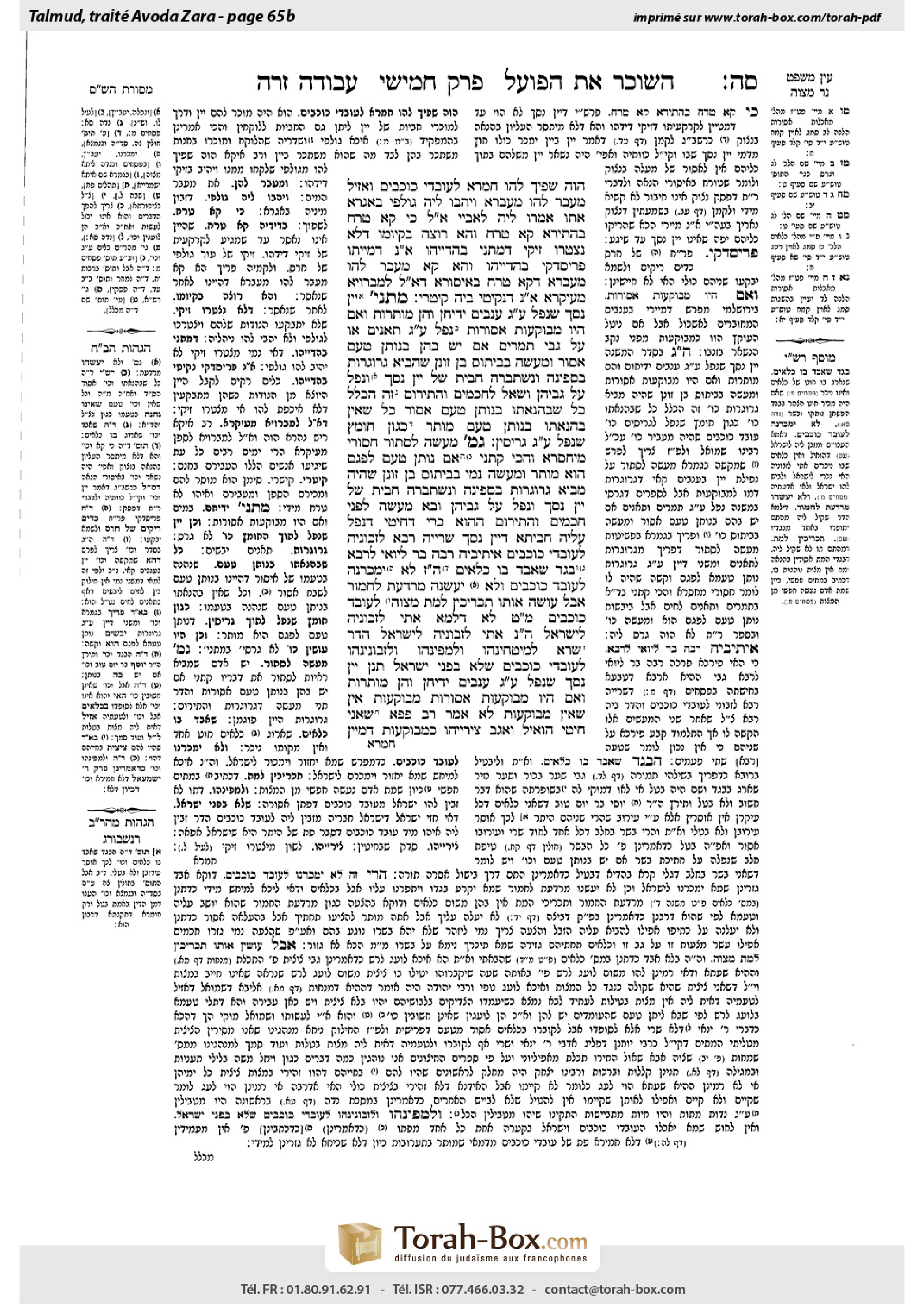
Avodah Zarah 65b: Talmud study for Daf Yomi
Study the Talmud for Daf Yomi with scanned pages, Hebrew text, English translations from Sefaria and AI-generated French translations.
Passage selection and English or AI-generated French translation are available where the scan has annotations. Daf Study is independent of Torah-Box and Sefaria.
Browse Avodah Zarah · עבודה זרה · All tractatesAvodah Zarah 65b text and translations
This page of Avodah Zarah includes the Aramaic text, an English translation and an AI-generated French translation, alongside the scan above.
עבודה זרה ס״ה ב · Aramaic and Hebrew text
הֲוָה שָׁפֵיךְ לְהוּ חַמְרָא לְגוֹיִם, וְאָזֵיל מְעַבַּר לְהוּ מַעְבָּרָא, וְיָהֲבוּ לֵיהּ גּוּלְפֵי בְּאַגְרָא. אֲתוֹ אֲמַרוּ לֵיהּ לְאַבָּיֵי, אֲמַר לְהוּ: כִּי קָא טָרַח — בְּהֶתֵּירָא קָא טָרַח.
וְהָא רוֹצֶה בְּקִיּוּמוֹ, דְּלָא נִצְטְרוֹ זִיקֵי! דְּמַתְנֵי בַּהֲדַיְיהוּ? אִי נָמֵי, דְּמַיְיתוּ (פְּרִיסְדְּקֵי) [פַּרְדִּיסְקֵי] בַּהֲדַיְיהוּ.
וְהָא קָא מְעַבַּר לְהוּ מַעְבָּרָא, דְּקָא טָרַח בְּאִיסּוּרָא! דַּאֲמַר לֵיהּ לְמַבָּרוֹיָא מֵעִיקָּרָא, אִי נָמֵי, דִּנְקִיטִי בֵּיהּ קִיטְרֵי.
מַתְנִי׳ יֵין נֶסֶךְ שֶׁנָּפַל עַל גַּבֵּי עֲנָבִים — יַדִּיחֵן וְהֵן מוּתָּרוֹת, וְאִם הָיוּ מְבוּקָּעוֹת — אֲסוּרוֹת. נָפַל עַל גַּבֵּי תְּאֵנִים אוֹ עַל גַּבֵּי תְּמָרִים, אִם יֵשׁ בָּהֶן בְּנוֹתֵן טַעַם — אָסוּר. וּמַעֲשֶׂה בְּבַיְתוֹס בֶּן זוּנֵן שֶׁהֵבִיא גְּרוֹגְרוֹת בִּסְפִינָה, וְנִשְׁתַּבְּרָה חָבִית שֶׁל יֵין נֶסֶךְ וְנָפַל עַל גַּבֵּיהֶן, וְשָׁאַל לַחֲכָמִים וְהִתִּירוּם.
זֶה הַכְּלָל: כֹּל שֶׁבַּהֲנָאָתוֹ בְּנוֹתֵן טַעַם — אָסוּר, כֹּל שֶׁאֵין בַּהֲנָאָתוֹ בְּנוֹתֵן טַעַם — מוּתָּר, כְּגוֹן חוֹמֶץ שֶׁנָּפַל עַל גַּבֵּי גְּרִיסִין.
גְּמָ׳ מַעֲשֶׂה לִסְתּוֹר? חַסּוֹרֵי מִיחַסְּרָא, וְהָכִי קָתָנֵי: אִם נוֹתֵן טַעַם לִפְגָם הוּא — מוּתָּר, וּמַעֲשֶׂה נָמֵי בְּבַיְתוֹס בֶּן זוּנֵן שֶׁהָיָה מֵבִיא גְּרוֹגְרוֹת בִּסְפִינָה, וְנִשְׁתַּבְּרָה חָבִית שֶׁל יֵין נֶסֶךְ וְנָפַל עַל גַּבֵּיהֶן, וּבָא מַעֲשֶׂה לִפְנֵי חֲכָמִים וְהִתִּירוּם.
הָהוּא (כרי) [כַּרְיָא] דְּחִיטֵּי דִּנְפַל עֲלֵיהּ חָבִיתָא דְּיֵין נֶסֶךְ, שַׁרְיֵיהּ רָבָא לְזַבּוֹנֵיהּ לְגוֹיִם.
אֵיתִיבֵיהּ רַבָּה בַּר לֵיוַאי לְרָבָא: בֶּגֶד שֶׁאָבַד בּוֹ כִּלְאַיִם, הֲרֵי זֶה לֹא יִמְכְּרֶנָּה לְגוֹי, וְלֹא יַעֲשֶׂנָּה מַרְדַּעַת לַחֲמוֹר, אֲבָל עוֹשֶׂה אוֹתוֹ תַּכְרִיכִין לְמֵת מִצְוָה.
לְגוֹי מַאי טַעְמָא לָא? דִּלְמָא אָתֵי לְזַבּוֹנֵיהּ לְיִשְׂרָאֵל, הָכָא נָמֵי אָתֵי לְזַבּוֹנֵיהּ לְיִשְׂרָאֵל!
הֲדַר שְׁרָא לְמִיטְּחִינְהוּ וְלִמְפִינְהוּ וּלְזַבּוֹנִינְהוּ לְגוֹיִם, שֶׁלֹּא בִּפְנֵי יִשְׂרָאֵל.
תְּנַן: יֵין נֶסֶךְ שֶׁנָּפַל עַל גַּבֵּי עֲנָבִים — יַדִּיחֵן וְהֵן מוּתָּרוֹת, וְאִם הָיוּ מְבוּקָּעוֹת — אֲסוּרוֹת. מְבוּקָּעוֹת — אִין, שֶׁאֵין מְבוּקָּעוֹת — לָא. אָמַר רַב פָּפָּא: שָׁאנֵי חִיטֵּי, הוֹאִיל וְאַגַּב צִירַיְיהוּ כִּמְבוּקָּעוֹת דָּמְיָין.
Avodah Zarah 65b · English translation
would pour wine which he sold to gentiles into their wineskins and go and ferry them over the crossing, and they would give him the jugs in which the wine had been stored as payment. The jugs that the wine had been stored in were included in the sale, and the gentiles would pay him by returning the jugs. People came and told Abaye that Rav Ika was accepting a wage from the wine of gentiles. Abaye said to them: When he labored, he labored with permitted wine, since he was pouring kosher wine into the wineskins, and only subsequently the wine was rendered forbidden by being in the possession of the gentiles.
The Gemara asks: But doesn’t he desire the preservation of the wine in the wineskins in that the wineskins should not be torn, as he would then need to return the jugs he received in payment? The Gemara answers: It is a case where he stipulated with the gentile purchasers that even if the wineskins were to tear it would be at their expense and not his, and he would keep the jugs in any event. Alternatively, it is a case where the gentile purchasers brought barrels [perisdakei] with them, so that they could pour the wine into them should the wineskins be torn.
The Gemara asks: But didn’t he ferry them over the crossing, which is laboring with forbidden wine? The Gemara answers: This is not a case where he was ferrying the wine over the crossing himself, as he made an arrangement with the ferrymen and said to the ferryman initially that the latter would ferry the buyers and the barrels without payment. Alternatively, it was a case where he held special signal knots in collusion with the ferryman that he would ferry these people without payment. In any event, he was not laboring for them himself.
MISHNA: In the case of wine used for a libation that fell on grapes, one rinses them and they are permitted. But if the grapes were cracked, they are forbidden. In a case where the wine fell on figs or on dates, if there is sufficient wine in them to impart flavor, they are forbidden. And there was an incident involving Boethus ben Zunen, who transported dried figs in a ship, and a barrel of wine used for a libation broke and fell on them, and he asked the Sages as to the halakha, and the Sages deemed the figs permitted.
This is the principle: Anything that benefits from a forbidden item imparting flavor to it, i.e., the forbidden item contributes a positive taste to it, is forbidden, and anything that does not benefit from a forbidden item imparting flavor to it is permitted, such as forbidden vinegar that fell onto split beans, as the flavor imparted by the vinegar does not enhance the taste of the beans.
GEMARA: The Gemara asks with regard to the incident related in the mishna: Was an incident cited to contradict the halakha stated immediately before it? The Gemara answers: The mishna is incomplete, and this is what it is teaching: If the wine imparts flavor to the detriment of the mixture, the food is permitted. And there was also an incident involving Boethus ben Zunen, who was transporting dried figs in a ship, and a barrel of wine used for a libation broke and fell on them, and the incident came before the Sages, and the Sages deemed the figs permitted because the flavor given by the wine did not enhance their taste but was instead to their detriment.
The Gemara relates: There was an incident involving a certain heap of wheat upon which a barrel of wine used for a libation fell. Rava permitted selling it to gentiles, as deriving benefit from it is not prohibited.
Rabba bar Livai raised an objection to Rava from a baraita: With regard to a garment in which diverse kinds, a prohibited mixture of wool and linen, have been lost, i.e., it is known that linen fibers became mixed into a woolen garment but they cannot be detected and removed, one may not sell the garment to a gentile, nor fashion it into a saddlecloth for a donkey, but one may make it into shrouds for a corpse with no one to bury it [met mitzva], as a corpse is not obligated in the observance of mitzvot.
Rabba bar Livai asked: What is the reason that it is not permitted to sell it to a gentile? Perhaps he will come to sell it to a Jew, who will not know that it is forbidden. Here too, with regard to the wheat, the gentile purchasers may come to sell it to a Jew, who is prohibited from consuming it.
Rava then retracted his decision and permitted grinding the wheat and baking bread with it and selling it to gentiles not in the presence of Jews. In this manner, Jews will not be likely to buy bread from the gentiles, as the bread of gentiles is forbidden to Jews.
We learned in the mishna: In the case of wine used for a libation that fell on grapes, one rinses them and they are permitted. But if the grapes were cracked, they are forbidden. The Gemara infers: If the grapes are cracked, they are forbidden, but grapes that are not cracked are not forbidden. If so, what is the cause for concern in the case where wine spilled on the wheat? It should be sufficient to rinse the wheat. Rav Pappa said: Wheat is different, since, because of its slits, its status is similar to that of grapes that are cracked.
Avodah Zarah 65b · Traduction française (IA)
il versait le vin qu'il vendait aux gentils dans leurs outres et allait les faire traverser le passage, et les gentils lui remettaient les outres dans lesquelles le vin avait été stocké en paiement. Les outres dans lesquelles le vin avait été stocké étaient incluses dans la vente, et les gentils lui payaient en rendant les outres. Des gens vinrent rapporter à Abaye que Rav Ika acceptait une rémunération du vin des gentils. Abaye dit à ceux-ci : Lorsqu'il travaillait, il travaillait avec du vin permis, car il versait du vin kasher dans les outres, et seulement ensuite le vin devenait interdit en étant en possession des gentils.
La Guemara demande : Mais ne désire-t-il pas la préservation du vin dans les outres afin que les outres ne se déchirent pas, car alors il aurait besoin de rendre les outres qu'il avait reçues en paiement ? La Guemara répond : C'est un cas où il avait stipulé avec les acheteurs gentils que même si les outres se déchiraient, cela serait à leur charge et non à la sienne, et il conserverait les outres en tout cas. Alternativement, c'est un cas où les acheteurs gentils avaient apporté des barils [perisdakei] avec eux, de sorte qu'ils pourraient verser le vin dedans en cas de déchirement des outres.
La Guemara demande : Mais n'était-ce pas un cas où il traversait le passage, ce qui constituerait un travail avec du vin interdit ? La Guemara répond : Ce n'est pas un cas où il traversait lui-même le vin sur le passage, car il avait fait un arrangement avec les ferrymen et avait dit au ferrymen au départ qu'il ferait traverser les acheteurs et les barils sans rémunération. Alternativement, c'était un cas où il avait mis des nœuds spéciaux en collusion avec le ferrymen pour qu'il traverse ces gens sans rémunération. En tout cas, il ne travaillait pas pour eux lui-même.
MICHNA : Dans le cas où un vin utilisé pour une libation tombe sur des raisins, on les rince et ils sont permis. Mais si les raisins étaient écrasés, ils sont interdits. Dans le cas où le vin tombe sur des figues ou des dattes, si suffisamment de vin est présent en eux pour leur imprimer un goût, ils sont interdits. Il y avait un incident impliquant Boethus ben Zunen, qui transportait des figues sèches en bateau, et un baril de vin utilisé pour une libation se brisa et tomba dessus, et il demanda aux Sages la halakha, et les Sages estimèrent les figues permises.
C'est le principe : Tout ce qui bénéficie d'un objet interdit qui imprime un goût à lui, c'est-à-dire que l'objet interdit contribue à un goût positif, est interdit, et tout ce qui ne bénéficie pas d'un objet interdit qui imprime un goût à lui est permis, comme le vinaigre interdit qui tomba sur des haricots éclatés, car le goût imprimé par le vinaigre n'améliore pas le goût des haricots.
GUEMARA : La Guemara demande concernant l'incident mentionné dans la mishna : Fût-ce un incident cité pour contredire la halakha énoncée immédiatement avant ? La Guemara répond : La mishna est incomplète, et c'est ce qu'elle enseigne : Si le vin imprime un goût à la détriment de la mixture, la nourriture est permise. Il y avait aussi un incident impliquant Boethus ben Zunen, qui transportait des figues sèches en bateau, et un baril de vin utilisé pour une libation se brisa et tomba dessus, et l'incident vint devant les Sages, et les Sages estimèrent les figues permises car le goût donné par le vin n'améliorait pas leur goût mais était plutôt à leur détriment.
La Guemara rapporte : Il y avait un incident concernant un tas de blé sur lequel un baril de vin utilisé pour une libation tomba. Rava permit de le vendre aux gentils, car il n'est pas interdit d'en tirer profit.
Rabba bar Livai souleva une objection contre Rava à partir d'une baraïta : Concernant un vêtement dans lequel diverses sortes, un mélange interdit de laine et de coton, ont été perdues, c'est-à-dire qu'il est connu que des fibres de coton se sont mêlées à un vêtement de laine mais qu'elles ne peuvent pas être détectées et retirées, on ne peut pas vendre le vêtement à un gentil, ni le transformer en couverture pour un âne, mais on peut le faire en linge de deuil pour un cadavre sans personne pour le faire enterrer [met mitsva], car un cadavre n'est pas tenu de l'observance des mitsvot.
Rabba bar Livai demanda : Quel est le motif qui rend illicite de le vendre à un gentil ? Peut-être qu'il viendra à vendre à un Juif, qui ne saura pas qu'il est interdit. Ici aussi, concernant le blé, les acheteurs gentils peuvent venir à vendre à un Juif, qui est interdit de le consommer.
Rava retira alors sa décision et permit de moudre le blé et de le faire cuire en pain avec, puis de le vendre aux gentils en leur absence. Ainsi, les Juifs ne seront pas enclins à acheter du pain des gentils, car le pain des gentils est interdit aux Juifs.
Nous avons appris dans la Michna : Dans le cas où un vin utilisé pour une libation tombe sur des raisins, on les rince et ils sont permis. Mais si les raisins étaient écrasés, ils sont interdits. La Guemara infère : Si les raisins sont écrasés, ils sont interdits, mais les raisins non écrasés ne sont pas interdits. Si tel est le cas, quelle est la cause de préoccupation dans le cas où du vin tombe sur le blé ? Il devrait suffire de rincer le blé. Rav Pappa dit : Le blé est différent, car, à cause de ses entailles, son statut est similaire à celui des raisins écrasés.
Traduction française générée par IA à partir de l’édition anglaise de Sefaria. Vérifie toujours un passage avec le texte source.
Text from Sefaria: William Davidson Edition - Vocalized Aramaic (CC BY NC); William Davidson Edition - English (CC BY NC).