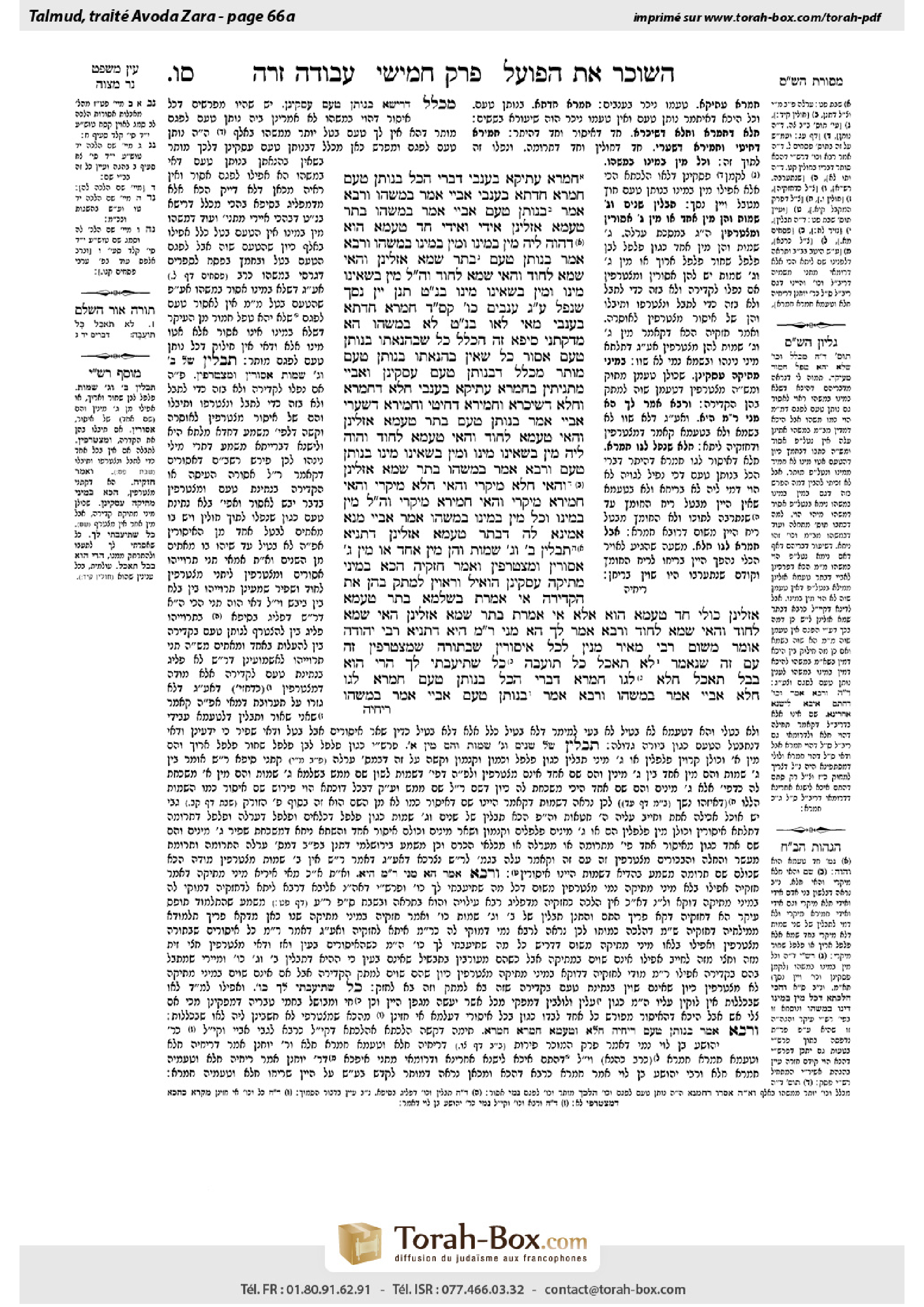
Avodah Zarah 66a: Talmud study for Daf Yomi
Study the Talmud for Daf Yomi with scanned pages, Hebrew text, English translations from Sefaria and AI-generated French translations.
Passage selection and English or AI-generated French translation are available where the scan has annotations. Daf Study is independent of Torah-Box and Sefaria.
Browse Avodah Zarah · עבודה זרה · All tractatesAvodah Zarah 66a text and translations
This page of Avodah Zarah includes the Aramaic text, an English translation and an AI-generated French translation, alongside the scan above.
עבודה זרה ס״ו א · Aramaic and Hebrew text
חַמְרָא עַתִּיקָא בְּעִנְבֵי, דִּבְרֵי הַכֹּל בְּנוֹתֵן טַעַם. חַמְרָא חַדְתָּא בְּעִנְבֵי, אַבָּיֵי אָמַר: בְּמַשֶּׁהוּ, וְרָבָא אָמַר: בְּנוֹתֵן טַעַם.
אַבָּיֵי אָמַר: בְּמַשֶּׁהוּ, בָּתַר טַעְמָא אָזְלִינַן, אִידֵּי וְאִידֵּי חַד טַעְמָא הוּא, דְּהָוֵה לֵיהּ מִין בְּמִינוֹ, וּמִין בְּמִינוֹ בְּמַשֶּׁהוּ.
וְרָבָא אָמַר: בְּנוֹתֵן טַעַם, בָּתַר שְׁמָא אָזְלִינַן, וְהַאי שְׁמָא לְחוּד וְהַאי שְׁמָא לְחוּד, וְהָוֵה לֵיהּ מִין בְּשֶׁאֵינוֹ מִינוֹ, וּמִין בְּשֶׁאֵינוֹ מִינוֹ בְּנוֹתֵן טַעַם.
תְּנַן: יֵין נֶסֶךְ שֶׁנָּפַל עַל גַּבֵּי עֲנָבִים כּוּ׳. קָא סָלְקָא דַּעְתִּין: חַמְרָא חַדְתָּא בְּעִנְבֵי, מַאי לָאו בְּנוֹתֵן טַעַם? לָא, בְּמַשֶּׁהוּ.
הָא מִדְּקָתָנֵי סֵיפָא, זֶה הַכְּלָל: כֹּל שֶׁבַּהֲנָאָתוֹ בְּנוֹתֵן טַעַם — אָסוּר, כֹּל שֶׁאֵין בַּהֲנָאָתוֹ בְּנוֹתֵן טַעַם — מוּתָּר, מִכְּלָל דִּבְנוֹתֵן טַעַם עָסְקִינַן!
וְאַבָּיֵי, מַתְנִיתִין בְּחַמְרָא עַתִּיקָא בְּעִנְבֵי.
חַלָּא דְּחַמְרָא וְחַלָּא דְּשִׁיכְרָא, וַחֲמִירָא דְּחִיטֵּי וַחֲמִירָא דִּשְׂעָרֵי, אַבָּיֵי אָמַר: בְּנוֹתֵן טַעַם, בָּתַר טַעְמָא אָזְלִינַן, וְהַאי טַעְמָא לְחוּד וְהַאי טַעְמָא לְחוּד, וְהָוֵה לֵיהּ מִין בְּשֶׁאֵינוֹ מִינוֹ, וּמִין בְּשֶׁאֵינוֹ מִינוֹ בְּנוֹתֵן טַעַם.
וְרָבָא אָמַר: בְּמַשֶּׁהוּ, בָּתַר שְׁמָא אָזְלִינַן, וְהַאי חַלָּא מִיקְּרֵי וְהַאי חַלָּא מִיקְּרֵי, וְהַאי חֲמִירָא מִיקְּרֵי וְהַאי חֲמִירָא מִיקְּרֵי, וַהֲוָה לֵיהּ מִין בְּמִינוֹ, וְכׇל מִין בְּמִינוֹ בְּמַשֶּׁהוּ.
אָמַר אַבָּיֵי: מְנָא אָמֵינָא לַהּ דְּבָתַר טַעְמָא אָזְלִינַן? דְּתַנְיָא: תַּבְלִין שְׁנַיִם וּשְׁלֹשָׁה שֵׁמוֹת, וְהֵן מִין אֶחָד, אוֹ מִין שְׁלֹשָׁה — אֲסוּרִין וּמִצְטָרְפִין. וְאָמַר חִזְקִיָּה: הָכָא בְּמִינֵי מְתִיקָה עָסְקִינַן, הוֹאִיל וּרְאוּיִן לְמַתֵּק בָּהֶן אֶת הַקְּדֵירָה. אִי אָמְרַתְּ בִּשְׁלָמָא בָּתַר טַעְמָא אָזְלִינַן — כּוּלֵּי חַד טַעְמָא הוּא, אֶלָּא אִי אָמְרַתְּ בָּתַר שְׁמָא אָזְלִינַן — הַאי שְׁמָא לְחוּד וְהַאי שְׁמָא לְחוּד!
וְרָבָא אָמַר לָךְ: הָא מַנִּי? רַבִּי מֵאִיר הִיא, דְּתַנְיָא: רַבִּי יְהוּדָה אוֹמֵר מִשּׁוּם רַבִּי מֵאִיר: מִנַּיִן לְכׇל אִיסּוּרִין שֶׁבַּתּוֹרָה שֶׁמִּצְטָרְפִין זֶה עִם זֶה? שֶׁנֶּאֱמַר: ״לֹא תֹאכַל כׇּל תּוֹעֵבָה״, כֹּל שֶׁתִּיעַבְתִּי לָךְ — הֲרֵי הוּא בְּבַל תֹּאכַל.
חַלָּא לְגוֹ חַמְרָא — דִּבְרֵי הַכֹּל בְּנוֹתֵן טַעַם. חַמְרָא לְגוֹ חַלָּא — אַבָּיֵי אָמַר: בְּמַשֶּׁהוּ, וְרָבָא אָמַר: בְּנוֹתֵן טַעַם.
אַבָּיֵי אָמַר: בְּמַשֶּׁהוּ,
Avodah Zarah 66a · English translation
§ With regard to old wine used for a libation that fell onto grapes, all agree that the grapes are forbidden only in a case where the wine imparts flavor to them. With regard to new wine used for a libation, i.e., wine that had just been squeezed and has not yet fermented, that fell onto grapes, Abaye says that any amount renders the grapes forbidden, and Rava says that they are forbidden only in a case where the wine imparts flavor to them.
The Gemara explains their respective opinions: Abaye says that any amount renders them forbidden because he maintains that when categorizing substances in the context of the halakhot of mixtures we follow the flavor, and this wine and those grapes are of the same flavor, which renders it a case of a substance in contact with the same type of substance. And the principle is that in a case of a substance in contact with the same type of substance, any amount of the forbidden substance renders the mixture forbidden.
And Rava says that the grapes are forbidden only in a case where the wine imparts flavor to them because he maintains that when categorizing substances in the context of the halakhot of mixtures we follow the name, and this wine has a discrete name, and those grapes have their own discrete name. And accordingly, this is a case of a substance in contact with a different type of substance. And the principle is that in a case of a substance in contact with a different type of substance, the mixture is forbidden only in a case where the forbidden item imparts flavor to it.
We learned in the mishna that in the case of wine used for a libation that fell on cracked grapes, the grapes are forbidden. It enters our mind that this is referring to new wine falling on grapes. What, is it not the intention of the mishna that they are forbidden only in a case where the wine imparts flavor to the grapes? If so, then it is the name that counts, as the flavor of the wine in this case is the same as the grapes. The Gemara rejects this premise: No, the mishna means that any amount of the wine renders the grapes forbidden.
The Gemara challenges this explanation. But from the fact that the mishna teaches in the last clause: This is the principle: Anything that benefits from a forbidden item imparting flavor to it is forbidden, and anything that does not benefit from a forbidden item imparting flavor to it is permitted, by inference, we are dealing with a case where the forbidden item imparts flavor to the permitted item.
And how does Abaye explain this? In his opinion, the ruling of the mishna is stated with regard to old wine that fell onto grapes, which are not of the same flavor, so it is reasonable that the grapes are rendered forbidden by an amount that imparts flavor.
This dispute between Abaye and Rava applies to another case as well. With regard to the case of wine vinegar and malt vinegar that became mixed together, and one is permitted and the other is forbidden, and also the case of leaven of wheat flour and leaven of barley flour that became mixed together, and one is permitted and the other is forbidden, Abaye says: The forbidden substance renders the mixture forbidden in a case where it imparts flavor to the mixture, because we follow the flavor, and this flavor is discrete and that flavor is discrete, and therefore it becomes a mixture of a type of food mixed with food not of its own type. And a type of food mixed with food not of its own type is forbidden in a case where the forbidden food imparts flavor to the mixture.
And Rava says: Any amount of the forbidden substance renders the mixture forbidden, in accordance with his opinion that we follow the name, and this is called vinegar and that is called vinegar, and this is called leaven and that is called leaven, and therefore it becomes a mixture of a type of food mixed with food of its own type, and in any case of a type of food mixed with food of its own type, any amount of the forbidden substance renders the mixture forbidden.
Abaye says: From where do I say that we follow the flavor? As it is taught in a baraita: Forbidden spices that are known by two or three different names but are of the same species, or of three different species, are forbidden, and combine together to render a dish forbidden. And Ḥizkiyya says: The reason the three species combine to render the dish forbidden is that here we are dealing with types of sweet spices. Since they are all fit to sweeten the dish, they combine, as they impart the same kind of flavor. Abaye explains: Granted, if you say we follow the flavor, they are all considered the same flavor, and therefore they combine. But if you say we follow the name, why should they combine to render the dish forbidden? This name is discrete and that name is discrete.
And Rava could say to you: In accordance with whose opinion is this baraita? It is the opinion of Rabbi Meir, who maintains that all forbidden foods combine, whether or not they have the same name or the same flavor, as it is taught in a baraita: Rabbi Yehuda says in the name of Rabbi Meir: From where is it derived that any foods forbidden by the Torah that fall into a mixture combine with one another to render a mixture forbidden? As it is stated: “You shall not eat anything abominable” (Deuteronomy 14:3), which indicates that anything that I have made abominable, i.e., forbidden, to you, is prohibited for consumption, and therefore all of these prohibitions are actually a single general prohibition.
With regard to forbidden vinegar that fell into a barrel of wine, all agree that the mixture is forbidden in a case where the forbidden vinegar imparts flavor to the mixture. In a case of forbidden wine that spilled into vinegar, since the sharper smell of the vinegar overwhelms the smell of the wine before it mixes in, Abaye says that any amount of the wine renders the mixture forbidden, and Rava says that it is forbidden only in a case where the wine imparts flavor to the vinegar.
The Gemara explains their respective opinions: Abaye says that any amount renders the mixture forbidden,
Avodah Zarah 66a · Traduction française (IA)
§ Concernant le vin vieux utilisé pour un libation qui est tombé sur des raisins, tous s'accordent sur le fait que les raisins sont interdits uniquement dans le cas où le vin imprime un goût aux raisins. Concernant le vin nouveau utilisé pour un libation, c'est-à-dire du vin qui vient d'être pressé et qui n'a pas encore fermenté, qui est tombé sur des raisins, Abaye dit que toute quantité rend les raisins interdits, et Rava dit qu'ils sont interdits uniquement dans le cas où le vin imprime un goût aux raisins.
La Guemara explique leurs opinions respectives : Abaye dit que toute quantité rend les raisins interdits car il considère que lors de la classification des substances dans le contexte des halakhot des mélanges, nous suivons le goût, et que ce vin et ces raisins sont du même goût, ce qui constitue un cas de substance en contact avec une substance de même type. Et le principe est que dans le cas d'une substance en contact avec une substance de même type, toute quantité de la substance interdite rend le mélange interdit.
Et Rava dit que les raisins sont interdits uniquement dans le cas où le vin imprime un goût aux raisins car il considère que lors de la classification des substances dans le contexte des halakhot des mélanges, nous suivons le nom, et que ce vin a un nom distinct, et que ces raisins ont leur propre nom distinct. Et ainsi, c'est un cas de substance en contact avec une substance de type différent. Et le principe est que dans le cas d'une substance en contact avec une substance de type différent, le mélange est interdit uniquement dans le cas où l'élément interdit imprime un goût à celui-ci.
Nous avons appris dans la Michna que dans le cas de vin utilisé pour un libation qui est tombé sur des raisins éclatés, les raisins sont interdits. Il nous vient à l'esprit que cela fait référence au vin nouveau tombant sur des raisins. Qu'est-ce que cela signifie, n'est-ce pas l'intention de la Michna qu'ils soient interdits uniquement dans le cas où le vin imprime un goût aux raisins ? Si c'est le cas, alors c'est le nom qui compte, car le goût du vin dans ce cas est le même que celui des raisins. La Guemara rejette cette hypothèse : Non, la Michna signifie que toute quantité de vin rend les raisins interdits.
La Guemara conteste cette explication. Mais à partir du fait que la Michna enseigne dans la dernière phrase : Ce principe est : Tout ce qui bénéficie d'un élément interdit imprimant un goût est interdit, et tout ce qui ne bénéficie pas d'un élément interdit imprimant un goût est permis, par déduction, nous sommes en présence d'un cas où l'élément interdit imprime un goût à l'élément permis.
Et comment Abaye explique-t-il cela ? À son avis, le jugement de la Michna est énoncé concernant un vin vieux tombant sur des raisins, qui ne sont pas du même goût, donc il est raisonnable que les raisins soient rendus interdits par une quantité imprimant un goût.
Ce débat entre Abaye et Rava s'applique également à un autre cas. En ce qui concerne le cas du vinaigre de vin et du vinaigre de malt qui se sont mélangés ensemble, et l'un est permis et l'autre interdit, ainsi que le cas du levain de farine de blé et du levain de farine de seigle qui se sont mélangés ensemble, et l'un est permis et l'autre interdit, Abaye dit : L'élément interdit rend le mélange interdit dans le cas où il imprime un goût au mélange, car nous suivons le goût, et ce goût est distinct et celui-ci est distinct, et donc il devient un mélange d'un type de nourriture mélangé avec une nourriture non de son propre type. Et un type de nourriture mélangé avec une nourriture non de son propre type est interdit dans le cas où la nourriture interdite imprime un goût au mélange.
Et Rava dit : Toute quantité de l'élément interdit rend le mélange interdit, conformément à son avis que nous suivons le nom, et cela s'appelle du vinaigre et cela s'appelle du vinaigre, et cela s'appelle du levain et cela s'appelle du levain, et donc il devient un mélange d'un type de nourriture mélangé avec une nourriture de son propre type, et dans tout cas d'un type de nourriture mélangé avec une nourriture de son propre type, toute quantité de l'élément interdit rend le mélange interdit.
Abaye dit : D'où dis-je que nous suivons le goût ? Comme il est enseigné dans une baraïta : Les épices interdits qui sont connus sous deux ou trois noms différents mais qui sont de la même espèce, ou de trois espèces différentes, sont interdits, et se combinent pour rendre un plat interdit. Et Ḥizkiyya dit : La raison pour laquelle les trois espèces se combinent pour rendre le plat interdit est que nous sommes en présence de types d'épices sucrés. Puisque tous sont adaptés à sucrer le plat, ils se combinent, car ils impriment le même genre de goût. Abaye explique : Bien sûr, si vous dites que nous suivons le goût, ils sont tous considérés comme du même goût, et donc ils se combinent. Mais si vous dites que nous suivons le nom, pourquoi devraient-ils se combiner pour rendre le plat interdit ? Ce nom est distinct et celui-ci est distinct.
Et Rava pourrait dire à vous : Selon l'opinion de qui est cette baraïta ? C'est l'opinion de Rabbi Meir, qui maintient que toutes les nourritures interdites se combinent, qu'elles aient le même nom ou le même goût ou non, comme il est enseigné dans une baraïta : Rabbi Yehuda dit en nom de Rabbi Meir : D'où est tiré le fait que toute nourriture interdite par la Torah qui tombe dans un mélange se combine avec l'autre pour rendre le mélange interdit ? Comme il est dit : « Vous ne mangerez pas de chose abominable » (Deutéronome 14:3), ce qui indique que toute chose que je vous ai rendue abominable, c'est-à-dire interdite, est interdite à la consommation, et donc toutes ces interdictions sont en réalité une seule interdiction générale.
Concernant le vinaigre interdit qui est tombé dans un tonneau de vin, tous s'accordent sur le fait que le mélange est interdit dans le cas où le vinaigre interdit imprime un goût au mélange. Dans le cas d'un vin interdit qui a coulé dans du vinaigre, puisque l'odeur plus forte du vinaigre domine l'odeur du vin avant qu'il ne se mélange, Abaye dit que toute quantité de vin rend le mélange interdit, et Rava dit qu'il est interdit uniquement dans le cas où le vin imprime un goût au vinaigre.
La Guemara explique leurs opinions respectives : Abaye dit que toute quantité rend la mixture interdite,
Traduction française générée par IA à partir de l’édition anglaise de Sefaria. Vérifie toujours un passage avec le texte source.
Text from Sefaria: William Davidson Edition - Vocalized Aramaic (CC BY NC); William Davidson Edition - English (CC BY NC).