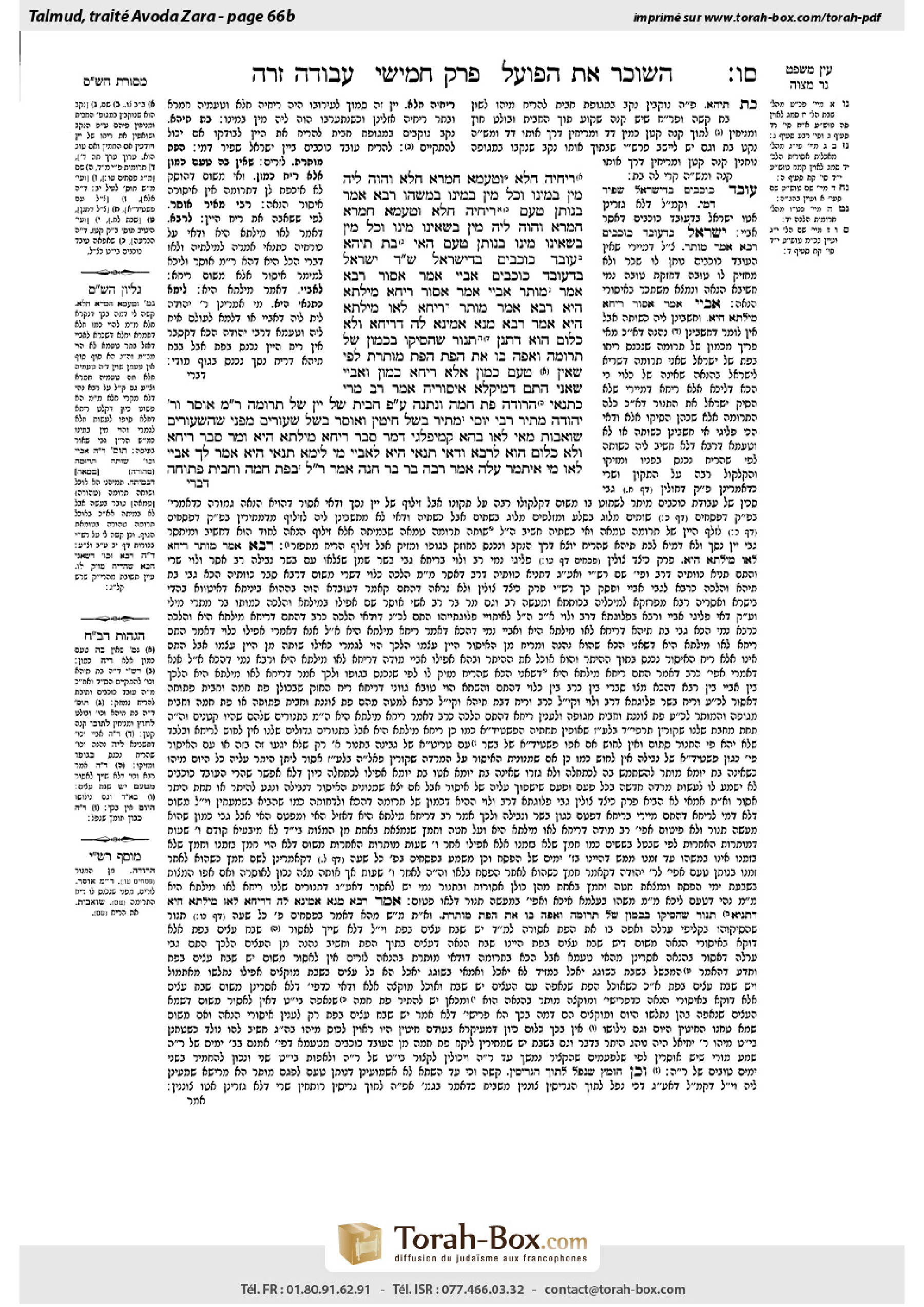
Avodah Zarah 66b: Talmud study for Daf Yomi
Study the Talmud for Daf Yomi with scanned pages, Hebrew text, English translations from Sefaria and AI-generated French translations.
Passage selection and English or AI-generated French translation are available where the scan has annotations. Daf Study is independent of Torah-Box and Sefaria.
Browse Avodah Zarah · עבודה זרה · All tractatesAvodah Zarah 66b text and translations
This page of Avodah Zarah includes the Aramaic text, an English translation and an AI-generated French translation, alongside the scan above.
עבודה זרה ס״ו ב · Aramaic and Hebrew text
רֵיחֵיהּ חַלָּא וְטַעְמָא חַמְרָא — חַלָּא, וְהָוֵה לֵיהּ מִין בְּמִינוֹ, וְכׇל מִין בְּמִינוֹ — בְּמַשֶּׁהוּ.
רָבָא אָמַר: בְּנוֹתֵן טַעַם, רֵיחֵיהּ חַלָּא וְטַעְמָא חַמְרָא — חַמְרָא, וְהָוֵה לֵיהּ מִין בְּשֶׁאֵינוֹ מִינוֹ, וְכׇל מִין בְּשֶׁאֵינוֹ מִינוֹ בְּנוֹתֵן טַעַם.
הַאי בַּת תִּיהָא, גּוֹי בִּדְיִשְׂרָאֵל — שַׁפִּיר דָּמֵי, יִשְׂרָאֵל בִּדְגוֹי — אַבָּיֵי אָמַר: אָסוּר, רָבָא אָמַר: מוּתָּר. אַבָּיֵי אָמַר: אָסוּר, רֵיחָא מִילְּתָא הִיא. רָבָא אָמַר: מוּתָּר, רֵיחָא לָאו מִילְּתָא הִיא.
אָמַר רָבָא: מְנָא אָמֵינָא לַהּ, דְּרֵיחָא וְלָא כְּלוּם הוּא? דִּתְנַן: תַּנּוּר שֶׁהִסִּיקוֹ בְּכַמּוֹן שֶׁל תְּרוּמָה וְאָפָה בּוֹ אֶת הַפַּת — הַפַּת מוּתֶּרֶת, לְפִי שֶׁאֵין טַעַם כַּמּוֹן אֶלָּא רֵיחָא כַּמּוֹן. וְאַבַּיֵּי? שָׁאנֵי הָתָם, דְּמִיקְלָא אִיסּוּרֵיהּ.
אָמַר רַב מָרִי: כְּתַנָּאֵי, הָרוֹדֶה פַּת חַמָּה וּנְתָנָהּ עַל פִּי חָבִית שֶׁל יַיִן שֶׁל תְּרוּמָה — רַבִּי מֵאִיר אוֹסֵר, וְרַבִּי יְהוּדָה מַתִּיר. רַבִּי יוֹסֵי מַתִּיר בְּשֶׁל חִיטִּין, וְאוֹסֵר בְּשֶׁל שְׂעוֹרִים, מִפְּנֵי שֶׁהַשְּׂעוֹרִים שׁוֹאֲבוֹת. מַאי לָאו בְּהָא קָמִיפַּלְגִי, דְּמָר סָבַר: רֵיחָא מִילְּתָא הִיא, וּמָר סָבַר: רֵיחָא וְלָא כְּלוּם הוּא?
לְרָבָא וַדַּאי תַּנָּאֵי הִיא, לְאַבָּיֵי מִי לֵימָא תַּנָּאֵי הִיא?
אָמַר לָךְ אַבָּיֵי: לָאו מִי אִיתְּמַר עֲלַהּ, אָמַר רַבָּה בַּר בַּר חָנָה אָמַר רֵישׁ לָקִישׁ: בְּפַת חַמָּה וְחָבִית פְּתוּחָה —
Avodah Zarah 66b · English translation
because a liquid whose smell is vinegar and its flavor is wine is considered vinegar, and the wine, when it spilled into the barrel of vinegar, took on the smell of vinegar from the moment it reached the airspace of the barrel, and it has therefore become a type of food mixed with food of its own type. And any type of forbidden food mixed with food of its own type renders the mixture forbidden by any amount.
Rava says that the mixture is forbidden only in a case where the wine imparts flavor to the vinegar, because a liquid whose smell is vinegar and its flavor is wine is considered wine, and it has therefore become a type of food mixed with food not of its own type. And any type of forbidden food mixed with food not of its own type renders the mixture forbidden only in a case where it imparts flavor to the mixture.
§ With regard to this bunghole [bat tiha], the hole in a barrel through which one can smell the wine, if a gentile smells a Jew’s wine through it, the wine is permitted, but for a Jew to smell a gentile’s wine through it, Abaye says that it is prohibited, whereas Rava says that it is permitted. Abaye says that it is prohibited because he holds that a smell is a substantial matter, a significant form of pleasure, and it is not permitted to derive benefit from a gentile’s wine. Rava says it is permitted because he holds that a smell is nothing; it is insignificant.
Rava says: From where do I say that a smell is nothing? It is as we learned in a mishna (Terumot 10:4): With regard to an oven that one lit with cumin stalks of teruma and baked bread in it, the bread is permitted because it has not absorbed the flavor of the cumin stalks but only the smell of the cumin stalks. This indicates that smell alone does not render a food forbidden. And how does Abaye explain this? He answers that it is different there, as the forbidden substance was burned. The smell of the forbidden cumin stalks entered the bread after the cumin stalks themselves were consumed by the fire, and a smell that is not from an extant substance is not forbidden. By contrast, in a case where the smell is from an extant source, it is forbidden.
Rav Mari said: This dispute between Abaye and Rava is parallel to a dispute between tanna’im, as it is taught in a mishna (Terumot 10:3): With regard to one who detached a hot loaf of bread from the oven and placed it on the opening of a barrel of wine of teruma, the portion of the produce designated for the priest, Rabbi Meir deems the bread forbidden to non-priests, as in his opinion the smell of the wine renders the bread forbidden to them, and Rabbi Yehuda deems it permitted. Rabbi Yosei deems it permitted in a case of wheat bread but deems it forbidden in a case of barley bread, because the barley draws out the fumes of the wine. Rav Mari explains: What, is it not with regard to this matter that the Sages in the mishna disagree: That one Sage, Rabbi Meir, holds that a smell is a substantial matter, and one Sage, Rabbi Yehuda, holds that a smell is nothing?
The Gemara remarks: According to the opinion of Rava, the dispute between him and Abaye is certainly parallel to a dispute between tanna’im, as he must concede that Rabbi Meir holds that a smell is a substantial matter. But according to the opinion of Abaye, shall we say that it is parallel to a dispute between tanna’im?
The Gemara answers: Abaye could say to you that Rabbi Yehuda also holds that a smell is a substantial matter. Wasn’t it stated with regard to that mishna that Rabba bar bar Ḥana says that Reish Lakish says: In the case of a hot loaf of bread and an open barrel,
Avodah Zarah 66b · Traduction française (IA)
car un liquide dont l'odeur est celle du vinaigre et le goût celui du vin est considéré comme du vinaigre, et le vin, lorsqu'il est renversé dans le tonneau de vinaigre, a pris l'odeur du vinaigre dès qu'il a atteint l'espace aérien du tonneau, et il est donc devenu un type de nourriture mélangée à une nourriture de son propre type. Et toute nourriture interdite mélangée à une nourriture de son propre type rend le mélange interdit, quels que soient la quantité.
Rava dit que le mélange est interdit uniquement dans le cas où le vin imprègne le vinaigre, car un liquide dont l'odeur est celle du vinaigre et le goût celui du vin est considéré comme du vin, et il est donc devenu un type de nourriture mélangée à une nourriture non de son propre type. Et toute nourriture interdite mélangée à une nourriture non de son propre type rend le mélange interdit uniquement dans le cas où elle imprègne le mélange.
§ En ce qui concerne ce trou de tonneau [bat tiha], le trou dans un tonneau par lequel on peut sentir le vin, si un non-Juif sent le vin d'un Juif par ce trou, le vin est permis, mais si un Juif sent le vin d'un non-Juif par ce trou, Abaye dit qu'il est interdit, tandis que Rava dit qu'il est permis. Abaye dit qu'il est interdit car il considère que l'odeur est une chose substantielle, une forme significative de plaisir, et il n'est pas permis d'en tirer un bénéfice du vin d'un non-Juif. Rava dit qu'il est permis car il considère que l'odeur est rien ; elle est insignifiante.
Rava dit : D'où dis-je que l'odeur est rien ? C'est comme nous l'avons appris dans une mitsva (Terumot 10:4) : En ce qui concerne un four allumé avec des tiges de cumin de terouma et où du pain a été cuit, le pain est permis car il n'a pas absorbé le goût des tiges de cumin mais seulement leur odeur. Cela montre que l'odeur seule ne rend pas une nourriture interdite. Et comment Abaye explique-t-il cela ? Il répond que c'est différent là, car la substance interdite a été brûlée. L'odeur des tiges de cumin interdites est entrée dans le pain après que les tiges de cumin elles-mêmes aient été consumées par le feu, et une odeur provenant d'une substance non existante n'est pas interdite. À l'inverse, dans le cas où l'odeur provient d'une source existante, elle est interdite.
Rav Mari dit : Ce débat entre Abaye et Rava est parallèle à un débat entre tannaïm, comme il est enseigné dans une mitsva (Terumot 10:3) : En ce qui concerne celui qui a détaché un pain chaud de l'four et l'a placé sur l'ouverture d'un tonneau de vin de terouma, la portion du produit destinée au prêtre, Rabbi Meir considère que le pain est interdit aux non-prêtres, car selon son avis, l'odeur du vin rend le pain interdit aux non-prêtres, et Rabbi Yehuda considère qu'il est permis. Rabbi Yosei considère qu'il est permis dans le cas du pain de blé mais interdit dans le cas du pain de seigle, car le seigle attire les vapeurs du vin. Rav Mari explique : Qu'est-ce que cela n'est pas concernant cette question que les Sages dans la mitsva s'opposent : Que l'un des Sages, Rabbi Meir, considère que l'odeur est une chose substantielle, et l'autre Sage, Rabbi Yehuda, considère que l'odeur est rien ?
La Guemara remarque : Selon l'opinion de Rava, le débat entre lui et Abaye est certainement parallèle à un débat entre tannaïm, car il doit reconnaître que Rabbi Meir considère que l'odeur est une chose substantielle. Mais selon l'opinion d'Abaye, devons-nous dire qu'il est parallèle à un débat entre tannaïm ?
La Guemara répond : Abaye pourrait dire à vous que Rabbi Yehuda considère également que l'odeur est une chose substantielle. N'était-ce pas dit concernant cette mitsna que Rabba bar bar Ḥana dit que Reish Lakish dit : Dans le cas d'un pain chaud et d'un tonneau ouvert,
Traduction française générée par IA à partir de l’édition anglaise de Sefaria. Vérifie toujours un passage avec le texte source.
Text from Sefaria: William Davidson Edition - Vocalized Aramaic (CC BY NC); William Davidson Edition - English (CC BY NC).