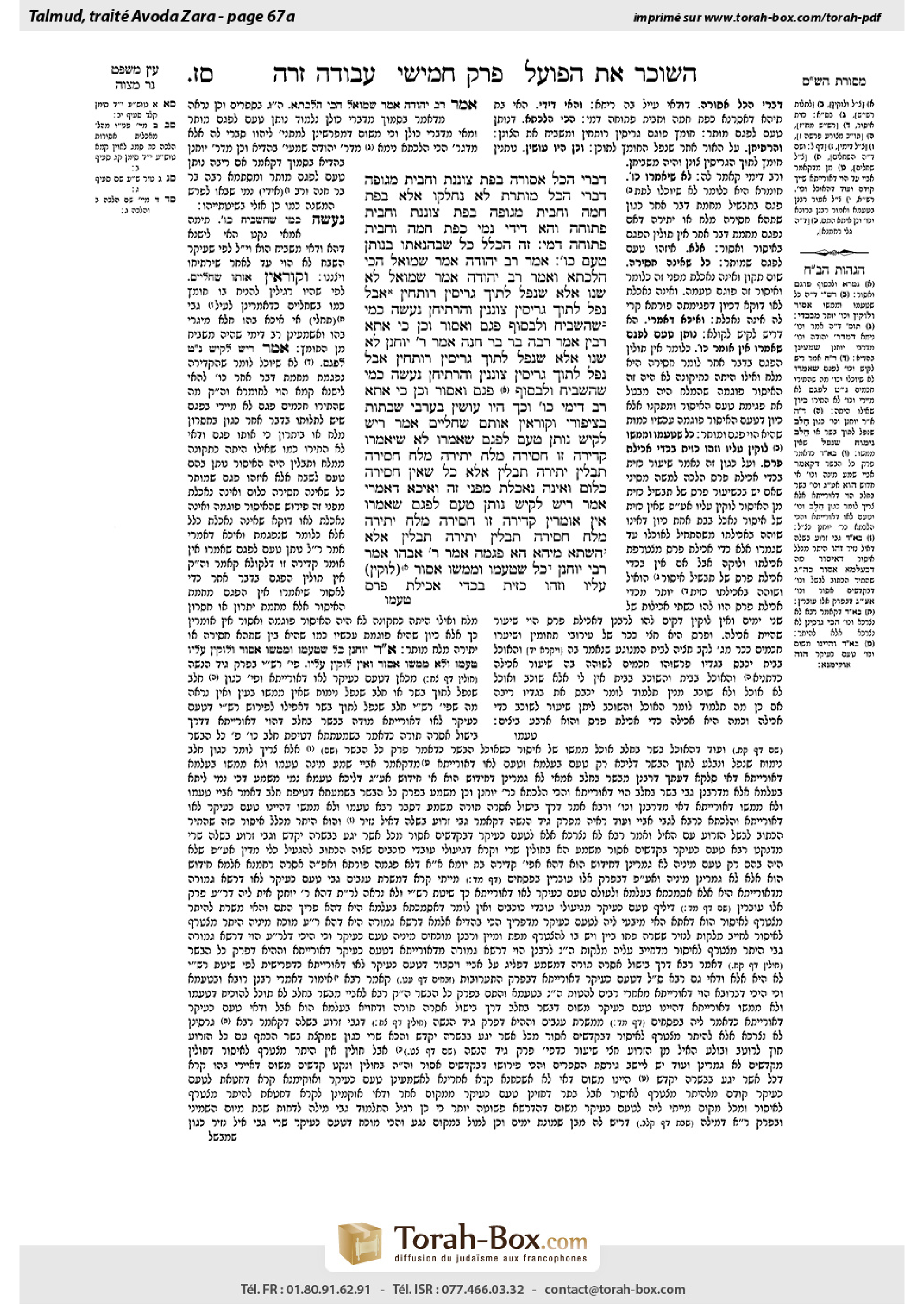
Avodah Zarah 67a: Talmud study for Daf Yomi
Study the Talmud for Daf Yomi with scanned pages, Hebrew text, English translations from Sefaria and AI-generated French translations.
Passage selection and English or AI-generated French translation are available where the scan has annotations. Daf Study is independent of Torah-Box and Sefaria.
Browse Avodah Zarah · עבודה זרה · All tractatesAvodah Zarah 67a text and translations
This page of Avodah Zarah includes the Aramaic text, an English translation and an AI-generated French translation, alongside the scan above.
עבודה זרה ס״ז א · Aramaic and Hebrew text
דִּבְרֵי הַכֹּל אֲסוּרָה, בְּפַת צוֹנֶנֶת וְחָבִית מְגוּפָה — דִּבְרֵי הַכֹּל מוּתֶּרֶת. לֹא נֶחְלְקוּ אֶלָּא בְּפַת חַמָּה וְחָבִית מְגוּפָה, בְּפַת צוֹנֶנֶת וְחָבִית פְּתוּחָה. וְהָא דִּידִי נָמֵי כְּפַת חַמָּה וְחָבִית פְּתוּחָה דָּמֵי.
זֶה הַכְּלָל, כֹּל שֶׁבַּהֲנָאָתוֹ בְּנוֹתֵן טַעַם כּוּ׳. אָמַר רַב יְהוּדָה אָמַר שְׁמוּאֵל: הָכִי הִלְכְתָא.
וְאָמַר רַב יְהוּדָה אָמַר שְׁמוּאֵל: לֹא שָׁנוּ אֶלָּא שֶׁנָּפַל לְתוֹךְ גְּרִיסִין רוֹתְחִין, אֲבָל נָפַל לְתוֹךְ גְּרִיסִין צוֹנְנִין וְהִרְתִּיחָן, נַעֲשָׂה כְּמִי שֶׁהִשְׁבִּיחַ וּלְבַסּוֹף פָּגַם, וְאָסוּר.
וְכֵן כִּי אֲתָא רָבִין אָמַר רַבָּה בַּר בַּר חָנָה אָמַר רַבִּי יוֹחָנָן: לֹא שָׁנוּ אֶלָּא שֶׁנָּפַל לְתוֹךְ גְּרִיסִין רוֹתְחִין, אֲבָל נָפַל לְתוֹךְ גְּרִיסִין צוֹנְנִין וְהִרְתִּיחָן, נַעֲשָׂה כְּמִי שֶׁהִשְׁבִּיחַ וּלְבַסּוֹף פָּגַם, וְאָסוּר. וְכֵן כִּי אֲתָא רַב דִּימִי כּוּ׳. וְכָךְ הָיוּ עוֹשִׂין בְּעַרְבֵי שַׁבָּתוֹת בְּצִיפּוֹרִי, וְקוֹרְאִין אוֹתָם שַׁחֲלַיִים.
אָמַר רֵישׁ לָקִישׁ: נוֹתֵן טַעַם לִפְגָם שֶׁאָמְרוּ, לֹא שֶׁיֹּאמְרוּ: קְדֵירָה זוֹ חֲסֵירָה מֶלַח, יְתֵירָה מֶלַח, חֲסֵירָה תַּבְלִין, יְתֵירָה תַּבְלִין, אֶלָּא כֹּל שֶׁאֵין חֲסֵירָה כְּלוּם, וְאֵינָהּ נֶאֱכֶלֶת מִפְּנֵי זֶה.
וְאִיכָּא דְּאָמְרִי, אָמַר רֵישׁ לָקִישׁ: נוֹתֵן טַעַם לִפְגָם שֶׁאָמְרוּ, אֵין אוֹמְרִין: קְדֵירָה זוֹ חֲסֵירָה מֶלַח, יְתֵירָה מֶלַח, חֲסֵירָה תַּבְלִין, יְתֵירָה תַּבְלִין, אֶלָּא הַשְׁתָּא מִיהָא הָא פָּגְמָה.
אָמַר רַבִּי אֲבָהוּ אָמַר רַבִּי יוֹחָנָן: כֹּל שֶׁטַּעְמוֹ וּמַמָּשׁוֹ אָסוּר, לוֹקִין עָלָיו, וְזֶהוּ כְּזַיִת בִּכְדֵי אֲכִילַת פְּרָס.
Avodah Zarah 67a · English translation
everyone agrees that it is forbidden, as the bread certainly absorbed of the smell of the wine? Furthermore, in the case of a cool loaf of bread and a stoppered barrel, everyone agrees that it is permitted. They disagree only with regard to the case of a hot loaf of bread and a stoppered barrel, or in the case of a cool loaf of bread and an open barrel. And this case of mine, i.e., the case of the bunghole, is also comparable to the case of a hot loaf of bread and an open barrel, in which everyone agrees that the bread is forbidden.
§ It is stated in the mishna: This is the principle: Anything that benefits from a forbidden item imparting flavor to it, i.e., the forbidden item contributes a positive taste to it, is forbidden, and anything that does not benefit from a forbidden item imparting flavor to it is permitted, e.g., forbidden vinegar that fell onto split beans, as the flavor imparted by the vinegar does not enhance the taste of the beans. Rav Yehuda says that Shmuel says: This is the halakha.
And Rav Yehuda says that Shmuel says: The Sages taught this only with regard to a case where the vinegar fell into hot split beans, imparting flavor to their detriment. But if the vinegar fell into cold split beans, the vinegar enhances the flavor, and if one subsequently heated them, it becomes like a dish that some added ingredient first enhanced its flavor and ultimately detracted from it, and it is rendered forbidden, as the initial flavor that was imparted was beneficial.
And similarly, when Ravin came from Eretz Yisrael to Babylonia he reported that Rabba bar bar Ḥana says that Rabbi Yoḥanan says: The Sages taught this only with regard to the case where the vinegar fell into hot split beans. But if the vinegar fell into cold split beans and one subsequently heated the mixture, it becomes like a dish that some added ingredient first enhanced its flavor and ultimately detracted from it, and it is rendered forbidden. And similarly, when Rav Dimi came, he also reported this in the name of Rabbi Yoḥanan and added: And they would prepare this dish of split beans and vinegar on the eves of Shabbat in Tzippori, and they would call it cress dish.
§ Reish Lakish says: With regard to the principle that the Sages said, that if a forbidden food imparts flavor to a permitted food to the detriment of the mixture it remains permitted, the criterion is not that people would say: This dish is lacking in salt or is overabundant in salt, is lacking in spices or is overabundant in spices, and that is why its flavor was detracted by the forbidden food. Rather, it is referring to any dish that is not lacking in anything, but will not be eaten only because of this forbidden substance that fell into it.
And there are those who say that Reish Lakish states a lenient interpretation of the principle: With regard to that which Sages said that if a forbidden food imparts flavor to a permitted food to the detriment of the mixture, it remains permitted, one does not say that a certain food is forbidden because its flavor was not actually detracted by the forbidden substance, as this dish is lacking in salt or is overabundant in salt, is lacking in spices or is overabundant in spices, and it is for that reason that the forbidden substance detracted from its flavor. Rather, since now, in any event, the forbidden substance detracted from its flavor, it is permitted.
§ Furthermore, with regard to a forbidden food that became mixed with a permitted food, Rabbi Abbahu says that Rabbi Yoḥanan says: In any case where the flavor and substance of the forbidden food are perceptible in the mixture, the mixture is forbidden, and one is flogged for consuming it. And it is a tradition that this is the measure for such a case: One who eats an olive-bulk of the forbidden element in the mixture in the time it takes to eat a half-loaf of bread is liable for eating the forbidden food.
Avodah Zarah 67a · Traduction française (IA)
Tout le monde convient qu'il est interdit, car le pain a certainement absorbé l'odeur du vin. De plus, dans le cas d'un pain froid et d'un tonneau bouché, tout le monde convient qu'il est permis. Ils ne s'entendent que sur le cas d'un pain chaud et d'un tonneau bouché, ou dans le cas d'un pain froid et d'un tonneau ouvert. Et ce cas-ci, à savoir celui du bouchon, est également comparable au cas d'un pain chaud et d'un tonneau ouvert, dans lequel tout le monde convient que le pain est interdit.
§ Il est dit dans la mitsva : Ce principe est le suivant : Tout ce qui bénéficie d'un objet interdit qui lui transmet un goût, c'est-à-dire que l'objet interdit contribue à un goût positif, est interdit, et tout ce qui ne bénéficie pas d'un objet interdit qui lui transmet un goût est permis, par exemple, du vinaigre interdit tombé sur des haricots écrasés, car le goût transmis par le vinaigre n'améliore pas le goût des haricots. Rav Yehuda dit que Shmuel dit : C'est la halakha.
Et Rav Yehuda dit que Shmuel dit : Les Sages ont enseigné cela uniquement dans le cas où le vinaigre est tombé dans des haricots écrasés chauds, transmettant un goût à leur détriment. Mais si le vinaigre est tombé dans des haricots écrasés froids, le vinaigre améliore le goût, et si l'on réchauffe ensuite le mélange, cela devient comme un plat où un ingrédient ajouté a d'abord amélioré le goût et finalement l'a détérioré, et il est rendu interdit, car le goût initial transmis était bénéfique.
Et de même, lorsque Ravin est venu de la Terre d'Israël en Babylone, il rapporta que Rabba bar bar Ḥana dit que Rabbi Yoḥanan dit : Les Sages ont enseigné cela uniquement dans le cas où le vinaigre est tombé dans des haricots écrasés chauds. Mais si le vinaigre est tombé dans des haricots écrasés froids et qu'on réchauffe ensuite le mélange, cela devient comme un plat où un ingrédient ajouté a d'abord amélioré le goût et finalement l'a détérioré, et il est rendu interdit. Et de même, lorsque Rav Dimi est venu, il a également rapporté cela au nom de Rabbi Yoḥanan et a ajouté : Et ils préparaient ce plat de haricots écrasés et de vinaigre aux veilles de Shabbat à Tzippori, et ils l'appelaient plat de cresson.
§ Reish Lakish dit : Concernant le principe que les Sages ont dit, que si un aliment interdit transmet un goût à un aliment permis à la détriment du mélange, il reste permis, le critère n'est pas que les gens disent : Ce plat manque de sel ou est trop salé, manque d'épices ou est trop épice, et c'est pour cela que son goût a été détérioré par l'aliment interdit. Plutôt, il s'agit de tout plat qui n'a rien manqué, mais ne sera pas mangé uniquement à cause de cette substance interdite tombée dedans.
Et ceux qui disent que Reish Lakish énonce une interprétation clémente du principe : Concernant ce que les Sages ont dit, que si un aliment interdit transmet un goût à un aliment permis à la détriment du mélange, il reste permis, on ne dit pas que certains aliments sont interdits parce que leur goût n'a pas été réellement détérioré par la substance interdite, car ce plat manque de sel ou est trop salé, manque d'épices ou est trop épice, et c'est pour cela que la substance interdite a détérioré son goût. Plutôt, puisque maintenant, en tout cas, la substance interdite a détérioré son goût, il est permis.
§ De plus, concernant un aliment interdit qui s'est mélangé à un aliment permis, Rabbi Abbahu dit que Rabbi Yoḥanan dit : Dans tout cas où le goût et la substance de l'aliment interdit sont perceptibles dans le mélange, le mélange est interdit, et celui qui en consomme est frappé. Et c'est une tradition que cela constitue la mesure pour de tels cas : celui qui mange une quantité d'olive du composant interdit dans le mélange pendant le temps qu'il faut pour manger une demi-boule de pain est puni pour avoir mangé l'aliment interdit.
Traduction française générée par IA à partir de l’édition anglaise de Sefaria. Vérifie toujours un passage avec le texte source.
Text from Sefaria: William Davidson Edition - Vocalized Aramaic (CC BY NC); William Davidson Edition - English (CC BY NC).