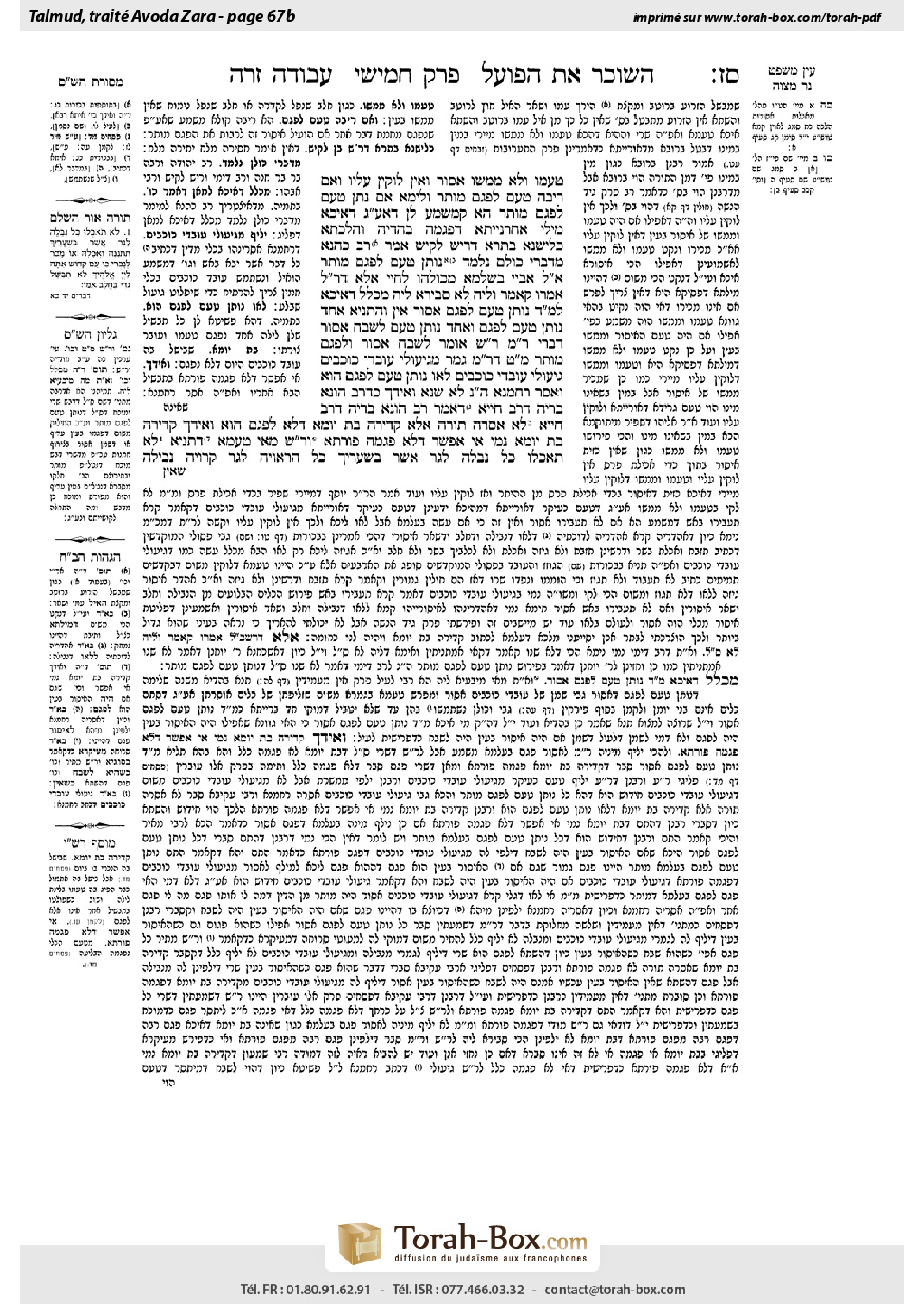
Avodah Zarah 67b: Talmud study for Daf Yomi
Study the Talmud for Daf Yomi with scanned pages, Hebrew text, English translations from Sefaria and AI-generated French translations.
Passage selection and English or AI-generated French translation are available where the scan has annotations. Daf Study is independent of Torah-Box and Sefaria.
Browse Avodah Zarah · עבודה זרה · All tractatesAvodah Zarah 67b text and translations
This page of Avodah Zarah includes the Aramaic text, an English translation and an AI-generated French translation, alongside the scan above.
עבודה זרה ס״ז ב · Aramaic and Hebrew text
טַעְמוֹ וְלֹא מַמָּשׁוֹ — אָסוּר, וְאֵין לוֹקִין עָלָיו, וְאִם רִיבָּה טַעַם לִפְגָם — מוּתָּר.
וְלֵימָא: אִם נָתַן טַעַם לִפְגָם — מוּתָּר! הָא קָמַשְׁמַע לַן, דְּאַף עַל גַּב דְּאִיכָּא מִילֵּי אַחְרָנְיָיתָא דְּפַגְמַהּ בַּהֲדֵיהּ, וְהִלְכְתָא כְּלִישָּׁנָא בָּתְרָא דְּרֵישׁ לָקִישׁ.
אָמַר רַב כָּהֲנָא: מִדִּבְרֵי כּוּלָּם נִלְמַד נוֹתֵן טַעַם לִפְגָם מוּתָּר. אֲמַר לֵיהּ אַבָּיֵי: בִּשְׁלָמָא מִכּוּלְּהוּ לְחַיֵּי, אֶלָּא דְּרֵישׁ לָקִישׁ — ״אָמְרוּ״ קָאָמַר, וְלֵיהּ לָא סְבִירָא לֵיהּ.
מִכְּלָל דְּאִיכָּא לְמַאן דְּאָמַר: נוֹתֵן טַעַם לִפְגָם — אָסוּר?
אִין, וְהָתַנְיָא: אֶחָד נוֹתֵן טַעַם לִפְגָם וְאֶחָד נוֹתֵן טַעַם לְשֶׁבַח — אָסוּר, דִּבְרֵי רַבִּי מֵאִיר. רַבִּי שִׁמְעוֹן אוֹמֵר: לְשֶׁבַח — אָסוּר, וְלִפְגָם — מוּתָּר.
מַאי טַעְמָא דְּרַבִּי מֵאִיר? גָּמַר מִגִּיעוּלֵי גוֹיִם, גִּיעוּלֵי גוֹיִם לָאו נוֹתֵן טַעַם לִפְגָם הוּא? וְאָסַר רַחֲמָנָא, הָכִי נָמֵי לָא שְׁנָא.
וְאִידַּךְ? כִּדְרַב הוּנָא בְּרֵיהּ דְּרַב חִיָּיא, דְּאָמַר רַב הוּנָא בְּרֵיהּ דְּרַב חִיָּיא: לֹא אָסְרָה תּוֹרָה אֶלָּא קְדֵירָה בַּת יוֹמָא, דְּלָא לִפְגָם הוּא. וְאִידָּךְ? קְדֵירָה בַּת יוֹמָא נָמֵי אִי אֶפְשָׁר דְּלָא פָּגְמָה פּוּרְתָּא.
וְרַבִּי שִׁמְעוֹן, מַאי טַעְמָא? דְּתַנְיָא: ״לֹא תֹאכְלוּ כׇּל נְבֵלָה לַגֵּר אֲשֶׁר בִּשְׁעָרֶיךָ״, כָּל הָרְאוּיָה לַגֵּר — קְרוּיָה נְבֵילָה,
Avodah Zarah 67b · English translation
But if only the flavor of the forbidden food is recognizable in the mixture, but not its substance, as it was completely dissolved into the permitted food, the mixture is forbidden, but one is not flogged for consuming it. And if the forbidden food amplified the flavor of the permitted food to its detriment, it is permitted.
The Gemara asks: But then let Rabbi Yoḥanan say: If the forbidden food imparts flavor to the detriment of the mixture, it is permitted. Why does he use the term: Amplified? The Gemara answers that this is what Rabbi Yoḥanan teaches us: That even if there are other substances that detracted from the flavor of the mixture along with the forbidden food, e.g., insufficient salt or excessive seasoning, this is not taken into consideration; since the forbidden food detracted from its flavor, the mixture is permitted. The Gemara comments: And the halakha is in accordance with the last version of the statement of Reish Lakish.
§ Rav Kahana says: From the statements of all the amora’im who were cited, namely, Shmuel, Rabbi Yoḥanan, and Reish Lakish, we learn that if a forbidden food imparts flavor to a permitted food to the detriment of the mixture, it is permitted. Abaye said to him: Granted, from all the rest of them this conclusion is very well; but how can this be concluded from the statement of Reish Lakish? He says only that the Sages said that if a forbidden food imparts flavor to a permitted food to its detriment, the mixture is permitted. Perhaps he is only citing what others said and he himself does not hold accordingly.
The Gemara asks with regard to Rav Kahana’s statement: By inference, is there one who says that if a forbidden food imparts flavor to a permitted food to the detriment of the mixture, it is forbidden?
The Gemara answer: Yes, and this opinion is taught in a baraita: Both in a case where the forbidden food imparts flavor to the detriment of the flavor of the permitted food, and in a case where it imparts flavor that enhances the permitted food, the mixture is forbidden; this is the statement of Rabbi Meir. Rabbi Shimon says: If it enhances the flavor it is forbidden, but if it causes it detriment it is permitted.
The Gemara explains: What is the reasoning of Rabbi Meir? He derives this halakha from the case of vessels of gentiles that require purging, i.e., vessels that gentiles used for cooking, which the Torah requires that one purge through fire and ritually purify before they may be used by Jews (see Numbers 31:22–23 and mishna on 75b). Is it not the case that vessels of gentiles that require purging impart flavor to food that is cooked in them to their detriment? Since time has passed since the gentiles cooked non-kosher food in the vessels, the flavor that the vessels transmit to food that a Jew cooks in them is certainly detrimental, and yet the Merciful One deems their use prohibited without purging. So too, the case here is no different, and even if the flavor imparted by the forbidden food is a detrimental one, the mixture should be forbidden.
And the opinion of the other tanna, Rabbi Shimon, who deems the mixture permitted if the flavor imparted is detrimental, can be explained in accordance with the opinion of Rav Huna, son of Rav Ḥiyya; as Rav Huna, son of Rav Ḥiyya, says: With regard to the vessels of gentiles, the Torah prohibits only a pot that was used for cooking on that very day, which does not yet impart flavor to the detriment of the food cooked in it. Rather, the flavor that it imparts is not considered detrimental. And the opinion of the other tanna, Rabbi Meir, can also be explained in accordance with this statement, as in his opinion, even in the case of a pot that was used for cooking on that very day, it is not possible that it does not detract from the flavor of food that is subsequently cooked in it even slightly.
The Gemara asks: And what is the reasoning of Rabbi Shimon? It is as it is taught in a baraita that from the verse: “You shall not eat of any unslaughtered animal carcass; you may give it to the resident alien [la’ger] who is within your gates, that he may eat it” (Deuteronomy 14:21), it is derived that with regard to animal carcasses, anything that is fit for a ger toshav to consume is called an unslaughtered carcass and is forbidden,
Avodah Zarah 67b · Traduction française (IA)
Mais si seul le goût de la nourriture interdite est identifiable dans le mélange, mais pas sa substance, car elle est complètement dissoute dans la nourriture permise, le mélange est interdit, mais on ne flagelle pas celui qui le consomme. Et si la nourriture interdite a renforcé le goût de la nourriture permise à son détriment, elle est permise.
La Guemara pose la question : Mais alors pourquoi Rabbi Yoḥanan dit-il : Si la nourriture interdite renforce le goût à détriment du mélange, il est permis. Pourquoi utilise-t-il le terme : renforce ? La Guemara répond que c'est ce que Rabbi Yoḥanan nous enseigne : que même s'il y a d'autres substances qui ont détérioré le goût du mélange avec la nourriture interdite, par exemple, du sel insuffisant ou un assaisonnement excessif, cela n'est pas pris en compte ; puisque la nourriture interdite a détérioré son goût, le mélange est permis. La Guemara commente : Et la halakha suit la dernière version de l'expression de Reish Lakish.
§ Rav Kahana dit : D'après les déclarations de tous les amoraïm cités, à savoir Shmuel, Rabbi Yoḥanan et Reish Lakish, nous apprenons que si une nourriture interdite renforce le goût d'une nourriture permise à son détriment, elle est permise. Abaye dit à lui : C'est évident, d'après tous les autres, cette conclusion est très bonne ; mais comment peut-on en conclure à partir de la déclaration de Reish Lakish ? Il dit seulement que les Sages ont dit que si une nourriture interdite renforce le goût d'une nourriture permise à son détriment, le mélange est permis. Peut-être qu'il cite seulement ce que d'autres ont dit et qu'il-même ne suit pas cette opinion.
La Guemara pose la question concernant la déclaration de Rav Kahana : Par déduction, y a-t-il quelqu'un qui affirme que si une nourriture interdite transmet un goût à une nourriture permise à son détriment, elle est interdite ?
La Guemara répond : Oui, et cette opinion est enseignée dans une baraïta : Quand une nourriture interdite transmet un goût à la détriment du goût de la nourriture permise, et quand elle transmet un goût qui améliore la nourriture permise, le mélange est interdit ; c'est l'opinion de Rabbi Meir. Rabbi Shimon dit : Si elle améliore le goût, elle est interdite, mais si elle cause un détriment, elle est permise.
La Guemara explique : Quel est le raisonnement de Rabbi Meir ? Il dérive cette halakha du cas des ustensiles des non-juifs qui nécessitent un nettoyage, c'est-à-dire des ustensiles utilisés par les non-juifs pour la cuisson, que la Torah exige qu'on les nettoie par le feu et qu'on les purifie rituellement avant de les utiliser par les Juifs (voir Nombres 31:22–23 et la mishna sur 75b). N'est-ce pas le cas où les ustensiles des non-juifs qui nécessitent un nettoyage transmettent un goût à la nourriture cuite dedans à leur détriment ? Puisque le temps est passé depuis que les non-juifs ont cuisiné de la nourriture non-kosher dans les ustensiles, le goût que les ustensiles transmettent à la nourriture que le Juif cuisine dedans est certainement nuisible, et pourtant l'Éternel considère leur utilisation interdite sans nettoyage. De même, le cas ici n'est pas différent, et même si le goût transmis par la nourriture interdite est nuisible, le mélange devrait être interdit.
Et l'opinion de l'autre tanna, Rabbi Shimon, qui considère le mélange comme permis si le goût transmis est nuisible, peut être expliquée en conformité avec l'opinion de Rav Huna, fils de Rav Ḥiyya ; car Rav Huna, fils de Rav Ḥiyya, dit : En ce qui concerne les ustensiles des non-juifs, la Torah interdit seulement une marmite utilisée pour la cuisson la même journée, qui n'implique pas encore un goût nuisible pour la nourriture cuite dedans. Plutôt, le goût qu'elle transmet n'est pas considéré comme nuisible. Et l'opinion de l'autre tanna, Rabbi Meir, peut aussi être expliquée en conformité avec cette déclaration, car selon son opinion, même dans le cas d'une marmite utilisée pour la cuisson la même journée, il n'est pas possible qu'elle ne détériore pas le goût de la nourriture cuite après.
La Guemara pose la question : Et quel est le raisonnement de Rabbi Shimon ? C'est ce qui est enseigné dans une baraïta, à partir de la parole : « Tu ne mangeras pas de carcasse d'animaux non immolés ; tu peux la donner à l'étranger qui habite dans tes villes, qu'il la mange » (Deutéronome 14:21), on dérive que concernant les carcasses d'animaux, tout ce qui est adapté à la consommation d'un ger toshav est appelé une carcasse non immolée et est interdit,
Traduction française générée par IA à partir de l’édition anglaise de Sefaria. Vérifie toujours un passage avec le texte source.
Text from Sefaria: William Davidson Edition - Vocalized Aramaic (CC BY NC); William Davidson Edition - English (CC BY NC).