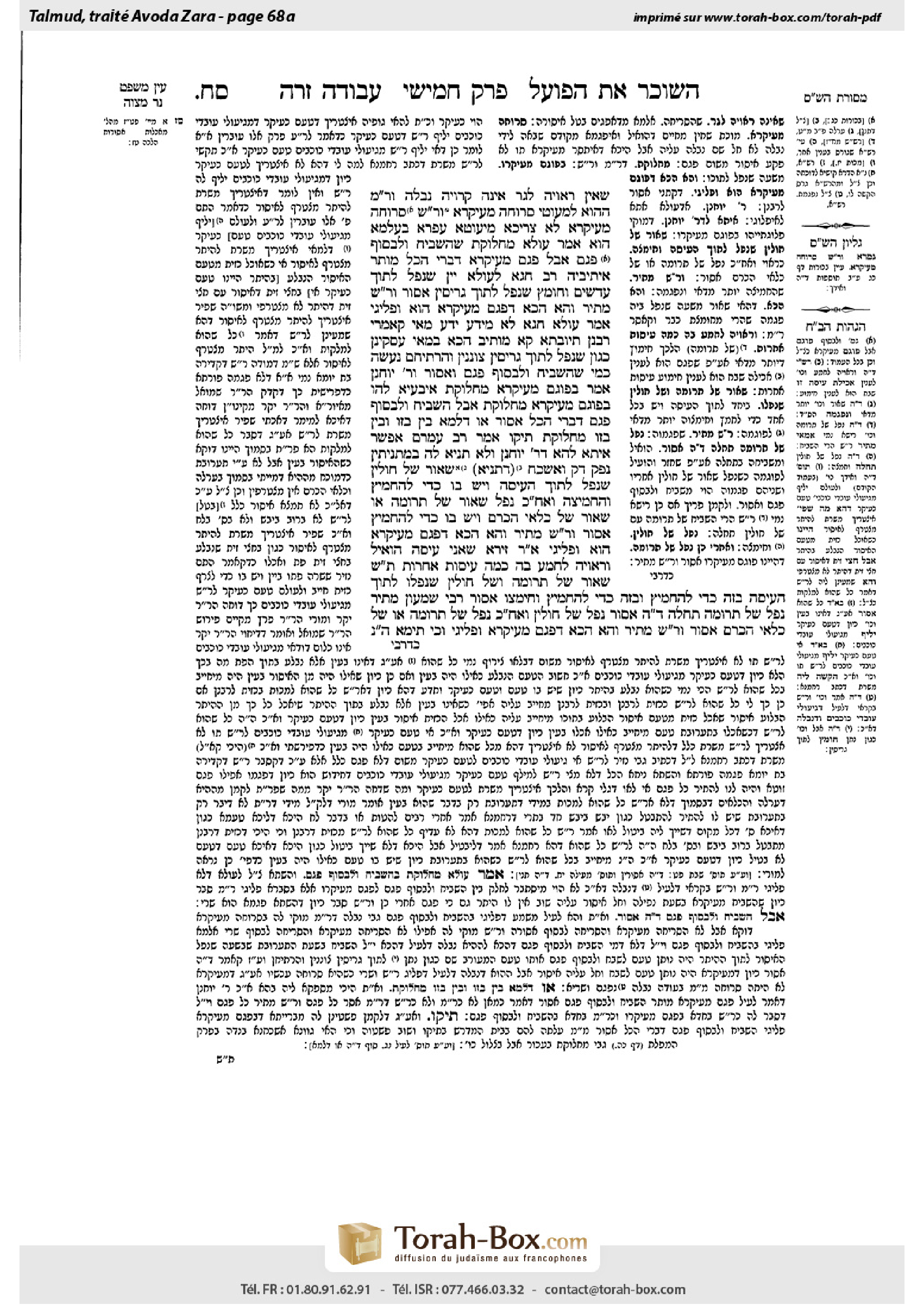
Avodah Zarah 68a: Talmud study for Daf Yomi
Study the Talmud for Daf Yomi with scanned pages, Hebrew text, English translations from Sefaria and AI-generated French translations.
Passage selection and English or AI-generated French translation are available where the scan has annotations. Daf Study is independent of Torah-Box and Sefaria.
Browse Avodah Zarah · עבודה זרה · All tractatesAvodah Zarah 68a text and translations
This page of Avodah Zarah includes the Aramaic text, an English translation and an AI-generated French translation, alongside the scan above.
עבודה זרה ס״ח א · Aramaic and Hebrew text
שֶׁאֵין רְאוּיָה לְגֵר — אֵינָהּ קְרוּיָה נְבֵלָה.
וְרַבִּי מֵאִיר, הָהוּא לְמַעוֹטֵי סְרוּחָה מֵעִיקָּרָא, וְרַבִּי שִׁמְעוֹן — סְרוּחָה מֵעִיקָּרָא לָא צְרִיכָא מִיעוּטָא, עַפְרָא בְּעָלְמָא הוּא.
אָמַר עוּלָּא: מַחְלוֹקֶת שֶׁהִשְׁבִּיחַ וּלְבַסּוֹף פָּגַם, אֲבָל פָּגַם מֵעִיקָּרָא — דִּבְרֵי הַכֹּל מוּתָּר.
אֵיתִיבֵיהּ רַב חַגָּא לְעוּלָּא: יַיִן שֶׁנָּפַל לְתוֹךְ עֲדָשִׁים, וְחוֹמֶץ שֶׁנָּפַל לְתוֹךְ גְּרִיסִין — אָסוּר, וְרַבִּי שִׁמְעוֹן מַתִּיר. וְהָא הָכָא דִּפְגַם מֵעִיקָּרָא הוּא, וּפְלִיגִי!
אָמַר עוּלָּא: חַגָּא לָא מִידָּע יָדַע מַאי קָאָמְרִי רַבָּנַן, תְּיוּבְתָּא קָא מוֹתֵיב? הָכָא בְּמַאי עָסְקִינַן? כְּגוֹן שֶׁנָּפַל לְתוֹךְ גְּרִיסִין צוֹנְנִין וְהִרְתִּיחָם, נַעֲשָׂה כְּמִי שֶׁהִשְׁבִּיחַ וּלְבַסּוֹף פָּגַם, וְאָסוּר.
וְרַבִּי יוֹחָנָן אָמַר: בְּפוֹגֵם מֵעִיקָּרָא מַחְלוֹקֶת.
אִיבַּעְיָא לְהוּ: בְּפוֹגֵם מֵעִיקָּרָא מַחְלוֹקֶת, אֲבָל הִשְׁבִּיחַ וּלְבַסּוֹף פָּגַם — דִּבְרֵי הַכֹּל אָסוּר, אוֹ דִּלְמָא בֵּין בָּזוֹ וּבֵין בָּזוֹ מַחְלוֹקֶת? תֵּיקוּ.
אָמַר רַב עַמְרָם: אֶפְשָׁר אִיתָא לְהָא דְּרַבִּי יוֹחָנָן, וְלָא תַּנְיָא לַהּ בְּמַתְנִיתִין?
נְפַק דָּק וְאַשְׁכַּח, דְּתַנְיָא: שְׂאוֹר שֶׁל חוּלִּין שֶׁנָּפַל לְתוֹךְ הָעִיסָּה, וְיֵשׁ בּוֹ כְּדֵי לְהַחְמִיץ וְהֶחְמִיצָה, וְאַחַר כָּךְ נָפַל שְׂאוֹר שֶׁל תְּרוּמָה אוֹ שְׂאוֹר שֶׁל כִּלְאֵי הַכֶּרֶם וְיֵשׁ בּוֹ כְּדֵי לְהַחְמִיץ — אָסוּר, וְרַבִּי שִׁמְעוֹן מַתִּיר.
וְהָא הָכָא, דִּפְגַם מֵעִיקָּרָא הוּא, וּפְלִיגִי!
אָמַר רַבִּי זֵירָא: שָׁאנֵי עִיסָּה, הוֹאִיל וּרְאוּיָה לְחַמֵּעַ בָּהּ כַּמָּה עִיסּוֹת אֲחֵרוֹת.
תָּא שְׁמַע: שְׂאוֹר שֶׁל תְּרוּמָה וְשֶׁל חוּלִּין שֶׁנָּפְלוּ לְתוֹךְ הָעִיסָּה, בְּזֶה כְּדֵי לְהַחְמִיץ וּבְזֶה כְּדֵי לְהַחְמִיץ וְחִימְּצוּ — אָסוּר, וְרַבִּי שִׁמְעוֹן מַתִּיר. נָפַל שֶׁל תְּרוּמָה תְּחִלָּה — דִּבְרֵי הַכֹּל אָסוּר. נָפַל שֶׁל חוּלִּין וְאַחַר כָּךְ נָפַל שֶׁל תְּרוּמָה אוֹ שֶׁל כִּלְאֵי הַכֶּרֶם — אָסוּר, וְרַבִּי שִׁמְעוֹן מַתִּיר.
וְהָא הָכָא, דִּפְגַם מֵעִיקָּרָא, וּפְלִיגִי! וְכִי תֵּימָא: הָכָא נָמֵי
Avodah Zarah 68a · English translation
and any carcass that is unfit even for a ger toshav to consume, e.g., one that turned rancid and is unfit for consumption, is not called an unslaughtered carcass with regard to its prohibition.
And what can Rabbi Meir respond to this? He could say: That verse is written to exclude meat that was rancid at the outset, i.e., that was not fit for consumption even before the animal’s death, due to a defect in the animal. By contrast, a carcass that was fit for consumption when the animal died and was consequently rendered forbidden remains forbidden even when it becomes rancid. And Rabbi Shimon could counter that meat that was rancid at the outset does not need specific exclusion by the verse, as it is considered as mere dust and does not fall under the category of an unslaughtered animal carcass.
§ Ulla says: This dispute between Rabbi Meir and Rabbi Shimon is with regard to a forbidden food that enhanced the flavor of a dish when it first fell into it and subsequently detracted from its flavor. In this case Rabbi Meir deems the dish forbidden, since the forbidden food enhanced its flavor at the outset. But in a case of forbidden food that detracted from the flavor of the dish at the outset, everyone agrees that it is permitted.
Rav Ḥagga raised an objection to the opinion of Ulla from a baraita: Forbidden wine that fell into lentils, or forbidden vinegar that fell into split beans, renders the food forbidden. And Rabbi Shimon deems them permitted. But here it is a case where the forbidden food detracted from the flavor of the dish at the outset, and the tanna’im disagree.
Ulla said: Ḥagga does not know what the Sages say, yet he raises an objection? Here we are dealing with a case where the vinegar fell into the cold split beans and one subsequently heated them, in which case it becomes like a forbidden food that enhanced the flavor of the mixture and subsequently detracted from it, as vinegar enhances the flavor of cold split beans, and it is consequently forbidden according to Rabbi Meir.
And Rabbi Yoḥanan says: The dispute between Rabbi Meir and Rabbi Shimon is with regard to a case where the forbidden food detracts from the flavor of the permitted food from the outset.
A dilemma was raised before the Sages: Does Rabbi Yoḥanan mean that the dispute is with regard to a case where the forbidden food detracts from its flavor from the outset, but if it enhanced it at first and subsequently detracted from it, everyone agrees that it is forbidden? Or, perhaps he means that the dispute is both in this case and in that case. The Gemara comments: The dilemma shall stand unresolved.
Rav Amram said: Is it possible that there is substance to this statement of Rabbi Yoḥanan, i.e., that there is disagreement with regard to a case where the forbidden food detracts from the flavor of the permitted food from the outset, but it is not taught in the Mishna?
Rav Amram went out, examined the Mishna, and discovered that this dispute is taught in a mishna (Orla 2:8): In the case of non-sacred leaven that fell into the dough, and there is enough of it to cause the dough to become leavened, and the dough indeed became leavened, and subsequently leaven of teruma, or leaven of forbidden diverse kinds planted in a vineyard, fell into this dough, and there is enough of it to cause the dough to become leavened, the dough is forbidden, because the forbidden leaven is considered to have contributed to the process of the leavening. But Rabbi Shimon deems the dough permitted, because the additional leaven has a negative impact on the dough, which was already leavened.
Rav Amram comments: But here it is a case where the forbidden substance detracted from the flavor of the dough at the outset, and Rabbi Meir and Rabbi Shimon disagree, as a mishna that is not attributed explicitly to a tanna represents the opinion of Rabbi Meir.
Rabbi Zeira said: Dough is different, because even if the additional leaven is detrimental to its flavor, in any event the dough is enhanced, since it is suitable for leavening several other batches of dough with it. The more it is leavened, the more it is enhanced in terms of this purpose.
The Gemara suggests another source for the statement of Rabbi Yoḥanan: Come and hear that which is taught in a baraita: In the case of leaven of teruma and non-sacred leaven that fell into the dough, if this one was sufficient to cause the dough to become leavened and that one was sufficient to cause the dough to become leavened, and they both cause the dough to become leavened, it is forbidden. Rabbi Shimon deems it permitted. If the leaven of teruma fell in first, everyone agrees that it is forbidden. If the non-sacred leaven fell in first and subsequently the leaven of teruma or of diverse kinds that were planted in a vineyard fell in, this is also forbidden; but Rabbi Shimon deems it permitted.
The Gemara comments: But here it is a case where the forbidden substance detracted from the flavor of the dough from the outset, and they disagree. And if you would say: Here too,
Avodah Zarah 68a · Traduction française (IA)
et toute carcasse qui est impropre même pour un ger toshav à consommer, par exemple, celle qui est devenue rance et impropre à la consommation, n'est pas appelée une carcasse non sacrifiée en ce qui concerne sa interdiction.
Et que peut répondre le Rabbi Meir à cela ? Il pourrait dire : Ce verset est écrit pour exclure la viande qui était déjà rance au départ, c'est-à-dire celle qui n'était pas propre à la consommation même avant la mort de l'animal, en raison d'un défaut dans l'animal. En revanche, une carcasse qui était propre à la consommation lors de la mort de l'animal et qui a ensuite été rendue interdite reste interdite même lorsqu'elle devient rance. Et le Rabbi Shimon pourrait contre-argumenter en disant que la viande qui était rance au départ n'a pas besoin d'être exclue spécifiquement par le verset, car elle est considérée comme de la poussière et ne tombe pas sous la catégorie d'une carcasse d'animal non sacrifiée.
§ Ulla dit : Ce débat entre le Rabbi Meir et le Rabbi Shimon concerne un aliment interdit qui a amélioré le goût d'un plat lorsqu'il est entré dedans et qui a ensuite détérioré ce goût. Dans ce cas, le Rabbi Meir considère le plat comme interdit, car l'aliment interdit a amélioré son goût au départ. Mais dans le cas d'un aliment interdit qui a détérioré le goût du plat dès le départ, tout le monde convient qu'il est permis.
Rav Ḥagga a soulevé une objection contre l'opinion d'Ulla, à partir d'une baraïta : Vin interdit qui est tombé dans des lentilles, ou vinaigre interdit qui est tombé dans des haricots épluchés, rend l'aliment interdit. Et le Rabbi Shimon considère qu'ils sont permis. Mais ici, il s'agit d'un cas où l'aliment interdit a détérioré le goût du plat dès le départ, et les tannaïm sont en désaccord.
Ulla a dit : Ḥagga ne connaît pas ce que disent les Sages, et pourtant il souleve une objection ? Ici, nous sommes en présence d'un cas où le vinaigre est tombé dans des haricots épluchés refroidis et qu'on les a ensuite réchauffés, ce qui fait qu'il devient comme un aliment interdit qui a amélioré le goût de la préparation et qui a ensuite détérioré ce goût, car le vinaigre améliore le goût des haricots épluchés refroidis, et il est donc interdit selon le Rabbi Meir.
Et Rabbi Yoḥanan dit : Le débat entre le Rabbi Meir et le Rabbi Shimon concerne un cas où l'aliment interdit détériore le goût de l'aliment permis dès le départ.
Un dilemme a été soulevé devant les Sages : Le Rabbi Yoḥanan veut-il dire que le débat concerne un cas où l'aliment interdit détériore le goût de l'aliment permis dès le départ, mais si celui-ci l'a amélioré d'abord et ensuite détérioré, tout le monde convient qu'il est interdit ? Ou, peut-être veut-il dire que le débat concerne à la fois ce cas et celui-ci. La Guemara commente : Ce dilemme restera sans solution.
Rav Amram a dit : Est-il possible que cette déclaration du Rabbi Yoḥanan ait un fondement, c'est-à-dire qu'il y a un désaccord concernant un cas où l'aliment interdit détériore le goût de l'aliment permis dès le départ, mais cela n'est pas enseigné dans la Michna ?
Rav Amram est sorti, a examiné la Michna, et a découvert que ce débat est enseigné dans une mishna (Orla 2:8) : Dans le cas d'une levain non sacré qui est tombé dans la pâte, et il y a assez de levain pour faire lever la pâte, et la pâte est effectivement devenue levée, et ensuite du levain de terouma, ou du levain interdit planté dans un vignoble, est tombé dans cette pâte, et il y a assez de levain pour faire lever la pâte, la pâte est interdite, car le levain interdit est considéré comme ayant contribué au processus de levain. Mais le Rabbi Shimon considère que la pâte est permise, car le levain supplémentaire a un impact négatif sur la pâte, qui était déjà levée.
Rav Amram commente : Mais ici, il s'agit d'un cas où la substance interdite a diminué le goût de la pâte dès le départ, et le Rabbi Meir et le Rabbi Shimon sont en désaccord, car une Michna qui n'est pas attribuée explicitement à un tanna représente l'opinion du Rabbi Meir.
Le Rabbi Zeira a dit : La pâte est différente, car même si le levain supplémentaire est défavorable à son goût, la pâte est quand même améliorée, car elle est propre à lever plusieurs autres lots de pâte. Plus elle est levée, plus elle est améliorée en ce sens.
La Guemara suggère une autre source pour la déclaration du Rabbi Yoḥanan : Viens écouter ce qui est enseigné dans une baraïta : Dans le cas d'un levain de terouma et d'un levain non sacré qui sont tombés dans la pâte, si l'un était suffisant pour faire lever la pâte et que l'autre était suffisant pour faire lever la pâte, et qu'ils ont tous les deux fait lever la pâte, elle est interdite. Le Rabbi Shimon considère qu'elle est permise. Si le levain de terouma est tombé en premier, tout le monde convient qu'elle est interdite. Si le levain non sacré est tombé en premier et ensuite le levain de terouma ou de diverses sortes plantés dans un vignoble est tombé, cela est aussi interdit ; mais le Rabbi Shimon considère qu'il est permis.
La Guemara observe : Mais ici, il s'agit d'un cas où la substance interdite a détérioré le goût de la pâte dès le départ, et ils sont en désaccord. Et si tu disais : Ici aussi,
Traduction française générée par IA à partir de l’édition anglaise de Sefaria. Vérifie toujours un passage avec le texte source.
Text from Sefaria: William Davidson Edition - Vocalized Aramaic (CC BY NC); William Davidson Edition - English (CC BY NC).