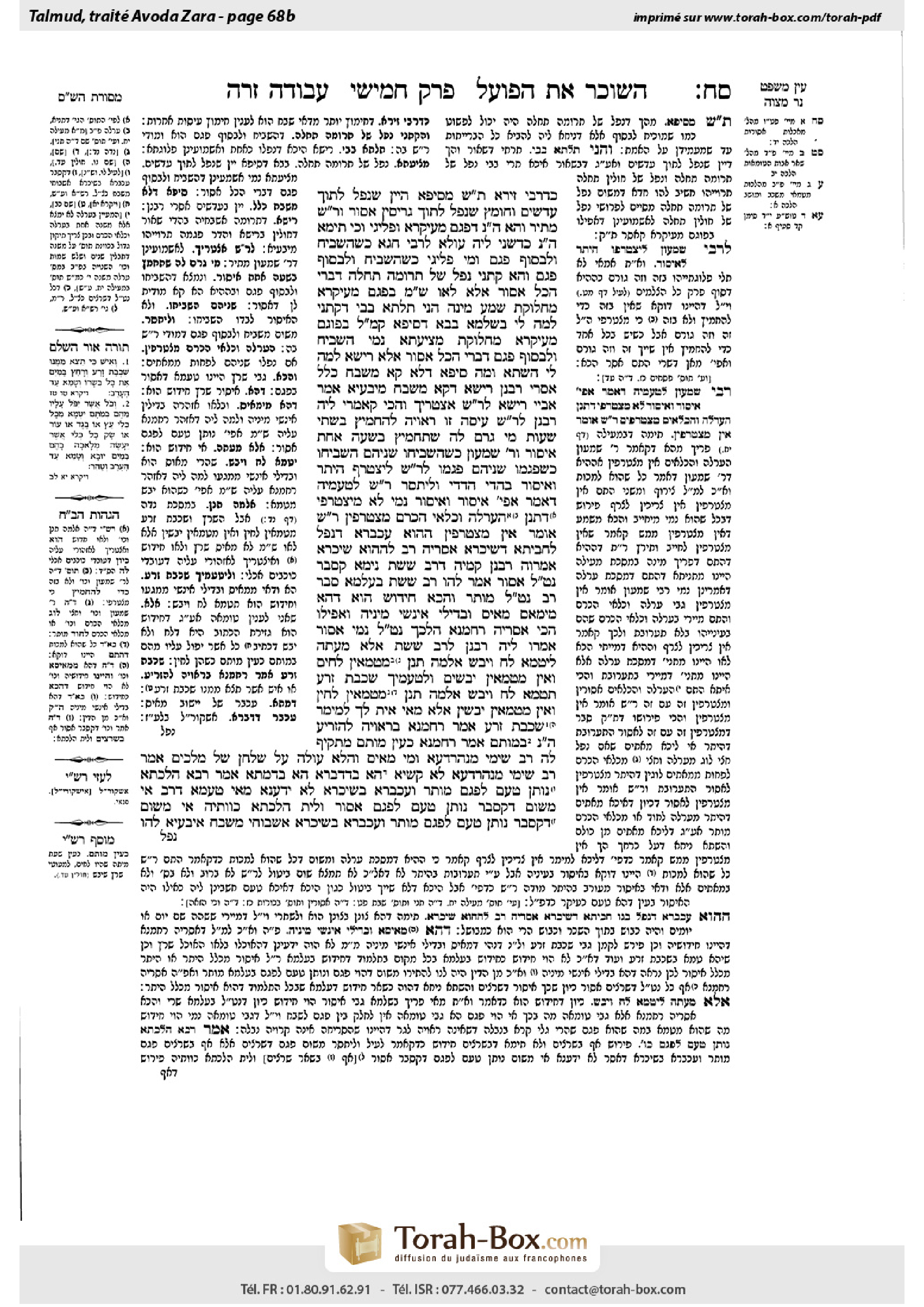
Avodah Zarah 68b: Talmud study for Daf Yomi
Study the Talmud for Daf Yomi with scanned pages, Hebrew text, English translations from Sefaria and AI-generated French translations.
Passage selection and English or AI-generated French translation are available where the scan has annotations. Daf Study is independent of Torah-Box and Sefaria.
Browse Avodah Zarah · עבודה זרה · All tractatesAvodah Zarah 68b text and translations
This page of Avodah Zarah includes the Aramaic text, an English translation and an AI-generated French translation, alongside the scan above.
עבודה זרה ס״ח ב · Aramaic and Hebrew text
כִּדְרַבִּי זֵירָא, תָּא שְׁמַע מִסֵּיפָא: הַיַּיִן שֶׁנָּפַל לְתוֹךְ עֲדָשִׁים, וְחוֹמֶץ שֶׁנָּפַל לְתוֹךְ גְּרִיסִין — אָסוּר, וְרַבִּי שִׁמְעוֹן מַתִּיר. וְהָא הָכִי נָמֵי דִּפְגַם מֵעִיקָּרָא, וּפְלִיגִי!
וְכִי תֵּימָא, הָכָא נָמֵי כִּדְשַׁנִּי לֵיהּ עוּלָּא לְרַבִּי חַגָּא: כְּשֶׁהִשְׁבִּיחַ וּלְבַסּוֹף פָּגַם, וּמִי פְּלִיגִי כְּשֶׁהִשְׁבִּיחַ וּלְבַסּוֹף פָּגַם? וְהָא קָתָנֵי: נָפַל שֶׁל תְּרוּמָה תְּחִלָּה — דִּבְרֵי הַכֹּל אָסוּר!
אֶלָּא לָאו שְׁמַע מִינַּהּ, בִּפְגַם מֵעִיקָּרָא מַחְלוֹקֶת? שְׁמַע מִינַּהּ.
הָנֵי תְּלָתָא בָּבֵי דְּקָתָנֵי, לְמָה לִי? בִּשְׁלָמָא בָּבָא דְּסֵיפָא, קָא מַשְׁמַע לַן: בְּפוֹגֵם מֵעִיקָּרָא מַחְלוֹקֶת. מְצִיעֲתָא נָמֵי, הִשְׁבִּיחַ וּלְבַסּוֹף פָּגַם — דִּבְרֵי הַכֹּל אָסוּר.
אֶלָּא רֵישָׁא לְמָה לִי? הַשְׁתָּא, וּמָה סֵיפָא דְּלָא קָא מַשְׁבַּח כְּלָל, אָסְרִי רַבָּנַן, רֵישָׁא דְּקָא מַשְׁבַּח מִיבַּעְיָא?
אָמַר אַבָּיֵי: רֵישָׁא לְרַבִּי שִׁמְעוֹן אִצְטְרִיךְ, וְהָכִי קָאָמְרִי לֵיהּ רַבָּנַן לְרַבִּי שִׁמְעוֹן: עִיסָּה זוֹ רְאוּיָה לְהַחְמִיץ בִּשְׁתֵּי שָׁעוֹת, מִי גָּרַם לָהּ שֶׁתַּחֲמִיץ בְּשָׁעָה אַחַת? אִיסּוּר.
וְרַבִּי שִׁמְעוֹן? כְּשֶׁהִשְׁבִּיחוּ, שְׁנֵיהֶם הִשְׁבִּיחוּ; כְּשֶׁפָּגְמוּ, שְׁנֵיהֶם פָּגְמוּ.
לְרַבִּי שִׁמְעוֹן, לִיצְטָרֵף הֶיתֵּר וְאִיסּוּר בַּהֲדֵי הֲדָדֵי וְלִיתְּסַר!
רַבִּי שִׁמְעוֹן לְטַעְמֵיהּ, דְּאָמַר: אֲפִילּוּ אִיסּוּר וְאִיסּוּר נָמֵי לָא מִיצְטָרְפִי,
דִּתְנַן: הָעׇרְלָה וְכִלְאֵי הַכֶּרֶם מִצְטָרְפִין, רַבִּי שִׁמְעוֹן אוֹמֵר: אֵין מִצְטָרְפִין.
הָהוּא עַכְבְּרָא דִּנְפַל לְחָבִיתָא דְּשִׁיכְרָא, אַסְרֵיהּ רַב לְהָהוּא שִׁיכְרָא. אַמְרוּהָ רַבָּנַן קַמֵּיהּ דְּרַב שֵׁשֶׁת: נֵימָא קָסָבַר נוֹתֵן טַעַם לִפְגָם אָסוּר?
אֲמַר לְהוּ רַב שֵׁשֶׁת: בְּעָלְמָא סָבַר רַב נוֹתֵן טַעַם לִפְגָם מוּתָּר, וְהָכָא חִידּוּשׁ הוּא, דְּהָא מִימְאָס מְאִיס וּבְדִילִי אִינָשֵׁי מִינֵּיהּ, וַאֲפִילּוּ הָכִי אַסְרֵיהּ רַחֲמָנָא. הִלְכָּךְ נוֹתֵן טַעַם לִפְגָם נָמֵי אָסוּר.
אֲמַרוּ לֵיהּ רַבָּנַן לְרַב שֵׁשֶׁת: אֶלָּא מֵעַתָּה, לִיטַמֵּא לַח וְיָבֵשׁ, אַלְּמָה תְּנַן: מְטַמְּאִין לַחִים וְאֵין מְטַמְּאִין יְבֵשִׁים?
וּלְטַעְמָיךְ, שִׁכְבַת זֶרַע תְּטַמֵּא לַח וְיָבֵשׁ, אַלְּמָה תְּנַן: מְטַמְּאִין לַחִין וְאֵין מְטַמְּאִין יְבֵשִׁין?
אֶלָּא מַאי אִית לָךְ לְמֵימַר? ״שִׁכְבַת זֶרַע״ אָמַר רַחֲמָנָא, בִּרְאוּיָה לְהַזְרִיעַ. הָכָא נָמֵי, ״בְּמֹתָם״ אָמַר רַחֲמָנָא, כְּעֵין מוֹתָם.
מַתְקֵיף לַהּ רַב שִׁימִי מִנְּהַרְדְּעָא: וּמִי מְאִיס? וַהֲלֹא עוֹלֶה עַל שֻׁלְחָן שֶׁל מְלָכִים! אָמַר רַב שִׁימִי מִנְּהַרְדְּעָא: לָא קַשְׁיָא, הָא בִּדְדַבְרָא, הָא בִּדְמָתָא.
אָמַר רָבָא: הִלְכְתָא נוֹתֵן טַעַם לִפְגָם מוּתָּר, וְעַכְבְּרָא בְּשִׁיכְרָא לָא יָדַעְנָא מַאי טַעְמָא דְּרַב, אִי מִשּׁוּם דְקָסָבַר נוֹתֵן טַעַם לִפְגָם אָסוּר, וְלֵית הִלְכְתָא כְּוָותֵיהּ, אִי מִשּׁוּם דְקָסָבַר נוֹתֵן טַעַם לִפְגָם מוּתָּר, וְעַכְבְּרָא בְּשִׁיכְרָא אַשְׁבּוֹחֵי מַשְׁבַּח.
אִיבַּעְיָא לְהוּ:
Avodah Zarah 68b · English translation
this can be explained in accordance with the explanation of Rabbi Zeira that dough is different because it is enhanced in any event, come and hear a refutation of that explanation from the latter clause of the same baraita: Forbidden wine that fell into lentils or forbidden vinegar that fell into split beans renders the food forbidden. And Rabbi Shimon deems them permitted. And here also, it is a case where the forbidden substance detracted from the flavor of the dough from the outset, and they disagree.
And if you would say: Here too, it can be explained as Ulla responded to Rabbi Ḥagga, that the baraita is referring to a case when the vinegar enhanced the flavor of the split beans and subsequently detracted from it, e.g., where it spilled into cold split beans and then they were heated, this cannot be said, as do they actually disagree in a case when the forbidden substance enhanced the flavor of the permitted food and subsequently detracted from it? But isn’t it taught in the first clause of the baraita that if the leaven of teruma fell in first, before the non-sacred leaven, everyone agrees that it renders the dough forbidden, as it enhanced the flavor of the dough at the outset, even though the flavor was subsequently detracted from by the non-sacred leaven?
Rather, must one not conclude from it that the dispute is with regard to a case where the forbidden substance detracted from the flavor of the food from the outset? The Gemara affirms: Conclude from it that this is so.
The Gemara asks: With regard to those three clauses that the baraita teaches concerning different cases, why do I need all three of them? Granted, the last clause, concerning the wine spilling into the lentils, teaches us that the dispute is with regard to a case where the forbidden substance detracts from the flavor of the food from the outset. The middle clause, with regard to the case where the leaven of teruma fell in first, also teaches a novel halakha, which is that in the case of a forbidden substance that enhanced the flavor of the food and subsequently detracted from it, everyone agrees that the mixture is forbidden.
But why do I need the first clause, concerning the case of non-sacred leaven and leaven of teruma falling into the dough together? It could have been inferred from the other two clauses that the dough is forbidden, in the following manner: Now that in the case of the last clause, where the forbidden substance does not enhance the permitted food at all, the Rabbis deem it forbidden, is it necessary to say that it is forbidden in the first clause, where the forbidden substance enhances the food’s flavor at first before detracting from it?
Abaye said: The first clause is necessary to teach that Rabbi Shimon deems it permitted. And this is what the Rabbis said to Rabbi Shimon: This dough was fit to become leavened in two hours if the permitted leaven had fallen into it alone. What caused it to become leavened in one hour? The forbidden leaven. Therefore, the dough is forbidden.
And Rabbi Shimon could respond that when the two types of leaven enhanced the flavor of the dough, they both enhanced it, not only the forbidden leaven; and when they subsequently detracted from it, they both detracted from it. Therefore, it is permitted.
The Gemara asks: Even according to the opinion of Rabbi Shimon, let the permitted leaven and the forbidden leaven combine together and render the dough forbidden, since Rabbi Shimon concedes that if the permitted food was initially enhanced by the forbidden substance it is forbidden.
The Gemara responds: Rabbi Shimon conforms to his standard line of reasoning, as he says that even a forbidden substance and another forbidden substance do not combine to render a mixture forbidden. Accordingly, a forbidden substance and a permitted substance certainly do not.
The Gemara comments: This is as we learned in a mishna (Me’ila 18a): If orla and diverse kinds planted in a vineyard fell into a permitted substance, and neither one is sufficient in its own quantity to render the mixture forbidden, they combine to render it forbidden if together they are of a sufficient quantity. Rabbi Shimon says: They do not combine, and each forbidden substance is treated individually. Here too, since when the forbidden leaven enhanced the dough, it was not sufficient to enhance it by itself, the permitted leaven does not combine with it to render the dough forbidden.
§ The Gemara recounts an incident involving a certain mouse that fell into a barrel of beer. Rav deemed that barrel of beer forbidden. The Sages said before Rav Sheshet: Shall we say that Rav maintains that even in a case where the forbidden substance imparts flavor to the detriment of the mixture, it is forbidden? Presumably, the mouse imparted flavor to the detriment of the beer.
Rav Sheshet said to them: Rav generally maintains that in a case where the forbidden substance imparts flavor to the detriment of the mixture, it is permitted. But here, in the case of a mouse, it is a novelty that the Torah prohibits the flavor from a mouse at all, as it is repulsive and people distance themselves from consuming it, and even so the Merciful One prohibits it. Therefore, although it imparts flavor to the detriment of the mixture, it is still forbidden.
The Sages said to Rav Sheshet: If that is so, that the halakha with regard to a mouse is considered a novelty and is therefore understood to be more stringent than the norm, then a dead mouse should impart ritual impurity whether it is moist or dried out. Why did we learn in a mishna (Nidda 54b) that carcasses of creeping animals impart impurity when they are moist but do not impart impurity when they are dried out?
Rav Sheshet responded: And according to your reasoning, in which you compare the halakhot of ritual impurity to forbidden foods, then with regard to semen, which is also repulsive, it should impart impurity whether moist or dried out. Why did we learn in a mishna (Nidda 54b) that semen imparts impurity when it is moist but it does not impart impurity when it is dried out?
Rather, what have you to say? With regard to the ritual impurity of semen, the Merciful One states: “The flow of seed” (Leviticus 15:16), meaning that the reference is to semen that is fit to fertilize. Here too, with regard to the ritual impurity of a mouse, the verse states: “When they have died” (Leviticus 11:32). The Merciful One states that the carcasses of creeping animals impart impurity only when they are similar to their state at time of their death, i.e., when they are still moist. Therefore, there is no contradiction to the claim that the prohibition against eating a mouse is a novelty and consequently applies even when it detracted from the flavor of the food into which it fell.
Rav Shimi of Neharde’a objects to the assumption that a mouse is repulsive: And is it repulsive? But isn’t it served at the table of kings and considered a delicacy? Rav Shimi of Neharde’a said in clarification: This is not difficult. This statement, that a mouse is served as a delicacy, is stated with regard to a field mouse, and that statement, that it is repulsive, is stated with regard to a city mouse.
Rava said: The halakha is that if the forbidden substance imparts flavor to the detriment of the mixture, it is permitted. But with regard to a mouse that fell into a barrel of beer, I do not know what the reason was that Rav deemed it forbidden. I do not know whether it was because he maintains that if the forbidden substance imparts flavor to the detriment of the mixture it is forbidden, and if so, the halakha is not in accordance with his opinion, or whether it was because although he maintains that if the forbidden substance imparts flavor to the detriment of the mixture it is permitted, a mouse that falls into beer enhances its flavor.
A dilemma was raised before the Sages:
Avodah Zarah 68b · Traduction française (IA)
cela peut être expliqué selon l'explication du Rabbi Zéira selon laquelle la pâte est différente car elle est améliorée de toute façon, viens écouter une réfutation de cette explication à partir de la dernière partie de la même baraïta : vin interdit tombant dans des lentilles ou vinaigre interdit tombant dans des haricots épluchés rend le repas interdit. Et le Rabbi Simon considère qu'ils sont permis. Et ici aussi, il s'agit d'un cas où la substance interdite a détérioré le goût de la pâte dès le début, et ils sont en désaccord.
Et si l'on disait : ici aussi, cela peut être expliqué comme Ulla a répondu au Rabbi Haggi, que la baraïta fait référence à un cas où le vinaigre a amélioré le goût des haricots épluchés et a ensuite détérioré ce goût, par exemple, où il est tombé dans des haricots épluchés froids et ensuite ils ont été chauffés, cela ne peut pas être dit, car est-ce que les parties s'opposent dans un cas où la substance interdite a amélioré le goût du repas permis et a ensuite détérioré ce goût ? Mais n'est-il pas enseigné dans la première partie de la baraïta que si la levain de terouma est tombé en premier, avant le levain non sacré, tout le monde est d'accord sur le fait qu'il rend la pâte interdite, car il a amélioré le goût de la pâte dès le début, même si le goût a ensuite été détérioré par le levain non sacré.
Plutôt, ne devons-nous pas conclure de cela que le désaccord est concernant un cas où la substance interdite a détérioré le goût du repas dès le début ? La Guemara affirme : concluez-en que c'est ainsi.
La Guemara pose la question : concernant ces trois clauses que la baraïta enseigne concernant des cas différents, pourquoi ai-je besoin de toutes les trois ? Cela étant, la dernière clause, concernant le vin tombant dans les lentilles, nous enseigne que le désaccord est concernant un cas où la substance interdite détériore le goût du repas dès le début. La clause intermédiaire, concernant le cas où le levain de terouma est tombé en premier, enseigne également une halakha nouvelle, qui est que dans le cas d'une substance interdite qui a amélioré le goût du repas et a ensuite détérioré ce goût, tout le monde est d'accord sur le fait que le mélange est interdit.
Mais pourquoi ai-je besoin de la première clause, concernant le cas du levain non sacré et du levain de terouma tombant dans la pâte ensemble ? On pourrait en déduire de la manière suivante à partir des autres deux clauses que la pâte est interdite : maintenant que dans le cas de la dernière clause, où la substance interdite n'améliore pas du tout le repas permis, les Rabbins considèrent qu'il est interdit, est-il nécessaire de dire qu'il est interdit dans la première clause, où la substance interdite améliore le goût du repas au début avant de le détériorer ?
Abaye dit : la première clause est nécessaire pour enseigner que le Rabbi Simon considère qu'il est permis. Et c'est ce que les Rabbins ont dit au Rabbi Simon : cette pâte était apte à lever en deux heures si le levain permis était tombé dedans seul. Qu'est-ce qui a causé qu'elle ait levé en une heure ? le levain interdit. Par conséquent, la pâte est interdite.
Et le Rabbi Simon pouvait répondre que lorsque les deux types de levain amélioraient le goût de la pâte, ils l'amélioraient tous les deux, pas seulement le levain interdit ; et lorsque ils l'ont ensuite détérioré, ils l'ont tous les deux détérioré. Par conséquent, il est permis.
La Guemara pose la question : même selon l'opinion du Rabbi Simon, faites que le levain permis et le levain interdit s'unissent ensemble et rendent la pâte interdite, car le Rabbi Simon reconnaît que si la nourriture permise a été initialement améliorée par la substance interdite, elle est interdite.
La Guemara répond : le Rabbi Simon suit sa ligne de raisonnement habituelle, car il dit que même une substance interdite et une autre substance interdite ne s'unissent pas pour rendre un mélange interdit. Par conséquent, une substance interdite et une substance permise ne s'unissent certainement pas non plus.
La Guemara commente : c'est comme nous avons appris dans une mitsva (Me’ila 18a) : si l'orla et les diverses sortes plantées dans un vignoble sont tombés dans une substance permise, et que ni l'un ni l'autre n'est suffisant en quantité pour rendre le mélange interdit, ils s'unissent pour rendre le mélange interdit si ensemble ils sont suffisants en quantité. Le Rabbi Simon dit : ils ne s'unissent pas, et chaque substance interdite est traitée individuellement. Ici aussi, puisque lorsque le levain interdit a amélioré la pâte, il n'était pas suffisant pour l'améliorer seul, le levain permis ne s'unira pas avec lui pour rendre la pâte interdite.
§ La Guemara raconte un incident concernant un certain rat tombant dans une barrique de bière. Rav considérait que cette barrique de bière était interdite. Les Sages dirent devant Rav Sheshet : devons-nous dire que Rav maintient que même dans un cas où la substance interdite imprime un goût à la détriment du mélange, il est interdit ? Probablement, le rat a imprégné le goût à la détriment de la bière.
Rav Sheshet dit à eux : Rav maintient généralement que dans un cas où la substance interdite imprime un goût à la détriment du mélange, il est permis. Mais ici, dans le cas du rat, c'est une nouveauté que la Torah interdise le goût d'un rat, car il est répugnant et les gens s'éloignent de le consommer, et même ainsi l'Éternel interdit. Par conséquent, même s'il imprime un goût à la détriment du mélange, il est encore interdit.
Les Sages dirent à Rav Sheshet : si c'est ainsi, que la halakha concernant un rat est considérée comme une nouveauté et est donc plus stricte que la norme, alors un rat mort devrait transmettre une impureté rituelle qu'il soit mouillé ou sec. Pourquoi avons-nous appris dans une mitsva (Nidda 54b) que les cadavres d'animaux rampants transmettent une impureté quand ils sont mouillés mais ne le font pas quand ils sont secs ?
Rav Sheshet répondit : Et selon votre raisonnement, où vous comparez les halakhot de l'impureté rituelle aux aliments interdits, alors concernant le sperme, qui est également répugnant, il devrait transmettre l'impureté qu'il soit mou ou sec. Pourquoi avons-nous appris dans une mitsva (Nidda 54b) que le sperme transmet l'impureté lorsqu'il est mou, mais ne transmet pas l'impureté lorsqu'il est sec ?
Plutôt, que dites-vous ? Concernant l'impureté rituelle du sperme, l'Éternel dit : « Le flux de semence » (Lévitique 15:16), ce qui signifie que la référence est au sperme capable de féconder. De même, concernant l'impureté rituelle d'une souris, la Parole dit : « Quand ils sont morts » (Lévitique 11:32). L'Éternel indique que les cadavres d'animaux rampants transmettent l'impureté uniquement lorsqu'ils sont dans l'état qu'ils occupaient au moment de leur mort, c'est-à-dire lorsqu'ils sont encore mouillés. Ainsi, il n'y a pas de contradiction avec l'affirmation que l'interdiction de manger une souris est une nouveauté et s'applique même lorsqu'elle a dégradé le goût du plat dans lequel elle est tombée.
Rav Shimi de Neharde’a s’oppose à l’hypothèse selon laquelle la souris est répugnante : Et est-ce répugnant ? Mais n’est-ce pas servi à la table des rois et considéré comme un délice ? Rav Shimi de Neharde’a dit en clarification : Ce n’est pas difficile. Cette déclaration, selon laquelle la souris est un délice, est faite concernant une souris de champ, et cette déclaration, selon laquelle elle est répugnante, est faite concernant une souris de ville.
Rava dit : La halakha est que si la substance interdite transmet un goût à l'inconvénient du mélange, elle est permise. Mais concernant une souris tombant dans une barrique de bière, je ne sais pas quelle était la raison pour laquelle Rav l’a déclarée interdite. Je ne sais pas si c’était parce qu’il maintient que si la substance interdite transmet un goût à l'inconvénient du mélange, elle est interdite, et dans ce cas, la halakha ne suit pas son avis, ou si c’était parce qu’il maintient que si la substance interdite transmet un goût à l'inconvénient du mélange, elle est permise, et qu’une souris tombant dans la bière améliore son goût.
Un dilemme a été soulevé devant les Sages :
Traduction française générée par IA à partir de l’édition anglaise de Sefaria. Vérifie toujours un passage avec le texte source.
Text from Sefaria: William Davidson Edition - Vocalized Aramaic (CC BY NC); William Davidson Edition - English (CC BY NC).