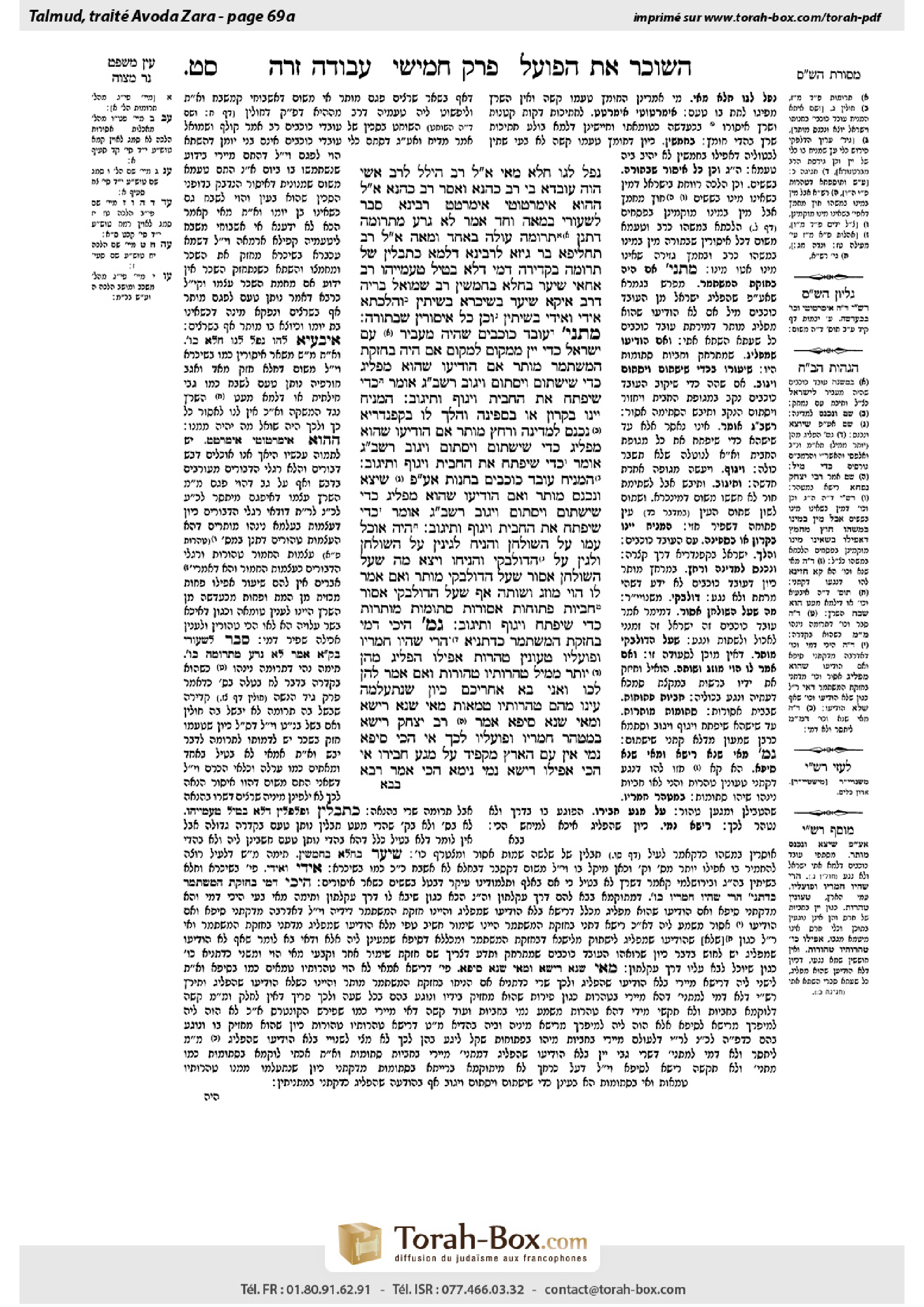
Avodah Zarah 69a: Talmud study for Daf Yomi
Study the Talmud for Daf Yomi with scanned pages, Hebrew text, English translations from Sefaria and AI-generated French translations.
Passage selection and English or AI-generated French translation are available where the scan has annotations. Daf Study is independent of Torah-Box and Sefaria.
Browse Avodah Zarah · עבודה זרה · All tractatesAvodah Zarah 69a text and translations
This page of Avodah Zarah includes the Aramaic text, an English translation and an AI-generated French translation, alongside the scan above.
עבודה זרה ס״ט א · Aramaic and Hebrew text
נְפַל לְגוֹ חַלָּא, מַאי? אֲמַר לֵיהּ רַב הִילֵּל לְרַב אָשֵׁי: הֲוָה עוֹבָדָא בֵּי רַב כָּהֲנָא, וַאֲסַר רַב כָּהֲנָא. אֲמַר לֵיהּ: הָהוּא אִימַּרְטוּטֵי אִימַּרְטַט.
רָבִינָא סְבַר לְשַׁעוֹרֵי בִּמְאָה וְחַד, אָמַר: לָא גָּרַע מִתְּרוּמָה, דִּתְנַן: תְּרוּמָה עוֹלָה בְּאֶחָד וּמֵאָה. אֲמַר לֵיהּ רַב תַּחְלִיפָא בַּר גִּיזָּא לְרָבִינָא: דִּלְמָא כְּתַבְלִין שֶׁל תְּרוּמָה בִּקְדֵירָה דָּמֵי, דְּלָא בָּטֵיל טַעְמַיְיהוּ!
רַב אַחַאי שַׁיעַר בְּחַלָּא בְּחַמְשִׁין, רַב שְׁמוּאֵל בְּרֵיהּ דְּרַב אִיקָא שַׁיעַר בְּשִׁיכְרָא בְּשִׁיתִּין.
וְהִלְכְתָא: אִידֵּי וְאִידֵּי בְּשִׁיתִּין, וְכֵן כׇּל אִיסּוּרִין שֶׁבַּתּוֹרָה.
מַתְנִי׳ נׇכְרִי שֶׁהָיָה מַעֲבִיר עִם יִשְׂרָאֵל כַּדֵּי יַיִן מִמָּקוֹם לְמָקוֹם, אִם הָיָה בְּחֶזְקַת הַמִּשְׁתַּמֵּר — מוּתָּר. אִם הוֹדִיעוֹ שֶׁהוּא מַפְלִיג כְּדֵי שֶׁיִּשְׁתּוֹם וְיִסְתּוֹם וְיִגּוֹב. רַבָּן שִׁמְעוֹן בֶּן גַּמְלִיאֵל אוֹמֵר: כְּדֵי שֶׁיִּפְתַּח אֶת הֶחָבִית וְיִגּוֹף וְתִיגּוֹב.
הַמַּנִּיחַ יֵינוֹ בְּקָרוֹן אוֹ בִּסְפִינָה, וְהָלַךְ לוֹ בְּקָפֶנְדַּרְיָא, נִכְנַס לִמְדִינָה וְרָחַץ — מוּתָּר.
אִם הוֹדִיעוֹ שֶׁהוּא מַפְלִיג — כְּדֵי שֶׁיִּשְׁתּוֹם, וְיִסְתּוֹם, וְיִגּוֹב. רַבָּן שִׁמְעוֹן בֶּן גַּמְלִיאֵל אוֹמֵר: כְּדֵי שֶׁיִּפְתַּח אֶת הֶחָבִית, וְיִגּוֹף, וְתִיגּוֹב.
הַמַּנִּיחַ נׇכְרִי בַּחֲנוּת, אַף עַל פִּי שֶׁיֹּצֵא וְנִכְנָס — מוּתָּר, וְאִם הוֹדִיעוֹ שֶׁהוּא מַפְלִיג — כְּדֵי שֶׁיִּשְׁתּוֹם וְיִסְתּוֹם וְיִגּוֹב. רַבָּן שִׁמְעוֹן בֶּן גַּמְלִיאֵל אוֹמֵר: כְּדֵי שֶׁיִּפְתַּח אֶת הֶחָבִית וְיִגּוֹף וְתִיגּוֹב.
הָיָה אוֹכֵל עִמּוֹ עַל הַשּׁוּלְחָן, וְהִנִּיחַ לְגִינִין עַל הַשּׁוּלְחָן וְלָגִין עַל הַדּוּלְבְּקִי, וְהִנִּיחוֹ וְיָצָא — מַה שֶּׁעַל הַשּׁוּלְחָן אָסוּר, שֶׁעַל הַדּוּלְבְּקִי מוּתָּר. וְאִם אָמַר לוֹ: הֱוֵי מוֹזֵג וְשׁוֹתֶה — אַף שֶׁעַל הַדּוּלְבְּקִי אָסוּר. חָבִיּוֹת פְּתוּחוֹת אֲסוּרוֹת, סְתוּמוֹת מוּתָּרוֹת, כְּדֵי שֶׁיִּפְתַּח וְיִגּוֹף וְתִיגּוֹב.
גְּמָ׳ הֵיכִי דָמֵי ״בְּחֶזְקַת הַמִּשְׁתַּמֵּר״? כִּדְתַנְיָא: הֲרֵי שֶׁהָיוּ חֲמָרָיו וּפוֹעֲלָיו טְעוּנִין טְהָרוֹת, אֲפִילּוּ הִפְלִיג מֵהֶן יוֹתֵר מִמִּיל — טׇהֳרוֹתָיו טְהוֹרוֹת, וְאִם אָמַר לָהֶן: ״לְכוּ וַאֲנִי בָּא אַחֲרֵיכֶם״, כֵּיוָן שֶׁנִּתְעַלְּמָה עֵינוֹ מֵהֶם — טׇהֳרוֹתָיו טְמֵאוֹת.
מַאי שְׁנָא רֵישָׁא, וּמַאי שְׁנָא סֵיפָא? אָמַר רַב יִצְחָק: רֵישָׁא בִּמְטַהֵר חֲמָרָיו וּפוֹעֲלָיו לְכָךְ.
אִי הָכִי, סֵיפָא נָמֵי? אֵין עַם הָאָרֶץ מַקְפִּיד עַל מַגַּע חֲבֵירוֹ. אִי הָכִי, אֲפִילּוּ רֵישָׁא נָמֵי נֵימָא הָכִי!
אָמַר רָבָא:
Avodah Zarah 69a · English translation
If a mouse fell into vinegar, what is the halakha? Does it enhance its flavor? Rav Hillel said to Rav Ashi: There was such an incident in the study hall of Rav Kahana, and Rav Kahana deemed the vinegar forbidden. This indicates that it enhances the flavor. Rav Ashi said to him: This is not a proof. That mouse was dismembered, and Rav Kahana deemed the vinegar forbidden due to concern that one might consume a substantive piece of the mouse in the vinegar, which is prohibited regardless of the taste.
The Gemara relates: Ravina thought that the quantity of vinegar necessary for nullifying the flavor of the mouse should be calculated at 101 times the volume of the mouse. He said: It should not be rendered worse, i.e., more stringent, than teruma, which is nullified by 101 times its volume in a mixture. This is as we learned in a mishna (Terumot 4:7): Teruma is nullified in a mixture by 101 times its volume of permitted food. Rav Taḥlifa bar Giza said to Ravina: Perhaps this case is similar to spice of teruma in a pot, whose flavor is not nullified even by 101 times its volume of permitted food, as the flavor imparted by spice is exceptionally strong.
Rav Aḥai calculated the amount of vinegar necessary to nullify the flavor of the mouse at fifty times its volume. Although forbidden food in a mixture usually requires the presence of sixty times its volume of permitted food to be nullified, vinegar has a sharp enough flavor that it nullifies the mouse with less. Rav Shmuel, son of Rav Ika, calculated the amount of beer necessary for nullifying the mouse at sixty times the volume of the mouse.
The Gemara concludes: And the halakha is that this and that, both vinegar and beer, nullify the mouse with sixty times its volume, and so is the ruling for all prohibitions in the Torah.
MISHNA: With regard to a gentile who was transporting barrels of wine from one place to another place together with a Jew, if the wine was under the presumption of being supervised, it is permitted. But if the Jew notified him that he was going far away, the wine is forbidden if the Jew left for a sufficient amount of time for the gentile to bore a hole [sheyishtom] in the barrel, seal it again with plaster, and for the plaster to dry. Rabban Shimon ben Gamliel says: The wine is forbidden only if it was sufficient time for the gentile to open the barrel by removing the stopper altogether, stop it again by making a new stopper, and for the new stopper to dry.
With regard to one who placed his wine in a wagon or on a ship with a gentile, and went on his way by a shortcut [bekappendarya], such that the gentile does not know when the Jew will encounter him, even if the Jew entered the city and bathed, the wine is permitted, because the gentile would not use the wine for a libation, for fear the owner might catch him at it.
If the Jew informed the gentile that he was going away for a long period of time, the wine is forbidden if it was sufficient time for the gentile to bore a hole in the barrel, seal it again with plaster, and for the plaster to dry. Rabban Shimon ben Gamliel says: It is forbidden only if it was sufficient time for him to open the barrel by removing the stopper altogether, stop it again, and for the new stopper to dry.
With regard to one who left a gentile in his shop, even if the Jew went out and came in and was not there all the time, the wine is permitted. But if the Jew informed the gentile that he was going away for a long period of time, the wine is forbidden if it was sufficient time for the gentile to bore a hole in the barrel, seal it again with plaster, and for the plaster to dry. Rabban Shimon ben Gamliel says: The wine is forbidden only if it was sufficient time for him to open the barrel, stop it again, and for the new stopper to dry.
If a Jew was eating with a gentile at the table, and left jugs [laginin] of wine on the table and a jug on the side table [hadulebaki], and he left it and went out, what is on the table is forbidden, as it is likely that the gentile handled it, whereas what is on the side table is permitted. But if the Jew said to the gentile: Mix water with the wine and drink, even the jug that is on the side table is forbidden. Similarly, open barrels are forbidden, but sealed barrels are permitted unless the Jew was out of the room for sufficient time for the gentile to open the barrel by removing the stopper, and stop it again by making a new stopper, and for the new stopper to dry.
GEMARA: What are the circumstances described by the phrase: Under the presumption of being supervised? The Gemara explains: It is as it is taught in a baraita: If one’s donkey drivers and laborers were unreliable with regard to ritual impurity [amei ha’aretz], and they were laden with wine or produce that was ritually pure, and he had instructed them not to tamper with it but he does not know whether or not they heeded him, even if he went away from them to a distance of more than a mil, his pure items are still pure, as it may be presumed that they heeded his instructions. But if he said to them: Go and I will come after you, so that they knew he would not be going with them, then once they are out of his sight his pure items are impure.
The Gemara asks: What is different in the first clause, where the produce is pure, and what is different in the latter clause, where it is impure? Rav Yitzḥak said: The ruling of the first clause is stated with regard to a case where he purified his donkey drivers and laborers for this assignment by having them immerse so they would not transfer impurity to the produce.
The Gemara raises a difficulty: If that is so, in the latter clause this would also apply. The Gemara answers: An am ha’aretz is not punctilious about contact with another person. Although they themselves were purified, they may have met another am ha’aretz on the way, and the produce would be rendered impure by him. The Gemara further objects: If so, then let us say so even in the first clause; the produce should be impure in that case as well.
Rava said:
Avodah Zarah 69a · Traduction française (IA)
Si une souris tombe dans du vinaigre, quelle est la halakha ? Est-ce que cela améliore son goût ? Rav Hillel a dit à Rav Ashi : Il y a eu un tel incident dans la salle de study de Rav Kahana, et Rav Kahana a déclaré le vinaigre interdit. Cela montre qu'il améliore le goût. Rav Ashi a dit à lui : Ce n'est pas une preuve. Cette souris a été démembrée, et Rav Kahana a déclaré le vinaigre interdit par crainte qu'on puisse consommer une partie substantielle de la souris dans le vinaigre, ce qui est interdit indépendamment du goût.
La Guemara rapporte : Ravina pensait que la quantité de vinaigre nécessaire pour éliminer le goût de la souris devait être calculée à 101 fois le volume de la souris. Il a dit : Il ne devrait pas être rendu plus strict que la terouma, qui est éliminée dans un mélange par 101 fois son volume de nourriture permise. C'est comme nous avons appris dans une mitsva (Terumot 4:7) : La terouma est éliminée dans un mélange par 101 fois son volume de nourriture permise. Rav Taḥlifa bar Giza a dit à Ravina : Peut-être que ce cas est similaire à un épice de terouma dans une marmite, dont le goût n'est pas éliminé même par 101 fois son volume de nourriture permise, car le goût apporté par l'épice est particulièrement fort.
Rav Aḥai a calculé la quantité de vinaigre nécessaire pour éliminer le goût de la souris à cinquante fois son volume. Bien que les aliments interdits dans un mélange nécessitent généralement la présence de soixante fois leur volume de nourriture permise pour être éliminés, le vinaigre a un goût assez fort pour éliminer la souris avec moins. Rav Shmuel, fils de Rav Ika, a calculé la quantité de bière nécessaire pour éliminer le goût de la souris à soixante fois le volume de la souris.
La Guemara conclut : Et la halakha est que cela et cela, à la fois le vinaigre et la bière, annulent la souris avec soixante fois son volume, et ainsi est la décision pour toutes les prohibitions de la Torah.
MICHNA : Concernant un non-Juif qui transportait des barriques de vin d'un lieu à un autre avec un Juif, si le vin était sous le présomption d'être surveillé, il est permis. Mais si le Juif avait informé qu'il allait s'éloigner, le vin est interdit si le Juif est parti pendant un temps suffisant pour que le non-Juif percède le baril, le scelle à nouveau avec du plâtre et que le plâtre sèche. Rabban Shimon ben Gamliel dit : Le vin est interdit seulement si le temps était suffisant pour que le non-Juif ouvre le baril en retirant le bouchon entièrement, le scelle à nouveau et que le nouveau bouchon sèche.
Concernant celui qui a mis son vin dans une charrette ou sur un bateau avec un non-Juif, et est parti par un chemin de traverse, de sorte que le non-Juif ne sait pas quand le Juif le rencontrera, même si le Juif est entré en ville et s'est lavé, le vin est permis, car le non-Juif ne l'utiliserait pas pour une libation, par crainte que l'propriétaire le découvre.
Si le Juif a informé le non-Juif qu'il allait s'absenter pendant une longue période, le vin est interdit si le temps était suffisant pour que le non-Juif perce le baril, le scelle à nouveau avec du plâtre et que le plâtre sèche. Rabban Shimon ben Gamliel dit : Il est interdit seulement si le temps était suffisant pour qu'il ouvre le baril en retirant le bouchon entièrement, le scelle à nouveau et que le nouveau bouchon sèche.
Concernant celui qui a laissé un non-Juif dans son magasin, même si le Juif est sorti et est revenu et n'était pas toujours présent, le vin est permis. Mais si le Juif a informé le non-Juif qu'il allait s'absenter pendant une longue période, le vin est interdit si le temps était suffisant pour que le non-Juif percède le baril, le scelle à nouveau avec du plâtre et que le plâtre sèche. Rabban Shimon ben Gamliel dit : Le vin est interdit seulement si le temps était suffisant pour qu'il ouvre le baril, le scelle à nouveau et que le nouveau bouchon sèche.
Si un Juif mangeait avec un non-Juif à la table, et avait laissé des tonneaux [laginin] de vin sur la table et un tonneau sur la table de côté [hadulebaki], et il est parti, ce qui est sur la table est interdit, car il est probable que le non-Juif l'ait manipulé, tandis que ce qui est sur la table de côté est permis. Mais si le Juif a dit au non-Juif : Mélangez de l'eau avec le vin et buvez, même le tonneau qui est sur la table de côté est interdit. De même, les tonneaux ouverts sont interdits, mais les tonneaux scellés sont permis à moins que le Juif ne soit sorti de la pièce pendant un temps suffisant pour que le non-Juif ouvre le tonneau en retirant le bouchon, le scelle à nouveau en faisant un nouveau bouchon et que le nouveau bouchon sèche.
GUEMARA : Quelles sont les circonstances décrites par la phrase : Sous le présomption d'être surveillé ? La Guemara explique : C'est comme il est enseigné dans une baraïta : Si les conducteurs et les ouvriers de son âne étaient peu fiables concernant l'impureté rituelle [amei ha’aretz], et qu'ils étaient chargés de vin ou de produits rituellement purs, et qu'il avait ordonné qu'ils ne touchent pas à cela mais qu'il ne sait pas s'ils ont obéi, même s'il est parti d'eux à une distance d'un mil, ses objets purs restent purs, car on peut présumer qu'ils ont obéi. Mais si il a dit à eux : Allez et je viendrai après vous, de sorte qu'ils sachent qu'il ne les accompagnerait pas, alors une fois qu'ils sont hors de son champ de vision, ses objets purs deviennent impurs.
La Guemara pose la question : Qu'est-ce qui diffère dans la première clause, où les produits sont purs, et qu'est-ce qui diffère dans la seconde clause, où ils sont impurs ? Rav Yitzḥak a dit : La décision de la première clause est énoncée concernant un cas où il a purifié ses conducteurs et ouvriers pour cette tâche en les immergeant afin qu'ils ne transmettent pas l'impureté aux produits.
La Guemara soulève une difficulté : Si c’est ainsi, cela s’appliquerait également dans la clause suivante. La Guemara répond : L’am ha’aretz n’est pas exigeant en ce qui concerne le contact avec une autre personne. Bien qu’ils aient été purifiés, ils pourraient avoir rencontré un autre am ha’aretz sur le chemin, et le produit serait rendu impur par lui. La Guemara soulève ensuite une autre objection : Si c’est ainsi, disons-le même dans la première clause ; le produit devrait être impur dans ce cas également.
Rava dit :
Traduction française générée par IA à partir de l’édition anglaise de Sefaria. Vérifie toujours un passage avec le texte source.
Text from Sefaria: William Davidson Edition - Vocalized Aramaic (CC BY NC); William Davidson Edition - English (CC BY NC).