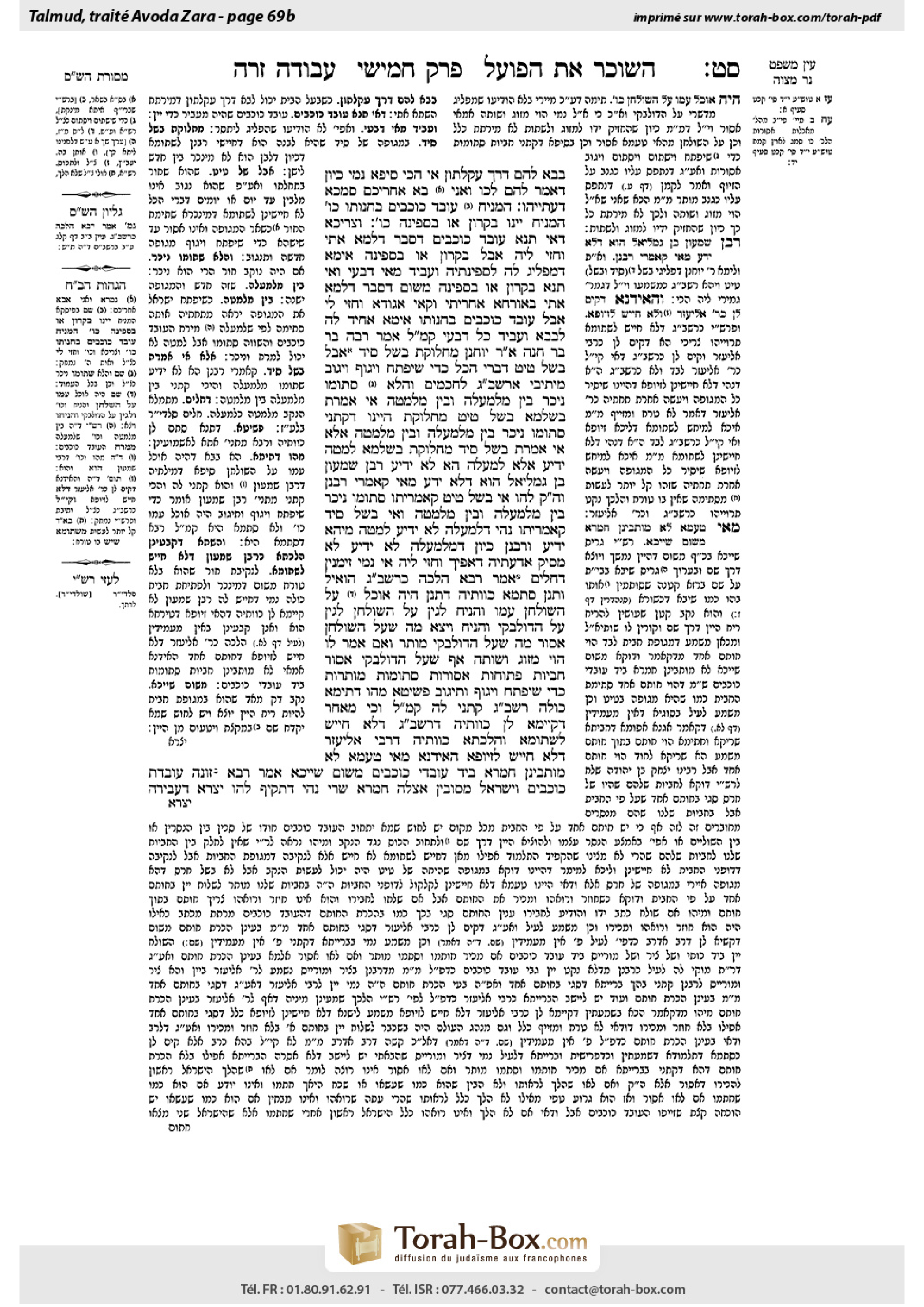
Avodah Zarah 69b: Talmud study for Daf Yomi
Study the Talmud for Daf Yomi with scanned pages, Hebrew text, English translations from Sefaria and AI-generated French translations.
Passage selection and English or AI-generated French translation are available where the scan has annotations. Daf Study is independent of Torah-Box and Sefaria.
Browse Avodah Zarah · עבודה זרה · All tractatesAvodah Zarah 69b text and translations
This page of Avodah Zarah includes the Aramaic text, an English translation and an AI-generated French translation, alongside the scan above.
עבודה זרה ס״ט ב · Aramaic and Hebrew text
בְּבָא לָהֶם דֶּרֶךְ עֲקַלָּתוֹן. אִי הָכִי, סֵיפָא נָמֵי? כֵּיוָן דְּאָמַר לָהֶם ״לְכוּ וַאֲנִי בָּא אַחֲרֵיכֶם״, סָמְכָא דַּעְתַּיְיהוּ.
הַמַּנִּיחַ נׇכְרִי בַּחֲנוּתוֹ כּוּ׳. הַמַּנִּיחַ יֵינוֹ בְּקָרוֹן אוֹ בִּסְפִינָה כּוּ׳. וּצְרִיכָא, דְּאִי תְּנָא נׇכְרִי — דְּסָבַר: דִּלְמָא אָתֵי וְחָזֵי לֵיהּ, אֲבָל בְּקָרוֹן אוֹ בִּסְפִינָה — אֵימָא דְּמַפְלֵיג לַהּ לִסְפִינְתֵּיהּ וְעָבֵיד מַאי דְּבָעֵי.
וְאִי תְּנָא בְּקָרוֹן אוֹ בִּסְפִינָה, מִשּׁוּם דְּסָבַר: דִּלְמָא אָתֵי בְּאוֹרְחָא אַחֲרִיתִי וְקָאֵי אַגּוּדָּא וְחָזֵי לִי, אֲבָל נׇכְרִי בַּחֲנוּתוֹ אֵימָא: אָחֵיד לֵהּ לְבָבָא וְעָבֵיד כֹּל דְּבָעֵי, קָא מַשְׁמַע לַן.
אָמַר רַבָּה בַּר בַּר חָנָה אָמַר רַבִּי יוֹחָנָן: מַחְלוֹקֶת בְּשֶׁל סִיד, אֲבָל בְּשֶׁל טִיט — דִּבְרֵי הַכֹּל כְּדֵי שֶׁיִּפְתַּח וְיִגּוֹף וְיִגּוֹב.
מֵיתִיבִי: אָמַר רַבָּן שִׁמְעוֹן בֶּן גַּמְלִיאֵל לַחֲכָמִים: וַהֲלֹא סִתּוּמוֹ נִיכָּר בֵּין מִלְּמַעְלָה וּבֵין מִלְּמַטָּה.
אִי אָמְרַתְּ בִּשְׁלָמָא בְּשֶׁל טִיט מַחְלוֹקֶת, הַיְינוּ דְּקָתָנֵי: סִתּוּמוֹ נִיכָּר בֵּין מִלְּמַעְלָה וּבֵין מִלְּמַטָּה, אֶלָּא אִי אָמְרַתְּ בְּשֶׁל סִיד מַחְלוֹקֶת, בִּשְׁלָמָא לְמַטָּה יְדִיעַ, אֶלָּא לְמַעְלָה הָא לָא יְדִיעַ.
רַבָּן שִׁמְעוֹן בֶּן גַּמְלִיאֵל הוּא דְּלָא יָדַע מַאי קָאָמְרִי רַבָּנַן, וְהָכִי קָאָמַר לְהוּ: אִי בְּשֶׁל טִיט קָאָמְרִיתוּ — סִתּוּמוֹ נִיכָּר בֵּין מִלְּמַעְלָה וּבֵין מִלְּמַטָּה, וְאִי בְּשֶׁל סִיד קָאָמְרִיתוּ — נְהִי דִּלְמַעְלָה לָא יְדִיעַ, לְמַטָּה מִיהָא יְדִיעַ. וְרַבָּנַן, כֵּיוָן דְּמִלְּמַעְלָה לָא יְדִיעַ, לָא מַסִּיק אַדַּעְתֵּיהּ דְּאָפֵיךְ וַחֲזֵי לֵיהּ. אִי נָמֵי, זִימְנִין דְּחָלֵים.
אָמַר רָבָא: הֲלָכָה כְּרַבָּן שִׁמְעוֹן בֶּן גַּמְלִיאֵל, הוֹאִיל וּתְנַן סְתָמָא כְּוָותֵיהּ.
דִּתְנַן: הָיָה אוֹכֵל עַל הַשּׁוּלְחָן עִמּוֹ, וְהִנִּיחַ לָגִין עַל הַשּׁוּלְחָן, לָגִין עַל הַדּוּלְבְּקִי וְהִנִּיחַ וְיָצָא — מָה שֶׁעַל הַשּׁוּלְחָן אָסוּר, מָה שֶׁעַל הַדּוּלְבְּקִי מוּתָּר, וְאִם אָמַר לוֹ: הֱוֵי מוֹזֵג וְשׁוֹתֶה — אַף שֶׁעַל הַדּוּלְבְּקִי אָסוּר. חָבִיּוֹת פְּתוּחוֹת אֲסוּרוֹת, סְתוּמוֹת מוּתָּרוֹת, כְּדֵי שֶׁיִּפְתַּח וְיִגּוֹף וְתִיגּוֹב.
פְּשִׁיטָא! מַהוּ דְּתֵימָא: כּוּלָּהּ רַבָּן שִׁמְעוֹן בֶּן גַּמְלִיאֵל קָתָנֵי לַהּ? קָא מַשְׁמַע לַן.
וְכִי מֵאַחַר דְּקַיְימָא לַן כְּוָותֵיהּ דְּרַבָּן שִׁמְעוֹן בֶּן גַּמְלִיאֵל דְּלָא חָיֵישׁ לְשִׁתּוּמָא, וְהִלְכְתָא כְּוָותֵיהּ דְּרַבִּי אֱלִיעֶזֶר דְּלָא חָיֵישׁ לְזִיּוּפָא, הָאִידָּנָא מַאי טַעְמָא לָא מוֹתְבִינַן חַמְרָא בְּיַד גּוֹיִם? מִשּׁוּם שַׁיְיכָּא.
אָמַר רָבָא: זוֹנָה גּוֹיָה, וְיִשְׂרָאֵל מְסוּבִּין אֶצְלָהּ — חַמְרָא שְׁרֵי, נְהִי דְּתָקֵיף לְהוּ יִצְרָא דַעֲבֵירָה,
Avodah Zarah 69b · English translation
It is a case where he came to them in a roundabout way, such that they would not know from where he might appear, and they would be afraid to tamper with the goods because he might catch them in the act. The Gemara objects: If that is so, this can apply to the latter clause also. The Gemara answers: In the case of the latter clause, since he said to them: Go and I will come after you, their minds are at ease that he will not surprise them.
§ The mishna teaches similar cases, including the case of one who left a gentile in his shop, and the case of one who placed his wine in a wagon or on a ship. The Gemara explains: And it is necessary for the mishna to cite all these cases, even though they appear similar, as, had the mishna taught only the case of the gentile transporting a Jew’s barrels, one might assume that the reason there is no concern that the gentile used the wine in that case is because he thinks that perhaps the owner will come and see him. But in a wagon or on a ship, one might say that he can take his ship far off and do what he desires in such a way that the owner cannot see him.
And had the mishna taught only the case where the Jew placed his wine in a wagon or on a ship, one might assume that the concern there is because the gentile thinks: Perhaps he will come on a different road or stand on the bank of the river and see me. But in the case of a gentile in his shop, one might say that he can hold the door closed and do whatever he desires with no concern of being seen. Therefore, the mishna teaches us that in all of these cases the same ruling applies, and there is no concern unless the Jew informed the gentile that he is going a great distance away.
§ There is a dispute in the mishna with regard to the length of time that causes the wine to be rendered forbidden if the owner notified the gentile that he is going off some distance. Rabba bar bar Ḥana says that Rabbi Yoḥanan says: The dispute is only with regard to the case of a stopper made of lime plaster, in which a hole can be sealed without being detected; but with regard to the case of a stopper made of clay, in which a patch would be detected, everyone agrees that the wine is forbidden only if there was enough time for the gentile to open the barrel by removing the stopper entirely, stop it again with a new stopper, and for the new stopper to dry.
The Gemara raises an objection to this explanation of the dispute from a baraita: Rabban Shimon ben Gamliel said to the Rabbis: But isn’t the sealing of the hole noticeable both from above and from below, and therefore the gentile will be wary of doing so?
The Gemara explains the objection: Granted, if you say that the dispute is also with regard to a stopper made of clay, this explanation is consistent with that which the baraita teaches as to the response of Rabban Shimon ben Gamliel: Its sealing is noticeable both from above and from below. But if you say that the dispute is with regard to a stopper made of lime plaster, granted, the location of the sealing is noticeable from below, as it is impossible to fill the entire hole with lime plaster, and an empty space remains below it; but the resealing is not noticeable from above.
The Gemara answers: It was Rabban Shimon ben Gamliel who did not know what the Rabbis were saying, and this is what he is saying to them: If you are speaking of a stopper made of clay, its sealing is noticeable both from above and from below. And if you are speaking of a stopper made of lime plaster, granted, it is not noticeable from above, but it is noticeable, in any event, from below. And how would the Rabbis respond to this claim? They maintain that since it is not noticeable from above that there is a patch, it does not occur to the gentile that the owner will turn the stopper over and see the patch. Alternatively, the Rabbis could answer that sometimes it seals firmly and is not detectable.
Rava says: The halakha is in accordance with the opinion of Rabban Shimon ben Gamliel, since we learned an unattributed mishna in accordance with his opinion.
This is as we learned in the last clause of the mishna: If a Jew was eating with a gentile at the table, and left jugs of wine on the table and a jug on the side table, and he left it and went out, what is on the table is forbidden, as it is likely that the gentile handled it, whereas what is on the side table is permitted. But if the Jew said to the gentile: Mix water with the wine and drink, even the jug that is on the side table is forbidden. Similarly, open barrels are forbidden, but sealed barrels are permitted unless the Jew was out of the room for sufficient time for the gentile to open the barrel by removing the stopper, stop it again by making a new stopper, and for the new stopper to dry.
The Gemara asks: Isn’t it obvious? This ruling is stated explicitly in the mishna. The Gemara answers: Lest you say that Rabban Shimon ben Gamliel teaches the entire clause, and this is the continuation of his previous statement and not an unattributed statement of the mishna, Rava teaches us that this is not so.
The Gemara asks: And since we maintain that the halakha is in accordance with the opinion of Rabban Shimon ben Gamliel, who is not concerned about a bored hole in the barrel, and even though there is a concern that the gentile may have opened and replaced the stopper the halakha is in accordance with the opinion of Rabbi Eliezer, who is not concerned with forgery of the seal, because excessive effort is required to forge a seal (see 31a), therefore, nowadays, what is the reason we do not place wine in sealed barrels in the possession of gentiles? The Gemara answers: It is because of the bunghole, the hole in a barrel through which one smells the wine, which the gentile might widen a bit to drink from it.
§ Rava says: In the case of a gentile prostitute, where Jews are dining at her table, the wine at the table is permitted. Granted, their passion for the sin of harlotry overwhelms their judgment,
Avodah Zarah 69b · Traduction française (IA)
Il s'agit d'un cas où il est venu vers eux par un chemin détourné, de sorte qu'ils ne savaient pas d'où il pourrait apparaître, et ils craignaient de manipuler les biens, car il pourrait les surprendre en flagrant délit. La Guemara s'oppose à cela : Si c'est ainsi, cela pourrait s'appliquer également à la clause suivante. La Guemara répond : Dans le cas de la clause suivante, puisqu'il a dit à eux : Allez, je viendrai après vous, leur esprit est tranquille qu'il ne les surprendra pas.
§ La Michna enseigne des cas similaires, y compris le cas d'un Juif qui a laissé un non-Juif dans son magasin, et le cas d'un Juif qui a mis son vin dans un chariot ou sur un bateau. La Guemara explique : Il est nécessaire que la Michna cite tous ces cas, même s'ils semblent similaires, car, si la Michna avait enseigné seulement le cas du non-Juif transportant les barriques du Juif, on pourrait penser que la raison pour laquelle il n'y a pas de préoccupation dans ce cas est que le non-Juif pense que peut-être l'propriétaire viendra le voir. Mais dans le cas d'un chariot ou d'un bateau, on pourrait dire qu'il peut emmener son bateau loin et faire ce qu'il veut de sorte que l'propriétaire ne puisse pas le voir.
Et si la Michna avait enseigné seulement le cas où le Juif avait mis son vin dans un chariot ou sur un bateau, on pourrait penser que la préoccupation est là car le non-Juif pense : Peut-être l'propriétaire viendra sur un autre chemin ou se tiendra sur la rive du fleuve et le verra. Mais dans le cas du non-Juif dans son magasin, on pourrait dire qu'il peut fermer la porte et faire ce qu'il veut sans craindre d'être vu. Ainsi, la Michna nous enseigne que dans tous ces cas la même décision s'applique, et il n'y a pas de préoccupation sauf si le Juif a informé le non-Juif qu'il allait s'éloigner.
§ Il y a un désaccord dans la Michna concernant la durée de temps qui rend le vin interdit si l'owner a informé le non-Juif qu'il allait s'éloigner. Rabba bar bar Ḥana dit que Rabbi Yoḥanan dit : Le désaccord est seulement concernant le cas d'un bouchon en plâtre de chaux, dans lequel un trou peut être scellé sans être détecté ; mais concernant le cas d'un bouchon en argile, dans lequel un patch serait détecté, tout le monde convient que le vin est interdit seulement si il y a eu assez de temps pour que le non-Juif ouvre la barrique en retirant le bouchon entièrement, le referme avec un nouveau bouchon, et que le nouveau bouchon sèche.
La Guemara soulève une objection à cette explication du désaccord à partir d'une baraïta : Rabban Shimon ben Gamliel dit aux Rabbins : Mais n'est-ce pas que le scellement du trou est visible à la fois du haut et du bas, et donc le non-Juif sera prudent de le faire ?
La Guemara explique l'objection : Admettons que vous disiez que le désaccord est aussi concernant un bouchon en argile, cette explication est cohérente avec ce que la baraïta enseigne comme réponse de Rabban Shimon ben Gamliel : Son scellement est visible à la fois du haut et du bas. Mais si vous disiez que le désaccord est concernant un bouchon en plâtre de chaux, admettons que le lieu du scellement est visible du bas, car il est impossible de remplir entièrement le trou avec du plâtre de chaux, et un espace vide reste en dessous ; mais le re-scellement n'est pas visible du haut.
La Guemara répond : C'était Rabban Shimon ben Gamliel qui ne savait pas ce que les Rabbins disaient, et c'est ce qu'il dit à eux : Si vous parlez d'un bouchon en argile, son scellement est visible à la fois du haut et du bas. Et si vous parlez d'un bouchon en plâtre de chaux, admettons qu'il n'est pas visible du haut, mais il est visible, en tout cas, du bas. Et comment les Rabbins répondraient-ils à cette affirmation ? Ils maintiennent que puisque ce n'est pas visible du haut qu'il y a un patch, cela ne vient pas à l'esprit du non-Juif que l'propriétaire tournera le bouchon et verra le patch. Alternativement, les Rabbins pourraient répondre que parfois il scelle fermement et n'est pas détectable.
Rava dit : La halakha est selon l'opinion de Rabban Shimon ben Gamliel, car nous avons appris une mishna non attribuée selon son opinion.
C'est ce que nous avons appris dans la dernière clause de la Michna : Si un Juif mangeait avec un non-Juif à la table, et avait laissé des barriques de vin sur la table et une barrique sur la table de côté, et il est parti, ce qui est sur la table est interdit, car il est probable que le non-Juif l'ait manipulé, tandis que ce qui est sur la table de côté est permis. Mais si le Juif a dit au non-Juif : Mélangez de l'eau avec le vin et buvez, même la barrique qui est sur la table de côté est interdite. De même, les barriques ouvertes sont interdites, mais les barriques scellées sont permises sauf si le Juif était sorti de la pièce pendant assez longtemps pour que le non-Juif ouvre la barrique en retirant le bouchon, le referme avec un nouveau bouchon, et que le nouveau bouchon sèche.
La Guemara demande : N'est-ce pas évident ? Cette décision est explicitement mentionnée dans la Michna. La Guemara répond : Pour éviter de dire que Rabban Shimon ben Gamliel enseigne toute la clause, et que c'est la continuation de son précédent discours et non une déclaration non attribuée de la Michna, Rava nous apprend que ce n'est pas ainsi.
La Guemara demande : Et puisque nous maintenons que la halakha est selon l'opinion de Rabban Shimon ben Gamliel, qui n'est pas préoccupé par un trou percé dans la barrique, et même si il y a une préoccupation que le non-Juif ait ouvert et remplacé le bouchon, la halakha est selon l'opinion de Rabbi Eliezer, qui n'est pas préoccupé par la contrefaçon du sceau, car un effort excessif est requis pour la contrefaire (voir 31a), donc, aujourd'hui, pourquoi ne pas placer le vin dans des barriques scellées en possession de non-Juifs ? La Guemara répond : C'est à cause du trou de bouchon, le trou dans une barrique par lequel on sent le vin, que le non-Juif pourrait agrandir un peu pour boire.
§ Rava dit : Dans le cas d'une prostituée non-Juive, où les Juifs dînent à sa table, le vin à la table est permis. Admettons que leur passion pour le péché de la prostituée écrase leur jugement,
Traduction française générée par IA à partir de l’édition anglaise de Sefaria. Vérifie toujours un passage avec le texte source.
Text from Sefaria: William Davidson Edition - Vocalized Aramaic (CC BY NC); William Davidson Edition - English (CC BY NC).