Avodah Zarah 70a: Talmud study for Daf Yomi
Study the Talmud for Daf Yomi with scanned pages, Hebrew text, English translations from Sefaria and AI-generated French translations.
Passage selection and English or AI-generated French translation are available where the scan has annotations. Daf Study is independent of Torah-Box and Sefaria.
Browse Avodah Zarah · עבודה זרה · All tractatesAvodah Zarah 70a text and translations
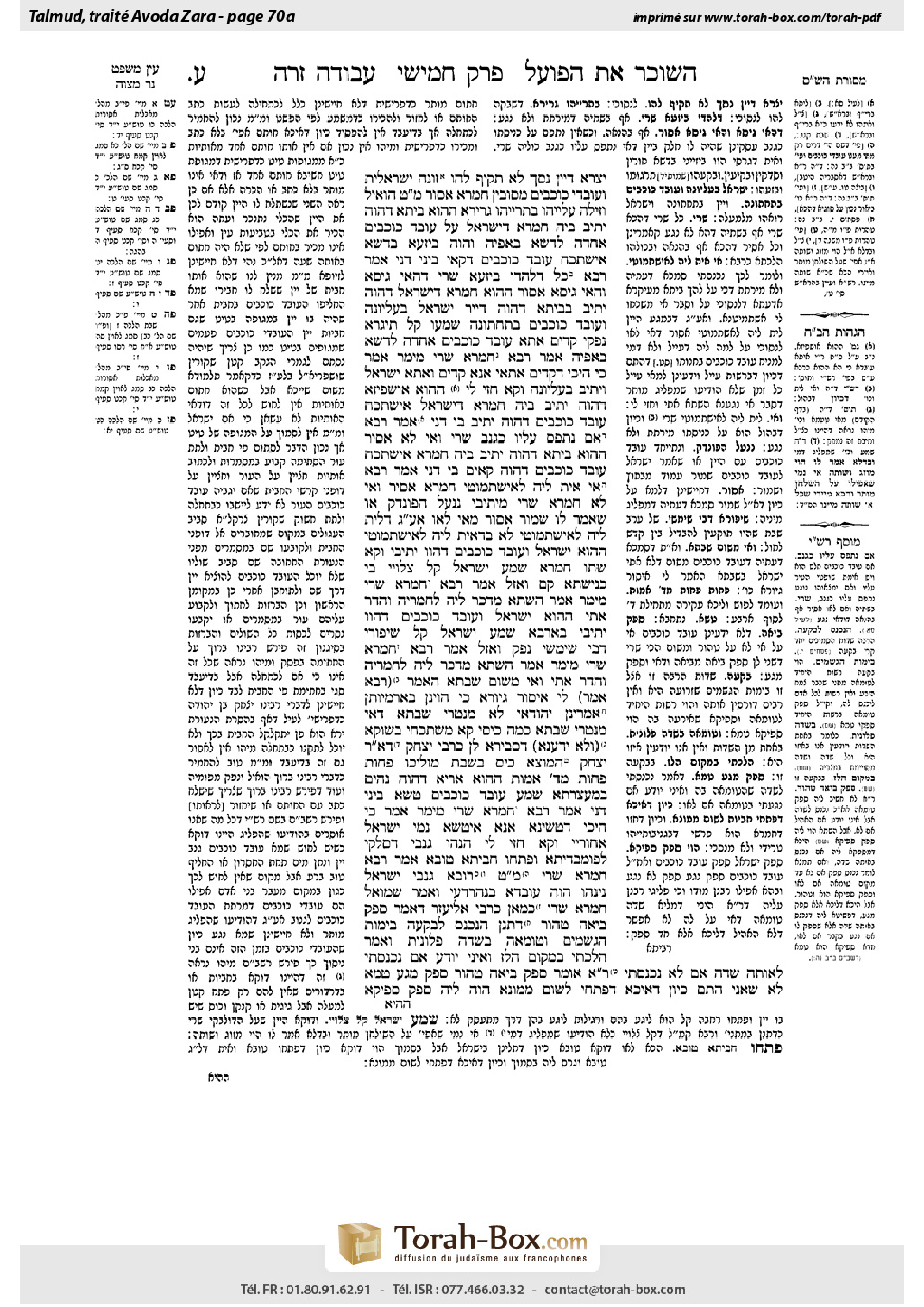
This page of Avodah Zarah includes the Aramaic text, an English translation and an AI-generated French translation, alongside the scan above.
עבודה זרה ע׳ א · Aramaic and Hebrew text
יִצְרָא דְּיֵין נֶסֶךְ לָא תָּקֵיף לְהוּ. זוֹנָה יִשְׂרְאֵלִית וְגוֹיִם מְסוּבִּין — חַמְרָא אָסוּר, מַאי טַעְמָא? הוֹאִיל וְזִילָה עֲלַיְיהוּ, בָּתְרַיְיהוּ גְּרִירָא.
הָהוּא בֵּיתָא דַּהֲוָה יָתֵיב בֵּיהּ חַמְרָא דְּיִשְׂרָאֵל, עָל גּוֹי אַחְדַּהּ לְדַשָּׁא בְּאַפֵּיהּ, וַהֲוָה בִּיזְעָא בְּדַשָּׁא, אִישְׁתְּכַח גּוֹי דְּקָאֵי בֵּינֵי דַּנֵּי. אֲמַר רָבָא: כֹּל דְּלַהֲדֵי בִּיזְעָא — שְׁרֵי, דְּהַאי גִּיסָא וְהַאי גִּיסָא — אֲסִיר.
הָהוּא חַמְרָא דְּיִשְׂרָאֵל, דַּהֲוָה יָתֵיב בְּבֵיתָא, דַּהֲוָה דָּיַיר יִשְׂרָאֵל בָּעֶלְיוֹנָה וְגוֹי בַּתַּחְתּוֹנָה. שְׁמַעוּ קָל תִּיגְרָא, נָפְקִי, קְדֵים אֲתָא גּוֹי אַחְדַּהּ לְדַשָּׁא בְּאַפֵּיהּ. אֲמַר רָבָא: חַמְרָא שְׁרֵי, מֵימָר אָמַר: כִּי הֵיכִי דִּקְדֵים אֲתַאי אֲנָא, קְדֵים וַאֲתָא יִשְׂרָאֵל וְיָתֵיב בָּעֶלְיוֹנָה וְקָא חָזֵי לִי.
הָהוּא אוּשְׁפִּיזָא דַּהֲוָה יָתֵיב בֵּיהּ חַמְרָא דְּיִשְׂרָאֵל, אִישְׁתְּכַח גּוֹי דַּהֲוָה יָתֵיב בֵּי דַנֵּי. אֲמַר רָבָא: אִם נִתְפָּס עָלָיו כְּגַנָּב — שְׁרֵי, וְאִי לָא — אֲסִיר.
הָהוּא בֵּיתָא דַּהֲוָה יָתֵיב בֵּיהּ חַמְרָא, אִישְׁתְּכַח גּוֹי דַּהֲוָה קָאֵים בֵּי דַנֵּי. אֲמַר רָבָא: אִי אִית לֵיהּ לְאִישְׁתְּמוֹטֵי — חַמְרָא אֲסִיר, וְאִי לָא — חַמְרָא שְׁרֵי. מֵיתִיבִי: נִנְעַל הַפּוּנְדָּק, אוֹ שֶׁאָמַר לוֹ: ״שְׁמוֹר״ — אָסוּר. מַאי לָאו אַף עַל גַּב דְּלֵית לֵיהּ לְאִישְׁתְּמוֹטֵי? לָא, בִּדְאִית לֵיהּ לְאִישְׁתְּמוֹטֵי.
הָהוּא יִשְׂרָאֵל וְגוֹי דַּהֲווֹ יָתְבִי וְקָא שָׁתוּ חַמְרָא, שְׁמַע יִשְׂרָאֵל קָל צַלּוֹיֵי בֵּי כְנִישְׁתָּא, קָם וַאֲזַל. אֲמַר רָבָא: חַמְרָא שְׁרֵי, מֵימָר אָמַר: הַשְׁתָּא מִדְּכַר לֵיהּ לְחַמְרֵיהּ וְהָדַר אָתֵי.
הָהוּא יִשְׂרָאֵל וְגוֹי דַּהֲווֹ יָתְבִי בְּאַרְבָּא, שְׁמַע יִשְׂרָאֵל קָל שִׁיפּוּרֵי דְּבֵי שִׁימְשֵׁי, נְפַק וַאֲזַל. אֲמַר רָבָא: חַמְרָא שְׁרֵי, מֵימָר אָמַר: הַשְׁתָּא מִדְּכַר לֵיהּ לְחַמְרֵיהּ וְהָדַר אָתֵי.
וְאִי מִשּׁוּם שַׁבְּתָא, הָאָמַר רָבָא: אֲמַר לִי אִיסּוּר גִּיּוֹרָא, כִּי הֲוֵינַן בְּאַרְמָיוּתַן אָמְרִינַן: יְהוּדָאֵי לָא מְנַטְּרִי שַׁבְּתָא, דְּאִי מְנַטְּרִי שַׁבְּתָא כַּמָּה כִּיסֵי קָא מִשְׁתַּכְחִי בְּשׁוּקָא. וְלָא יָדַעְנָא דִּסְבִירָא לַן כְּרַבִּי יִצְחָק, דְּאָמַר רַבִּי יִצְחָק: הַמּוֹצֵא כִּיס בְּשַׁבָּת מוֹלִיכוֹ פָּחוֹת פָּחוֹת מֵאַרְבַּע אַמּוֹת.
הָהוּא אַרְיָא דַּהֲוָה נָהֵים בְּמַעְצַרְתָּא, שְׁמַע גּוֹי, טְשָׁא בֵּינֵי דַּנֵּי. אָמַר רָבָא: חַמְרָא שְׁרֵי, מֵימָר אָמַר: כִּי הֵיכִי דְּטָשֵׁינָא אֲנָא, אִיטְשָׁא נָמֵי יִשְׂרָאֵל אֲחוֹרַיי וְקָא חָזֵי לִי.
הָנְהוּ גַּנָּבֵי דְּסָלְקִי לְפוּמְבְּדִיתָא, וּפְתַחוּ חָבְיָתָא טוּבָא. אֲמַר רָבָא: חַמְרָא שְׁרֵי. מַאי טַעְמָא? רוּבָּא גַּנָּבֵי יִשְׂרָאֵל נִינְהוּ. הֲוָה עוֹבָדָא בִּנְהַרְדְּעָא, וְאָמַר שְׁמוּאֵל: חַמְרָא שְׁרֵי.
כְּמַאן? כְּרַבִּי אֱלִיעֶזֶר, דְּאָמַר: סְפֵק בִּיאָה טָהוֹר.
דִּתְנַן: הַנִּכְנָס לְבִקְעָה בִּימוֹת הַגְּשָׁמִים, וְטוּמְאָה בְּשָׂדֶה פְּלוֹנִית, וְאָמַר: הָלַכְתִּי בַּמָּקוֹם הַלָּז, וְאֵינִי יוֹדֵעַ אִם נִכְנַסְתִּי לְאוֹתָהּ שָׂדֶה אִם לֹא נִכְנַסְתִּי, רַבִּי אֱלִיעֶזֶר אוֹמֵר: סְפֵק בִּיאָה — טָהוֹר, סְפֵק מַגָּע — טָמֵא!
לָא, שָׁאנֵי הָתָם, כֵּיוָן דְּאִיכָּא דְּפָתְחִי לְשׁוּם מָמוֹנָא, הָוֵה לֵיהּ סְפֵק סְפֵיקָא.
Avodah Zarah 70a · English translation
but the passion for wine used for a libation does not overwhelm their judgment, and they will not allow her to use it for a libation. In the case of a Jewish prostitute and gentiles dining with her, the wine is forbidden. What is the reason? It is that since she is contemptible in their eyes, she is subjugated to them, and they use the wine for a libation without consideration for her.
§ The Gemara relates: There was an incident involving a certain house where Jews’ wine was stored. A gentile entered the house, and he locked the door before the Jew, but there was a crack in the door, and the gentile was found standing between the barrels. Rava said: All the barrels that were opposite the crack through which the gentile could be seen are permitted, because he would have been wary about being seen tampering with them. Barrels on this side and that side of the crack, where the gentile could not be seen, are forbidden, as perhaps the gentile used them for a libation.
The Gemara relates: There was an incident involving a certain Jew’s wine that was stored in the lower story of a house, in which the Jew was living in the upper story and a gentile in the lower story, and the wine could be supervised from the upper story. One day the residents heard a sound of quarreling and went outside. The gentile came back in first and locked the door before the Jew. Rava said: The wine is permitted, because the gentile presumably said to himself: Just as I came back in early, perhaps my neighbor the Jew came back in early and is sitting in the upper story and watching me, and therefore he would not use the wine for a libation.
The Gemara relates: There was an incident involving a certain inn [ushpiza] where a Jew’s wine was stored, and a gentile was found sitting among the barrels. Rava said: If he was caught as a thief, i.e., if the gentile seemed startled and did not have a good explanation for being there, the wine is permitted, as the gentile was presumably afraid about being caught and would not have used it for a libation. But if not, the wine is forbidden.
The Gemara relates: There was an incident involving a certain house where wine was stored. A gentile was found standing among the barrels. Rava said: If he has a way to excuse his entrance to where the wine was stored, the wine is forbidden, but if not, the wine is permitted. The Gemara raises an objection to this ruling from a baraita: If an inn was locked and a gentile was inside, or if the Jew said to the gentile: Safeguard my wine, the wine is forbidden. What, is it not forbidden even if the gentile does not have a way to excuse his entrance? The Gemara answers: No, the baraita is referring to a situation where he does have a way to excuse his entrance; otherwise the wine is permitted.
The Gemara relates: There was an incident involving a certain Jew and a certain gentile who were sitting and drinking wine. The Jew heard the sound of praying at the synagogue. He got up and went to pray. Rava said: The wine is permitted, because the gentile presumably said to himself: Any moment now he will remember his wine and come back.
The Gemara relates: There was an incident involving a certain Jew and a certain gentile who were sitting on a ship. The Jew heard the sound of the shofar of twilight indicating the beginning of Shabbat. He disembarked and went into town to spend Shabbat there. Rava said: The wine is permitted, because the gentile presumably said to himself: Any moment now he will remember his wine and come back.
The Gemara comments: And if one might object that the gentile is presumably not concerned because he knows that the Jew will not return until the end of Shabbat, didn’t Rava say: Issur the Convert told me: When we were still gentiles, before converting, we used to say: Jews do not actually observe Shabbat, as, if they observe Shabbat, how many wallets would be found in the marketplace that the Jews could not take on Shabbat? And I did not know that we maintain that the halakha is in accordance with the opinion of Rabbi Yitzḥak, as Rabbi Yitzḥak says: One who finds a wallet on Shabbat may carry it in increments of less than four cubits. Evidently, gentiles assume that a Jew would violate Shabbat for monetary gain.
The Gemara relates: There was an incident involving a certain lion who roared in a winepress. A gentile heard the roar and was frightened, and he hid among the barrels of wine. Rava said: The wine is permitted, because the gentile presumably said to himself: Just as I am hiding, a Jew might also be hiding behind me and see me.
The Gemara relates: There was an incident involving certain thieves who came to Pumbedita and opened many barrels of wine. Rava said: The wine is permitted. What is the reason? Most of the thieves in Pumbedita are Jews, and the halakha follows the majority, and therefore the wine is not rendered forbidden. There was a similar incident in Neharde’a, and Shmuel said: The wine is permitted.
The Gemara asks: In accordance with whose opinion is this? Perhaps it is in accordance with the opinion of Rabbi Eliezer, who says with regard to cases of uncertainty concerning ritual purity that if the uncertainty is with regard to a person’s entry into a certain place, he is deemed pure.
This is as we learned in a mishna (Teharot 6:5): With regard to one who enters into a valley during the rainy season, i.e., winter, when people generally do not enter this area, and there was ritual impurity in such and such a field, and he said: I know I walked to that place, i.e., I walked in the valley, but I do not know whether I entered that field where the ritual impurity was or whether I did not enter, Rabbi Eliezer says: In a case of uncertainty with regard to entry, i.e., it is uncertain whether he entered the area where the ritual impurity is located, he is ritually pure. But if he certainly entered the area where the ritual impurity is located and the uncertainty pertains to contact with the source of ritual impurity, he is ritually impure. Apparently, the ruling of Shmuel, that in a case where it is uncertain whether gentile thieves entered the house at all the wine is permitted, is in accordance with the opinion of Rabbi Eliezer.
The Gemara rejects this: No, it is different there, with regard to the wine barrels. Since there are thieves who open barrels for the sake of perhaps finding money in them and are not interested in the wine, it is a case of compound uncertainty, as it is uncertain whether the thieves were gentiles or Jews, and even if they were gentiles, it is uncertain whether or not they touched the wine. In a case of compound uncertainty, everyone agrees that the wine is not forbidden.
Avodah Zarah 70a · Traduction française (IA)
mais la passion du vin utilisé pour une libation ne domine pas leur jugement, et ils ne permettront pas qu'elle l'utilise pour une libation. Dans le cas d'une prostituée juive et de gens du monde qui dînent avec elle, le vin est interdit. Quelle est la raison ? C'est que, puisqu'elle est méprisée à leurs yeux, elle est soumise à eux, et ils utilisent le vin pour une libation sans considération pour elle.
§ La Guemara rapporte : Il y avait un incident concernant une maison où le vin des Juifs était stocké. Un gentil entra dans la maison et verrouilla la porte avant le Juif, mais il y avait une fente dans la porte, et le gentil fut trouvé debout entre les tonneaux. Rava dit : Tous les tonneaux qui étaient opposés à la fente par laquelle le gentil pouvait être vu sont permis, car il aurait eu peur d'être vu manipulant ceux-ci. Les tonneaux de ce côté et de l'autre de la fente, où le gentil ne pouvait pas être vu, sont interdits, car peut-être le gentil les utilisait pour une libation.
La Guemara rapporte : Il y avait un incident concernant un vin d'un Juif stocké dans l'étage inférieur d'une maison, où le Juif habitait dans l'étage supérieur et un gentil dans l'étage inférieur, et le vin pouvait être surveillé depuis l'étage supérieur. Un jour, les habitants entendirent un bruit de dispute et sortirent. Le gentil entra d'abord et verrouilla la porte avant le Juif. Rava dit : Le vin est permis, car le gentil se dit probablement : Puisque je suis entré tôt, peut-être mon voisin le Juif est-il entré tôt et est assis dans l'étage supérieur et me surveille, et par conséquent il ne l'utiliserait pas pour une libation.
La Guemara rapporte : Il y avait un incident concernant un auberge [ushpiza] où le vin d'un Juif était stocké, et un gentil fut trouvé assis parmi les tonneaux. Rava dit : Si on l'a trouvé comme un voleur, c'est-à-dire si le gentil semblait surpris et n'avait pas d'explication valable pour être là, le vin est permis, car le gentil était probablement effrayé d'être pris et n'aurait pas utilisé le vin pour une libation. Mais si ce n'est pas le cas, le vin est interdit.
La Guemara rapporte : Il y avait un incident concernant une maison où du vin était stocké. Un gentil fut trouvé debout parmi les tonneaux. Rava dit : Si il a un moyen d'excuser son entrée dans l'endroit où le vin était stocké, le vin est interdit, mais si ce n'est pas le cas, le vin est permis. La Guemara soulève une objection contre cette décision à partir d'une baraïta : Si une auberge était verrouillée et un gentil était à l'intérieur, ou si le Juif disait au gentil : Garde mon vin, le vin est interdit. Qu'est-ce que cela ne l'interdit pas même si le gentil n'a pas de moyen d'excuser son entrée ? La Guemara répond : Non, la baraïta fait référence à un cas où il a un moyen d'excuser son entrée ; autrement, le vin est permis.
La Guemara rapporte : Il y avait un incident concernant un Juif et un gentil qui étaient assis et buvaient du vin. Le Juif entendit le son de la prière dans la synagogue. Il se leva et alla prier. Rava dit : Le vin est permis, car le gentil se dit probablement : D'un moment à l'autre, il va se souvenir de son vin et revenir.
La Guemara rapporte : Il y avait un incident concernant un Juif et un gentil qui étaient assis sur un bateau. Le Juif entendit le son du cor de l'après-midi indiquant le début du Shabbat. Il quitta le bateau et alla en ville pour y passer le Shabbat. Rava dit : Le vin est permis, car le gentil se dit probablement : D'un moment à l'autre, il va se souvenir de son vin et revenir.
La Guemara commente : Et si l'on objecte que le gentil n'est pas préoccupé, car il sait que le Juif ne reviendra pas avant la fin du Shabbat, n'a-t-on pas dit Rava : L'interdit du Converti m'a dit : Quand nous étions encore des gentils, avant de nous convertir, nous disions : les Juifs ne respectent pas le Shabbat, car, s'ils le respectaient, combien de portefeuilles trouverait-on sur le marché que les Juifs ne pourraient pas prendre le Shabbat ? Et je ne savais pas que nous maintenons que la halakha suit l'opinion de Rabbi Yitzḥak, car Rabbi Yitzḥak dit : Celui qui trouve un portefeuille le Shabbat peut le transporter par segments de moins de quatre coudées. Évidemment, les gentils supposent que le Juif violerait le Shabbat pour un gain matériel.
La Guemara rapporte : Il y avait un incident concernant un lion qui rugissait dans une presse à vin. Un gentil entendit le rugissement et fut effrayé, et il se cacha parmi les tonneaux de vin. Rava dit : Le vin est permis, car le gentil se dit probablement : Comme je me cache, un Juif pourrait aussi se cacher derrière moi et me voir.
La Guemara rapporte : Il y avait un incident concernant certains voleurs qui sont arrivés à Pumbedita et ont ouvert beaucoup de tonneaux de vin. Rava dit : Le vin est permis. Quelle est la raison ? La plupart des voleurs à Pumbedita sont des Juifs, et la halakha suit la majorité, et par conséquent le vin n'est pas rendu interdit. Il y avait un incident similaire à Neharde’a, et Shmuel dit : Le vin est permis.
La Guemara pose la question : Sur l'opinion de qui est-ce ? Peut-être c'est sur l'opinion de Rabbi Eliezer, qui dit concernant les cas d'incertitude concernant la pureté rituelle que si l'incertitude est relative à l'entrée d'une personne dans un certain lieu, il est considéré comme pur.
C’est ce que nous avons appris dans une mitsna (Téharot 6:5) : concernant celui qui entre dans une vallée pendant la saison des pluies, c’est-à-dire l’hiver, lorsque les gens ne pénètrent généralement pas dans cette zone, et qu’il y avait une impureté rituelle dans un tel et tel champ, et qu’il dit : Je sais que j’ai marché jusqu’à ce lieu, c’est-à-dire que j’ai marché dans la vallée, mais je ne sais pas si j’ai pénétré dans ce champ où il y avait de l’impureté rituelle ou si je n’y ai pas pénétré, Rabbi Éliezer dit : Dans un cas d’incertitude concernant l’entrée, c’est-à-dire s’il est incertain qu’il ait pénétré dans la zone où il y a de l’impureté rituelle, il est rituellement pur. Mais si l’on sait qu’il a pénétré dans la zone où il y a de l’impureté rituelle et que l’incertitude concerne le contact avec la source de l’impureté rituelle, il est rituellement impur. Apparemment, la décision de Shmuel, selon laquelle, dans un cas où il est incertain que des voleurs païens aient pénétré dans la maison, le vin est permis, s’inscrit dans la perspective de Rabbi Éliezer.
La Guemara rejette cette interprétation : Non, c’est différent là-bas, concernant les barils de vin. Puisque des voleurs ouvrent les barils à la recherche de peut-être de l’argent à l’intérieur et qu’ils n’ont pas l’intention du vin, c’est un cas d’incertitude multiple, car il est incertain si ces voleurs étaient païens ou juifs, et même s’ils étaient païens, il est incertain s’ils ont touché le vin. Dans un cas d’incertitude multiple, tout le monde convient que le vin n’est pas interdit.
Traduction française générée par IA à partir de l’édition anglaise de Sefaria. Vérifie toujours un passage avec le texte source.
Text from Sefaria: William Davidson Edition - Vocalized Aramaic (CC BY NC); William Davidson Edition - English (CC BY NC).