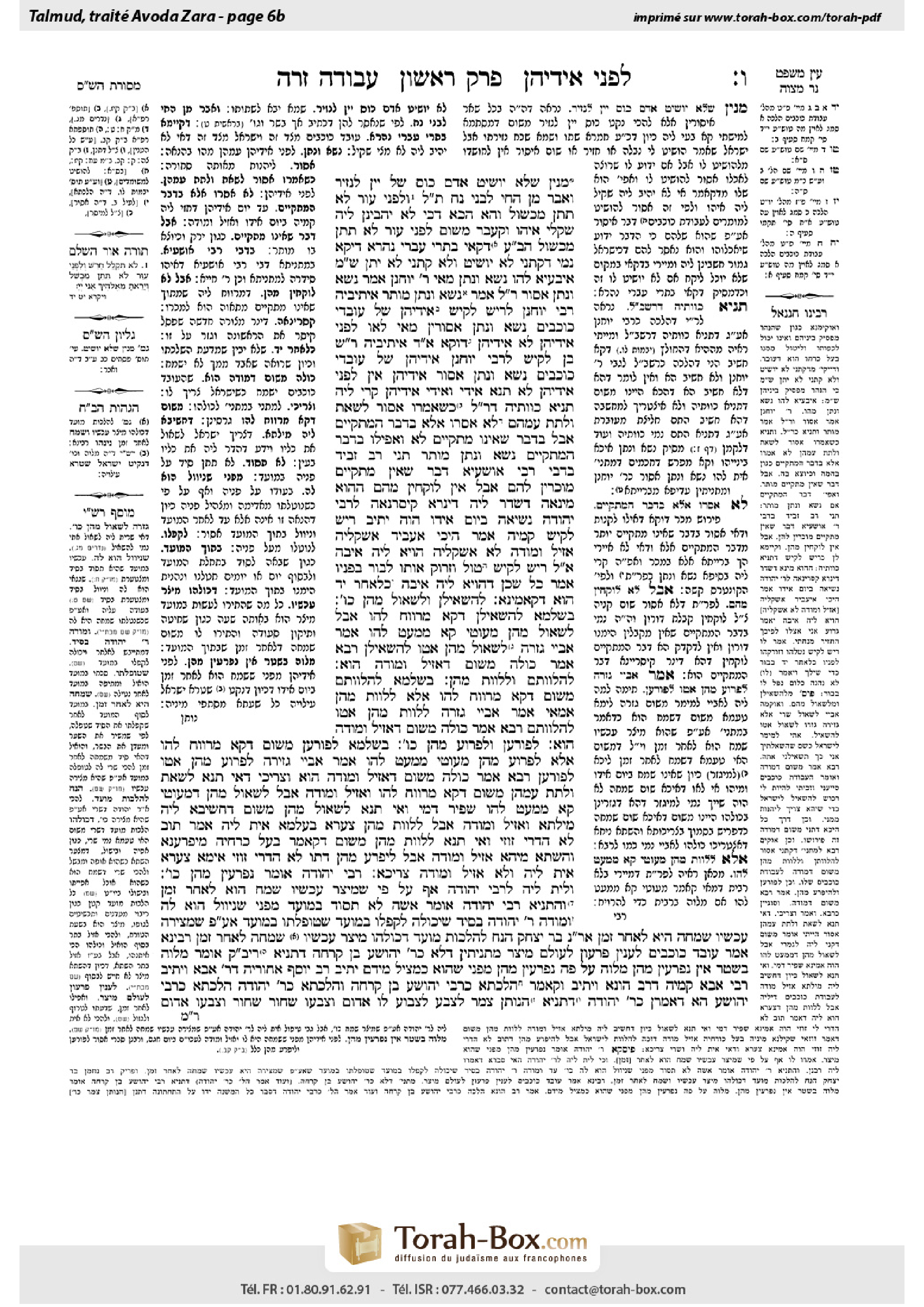
Avodah Zarah 6b: Talmud study for Daf Yomi
Study the Talmud for Daf Yomi with scanned pages, Hebrew text, English translations from Sefaria and AI-generated French translations.
Passage selection and English or AI-generated French translation are available where the scan has annotations. Daf Study is independent of Torah-Box and Sefaria.
Browse Avodah Zarah · עבודה זרה · All tractatesAvodah Zarah 6b text and translations
This page of Avodah Zarah includes the Aramaic text, an English translation and an AI-generated French translation, alongside the scan above.
עבודה זרה ו׳ ב · Aramaic and Hebrew text
מִנַּיִן שֶׁלֹּא יוֹשִׁיט אָדָם כּוֹס שֶׁל יַיִן לְנָזִיר, וְאֵבֶר מִן הַחַי לִבְנֵי נֹחַ? תַּלְמוּד לוֹמַר: ״וְלִפְנֵי עִוֵּר לֹא תִתֵּן מִכְשֹׁל״; וְהָא הָכָא, דְּכִי לָא יָהֲבִינַן לֵיהּ, שָׁקְלִי אִיהוּ, וְקָעָבַר מִשּׁוּם ״לִפְנֵי עִוֵּר לֹא תִתֵּן מִכְשֹׁל״!
הָכָא בְּמַאי עָסְקִינַן? דְּקָאֵי בִּתְרֵי עֶבְרֵי נַהֲרָא. דַּיְקָא נָמֵי, דְּקָתָנֵי ״לֹא יוֹשִׁיט״ וְלָא קָתָנֵי ״לֹא יִתֵּן״, שְׁמַע מִינַּהּ.
אִיבַּעְיָא לְהוּ: נָשָׂא וְנָתַן — מַאי? רַבִּי יוֹחָנָן אָמַר: נָשָׂא וְנָתַן — אָסוּר. רֵישׁ לָקִישׁ אָמַר: נָשָׂא וְנָתַן — מוּתָּר. אֵיתִיבֵיהּ רַבִּי יוֹחָנָן לְרֵישׁ לָקִישׁ: אֵידֵיהֶן שֶׁל גּוֹיִם נָשָׂא וְנָתַן — אֲסוּרִין, מַאי לָאו לִפְנֵי אֵידֵיהֶן? לָא, אֵידֵיהֶן דַּוְקָא.
אִיכָּא דְּאָמְרִי, אֵיתִיבֵיהּ רַבִּי שִׁמְעוֹן בֶּן לָקִישׁ לְרַבִּי יוֹחָנָן: אֵידֵיהֶן שֶׁל גּוֹיִם — נָשָׂא וְנָתַן אָסוּר. אֵידֵיהֶן — אִין, לִפְנֵי אֵידֵיהֶן — לָא! תַּנָּא, אִידֵּי וְאִידֵּי, ״אֵידֵיהֶן״ קָרֵי לֵיהּ.
תַּנְיָא כְּוָותֵיהּ דְּרֵישׁ לָקִישׁ: כְּשֶׁאָמְרוּ ״אָסוּר לָשֵׂאת וְלָתֵת עִמָּהֶם״ — לֹא אָסְרוּ אֶלָּא בְּדָבָר הַמִּתְקַיֵּים, אֲבָל בְּדָבָר שֶׁאֵינוֹ מִתְקַיֵּים — לֹא, וַאֲפִילּוּ בְּדָבָר הַמִּתְקַיֵּים נָשָׂא וְנָתַן — מוּתָּר. תָּנֵי רַב זְבִיד בִּדְבֵי רַבִּי אוֹשַׁעְיָא: דָּבָר שֶׁאֵין מִתְקַיֵּים מוֹכְרִין לָהֶם, אֲבָל אֵין לוֹקְחִין מֵהֶם.
הָהוּא מִינָאָה דְּשַׁדַּר לֵיהּ דִּינָרָא קֵיסָרְנָאָה לְרַבִּי יְהוּדָה נְשִׂיאָה בְּיוֹם אֵידוֹ, הֲוָה יָתֵיב רֵישׁ לָקִישׁ קַמֵּיהּ. אֲמַר: הֵיכִי אֶעֱבֵיד? אֶשְׁקְלֵיהּ — אָזֵיל וּמוֹדֶה, לָא אֶשְׁקְלֵיהּ — הָוְיָא לֵיהּ אֵיבָה. אֲמַר לֵיהּ רֵישׁ לָקִישׁ: טוֹל וּזְרוֹק אוֹתוֹ לְבוֹר בְּפָנָיו. אָמַר: כׇּל שֶׁכֵּן דְּהָוְיָא לֵיהּ אֵיבָה! כִּלְאַחַר יָד הוּא דְּקָאָמֵינָא.
לְהַשְׁאִילָן וְלִשְׁאוֹל מֵהֶן כּוּ׳. בִּשְׁלָמָא לְהַשְׁאִילָן — דְּקָא מַרְוַוח לְהוּ, אֲבָל לִשְׁאוֹל מֵהֶן — מַעוֹטֵי קָא מְמַעֵט לְהוּ? אָמַר אַבָּיֵי: גְּזֵרָה לִשְׁאוֹל מֵהֶן אַטּוּ לְהַשְׁאִילָן. רָבָא אָמַר: כּוּלָּהּ מִשּׁוּם דְּאָזֵיל וּמוֹדֶה הוּא.
לְהַלְווֹתָם וְלִלְווֹת מֵהֶן. בִּשְׁלָמָא לְהַלְווֹתָם — מִשּׁוּם דְּקָא מַרְוַוח לְהוּ, אֶלָּא לִלְווֹת מֵהֶן — אַמַּאי? אָמַר אַבָּיֵי: גְּזֵרָה לִלְווֹת מֵהֶן אַטּוּ לְהַלְווֹתָם. רָבָא אָמַר: כּוּלָּהּ מִשּׁוּם דְּאָזֵיל וּמוֹדֶה הוּא.
לְפוֹרְעָן וְלִפְרוֹעַ מֵהֶן כּוּ׳. בִּשְׁלָמָא לְפוֹרְעָן — מִשּׁוּם דְּקָא מַרְוַוח לְהוּ, אֶלָּא לִפְרוֹעַ מֵהֶן — מַעוֹטֵי מְמַעֵט לְהוּ? אָמַר אַבָּיֵי: גְּזֵירָה לִפְרוֹעַ מֵהֶן אַטּוּ לְפוֹרְעָן. רָבָא אָמַר: כּוּלָּהּ מִשּׁוּם דְּאָזֵיל וּמוֹדֶה הוּא.
וּצְרִיכִי, דְּאִי תְּנָא לָשֵׂאת וְלָתֵת עִמָּהֶן, מִשּׁוּם דְּקָא מַרְוַוח לְהוּ וְאָזֵיל וּמוֹדֶה, אֲבָל לִשְׁאוֹל מֵהֶן, דְּמַעוֹטֵי קָא מְמַעֵט לְהוּ — שַׁפִּיר דָּמֵי.
וְאִי תְּנָא לִשְׁאוֹל מֵהֶן, מִשּׁוּם דַּחֲשִׁיבָא לֵיהּ מִילְּתָא, וְאָזֵיל וּמוֹדֶה. אֲבָל לִלְווֹת מֵהֶן, צַעֲרָא בְּעָלְמָא אִית לֵיהּ, אָמַר: ״תּוּב לָא הָדְרִי זוּזֵי״.
וְאִי תְּנָא לִלְווֹת מֵהֶן, מִשּׁוּם דְּקָאָמַר: ״בְּעַל כָּרְחֵיהּ מִיפְּרַעְנָא״, וְהַשְׁתָּא מִיהָא אָזֵיל וּמוֹדֶה, אֲבָל לִיפָּרַע מֵהֶן, דְּתוּ לָא הָדְרִי זוּזֵי, אֵימָא צַעֲרָא אִית לֵיהּ, וְלָא אָזֵיל וּמוֹדֶה — צְרִיכָא.
רַבִּי יְהוּדָה אוֹמֵר: נִפְרָעִין מֵהֶן כּוּ׳. וְלֵית לֵיהּ לְרַבִּי יְהוּדָה ״אַף עַל פִּי שֶׁמֵּיצֵר עַכְשָׁיו שָׂמֵחַ הוּא לְאַחַר זְמַן״?
וְהָתַנְיָא: רַבִּי יְהוּדָה אוֹמֵר: אִשָּׁה לֹא תָּסוּד בַּמּוֹעֵד, מִפְּנֵי שֶׁנִּיוּוּל הוּא לָהּ. וּמוֹדֶה רַבִּי יְהוּדָה בְּסִיד שֶׁיְּכוֹלָה לְקַפְּלוֹ בַּמּוֹעֵד, שֶׁטּוֹפַלְתּוֹ בַּמּוֹעֵד, אַף עַל פִּי שֶׁמְּצֵירָה עַכְשָׁיו, שְׂמֵחָה הִיא לְאַחַר זְמַן!
אָמַר רַב נַחְמָן בַּר יִצְחָק: הַנַּח לְהִלְכוֹת מוֹעֵד, דְּכוּלְּהוּ מֵיצֵר עַכְשָׁיו, (שְׂמֵחָה) [שָׂמֵחַ] לְאַחַר זְמַן. רָבִינָא אָמַר: גּוֹי לְעִנְיַן פֵּרָעוֹן לְעוֹלָם מֵיצֵר.
מַתְנִיתִין דְּלָא כְּרַבִּי יְהוֹשֻׁעַ בֶּן קׇרְחָה, דְּתַנְיָא: רַבִּי יְהוֹשֻׁעַ בֶּן קׇרְחָה אוֹמֵר: מִלְוֶה בִּשְׁטָר אֵין נִפְרָעִין מֵהֶן, מִלְוֶה עַל פֶּה נִפְרָעִין מֵהֶן, מִפְּנֵי שֶׁהוּא כְּמַצִּיל מִיָּדָם.
יָתֵיב רַב יוֹסֵף אֲחוֹרֵיהּ דְּרַבִּי אַבָּא, וְיָתֵיב רַבִּי אַבָּא קַמֵּיהּ דְּרַב הוּנָא, וְיָתֵיב וְקָאָמַר: הִלְכְתָא כְּרַבִּי יְהוֹשֻׁעַ בֶּן קׇרְחָה, וְהִלְכְתָא כְּרַבִּי יְהוּדָה.
הִלְכְתָא כְּרַבִּי יְהוֹשֻׁעַ — הָא דַּאֲמַרַן, כְּרַבִּי יְהוּדָה — דְּתַנְיָא: הַנּוֹתֵן צֶמֶר לַצַבָּע לִצְבּוֹעַ לוֹ אָדוֹם וּצְבָעוֹ שָׁחוֹר, שָׁחוֹר וּצְבָעוֹ אָדוֹם.
Avodah Zarah 6b · English translation
From where is it derived that a person may not extend a cup of wine to a nazirite, who is prohibited from drinking wine, and that he may not extend a limb severed from a living animal to descendants of Noah? The verse states: “And you shall not put a stumbling block before the blind” (Leviticus 19:14). But here, in both cases, if one does not give it to him, he can take it himself, and yet the one who provides it to him transgresses due to the prohibition: “You shall not put a stumbling block before the blind.”
The Gemara answers: Here we are dealing with a case where they are standing on the two sides of a river, and therefore the recipient could not have taken it himself. Since his help was instrumental, the one who conveyed the item has violated the prohibition of putting a stumbling block before the blind. The Gemara adds: The language of the baraita is also precise, as it teaches: A person may not extend, and it does not teach: One may not give. Learn from the usage of the term extend that the baraita is referring to one located on one side of a river, who extends the item to the one on the other side.
§ A dilemma was raised before the Sages: If one ignored the injunction of the mishna and engaged in business with gentiles before their festival, what is the status of the profit that he earned? Rabbi Yoḥanan says: If he engaged in business, it is prohibited to derive benefit from his profits. Reish Lakish says: If he engaged in business, it is permitted to derive benefit from his profits. Rabbi Yoḥanan raised an objection to Reish Lakish from a baraita: With regard to the festivals of gentiles, if one engaged in business, these profits are prohibited. What, is it not referring to one who engages in business with gentiles before their festivals? Reish Lakish responded: No, the baraita is referring to business conducted specifically during their festivals.
There are those who say that there is a different version of the above exchange. Rabbi Shimon ben Lakish raised an objection to Rabbi Yoḥanan from a baraita: With regard to the festivals of gentiles, if one engaged in business these profits are prohibited. Isn’t it correct to infer from the baraita that if the business occurred during their festivals, yes, deriving benefit from the profits is prohibited, but if it took place before their festivals, no, it is not prohibited? Rabbi Yoḥanan responded: No; the tanna calls both this, the days before the festival, and that, the festival itself: Their festivals.
The Gemara notes that it is taught in a baraita in accordance with the opinion of Reish Lakish: When the Sages said that it is prohibited to engage with the gentiles in business, they prohibited it only in the case of an item that endures. But with regard to an item that does not endure, it is not prohibited. And even with regard to an item that endures, if one did engage in business with gentiles, deriving benefit from the profits is permitted. Rav Zevid taught a baraita from the school of Rabbi Oshaya: With regard to an item that does not endure, one may sell it to them, but one may not buy it from them.
The Gemara relates: There was an incident involving a certain heretic who sent a Caesarean dinar to Rabbi Yehuda Nesia on the day of the heretic’s festival. Rabbi Yehuda Nesia said to Reish Lakish, who was sitting before him: What shall I do? If I take the dinar, he will go and thank his idol for the success of his endeavor, but if I do not take the dinar, he will harbor enmity toward me. Reish Lakish said to him: Take it and throw it into a pit in the presence of the heretic. Rabbi Yehuda Nesia said: All the more so, this will cause him to harbor enmity toward me. Reish Lakish explained: I said, i.e., I meant, that you should throw it in an unusual manner, so that it looks as though the dinar inadvertently fell from your hand into the pit.
§ The mishna teaches that it is prohibited to lend them items and to borrow items from them during the three days preceding their festivals. The Gemara asks: Granted, it is prohibited to lend the items to them, as this causes them to have a profit. But why is it prohibited to borrow the items from them during this period? Doesn’t this serve to reduce for them the property they possess during the festival? Abaye said: The Sages issued a decree that it is prohibited to borrow the items from them due to the concern that he might come to lend the items to them. Rava said: All of it, lending and borrowing, is prohibited for the same reason, as in either situation the gentile might go and give thanks to his idol, as he will be pleased that the Jew was forced to borrow the items from him.
The mishna further teaches that it is prohibited to lend money to them or to borrow money from them. The Gemara asks: Granted, it is prohibited to lend money to them, as this causes them to have a profit. But if one wants to borrow money from them, why is it prohibited? Abaye said: The Sages issued a decree that it is prohibited to borrow money from them, due to the concern that he might come to lend money to them. Rava said: All of it, lending and borrowing money, is prohibited for the same reason, as in either situation the gentile will go and give thanks to his object of idol worship.
The mishna also teaches that it is prohibited to repay debts owed to them and to collect payment of their debts. Once again, the Gemara asks: Granted, it is prohibited to repay debts owed to them, as giving them the money at this time causes them to have a profit. But why is it prohibited to collect payment of their debts? Doesn’t this serve to reduce their fortune? Abaye said: The Sages issued a decree that it is prohibited to collect debts from them, due to the concern that he might come to repay their debts. Rava said: All of it, repaying and collecting debts, is prohibited for the same reason, as in either situation the gentile might go and give thanks to his idol for having had sufficient funds to pay his debts.
The Gemara notes: And all of the prohibitions listed in the mishna are necessary. As, if the mishna had taught only that it is prohibited to engage with them in business, one could have said that the reason for the prohibition is because it causes the gentile to have a profit, and he will go and give thanks to his idol. But with regard to borrowing items from them, which serves to reduce for them the property they possess during the festival, one may well do so.
And if the mishna had further taught only that it is prohibited to borrow items from them, one might have thought that this is because the matter is significant to the gentile, as he is pleased that the Jew is forced to borrow items from him, and therefore he might go and give thanks. But it might have been supposed that to borrow money from them is permitted, as there is only distress for the gentile when he lends money, as he would say: My money will not return to me again, since the borrower may never repay the loan.
And if the mishna had taught in addition only that it is prohibited to borrow money from them, one might have thought that this is because the gentile says: I will forcibly collect payment from the Jew against his will, by means of the promissory note, and now in any event he will go and give thanks that the Jew is forced to borrow money from him. But with regard to collecting payment from them, as this money will never return to him again, one might say that he has distress about paying back the debt, and he will not go and give thanks. Since one might have reached these conclusions, it is necessary for the mishna to state each ruling explicitly.
§ The mishna teaches that Rabbi Yehuda says: One may collect the repayment of debts from them, because this causes the gentile distress. The Gemara asks: And doesn’t Rabbi Yehuda accept the principle that even though he is distressed now, he will be happy afterward?
But isn’t it taught in a baraita: Rabbi Yehuda says: A woman may not apply lime to her skin during the intermediate days of the Festival in order to remove bodily hair and soften her skin, because this temporarily disfigures her until the lime is removed. And Rabbi Yehuda concedes with regard to lime that she can peel off during the intermediate days of the Festival that she may apply it on the intermediate days of the Festival, as even though she is distressed now, as the lime renders her unattractive, she will be happy afterward, when the lime is removed and she becomes more attractive. It is evident from this baraita that Rabbi Yehuda does take into account the joy that will be experienced at a later time with regard to permitting an action now.
Rav Naḥman bar Yitzḥak says in response: Leave aside the halakhot of the intermediate days of a Festival. These cannot be compared to other cases, as with regard to all the labors permitted on a Festival this is the reason for the leniency: Although he is distressed by performing them now, as they involve effort and trouble, he will be happy afterward on the Festival itself that he has performed them, when he enjoys the benefits of the labor he has performed. Due to the joy they will bring him on the Festival, these labors are permitted. Ravina said that there is a different answer: Rabbi Yehuda maintains that with regard to repaying a debt a gentile is always distressed, even after the fact. But in general, Rabbi Yehuda does take into account the joy that will be experienced at a later time.
The Gemara notes: The mishna is not in accordance with the opinion of Rabbi Yehoshua ben Korḥa, as it states that one may not collect payment from a gentile during the three days preceding their festivals, without differentiating between various cases. As it is taught in a baraita: Rabbi Yehoshua ben Korḥa says: In the case of a loan with a promissory note, one may not collect payment from gentiles before their festivals, as one can demand repayment of the debt by presenting the promissory note in his possession at a later stage. By contrast, in the case of a loan by oral agreement, one may collect payment from them, because he is considered as one who salvages money from them, since he has no promissory note and cannot be sure that the gentile will repay the loan at another time.
The Gemara relates: Rav Yosef sat behind Rabbi Abba in the study hall, and Rabbi Abba sat before Rav Huna, as a student before his teacher. And Rav Huna sat and said the following statements: The halakha is in accordance with the opinion of Rabbi Yehoshua ben Korḥa, and the halakha is in accordance with the opinion of Rabbi Yehuda.
The Gemara explains: As for the statement that the halakha is in accordance with the opinion of Rabbi Yehoshua ben Korḥa, this is referring to that which we said with regard to collecting a loan by oral agreement from gentiles during the days preceding their festivals. As for the statement that the halakha is in accordance with the opinion of Rabbi Yehuda, this is as it is taught in a mishna (Bava Kamma 100b): In the case of one who gives wool to a dyer to dye it red for him and instead he dyed it black, or one who gives wool to a dyer to dye it black and instead he dyed it red,
Avodah Zarah 6b · Traduction française (IA)
D'où tire-t-on que personne ne doit offrir un verre de vin à un nazir, qui est interdit de boire du vin, et qu'on ne doit pas offrir un membre coupé d'un animal vivant aux descendants d'Noé ? La Parashah dit : « Et tu ne placeras point un obstacle devant le boiteux » (Lévitique 19:14). Mais ici, dans les deux cas, si on ne lui donne pas, il peut le prendre lui-même, et pourtant celui qui lui donne transgresse la prohibition : « Tu ne placeras point un obstacle devant le boiteux. »
La Guemara répond : Ici, nous sommes en présence d'un cas où ils sont debout des deux côtés d'un fleuve, et donc le receveur ne pouvait pas prendre lui-même l'objet. Puisque son aide a été déterminante, celui qui a transmis l'objet a violé la prohibition de placer un obstacle devant le boiteux. La Guemara ajoute : La formulation de la baraïta est aussi précise, car elle enseigne : On ne doit pas étendre, et ne dit pas : On ne doit pas donner. Apprends de l'usage du terme « étendre » que la baraïta fait référence à celui qui est du côté d'un fleuve, qui étend l'objet à celui qui est de l'autre côté.
§ Un dilemme a été soulevé devant les Sages : Si l'on a ignoré l'interdiction de la Michna et s'est engagé dans un commerce avec des non-juifs avant leurs fêtes, quelle est la situation des bénéfices qu'il a gagnés ? Rabbi Yoḥanan dit : Si l'on s'est engagé dans un commerce, il est interdit de tirer profit de ses bénéfices. Reish Lakish dit : Si l'on s'est engagé dans un commerce, il est permis de tirer profit de ses bénéfices. Rabbi Yoḥanan a soulevé un objection contre Reish Lakish à partir d'une baraïta : En ce qui concerne les fêtes des non-juifs, si l'on s'est engagé dans un commerce, ces bénéfices sont interdits. Qu'est-ce que cela ne signifie pas qu'il s'agit d'une personne qui s'est engagé dans un commerce avec des non-juifs avant leurs fêtes ? Reish Lakish a répondu : Non, la baraïta fait référence à un commerce effectué spécifiquement durant leurs fêtes.
Certains disent qu'il existe une version différente de l'échange ci-dessus. Rabbi Shimon ben Lakish a soulevé une objection contre Rabbi Yoḥanan à partir d'une baraïta : En ce qui concerne les fêtes des non-juifs, si l'on s'est engagé dans un commerce, ces bénéfices sont interdits. N'est-ce pas correct d'inférer de la baraïta que si le commerce s'est déroulé durant leurs fêtes, oui, tirer profit des bénéfices est interdit, mais si cela s'est produit avant leurs fêtes, non, il n'est pas interdit ? Rabbi Yoḥanan a répondu : Non ; le tanna appelle à la fois ces jours avant la fête et cette fête elle-même : Leurs fêtes.
La Guemara note que cela est enseigné dans une baraïta selon l'opinion de Reish Lakish : Lorsque les Sages ont dit qu'il est interdit d'engager un commerce avec les non-juifs, ils ont interdit cela uniquement dans le cas d'un objet durable. Mais en ce qui concerne un objet non durable, il n'est pas interdit. Et même en ce qui concerne un objet durable, si l'on a engagé un commerce avec des non-juifs, tirer profit des bénéfices est permis. Rav Zevid a enseigné une baraïta de la scolie de Rabbi Oshaya : En ce qui concerne un objet non durable, on peut le vendre à eux, mais on ne peut pas le acheter à eux.
La Guemara rapporte : Il y avait un incident concernant un certain hérétique qui a envoyé un dinar caésarien à Rabbi Yehuda Nesia le jour de la fête de l'hérétique. Rabbi Yehuda Nesia a dit à Reish Lakish, qui était assis devant lui : Que dois-je faire ? Si je prends le dinar, il ira et remerciera son idole pour le succès de son entreprise, mais si je ne le prends pas, il me portera haine. Reish Lakish a dit à lui : Prends-le et jette-le dans un puits devant l'hérétique. Rabbi Yehuda Nesia a dit : D'autant plus, cela causera qu'il me porte haine. Reish Lakish a expliqué : Je dis, c'est-à-dire que je veux dire, que tu devrais le jeter d'une manière inhabituelle, de sorte qu'il semble que le dinar est tombé accidentellement de ta main dans le puits.
§ La Michna enseigne que c'est interdit de prêter des objets ou de les emprunter à eux durant les trois jours précédant leurs fêtes. La Guemara demande : D'accord, c'est interdit de prêter des objets à eux, car cela leur donne un bénéfice. Mais pourquoi est-il interdit d'emprunter des objets à eux durant cette période ? N'est-ce pas cela qui réduit leur propriété durant la fête ? Abaye a dit : Les Sages ont émis un décret interdisant d'emprunter des objets à eux en raison de la crainte qu'il puisse finir par prêter des objets à eux. Rava a dit : Tout cela, prêter et emprunter, est interdit pour la même raison, car dans chaque cas le non-juif pourrait aller et remercier son idole, car il sera content que le Juif ait été contraint d'emprunter des objets à lui.
La Michna enseigne également que c'est interdit de prêter de l'argent à eux ou d'emprunter de l'argent à eux. La Guemara demande : D'accord, c'est interdit de prêter de l'argent à eux, car cela leur donne un bénéfice. Mais si l'on veut emprunter de l'argent à eux, pourquoi est-ce interdit ? Abaye a dit : Les Sages ont émis un décret interdisant d'emprunter de l'argent à eux en raison de la crainte qu'il puisse finir par prêter de l'argent à eux. Rava a dit : Tout cela, prêter et emprunter de l'argent, est interdit pour la même raison, car dans chaque cas le non-juif ira et remerciera son objet d'idolatrise pour avoir eu suffisamment d'argent pour payer ses dettes.
La Michna enseigne également que c'est interdit de rembourser des dettes qu'on leur doit et de recouvrer le paiement de leurs dettes. À nouveau, la Guemara demande : D'accord, c'est interdit de rembourser des dettes qu'on leur doit, car donner de l'argent à cette époque leur donne un bénéfice. Mais pourquoi est-il interdit de recouvrer le paiement de leurs dettes ? N'est-ce pas cela qui réduit leur fortune ? Abaye a dit : Les Sages ont émis un décret interdisant de recouvrer des dettes à eux en raison de la crainte qu'il puisse finir par rembourser leurs dettes. Rava a dit : Tout cela, rembourser et recouvrer des dettes, est interdit pour la même raison, car dans chaque cas le non-juif pourrait aller et remercier son idole pour avoir eu suffisamment d'argent pour payer ses dettes.
La Guemara note : Et toutes les interdictions énumérées dans la mitsva sont nécessaires. Car, si la mitsva avait enseigné seulement que c'est interdit d'entretenir des relations commerciales avec eux, on aurait pu dire que la raison de l'interdiction est qu'elle fait gagner du profit au gentil, et il ira ensuite rendre grâce à son idole. Mais concernant l'emprunt d'objets d'entre eux, qui sert à réduire la propriété qu'ils possèdent pendant la fête, on pourrait très bien le faire.
Et si la mitsva avait seulement enseigné que c'est interdit d'emprunter des objets d'entre eux, on aurait pu penser que c'est parce que cela est important pour le gentil, car il est content que le Juif soit contraint d'emprunter des objets à lui, et donc il pourrait aller rendre grâce. Mais on aurait pu penser que l'emprunt d'argent d'entre eux est permis, car c'est seulement une détresse pour le gentil lorsqu'il prête de l'argent, car il dirait : Mon argent ne reviendra plus à moi, car le prêteur ne remboursera jamais le prêt.
Et si la mitsva avait enseigné en plus seulement que c'est interdit d'emprunter de l'argent d'entre eux, on aurait pu penser que c'est parce que le gentil dit : Je vais forcer le Juif à rembourser contre sa volonté, par le moyen de l'acte de prêt, et maintenant en tout cas il ira rendre grâce que le Juif est contraint d'emprunter de l'argent à lui. Mais concernant la collecte de la dette d'entre eux, comme cet argent ne reviendra jamais à lui, on pourrait dire qu'il est en détresse à l'idée de rembourser la dette, et il ne va pas rendre grâce. Puisque l'on aurait pu en arriver à ces conclusions, il est nécessaire que la mitsva énonce chaque règlement explicitement.
§ La mitsva enseigne que Rabbi Yéhuda dit : On peut récupérer le remboursement des dettes d'entre eux, car cela cause une détresse au gentil. La Guemara demande : Et ne serait-ce pas que Rabbi Yéhuda accepte le principe que même s'il est en détresse maintenant, il sera heureux après ?
Mais n’est-ce pas enseigné dans une baraïta : Rabbi Yéhuda dit : Une femme ne doit pas appliquer du chaux sur sa peau pendant les jours intermédiaires du festival afin d’éliminer les poils du corps et d’adoucir sa peau, car cela la défigure temporairement jusqu’à ce que le chaux soit retiré. Et Rabbi Yéhuda reconnaît, en ce qui concerne le chaux, qu’elle peut le retirer pendant les jours intermédiaires du festival, car même si elle est actuellement inquiète, car le chaux la rend peu attrayante, elle sera heureuse plus tard, lorsque le chaux sera retiré et qu’elle deviendra plus attrayante. Il est évident de cette baraïta que Rabbi Yéhuda tient compte de la joie future en ce qui concerne la permission d’agir maintenant.
Rav Naḥman bar Yitzḥak répond : Oubliez les halakhot des jours intermédiaires d’un festival. Ces cas ne peuvent pas être comparés à d’autres, car concernant toutes les œuvres permises pendant un festival, la raison de la leniencé est la suivante : Bien qu’il soit inquiet d’accomplir ces œuvres maintenant, car elles impliquent un effort et une peine, il sera heureux plus tard pendant le festival lui-même, car il profitera des bénéfices de l’œuvre qu’il a accomplie. En raison de la joie qu’ils lui apporteront pendant le festival, ces œuvres sont permises. Ravina a dit qu’il y a une autre réponse : Rabbi Yéhuda maintient que concernant le remboursement d’une dette, un non-Juif est toujours inquiet, même après coup. Mais en général, Rabbi Yéhuda tient compte de la joie future.
La Guemara note que la Michna ne correspond pas à l'opinion de Rabbi Yéhoshua ben Korḥa, car elle indique qu'on ne peut pas récupérer un prêt auprès d'un non-Juif pendant les trois jours précédant ses fêtes, sans distinguer les cas. Comme il est enseigné dans une baraïta : Rabbi Yéhoshua ben Korḥa dit : Dans le cas d'un prêt avec un billet de remboursement, on ne peut pas récupérer le prêt auprès des non-Juifs avant leurs fêtes, car on peut exiger le remboursement en présentant le billet de remboursement en possession à une date ultérieure. En revanche, dans le cas d'un prêt par accord oral, on peut récupérer le prêt auprès d'eux, car on est considéré comme celui qui récupère de l'argent auprès d'eux, car on n'a pas de billet de remboursement et on ne peut pas être sûr que le non-Juif remboursera le prêt à une autre date.
La Guemara rapporte : Rav Yosef était assis derrière Rabbi Abba dans la salle de étude, et Rabbi Abba était assis devant Rav Huna, comme un étudiant devant son maître. Et Rav Huna s'est assis et a dit les propos suivants : La halakha suit l'opinion de Rabbi Yéhoshua ben Korḥa, et la halakha suit l'opinion de Rabbi Yéhuda.
La Guemara explique : En ce qui concerne l'affirmation que la halakha suit l'opinion de Rabbi Yéhoshua ben Korḥa, cela fait référence à ce que nous avons dit concernant la récupération d'un prêt par accord oral auprès des non-Juifs pendant les jours précédant leurs fêtes. En ce qui concerne l'affirmation que la halakha suit l'opinion de Rabbi Yéhuda, cela fait référence à ce qui est enseigné dans une mitsva (Bava Kamma 100b) : Dans le cas d'une personne qui donne du laine à un teinturier pour la teindre en rouge et qu'il la teint en noir, ou d'une personne qui donne du laine à un teinturier pour la teindre en noir et qu'il la teint en rouge,
Traduction française générée par IA à partir de l’édition anglaise de Sefaria. Vérifie toujours un passage avec le texte source.
Text from Sefaria: William Davidson Edition - Vocalized Aramaic (CC BY NC); William Davidson Edition - English (CC BY NC).