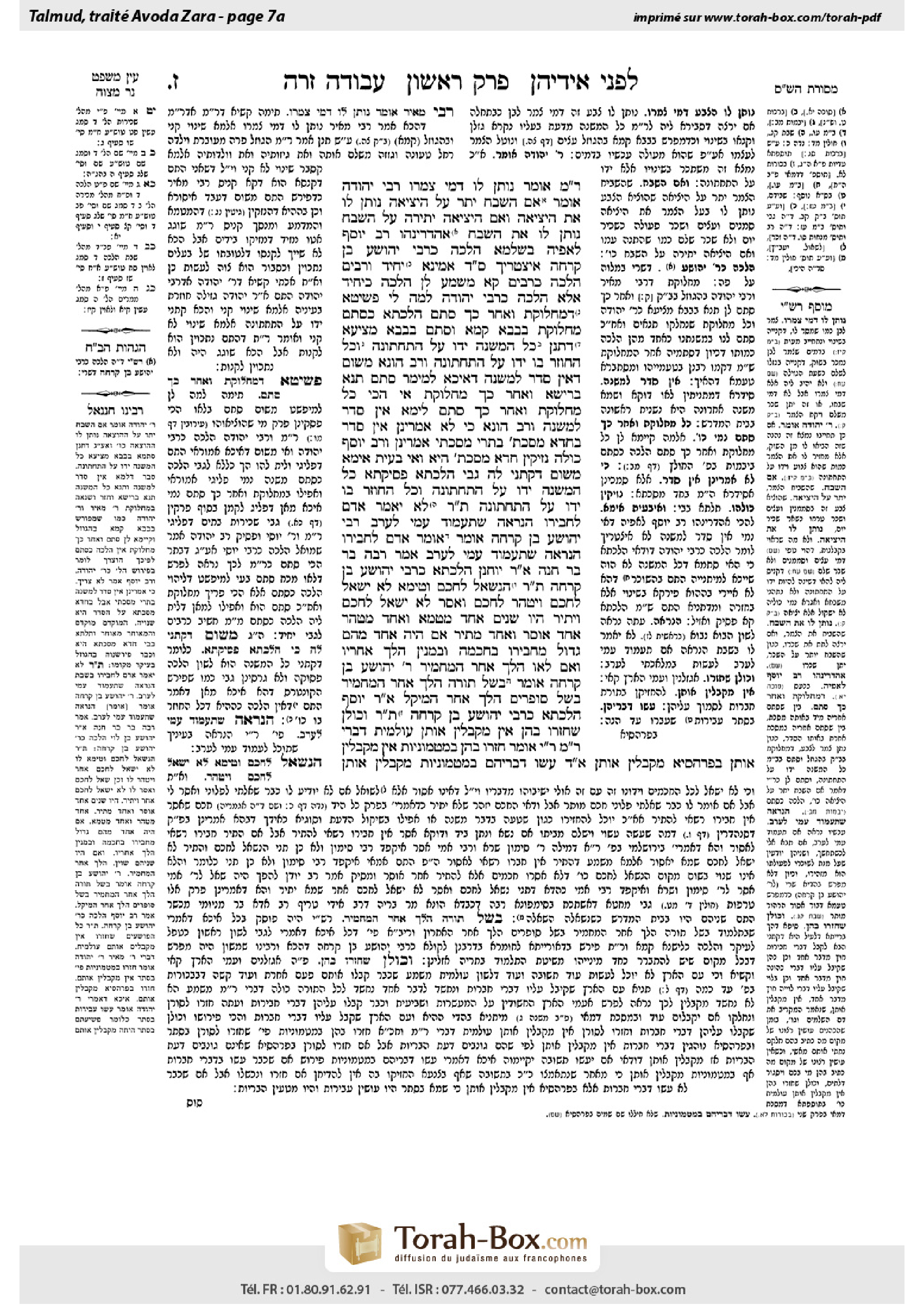
Avodah Zarah 7a: Talmud study for Daf Yomi
Study the Talmud for Daf Yomi with scanned pages, Hebrew text, English translations from Sefaria and AI-generated French translations.
Passage selection and English or AI-generated French translation are available where the scan has annotations. Daf Study is independent of Torah-Box and Sefaria.
Browse Avodah Zarah · עבודה זרה · All tractatesAvodah Zarah 7a text and translations
This page of Avodah Zarah includes the Aramaic text, an English translation and an AI-generated French translation, alongside the scan above.
עבודה זרה ז׳ א · Aramaic and Hebrew text
רַבִּי מֵאִיר אוֹמֵר: נוֹתֵן לוֹ דְּמֵי צַמְרוֹ. רַבִּי יְהוּדָה אוֹמֵר: אִם הַשֶּׁבַח יָתֵר עַל הַיְּצִיאָה — נוֹתֵן לוֹ אֶת הַיְּצִיאָה, וְאִם הַיְּצִיאָה יְתֵירָה עַל הַשֶּׁבַח — נוֹתֵן לוֹ אֶת הַשֶּׁבַח.
אַהְדְּרִינְהוּ רַב יוֹסֵף לְאַפֵּיהּ. בִּשְׁלָמָא הֲלָכָה כְּרַבִּי יְהוֹשֻׁעַ בֶּן קׇרְחָה אִיצְטְרִיךְ, סָלְקָא דַּעְתָּךְ אָמֵינָא: יָחִיד וְרַבִּים הֲלָכָה כְּרַבִּים, קָא מַשְׁמַע לַן הֲלָכָה כְּיָחִיד.
אֶלָּא הֲלָכָה כְּרַבִּי יְהוּדָה לְמָה לִי? פְּשִׁיטָא, דְּמַחְלוֹקֶת וְאַחַר כָּךְ סְתָם — הִלְכְתָא כִּסְתָם.
מַחְלוֹקֶת בְּבָבָא קַמָּא, וּסְתָם בְּבָבָא מְצִיעָא, דִּתְנַן: כׇּל הַמְשַׁנֶּה — יָדוֹ עַל הַתַּחְתּוֹנָה, וְכׇל הַחוֹזֵר בּוֹ — יָדוֹ עַל הַתַּחְתּוֹנָה.
וְרַב הוּנָא? מִשּׁוּם דְּאֵין סֵדֶר לַמִּשְׁנָה, דְּאִיכָּא לְמֵימַר סְתָם תְּנָא בְּרֵישָׁא, וְאַחַר כָּךְ מַחְלוֹקֶת. אִי הָכִי, כֹּל מַחְלוֹקֶת וְאַחַר כָּךְ סְתָם — לֵימָא אֵין סֵדֶר לַמִּשְׁנָה!
וְרַב הוּנָא? כִּי לָא אָמְרִינַן אֵין סֵדֶר — בַּחֲדָא מַסֶּכְתָּא, בִּתְרֵי מַסְּכָתֵי אָמְרִינַן. וְרַב יוֹסֵף: כּוּלָּהּ נְזִיקִין חֲדָא מַסֶּכְתָּא הִיא.
וְאִי בָּעֵית אֵימָא, מִשּׁוּם דְּקָתָנֵי לַהּ גַּבֵּי הִלְכָתָא פְּסִיקָתָא: כׇּל הַמְשַׁנֶּה — יָדוֹ עַל הַתַּחְתּוֹנָה, וְכׇל הַחוֹזֵר בּוֹ — יָדוֹ עַל הַתַּחְתּוֹנָה.
תָּנוּ רַבָּנַן: לֹא יֹאמַר אָדָם לַחֲבֵירוֹ ״הֲנִרְאֶה שֶׁתַּעֲמוֹד עִמִּי לָעֶרֶב״. רַבִּי יְהוֹשֻׁעַ בֶּן קׇרְחָה אוֹמֵר: אוֹמֵר אָדָם לַחֲבֵירוֹ ״הֲנִרְאֶה שֶׁתַּעֲמוֹד עִמִּי לָעֶרֶב״. אָמַר רַבָּה בַּר בַּר חָנָה אָמַר רַבִּי יוֹחָנָן: הִלְכְתָא כְּרַבִּי יְהוֹשֻׁעַ בֶּן קׇרְחָה.
תָּנוּ רַבָּנַן: הַנִּשְׁאָל לְחָכָם וְטִימֵּא — לֹא יִשָּׁאֵל לְחָכָם וִיטַהֵר, לְחָכָם וְאָסַר — לֹא יִשָּׁאֵל לְחָכָם וְיַתִּיר.
הָיוּ שְׁנַיִם, אֶחָד מְטַמֵּא וְאֶחָד מְטַהֵר, אֶחָד אוֹסֵר וְאֶחָד מַתִּיר, אִם הָיָה אֶחָד מֵהֶם גָּדוֹל מֵחֲבֵירוֹ בְּחָכְמָה וּבְמִנְיָן — הַלֵּךְ אַחֲרָיו, וְאִם לָאו — הַלֵּךְ אַחַר הַמַּחְמִיר. רַבִּי יְהוֹשֻׁעַ בֶּן קׇרְחָה אוֹמֵר: בְּשֶׁל תּוֹרָה הַלֵּךְ אַחַר הַמַּחְמִיר, בְּשֶׁל סוֹפְרִים הַלֵּךְ אַחַר הַמֵּיקֵל. אָמַר רַב יוֹסֵף: הִלְכְתָא כְּרַבִּי יְהוֹשֻׁעַ בֶּן קׇרְחָה.
תָּנוּ רַבָּנַן: וְכוּלָּן שֶׁחָזְרוּ בָּהֶן — אֵין מְקַבְּלִין אוֹתָן עוֹלָמִית, דִּבְרֵי רַבִּי מֵאִיר. רַבִּי יְהוּדָה אוֹמֵר: חָזְרוּ בָּהֶן בְּמַטְמוֹנִיּוֹת — אֵין מְקַבְּלִין אוֹתָן, בְּפַרְהֶסְיָא — מְקַבְּלִין אוֹתָן. אִיכָּא דְּאָמְרִי: עָשׂוּ דִּבְרֵיהֶם בְּמַטְמוֹנִיּוֹת — מְקַבְּלִין אוֹתָן,
Avodah Zarah 7a · English translation
Rabbi Meir says: The dyer gives the owner of the wool the value of his wool. Since the dyer deviated from the owner’s wishes, he is considered akin to a robber who acquires the stolen item by changing it. Therefore, like a robber he keeps the changed item and pays the owner its original value. Rabbi Yehuda says: The dyer does not acquire the wool; rather, the owner of the wool must reimburse the dyer for his expenses, without losing out himself. If the value of the enhancement, i.e., the enhanced value of the wool, exceeds the dyer’s expenses, the owner of the wool gives the dyer the expenses. And if the expenses exceed the enhancement, he gives him the value of the enhancement.
Rav Yosef turned his face away to demonstrate his displeasure with Rav Huna’s comment. The Gemara explains why Rav Yosef was unhappy: Granted, his ruling that the halakha is in accordance with the opinion of Rabbi Yehoshua ben Korḥa was necessary, as it might enter your mind to say that because this is a dispute between an individual and the many, the halakha should be in accordance with the opinion of the many, not in accordance with Rabbi Yehoshua ben Korḥa. Rav Huna therefore teaches us that in this case the halakha is in accordance with Rabbi Yehoshua ben Korḥa despite the fact that he is an individual.
But why do I need the statement that the halakha is in accordance with the opinion of Rabbi Yehuda? It is obvious that this is the case, as there is a well-known principle that whenever there is a dispute in a mishna and afterward one opinion is presented as the ruling of an unattributed mishna, i.e., without attribution to a particular Sage or that the ruling is subject to debate, the halakha is in accordance with the opinion presented in the unattributed mishna.
The Gemara adds that here the ruling of the unattributed mishna appears after the dispute, as the dispute between Rabbi Yehuda and Rabbi Meir appears in tractate Bava Kamma, and the unattributed mishna appears in Bava Metzia, which is the next tractate in the order of the Mishna. As we learned in a mishna (Bava Metzia 76a): Whoever changes the terms accepted by both parties is at a disadvantage, and whoever reneges on an agreement is at a disadvantage. This statement is in accordance with the opinion of Rabbi Yehuda, who holds that a craftsman who deviates from his assignment is at a disadvantage, as he receives only the expense or the enhancement, whichever is worth less.
The Gemara asks: And why did Rav Huna feel it necessary to state explicitly that the halakha is in accordance with the opinion of Rabbi Yehuda? It was necessary because Rav Huna holds that the Mishna is not sequential, and therefore it is not clear that the mishna in Bava Kamma precedes the mishna in Bava Metzia. Consequently, it can be said that in fact this is a case of an unattributed mishna that is taught first, and only afterward appears the dispute between Rabbi Yehuda and Rabbi Meir. The Gemara challenges: If that is so, that the Mishna is not sequential, then in every case of a dispute that is afterward followed by an unattributed mishna, let us say that the Mishna is not sequential.
The Gemara explains: And Rav Huna? How would he respond to this claim? He would say: When do we not say that the Mishna is non-sequential? The Mishna is considered sequential when both mishnayot appear in one tractate, but when they are in two different tractates, we do say that the Mishna is not sequential, and it is unclear which one was taught last. Therefore, in this case, as each mishna is found in a different tractate, one in Bava Kamma and the other in Bava Metzia, one cannot say for certain which was taught first. And how would Rav Yosef respond? He would say: All of tractate Nezikin, i.e., Bava Kamma, Bava Metzia, and Bava Batra, is considered one tractate, and therefore its internal order of mishnayot is sequential.
And if you wish, say instead that Rav Yosef maintained that it was not necessary to say that the halakha is in accordance with the opinion of Rabbi Yehuda, because his ruling is taught amid other decided halakhot: Whoever changes the terms accepted by both parties is at a disadvantage, and whoever reneges on an agreement is at a disadvantage, i.e., this statement is unrelated to the subject matter of the chapter in which it appears. Consequently, it is evidently the accepted halakha and therefore Rav Huna’s statement was unnecessary.
§ The Gemara discusses other halakhot that are in accordance with the opinion of Rabbi Yehoshua ben Korḥa. The Sages taught: A person may not say to another on Shabbat: Does it seem that you will join me this evening? This is prohibited, as the speaker is hinting that he would like to hire him for labor after the conclusion of Shabbat. Rabbi Yehoshua ben Korḥa says: A person may say to another on Shabbat: Does it seem that you will join me this evening? In this case, he is not asking him explicitly. Rabba bar bar Ḥana says that Rabbi Yoḥanan says: The halakha is in accordance with the opinion of Rabbi Yehoshua ben Korḥa.
The Sages taught: In the case of one who asks a question of a Sage with regard to an issue of ritual impurity and the Sage rules that the item is impure, he may not ask the same question of another Sage and have him rule that it is pure. Similarly, in the case of one who asks a Sage a halakhic question and he deems it forbidden, he may not ask the question of another Sage and have him deem it permitted.
In a situation where there were two Sages sitting together and one deems an item impure and the other one deems it pure, or if one deems it prohibited and the other one deems it permitted, the questioner should proceed as follows: If one of the Sages was superior to the other in wisdom and in number, one should follow his ruling, and if not, he should follow the one who rules stringently. Rabbi Yehoshua ben Korḥa says: If the uncertainty exists with regard to a Torah law, follow the one who rules stringently; if it exists with regard to a rabbinic law, follow the one who rules leniently. Rav Yosef said: The halakha is in accordance with the opinion of Rabbi Yehoshua ben Korḥa.
The Sages taught: And with regard to all of the people who are not deemed credible due to sins that they performed, even when they retract and repent from their evil ways, society never accepts them; this is the statement of Rabbi Meir. Rabbi Yehuda says: If they retract their ways in private, society does not accept them, but if they repent in public [befarheseya], society accepts them. There are those who say that there is another version of this discussion: If they performed their sinful matters in private, then when they repent society accepts them.
Avodah Zarah 7a · Traduction française (IA)
Le Rabbi Meïr dit : Le teinturier doit donner à l'propriétaire de la laine la valeur de sa laine. Puisque le teinturier s'est écarté des souhaits de l'propriétaire, il est considéré comme un voleur qui acquiert un objet volé en le modifiant. Ainsi, comme un voleur, il garde l'objet modifié et paie à l'propriétaire sa valeur originale. Le Rabbi Yéhuda dit : Le teinturier ne possède pas la laine ; l'propriétaire de la laine doit indemniser le teinturier pour ses dépenses, sans subir de perte. Si la valeur de l'amélioration, c'est-à-dire la valeur augmentée de la laine, excède les dépenses du teinturier, l'propriétaire de la laine donne au teinturier ses dépenses. Et si les dépenses excèdent l'amélioration, il lui donne la valeur de l'amélioration.
Rav Yosef a tourné son visage pour montrer son mécontentement à l'égard du commentaire de Rav Huna. La Guemara explique pourquoi Rav Yosef était mécontent : Cela étant, son jugement que la halakha suit l'opinion du Rabbi Yéhoshua ben Korkha était nécessaire, car il pourrait entrer en vous l'idée que, puisque c'est un désaccord entre un individu et la majorité, la halakha devrait suivre l'opinion de la majorité, pas celle du Rabbi Yéhoshua ben Korkha. Rav Huna enseigne donc que dans ce cas la halakha suit l'opinion du Rabbi Yéhoshua ben Korkha, malgré le fait qu'il soit un individu.
Mais pourquoi ai-je besoin de la déclaration que la halakha suit l'opinion du Rabbi Yéhuda ? C'est évident, car il existe un principe bien connu : chaque fois qu'il y a un désaccord dans une mitsna et que par la suite une opinion est présentée comme la décision d'une mitsna non attribuée, c'est-à-dire sans attribution à un sage particulier ou que la décision est sujette à débat, la halakha suit l'opinion présentée dans la mitsna non attribuée.
La Guemara ajoute que dans ce cas, la décision de la mitsva non attribuée apparaît après le désaccord, car le désaccord entre le Rabbi Yéhuda et le Rabbi Meïr apparaît dans le traité Bava Kamma, et la mitsva non attribuée apparaît dans Bava Métsia, qui est le traité suivant dans l'ordre de la Michna. Comme nous l'avons appris dans une mitsva (Bava Métsia 76a) : Celui qui modifie les termes acceptés par les deux parties est désavantagé, et celui qui rompt un accord est désavantagé. Cette déclaration suit l'opinion du Rabbi Yéhuda, qui considère que le maître qui s'écarte de sa tâche est désavantagé, car il reçoit seulement les dépenses ou l'amélioration, celui qui a la valeur la plus faible.
La Guemara pose la question : Et pourquoi Rav Huna a-t-il jugé nécessaire de déclarer explicitement que la halakha suit l'opinion du Rabbi Yéhuda ? C'était nécessaire car Rav Huna considère que la Michna n'est pas séquentielle, et donc il n'est pas clair que la mitsva de Bava Kamma précède celle de Bava Métsia. Ainsi, on pourrait dire que cette mitsva non attribuée est enseignée en premier, et seulement ensuite apparaît le désaccord entre le Rabbi Yéhuda et le Rabbi Meïr. La Guemara conteste : Si c'est ainsi, que la Michna n'est pas séquentielle, alors dans chaque cas de désaccord suivi d'une mitsva non attribuée, disons que la Michna n'est pas séquentielle.
La Guemara explique : Et Rav Huna ? Comment répondrait-il à cette allégation ? Il dirait : Quand ne disons-nous pas que la Michna n'est pas séquentielle ? La Michna est considérée comme séquentielle lorsque les deux mitsvot apparaissent dans un même traité, mais lorsque elles sont dans deux traités différents, nous disons que la Michna n'est pas séquentielle, et il est incertain quel est celui qui a été enseigné en dernier. Ainsi, dans ce cas, comme chaque mitsva est trouvée dans un traité différent, l'une dans Bava Kamma et l'autre dans Bava Métsia, on ne peut pas dire avec certitude quel a été enseigné en premier. Et comment répondrait Rav Yosef ? Il dirait : Tout le traité de Nezikin, c'est-à-dire Bava Kamma, Bava Métsia et Bava Batra, est considéré comme un seul traité, et donc l'ordre interne des mitsvot est séquentiel.
Et si vous le souhaitez, dites plutôt que Rav Yosef maintenait que ce n'était pas nécessaire de déclarer que la halakha suit l'opinion du Rabbi Yéhuda, car son jugement est enseigné parmi d'autres halakhot décidées : Celui qui modifie les termes acceptés par les deux parties est désavantagé, et celui qui rompt un accord est désavantagé, c'est-à-dire que cette déclaration est indépendante du sujet du chapitre dans lequel elle apparaît. Ainsi, elle est clairement la halakha acceptée et donc le commentaire de Rav Huna était inutile.
§ La Guemara discute d'autres halakhot qui suivent l'opinion du Rabbi Yéhoshua ben Korkha. Les Sages ont enseigné : Une personne ne peut pas dire à un autre le sabbat : Semble-t-il que tu viendras me rejoindre ce soir ? Cela est interdit, car le locuteur suggère qu'il souhaite embaucher l'autre pour un travail après la fin du sabbat. Le Rabbi Yéhoshua ben Korkha dit : Une personne peut dire à un autre le sabbat : Semble-t-il que tu viendras me rejoindre ce soir ? Dans ce cas, il ne le demande pas explicitement. Rabba bar bar Ḥana dit que Rabbi Yoḥanan dit : La halakha suit l'opinion du Rabbi Yéhoshua ben Korkha.
Les Sages ont enseigné : Dans le cas d'une personne qui pose une question à un Sage concernant une impureté rituelle et le Sage déclare que l'objet est impur, il ne peut pas poser la même question à un autre Sage et avoir celui-ci déclarer qu'il est pur. De même, dans le cas d'une personne qui pose une question halakhique à un Sage et celui-ci déclare qu'il est interdit, il ne peut pas poser la question à un autre Sage et avoir celui-ci déclarer qu'il est permis.
Dans un cas où deux Sages étaient assis ensemble et l'un déclare un objet impur et l'autre un objet pur, ou si l'un déclare qu'il est interdit et l'autre qu'il est permis, le questionneur doit agir ainsi : Si l'un des Sages était supérieur à l'autre en sagesse et en nombre, il faut suivre son jugement, et si ce n'est pas le cas, il faut suivre celui qui juge strictement. Le Rabbi Yéhoshua ben Korkha dit : Si l'incertitude concerne une loi de la Torah, suivez celui qui juge strictement ; si elle concerne une loi rabbinique, suivez celui qui juge avec douceur. Rav Yosef a dit : La halakha suit l'opinion du Rabbi Yéhoshua ben Korkha.
Les Sages enseignent : Et concernant toutes les personnes qui ne sont pas considérées comme dignes de confiance en raison des péchés qu'elles ont commis, même lorsqu'elles renoncent et se repentent de leurs mauvaises façons, la société ne les accepte jamais ; c'est la parole de Rabbi Meir. Rabbi Yéhuda dit : Si elles renoncent à leurs mauvaises façons en privé, la société ne les accepte pas, mais si elles se repentent en public [befarheseya], la société les accepte. Il y a ceux qui disent qu'il existe une autre version de cette discussion : Si elles ont accompli leurs mauvaises actions en privé, alors lorsqu'elles se repentent, la société les accepte.
Traduction française générée par IA à partir de l’édition anglaise de Sefaria. Vérifie toujours un passage avec le texte source.
Text from Sefaria: William Davidson Edition - Vocalized Aramaic (CC BY NC); William Davidson Edition - English (CC BY NC).