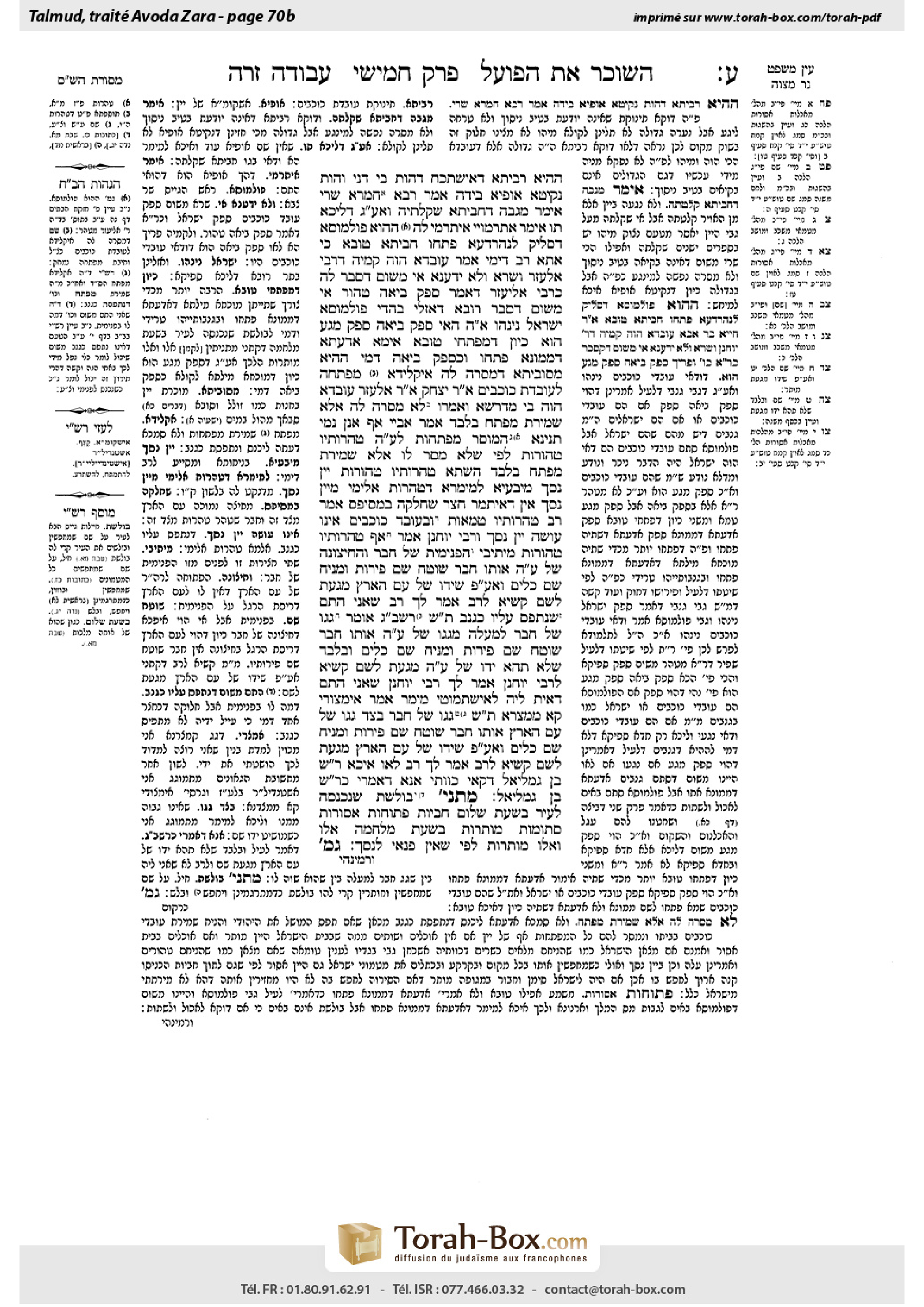
Avodah Zarah 70b: Talmud study for Daf Yomi
Study the Talmud for Daf Yomi with scanned pages, Hebrew text, English translations from Sefaria and AI-generated French translations.
Passage selection and English or AI-generated French translation are available where the scan has annotations. Daf Study is independent of Torah-Box and Sefaria.
Browse Avodah Zarah · עבודה זרה · All tractatesAvodah Zarah 70b text and translations
This page of Avodah Zarah includes the Aramaic text, an English translation and an AI-generated French translation, alongside the scan above.
עבודה זרה ע׳ ב · Aramaic and Hebrew text
הָהִיא רְבִיתָא דְּאִישְׁתְּכַח דַּהֲוָת בֵּי דַנֵּי, וַהֲוָת נְקִיטָא אוּפְיָא בִּידַהּ, אָמַר רָבָא: חַמְרָא שְׁרֵי, אֵימַר מִגַּבַּהּ דְּחָבִיתָא שְׁקַלְתֵּיהּ, וְאַף עַל גַּב דְּלֵיכָּא תּוּ, אֵימַר אִתְרְמוֹיֵי אִתְרְמִי לַהּ.
הָהוּא פּוּלְמוּסָא דִּסְלֵיק לִנְהַרְדְּעָא, פְּתַחוּ חָבְיָתָא טוּבָא. כִּי אֲתָא רַב דִּימִי אָמַר: עוֹבָדָא הֲוָה קַמֵּיהּ דְּרַבִּי אֶלְעָזָר, וּשְׁרָא. וְלָא יָדַעְנָא, אִי מִשּׁוּם דְּסָבַר לַהּ כְּרַבִּי אֱלִיעֶזֶר דְּאָמַר: סְפֵק בִּיאָה טָהוֹר, אִי מִשּׁוּם דְּסָבַר: רוּבָּא דְּאָזְלִי בַּהֲדֵי פּוּלְמוּסָא יִשְׂרָאֵל נִינְהוּ.
אִי הָכִי, הַאי סְפֵק בִּיאָה? סְפֵק מַגָּע הוּא! כֵּיוָן דְּמִפַּתְחִי טוּבָא, אֵימָא אַדַּעְתָּא דְּמָמוֹנָא פְּתַחוּ, וְכִסְפֵק בִּיאָה דָּמֵי.
הָהִיא מָסוֹבִיתָא דִּמְסַרָה לַהּ אִיקְּלִידָא (מַפְתְּחָה) לְגוֹיָה, אָמַר רַבִּי יִצְחָק אָמַר רַבִּי אֶלְעָזָר: עוֹבָדָא הֲוָה בֵּי מִדְרְשָׁא, וַאֲמַרוּ: לֹא מָסְרָה לָהּ אֶלָּא שְׁמִירַת מַפְתֵּחַ בִּלְבָד.
אָמַר אַבָּיֵי: אַף אֲנַן נָמֵי תְּנֵינָא: הַמּוֹסֵר מַפְתְּחוֹת לְעַם הָאָרֶץ — טׇהֳרוֹתָיו טְהוֹרוֹת, לְפִי שֶׁלֹּא מָסַר לוֹ אֶלָּא שְׁמִירַת מַפְתֵּחַ בִּלְבָד. הַשְׁתָּא טׇהֳרוֹתָיו טְהוֹרוֹת, יֵין נֶסֶךְ מִיבַּעְיָא?
לְמֵימְרָא דִּטְהָרוֹת אַלִּימִי מִיֵּין נֶסֶךְ? אִין, דְּאִיתְּמַר: חָצֵר שֶׁחִלְּקָהּ בִּמְסִיפָס, אָמַר רַב: טׇהֳרוֹתָיו טְמֵאוֹת, וּבְגוֹי אֵינוֹ עוֹשֶׂה יֵין נֶסֶךְ, וְרַבִּי יוֹחָנָן אָמַר: אַף טׇהֳרוֹתָיו טְהוֹרוֹת.
מֵיתִיבִי: הַפְּנִימִית שֶׁל חָבֵר וְהַחִיצוֹנָה שֶׁל עַם הָאָרֶץ, אוֹתוֹ חָבֵר שׁוֹטֵחַ שָׁם פֵּירוֹת וּמַנִּיחַ שָׁם כֵּלִים, וְאַף עַל פִּי שֶׁיָּדוֹ שֶׁל עַם הָאָרֶץ מַגַּעַת לְשָׁם. קַשְׁיָא לְרַב!
אָמַר לְךָ רַב: שָׁאנֵי הָתָם, שֶׁנִּתְפָּס עָלָיו כְּגַנָּב.
תָּא שְׁמַע: רַבָּן שִׁמְעוֹן בֶּן גַּמְלִיאֵל אוֹמֵר: גַּגּוֹ שֶׁל חָבֵר לְמַעְלָה מִגַּגּוֹ שֶׁל עַם הָאָרֶץ, אוֹתוֹ חָבֵר שׁוֹטֵחַ שָׁם פֵּירוֹת וּמַנִּיחַ שָׁם כֵּלִים, וּבִלְבַד שֶׁלֹּא תְּהֵא יָדוֹ שֶׁל עַם הָאָרֶץ מַגַּעַת לְשָׁם. קַשְׁיָא לְרַבִּי יוֹחָנָן!
אָמַר לָךְ רַבִּי יוֹחָנָן: שָׁאנֵי הָתָם, דְּאִית לֵיהּ לְאִישְׁתְּמוֹטֵי, מֵימָר אָמַר: אִימְּצוֹרֵי קָא מִמְּצַרְנָא.
תָּא שְׁמַע: גַּגּוֹ שֶׁל חָבֵר בְּצַד גַּגּוֹ שֶׁל עַם הָאָרֶץ, אוֹתוֹ חָבֵר שׁוֹטֵחַ שָׁם פֵּירוֹת וּמַנִּיחַ שָׁם כֵּלִים, וְאַף עַל פִּי שֶׁיָּדוֹ שֶׁל עַם הָאָרֶץ מַגַּעַת לְשָׁם. קַשְׁיָא לְרַב! אָמַר לְךָ רַב: לָאו אִיכָּא רַבִּי שִׁמְעוֹן בֶּן גַּמְלִיאֵל דְּקָאֵי כְּוָותִי? אֲנָא דַּאֲמַרִי כְּרַבִּי שִׁמְעוֹן בֶּן גַּמְלִיאֵל.
מַתְנִי׳ בּוֹלֶשֶׁת שֶׁנִּכְנְסָה לְעִיר, בִּשְׁעַת שָׁלוֹם — חָבִיּוֹת פְּתוּחוֹת אֲסוּרוֹת, סְתוּמוֹת מוּתָּרוֹת; בִּשְׁעַת מִלְחָמָה — אֵלּוּ וְאֵלּוּ מוּתָּרוֹת, לְפִי שֶׁאֵין פְּנַאי לְנַסֵּךְ.
Avodah Zarah 70b · English translation
The Gemara relates: There was an incident involving a certain gentile girl who was found among wine barrels and she was holding wine froth in her hand. Rava said: The wine is permitted, as it is reasonable to say that she took it from the outside of the barrel and not from inside the barrel. And even if there is no more of the froth on the outside of the barrel, it is reasonable to say that she happened upon the froth while it was still there, even though it is no longer there.
The Gemara relates: There was an incident involving a certain army [pulmusa] that entered Neharde’a and opened many barrels of wine. When Rav Dimi came from Eretz Yisrael to Babylonia, he said: There was a similar incident that was brought before Rabbi Elazar, and he deemed the wine permitted. But I do not know whether he permitted it because he holds in accordance with the opinion of Rabbi Eliezer, who says: Concerning uncertainty with regard to entry, the person or item is ritually pure, or whether he permitted it because he maintains that most of those who went with that army were Jews, i.e., that although it was a gentile army, the ancillaries were mostly Jews.
The Gemara asks: If that is so, if he holds in accordance with the opinion of Rabbi Eliezer, why did he permit the wine? Is this a case of uncertainty with regard to entry? It is clear that the ancillaries came and opened the barrels, so it is a case of uncertainty with regard to contact, i.e., whether they touched the wine or not, and Rabbi Eliezer agrees that such a case is treated stringently. The Gemara answers: Since they opened many barrels, it is reasonable to say that they opened the barrels only with the intention of finding money and had no interest in the wine itself. And therefore it is similar to a case of uncertainty with regard to entry.
The Gemara relates: There was an incident involving a certain female owner of a wine shop who transferred the key [iklida] to the door of her wine shop to a gentile woman. Rabbi Yitzḥak said that Rabbi Elazar said: There was a similar incident that was brought before the Sages in the study hall, and they said: She transferred to her the responsibility for safeguarding the key alone but did not authorize her to enter the tavern, so there is no concern that she entered there.
Abaye said: We learn this halakha in a mishna as well (Teharot 7:1): In the case of one who transferred keys to one who is unreliable with regard to ritual impurity [am ha’aretz], even though contact with an am ha’aretz renders pure items impure, his pure items are pure, because he transferred to the am ha’aretz the responsibility for safeguarding the key alone and did not authorize him to enter. Now that the mishna has determined that his pure items are pure, is it necessary to state this principle with regard to the halakhot of wine used for a libation?
The Gemara asks with regard to Abaye’s reasoning: Is this to say that the halakhot of ritually pure items are more stringent than those concerning wine used for a libation? The Gemara answers: Indeed, that is so. As it was stated that there was a dispute with regard to a courtyard whose owners divided it among themselves with a low partition [meseifas]. Rav says: If one’s neighbor on the other side of the partition is an am ha’aretz, one’s pure items that he leaves in the courtyard are rendered impure, but in the case of a gentile neighbor, this does not render his wine an idolatrous libation. And Rabbi Yoḥanan says: His pure items remain pure as well. Evidently, Rav considers the halakhot of purity more stringent than those of wine used for a libation.
The Gemara raises an objection to the opinion of Rav from a baraita: If the inner courtyard belongs to a ḥaver, i.e., one devoted to the meticulous observance of mitzvot, especially the halakhot of ritual purity, teruma, and tithes, and the outer courtyard to an am ha’aretz, that ḥaver may lay out his produce there, in the inner courtyard, and place his vessels there, without concern that the am ha’aretz will touch them and render them impure. And this applies even if the hand of the am ha’aretz can reach there. This poses a difficulty to the opinion of Rav, who holds that even in a situation where there is a partition there is concern about contact with an am ha’aretz.
The Gemara answers that Rav could have said to you: It is different there, as were the am ha’aretz to tamper with the produce, he could be caught and accused as a thief, as he has no business being in the inner courtyard. Therefore, there is no concern that he will tamper with it.
The Gemara suggests: Come and hear support for Rav’s opinion from a baraita (Tosefta, Teharot 9:11): Rabban Shimon ben Gamliel says: If the roof of a ḥaver is above the roof of his neighbor who is an am ha’aretz, that ḥaver may lay out produce there and place vessels there, provided that the hand of the am ha’aretz cannot reach there; but if it is within his reach, the pure items of the ḥaver are rendered impure. This poses a difficulty to the opinion of Rabbi Yoḥanan, who deems permitted pure items in a courtyard divided by a low partition.
The Gemara answers that Rabbi Yoḥanan could have said to you: It is different there, as were the am ha’aretz to be discovered reaching up to the upper roof, he has a way to excuse his behavior by saying: I merely stretched myself; I was not intending to tamper with anything.
Come and hear that which is taught in that same baraita: If the roof of a ḥaver is beside the roof of an am ha’aretz, that ḥaver may lay out produce there and place vessels there, even if the hand of the am ha’aretz can reach there. This poses a difficulty to the statement of Rav. The Gemara answers that Rav could have said to you: Isn’t there the opinion of Rabbi Shimon ben Gamliel, which stands in accordance with my opinion with regard to roofs that are next to one another? What I say is in accordance with the opinion of Rabbi Shimon ben Gamliel.
MISHNA: In the case of a military unit [boleshet] that entered a city, if it entered during peacetime, then after the soldiers leave the open barrels of wine are forbidden, but the sealed barrels are permitted. If the unit entered in wartime, both these barrels and those barrels are permitted, because in wartime there is no time to pour wine for libations, and one can be certain that the soldiers did not do so.
Avodah Zarah 70b · Traduction française (IA)
La Guemara rapporte : Il y avait un incident concernant une jeune fille païenne qui avait été trouvée parmi des barriques de vin et tenait une mousse de vin dans sa main. Rava dit : Le vin est permis, car il est raisonnable de dire qu'elle l'a pris à l'extérieur de la barrique et non à l'intérieur. Et même si il n'y a plus de mousse à l'extérieur de la barrique, il est raisonnable de dire qu'elle a trouvé la mousse alors qu'elle était encore là, même si elle n'y est plus.
La Guemara rapporte : Il y avait un incident concernant une certaine armée [pulmusa] qui est entrée à Neharde’a et a ouvert de nombreuses barriques de vin. Quand Rav Dimi est venu de la Terre d'Israël vers Babylone, il a dit : Il y avait un incident similaire qui a été soumis à Rabbi Elazar, et il a considéré le vin comme permis. Mais je ne sais pas si c'est parce qu'il suivait l'opinion de Rabbi Eliezer, qui dit : En cas d'incertitude concernant l'entrée, la personne ou l'objet est rituellement pur, ou s'il l'a permis parce qu'il considère que la plupart de ceux qui accompagnaient cette armée étaient des Juifs, c'est-à-dire que bien que ce soit une armée païenne, les assistants étaient principalement des Juifs.
La Guemara pose la question : Si c'est ainsi, pourquoi a-t-il permis le vin s'il suivait l'opinion de Rabbi Eliezer ? Est-ce un cas d'incertitude concernant l'entrée ? Il est clair que les assistants sont entrés et ont ouvert les barriques, donc c'est un cas d'incertitude concernant le contact, c'est-à-dire s'ils ont touché le vin ou non, et Rabbi Eliezer considère que ce cas est traité de manière stricte. La Guemara répond : Comme ils ont ouvert de nombreuses barriques, il est raisonnable de dire qu'ils ont ouvert les barriques uniquement avec l'intention de trouver de l'argent et n'avaient pas d'intérêt pour le vin lui-même. Et donc, cela est similaire à un cas d'incertitude concernant l'entrée.
La Guemara rapporte : Il y avait un incident concernant une certaine propriétaire d'un magasin de vin qui a transféré la clé [iklida] de la porte de son magasin de vin à une femme païenne. Rabbi Yitzḥak a dit que Rabbi Elazar a dit : Il y avait un incident similaire qui a été soumis aux Sages dans la salle de étude, et ils ont dit : Elle a transféré à elle seule la responsabilité de garder la clé, mais n'a pas autorisé elle à entrer dans le magasin, donc il n'y a pas de préoccupation qu'elle y soit entrée.
Abaye a dit : Nous apprenons cette halakha également dans une mitsna (Teharot 7:1) : Dans le cas d'une personne qui a transféré des clés à une personne peu fiable concernant la pureté rituelle [am ha’aretz], même si le contact avec un am ha’aretz rend les objets purs impurs, ses objets purs restent purs, car il a transféré à l'am ha’aretz la responsabilité de garder la clé seule et n'a pas autorisé lui à entrer. Maintenant que la mitsna a déterminé que ses objets purs restent purs, est-il nécessaire d'énoncer ce principe concernant les halakhot du vin utilisé pour un libation ?
La Guemara pose la question concernant la raison d'Abaye : Est-ce pour dire que les halakhot des objets rituellement purs sont plus strictes que celles concernant le vin utilisé pour un libation ? La Guemara répond : En effet, c'est ainsi. Comme il a été dit qu'il y avait un débat concernant un jardin dont les propriétaires l'avaient divisé avec une cloison basse [meseifas]. Rav dit : Si le voisin de l'autre côté de la cloison est un am ha’aretz, les objets purs que l'on laisse dans le jardin sont rendus impurs, mais dans le cas d'un voisin païen, cela ne rend pas son vin un libation idolâtre. Et Rabbi Yoḥanan dit : Ses objets purs restent purs également. Évidemment, Rav considère que les halakhot de pureté sont plus strictes que celles du vin utilisé pour un libation.
La Guemara soulève une objection contre l'opinion de Rav, tirée d'une baraïta : Si la cour intérieure appartient à un ḥaver, c'est-à-dire à une personne dévouée à l'observation des mitsvot, surtout les halakhot de pureté rituelle, de terouma et des dîmes, et la cour extérieure à un am ha’aretz, ce ḥaver peut déposer ses produits là, dans la cour intérieure, et placer ses ustensiles là, sans craindre que l'am ha’aretz les touche et les rende impurs. Et cela s'applique même si la main de l'am ha’aretz peut y parvenir. Cela pose un problème pour l'opinion de Rav, qui considère que même dans un cas où il y a une cloison, il y a une crainte concernant le contact avec un am ha’aretz.
La Guemara répond que Rav aurait pu dire à vous : C'est différent là, car si l'am ha’aretz manipulait les produits, il pourrait être attrapé et accusé de vol, car il n'a pas le droit d'être dans la cour intérieure. Donc, il n'y a pas de crainte qu'il les manipule.
La Guemara suggère : Venez entendre un soutien pour l'opinion de Rav tiré d'une baraïta (Tosefta, Teharot 9:11) : Rabban Shimon ben Gamliel dit : Si le toit d'un ḥaver est au-dessus du toit de son voisin qui est un am ha’aretz, ce ḥaver peut déposer ses produits là et placer ses ustensiles là, à condition que la main de l'am ha’aretz ne puisse pas y parvenir ; mais si c'est à portée de main, les objets purs du ḥaver sont rendus impurs. Cela pose un problème pour l'opinion de Rabbi Yoḥanan, qui considère que les objets purs sont permis dans un jardin divisé par une cloison basse.
La Guemara répond que Rabbi Yoḥanan aurait pu dire à vous : C'est différent là, car si l'am ha’aretz est découvert atteignant le toit supérieur, il a un moyen d'excuser son comportement en disant : Je me suis simplement étiré ; je n'avais pas l'intention de manipuler quoi que ce soit.
Venez entendre ce qui est enseigné dans ce même baraïta : Si le toit d'un ḥaver est adjacent à celui d'un am ha’aretz, ce ḥaver peut déposer ses produits là et placer ses ustensiles là, même si la main de l'am ha’aretz peut y parvenir. Cela pose un problème pour l'affirmation de Rav. La Guemara répond que Rav aurait pu dire à vous : N'est-ce pas l'opinion de Rabbi Shimon ben Gamliel, qui correspond à mon opinion concernant les toits qui sont côte à côte ? Ce que je dis est en conformité avec l'opinion de Rabbi Shimon ben Gamliel.
MICHNA : Dans le cas d'une unité militaire [boleshet] qui entre dans une ville, si elle entre pendant la paix, alors après que les soldats quittent la ville, les barriques de vin ouvertes sont interdites, mais les barriques scellées sont permises. Si l'unité entre en temps de guerre, alors ces barriques et celles-ci sont permises, car en temps de guerre il n'y a pas de temps pour verser du vin pour les libations, et on peut être certain que les soldats n'ont pas fait cela.
Traduction française générée par IA à partir de l’édition anglaise de Sefaria. Vérifie toujours un passage avec le texte source.
Text from Sefaria: William Davidson Edition - Vocalized Aramaic (CC BY NC); William Davidson Edition - English (CC BY NC).