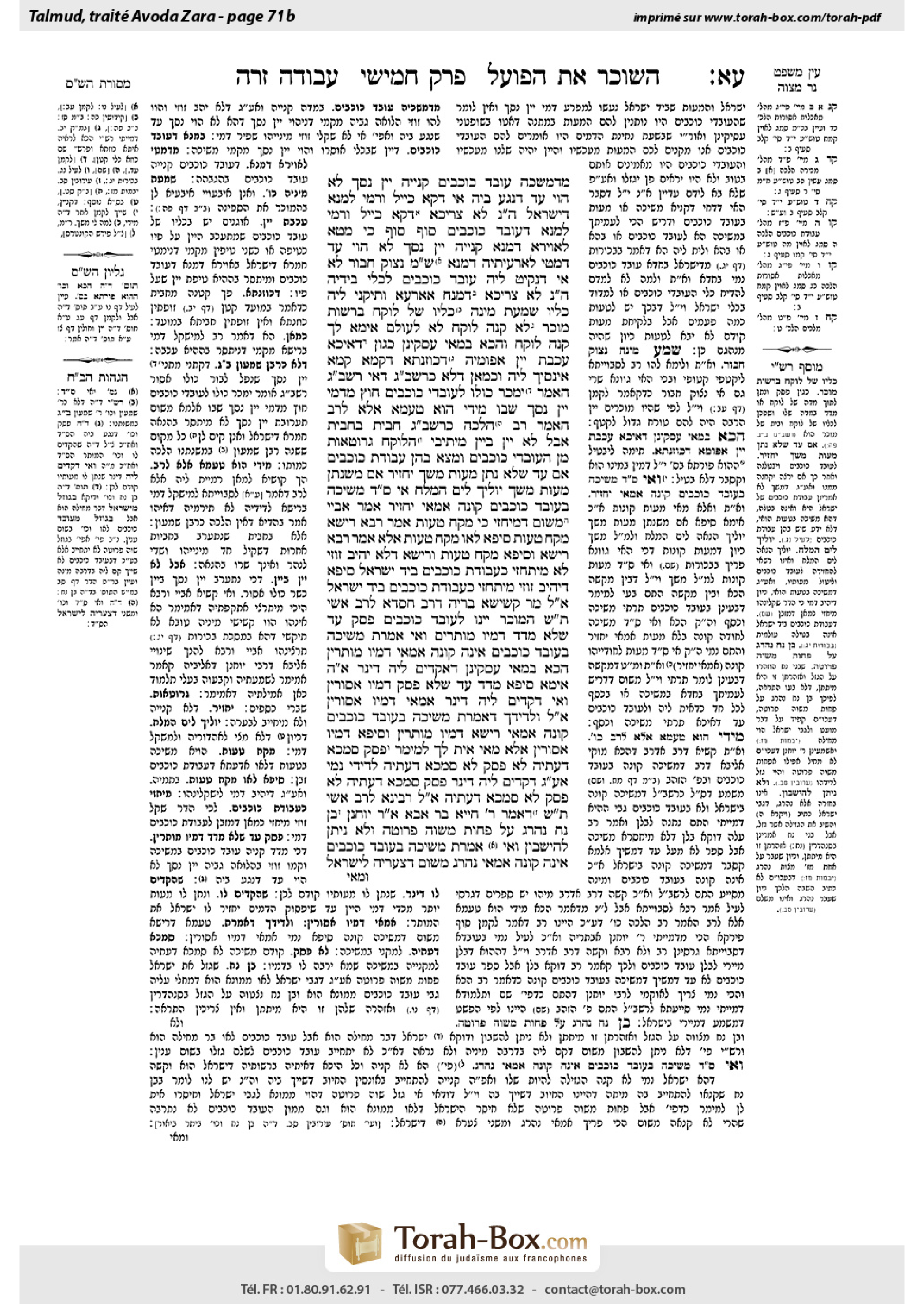
Avodah Zarah 71b: Talmud study for Daf Yomi
Study the Talmud for Daf Yomi with scanned pages, Hebrew text, English translations from Sefaria and AI-generated French translations.
Passage selection and English or AI-generated French translation are available where the scan has annotations. Daf Study is independent of Torah-Box and Sefaria.
Browse Avodah Zarah · עבודה זרה · All tractatesAvodah Zarah 71b text and translations
This page of Avodah Zarah includes the Aramaic text, an English translation and an AI-generated French translation, alongside the scan above.
עבודה זרה ע״א ב · Aramaic and Hebrew text
מִדְּמַשְׁכֵהּ גּוֹי קַנְיֵיהּ, יֵין נֶסֶךְ לָא הָוֵי עַד דְּנָגַע בֵּיהּ!
אִי דְּקָא כָיֵיל וְרָמֵי לְמָנָא דְּיִשְׂרָאֵל, הָכִי נָמֵי. לָא צְרִיכָא דְּקָא כָיֵיל וְרָמֵי לְמָנָא דְּגוֹי.
סוֹף סוֹף, כִּי מְטָא לְאַוֵּירָא דְּמָנָא קַנְיֵיהּ, יֵין נֶסֶךְ לָא הָוֵי עַד דְּמָטֵי לְאַרְעִיתֵיהּ דְּמָנָא, שְׁמַע מִינַּהּ נִצּוֹק חִבּוּר?
לָא, אִי דְּנָקֵיט לֵיהּ גּוֹי לִכְלִי בִּידֵיהּ — הָכִי נָמֵי; לָא צְרִיכָא דְּמַנַּח אַאַרְעָא.
וְתִיקְּנֵי לֵיהּ כִּלְיוֹ! שָׁמְעַתְּ מִינַּהּ: כִּלְיוֹ שֶׁל לוֹקֵחַ בִּרְשׁוּת מוֹכֵר — לֹא קָנָה לוֹקֵחַ.
לָא, לְעוֹלָם אֵימָא לָךְ: קָנָה לוֹקֵחַ, וְהָכָא בְּמַאי עָסְקִינַן? כְּגוֹן דְּאִיכָּא עַכֶּבֶת יַיִן אַפּוּמַּיהּ דְּכוּזַנְתָּא, דְּקַמָּא קַמָּא אִינְּסֵיךְ לֵיהּ.
וּכְמַאן? דְּלָא כְּרַבָּן שִׁמְעוֹן בֶּן גַּמְלִיאֵל, דְּאִי רַבָּן שִׁמְעוֹן בֶּן גַּמְלִיאֵל, הָאָמַר: יִמָּכֵר כּוּלּוֹ לְגוֹיִם חוּץ מִדְּמֵי יֵין נֶסֶךְ שֶׁבּוֹ!
מִידֵּי הוּא טַעְמָא, אֶלָּא לְרַב, הָאָמַר רַב: הֲלָכָה כְּרַבָּן שִׁמְעוֹן בֶּן גַּמְלִיאֵל — חָבִית בְּחָבִית, אֲבָל לֹא יַיִן בְּיַיִן.
מֵיתִיבִי: הַלּוֹקֵחַ גְּרוּטָאוֹת מִן הַגּוֹיִם וּמָצָא בָּהֶן עֲבוֹדָה זָרָה, אִם עַד שֶׁלֹּא נָתַן מָעוֹת מָשַׁךְ — יַחֲזִיר, אִם מִשֶּׁנָּתַן מָעוֹת מָשַׁךְ — יוֹלִיךְ לְיָם הַמֶּלַח. אִי סָלְקָא דַעְתָּךְ מְשִׁיכָה בְּגוֹי קוֹנָה, אַמַּאי יַחְזִיר? אָמַר אַבָּיֵי: מִשּׁוּם דְּמִיחֲזֵי כִּי מִקָּח טָעוּת.
אָמַר רָבָא: רֵישָׁא מִקָּח טָעוּת, סֵיפָא לָאו מִקָּח טָעוּת? אֶלָּא אָמַר רָבָא: רֵישָׁא וְסֵיפָא מִקָּח טָעוּת, וְרֵישָׁא דְּלָא יָהֵיב זוּזֵי — לָא מִיתְחֲזֵי כַּעֲבוֹדָה זָרָה בְּיַד יִשְׂרָאֵל, סֵיפָא דְּיָהֵיב זוּזֵי — מִיתְחֲזֵי כַּעֲבוֹדָה זָרָה בְּיַד יִשְׂרָאֵל.
אֲמַר לֵיהּ מָר קַשִּׁישָׁא בְּרֵיהּ דְּרַב חִסְדָּא לְרַב אָשֵׁי: תָּא שְׁמַע, הַמּוֹכֵר יֵינוֹ לְנׇכְרִי, פָּסַק עַד שֶׁלֹּא מָדַד — דָּמָיו מוּתָּרִים. וְאִי אָמְרַתְּ מְשִׁיכָה בְּגוֹי אֵינָהּ קוֹנָה, אַמַּאי דָּמָיו מוּתָּרִין? הָכָא בְּמַאי עָסְקִינַן — דְּאַקְדֵּים לֵיהּ דִּינָר.
אִי הָכִי, אֵימָא סֵיפָא: מָדַד עַד שֶׁלֹּא פָּסַק — דָּמָיו אֲסוּרִין, וְאִי דְּקָדֵים לֵיהּ דִּינָר, אַמַּאי דָּמָיו אֲסוּרִין?
אֲמַר לֵיהּ: וּלְדִידָךְ דְּאָמְרַתְּ מְשִׁיכָה בְּגוֹי קוֹנָה, אַמַּאי רֵישָׁא דָּמָיו מוּתָּרִין, וְסֵיפָא דָּמָיו אֲסוּרִין?
אֶלָּא מַאי אִית לָךְ לְמֵימַר? פָּסַק — סָמְכָא דַּעְתֵּיהּ; לֹא פָּסַק — לָא סָמְכָא דַּעְתֵּיהּ.
לְדִידִי נָמֵי, אַף עַל גַּב דִּקְדֵים לֵיהּ דִּינָר — פָּסַק, סָמְכָא דַּעְתֵּיהּ; לֹא פָּסַק, לָא סָמְכָא דַּעְתֵּיהּ.
אֲמַר לֵיהּ רָבִינָא לְרַב אָשֵׁי: תָּא שְׁמַע, דְּאָמַר רַבִּי חִיָּיא בַּר אַבָּא אָמַר רַבִּי יוֹחָנָן: בֶּן נֹחַ נֶהֱרָג עַל פָּחוֹת מִשָּׁוֶה פְּרוּטָה, וְלֹא נִיתָּן לְהִישָּׁבוֹן, וְאִי אָמְרַתְּ מְשִׁיכָה בְּגוֹי אֵינָהּ קוֹנָה, אַמַּאי נֶהֱרָג?
מִשּׁוּם דְּצַעֲרֵיהּ לְיִשְׂרָאֵל.
Avodah Zarah 71b · English translation
from the moment that he pulled it, the gentile acquired it, whereas it did not become wine used for a libation until he touched it. Therefore, the seller can receive payment for the wine he sold, because at the time of the acquisition the wine was permitted.
The Gemara rejects this proof: If it is a case where the seller measures the wine and pours it into the vessel of a Jew, it is indeed permitted to do so without receiving payment first. Rav’s ruling is not necessary except in a case where he measures the wine and pours it into the vessel of the gentile, which contains wine used for a libation, and the wine is rendered forbidden upon contact with the vessel even before the gentile acquires it by pulling it.
The Gemara raises an objection: Ultimately, even in this case, when the wine reaches the interior airspace of the gentile’s vessel, he acquires it, as this too is a mode of acquisition. And it does not become wine used for a libation until it reaches the bottom of the vessel, making contact with it, so the acquisition occurs before the wine becomes forbidden. Can one conclude from this that in the opinion of Rav a stream of liquid serves as a connection between two bodies of liquid? If so, when the Jew pours the wine into the gentile’s vessel, the flow of wine that is in contact with the forbidden wine at the bottom of the vessel would render all the wine being poured into the vessel forbidden.
The Gemara rejects this conclusion: No, a stream of liquid does not serve as a connection, and therefore if the gentile is holding the vessel in his hand, the gentile indeed acquires the wine before it becomes forbidden, and therefore the money paid for it is permitted. Rav’s ruling is not necessary unless the gentile’s vessel is set on the ground, so that there is no act of acquisition before the wine becomes forbidden.
The Gemara asks: But let the vessels of the gentile acquire the wine from the moment it enters the interior airspace. Can one conclude from this that if the buyer’s vessels are in the domain of the seller, the buyer does not acquire the merchandise once it is placed in his vessels? This is an issue that is subject to a dispute between the Sages, which remains unresolved.
The Gemara rejects this: No, actually, I could say to you that the buyer acquires the merchandise in such a case. But here, where the wine is rendered forbidden before being acquired by the gentile, we are dealing with a case where there is a remnant of wine remaining on the mouth of the gentile’s jug [kuzanta], which renders the wine poured into the jug forbidden, as each bit of wine becomes libation wine when it comes into contact with the remnant of wine on the mouth as it is poured into the jug. This is why Rav told the wine shopkeepers to take the money before measuring the wine into the gentile’s vessel.
The Gemara raises an objection: And in accordance with whose opinion does Rav say this? It is not in accordance with the opinion of Rabban Shimon ben Gamliel; as, if it were in accordance with the opinion of Rabban Shimon ben Gamliel, doesn’t he say that libation wine that became mixed with other wine may all be sold to gentiles for the monetary value of the entire mixture except for the value of the wine used for a libation that is in the mixture? Accordingly, it is permitted to accept payment for wine that was poured into a gentile’s vessel, and the halakha is in accordance with the opinion of Rabban Shimon ben Gamliel.
The Gemara answers: The explanation of this ruling can be only according to the opinion of Rav, who issued the ruling. And doesn’t Rav say that the halakha is in accordance with the opinion of Rabban Shimon ben Gamliel only in the case of a barrel of permitted wine that became intermingled with another barrel of libation wine, but not in the case of wine that became mixed with other wine in the same barrel? Therefore, explaining Rav’s statement as contradicting the opinion of Rabban Shimon ben Gamliel is not problematic; consequently, it cannot be proven from his statement that a gentile does not acquire an item by pulling it.
The Gemara raises another objection to the statement of Ameimar that a gentile can acquire an object by pulling it. It is taught in a baraita: With regard to one who buys broken vessels made of gold or silver from the gentiles and finds among them an object of idol worship, if he pulled the object of idol worship, thereby performing an act of acquisition, before he gave the money to the gentile, he may return the object of idol worship to the gentile. But if he pulled it after he gave the money to the gentile, he may not return it. Since the idol’s status was not revoked, he must take it and cast it into the Dead Sea. In that case, if it enters your mind that pulling an object acquires it in a transaction with a gentile, as Ameimar maintains, then why may he return the object once he has pulled it, since it is his? Abaye said: He may return it because it appears to be a mistaken transaction, since he clearly did not intend to purchase an object of idol worship.
Rava said: Then why, in the second instance, where he paid the money, may he not return it? Is the purchase in the first clause a mistaken transaction but the purchase in the latter clause not a mistaken transaction? Rather, Rava said: The purchase in the first clause and the purchase in the latter clause are both a mistaken transaction, but in the case presented in the first clause, where he did not pay him the dinars, it does not appear as though there is an object of idol worship in the possession of a Jew, and so he may return it. By contrast, in the latter clause, where he did pay him the dinars, it appears as though there is an object of idol worship in the possession of a Jew, and therefore he must cast away the object rather than return it.
§ The Gemara cites a claim against Rav Ashi’s opinion that a gentile cannot acquire an item by pulling it: Mar Kashisha, son of Rav Ḥisda, said to Rav Ashi: Come and hear an objection to your opinion from the mishna: In the case of a Jew who sells his wine to a gentile, if he fixed a price before he measured the wine into the gentile’s vessel, deriving benefit from the money paid for the wine is permitted, as the wine was acquired by the gentile before he touched it. And if you say that pulling an item does not acquire it in a transaction involving a gentile, why is the money paid for it permitted? Rav Ashi replied: Here we are dealing with a case where the gentile paid him a dinar in advance, before the measuring, thereby acquiring the wine with money.
One of the Sages raised an objection: If that is so, say the last clause: But if the Jew measured the wine into the gentile’s vessel, thereby rendering it forbidden, before he fixed a price, the money paid for the wine is forbidden. And if he paid him a dinar in advance, why should the money paid for it be forbidden?
Rav Ashi said to him: And according to you, as you say that pulling acquires items in a transaction involving a gentile, why in the first clause is the money paid for it permitted, and in the latter clause the money paid for it is forbidden?
Rather, what have you to say to explain the distinction between the two cases? You say that when the Jew fixed a price, the gentile consequently relied on him that the sale would not be canceled, and so the sale was concluded by the pulling. But in a case where he did not fix a price, the gentile did not rely on him that the sale would not be canceled, and therefore the sale was not concluded.
According to my opinion as well, even though the gentile gave him a dinar in advance, if he fixed a price, the gentile relied on him that the sale would not be canceled, and if he did not fix a price, the gentile did not rely on him that the sale would not be canceled.
Ravina said to Rav Ashi: Come and hear another proof against your opinion, as Rabbi Ḥiyya bar Abba says that Rabbi Yoḥanan says: A descendant of Noah, i.e., a gentile, is executed by the court for theft of even less than the value of one peruta; but if he stole less than the value of one peruta from a Jew, it is not subject to restitution, i.e., he is not obligated to return it, as the Jew presumably waived the debt. And if you say that pulling an item does not acquire it in a transaction involving a gentile, why should he be executed? He did not commit a legally significant act by stealing the item, as it remains in the possession of the owner.
The Gemara answers: He is executed because he caused a Jew distress by stealing the item, even though by the halakhot of acquisition the thief did not acquire it.
Avodah Zarah 71b · Traduction française (IA)
Dès que l'homme l'a tiré, l'infidèle l'a acquis, tandis que ce n'est pas devenu vin utilisé pour une libation jusqu'à ce qu'il le touche. Ainsi, le vendeur peut recevoir le paiement pour le vin qu'il a vendu, car au moment de l'acquisition, le vin était permis.
La Guemara rejette cette preuve : Si c'est un cas où le vendeur mesure le vin et le verse dans le récipient d'un Juif, il est effectivement permis de le faire sans recevoir le paiement d'abord. La décision de Rav n'est nécessaire que dans un cas où il mesure le vin et le verse dans le récipient de l'infidèle, qui contient du vin utilisé pour une libation, et le vin devient interdit en contact avec le récipient même avant que l'infidèle ne l'acquière en le tirant.
La Guemara soulève une objection : Finalement, même dans ce cas, lorsque le vin atteint l'espace intérieur du récipient de l'infidèle, il l'acquiert, car cela aussi est un mode d'acquisition. Et ce n'est pas devenu vin utilisé pour une libation jusqu'à ce qu'il atteigne le fond du récipient, en contact avec lui, donc l'acquisition a lieu avant que le vin ne devienne interdit. Peut-on conclure de cela que, selon l'opinion de Rav, un courant de liquide sert de connexion entre deux masses de liquide ? Si oui, lorsque le Juif verse le vin dans le récipient de l'infidèle, le courant de vin en contact avec le vin interdit au fond du récipient rendrait tout le vin versé dans le récipient interdit.
La Guemara rejette cette conclusion : Non, un courant de liquide ne sert pas de connexion, et donc si le gentil tient le récipient en main, le gentil acquiert effectivement le vin avant qu'il ne devienne interdit, et donc le paiement pour ce vin est permis. La décision de Rav n'est nécessaire que si le récipient du gentil est posé sur le sol, de sorte qu'il n'y ait pas d'acte d'acquisition avant que le vin ne devienne interdit.
La Guemara pose une question : Mais si les récipients du gentil acquièrent le vin dès qu'il entre dans l'espace intérieur de l'air, peut-on conclure de cela que si les récipients du acheteur sont dans le domaine du vendeur, l'acheteur ne possède pas le produit une fois qu'il est placé dans ses récipients ? C'est une question soumise à un débat entre les Sages, qui reste sans solution.
La Guemara rejette cela : Non, en réalité, je pourrais dire à vous que l'acheteur acquiert le produit dans ce cas. Mais ici, où le vin devient interdit avant d'être acquis par le gentil, nous sommes dans un cas où il reste un peu de vin sur le bord du récipient du gentil [kuzanta], ce qui rend le vin versé dans le récipient interdit, car chaque goutte de vin devient vin de libation lorsqu'elle entre en contact avec le reste de vin sur le bord en étant versé dans le récipient. C'est pourquoi Rav a dit aux vendeurs de vin de prendre l'argent avant de mesurer le vin dans le récipient du gentil.
La Guemara soulève une objection : Et selon l'opinion de qui Rav dit cela ? Ce n'est pas selon l'opinion de Rabban Shimon ben Gamliel ; car, si c'était selon l'opinion de Rabban Shimon ben Gamliel, ne dit-il pas que le vin de libation qui s'est mélangé à d'autres vins peut être vendu aux idolâtres pour la valeur totale du mélange, sauf la valeur du vin de libation qui est dans le mélange ? Ainsi, il est permis d'accepter le paiement pour le vin versé dans le récipient de l'idolâtre, et la halakha suit l'opinion de Rabban Shimon ben Gamliel.
La Guemara répond : L'explication de cette décision ne peut être que selon l'opinion de Rav, qui a rendu cette décision. Et ne dit-il pas Rav que la halakha suit l'opinion de Rabban Shimon ben Gamliel uniquement dans le cas d'un tonneau de vin permis qui s'est mêlé à un autre tonneau de vin de libation, mais pas dans le cas d'un vin qui s'est mélangé à d'autres vins dans le même tonneau ? Ainsi, expliquer la déclaration de Rav comme contredisant l'opinion de Rabban Shimon ben Gamliel n'est pas problématique ; par conséquent, il ne peut pas être prouvé à partir de sa déclaration que l'idolâtre ne possède pas un objet en tirant.
La Guemara soulève une autre objection contre la déclaration d'Ameimar selon laquelle un non-Juif peut acquérir un objet en le tirant. Il est enseigné dans une baraïta : Concernant celui qui achète des récipients cassés en or ou en argent auprès des non-Juifs et découvre parmi eux un objet d'idolâtrie, si l'objet d'idolâtrie a été tiré, effectuant ainsi un acte d'acquisition, avant de lui donner l'argent, il peut rendre l'objet d'idolâtrie au non-Juif. Mais si l'objet a été tiré après avoir donné l'argent au non-Juif, il ne peut pas le rendre. Puisque le statut de l'idole n'a pas été révoqué, il doit le prendre et le jeter dans la Mer Morte. Dans ce cas, si cela entre dans votre esprit que tirer un objet l'acquiert dans une transaction avec un non-Juif, comme Ameimar le maintient, pourquoi peut-il le rendre une fois qu'il l'a tiré, puisque c'est sien ? Abaye a dit : Il peut le rendre car cela semble être une transaction erronée, car il n'avait clairement pas l'intention d'acheter un objet d'idolâtrie.
Rava a dit : Alors pourquoi, dans le second cas, où il a payé l'argent, ne peut-il pas le rendre ? Est-ce que la transaction du premier cas est une transaction erronée mais celle du second cas ne l'est pas ? Plutôt, Rava a dit : Les transactions du premier cas et du second cas sont toutes deux des transactions erronées, mais dans le cas présenté dans le premier cas, où il n'a pas payé les dinars, cela ne semble pas comme s'il y avait un objet d'idolâtrie dans la possession d'un Juif, et donc il peut le rendre. En revanche, dans le second cas, où il a payé les dinars, cela semble comme s'il y avait un objet d'idolâtrie dans la possession d'un Juif, et donc il doit jeter l'objet plutôt que le rendre.
§ La Guemara cite une critique contre l'opinion de Rav Ashi selon laquelle un non-Juif ne peut acquérir un objet en le tirant : Mar Kashisha, fils de Rav Ḥisda, dit à Rav Ashi : Viens entendre une objection contre ton opinion tirée de la Michna : Dans le cas d'un Juif qui vend son vin à un non-Juif, si il a fixé un prix avant de mesurer le vin dans le récipient du non-Juif, il est permis de tirer profit de l'argent payé pour le vin, car le vin avait été acquis par le non-Juif avant qu'il ne le touche. Et si tu dis que tirer un objet ne permet pas d'acquérir en transaction avec un non-Juif, pourquoi est-il permis de tirer profit de l'argent payé ? Rav Ashi répondit : Ici, nous sommes en présence d'un cas où le non-Juif lui avait payé un dinar à l'avance, avant la mesure, ce qui permettait d'acquérir le vin avec de l'argent.
Un des Sages émit une objection : Si c'est ainsi, dis la dernière phrase : Mais si le Juif avait mesuré le vin dans le récipient du non-Juif, ce qui rendait le vin interdit, avant de fixer un prix, l'argent payé pour le vin est interdit. Et si il avait payé un dinar à l'avance, pourquoi l'argent payé serait-il interdit ?
Rav Ashi dit à lui : Et selon toi, comme tu dis que tirer permet d'acquérir un objet en transaction avec un non-Juif, pourquoi dans la première phrase l'argent payé est-il permis, et dans la seconde phrase l'argent payé est-il interdit ?
Plutôt, que dis-tu pour expliquer la distinction entre les deux cas ? Tu dis que lorsque le Juif a fixé un prix, le non-Juif s'est donc appuyé sur lui pour que la vente ne soit pas annulée, et donc la vente a été conclue par le tirage. Mais dans le cas où il n'avait pas fixé un prix, le non-Juif n'avait pas appuyé sur lui pour que la vente ne soit pas annulée, et donc la vente n'a pas été conclue.
Selon mon opinion également, même si le non-Juif lui avait donné un dinar à l'avance, si il avait fixé un prix, le non-Juif s'était appuyé sur lui pour que la vente ne soit pas annulée, et si il n'avait pas fixé un prix, le non-Juif n'avait pas appuyé sur lui pour que la vente ne soit pas annulée.
Ravina dit à Rav Ashi : Viens entendre une autre preuve contre ton opinion, car Rabbi Ḥiyya bar Abba dit que Rabbi Yoḥanan dit : Un descendant de Noé, c'est-à-dire un non-Juif, est exécuté par la cour pour vol d'un montant inférieur à la valeur d'un peruta ; mais s'il avait volé moins que la valeur d'un peruta à un Juif, cela n'est pas soumis à restitution, c'est-à-dire qu'il n'est pas tenu de le rendre, car le Juif a probablement renoncé à la dette. Et si tu dis que tirer un objet ne permet pas d'acquérir en transaction avec un non-Juif, pourquoi devrait-il être exécuté ? Il n'a pas commis un acte juridiquement significatif en volant l'objet, car il reste en possession du propriétaire.
La Guemara répond : Il est exécuté car il a causé un malheur à un Juif en volant l'objet, même si, selon les halakhot de l'acquisition, le voleur n'a pas acquis l'objet.
Traduction française générée par IA à partir de l’édition anglaise de Sefaria. Vérifie toujours un passage avec le texte source.
Text from Sefaria: William Davidson Edition - Vocalized Aramaic (CC BY NC); William Davidson Edition - English (CC BY NC).