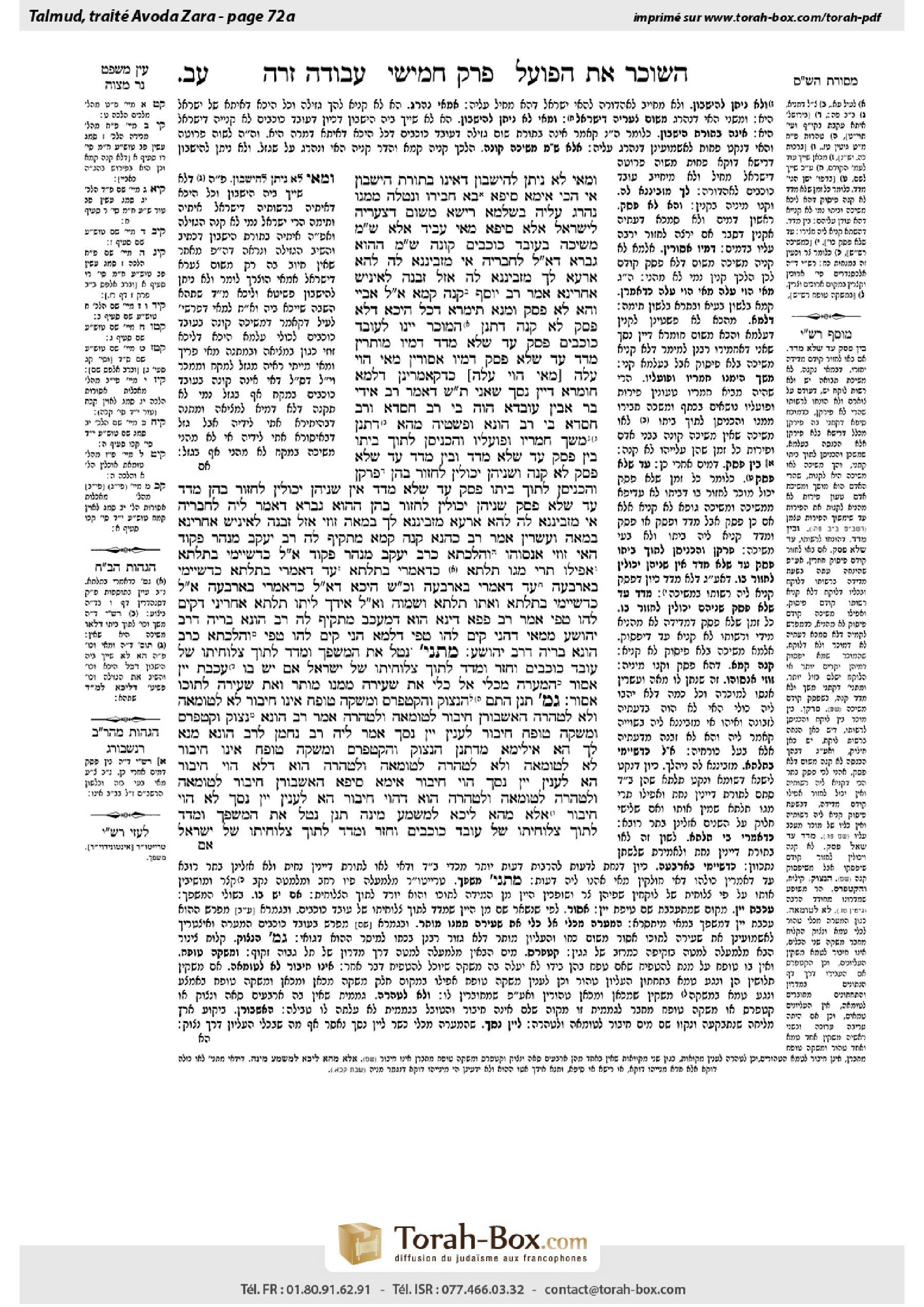
Avodah Zarah 72a: Talmud study for Daf Yomi
Study the Talmud for Daf Yomi with scanned pages, Hebrew text, English translations from Sefaria and AI-generated French translations.
Passage selection and English or AI-generated French translation are available where the scan has annotations. Daf Study is independent of Torah-Box and Sefaria.
Browse Avodah Zarah · עבודה זרה · All tractatesAvodah Zarah 72a text and translations
This page of Avodah Zarah includes the Aramaic text, an English translation and an AI-generated French translation, alongside the scan above.
עבודה זרה ע״ב א · Aramaic and Hebrew text
וּמַאי ״לֹא נִיתַּן לְהִישָּׁבוֹן״? דְּאֵינוֹ בְּתוֹרַת הִישָּׁבוֹן.
אִי הָכִי, אֵימָא סֵיפָא: בָּא חֲבֵירוֹ וּנְטָלָהּ מִמֶּנּוּ — נֶהֱרָג עָלֶיהָ. בִּשְׁלָמָא רֵישָׁא, מִשּׁוּם דְּצַעֲרֵיהּ לְיִשְׂרָאֵל, אֶלָּא סֵיפָא, מַאי עָבֵיד?
אֶלָּא שְׁמַע מִינַּהּ, מְשִׁיכָה בְּגוֹי קוֹנָה, שְׁמַע מִינַּהּ.
הָהוּא גַּבְרָא דַּאֲמַר לֵיהּ לְחַבְרֵיהּ: ״אִי מְזַבֵּינְנָא לַהּ לְהָא אַרְעָא — לָךְ מְזַבֵּינְנָא לַהּ״, אֲזַל זַבְּנַהּ לְאִינִישׁ אַחֲרִינָא, אֲמַר רַב יוֹסֵף: קְנָה קַמָּא.
אֲמַר לֵיהּ אַבָּיֵי: וְהָא לָא פְּסַק! וּמְנָא תֵּימְרָא דְּכֹל הֵיכָא דְּלָא פְּסַק לָא קְנָה? דִּתְנַן: הַמּוֹכֵר יֵינוֹ לְנׇכְרִי, פָּסַק עַד שֶׁלֹּא מָדַד — דָּמָיו מוּתָּרִין, מָדַד עַד שֶׁלֹּא פָּסַק — דָּמָיו אֲסוּרִין.
מַאי הָוֵי עֲלַהּ? מַאי הָוֵי עֲלַהּ?! כִּדְקָאָמְרִינַן! דִּלְמָא חוּמְרָא דְּיֵין נֶסֶךְ שָׁאנֵי.
תָּא שְׁמַע, דְּאָמַר רַב אִידִי בַּר אָבִין: עוֹבָדָא הֲוָה בֵּי רַב חִסְדָּא, וְרַב חִסְדָּא בֵּי רַב הוּנָא, וּפַשְׁטֻיהָ מֵהָא דִּתְנַן: מָשַׁךְ חֲמָרָיו וּפוֹעֲלָיו וְהִכְנִיסָן לְתוֹךְ בֵּיתוֹ, בֵּין פָּסַק עַד שֶׁלֹּא מָדַד וּבֵין מָדַד עַד שֶׁלֹּא פָּסַק — לֹא קָנָה, וּשְׁנֵיהֶן יְכוֹלִין לַחֲזוֹר בָּהֶן.
פֵּרְקָן וְהִכְנִיסָן לְתוֹךְ בֵּיתוֹ, פָּסַק עַד שֶׁלֹּא מָדַד — אֵין שְׁנֵיהֶן יְכוֹלִין לַחֲזוֹר בָּהֶן, מָדַד עַד שֶׁלֹּא פָּסַק — שְׁנֵיהֶן יְכוֹלִין לַחֲזוֹר בָּהֶן.
הָהוּא גַּבְרָא דַּאֲמַר לֵיהּ לְחַבְרֵיהּ: ״אִי מְזַבֵּינְנָא לַהּ לְהָא אַרְעָא — מְזַבֵּינְנָא לָךְ בִּמְאָה זוּזֵי״, אֲזַל זַבְּנַהּ לְאִינִישׁ אַחֲרִינָא בִּמְאָה וְעֶשְׂרִין. אָמַר רַב כָּהֲנָא: קְנָה קַמָּא. מַתְקֵיף לַהּ רַב יַעֲקֹב מִנְּהַר פְּקוֹד: הַאי זוּזֵי אַנְסוּהּ! וְהִלְכְתָא כְּרַב יַעֲקֹב מִנְּהַר פְּקוֹד.
אֲמַר לֵיהּ ״כִּדְשָׁיְימִי בִּתְלָתָא״ — אֲפִילּוּ תְּרֵי מִגּוֹ תְּלָתָא. ״כִּדְאָמְרִי בִּתְלָתָא״ — עַד דְּאָמְרִי בִּתְלָתָא. ״כִּדְשָׁיְימִי בְּאַרְבְּעָה״ — עַד דְּאָמְרִי בְּאַרְבָּעָה, וְכׇל שֶׁכֵּן הֵיכָא דַּאֲמַר לֵיהּ ״כִּדְאָמְרִי בְּאַרְבָּעָה״.
אֲמַר לֵיהּ: ״כִּדְשָׁיְימִי בִּתְלָתָא״, וַאֲתוֹ תְּלָתָא וְשָׁמוּהָ, וַאֲמַר לֵיהּ אִידַּךְ: לֵיתוֹ תְּלָתָא אַחֲרִינֵי דְּקִים לְהוּ טְפֵי! אָמַר רַב פָּפָּא: דִּינָא הוּא דִּמְעַכֵּב. מַתְקֵיף לַהּ רַב הוּנָא בְּרֵיהּ דְּרַב יְהוֹשֻׁעַ: מִמַּאי דְּהָנֵי קִים לְהוּ טְפֵי? דִּלְמָא הָנֵי קִים לְהוּ טְפֵי! וְהִלְכְתָא כְּרַב הוּנָא בְּרֵיהּ דְּרַב יְהוֹשֻׁעַ.
מַתְנִי׳ נָטַל אֶת הַמַּשְׁפֵּךְ וּמָדַד לְתוֹךְ צְלוֹחִיתוֹ שֶׁל נׇכְרִי, וְחָזַר וּמָדַד לְתוֹךְ צְלוֹחִיתוֹ שֶׁל יִשְׂרָאֵל, אִם יֵשׁ בּוֹ עַכֶּבֶת יַיִן — אָסוּר. הַמְעָרֶה מִכְּלִי אֶל כְּלִי, אֶת שֶׁעֵירָה מִמֶּנּוּ — מוּתָּר, וְאֶת שֶׁעֵירָה לְתוֹכוֹ — אָסוּר.
גְּמָ׳ תְּנַן הָתָם: הַנִּצּוֹק, וְהַקָּטַפְרֵס, וּמַשְׁקֶה טוֹפֵחַ — אֵינוֹ חִיבּוּר, לֹא לְטוּמְאָה וְלֹא לְטׇהֳרָה. הָאַשְׁבּוֹרֶן — חִיבּוּר לְטוּמְאָה וּלְטׇהֳרָה.
אָמַר רַב הוּנָא: נִצּוֹק וְקָטַפְרֵס וּמַשְׁקֶה טוֹפֵחַ חִיבּוּר לְעִנְיַן יֵין נֶסֶךְ.
אֲמַר לֵיהּ רַב נַחְמָן לְרַב הוּנָא: מְנָא לָךְ הָא? אִילֵּימָא מִדִּתְנַן: הַנִּצּוֹק וְהַקָּטַפְרֵס וּמַשְׁקֶה טוֹפֵחַ אֵינוֹ חִיבּוּר לֹא לְטוּמְאָה וְלֹא לְטׇהֳרָה, לְטוּמְאָה וּלְטׇהֳרָה הוּא דְּלָא הָוֵי חִיבּוּר, הָא לְעִנְיַן יֵין נֶסֶךְ הָוֵי חִיבּוּר — אֵימָא סֵיפָא: הָאַשְׁבּוֹרֶן חִיבּוּר לְטוּמְאָה וּלְטׇהֳרָה, לְטוּמְאָה וּלְטׇהֳרָה הוּא דְּהָוֵי חִיבּוּר, הָא לְעִנְיַן יֵין נֶסֶךְ לָא הָוֵי חִיבּוּר. אֶלָּא מֵהָא לֵיכָּא לְמִשְׁמַע מִינַּהּ.
תְּנַן: נָטַל אֶת הַמַּשְׁפֵּךְ וּמָדַד לְתוֹךְ צְלוֹחִיתוֹ שֶׁל נׇכְרִי, וְחָזַר וּמָדַד לְתוֹךְ צְלוֹחִיתוֹ שֶׁל יִשְׂרָאֵל.
Avodah Zarah 72a · English translation
And what does it mean that the stolen object is not subject to restitution? It means that it is not subject to the halakhot of restitution, because it is not technically a theft.
The Gemara asks: If that is so, say the latter clause of that halakhic statement: If another descendant of Noah came and took the stolen item from him, he is also executed for it. Granted, with regard to the first clause it can be explained that although there is no obligation to return the item, the gentile is executed because he caused the Jew distress; but with regard to the latter clause, what did he do? He did not cause the Jew distress, and since the item is worth less than one peruta, one is not obligated to return it unless he stole it from a gentile. Consequently, the second theft should not be considered a legally significant act.
Rather, should one not conclude from it that one pulling an item acquires it in a transaction performed by a gentile? Accordingly, the actions of both the first and second gentiles are legally significant acts of theft, for which they are liable to be executed. The Gemara affirms: Conclude from it that this is so.
§ The Gemara relates: There was an incident involving a certain man who said to another: If I sell this land, I will sell it to you, and they performed a formal act of acquisition to ratify the agreement. He went and sold it to another person. Rav Yosef said: The first one has acquired it.
Abaye said to him: But he did not fix a price with him for it. And from where do you say that wherever the people involved in the transaction did not fix a price, the buyer has not acquired the item, even if they performed a formal act of acquisition? It is from that which we learned in the mishna: In the case of a Jew who sells his wine to a gentile, if he fixed a price before he measured the wine into the gentile’s vessel, deriving benefit from the money paid for the wine is permitted. But if the Jew measured the wine into the gentile’s vessel, thereby rendering it forbidden, before he fixed a price, the money paid for the wine is forbidden.
The Gemara asks: What halakhic conclusion was reached about this matter? The Gemara interjects: What is meant by the question: What halakhic conclusion was reached about this matter? The conclusion is as we have stated, that it is evident from the mishna that the acquisition goes into effect only after the price is fixed. The Gemara explains its question: Perhaps due to the stringency of the prohibition of wine used for a libation, the case of the mishna is different and is not characteristic of the halakha in monetary matters.
The Gemara suggests: Come and hear a proof that an acquisition goes into effect only after the price is fixed, as Rav Idi bar Avin said: There was an incident that came before the school of Rav Ḥisda, and Rav Ḥisda brought it before the school of Rav Huna, and Rav Huna resolved it from that which we learned in a baraita: If one bought from another produce that was loaded on the seller’s donkeys or carried by his laborers, and the purchaser drew the seller’s donkey drivers or laborers laden with produce and brought them into his house, in this case, whether the seller fixed a price before he measured the produce or whether he measured the produce before he fixed a price, the purchaser has not acquired the produce, and both of them, the purchaser or the seller, can retract the transaction, as no act of acquisition took place.
The baraita continues: But if the purchaser unloaded the produce and brought it into his house, this constitutes an act of acquisition, and therefore if he fixed a price before he measured the produce, neither of them can retract, but if he measured the produce before he fixed a price, both of them can retract. This illustrates that even if there was an act of acquisition, they can retract the transaction until the price has been fixed, in accordance with the statement of Abaye.
§ There was a related incident involving a certain man who said to another: If I will desire to sell this land, I will sell it to you for one hundred dinars, and they performed an act of acquisition to ratify the agreement. He went and sold it to another person for one hundred and twenty dinars. Rav Kahana said: The first one has acquired it. Rav Ya’akov of Nehar Pekod objects to this: Those twenty additional dinars compelled him to sell it to the second purchaser. The Gemara concludes: And the halakha is in accordance with the opinion of Rav Ya’akov of Nehar Pekod.
§ If the seller said to the purchaser: I will sell you this merchandise as it is assessed by three people, even if two out of the three agreed to a certain assessment, the seller must accept this price. If he said: I will sell you this merchandise in accordance with the price that is stated by three people, he is not held to their assessment unless it is stated by all three. If he said: As it is assessed by four people, he is not held to their assessment unless it is stated by all four; and all the more so in a case where he said to him: In accordance with the price that is stated by four people.
If the seller said to the buyer: I will sell you this merchandise as it is assessed by three people, and three people came and assessed it, and the other one, the purchaser, said: Let three other people, who are more proficient in their assessment, come and assess the merchandise, Rav Pappa said: The halakha is that he can prevent the price from being set until more proficient people assess the merchandise. Rav Huna, son of Rav Yehoshua, objects to this: From where can he know that those other three are more proficient in their assessment? Perhaps these, the first three, are more proficient. The Gemara concludes: And the halakha is in accordance with the opinion of Rav Huna, son of Rav Yehoshua.
MISHNA: In a case where a Jew took a funnel and measured wine into a gentile’s jug, and then measured wine with the same funnel into a Jew’s jug, if there is a remnant of wine left in the funnel, the wine measured into the Jew’s jug is forbidden, as some of the wine that was measured into the gentile’s jug is mixed in it. In the case of one who pours wine from one vessel into another vessel, the wine left in the vessel from which he poured is permitted, but the wine in the vessel into which he poured is forbidden.
GEMARA: We learned in a mishna elsewhere (Teharot 8:9): A stream of water, and water descending an incline [vehakatafres], and liquid that rendered an item moist do not constitute a connection between liquids, neither with regard to ritual impurity nor with regard to purity. These liquids do not constitute a connection that transmits impurity, e.g., if impure water is in one place and becomes attached to water above it, the water above is not considered attached to the impure water and is not rendered impure. They also do not constitute a connection for purification, e.g., if two collections of water are attached via the pouring of a stream, they do not join together to form the amount of water necessary to form a valid ritual bath, through which people and items can become ritually pure. A pond constitutes a connection between liquids with regard to impurity and with regard to purity.
Rav Huna says: A stream of water, and water descending an incline, and liquid that rendered an item moist constitute a connection with regard to the matter of wine used for a libation.
Rav Naḥman said to Rav Huna: From where do you derive this? If we say it is derived from that which we learned in the mishna: A stream, and water descending an incline, and liquid that rendered an item moist do not constitute a connection between liquids, neither with regard to ritual impurity nor with regard to purity, and it is inferred that it is with regard to impurity and with regard to purity that it does not constitute a connection, but with regard to wine used for a libation it does constitute a connection, then say the latter clause: A pond constitutes a connection between liquids with regard to impurity and with regard to purity. It can be inferred from here that with regard to impurity and with regard to purity it is a connection, but with regard to wine used for a libation it is not a connection, contrary to the halakha inferred from the former clause. Rather, clearly no inference is to be learned from this mishna.
The Gemara attempts to bring proof for Rav Huna’s opinion from that which we learned in the mishna here: In a case where a Jew took a funnel and measured wine into a gentile’s jug, and then measured wine with the same funnel into a Jew’s jug,
Avodah Zarah 72a · Traduction française (IA)
Et que signifie-t-il que l'objet volé n'est pas soumis à la restitution ? Cela signifie qu'il n'est pas soumis aux halakhot de la restitution, car il n'est pas techniquement un vol.
La Guemara pose la question : Si c'est ainsi, disons la seconde partie de cette déclaration halakhique : Si un autre descendant de Noé est venu et a pris l'objet volé de lui, il est également exécuté pour cela. Cela étant dit, concernant la première partie, on peut expliquer que bien qu'il n'y ait pas d'obligation de rendre l'objet, le gentil est exécuté car il a causé au Juif une détresse ; mais concernant la seconde partie, que fait-il ? Il n'a pas causé de détresse au Juif, et puisque l'objet vaut moins d'un peruta, on n'est pas tenu de le rendre à moins qu'il ne soit volé à un gentil. Ainsi, le second vol ne devrait pas être considéré comme un acte juridiquement significatif.
Plutôt, ne devrait-on pas conclure de cela que tirer un objet acquiert cet objet dans une transaction effectuée par un gentil ? Ainsi, les actions des deux gentils, le premier et le second, sont des actes juridiquement significatifs de vol, pour lesquels ils sont réputés coupables d'être exécutés. La Guemara affirme : Concluez-en ainsi.
§ La Guemara relate : Il y avait un incident concernant un certain homme qui dit à un autre : Si je vends cette terre, je la vends à toi, et ils ont accompli une formalité d'acquisition pour valider l'accord. Il est allé et l'a vendu à une autre personne. Rav Yosef a dit : Le premier l'a acquis.
Abaye a dit à lui : Mais il n'a pas fixé un prix avec lui. Et d'où dis-tu que partout où les personnes impliquées dans la transaction n'ont pas fixé un prix, l'acheteur n'a pas acquis l'objet, même s'ils ont accompli une formalité d'acquisition ? C'est d'après ce que nous avons appris dans la michna : Dans le cas d'un Juif qui vend son vin à un gentil, si il a fixé un prix avant de mesurer le vin dans le récipient du gentil, il est permis de tirer profit de l'argent payé pour le vin. Mais si le Juif a mesuré le vin dans le récipient du gentil, rendant ainsi le vin interdit, avant de fixer un prix, l'argent payé pour le vin est interdit.
La Guemara pose la question : Quelle conclusion halakhique a-t-on tirée de cela ? La Guemara interrompt : Que signifie la question : Quelle conclusion halakhique a-t-on tirée de cela ? La conclusion est celle que nous avons évoquée, à savoir que c'est évident à partir de la michna que l'acquisition n'entre en vigueur qu'après que le prix ait été fixé. La Guemara explique sa question : Peut-être en raison de la stricte interdiction du vin utilisé pour une libation, le cas de la michna est différent et n'est pas représentatif de la halakha dans les affaires monétaires.
La Guemara suggère : Viens écouter une preuve que l'acquisition n'entre en vigueur qu'après que le prix ait été fixé, comme Rav Idi bar Avin a dit : Il y avait un incident qui s'était produit avant la maison de Rav Ḥisda, et Rav Ḥisda l'a rapporté devant la maison de Rav Huna, et Rav Huna l'a résolu à partir de ce que nous avons appris dans une baraïta : Si l'un achète à un autre des produits chargés sur les ânes du vendeur ou portés par ses ouvriers, et l'acheteur fait descendre les conducteurs d'ânes ou les ouvriers du vendeur chargés de produits et les amène chez lui, dans ce cas, que le vendeur ait fixé un prix avant de mesurer les produits ou que le vendeur ait mesuré les produits avant de fixer un prix, l'acheteur n'a pas acquis les produits, et les deux, l'acheteur ou le vendeur, peuvent révoquer la transaction, car il n'y a eu aucune formalité d'acquisition.
La baraïta continue : Mais si l'acheteur décharge les produits et les amène chez lui, cela constitue une formalité d'acquisition, et donc si le vendeur a fixé un prix avant de mesurer les produits, aucun des deux ne peut révoquer, mais si le vendeur a mesuré les produits avant de fixer un prix, les deux peuvent révoquer. Cela illustre que même s'il y avait une formalité d'acquisition, ils peuvent révoquer la transaction jusqu'à ce que le prix ait été fixé, conformément à l'affirmation d'Abaye.
§ Il y avait un incident lié à un certain homme qui a dit à un autre : Si je désire vendre cette terre, je la vends à toi pour cent dinars, et ils ont effectué une formalité d'acquisition pour valider l'accord. Il est allé et l'a vendu à une autre personne pour cent vingt dinars. Rav Kahana a dit : Le premier l'a acquis. Rav Ya'akov de Nehar Pekod s'oppose à cela : Ces vingt dinars supplémentaires l'ont poussé à vendre à l'acheteur second. La Guemara conclut : Et la halakha est selon l'opinion de Rav Ya'akov de Nehar Pekod.
§ Si le vendeur dit à l'acheteur : Je te vends ce bien selon l'évaluation de trois personnes, même si deux des trois ont convenu d'une certaine évaluation, le vendeur doit accepter ce prix. Si il dit : Je te vends ce bien selon le prix déclaré par trois personnes, il n'est pas tenu de respecter leur évaluation à moins qu'elle ne soit déclarée par tous les trois. Si il dit : Selon l'évaluation de quatre personnes, il n'est pas tenu de respecter leur évaluation à moins qu'elle ne soit déclarée par tous les quatre ; et encore plus dans le cas où il dit à lui : Selon le prix déclaré par quatre personnes.
Si le vendeur a dit à l'acheteur : Je te vends ce bien selon l'évaluation de trois personnes, et trois personnes sont venues et ont évalué ce bien, et l'autre, l'acheteur, a dit : Faisons venir trois autres personnes, plus compétents dans leur évaluation, pour évaluer ce bien, Rav Pappa a dit : La halakha est que l'on peut empêcher la fixation du prix jusqu'à ce que des personnes plus compétentes évaluent ce bien. Rav Huna, fils de Rav Yehoshua, s'oppose à cela : D'où sait-il que ces autres trois sont plus compétents dans leur évaluation ? Peut-être ces premiers trois sont plus compétents. La Guemara conclut : Et la halakha est selon l'opinion de Rav Huna, fils de Rav Yehoshua.
MICHNA : Dans un cas où un Juif utilise un tuyau pour mesurer du vin dans un tonneau d’un non-Juif, puis mesure du vin avec le même tuyau dans un tonneau d’un Juif, si du vin reste dans le tuyau, le vin mesuré dans le tonneau du Juif est interdit, car une partie du vin mesuré dans le tonneau du non-Juif est mélangé à celui-ci. Dans le cas où l'on verse du vin d'un récipient dans un autre récipient, le vin restant dans le récipient d'où l'on a versé est permis, mais le vin dans le récipient dans lequel on a versé est interdit.
GUEMARA : Nous avons appris dans une mitsva ailleurs (Téharot 8:9) : Un courant d'eau, et l'eau descendant une pente, et une liqueur qui a rendu un objet humide ne constituent pas un lien entre liquides, ni en ce qui concerne l'impureté rituelle ni en ce qui concerne la pureté. Ces liquides ne constituent pas un lien qui transmet l'impureté, par exemple, si de l'eau impure est dans un lieu et s'attache à de l'eau au-dessus d'elle, l'eau au-dessus n'est pas considérée comme attachée à l'eau impure et n'est pas rendue impure. Ils ne constituent pas non plus un lien pour la purification, par exemple, si deux collections d'eau sont attachées par le courant d'un ruisseau, elles ne forment pas ensemble la quantité d'eau nécessaire pour former un bain rituel valide, par lequel les personnes et les objets peuvent devenir purement rituellement. Un étang constitue un lien entre liquides en ce qui concerne l'impureté et la pureté.
Rav Huna dit : Un courant d'eau, et l'eau descendant une pente, et une liqueur qui a rendu un objet humide constituent un lien en ce qui concerne l'usage du vin pour un libation.
Rav Naḥman a dit à Rav Huna : D'où tirez-vous cela ? Si nous disons qu'il est tiré de ce que nous avons appris dans la mitsna : Un courant d'eau, et l'eau descendant une pente, et une liqueur qui a rendu un objet humide ne constituent pas un lien entre liquides, ni en ce qui concerne l'impureté rituelle ni en ce qui concerne la pureté, et on en déduit qu'il s'agit de l'impureté et de la pureté que cela ne constitue pas un lien, mais en ce qui concerne l'usage du vin pour un libation, cela constitue un lien, alors dites la clause suivante : Un étang constitue un lien entre liquides en ce qui concerne l'impureté et la pureté. On peut en déduire ici que, en ce qui concerne l'impureté et la pureté, cela constitue un lien, mais en ce qui concerne l'usage du vin pour un libation, cela ne constitue pas un lien, contrairement à la halakha déduite de la clause précédente. Plutôt, il est clair que aucune déduction ne peut être tirée de cette mitsna.
La Guemara tente de rapporter une preuve en faveur de l'opinion de Rav Huna à partir de ce que nous avons appris dans la mitsna ici : Dans un cas où un Juif utilise un tuyau pour mesurer du vin dans un tonneau d'un non-Juif, puis mesure du vin avec le même tuyau dans un tonneau d'un Juif,
Traduction française générée par IA à partir de l’édition anglaise de Sefaria. Vérifie toujours un passage avec le texte source.
Text from Sefaria: William Davidson Edition - Vocalized Aramaic (CC BY NC); William Davidson Edition - English (CC BY NC).