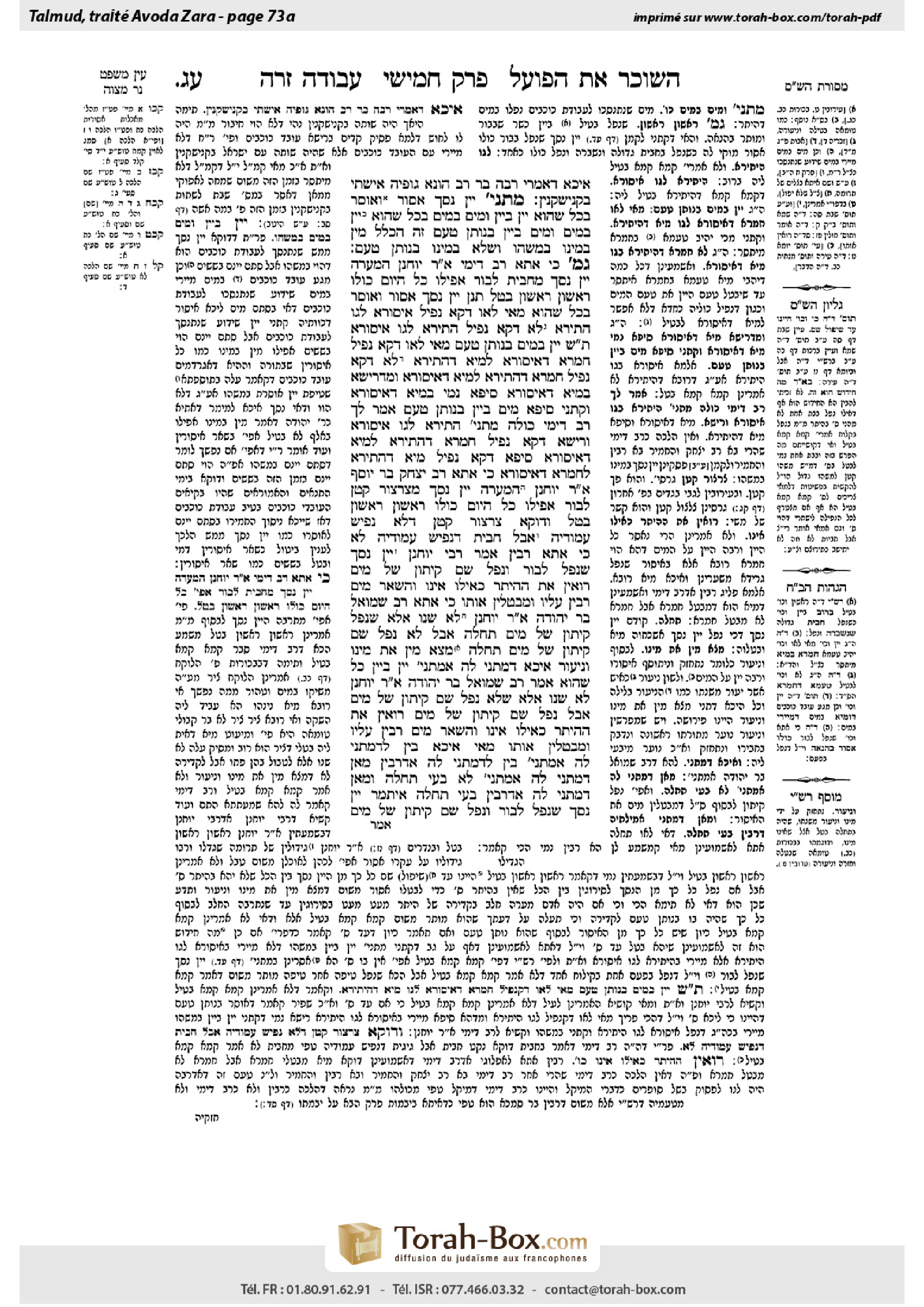
Avodah Zarah 73a: Talmud study for Daf Yomi
Study the Talmud for Daf Yomi with scanned pages, Hebrew text, English translations from Sefaria and AI-generated French translations.
Passage selection and English or AI-generated French translation are available where the scan has annotations. Daf Study is independent of Torah-Box and Sefaria.
Browse Avodah Zarah · עבודה זרה · All tractatesAvodah Zarah 73a text and translations
This page of Avodah Zarah includes the Aramaic text, an English translation and an AI-generated French translation, alongside the scan above.
עבודה זרה ע״ג א · Aramaic and Hebrew text
אִיכָּא דְּאָמְרִי: רַבָּה בַּר רַב הוּנָא גּוּפֵיהּ אִישְׁתִּי בִּקְנִישְׁקְנִין.
מַתְנִי׳ יֵין נֶסֶךְ אָסוּר וְאוֹסֵר בְּכׇל שֶׁהוּא, יַיִן בְּיַיִן וּמַיִם בְּמַיִם בְּכׇל שֶׁהוּא, יַיִן בְּמַיִם וּמַיִם בְּיַיִן בְּנוֹתֵן טַעַם.
זֶה הַכְּלָל: מִין בְּמִינוֹ — בְּמַשֶּׁהוּ, וְשֶׁלֹּא בְּמִינוֹ — בְּנוֹתֵן טַעַם.
גְּמָ׳ כִּי אֲתָא רַב דִּימִי אָמַר רַבִּי יוֹחָנָן: הַמְעָרֶה יֵין נֶסֶךְ מֵחָבִית לַבּוֹר, אֲפִילּוּ כׇּל הַיּוֹם כּוּלּוֹ — רִאשׁוֹן רִאשׁוֹן בָּטֵל.
תְּנַן: יֵין נֶסֶךְ אָסוּר וְאוֹסֵר בְּכׇל שֶׁהוּא. מַאי לָאו דְּקָא נָפֵיל אִיסּוּרָא לְגוֹ הֶתֵּירָא? לָא, דְּקָא נָפֵיל הֶתֵּירָא לְגוֹ אִיסּוּרָא.
תָּא שְׁמַע: יַיִן בְּמַיִם — בְּנוֹתֵן טַעַם. מַאי לָאו דְּקָא נָפֵיל חַמְרָא דְּאִיסּוּרָא לְמַיָּא דְּהֶתֵּירָא? לָא, דְּקָא נָפֵיל חַמְרָא דְּהֶתֵּירָא לְמַיָּא דְּאִיסּוּרָא.
וּמִדְּרֵישָׁא בְּמַיָּא דְּאִיסּוּרָא, סֵיפָא נָמֵי בְּמַיָּא דְּאִיסּוּרָא, וְקָתָנֵי סֵיפָא: מַיִם בְּיַיִן — בְּנוֹתֵן טַעַם! אָמַר לְךָ רַב דִּימִי: כּוּלָּהּ מַתְנִיתִין הֶתֵּירָא לְגוֹ אִיסּוּרָא, וְרֵישָׁא דְּקָא נָפֵיל חַמְרָא דְּהֶתֵּירָא לְמַיָּא דְּאִיסּוּרָא, סֵיפָא דְּקָא נָפֵיל מַיָּא דְּהֶתֵּירָא לַחֲמָרָא דְּאִיסּוּרָא.
כִּי אֲתָא רַב יִצְחָק בַּר יוֹסֵף אָמַר רַבִּי יוֹחָנָן: הַמְעָרֶה יֵין נֶסֶךְ מִצַּרְצוּר קָטָן לְבוֹר, אֲפִילּוּ כׇּל הַיּוֹם כּוּלּוֹ — רִאשׁוֹן רִאשׁוֹן בָּטֵל. וְדַוְקָא צַרְצוּר קָטָן, דְּלָא נְפִישׁ עַמּוּדֵיהּ, אֲבָל חָבִית דִּנְפִישׁ עַמּוּדֵיהּ — לָא.
כִּי אֲתָא רָבִין אָמַר רַבִּי יוֹחָנָן: יֵין נֶסֶךְ שֶׁנָּפַל לַבּוֹר, וְנָפַל שָׁם קִיתוֹן שֶׁל מַיִם — רוֹאִין אֶת הַהֶיתֵּר כְּאִילּוּ אֵינוֹ, וְהַשְּׁאָר מַיִם רָבִין עָלָיו וּמְבַטְּלִין אוֹתוֹ.
כִּי אֲתָא רַב שְׁמוּאֵל בַּר יְהוּדָה, אָמַר רַבִּי יוֹחָנָן: לֹא שָׁנוּ אֶלָּא שֶׁנָּפַל קִיתוֹן שֶׁל מַיִם תְּחִלָּה, אֲבָל לֹא נָפַל שָׁם קִיתוֹן שֶׁל מַיִם תְּחִלָּה — מָצָא מִין אֶת מִינוֹ וְנֵיעוֹר.
אִיכָּא דְּמַתְנֵי לַהּ אַמַּתְנִיתִין: יַיִן בְּיַיִן — כׇּל שֶׁהוּא. אָמַר רַב שְׁמוּאֵל בַּר יְהוּדָה אָמַר רַבִּי יוֹחָנָן: לֹא שָׁנוּ אֶלָּא שֶׁלֹּא נָפַל שָׁם קִיתוֹן שֶׁל מַיִם, אֲבָל נָפַל שָׁם קִיתוֹן שֶׁל מַיִם — רוֹאִין אֶת הַהֶיתֵּר כְּאִילּוּ אֵינוֹ, וְהַשְּׁאָר מַיִם רָבִין עָלָיו וּמְבַטְּלִין אוֹתוֹ.
מַאי אִיכָּא בֵּין לִדְמַתְנֵי לַהּ אַמַּתְנִיתִין, בֵּין לִדְמַתְנֵי לַהּ אַדְּרָבִין? מַאן דְּמַתְנֵי לַהּ אַמַּתְנִיתִין — לָא בָּעֵי תְּחִלָּה, וּמַאן דְּמַתְנֵי לַהּ אַדְּרָבִין — בָּעֵי תְּחִלָּה.
אִיתְּמַר: יֵין נֶסֶךְ שֶׁנָּפַל לַבּוֹר, וְנָפַל שָׁם קִיתוֹן שֶׁל מַיִם,
Avodah Zarah 73a · English translation
There are those who say that Rabba bar Rav Huna himself drank from a kenishkanin.
MISHNA: Wine used for a libation is forbidden, and any amount of it renders other wine forbidden if they are mixed together. Wine used for a libation that became mixed with wine, or water that was used for an idolatrous libation that became mixed with ordinary water, renders the mixture forbidden with any amount of the forbidden wine or water; but wine used for a libation that became mixed with water, or water used for a libation that became mixed with wine renders the mixture forbidden only if the forbidden liquid is sufficient to impart flavor to the mixture, i.e., for the wine to flavor the water or for the water to dilute the wine to an extent that can be tasted.
This is the principle: A substance in contact with the same type of substance renders the mixture forbidden with any amount of the forbidden substance, but a substance in contact with a different type of substance renders the mixture forbidden only in a case where it imparts flavor to it.
GEMARA: When Rav Dimi came from Eretz Yisrael to Babylonia, he reported that Rabbi Yoḥanan says: In the case of one who pours wine used for a libation from a barrel into a wine cistern, even if he does this all day long, the forbidden wine is nullified little by little upon contact with the wine in the cistern, and the wine is consequently permitted.
The Gemara raises an objection to the halakha reported by Rav Dimi from that which we learned in the mishna: Wine used for a libation is forbidden, and any amount of it renders other wine forbidden. What, is it not referring to a case where the forbidden substance fell into the permitted substance, as in the case of Rav Dimi’s statement? The Gemara rejects this: No, it is referring to a case where the permitted substance fell into the forbidden substance.
The Gemara suggests: Come and hear a further objection to the halakha reported by Rav Dimi from the continuation of the mishna: Wine that became mixed with water renders the mixture forbidden if it is sufficient to impart flavor to it. What, is it not referring to a case where forbidden wine fell into permitted water, and contrary to Rav Dimi’s statement, the wine is not nullified but instead renders the mixture forbidden the moment there is a sufficient amount of it to impart flavor? The Gemara answers: No, it is referring to a case where permitted wine fell into forbidden water, and as long as the water influences the flavor of the wine, it is forbidden.
The Gemara challenges: And from the fact that the first clause is referring to forbidden water, by inference, the latter clause is also dealing with forbidden water, and the latter clause teaches: Water that became mixed with wine renders the mixture forbidden in a case where it imparts flavor to it. The Gemara answers that Rav Dimi could have said to you that the entire mishna is dealing with permitted substances falling into forbidden substances, and the first clause is dealing with a case where permitted wine fell into forbidden water, while the latter clause is dealing with a case where permitted water fell into forbidden wine.
When Rav Yitzḥak bar Yosef came from Eretz Yisrael to Babylonia, he reported that Rabbi Yoḥanan says: In the case of one who pours wine used for a libation from a small canteen into a wine cistern, even if he did so all day long, the forbidden wine is nullified little by little in the permitted wine. And this applies specifically to a small canteen, whose stream is not significant. But if one pours wine from a barrel, whose stream is significant, this does not apply.
§ When Ravin came from Eretz Yisrael to Babylonia, he said that Rabbi Yoḥanan says: In the case of wine used for a libation that fell into a wine cistern, and where a pitcher of water also fell there, one considers the permitted wine as though it is nonexistent, and it is not rendered forbidden by the wine used for a libation; and with regard to the rest, i.e., the wine used for a libation, the volume of the water is greater than the volume of the wine and nullifies it.
When Rav Shmuel bar Yehuda came from Eretz Yisrael he said that Rabbi Yoḥanan says: The Sages taught this only with regard to a case where the pitcher of water fell in first, but if the pitcher of water did not fall in first, the wine used for a libation has found its own type, i.e., the wine in the cistern, and been awakened. In other words, the wine used for a libation renders the wine in the cistern forbidden, causing the volume of the wine that is forbidden to become larger, and the water that subsequently falls in is not sufficient to nullify all of the wine.
The Gemara comments: There are those who teach this halakha with regard to the mishna, which states that wine used for a libation that became mixed with permitted wine renders it forbidden with any amount. Rav Shmuel bar Yehuda says that Rabbi Yoḥanan says: The mishna taught this only with regard to a case where a pitcher of water did not also fall into the permitted wine; but if a pitcher of water fell there, one considers the permitted wine as though it is nonexistent, and it is not rendered forbidden by the wine used for a libation, and with regard to the rest, i.e., the wine used for a libation, the volume of the water is greater than the volume of the wine and nullifies it.
The Gemara asks: What difference is there between the one who teaches this about the mishna and the one who teaches it about the statement of Ravin? The Gemara explains: The one who teaches it about the mishna does not need for the pitcher of water to have fallen in first; in any event the water nullifies the forbidden wine. But the one who teaches it about the statement of Ravin adds to Ravin’s statement, and so he needs the pitcher of water to have fallen in first.
§ It was stated that in a case of wine used for a libation that fell into a wine cistern, and where a pitcher of water also fell there,
Avodah Zarah 73a · Traduction française (IA)
Il y a ceux qui disent que Rabba bar Rav Huna lui-même a bu d'un kenishkanin.
MICHNA : Le vin utilisé pour une libation est interdit, et toute quantité de ce vin rend le vin autre interdit s'ils sont mélangés. Le vin utilisé pour une libation qui s'est mêlé à du vin, ou l'eau utilisée pour une libation qui s'est mêlée à de l'eau ordinaire, rend le mélange interdit avec toute quantité du vin ou de l'eau interdit ; mais le vin utilisé pour une libation qui s'est mêlé à de l'eau, ou l'eau utilisée pour une libation qui s'est mêlée à du vin, rend le mélange interdit uniquement si le liquide interdit est suffisant pour imprimer un goût au mélange, c'est-à-dire si le vin imprime un goût à l'eau ou si l'eau dilue le vin à un point où il peut être goûté.
C'est le principe : une substance en contact avec une substance du même type rend le mélange interdit avec toute quantité de la substance interdite, mais une substance en contact avec une substance d'un type différent rend le mélange interdit uniquement dans le cas où elle imprime un goût au mélange.
GUEMARA : Quand Rav Dimi est venu de la Terre d'Israël vers Babylone, il a rapporté que Rabbi Yoḥanan dit : Dans le cas d'une personne qui verse du vin utilisé pour une libation provenant d'un tonneau dans un réservoir de vin, même s'il le fait toute la journée, le vin interdit est progressivement annulé en contact avec le vin du réservoir, et le vin est donc rendu permis.
La Guemara soulève une objection contre la halakha rapportée par Rav Dimi à partir de ce que nous avons appris dans la mishna : Le vin utilisé pour une libation est interdit, et toute quantité de ce vin rend l'autre vin interdit. Qu'est-ce que cela ne signifie pas un cas où la substance interdite est tombée dans la substance permise, comme dans l'affirmation de Rav Dimi ? La Guemara rejette cela : Non, cela signifie un cas où la substance permise est tombée dans la substance interdite.
La Guemara suggère : Approchez-vous et entendez une autre objection contre la halakha rapportée par Rav Dimi à partir de la continuation de la mishna : Le vin qui s'est mêlé à l'eau rend le mélange interdit si la quantité est suffisante pour imprimer un goût. Qu'est-ce que cela ne signifie pas un cas où le vin interdit est tombé dans l'eau permise, et contrairement à l'affirmation de Rav Dimi, le vin n'est pas annulé mais rend le mélange interdit dès qu'il y a une quantité suffisante pour imprimer un goût ? La Guemara répond : Non, cela signifie un cas où le vin permis est tombé dans l'eau interdite, et tant que l'eau influence le goût du vin, il est interdit.
La Guemara soulève un doute : Et à partir du fait que la première clause fait référence à l'eau interdite, par déduction, la deuxième clause est également traitée en matière d'eau interdite, et la deuxième clause enseigne : L'eau qui s'est mêlée au vin rend le mélange interdit dans le cas où elle imprime un goût. La Guemara répond que Rav Dimi aurait pu dire à vous que toute la mishna traite du cas où des substances permises tombent dans des substances interdites, et la première clause traite d'un cas où le vin permis est tombé dans l'eau interdite, tandis que la deuxième clause traite d'un cas où l'eau permise est tombée dans le vin interdit.
Quand Rav Yitzḥak bar Yosef est venu de la Terre d'Israël vers Babylone, il rapporta que Rabbi Yoḥanan dit : Dans le cas d'une personne qui verse du vin utilisé pour une libation d'un petit récipient dans un réservoir de vin, même s'il le fait toute la journée, le vin interdit est annulé peu à peu dans le vin permis. Et cela s'applique spécifiquement à un petit récipient, dont le débit n'est pas significatif. Mais si l'on verse du vin d'un tonneau, dont le débit est significatif, cela ne s'applique pas.
§ Quand Ravin est venu de la Terre d'Israël vers Babylone, il dit que Rabbi Yoḥanan dit : Dans le cas où du vin utilisé pour une libation est tombé dans un réservoir de vin, et où un récipient d'eau est également tombé là, on considère le vin permis comme s'il n'existait pas, et il n'est pas rendu interdit par le vin utilisé pour une libation ; et concernant le reste, c'est-à-dire le vin utilisé pour une libation, le volume de l'eau est supérieur au volume du vin et l'annule.
Quand Rav Shmuel bar Yehuda est venu de la Terre d'Israël, il dit que Rabbi Yoḥanan dit : Les Sages ont enseigné cela uniquement dans le cas où le récipient d'eau est tombé en premier, mais si le récipient d'eau n'est pas tombé en premier, le vin utilisé pour une libation a trouvé son propre type, c'est-à-dire le vin du réservoir, et a été réveillé. En d'autres termes, le vin utilisé pour une libation rend le vin du réservoir interdit, ce qui fait que le volume du vin interdit devient plus grand, et l'eau qui tombe ensuite n'est pas suffisante pour annuler tout le vin.
La Guemara commente : Il y a ceux qui enseignent cette halakha concernant la mishna, qui stipule que le vin utilisé pour une libation qui s'est mêlé à du vin permis rend ce dernier interdit avec toute quantité. Rav Shmuel bar Yehuda dit que Rabbi Yoḥanan dit : La mishna a enseigné cela uniquement dans le cas où un récipient d'eau n'a pas également tombé dans le vin permis ; mais si un récipient d'eau est tombé là, on considère le vin permis comme s'il n'existait pas, et il n'est pas rendu interdit par le vin utilisé pour une libation, et concernant le reste, c'est-à-dire le vin utilisé pour une libation, le volume de l'eau est supérieur au volume du vin et l'annule.
La Guemara pose la question : Quelle différence y a-t-il entre celui qui enseigne cela concernant la mishna et celui qui enseigne cela concernant l'affirmation de Ravin ? La Guemara explique : Celui qui enseigne cela concernant la mishna n'a pas besoin que le récipient d'eau ait tombé en premier ; en tout cas, l'eau annule le vin interdit. Mais celui qui enseigne cela concernant l'affirmation de Ravin ajoute à l'affirmation de Ravin, et donc il a besoin que le récipient d'eau ait tombé en premier.
§ On a dit que dans le cas d'un vin utilisé pour une libation qui est tombé dans un réservoir à vin, et où un bidon d'eau est également tombé là,
Traduction française générée par IA à partir de l’édition anglaise de Sefaria. Vérifie toujours un passage avec le texte source.
Text from Sefaria: William Davidson Edition - Vocalized Aramaic (CC BY NC); William Davidson Edition - English (CC BY NC).