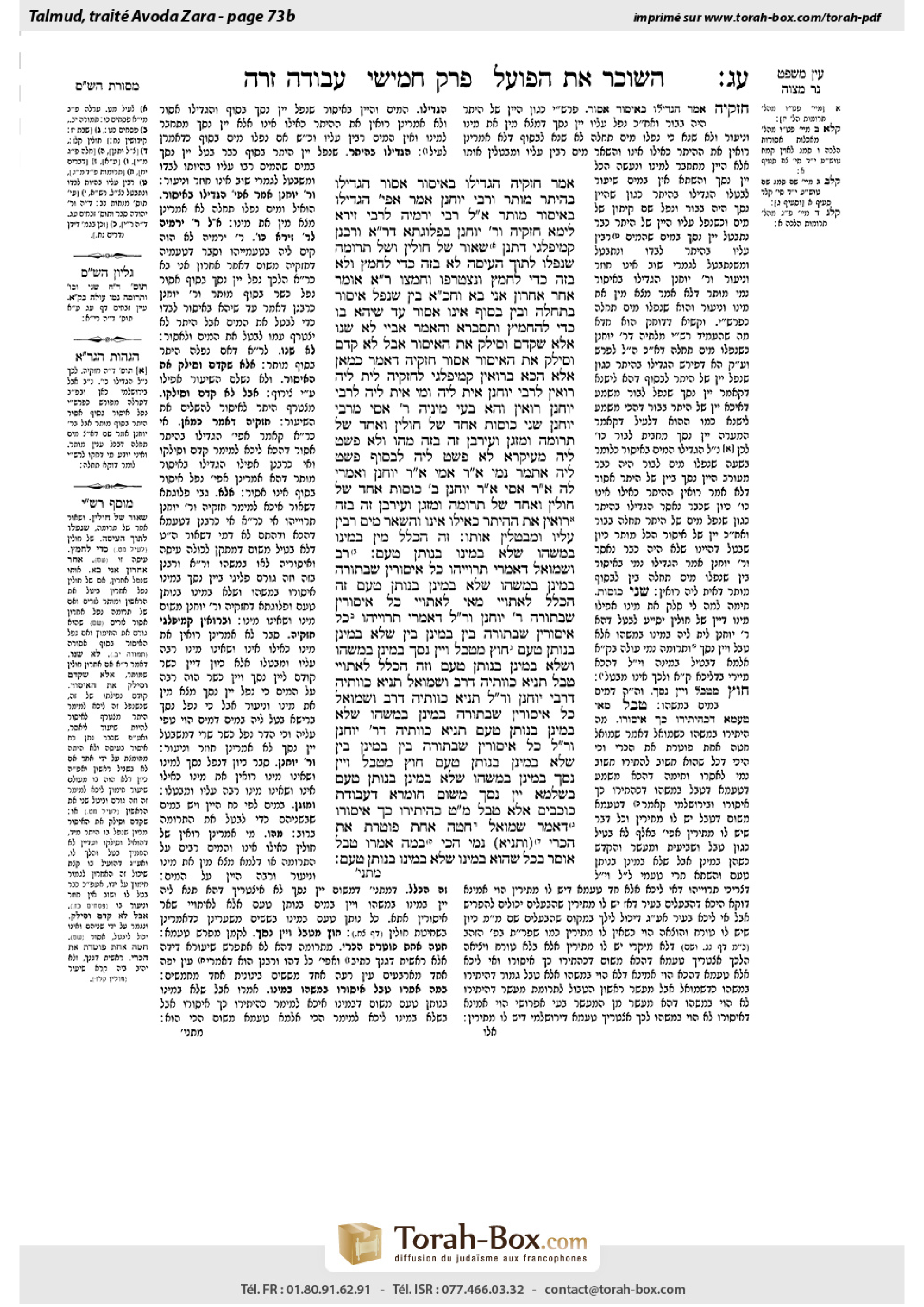
Avodah Zarah 73b: Talmud study for Daf Yomi
Study the Talmud for Daf Yomi with scanned pages, Hebrew text, English translations from Sefaria and AI-generated French translations.
Passage selection and English or AI-generated French translation are available where the scan has annotations. Daf Study is independent of Torah-Box and Sefaria.
Browse Avodah Zarah · עבודה זרה · All tractatesAvodah Zarah 73b text and translations
This page of Avodah Zarah includes the Aramaic text, an English translation and an AI-generated French translation, alongside the scan above.
עבודה זרה ע״ג ב · Aramaic and Hebrew text
אָמַר חִזְקִיָּה: הִגְדִּילוּ בְּאִיסּוּר — אָסוּר, הִגְדִּילוּ בְּהֶיתֵּר — מוּתָּר.
וְרַבִּי יוֹחָנָן אָמַר: אֲפִילּוּ הִגְדִּילוּ בְּאִיסּוּר — מוּתָּר.
אֲמַר לֵיהּ רַבִּי יִרְמְיָה לְרַבִּי זֵירָא: לֵימָא חִזְקִיָּה וְרַבִּי יוֹחָנָן בִּפְלוּגְתָּא דְּרַבִּי אֱלִיעֶזֶר וְרַבָּנַן קָמִיפַּלְגִי?
דִּתְנַן: שְׂאוֹר שֶׁל חוּלִּין וְשֶׁל תְּרוּמָה שֶׁנָּפְלוּ לְתוֹךְ הָעִיסָּה, לֹא בָּזֶה כְּדֵי לְחַמֵּץ וְלֹא בָּזֶה כְּדֵי לְחַמֵּץ, וְנִצְטָרְפוּ וְחִמְּצוּ,
רַבִּי אֱלִיעֶזֶר אוֹמֵר: אַחַר אַחֲרוֹן אֲנִי בָּא, וַחֲכָמִים אוֹמְרִים: בֵּין שֶׁנָּפַל אִיסּוּר בַּתְּחִלָּה וּבֵין בַּסּוֹף — אֵינוֹ אָסוּר עַד שֶׁיְּהֵא בּוֹ כְּדֵי לְהַחְמִיץ.
וְתִסְבְּרַאּ?! וְהָאָמַר אַבָּיֵי: לֹא שָׁנוּ אֶלָּא שֶׁקָּדַם וְסִילֵּק אֶת הָאִיסּוּר, אֲבָל לֹא קָדַם וְסִילֵּק אֶת הָאִיסּוּר — אָסוּר. חִזְקִיָּה דְּאָמַר כְּמַאן?
אֶלָּא, הָכָא בְּרוֹאִין קָמִיפַּלְגִי: לְחִזְקִיָּה לֵית לֵיהּ רוֹאִין, לְרַבִּי יוֹחָנָן אִית לֵיהּ.
וּמִי אִית לֵיהּ לְרַבִּי יוֹחָנָן רוֹאִין? וְהָא בָּעֵי מִינֵּיהּ רַבִּי אַסִּי מֵרַבִּי יוֹחָנָן: שְׁנֵי כּוֹסוֹת, אֶחָד שֶׁל חוּלִּין וְאֶחָד שֶׁל תְּרוּמָה, וּמְזָגָן וְעֵירְבָן זֶה בָּזֶה מַהוּ? וְלָא פְּשַׁט לֵיהּ!
מֵעִיקָּרָא לָא פְּשַׁט לֵיהּ, לְבַסּוֹף פְּשַׁט לֵיהּ. אִתְּמַר נָמֵי: אָמַר רַבִּי אַמֵּי אָמַר רַבִּי יוֹחָנָן, וְאָמְרִי לַהּ אָמַר רַבִּי אַסִּי אָמַר רַבִּי יוֹחָנָן: שְׁנֵי כּוֹסוֹת, אֶחָד שֶׁל חוּלִּין וְאֶחָד שֶׁל תְּרוּמָה, וּמְזָגָן וְעֵירְבָן זֶה בָּזֶה — רוֹאִין אֶת הַהֶיתֵּר כְּאִילּוּ אֵינוֹ, וְהַשְּׁאָר מַיִם רָבִין עָלָיו וּמְבַטְּלִין אוֹתוֹ.
זֶה הַכְּלָל: מִין בְּמִינוֹ — בְּמַשֶּׁהוּ, שֶׁלֹּא בְּמִינוֹ — בְּנוֹתֵן טַעַם.
רַב וּשְׁמוּאֵל דְּאָמְרִי תַּרְוַיְיהוּ: כׇּל אִיסּוּרִין שֶׁבַּתּוֹרָה — בְּמִינָן בְּמַשֶּׁהוּ, שֶׁלֹּא בְּמִינָן — בְּנוֹתֵן טַעַם.
זֶה הַכְּלָל — לְאֵתוֹיֵי מַאי? לְאֵתוֹיֵי כׇּל אִיסּוּרִין שֶׁבַּתּוֹרָה.
רַבִּי יוֹחָנָן וְרֵישׁ לָקִישׁ דְּאָמְרִי תַּרְוַיְיהוּ: כׇּל אִיסּוּרִין שֶׁבַּתּוֹרָה, בֵּין בְּמִינָן בֵּין שֶׁלֹּא בְּמִינָן — בְּנוֹתֵן טַעַם, חוּץ מִטֶּבֶל וְיֵין נֶסֶךְ — בְּמִינָן בְּמַשֶּׁהוּ, וְשֶׁלֹּא בְּמִינָן — בְּנוֹתֵן טַעַם. וְזֶה הַכְּלָל — לְאֵתוֹיֵי טֶבֶל.
תַּנְיָא כְּוָותֵיהּ דְּרַב וּשְׁמוּאֵל, תַּנְיָא כְּוָותֵיהּ דְּרַבִּי יוֹחָנָן וְרֵישׁ לָקִישׁ.
תַּנְיָא כְּוָותֵיהּ דְּרַב וּשְׁמוּאֵל: כׇּל אִיסּוּרִין שֶׁבַּתּוֹרָה, בְּמִינָן — בְּמַשֶּׁהוּ, שֶׁלֹּא בְּמִינָן — בְּנוֹתֵן טַעַם.
תַּנְיָא כְּוָותֵיהּ דְּרַבִּי יוֹחָנָן וְרֵישׁ לָקִישׁ: כׇּל אִיסּוּרִין שֶׁבַּתּוֹרָה, בֵּין בְּמִינָן בֵּין שֶׁלֹּא בְּמִינָן — בְּנוֹתֵן טַעַם, חוּץ מִטֶּבֶל וְיֵין נֶסֶךְ, בְּמִינָן — בְּמַשֶּׁהוּ, שֶׁלֹּא בְּמִינָן — בְּנוֹתֵן טַעַם.
בִּשְׁלָמָא יֵין נֶסֶךְ, מִשּׁוּם חוּמְרָא דַּעֲבוֹדָה זָרָה, אֶלָּא טֶבֶל מַאי טַעְמָא?
כְּהֶיתֵּירוֹ כָּךְ אִיסּוּרוֹ, דְּאָמַר שְׁמוּאֵל: חִטָּה אַחַת פּוֹטֶרֶת אֶת הַכְּרִי. וְתַנְיָא נָמֵי הָכִי: בַּמֶּה אָמְרוּ טֶבֶל אוֹסֵר בְּכׇל שֶׁהוּא? בְּמִינוֹ, שֶׁלֹּא בְּמִינוֹ — בְּנוֹתֵן טַעַם.
Avodah Zarah 73b · English translation
Ḥizkiyya says: If the volume of the water and the wine was increased by the forbidden wine, i.e., the forbidden wine fell in last, the mixture is forbidden, because the forbidden wine renders the permitted wine forbidden by the principle of a substance in contact with the same type of substance, and the water does not nullify the forbidden wine. But if the volume of the water and the forbidden wine was increased by the permitted wine, i.e., there was a mixture of wine used for a libation and water, and the wine used for a libation was nullified by the water and then permitted wine fell into the mixture, in such a case the permitted wine is not rendered forbidden by the forbidden wine that had already been nullified, and so the entire mixture is permitted.
And Rabbi Yoḥanan says: Even if the volume of the permitted wine and the water was increased by the forbidden wine, the mixture is permitted.
Rabbi Yirmeya said to Rabbi Zeira: Shall we say that Ḥizkiyya and Rabbi Yoḥanan disagree with regard to the issue that is the subject of the dispute between Rabbi Eliezer and the Rabbis?
As we learned in a mishna (Orla 2:11): In the case of non-sacred leaven and teruma leaven that fell into a non-sacred batch of dough, and neither is this one alone potent enough to cause the dough to become leavened, nor is that one alone potent enough to cause the dough to become leavened, and they combined and caused the dough to become leavened, there is a dispute as to whether this dough has the status of teruma, and is therefore forbidden to non-priests, or non-sacred bread.
Rabbi Eliezer says: I follow the final element that fell into the dough. If the teruma fell in last, the dough is forbidden to non-priests. And the Rabbis say: Whether the forbidden item, i.e., the teruma, fell in first or whether it fell in last, the dough is not forbidden unless there is enough of the forbidden leaven alone to cause the dough to become leavened. Apparently, Ḥizkiyya holds in accordance with the opinion of Rabbi Eliezer that if the forbidden substance is mixed in last, the mixture is rendered forbidden, and Rabbi Yoḥanan holds in accordance with the opinion of the Rabbis that if the amount of the forbidden substance is not sufficient in and of itself to render the mixture forbidden, the mixture is permitted.
The Gemara responds: And how can you understand that this is the same dispute? But doesn’t Abaye say: Rabbi Eliezer taught that the mixture is permitted when the permitted leaven fell in last only in a case when one first removed the forbidden leaven before the permitted leaven fell into the dough and made it rise. But if one did not first remove the forbidden leaven, the dough is forbidden even if the permitted leaven fell in last. According to Abaye’s interpretation, in accordance with whose opinion does Ḥizkiyya state his ruling with regard to a mixture of forbidden wine, permitted wine, and permitted water, that if the forbidden wine was mixed in last the mixture is forbidden? According to the Rabbis the mixture should be permitted in any event, as there is not enough forbidden wine to render the mixture forbidden, and according to Rabbi Eliezer, even if the permitted wine was mixed in last the mixture should be forbidden, as the forbidden wine was not removed.
Rather, here Ḥizkiyya and Rabbi Yoḥanan disagree concerning the principle that with regard to a mixture of a forbidden substance and a permitted substance of the same type, and a permitted substance of a different type, one considers the permitted substance of the same type as though it were nonexistent so that the substance of the other type can nullify the forbidden substance. Ḥizkiyya is not of the opinion that one considers it as though it were nonexistent, whereas Rabbi Yoḥanan is of the opinion that one considers it as though it were nonexistent, and so he maintains that in any event the water nullifies the forbidden wine, and the permitted wine in the mixture is disregarded.
The Gemara asks: And is Rabbi Yoḥanan of the opinion that one considers the permitted substance of the same type as though it were nonexistent? But didn’t Rabbi Asi ask Rabbi Yoḥanan the following question: If one had two cups of wine, one non-sacred and one of teruma, and he diluted them with water and mixed them together, and there is sufficient water between the two cups to nullify the teruma wine, what is the halakha? Is the non-sacred wine, which is the same type of substance as the teruma wine, considered to be nonexistent, and the water in the mixture nullifies the teruma wine, or does the teruma wine render the non-sacred wine forbidden, and the water in both cups is insufficient to nullify the combined wine? And Rabbi Yoḥanan did not resolve the dilemma for him, indicating that he did not have a set opinion on the matter.
The Gemara answers: Initially he did not resolve the dilemma for him, but ultimately he resolved for him that the permitted substance of the same type is considered as though it were nonexistent. It was also stated that this was Rabbi Yoḥanan’s ultimate opinion, as Rabbi Ami says that Rabbi Yoḥanan says, and some say that it is Rabbi Asi who says that Rabbi Yoḥanan says: If one had two cups of wine, one non-sacred and one of teruma, and he diluted them with water and mixed them together, and there is sufficient water in each of the cups to nullify the teruma wine, one considers the permitted wine as though it were nonexistent, and as for the rest, the teruma wine, the volume of the water is greater than the volume of the wine and nullifies it.
§ The mishna states that this is the principle: A substance in contact with the same type of substance renders the mixture forbidden with any amount of the forbidden substance, but a substance in contact with a different type of substance renders the mixture forbidden only in a case where it imparts flavor to it.
The Gemara presents an amoraic dispute with regard to this principle: Rav and Shmuel both say: With regard to any food forbidden by the Torah that becomes mixed with permitted food, if the permitted food is of its own type, then even any amount of the forbidden substance renders the entire mixture forbidden. If the forbidden food is mixed with another type of substance, then the mixture becomes forbidden only in a case where there is enough of the forbidden food to impart flavor to the mixture.
According to Rav and Shmuel, what is added by the statement in the mishna: This is the principle, etc.? This is stated to include any food forbidden by the Torah, and not only wine used for a libation.
Rabbi Yoḥanan and Reish Lakish both say: With regard to any food forbidden by the Torah that falls into a mixture, whether of its own type of food or another type of food, the mixture is forbidden in a case where there is enough of the forbidden item to impart flavor to the mixture. This is the halakha except for the cases of untithed produce and wine used for a libation, which render a mixture with their own type of food forbidden in a case where any amount of the forbidden food was mixed with the permitted food; but if they are mixed with another type of substance, the mixture is forbidden only in a case where it imparts flavor to it. And according to this opinion, the statement in the mishna: This is the principle, etc., is stated to include the case of untithed produce, which is not mentioned in the mishna explicitly.
It is taught in a baraita in accordance with the opinion of Rav and Shmuel, and it is taught in another baraita in accordance with the opinion of Rabbi Yoḥanan and Reish Lakish.
The Gemara elaborates: It is taught in a baraita in accordance with the opinion of Rav and Shmuel: With regard to any food forbidden by the Torah that becomes mixed with a permitted food, in a case where the permitted food is of its own type, then even any amount of the forbidden substance renders the entire mixture forbidden. But in a case where the forbidden food was mixed with another type of substance, then the mixture becomes forbidden only in a case where there is enough of the forbidden item to impart flavor to the mixture.
It is taught in another baraita in accordance with the opinion of Rabbi Yoḥanan and Reish Lakish: With regard to any food forbidden by the Torah that falls into a mixture, whether of its own type of food or another type of food, the mixture is forbidden in a case where there is enough of the forbidden food to impart flavor to the mixture. This is the halakha except for the cases of untithed produce and wine used for a libation, which render a mixture with their own type of food forbidden in a case where any amount of the forbidden food was mixed with the permitted food; but if they are mixed with another type of substance, the mixture is forbidden only in a case where they impart flavor to it.
The Gemara asks: According to the opinion of Rabbi Yoḥanan and Reish Lakish, why are untithed produce and wine used for a libation treated more stringently than other forbidden foods? Granted, wine used for a libation is treated stringently due to the severity of idol worship, but with regard to untithed produce, what is the reason that any amount of it that is mixed with permitted food of its own type renders the mixture forbidden?
The Gemara answers: Just as it assumes its permitted status, so it assumes its forbidden status, as Shmuel says: Even one grain of wheat given as teruma exempts the entire heap of grain from the obligation of teruma. Since any amount of teruma given renders the entire heap of produce permitted, any amount of untithed produce also renders the entire mixture forbidden. And this is also taught in a baraita: With regard to what situation did the Sages say that any amount of untithed produce renders a mixture forbidden? It is with regard to untithed produce that becomes mixed with its own type, but with regard to untithed produce that becomes mixed with another type, the mixture is forbidden only in a case where the untithed produce imparts flavor to it.
Avodah Zarah 73b · Traduction française (IA)
Ḥizkiyya dit : Si la quantité d'eau et de vin a été augmentée par le vin interdit, c'est-à-dire que le vin interdit est tombé en dernier, le mélange est interdit, car le vin interdit rend le vin permis interdit selon le principe d'une substance en contact avec une substance de même type, et l'eau ne nullifie pas le vin interdit. Mais si la quantité d'eau et du vin interdit a été augmentée par le vin permis, c'est-à-dire qu'il y avait un mélange de vin utilisé pour une libation et d'eau, et que le vin utilisé pour une libation a été nullifié par l'eau, puis du vin permis est tombé dans le mélange, dans ce cas le vin permis n'est pas rendu interdit par le vin interdit déjà nullifié, et donc l'ensemble du mélange est permis.
Et Rabbi Yoḥanan dit : Même si la quantité du vin permis et de l'eau a été augmentée par le vin interdit, le mélange est permis.
Rabbi Yirmeya demanda à Rabbi Zeira : Devons-nous dire que Ḥizkiyya et Rabbi Yoḥanan sont en désaccord sur la question qui est au centre du débat entre Rabbi Eliezer et les Rabbins ?
Comme nous l'avons appris dans une mitsna (Orla 2:11) : Dans le cas où du levain non sacré et du levain terouma sont tombés dans une pâte non sacrée, et ni l'un ni l'autre n'est suffisamment puissant seul pour faire lever la pâte, et qu'ils se sont combinés pour faire lever la pâte, il y a un débat sur le fait que cette pâte ait le statut de terouma, et donc soit interdite aux non-prêtres, ou du pain non sacré.
Rabbi Eliezer dit : Je suis en accord avec l'élément qui est tombé en dernier dans la pâte. Si le terouma est tombé en dernier, la pâte est interdite aux non-prêtres. Et les Rabbins disent : Qu'importe si l'élément interdit, c'est-à-dire le terouma, est tombé en premier ou en dernier, la pâte n'est pas interdite à moins qu'il y ait suffisamment de levain interdit seul pour faire lever la pâte. Apparemment, Ḥizkiyya suit l'opinion de Rabbi Eliezer qui dit que si la substance interdite est mélangée en dernier, le mélange est rendu interdit, et Rabbi Yoḥanan suit l'opinion des Rabbins qui disent que si la quantité de la substance interdite n'est pas suffisante en soi pour rendre le mélange interdit, le mélange est permis.
La Guemara répond : Et comment pouvez-vous comprendre que c'est le même débat ? Mais ne dit pas Abaye : Rabbi Eliezer enseigna que le mélange est permis lorsque le levain permis est tombé en dernier, uniquement dans le cas où l'on a d'abord retiré le levain interdit avant que le levain permis ne tombe dans la pâte et ne la fasse lever. Mais si l'on n'a pas d'abord retiré le levain interdit, la pâte est interdite même si le levain permis est tombé en dernier. Selon l'interprétation d'Abaye, selon quel avis Ḥizkiyya énonce son jugement concernant un mélange de vin interdit, de vin permis et d'eau permis, que si le vin interdit a été mélangé en dernier, le mélange est interdit ? Selon les Rabbins, le mélange devrait être permis dans tous les cas, car il n'y a pas assez de vin interdit pour rendre le mélange interdit, et selon Rabbi Eliezer, même si le vin permis a été mélangé en dernier, le mélange devrait être interdit, car le vin interdit n'a pas été retiré.
En réalité, Ḥizkiyya et Rabbi Yoḥanan sont en désaccord concernant le principe selon lequel, dans un mélange d'une substance interdite et d'une substance permise du même type, et d'une substance permise d'un autre type, on considère la substance permise du même type comme si elle n'existait pas, de sorte que la substance de l'autre type puisse nullifier la substance interdite. Ḥizkiyya ne considère pas que l'on considère la substance permise du même type comme si elle n'existait pas, tandis que Rabbi Yoḥanan considère que l'on considère la substance permise du même type comme si elle n'existait pas, et donc il maintient que, dans tous les cas, l'eau nullifie le vin interdit, et le vin permis dans le mélange est ignoré.
La Guemara demande : Et Rabbi Yoḥanan considère-t-il que la substance permise du même type est considérée comme si elle n'existait pas ? Mais n’a-t-il pas posé à Rabbi Yoḥanan la question suivante : Si l’on avait deux verres de vin, l’un non sacré et l’autre de terouma, et qu’on les a dilués avec de l’eau et qu’on les a mélangés ensemble, et qu’il y a suffisamment d’eau entre les deux verres pour nullifier le vin terouma, quelle est la halakha ? Le vin non sacré, qui est de la même substance que le vin terouma, est-il considéré comme s’il n’existait pas, et l’eau dans le mélange nullifie le vin terouma, ou le vin terouma rend le vin non sacré interdit, et l’eau dans les deux verres est insuffisante pour nullifier le vin combiné ? Et Rabbi Yoḥanan n’a pas résolu ce dilemme pour lui, indiquant qu’il n’avait pas d’opinion fixe sur la question.
La Guemara répond : Initialement, il n’a pas résolu ce dilemme pour lui, mais finalement, il l’a résolu en disant que la substance permise du même type est considérée comme si elle n’existait pas. Il a également été dit que c’était l’avis ultérieur de Rabbi Yoḥanan, car Rabbi Ami dit que Rabbi Yoḥanan dit, et certains disent que c’est Rabbi Asi qui dit que Rabbi Yoḥanan dit : Si l’on avait deux verres de vin, l’un non sacré et l’autre de terouma, et qu’on les a dilués avec de l’eau et qu’on les a mélangés ensemble, et qu’il y a suffisamment d’eau dans chaque verre pour nullifier le vin terouma, on considère le vin permis comme s’il n’existait pas, et quant au reste, le vin terouma, la quantité d’eau est supérieure à la quantité de vin et nullifie ce dernier.
§ La mitsva énonce que ce principe est le suivant : Une substance en contact avec une substance de même type rend le mélange interdit avec toute quantité de la substance interdite, mais une substance en contact avec une substance d’un autre type rend le mélange interdit uniquement dans le cas où elle imprime un goût.
La Guemara présente un débat entre les amoraïm concernant ce principe : Rav et Shmuel disent tous les deux : Concernant toute nourriture interdite par la Torah qui se mélange à une nourriture permise, si la nourriture permise est de son propre type, alors même une quantité minime de la nourriture interdite rend le mélange interdit. Si la nourriture interdite se mélange à un autre type de substance, alors le mélange devient interdit uniquement dans le cas où il y a suffisamment de nourriture interdite pour imprimer un goût au mélange.
Selon Rav et Shmuel, à quoi sert l'affirmation dans la mitsva : « C'est le principe, etc. » ? Cela est dit pour inclure toute nourriture interdite par la Torah, et non seulement le vin utilisé pour un sacrifice.
Rabbi Yoḥanan et Reish Lakish disent tous les deux : Concernant toute nourriture interdite par la Torah qui tombe dans un mélange, que ce soit de son propre type de nourriture ou d'un autre type de nourriture, le mélange est interdit dans le cas où il y a suffisamment de nourriture interdite pour imprimer un goût au mélange. C'est la halakha, sauf pour les cas des produits non titrés et du vin utilisé pour un sacrifice, qui rendent un mélange avec leur propre type de nourriture interdit dans le cas où une quantité minime de nourriture interdite est mélangée à la nourriture permise ; mais si elles sont mélangées à un autre type de substance, le mélange est interdit uniquement dans le cas où elles impriment un goût. Selon cet avis, l'affirmation dans la mitsva : « C'est le principe, etc. » est dite pour inclure le cas des produits non titrés, qui n'est pas mentionné explicitement dans la mitsva.
Il est enseigné dans une baraïta selon l'avis de Rav et Shmuel, et il est enseigné dans une autre baraïta selon l'avis de Rabbi Yoḥanan et Reish Lakish.
La Guemara développe : Il est enseigné dans une baraïta selon l'avis de Rav et Shmuel : Concernant toute nourriture interdite par la Torah qui se mélange à une nourriture permise, dans le cas où la nourriture permise est de son propre type, alors même une quantité minime de la nourriture interdite rend le mélange interdit. Mais dans le cas où la nourriture interdite a été mélangée à un autre type de substance, alors le mélange devient interdit uniquement dans le cas où il y a suffisamment de nourriture interdite pour imprimer un goût au mélange.
Il est enseigné dans une autre baraïta selon l'avis de Rabbi Yoḥanan et Reish Lakish : Concernant toute nourriture interdite par la Torah qui tombe dans un mélange, que ce soit de son propre type de nourriture ou d'un autre type de nourriture, le mélange est interdit dans le cas où il y a suffisamment de nourriture interdite pour imprimer un goût au mélange. C'est la halakha, sauf pour les cas des produits non titrés et du vin utilisé pour un sacrifice, qui rendent un mélange avec leur propre type de nourriture interdit dans le cas où une quantité minime de nourriture interdite est mélangée à la nourriture permise ; mais si elles sont mélangées à un autre type de substance, le mélange est interdit uniquement dans le cas où elles impriment un goût.
La Guemara pose la question : Selon l'avis de Rabbi Yoḥanan et de Reish Lakish, pourquoi les produits non titrés et le vin utilisé pour un sacrifice sont-ils traités avec plus de rigueur que d'autres aliments interdits ? Bien sûr, le vin utilisé pour un sacrifice est traité avec plus de rigueur en raison de la gravité du culte idolâtre, mais concernant les produits non titrés, quelle est la raison pour laquelle toute quantité d'eux mélangée à une nourriture permise de son propre type rend le mélange interdit ?
La Guemara répond : Comme il assume son statut permis, il assume aussi son statut interdit, comme Shmuel le dit : Même une graine de blé donnée comme terouma exempt l'ensemble de la pile de blé de l'obligation de terouma. Puisque toute quantité de terouma donnée rend l'ensemble de la récolte permise, toute quantité de produits non titrés rend aussi l'ensemble du mélange interdit. Et cela est également enseigné dans une baraïta : Concernant quelle situation les Sages ont-ils dit que toute quantité de produits non titrés rend un mélange interdit ? C'est concernant les produits non titrés qui se mêlent à leur propre type, mais concernant les produits non titrés qui se mêlent à un autre type, le mélange est interdit uniquement dans le cas où les produits non titrés impriment un goût.
Traduction française générée par IA à partir de l’édition anglaise de Sefaria. Vérifie toujours un passage avec le texte source.
Text from Sefaria: William Davidson Edition - Vocalized Aramaic (CC BY NC); William Davidson Edition - English (CC BY NC).