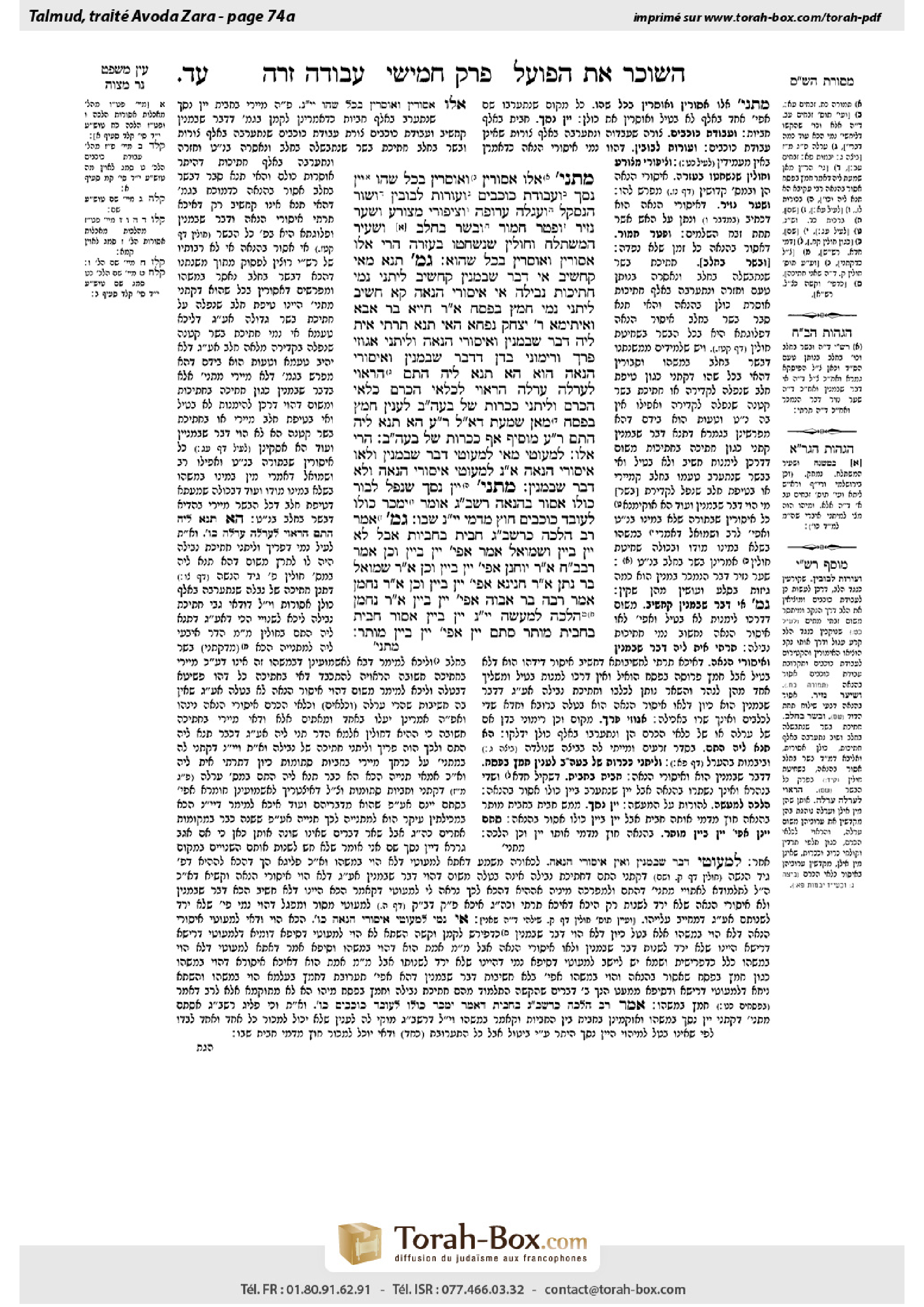
Avodah Zarah 74a: Talmud study for Daf Yomi
Study the Talmud for Daf Yomi with scanned pages, Hebrew text, English translations from Sefaria and AI-generated French translations.
Passage selection and English or AI-generated French translation are available where the scan has annotations. Daf Study is independent of Torah-Box and Sefaria.
Browse Avodah Zarah · עבודה זרה · All tractatesAvodah Zarah 74a text and translations
This page of Avodah Zarah includes the Aramaic text, an English translation and an AI-generated French translation, alongside the scan above.
עבודה זרה ע״ד א · Aramaic and Hebrew text
מַתְנִי׳ אֵלּוּ אֲסוּרִין, וְאוֹסְרִין בְּכׇל שֶׁהוּ: יֵין נֶסֶךְ, וַעֲבוֹדָה זָרָה, וְעוֹרוֹת לְבוּבִין,
וְשׁוֹר הַנִּסְקָל, וְעֶגְלָה עֲרוּפָה,
וְצִיפּוֹרֵי מְצוֹרָע, וּשְׂעַר נָזִיר, וּפֶטֶר חֲמוֹר, וּבָשָׂר בְּחָלָב, וְשָׂעִיר הַמִּשְׁתַּלֵּחַ, וְחוּלִּין שֶׁנִּשְׁחֲטוּ בַּעֲזָרָה — הֲרֵי אֵלּוּ אֲסוּרִין וְאוֹסְרִין בְּכׇל שֶׁהוּא.
גְּמָ׳ תַּנָּא מַאי קָחָשֵׁיב? אִי דָּבָר שֶׁבְּמִנְיָן קָחָשֵׁיב, לִיתְנֵי נָמֵי חֲתִיכוֹת נְבֵילָה! אִי אִיסּוּרֵי הֲנָאָה קָא חָשֵׁיב, לִיתְנֵי נָמֵי חָמֵץ בְּפֶסַח! אָמַר רַבִּי חִיָּיא בַּר אַבָּא, וְאִיתֵּימָא רַבִּי יִצְחָק נַפָּחָא: הַאי תַּנָּא תַּרְתֵּי אִית לֵיהּ — דָּבָר שֶׁבְּמִנְיָן וְאִיסּוּרֵי הֲנָאָה.
וְלִיתְנֵי אֱגוֹזֵי פֶּרֶךְ וְרִימּוֹנֵי בָּדָן, דְּדָבָר שֶׁבְּמִנְיָן וְאִיסּוּרֵי הֲנָאָה הוּא!
הָא תְּנָא לֵיהּ הָתָם: הָרָאוּי לְעׇרְלָה — עׇרְלָה, הָרָאוּי לְכִלְאֵי הַכֶּרֶם — כִּלְאֵי הַכֶּרֶם.
וְלִיתְנֵי כִּכָּרוֹת שֶׁל בַּעַל הַבַּיִת לְעִנְיַן חָמֵץ בְּפֶסַח! מַאן שָׁמְעַתְּ דַּאֲמַר לַהּ? רַבִּי עֲקִיבָא, הָא תְּנָא לֵיהּ הָתָם: רַבִּי עֲקִיבָא מוֹסִיף אַף כִּכָּרוֹת שֶׁל בַּעַל הַבַּיִת.
״הֲרֵי אֵלּוּ״ לְמַעוֹטֵי מַאי? לְמַעוֹטֵי דָּבָר שֶׁבְּמִנְיָן וְלָאו אִיסּוּרֵי הֲנָאָה, אִי נָמֵי לְמַעוֹטֵי אִיסּוּר הֲנָאָה וְלֹא דָּבָר שֶׁבְּמִנְיָן.
מַתְנִי׳ יֵין נֶסֶךְ שֶׁנָּפַל לַבּוֹר, כּוּלּוֹ אָסוּר בַּהֲנָאָה. רַבָּן שִׁמְעוֹן בֶּן גַּמְלִיאֵל אוֹמֵר: יִמָּכֵר כּוּלּוֹ לְגוֹי, חוּץ מִדְּמֵי יֵין נֶסֶךְ שֶׁבּוֹ.
גְּמָ׳ אָמַר רַב: הֲלָכָה כְּרַבָּן שִׁמְעוֹן בֶּן גַּמְלִיאֵל חָבִית בְּחָבִיּוֹת, אֲבָל לֹא יַיִן בְּיַיִן. וּשְׁמוּאֵל אָמַר: אֲפִילּוּ יַיִן בְּיַיִן. וְכֵן אָמַר רַבָּה בַּר בַּר חָנָה אָמַר רַבִּי יוֹחָנָן: אֲפִילּוּ יַיִן בְּיַיִן. וְכֵן אָמַר רַבִּי שְׁמוּאֵל בַּר נַחְמָנִי אָמַר רַבִּי חֲנִינָא: אֲפִילּוּ יַיִן בְּיַיִן. וְכֵן אָמַר רַב נַחְמָן אָמַר רַבָּה בַּר אֲבוּהּ: אֲפִילּוּ יַיִן בְּיַיִן.
אָמַר רַב נַחְמָן: הֲלָכָה לְמַעֲשֶׂה, יֵין נֶסֶךְ יַיִן בְּיַיִן — אָסוּר, חָבִית בְּחָבִית — מוּתָּר, סְתָם יַיִן אֲפִילּוּ יַיִן בְּיַיִן — מוּתָּר.
Avodah Zarah 74a · English translation
MISHNA: These following items are themselves forbidden, and any amount of them renders other items with which they become mixed forbidden: Wine used for a libation; and objects of idol worship; and hides with a tear opposite the heart, indicating the idolatrous practice of sacrificing hearts of live animals.
And this halakha also applies to an ox that has been condemned to be stoned (see Exodus 21:28), from which it is prohibited to derive benefit even before its sentence is carried out; and it applies to a heifer whose neck is broken when a person is found killed in an area between two cities and the murderer is unknown (see Deuteronomy 21:1–9), which is likewise forbidden from the time it is taken down to the river to be killed. In these cases, if the animal becomes mixed in a herd of similar animals, all of the animals in the herd are forbidden.
And this halakha also applies to birds designated for the purification of a leper (Leviticus 14:1–6), and the shorn hair of a nazirite (Numbers 6:18), and a firstborn donkey (Exodus 13:13), and meat that was cooked in milk (Exodus 23:19), and the scapegoat of Yom Kippur (Leviticus 16:7–10), and the meat of a non-sacred animal that was slaughtered in the Temple courtyard. All of these are forbidden themselves, and any amount of them renders a mixture forbidden.
GEMARA: According to what criterion does the tanna who teaches this mishna reckon cases? If he reckons based on any item that is counted, i.e., any item that is significant enough to be considered individually, which therefore cannot be nullified in a mixture even in a very large majority of permitted items, let him also teach the case of significant cuts of an unslaughtered animal carcass. And if he reckons based on items from which deriving benefit is prohibited, let him also teach the case of leavened bread on Passover. Rabbi Ḥiyya bar Abba said, and some say it was Rabbi Yitzḥak Nappaḥa who said: This tanna has two criteria. He reckons based on any item that is both counted and from which deriving benefit is prohibited.
The Gemara challenges: But let the tanna teach the cases of perekh nuts, a type of nut that has a brittle shell, and Badan pomegranates, pomegranates from Badan; as these fruits are considered significant, and when they grow during the first three years after the tree was planted [orla], they belong to the category of items that are counted and from which deriving benefit is prohibited.
The Gemara responds: The Mishna taught that case there, in tractate Orla (3:7), where perekh nuts and Badan pomegranates are listed among the forbidden items that cannot be nullified in a mixture, and it is stated with regard to such items: Those items to which the prohibition of orla applies render the entire mixture forbidden by imparting to it the status of orla, while those to which the prohibition of diverse kinds planted in a vineyard applies render the mixture forbidden by imparting to it the status of diverse kinds planted in a vineyard. Therefore, it is unnecessary to mention those cases here.
The Gemara suggests: But let the tanna teach the case of loaves of a homeowner, each of which is unique and significant, with regard to the prohibition against deriving benefit from leavened bread on Passover. The Gemara explains: Whom did you hear who says that such loaves are not nullified in a mixture? This is taught by Rabbi Akiva, and he taught it there in tractate Orla (3:7): Rabbi Akiva adds to the list the loaves of a homeowner.
At the end of the mishna here, the tanna reiterates the halakha stated at its beginning, saying: All of these are forbidden themselves, and any amount of them renders a mixture forbidden. The Gemara asks: The purpose of this reiteration is to exclude what? The Gemara answers: It serves to exclude any item that is counted but from which deriving benefit is not prohibited, or to exclude items from which deriving benefit is prohibited but that are not counted.
MISHNA: In the case of wine used for a libation that fell into a wine cistern, it is prohibited to derive benefit from all of the wine in the cistern, even if the volume of the wine used for a libation was tiny in comparison to the volume of the wine in the cistern. Rabban Shimon ben Gamliel says: All of the wine in the cistern may be sold to a gentile, and the money paid for it is permitted except for the value of the wine used for a libation that is included in it.
GEMARA: Rav says: The halakha is in accordance with the opinion of Rabban Shimon ben Gamliel in a case where a barrel of wine used for a libation became intermingled with barrels of permitted wine, but not when the wine itself became mixed with permitted wine. And Shmuel says: Even when the wine itself became mixed with permitted wine, the halakha is in accordance with the opinion of Rabban Shimon ben Gamliel. And likewise, Rabba bar bar Ḥana says that Rabbi Yoḥanan says: Even when wine became mixed with wine, the halakha is in accordance with the opinion of Rabban Shimon ben Gamliel. And likewise, Rabbi Shmuel bar Naḥmani says that Rabbi Ḥanina says: Even when wine became mixed with wine, the halakha is in accordance with the opinion of Rabban Shimon ben Gamliel. And likewise, Rav Naḥman says that Rabba bar Avuh says: Even when wine became mixed with wine, the halakha is in accordance with the opinion of Rabban Shimon ben Gamliel.
Rav Naḥman says: The practical halakha is that with regard to wine that was actually used for a libation, wine that became mixed with wine renders the entire mixture forbidden, but if a barrel became intermingled with barrels of permitted wine, it is permitted to sell the barrels in the manner described by Rabban Shimon ben Gamliel. With regard to nondescript wine of gentiles, which is forbidden due to the suspicion that it was used for a libation, even if wine became mixed with wine, it is permitted to sell the mixture in the manner described by Rabban Shimon ben Gamliel.
Avodah Zarah 74a · Traduction française (IA)
MICHNA: Ces objets suivants sont eux-mêmes interdits, et toute quantité d'entre eux rend interdits d'autres objets avec lesquels ils sont mélangés : Le vin utilisé pour un libation ; et les objets de culte idolâtre ; et les peaux de bêtes avec une déchirure opposée au cœur, indiquant la pratique idolâtre de sacrifier les cœurs des animaux vivants.
Et cette halakha s'applique également à un bœuf condamné à être lapidé (cf. Exode 21:28), d'où il est interdit d'extraire un bénéfice même avant que la sentence ne soit exécutée ; et elle s'applique à une vache dont le cou est brisé lorsqu'un homme est trouvé tué dans une zone entre deux villes et que l'assassin est inconnu (cf. Deutéronome 21:1–9), qui est également interdit dès qu'elle est ramenée au fleuve pour être tuée. Dans ces cas, si l'animal est mélangé à un troupeau d'animaux semblables, tous les animaux du troupeau sont interdits.
Et cette halakha s'applique également aux oiseaux désignés pour la purification d'un lépreux (Lévitique 14:1–6), et aux cheveux de laine d'un nazir (Nombres 6:18), et à un âne premier-né (Exode 13:13), et à la viande cuite avec du lait (Exode 23:19), et au bouc expiatoire du Yom Kippour (Lévitique 16:7–10), et à la viande d'un animal non sacré tué dans le courtyard du Temple. Tous ces objets sont eux-mêmes interdits, et toute quantité d'entre eux rend un mélange interdit.
GUEMARA : Selon quel critère le tanna qui enseigne cette mésna évalue-t-il les cas ? Si il évalue selon tout objet qui est compté, c'est-à-dire tout objet suffisamment important pour être considéré individuellement, et donc ne peut être annulé dans un mélange même dans une très grande majorité d'objets permis, qu'il enseigne aussi le cas des morceaux significatifs d'un cadavre d'animaux non sacrifiés. Et si il évalue selon des objets d'où il est interdit d'extraire un bénéfice, qu'il enseigne aussi le cas du pain aisé pendant la Pâque. Rabbi Ḥiyya bar Abba a dit, et certains disent que c'était Rabbi Yitzḥak Nappaḥa qui a dit : Ce tanna a deux critères. Il évalue selon tout objet qui est à la fois compté et d'où il est interdit d'extraire un bénéfice.
La Guemara conteste : Mais qu'on fasse enseigner le cas des noix perekh, un type de noix avec une coque fragile, et des pamplemousses de Badan ; car ces fruits sont considérés comme significatifs, et lorsqu'ils grandissent pendant les trois premières années après la plantation de l'arbre [oula], ils appartiennent à la catégorie d'objets qui sont comptés et d'où il est interdit d'extraire un bénéfice.
La Guemara répond : La mésna a enseigné ce cas là, dans le traité Orla (3:7), où les noix perekh et les pamplemousses de Badan sont mentionnés parmi les objets interdits qui ne peuvent pas être annulés dans un mélange, et il est dit concernant ces objets : Ces objets auxquels s'applique l'interdiction d'oula rendent le mélange entier interdit en lui conférant le statut d'oula, tandis que ceux auxquels s'applique l'interdiction des cultures diverses plantées dans un vignoble rendent le mélange interdit en lui conférant le statut des cultures diverses plantées dans un vignoble. Par conséquent, il n'est pas nécessaire de mentionner ces cas ici.
La Guemara suggère : Mais qu'on fasse enseigner le cas des pains d'un propriétaire, chacun étant unique et significatif, concernant l'interdiction d'extraire un bénéfice du pain aisé pendant la Pâque. La Guemara explique : À qui as-tu entendu dire que tels pains ne sont pas annulés dans un mélange ? C'est enseigné par Rabbi Akiva, et il l'a enseigné là dans le traité Orla (3:7) : Rabbi Akiva ajoute à la liste les pains d'un propriétaire.
À la fin de la mésna ici, le tanna répète la halakha énoncée au début, en disant : Tous ces objets sont eux-mêmes interdits, et toute quantité d'entre eux rend un mélange interdit. La Guemara demande : L'objectif de cette répétition est d'exclure quoi ? La Guemara répond : Elle sert à exclure tout objet qui est compté mais d'où il n'est pas interdit d'extraire un bénéfice, ou à exclure des objets d'où il est interdit d'extraire un bénéfice mais qui ne sont pas comptés.
MICHNA : Dans le cas où le vin utilisé pour un libation est tombé dans un cisternes de vin, il est interdit d'extraire un bénéfice de tout le vin du cisternes, même si la quantité de vin utilisé pour un libation était minuscule par rapport à la quantité de vin dans le cisternes. Rabban Shimon ben Gamliel dit : Tout le vin du cisternes peut être vendu à un non-juif, et l'argent reçu est permis sauf la valeur du vin utilisé pour un libation qui est inclus dans celui-ci.
GUEMARA : Rav dit : La halakha est selon l'opinion de Rabban Shimon ben Gamliel dans le cas où un baril de vin utilisé pour un libation s'est mêlé à des barils de vin permis, mais pas lorsqu'il s'est mélangé avec du vin permis. Et Shmuel dit : Même lorsqu'il s'est mélangé avec du vin permis, la halakha est selon l'opinion de Rabban Shimon ben Gamliel. Et de même, Rabba bar bar Ḥana dit que Rabbi Yoḥanan dit : Même lorsqu'il s'est mélangé avec du vin, la halakha est selon l'opinion de Rabban Shimon ben Gamliel. Et de même, Rabbi Shmuel bar Naḥmani dit que Rabbi Ḥanina dit : Même lorsqu'il s'est mélangé avec du vin, la halakha est selon l'opinion de Rabban Shimon ben Gamliel. Et de même, Rav Naḥman dit que Rabba bar Avuh dit : Même lorsqu'il s'est mélangé avec du vin, la halakha est selon l'opinion de Rabban Shimon ben Gamliel.
Rav Naḥman dit : La halakha pratique est que concernant le vin qui a été effectivement utilisé pour un libation, le vin qui s'est mélangé avec du vin rend le mélange entier interdit, mais si un baril s'est mêlé à des barils de vin permis, il est permis de vendre les barils selon la description de Rabban Shimon ben Gamliel. Concernant le vin de non-juif indéterminé, qui est interdit en raison de la suspicion qu'il a été utilisé pour un libation, même si le vin s'est mélangé avec du vin, il est permis de vendre le mélange selon la description de Rabban Shimon ben Gamliel.
Traduction française générée par IA à partir de l’édition anglaise de Sefaria. Vérifie toujours un passage avec le texte source.
Text from Sefaria: William Davidson Edition - Vocalized Aramaic (CC BY NC); William Davidson Edition - English (CC BY NC).