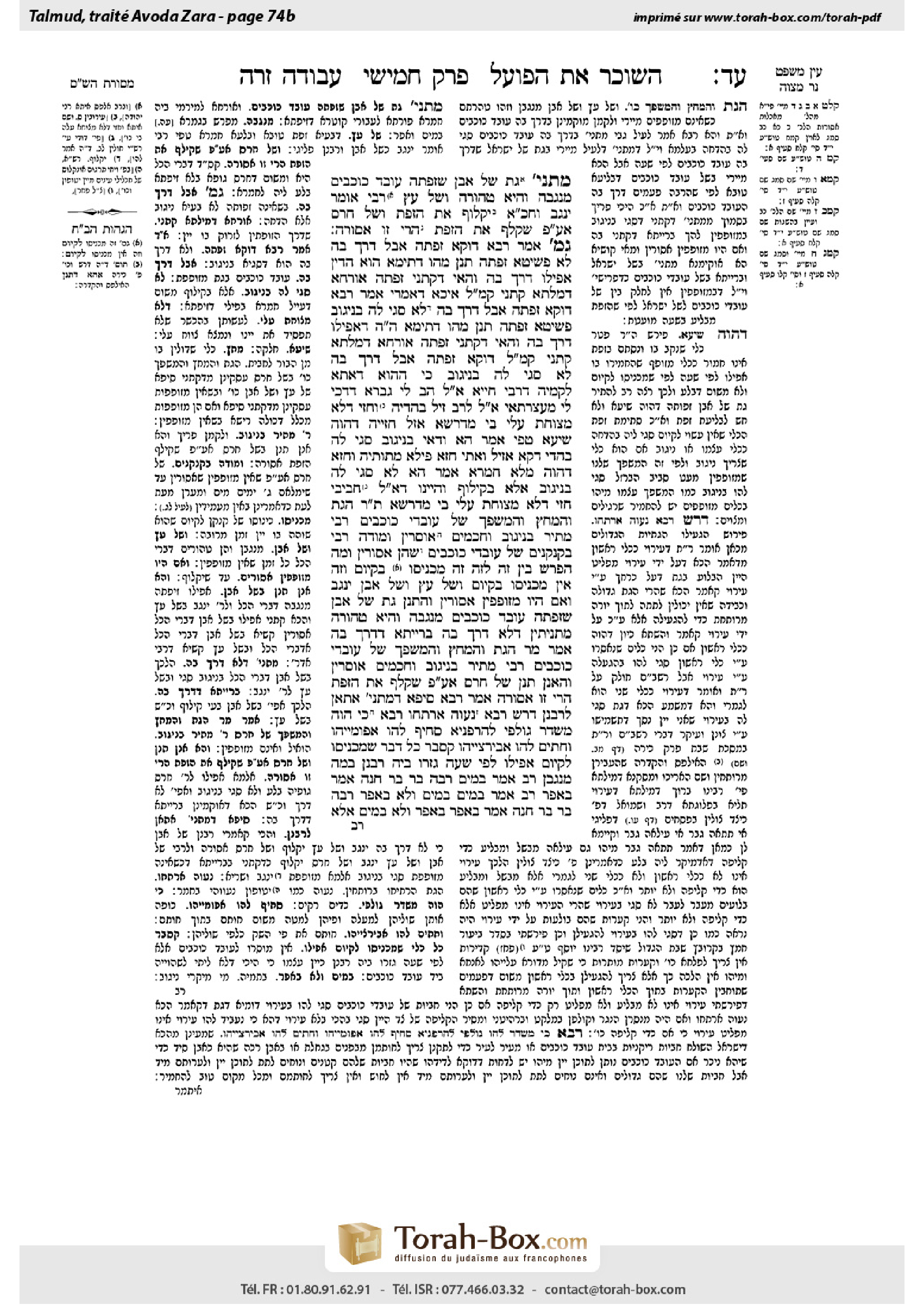
Avodah Zarah 74b: Talmud study for Daf Yomi
Study the Talmud for Daf Yomi with scanned pages, Hebrew text, English translations from Sefaria and AI-generated French translations.
Passage selection and English or AI-generated French translation are available where the scan has annotations. Daf Study is independent of Torah-Box and Sefaria.
Browse Avodah Zarah · עבודה זרה · All tractatesAvodah Zarah 74b text and translations
This page of Avodah Zarah includes the Aramaic text, an English translation and an AI-generated French translation, alongside the scan above.
עבודה זרה ע״ד ב · Aramaic and Hebrew text
מַתְנִי׳ גַּת שֶׁל אֶבֶן שֶׁזְּפָתָהּ גּוֹי, מְנַגְּבָהּ וְהִיא טְהוֹרָה. וְשֶׁל עֵץ, רַבִּי אוֹמֵר: יְנַגֵּב, וַחֲכָמִים אוֹמְרִים: יִקְלוֹף אֶת הַזֶּפֶת. וְשֶׁל חֶרֶס, אַף עַל פִּי שֶׁקָּלַף אֶת הַזֶּפֶת — הֲרֵי זוֹ אֲסוּרָה.
גְּמָ׳ אָמַר רָבָא: דַּוְקָא זְפָתָהּ, אֲבָל דָּרַךְ בָּהּ — לֹא. פְּשִׁיטָא, ״זְפָתָהּ״ תְּנַן! מַהוּ דְּתֵימָא: הוּא הַדִּין אֲפִילּוּ דָּרַךְ בָּהּ, וְהַאי דְּקָתָנֵי ״זְפָתָהּ״ — אוֹרְחָא דְּמִלְּתָא קָתָנֵי, קָא מַשְׁמַע לַן.
אִיכָּא דְּאָמְרִי, אָמַר רָבָא: דַּוְקָא זְפָתָהּ, אֲבָל דָּרַךְ בָּהּ לָא סַגִּי לַהּ בְּנִיגּוּב. פְּשִׁיטָא, ״זְפָתָהּ״ תְּנַן! מַהוּ דְּתֵימָא: הוּא הַדִּין דַּאֲפִילּוּ דָּרַךְ בָּהּ, וְהַאי דְּקָתָנֵי ״זְפָתָהּ״ אוֹרְחָא דְמִלְּתָא קָתָנֵי, קָא מַשְׁמַע לַן דַּוְקָא זְפָתָהּ, אֲבָל דָּרַךְ בָּהּ לָא סַגִּי לַהּ בְּנִיגּוּב.
כִּי הָהוּא דַּאֲתָא לְקַמֵּיהּ דְּרַבִּי חִיָּיא, אֲמַר לֵיהּ: הַב לִי גַּבְרָא (דדכי) [דִּמְדַכֵּי] לִי מַעְצַרְתַּאי, אֲמַר לֵיהּ לְרַב: זִיל בַּהֲדֵיהּ וַחֲזִי דְּלָא מְצַוְּחַתְּ עֲלַי בֵּי מִדְרְשָׁא. אֲזַל חַזְיַיהּ דַּהֲוָה שִׁיעָא טְפֵי, אֲמַר: הָא וַדַּאי בְּנִיגּוּב סַגִּי לַהּ. בַּהֲדֵי דְּקָא אָזֵיל וְאָתֵי, חֲזָא פִּילָא מִתּוּתֵיהּ וַחֲזָא דַּהֲוָה מְלֵא חַמְרָא, אֲמַר: הָא לָא סַגִּי לַהּ בְּנִיגּוּב אֶלָּא בְּקִילּוּף, וְהַיְינוּ דַּאֲמַר לִי חַבִּיבִי: חֲזִי דְּלָא מְצַוְּחַתְּ עֲלַי בֵּי מִדְרְשָׁא.
תָּנוּ רַבָּנַן: הַגַּת וְהַמַּחַץ וְהַמַּשְׁפֵּךְ שֶׁל גּוֹיִם, רַבִּי מַתִּיר בְּנִיגּוּב, וַחֲכָמִים אוֹסְרִין. וּמוֹדֶה רַבִּי בְּקַנְקַנִּים שֶׁל גּוֹיִם שֶׁהֵן אֲסוּרִין. וּמָה הֶפְרֵשׁ בֵּין זֶה לָזֶה? זֶה מַכְנִיסוֹ בְּקִיּוּם, וְזֶה אֵין מַכְנִיסוֹ בְּקִיּוּם. וְשֶׁל עֵץ וְשֶׁל אֶבֶן — יְנַגֵּב, וְאִם הָיוּ מְזוּפָּפִין — אֲסוּרִין.
וְהָתְנַן: גַּת שֶׁל אֶבֶן שֶׁזְּפָתָהּ גּוֹי — מְנַגְּבָהּ וְהִיא טְהוֹרָה! מַתְנִיתִין דְּלֹא דָּרַךְ בָּהּ, בָּרַיְיתָא דְּדָרַךְ בָּהּ.
אָמַר מָר: הַגַּת וְהַמַּחַץ וְהַמַּשְׁפֵּךְ שֶׁל גּוֹיִם, רַבִּי מַתִּיר בְּנִיגּוּב, וַחֲכָמִים אוֹסְרִין. וְהָאֲנַן תְּנַן: שֶׁל חֶרֶס, אַף עַל פִּי שֶׁקָּלַף אֶת הַזֶּפֶת — הֲרֵי זוֹ אֲסוּרָה! אָמַר רָבָא: סֵיפָא דְּמַתְנִיתִין אֲתָאן לְרַבָּנַן.
דָּרֵשׁ רָבָא: נַעֲוָה אַרְתַּחוּ. רָבָא כִּי הֲוָה מְשַׁדַּר גּוּלְפֵי לְהַרְפַּנְיָא, סָחֵיף לְהוּ אַפּוּמַּיְיהוּ וְחָתֵים לְהוּ אַבִּירְצַיְיהוּ. קָסָבַר: כׇּל דָּבָר שֶׁמַּכְנִיסוֹ לְקִיּוּם, אֲפִילּוּ לְפִי שָׁעָה — גְּזַרוּ בֵּיהּ רַבָּנַן.
בַּמֶּה מְנַגְּבָן? רַב אָמַר: בְּמַיִם, רַבָּה בַּר בַּר חָנָה אָמַר: בְּאֵפֶר. רַב אָמַר בְּמַיִם — בְּמַיִם וְלֹא בְּאֵפֶר? רַבָּה בַּר בַּר חָנָה אָמַר בְּאֵפֶר — בְּאֵפֶר וְלֹא בְּמַיִם? אֶלָּא
Avodah Zarah 74b · English translation
MISHNA: In the case of a stone winepress that a gentile lined with pitch and then poured wine onto the pitch to neutralize its flavor, one may cleanse it and it is pure, i.e., wine pressed in it is permitted. And if the winepress is fashioned of wood, Rabbi Yehuda HaNasi says: One may cleanse it, but the Rabbis say: One must peel off the pitch completely. And if the winepress is of earthenware, even if one peeled off the pitch, this press is forbidden.
GEMARA: Rava says: The requirement to cleanse the winepress applies specifically if the gentile lined it with pitch. But if he only trod on his grapes in it without lining it with pitch, this is not required. The Gemara asks: Isn’t this obvious? We learned in the mishna that cleansing the winepress is necessary if the gentile lined it with pitch. The Gemara responds: Lest you say that the same is true that it requires cleansing even if he trod on his grapes in it, and the fact that the mishna teaches a case where he lined it with pitch is because the mishna is teaching the manner in which the matter typically occurs, therefore Rava teaches us that this is not the case.
There are those who say that Rava says: Cleansing the winepress is effective specifically if the gentile lined it with pitch. But if he trod on his grapes in it as well, cleansing it is not sufficient to purify the winepress. The Gemara asks: Isn’t this obvious? We learned in the mishna that cleansing the winepress is sufficient if the gentile lined it with pitch. The Gemara responds: Lest you say that the same is true and that cleansing is sufficient even if he trod on his grapes in it, and the fact that the mishna teaches a case where he lined it with pitch is because the mishna is teaching the manner in which the matter typically occurs, therefore Rava teaches us that cleansing the winepress is sufficient specifically if he lined it with pitch, but if he trod on his grapes in it, cleansing it is not sufficient.
This is similar to an incident involving a certain man who came before Rabbi Ḥiyya and said to him: Give me a man who will purify my winepress that I purchased from a gentile. Rabbi Ḥiyya said to Rav: Go with him and see to it that you conduct yourself in such a manner that will not cause people to complain against me in the study hall. Rav went with him and saw that the winepress was very smooth with pitch. Rav said: Cleansing will certainly be sufficient for this, because it does not absorb the wine. While Rav was going and coming, he saw a crack underneath his feet and saw that it was full of wine. He then said: Cleansing is not sufficient for this; rather, it requires peeling. And this is what my uncle [ḥavivi] meant when he said to me: See to it that you do not cause people to complain against me in the study hall.
The Sages taught: With regard to the winepress and its utensils, the ladle and the funnel, which belong to gentiles, Rabbi Yehuda HaNasi permits them by cleansing, and the Rabbis deem them forbidden. And Rabbi Yehuda HaNasi concedes with regard to earthenware jugs belonging to gentiles that they are forbidden. And what is the difference between this case and that case? This jug contains the wine for storage purposes, and that case, involving a ladle and a funnel, involves utensils that do not contain it for storage purposes but only temporarily. And if the winepress or its utensils are fashioned of wood or stone, one must cleanse them, but if they were lined with pitch, they are forbidden, and cleansing is not sufficient to render them permitted.
The Gemara raises an objection to the last clause of the baraita: But didn’t we learn in the mishna that in the case of a stone winepress that a gentile lined with pitch, one may cleanse it and it is pure? The Gemara answers: The mishna is referring to a case where the gentile did not tread on his grapes in it, whereas the baraita is referring to a case where he trod on his grapes in it.
The Master said above: With regard to the winepress and the ladle and the funnel that belong to gentiles, Rabbi Yehuda HaNasi permits them by cleansing, and the Rabbis deem them forbidden. The Gemara asks: But didn’t we learn in the mishna that if the winepress is of earthenware, even if one peeled off the pitch this press is forbidden? Rava said: In the last clause of the mishna we arrive at the opinion of the Rabbis.
Rava taught: If one has a tank of wine used by gentiles, he must scald it in order to render it permitted for use. When Rava would dispatch empty kegs to Harpanya, he would turn them over, placing them in their sacks on their openings, and seal the sacks on their brims, so that the gentile carriers would not be able to use them for wine. He maintained that with regard to anything that is used to contain wine for storage, even if the wine may be stored in it only temporarily, the Sages decreed that it is forbidden for use as though it had contained wine.
§ The Gemara asks with regard to the cleansing mentioned in the mishna: How does one cleanse a winepress, or utensils used by a gentile for wine? Rav says: One cleans it with water. Rabba bar bar Ḥana says: One cleans it with ashes. The Gemara asks: When Rav says: One cleans it with water, does he mean only with water and not with ashes as well? Furthermore, when Rabba bar bar Ḥana says: One cleans it with ashes, does he mean only with ashes, and not with water as well? Rather, their statements must be understood as follows:
Avodah Zarah 74b · Traduction française (IA)
MICHNA : Dans le cas d'une presse à vin en pierre que les non-Juifs ont recouvert de bitume et ont ensuite versé du vin sur le bitume pour neutraliser son goût, on peut la nettoyer et elle est pure, c'est-à-dire que le vin pressé dans elle est permis. Et si la presse est en bois, Rabbi Yehuda HaNasi dit : On peut la nettoyer, mais les Sages disent : On doit retirer entièrement le bitume. Et si la presse est en terre cuite, même si on retire le bitume, cette presse est interdite.
GUEMARA : Rava dit : La nécessité de nettoyer la presse à vin s'applique spécifiquement si les non-Juifs l'ont recouverte de bitume. Mais si ils n'ont fait qu'écraser leurs raisins dedans sans la recouvrir de bitume, cela n'est pas requis. La Guemara pose la question : N'est-ce pas évident ? Nous avons appris dans la mishna que le nettoyage de la presse à vin est nécessaire si les non-Juifs l'ont recouverte de bitume. La Guemara répond : De peur que vous ne disiez que cela s'applique également si ils ont écrasé leurs raisins dedans, et que le fait que la mishna enseigne un cas où ils l'ont recouverte de bitume est parce que la mishna enseigne la manière dont cela se produit habituellement, donc Rava nous enseigne que cela n'est pas le cas.
Certains disent que Rava dit : Le nettoyage de la presse à vin est efficace spécifiquement si les non-Juifs l'ont recouverte de bitume. Mais si ils ont écrasé leurs raisins dedans également, le nettoyage n'est pas suffisant pour purifier la presse à vin. La Guemara pose la question : N'est-ce pas évident ? Nous avons appris dans la mishna que le nettoyage de la presse à vin est suffisant si les non-Juifs l'ont recouverte de bitume. La Guemara répond : De peur que vous ne disiez que cela s'applique également et que le nettoyage est suffisant même si ils ont écrasé leurs raisins dedans, et que le fait que la mishna enseigne un cas où ils l'ont recouverte de bitume est parce que la mishna enseigne la manière dont cela se produit habituellement, donc Rava nous enseigne que le nettoyage de la presse à vin est suffisant spécifiquement si ils l'ont recouverte de bitume, mais si ils ont écrasé leurs raisins dedans, le nettoyage n'est pas suffisant.
Cela ressemble à un incident concernant un certain homme qui s'est présenté devant Rabbi Ḥiyya et lui a dit : Donnez-moi un homme qui purifiera ma presse à vin que j'ai achetée chez un non-Juif. Rabbi Ḥiyya a dit à Rav : Va avec lui et assure-toi que tu t'y conduises de telle sorte que cela ne cause pas de plaintes contre moi dans la salle de étude. Rav est allé avec lui et a vu que la presse à vin était très lisse avec du bitume. Rav a dit : Le nettoyage sera certainement suffisant pour cela, car elle ne capte pas le vin. Alors que Rav allait et revenait, il a vu une fissure sous ses pieds et a vu qu'elle était pleine de vin. Il a alors dit : Le nettoyage n'est pas suffisant pour cela ; il faut la débarrasser du bitume. Et c'est ce que mon oncle [ḥavivi] voulait dire lorsqu'il m'a dit : Assure-toi que tu ne causes pas de plaintes contre moi dans la salle de étude.
Les Sages ont enseigné : En ce qui concerne la presse à vin et ses ustensiles, le récipient et le tuyau, qui appartiennent aux non-Juifs, Rabbi Yehuda HaNasi permet leur utilisation par le nettoyage, et les Sages les déclarent interdits. Et Rabbi Yehuda HaNasi reconnaît, en ce qui concerne les récipients en terre cuite appartenant aux non-Juifs, qu'ils sont interdits. Et quelle est la différence entre ce cas et celui-là ? Ce récipient contient le vin à des fins de stockage, et ce cas, concernant un récipient et un tuyau, concerne des ustensiles qui ne contiennent pas le vin à des fins de stockage mais seulement temporairement. Et si la presse à vin ou ses ustensiles sont en bois ou en pierre, on doit les nettoyer, mais s'ils sont recouverts de bitume, ils sont interdits, et le nettoyage n'est pas suffisant pour les rendre permis.
La Guemara soulève une objection contre la dernière phrase de la baraïta : Mais n'avons-nous pas appris dans la mishna que dans le cas d'une presse à vin en pierre que les non-Juifs ont recouverte de bitume, on peut la nettoyer et elle est pure ? La Guemara répond : La mishna fait référence à un cas où les non-Juifs n'ont pas foulé leurs raisins dedans, tandis que la baraïta fait référence à un cas où ils ont foulé leurs raisins dedans.
Le Maître a dit ci-dessus : En ce qui concerne la presse à vin et le récipient et le tuyau qui appartiennent aux non-Juifs, Rabbi Yehuda HaNasi permet leur utilisation par le nettoyage, et les Sages les déclarent interdits. La Guemara pose la question : Mais n'avons-nous pas appris dans la mishna que si la presse est en terre cuite, même si on retire le bitume, cette presse est interdite ? Rava dit : Dans la dernière phrase de la mishna, nous arrivons à l'opinion des Sages.
Rava enseigna : Si l'on a un tonneau de vin utilisé par des non-Juifs, il faut le faire bouillir pour le rendre permis à l'usage. Lorsque Rava envoyait des tonneaux vides à Harpanya, il les retournait, les plaçait dans leurs sacs sur leurs ouvertures, et scellait les sacs sur leurs bords, afin que les porteurs non-Juifs ne puissent pas les utiliser pour le vin. Il maintenait que concernant toute chose utilisée pour contenir du vin à des fins de stockage, même si le vin peut être stocké dedans seulement temporairement, les Sages ont décrété qu'il est interdit d'en faire usage comme s'il avait contenu du vin.
§ La Guemara pose la question concernant le nettoyage mentionné dans la mishna : Comment nettoyer une presse à vin, ou des ustensiles utilisés par des non-Juifs pour le vin ? Rav dit : On le nettoie avec de l'eau. Rabba bar bar Ḥana dit : On le nettoie avec des cendres. La Guemara pose la question : Lorsque Rav dit : On le nettoie avec de l'eau, veut-il dire uniquement avec de l'eau et pas aussi avec des cendres ? De plus, lorsque Rabba bar bar Ḥana dit : On le nettoie avec des cendres, veut-il dire uniquement avec des cendres et pas aussi avec de l'eau ? Plutôt, leurs déclarations doivent être comprises ainsi :
Traduction française générée par IA à partir de l’édition anglaise de Sefaria. Vérifie toujours un passage avec le texte source.
Text from Sefaria: William Davidson Edition - Vocalized Aramaic (CC BY NC); William Davidson Edition - English (CC BY NC).