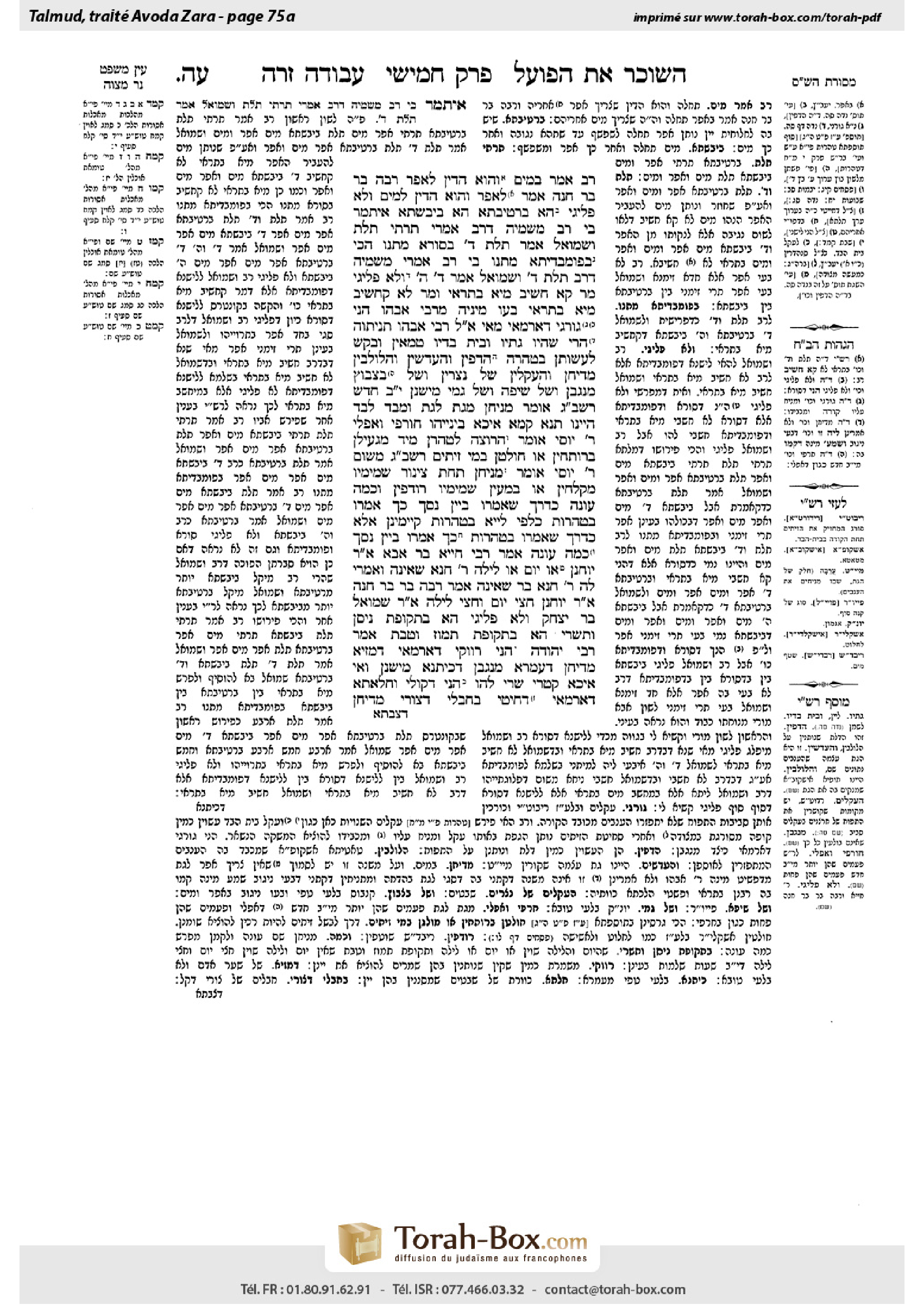
Avodah Zarah 75a: Talmud study for Daf Yomi
Study the Talmud for Daf Yomi with scanned pages, Hebrew text, English translations from Sefaria and AI-generated French translations.
Passage selection and English or AI-generated French translation are available where the scan has annotations. Daf Study is independent of Torah-Box and Sefaria.
Browse Avodah Zarah · עבודה זרה · All tractatesAvodah Zarah 75a text and translations
This page of Avodah Zarah includes the Aramaic text, an English translation and an AI-generated French translation, alongside the scan above.
עבודה זרה ע״ה א · Aramaic and Hebrew text
רַב אָמַר: בְּמַיִם, וְהוּא הַדִּין לְאֵפֶר. רַבָּה בַּר בַּר חָנָה אָמַר: לְאֵפֶר, וְהוּא הַדִּין לְמַיִם, וְלָא פְּלִיגִי — הָא בְּרַטִּיבְתָּא, הָא בְּיַבִּשְׁתָּא.
אִיתְּמַר בֵּי רַב מִשְּׁמֵיהּ דְּרַב אָמְרִי: תַּרְתֵּי תְּלָת, וּשְׁמוּאֵל אָמַר: תְּלָת אַרְבַּע.
בְּסוּרָא מַתְנוּ הָכִי, בְּפוּמְבְּדִיתָא מַתְנוּ: בֵּי רַב אָמְרִי מִשְּׁמֵיהּ דְּרַב: תְּלָת אַרְבַּע, וּשְׁמוּאֵל אָמַר: אַרְבַּע חָמֵשׁ.
וְלָא פְּלִיגִי, מָר קָא חָשֵׁיב מַיָּא בָּתְרָאֵי, וּמָר לָא קָחָשֵׁיב מַיָּא בָּתְרָאֵי.
בְּעוֹ מִינֵּיהּ מֵרַבִּי אֲבָהוּ: הָנֵי גּוּרְגֵּי דַּאֲרַמָּאֵי מַאי?
אֲמַר לְהוּ רַבִּי אֲבָהוּ: תְּנֵיתוּהָ, הֲרֵי שֶׁהָיוּ גִּתָּיו וּבֵית בַּדָּיו טְמֵאִין, וּבִקֵּשׁ לַעֲשׂוֹתָן בְּטָהֳרָה — הַדַּפִּין וְהָעֲדָשִׁין וְהַלּוּלָבִין מַדִּיחָן, וְהָעֲקָלִין שֶׁל נְצָרִין וְשֶׁל בִּצְבּוּץ מְנַגְּבָן, וְשֶׁל שִׁיפָה וְשֶׁל גֶּמִי מְיַשְּׁנָן שְׁנֵים עָשָׂר חֹדֶשׁ. רַבָּן שִׁמְעוֹן בֶּן גַּמְלִיאֵל אוֹמֵר: מַנִּיחָן מִגַּת לְגַת וּמִבַּד לְבַד.
הַיְינוּ תַּנָּא קַמָּא! אִיכָּא בֵּינַיְיהוּ: חוֹרְפֵי וְאַפְלֵי.
רַבִּי יוֹסֵי אוֹמֵר: הָרוֹצֶה לְטַהֲרָן מִיָּד, מַגְעִילָן בְּרוֹתְחִין, אוֹ חוֹלְטָן בְּמֵי זֵיתִים. רַבָּן שִׁמְעוֹן בֶּן גַּמְלִיאֵל מִשּׁוּם רַבִּי יוֹסֵי אוֹמֵר: מַנִּיחָן תַּחַת צִינּוֹר שֶׁמֵּימָיו מְקַלְּחִין, אוֹ בְּמַעְיָן שֶׁמֵּימָיו רוֹדְפִין. וְכַמָּה? עוֹנָה.
כְּדֶרֶךְ שֶׁאָמְרוּ בְּיֵין נֶסֶךְ, כָּךְ אָמְרוּ בִּטְהָרוֹת.
כְּלַפֵּי לְיָיא! בִּטְהָרוֹת קָיְימִינַן! אֶלָּא, כְּדֶרֶךְ שֶׁאָמְרוּ בִּטְהָרוֹת, כָּךְ אָמְרוּ בְּיֵין נֶסֶךְ.
כַּמָּה עוֹנָה? אָמַר רַבִּי חִיָּיא בַּר אַבָּא אָמַר רַבִּי יוֹחָנָן: אוֹ יוֹם אוֹ לַיְלָה. רַבִּי חָנָא שְׁאִינָה, וְאָמְרִי לַהּ רַבִּי חָנָא בַּר שְׁאִינָה, אָמַר רַבָּה בַּר בַּר חָנָה אָמַר רַבִּי יוֹחָנָן: חֲצִי יוֹם וַחֲצִי לַיְלָה.
אָמַר רַבִּי שְׁמוּאֵל בַּר יִצְחָק: וְלָא פְּלִיגִי, הָא בִּתְקוּפַת נִיסָן וְתִשְׁרִי, הָא בִּתְקוּפַת תַּמּוּז וְטֵבֵת.
אָמַר רַב יְהוּדָה: הָנֵי רְוָוקֵי דַּאֲרַמָּאֵי דְּמַזְיָא — מַדִּיחָן, דְּעַמְרָא — מְנַגְּבָן, דְּכִיתָּנָא — מְיַשְּׁנָן, וְאִי אִיכָּא קִטְרֵי — שָׁרֵי לְהוּ. הָנֵי דִּקוּלֵי וְחַלָּאתָא דַּאֲרַמָּאֵי דְּחַיְטִי בְּחַבְלֵי דְּצוּרֵי — מְדִיחָן,
Avodah Zarah 75a · English translation
Rav says: One must cleanse it with water first, and the same must be done with ashes subsequently, and Rabba bar bar Ḥana says: One must cleanse it with ashes first, and the same must be done with water subsequently. The Gemara comments: And they do not disagree. This statement, that it must be cleansed first with ashes and subsequently with water, was stated with regard to a damp winepress. That statement, that first it must be moistened with water and then cleansed with ashes, was stated with regard to a dry winepress.
A dispute was stated with regard to this matter: The Sages of the school of Rav say in the name of Rav that the cleansing process consists of two stages for a damp winepress, namely, ashes and water, and three stages for a dry winepress, namely, water, ashes, and water. And Shmuel says that it consists of three stages for a damp winepress, namely, ashes, water, and ashes, and four stages for a dry winepress, namely, water, ashes, water, and ashes.
In Sura they taught the dispute in this preceding manner, but in Pumbedita they taught it in the following manner: The Sages of the school of Rav said in the name of Rav that the cleansing process consists of three stages for a damp winepress, namely, ashes, water, and ashes, and four stages for a dry winepress, namely, water, ashes, water, and ashes. And Shmuel says that it consists of four stages for a damp winepress, namely, ashes, water, ashes, and water, and five stages for a dry winepress, namely, water, ashes, water, ashes, and water.
The Gemara comments with regard to the latter version of the dispute: And they do not actually disagree. One Sage, Shmuel, counts the last rinsing with water, which is only in order to remove the ashes, and the other Sage, Rav, does not count the last rinsing with water. Therefore Rav counts three and four stages, whereas Shmuel counts four and five.
§ The students asked Rabbi Abbahu with regard to a similar issue of cleansing a utensil from wine of gentiles: With regard to those wicker nets [gorgei] used to hold the grapes during the treading, which belong to gentiles, what is the way to cleanse them?
Rabbi Abbahu said to them: You learned this in a baraita: In the case of one whose winepresses or olive presses were impure, and he wished to prepare his grapes and olives in a state of purity, he must first cleanse the presses from the impure produce for which they were used. He must rinse the planks used as a frame in the winepress, and the troughs, and the twigs used as brooms in the winepress; and he must cleanse the pressing baskets with ashes and water if they were made of palm leaves or of hemp [bitzbutz], or leave them dormant twelve months if they were made of bulrush or of reeds, because these absorb more of the wine. Rabban Shimon ben Gamliel says: He may leave them dormant from one wine-pressing season to the next wine-pressing season, or from one olive-pressing season to the next olive-pressing season.
The Gemara interjects: Isn’t this opinion of Rabban Shimon ben Gamliel the same as that of the first tanna, as twelve months pass from one wine-pressing season to the next? The Gemara responds: The difference between them is with regard to early-ripening grapes and late-ripening grapes. Rabban Shimon ben Gamliel does not require a precise measure of twelve months, as the lapse between ripening seasons may be greater or less.
The baraita continues: Rabbi Yosei says: One who wishes to purify the winepress or olive press immediately without waiting a year can purge them by pouring boiling water over them, or scald them in water used for cooking olives. Rabban Shimon ben Gamliel says in the name of Rabbi Yosei: He can place them under a pipe whose water flows constantly or in a spring with rapid waters. And for how long should he leave them there? He should leave them for an interval of time, as the Gemara will explain.
The baraita adds: In the same way that the Sages stated these cleansing instructions with regard to a winepress used for libation wine, so they stated these instructions with regard to matters of purity.
The Gemara asks with regard to this last clause: Isn’t it the opposite? We are dealing in this baraita with matters of purity, not with the matter of wine used for a libation. Rather, the baraita should be emended: In the same way that the Sages stated this with regard to matters of purity, so they stated this with regard to libation wine.
The Gemara asks: How long is an interval of time? Rabbi Ḥiyya bar Abba says that Rabbi Yoḥanan says: It is either an entire day or an entire night. Rabbi Ḥana Sha’ina, and some say Rabbi Ḥana bar Sha’ina, says that Rabba bar bar Ḥana says that Rabbi Yoḥanan says: It is half a day and half a night.
Rabbi Shmuel bar Yitzḥak says: And they do not disagree. This statement, that it is either a day or a night, is referring to the season of Nisan or Tishrei, i.e., the fall or spring, when the day and the night are of equal length, and that statement, that it is half a day and half a night, is referring to the season of Tammuz or Tevet, i.e., the summer or winter, when they are not equal, and so twelve hours are measured by half the day and half the night.
§ Rav Yehuda says: In order to cleanse those gentiles’ straining bags [ravukei], which are used for straining yeast from wine, with regard to those made of hair, which is not absorbent, one may rinse them. With regard to those made of wool, one must cleanse them with ashes and water. With regard to those made of flax, which is more absorbent, one must leave them dormant. And if there are knots, one must undo them. In order to cleanse those gentiles’ baskets and strainers, with regard to those that are plaited from palm strips, one may rinse them.
Avodah Zarah 75a · Traduction française (IA)
Rav dit : On doit d'abord le nettoyer à l'eau, et ensuite avec des cendres, et Rabba bar bar Ḥana dit : On doit d'abord le nettoyer avec des cendres, et ensuite avec de l'eau. La Guemara commente : Et ils ne sont pas en désaccord. Cette déclaration, selon laquelle il faut d'abord le nettoyer avec des cendres et ensuite avec de l'eau, a été émise en référence à une cave à vin humide. Cette déclaration, selon laquelle il faut d'abord le mouiller avec de l'eau et ensuite le nettoyer avec des cendres, a été émise en référence à une cave à vin sèche.
Un débat a été évoqué à ce sujet : Les Sages de l'école de Rav disent en nom de Rav que le processus de nettoyage comprend deux étapes pour une cave à vin humide, à savoir des cendres et de l'eau, et trois étapes pour une cave à vin sèche, à savoir de l'eau, des cendres et de l'eau. Et Shmuel dit que ce processus comprend trois étapes pour une cave à vin humide, à savoir des cendres, de l'eau et des cendres, et quatre étapes pour une cave à vin sèche, à savoir de l'eau, des cendres, de l'eau et des cendres.
À Sura, ils ont enseigné ce débat de cette manière, mais à Pumbedita, ils l'ont enseigné ainsi : Les Sages de l'école de Rav disent en nom de Rav que le processus de nettoyage comprend trois étapes pour une cave à vin humide, à savoir des cendres, de l'eau et des cendres, et quatre étapes pour une cave à vin sèche, à savoir de l'eau, des cendres, de l'eau et des cendres. Et Shmuel dit que ce processus comprend quatre étapes pour une cave à vin humide, à savoir des cendres, de l'eau, des cendres et de l'eau, et cinq étapes pour une cave à vin sèche, à savoir de l'eau, des cendres, de l'eau, des cendres et de l'eau.
La Guemara commente concernant cette version ultérieure du débat : Ils ne sont pas réellement en désaccord. Un Sage, Shmuel, compte le dernier rinçage avec de l'eau, qui est uniquement pour enlever les cendres, et l'autre Sage, Rav, ne compte pas ce dernier rinçage avec de l'eau. Ainsi, Rav compte trois et quatre étapes, tandis que Shmuel compte quatre et cinq.
§ Les étudiants ont interrogé Rabbi Abbahu concernant un problème similaire de nettoyage d'un ustensile de vin des gentils : En ce qui concerne ces filets [gorgei] utilisés pour tenir les raisins pendant la fermentation, qui appartiennent aux gentils, quelle est la méthode de nettoyage ?
Rabbi Abbahu a dit à eux : Vous avez appris cela dans une baraïta : Dans le cas d'une personne dont les caves à vin ou les presses à huile étaient impures, et qui souhaitait préparer ses raisins et ses olives dans un état de pureté, il devait d'abord nettoyer les presses des produits impurs pour lesquels elles avaient été utilisées. Il devait rincer les planches utilisées comme structure dans la cave à vin, les bassins et les branches utilisées comme balais dans la cave à vin ; et il devait nettoyer les paniers de pressage avec des cendres et de l'eau s'ils étaient faits de feuilles de palmier ou de lin [bitzbutz], ou les laisser dormir douze mois s'ils étaient faits de roseaux ou de joncs, car ces derniers absorbent davantage du vin. Rabban Shimon ben Gamliel dit : Il peut les laisser dormir d'une saison de pressage de vin à la suivante, ou d'une saison de pressage d'olive à la suivante.
La Guemara interrompt : N'est-ce pas l'opinion de Rabban Shimon ben Gamliel la même que celle du premier tanna, puisque douze mois passent d'une saison de pressage de vin à la suivante ? La Guemara répond : La différence entre eux concerne les raisins mûrs tôt et ceux mûrs tardivement. Rabban Shimon ben Gamliel ne nécessite pas une mesure précise de douze mois, car l'intervalle entre les saisons de maturité peut être plus ou moins long.
La baraïta continue : Rabbi Yosei dit : Celui qui souhaite purifier la cave à vin ou la presse à huile sans attendre un an peut les purger en versant de l'eau bouillante sur eux, ou en les faisant bouillir dans de l'eau utilisée pour cuire des olives. Rabban Shimon ben Gamliel dit en nom de Rabbi Yosei : Il peut les placer sous un robinet dont l'eau coule constamment ou dans un cours d'eau à courant rapide. Et pendant combien de temps doit-il les laisser là ? Il doit les laisser pendant un intervalle de temps, comme l'explique la Guemara.
La baraïta ajoute : De la même manière que les Sages ont établi ces instructions de nettoyage concernant une cave à vin utilisée pour le vin de libation, ils ont établi ces instructions concernant les affaires de pureté.
La Guemara pose la question concernant cette dernière clause : N'est-ce pas l'inverse ? Nous traitons dans cette baraïta des affaires de pureté, pas du vin utilisé pour une libation. Plutôt, la baraïta devrait être corrigée : De la même manière que les Sages ont établi cela concernant les affaires de pureté, ils l'ont établi concernant le vin de libation.
La Guemara pose la question : Combien de temps est un intervalle de temps ? Rabbi Ḥiyya bar Abba dit que Rabbi Yoḥanan dit : C'est soit un jour entier, soit une nuit entière. Rabbi Ḥana Sha’ina, et certains disent Rabbi Ḥana bar Sha’ina, dit que Rabba bar bar Ḥana dit que Rabbi Yoḥanan dit : C'est la moitié d'un jour et la moitié d'une nuit.
Rabbi Shmuel bar Yitzḥak dit : Et ils ne sont pas en désaccord. Cette déclaration, selon laquelle c'est soit un jour soit une nuit, fait référence à la saison de Nisan ou de Tishrei, c'est-à-dire l'automne ou le printemps, où le jour et la nuit sont de même durée, et cette déclaration, selon laquelle c'est la moitié d'un jour et la moitié d'une nuit, fait référence à la saison de Tammuz ou de Tevet, c'est-à-dire l'été ou l'hiver, où ils ne sont pas égaux, et ainsi douze heures sont mesurées par la moitié d'un jour et la moitié d'une nuit.
§ Rav Yehuda dit : Afin de nettoyer ces sacs de filtration [ravukei] des gentils, utilisés pour filtrer la levure du vin, concernant ceux faits de cheveux, qui ne sont pas absorbants, on peut les rincer. Concernant ceux faits de laine, on doit les nettoyer avec des cendres et de l'eau. Concernant ceux faits de lin, qui sont plus absorbants, on doit les laisser dormir. Et si des nœuds existent, on doit les dénouer. Afin de nettoyer ces paniers et filtres des gentils, concernant ceux tissés à partir de feuilles de palmier, on peut les rincer.
Traduction française générée par IA à partir de l’édition anglaise de Sefaria. Vérifie toujours un passage avec le texte source.
Text from Sefaria: William Davidson Edition - Vocalized Aramaic (CC BY NC); William Davidson Edition - English (CC BY NC).