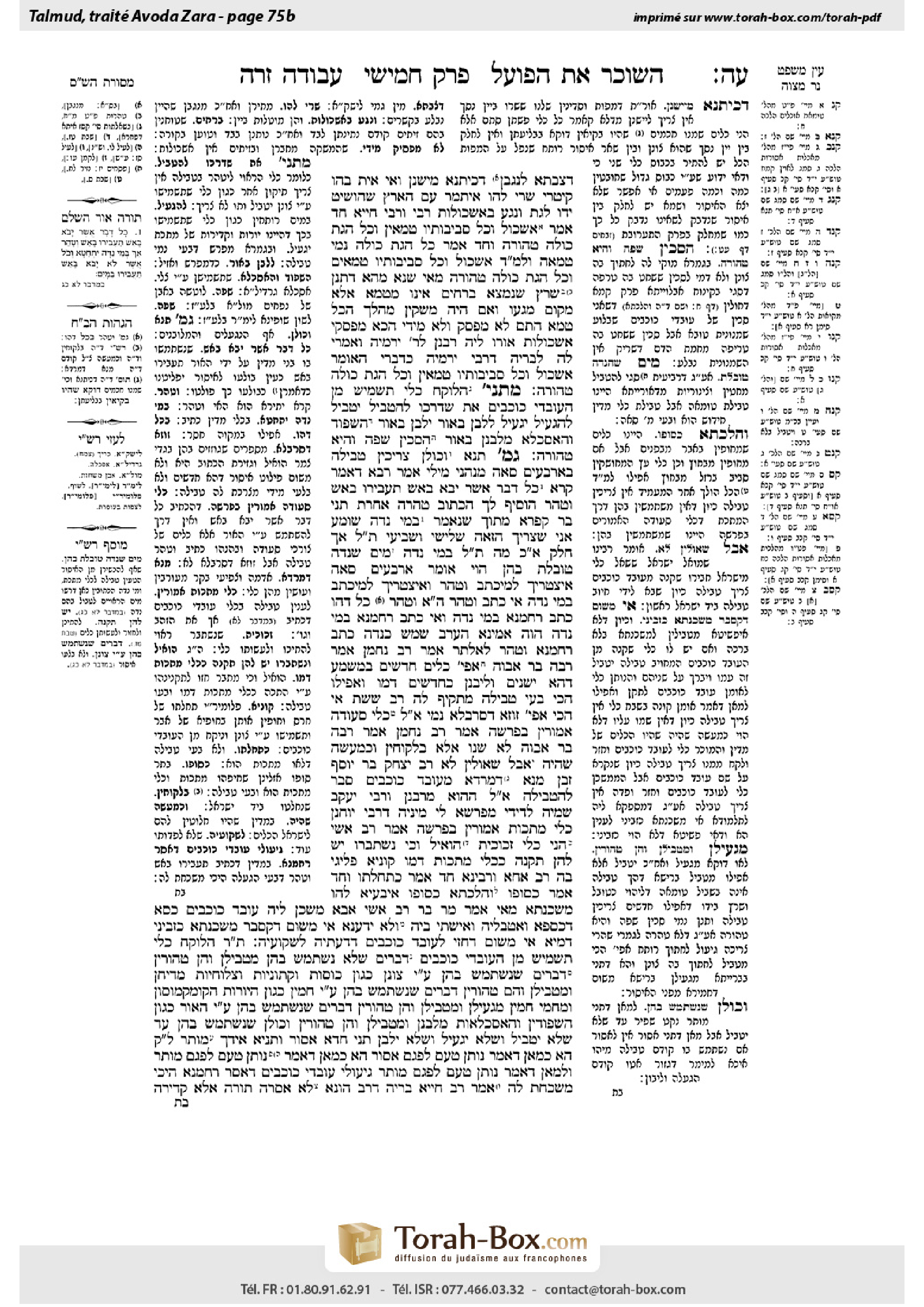
Avodah Zarah 75b: Talmud study for Daf Yomi
Study the Talmud for Daf Yomi with scanned pages, Hebrew text, English translations from Sefaria and AI-generated French translations.
Passage selection and English or AI-generated French translation are available where the scan has annotations. Daf Study is independent of Torah-Box and Sefaria.
Browse Avodah Zarah · עבודה זרה · All tractatesAvodah Zarah 75b text and translations
This page of Avodah Zarah includes the Aramaic text, an English translation and an AI-generated French translation, alongside the scan above.
עבודה זרה ע״ה ב · Aramaic and Hebrew text
דְּצַבְתָּא — לְנַגְּבָן, דְּכִיתָּנָא — מְיַשְּׁנָן, וְאִי אִית בְּהוּ קִיטְרֵי — שָׁרֵי לְהוּ.
אִיתְּמַר: עַם הָאָרֶץ שֶׁהוֹשִׁיט יָדוֹ לַגַּת וְנָגַע בְּאֶשְׁכּוֹלוֹת, רַבִּי וְרַבִּי חִיָּיא — חַד אָמַר: אֶשְׁכּוֹל וְכׇל סְבִיבוֹתָיו טְמֵאִין, וְכׇל הַגַּת כּוּלָּהּ טְהוֹרָה; וְחַד אָמַר: כׇּל הַגַּת כּוּלָּהּ נָמֵי טְמֵאָה.
וּלְמַאן דְּאָמַר: אֶשְׁכּוֹל וְכׇל סְבִיבוֹתָיו טְמֵאִים, וְכׇל הַגַּת כּוּלָּהּ טְהוֹרָה, מַאי שְׁנָא מֵהָא דִּתְנַן: שֶׁרֶץ שֶׁנִּמְצָא בָּרֵחַיִם אֵינוֹ מְטַמֵּא אֶלָּא מְקוֹם מַגָּעוֹ, וְאִם הָיָה מַשְׁקִין מְהַלֵּךְ — הַכֹּל טָמֵא?
הָתָם לָא מַפְסֵק וְלָא מִידֵּי, הָכָא מַפְסְקִי אֶשְׁכּוֹלוֹת.
אוֹרוֹ לֵיהּ רַבָּנַן לְרַבִּי יִרְמְיָה, וְאָמְרִי לַהּ לִבְרֵיהּ דְּרַבִּי יִרְמְיָה, כְּדִבְרֵי הָאוֹמֵר: אֶשְׁכּוֹל וְכׇל סְבִיבוֹתָיו טְמֵאִין, וְכׇל הַגַּת כּוּלָּהּ טְהוֹרָה.
מַתְנִי׳ הַלּוֹקֵחַ כְּלֵי תַּשְׁמִישׁ מִן הַגּוֹיִם, אֶת שֶׁדַּרְכּוֹ לְהַטְבִּיל — יַטְבִּיל, לְהַגְעִיל — יַגְעִיל, לְלַבֵּן בָּאוּר — יְלַבֵּן בָּאוּר. הַשַּׁפּוּד וְהָאַסְכָּלָא — מְלַבְּנָן בָּאוּר, הַסַּכִּין — שָׁפָהּ וְהִיא טְהוֹרָה.
גְּמָ׳ תָּנָא: וְכוּלָּן צְרִיכִין טְבִילָה בְּאַרְבָּעִים סְאָה. מְנָהָנֵי מִילֵּי? אָמַר רָבָא, דְּאָמַר קְרָא: ״כׇּל דָּבָר אֲשֶׁר יָבֹא בָאֵשׁ תַּעֲבִירוּ בָאֵשׁ וְטָהֵר״, הוֹסִיף לְךָ הַכָּתוּב טׇהֳרָה אַחֶרֶת.
תָּנֵי בַּר קַפָּרָא: מִתּוֹךְ שֶׁנֶּאֱמַר ״בְּמֵי נִדָּה״, שׁוֹמֵעַ אֲנִי שֶׁצָּרִיךְ הַזָּאָה שְׁלִישִׁי וּשְׁבִיעִי, תַּלְמוּד לוֹמַר ״אַךְ״ — חָלַק.
אִם כֵּן, מָה תַּלְמוּד לוֹמַר ״בְּמֵי נִדָּה״? מַיִם שֶׁנִּדָּה טוֹבֶלֶת בָּהֶן, הֱוֵי אוֹמֵר: אַרְבָּעִים סְאָה.
אִיצְטְרִיךְ לְמִיכְתַּב ״וְטָהֵר״, וְאִיצְטְרִיךְ לְמִיכְתַּב ״בְּמֵי נִדָּה״. אִי כְּתַב ״וְטָהֵר״, הֲוָה אָמֵינָא ״וְטָהֵר״ כֹּל דְּהוּ, כְּתַב רַחֲמָנָא ״בְּמֵי נִדָּה״.
וְאִי כְּתַב רַחֲמָנָא בְּמֵי נִדָּה, הֲוָה אָמֵינָא הֶעֱרֵב שֶׁמֶשׁ כְּנִדָּה, כְּתַב רַחֲמָנָא ״וְטָהֵר״ לְאַלְתַּר.
אָמַר רַב נַחְמָן אָמַר רַבָּה בַּר אֲבוּהּ: אֲפִילּוּ כֵּלִים חֲדָשִׁים בַּמַּשְׁמָע, דְּהָא יְשָׁנִים וְלִיבְּנָן כַּחֲדָשִׁים דָּמוּ, וַאֲפִילּוּ הָכִי בָּעֵי טְבִילָה. מַתְקֵיף לַהּ רַב שֵׁשֶׁת: אִי הָכִי, אֲפִילּוּ זוּזָא דְּסַרְבָּלָא נָמֵי! אֲמַר לֵיהּ: כְּלֵי סְעוּדָה אֲמוּרִין בַּפָּרָשָׁה.
אָמַר רַב נַחְמָן אָמַר רַבָּה בַּר אֲבוּהּ: לֹא שָׁנוּ אֶלָּא בִּלְקוּחִין, וּכְמַעֲשֶׂה שֶׁהָיָה, אֲבָל שְׁאוּלִין — לָא.
רַב יִצְחָק בַּר יוֹסֵף זְבַן מָנָא דְּמַרְדָּא מִגּוֹי, סְבַר לְהַטְבִּילָהּ, אֲמַר לֵיהּ הָהוּא מֵרַבָּנַן וְרַבִּי יַעֲקֹב שְׁמֵיהּ: לְדִידִי מִפָּרְשָׁא לֵיהּ מִינֵּיהּ דְּרַבִּי יוֹחָנָן: כְּלֵי מַתָּכוֹת אֲמוּרִין בַּפָּרָשָׁה.
אָמַר רַב אָשֵׁי: הָנֵי כְּלֵי זְכוּכִית, הוֹאִיל וְכִי נִשְׁתַּבְּרוּ יֵשׁ לָהֶן תַּקָּנָה, כִּכְלֵי מַתָּכוֹת דָּמוּ. קוּנְיָא, פְּלִיגִי בַּהּ רַב אַחָא וְרָבִינָא, חַד אָמַר: כִּתְחִלָּתוֹ, וְחַד אָמַר: כְּסוֹפוֹ, וְהִלְכְתָא כְּסוֹפוֹ.
אִיבַּעְיָא לְהוּ: מַשְׁכַּנְתָּא מַאי? אָמַר מָר בַּר רַב אָשֵׁי: אַבָּא מַשְׁכֵּן לֵיהּ גּוֹי כָּסָא דְּכַסְפָּא, וְאַטְבְּלֵיהּ וְאִישְׁתִּי בֵּיהּ, וְלָא יָדַעְנָא אִי מִשּׁוּם דְקָסָבַר מַשְׁכַּנְתָּא כִּזְבִינֵי דָּמְיָא, אִי מִשּׁוּם דְּחָזֵי לְגוֹי דְּדַעְתֵּיהּ לְשַׁקּוֹעֵיהּ.
תָּנוּ רַבָּנַן: הַלּוֹקֵחַ כְּלֵי תַּשְׁמִישׁ מִן הַגּוֹיִם, דְּבָרִים שֶׁלֹּא נִשְׁתַּמֵּשׁ בָּהֶן — מַטְבִּילָן וְהֵן טְהוֹרִין. דְּבָרִים שֶׁנִּשְׁתַּמֵּשׁ בָּהֶן עַל יְדֵי צוֹנֵן, כְּגוֹן כּוֹסוֹת וְקִתּוֹנִיּוֹת וּצְלוֹחִיּוֹת — מַדִּיחָן וּמַטְבִּילָן וְהֵם טְהוֹרִין. דְּבָרִים שֶׁנִּשְׁתַּמֵּשׁ בָּהֶן עַל יְדֵי חַמִּין, כְּגוֹן הַיּוֹרוֹת הַקּוּמְקְמוֹסִין וּמְחַמֵּי חַמִּין — מַגְעִילָן וּמַטְבִּילָן וְהֵן טְהוֹרִין. דְּבָרִים שֶׁנִּשְׁתַּמֵּשׁ בָּהֶן עַל יְדֵי הָאוּר, כְּגוֹן הַשַּׁפּוּדִין וְהָאַסְכְּלָאוֹת — מְלַבְּנָן וּמַטְבִּילָן וְהֵן טְהוֹרִין.
וְכוּלָּן שֶׁנִּשְׁתַּמֵּשׁ בָּהֶן עַד שֶׁלֹּא יַטְבִּיל וְשֶׁלֹּא יַגְעִיל וְשֶׁלֹּא יְלַבֵּן, תָּנֵי חֲדָא: אָסוּר, וְתַנְיָא אִידַּךְ: מוּתָּר.
לָא קַשְׁיָא, הָא כְּמַאן דְּאָמַר: נוֹתֵן טַעַם לִפְגָם — אָסוּר, הָא כְּמַאן דְּאָמַר: נוֹתֵן טַעַם לִפְגָם — מוּתָּר.
וּלְמַאן דְּאָמַר: נוֹתֵן טַעַם לִפְגָם — מוּתָּר, גִּיעוּלֵי גוֹיִם דְּאָסַר רַחֲמָנָא הֵיכִי מַשְׁכַּחַתְּ לַהּ?
אָמַר רַב חִיָּיא בְּרֵיהּ דְּרַב הוּנָא: לֹא אָסְרָה תּוֹרָה אֶלָּא קְדֵירָה
Avodah Zarah 75b · English translation
With regard to those that are plaited from tzavta, one must cleanse them with ashes and water. With regard to those that are plaited from flax, one must leave them dormant. And if they have knots, one must undo them.
§ The Gemara discusses another aspect of the purity of a winepress. It was stated: In the case of one who is unreliable with regard to ritual impurity [am ha’aretz] who reached his hand into the winepress and touched grape clusters that were lying in the wine, Rabbi Yehuda HaNasi and Rabbi Ḥiyya disagree. One says that the cluster he touched and all its surroundings are rendered impure, but the rest of the entire winepress is pure, and one says that the rest of the entire winepress is also rendered impure, as the entire winepress is considered connected due to the wine in it.
The Gemara asks: And according to the one who says that the cluster and all its surroundings are impure but the rest of the entire winepress is pure, in what way is this case different from that which we learned in a mishna (Teharot 9:8): The carcass of a creeping animal that was found in an oil press transmits impurity to the place it touched alone, but if there was liquid flowing in the mill, it is all rendered impure? Why is it not the halakha in the case of the winepress as well that the entire winepress is impure due to the liquid in it?
The Gemara answers: There, in the case of the oil press, there is nothing that interrupts the flow of the liquid, and therefore the liquid connects everything to render it impure. Here, the clusters of grapes interrupt the flow of the wine, and so there is no uninterrupted connection between all of the wine in the winepress.
The Sages taught Rabbi Yirmeya, and some say they taught the son of Rabbi Yirmeya, in accordance with the statement of the one who says: The cluster and all its surroundings are impure, but the entire winepress is pure.
MISHNA: One who purchases cooking utensils from the gentiles must prepare them for use by Jews in the following manner: With regard to those utensils whose manner of preparation is to immerse them in a ritual bath, as they require no further preparation, he must immerse them accordingly. With regard to those utensils whose manner of preparation is to purge them with boiling water, as those utensils are used with boiling water, e.g., pots, he must purge them accordingly. With regard to those whose manner of preparation is to heat until white-hot in the fire, as they are used for grilling, he must heat them until white-hot in the fire. Therefore, with regard to the spit [hashappud] and the grill [veha’askela], he must heat them until white-hot in the fire. With regard to the knife, he must polish it and it is rendered pure.
GEMARA: The Sages taught: And they all require immersion in forty se’a of water, including utensils that must first be purged in boiling water or heated until white-hot. The Gemara asks: From where is this matter derived? Rava says: It is derived from that which the verse states with regard to utensils captured in the battle against the Midianites: “Anything that may tolerate the fire, you shall make to go through the fire, and it shall be pure” (Numbers 31:23). By stating: “And it shall be pure,” the verse added to the process another required act of purification in addition to heating the utensil with fire, which is understood to be immersion.
Bar Kappara teaches an additional source for this halakha: From that which is stated in the continuation of the verse: “Nevertheless it shall be purified with the water of sprinkling [nidda],” I would derive that the utensils require sprinkling of purification water on the third and the seventh day of their purification process, as is the halakha in the case of one who is impure with impurity imparted by a corpse. Therefore, the verse states “nevertheless,” indicating that the Torah makes a distinction in this case, and that sprinkling on the third and seventh day are not required.
If that is so, what is the meaning when the verse states: “With the water of sprinkling [nidda]”? Clearly, the term nidda is referring not to sprinkling but to a menstruating woman, who is also called a nidda. Accordingly, the verse means that the utensils must be immersed in water in which a menstruating woman can immerse in order to become pure; and you must say that this is referring to a ritual bath that contains forty se’a of water.
The Gemara explains that both sources for this halakha are necessary: It was necessary for the Torah to write “and it shall be pure,” and it was necessary for the Torah to write “with the water of sprinkling,” because if the Torah had written only “and it shall be pure,” I would say that the verse means: “And it shall be pure” by immersion in any amount of water. Therefore the Merciful One writes: “With the water of sprinkling.”
And if the Merciful One had written only “with the water of sprinkling,” I would say that the process requires the setting of the sun, as is the halakha with regard to a menstruating woman, whose immersion renders her pure only after sunset. Therefore, the Merciful One writes: “And it shall be pure,” indicating that the utensils can be purified immediately.
§ Rav Naḥman says that Rabba bar Avuh says: Even new utensils that were never used that are bought from gentiles are meant to be included in the requirement of immersion, as old utensils that one heated until white-hot are similar to new utensils, as they do not contain the flavor of non-kosher food, and nevertheless they require immersion. Rav Sheshet objects to this: If so, then even scissors for cutting clothing [zuza desarbela] should require immersion as well. Rav Naḥman said to him: Only utensils used in the preparation of meals are mentioned in the passage in the Torah, and only those require immersion.
Rav Naḥman says that Rabba bar Avuh says: The Sages taught this only with regard to utensils that were purchased from gentiles and are therefore comparable to the utensils mentioned in the incident that was related in the passage; but the requirement does not apply to borrowed utensils.
Rav Yitzḥak bar Yosef bought a utensil of marda, a mixture of earth and dung, from a gentile. He thought he was required to immerse it. One of the Sages, and Rabbi Ya’akov was his name, said to him: It was explained to me personally by Rabbi Yoḥanan himself that this requirement applies to metal utensils alone, as those are the utensils mentioned in the passage.
Rav Ashi says: With regard to those glass utensils, since when broken they can be fixed, i.e., remade, if one melts them down and fashions the material into new utensils, they are similar to metal utensils and also require immersion. With regard to lead-glazed earthenware utensils, Rav Aḥa and Ravina disagree. One says: The halakha is in accordance with its initial state; since it was initially an earthenware utensil, it does not require immersion. And one says: The halakha is in accordance with its ultimate state; since it is coated with metal, it requires immersion. The Gemara concludes: And the halakha is in accordance with its ultimate state.
A dilemma was raised before the Sages: If a Jew is holding a gentile’s utensil as collateral, what is the halakha? Is he required to immerse it or not? Mar bar Rav Ashi said: A gentile once gave my father a silver goblet as collateral, and he immersed it and drank from it. But I do not know whether this was because he maintained that possessing a utensil as collateral is considered like a purchase, or because he saw that the gentile’s intention was to leave it with him, and therefore he considered it as his own.
§ The Sages taught: One who purchases utensils from the gentiles must prepare them for use in the following manner: With regard to items that the gentile did not use, one immerses them, and they are pure. With regard to items that the gentile used for cold food or drink, such as cups and jugs and flasks, one rinses them and immerses them, and they are pure. With regard to items that the gentile used for hot food or drink, such as large pots, small kettles [hakumkamusun], and samovars, one purges them with boiling water and immerses them, and they are pure. With regard to items that the gentile used with fire, such as spits and grills, one heats them until white-hot and immerses them, and they are pure.
And with regard to all utensils that one used before immersing and purging and heating them until white-hot, it is taught in one baraita that the food prepared with them is forbidden, and it is taught in another baraita that the food prepared with them is permitted.
The Gemara explains: This contradiction is not difficult. This ruling, that the food prepared with such utensils is forbidden, is according to the one who says that if a forbidden substance imparts flavor to a permitted food to the detriment of the mixture, the permitted food is forbidden. That ruling, that the food prepared with such utensils is permitted, is according to the one who says that if a forbidden substance imparts flavor to a permitted food to the detriment of the mixture, it remains permitted. Here too, since the flavor of non-kosher food imparted by the utensil detracts from the flavor of the food, such food is permitted.
The Gemara asks: But according to the one who says that that if a forbidden substance imparts flavor to a permitted food to the detriment of the mixture then the mixture is permitted, with regard to utensils of gentiles that require purging, which the Merciful One renders forbidden until they are purged, how can you find these circumstances when it is actually prohibited to use the utensils until they are purged? Since utensils impart a detrimental flavor to food that is cooked in them, there seems to be no reason not to use utensils of gentiles without purging them.
Rav Ḥiyya, son of Rav Huna, says: The Torah renders forbidden only a pot
Avodah Zarah 75b · Traduction française (IA)
Concernant ceux qui sont tissés à partir de tzavta, il faut les nettoyer avec des cendres et de l'eau. Concernant ceux qui sont tissés à partir de lin, il faut les laisser dormir. Et si ils ont des nœuds, il faut les dénouer.
§ La Guemara discute d'un autre aspect de la pureté d'une vigne. Il a été dit : Dans le cas d'une personne peu fiable en matière de souillure rituelle [am ha'aretz] qui a tendu sa main vers la vigne et a touché des grappes qui étaient dans le vin, Rabbi Yehuda HaNasi et Rabbi Ḥiyya sont en désaccord. L'un dit que la grappe qu'il a touchée et tout ce qui l'entoure est souillée, mais le reste de toute la vigne est pur, et l'autre dit que le reste de toute la vigne est également souillé, car toute la vigne est considérée comme connectée en raison du vin qu'elle contient.
La Guemara pose la question : Et selon celui qui dit que la grappe et tout ce qui l'entoure est souillée mais que le reste de toute la vigne est pur, dans quelle mesure ce cas diffère-t-il de celui que nous avons appris dans une mitsna (Teharot 9:8) : Le cadavre d'un animal rampant trouvé dans une presse à huile transmet la souillure uniquement à la place qu'il a touchée, mais si il y avait un liquide qui coulait dans la meule, tout est rendu souillé ? Pourquoi ce cas ne serait-il pas aussi souillé selon la halakha dans le cas de la vigne en raison du liquide qu'elle contient ?
La Guemara répond : Là, dans le cas de la presse à huile, il n'y a rien qui interrompt le courant du liquide, et donc le liquide rend tout impur. Ici, les grappes de raisin interrompent le courant du vin, et donc il n'y a pas de connexion continue entre tout le vin de la vigne.
Les Sages ont enseigné à Rabbi Yirmeya, et certains disent qu'ils ont enseigné au fils de Rabbi Yirmeya, conformément à l'affirmation de celui qui dit : La grappe et tout ce qui l'entoure est impure, mais toute la vigne est pure.
MICHNA : Celui qui achète des ustensiles de cuisine aux non-Juifs doit les préparer pour leur utilisation par les Juifs de la manière suivante : Concernant ceux dont la méthode de préparation est d'être immergés dans un bain rituel, car ils n'ont besoin d'aucune autre préparation, il doit les immerger ainsi. Concernant ceux dont la méthode de préparation est de les purger avec de l'eau bouillante, car ces ustensiles sont utilisés avec de l'eau bouillante, par exemple des casseroles, il doit les purger ainsi. Concernant ceux dont la méthode de préparation est de les chauffer jusqu'à être blanchâtres dans le feu, car ils sont utilisés pour la grillade, il doit les chauffer jusqu'à être blanchâtres dans le feu. Ainsi, concernant le brochet et la grille, il doit les chauffer jusqu'à être blanchâtres dans le feu. Concernant le couteau, il doit le polir et il est rendu pur.
GUEMARA : Les Sages ont enseigné : Et tous nécessitent une immersion dans quarante se'a d'eau, y compris les ustensiles qui doivent d'abord être purgés avec de l'eau bouillante ou chauffés jusqu'à être blanchâtres. La Guemara pose la question : D'où cette matière est-elle dérivée ? Rava dit : Elle est dérivée de ce que le verset mentionne concernant les ustensiles capturés dans la bataille contre les Midianites : « Tout ce qui peut supporter le feu, vous ferez passer par le feu, et il sera pur » (Nombres 31:23). En disant : « Et il sera pur », le verset a ajouté à la procédure un autre acte de purification nécessaire en plus du chauffage de l'ustensile avec le feu, qui est compris comme une immersion.
Bar Kappara enseigne une autre source pour cette halakha : De ce qui est dit dans la continuation du verset : « Cependant, il sera purifié avec l'eau de sprinkling [nidda] », je déduis que les ustensiles nécessitent le sprinkling de l'eau de purification sur le troisième et le septième jour de leur processus de purification, comme c'est la halakha dans le cas d'une personne souillée par une souillure transmise par un cadavre. Ainsi, le verset dit « cependant », indiquant que la Torah fait une distinction dans ce cas, et que le sprinkling le troisième et le septième jour n'est pas requis.
Si c'est ainsi, quelle est la signification lorsque le verset dit : « Avec l'eau de sprinkling [nidda] » ? Évidemment, le terme nidda ne fait pas référence au sprinkling mais à une femme en période de menstruation, qui est aussi appelée une nidda. Ainsi, le verset signifie que les ustensiles doivent être immergés dans l'eau dans lequel une femme en période de menstruation peut s'immerger pour devenir pure ; et vous devez dire que cela fait référence à un bain rituel contenant quarante se'a d'eau.
La Guemara explique que les deux sources pour cette halakha sont nécessaires : Il était nécessaire que la Torah ait écrit « et il sera pur », et il était nécessaire que la Torah ait écrit « avec l'eau de sprinkling », car si la Torah avait écrit seulement « et il sera pur », je dirais que le verset signifie : « Et il sera pur » par immersion dans n'importe quelle quantité d'eau. Ainsi, le Mercieux a écrit : « Avec l'eau de sprinkling ».
Et si le Mercieux avait écrit seulement « avec l'eau de sprinkling », je dirais que le processus exige la mise du soleil, comme c'est la halakha concernant une femme en période de menstruation, dont l'immersion rend pure uniquement après le coucher du soleil. Ainsi, le Mercieux a écrit : « Et il sera pur », indiquant que les ustensiles peuvent être purifiés immédiatement.
§ Rav Naḥman dit que Rabba bar Avuh dit : Même les ustensiles nouveaux qui n'ont jamais été utilisés, achetés aux non-Juifs, doivent être inclus dans la nécessité d'immersion, car les ustensiles anciens que l'on a chauffés jusqu'à être blanchâtres sont semblables aux ustensiles nouveaux, car ils n'ont pas le goût de nourriture non-kosher, et pourtant ils nécessitent l'immersion. Rav Sheshet s'oppose à cela : Si c'est ainsi, alors même les ciseaux pour couper les vêtements [zuza desarbela] devraient nécessiter l'immersion. Rav Naḥman a dit à lui : Seuls les ustensiles utilisés dans la préparation des repas sont mentionnés dans le passage de la Torah, et seulement ceux-là nécessitent l'immersion.
Rav Naḥman dit que Rabba bar Avuh dit : Les Sages ont enseigné cela uniquement concernant les ustensiles achetés chez les non-Juifs et donc comparables aux ustensiles mentionnés dans l'incident rapporté dans le passage ; mais la exigence ne s'applique pas aux ustensiles empruntés.
Rav Yitzḥak bar Yosef acheta un ustensile de marda, mélange de terre et de crottin, chez un non-Juif. Il pensait être tenu de le purifier. Un des Sages, et Rabbi Ya’akov était son nom, lui dit : On m'a expliqué personnellement par Rabbi Yoḥanan lui-même que cette exigence s'applique uniquement aux ustensiles métalliques, car ce sont les ustensiles mentionnés dans le passage.
Rav Ashi dit : Concernant ces ustensiles en verre, puisqu'ils peuvent être réparés, c'est-à-dire recréés, si l'on fond leur matière et qu'on en fait de nouveaux ustensiles, ils sont comparables aux ustensiles métalliques et nécessitent également la purification. Concernant les ustensiles en terre recouverts de glaçure en plomb, Rav Aḥa et Ravina s'opposent. L'un dit : La halakha suit leur état initial ; puisqu'ils étaient initialement des ustensiles en terre, ils n'ont pas besoin de purification. L'autre dit : La halakha suit leur état final ; puisqu'ils sont recouverts de métal, ils nécessitent la purification. La Guemara conclut : Et la halakha suit leur état final.
Un dilemme fut soulevé devant les Sages : Si un Juif tient un ustensile d'un non-Juif en garantie, quelle est la halakha ? Doit-il le purifier ou non ? Mar bar Rav Ashi dit : Un non-Juif m'a donné un gobelet en argent en garantie, et mon père le purifia et le but. Mais je ne sais pas si cela était parce qu'il considérait que tenir un ustensile en garantie est comme un achat, ou parce qu'il voyait que l'intention du non-Juif était de le laisser avec lui, et donc de le considérer comme sien.
§ Les Sages enseignèrent : Celui qui achète des ustensiles chez les non-Juifs doit les préparer à l'usage de la manière suivante : Concernant les objets que le non-Juif n'a pas utilisés, on les purifie et ils sont purs. Concernant les objets que le non-Juif a utilisés pour des aliments ou boissons froids, tels que des coupes, des jarres et des flacons, on les rince et on les purifie, et ils sont purs. Concernant les objets que le non-Juif a utilisés pour des aliments ou boissons chauds, tels que de grands chaudrons, de petits bouilloirs [hakumkamusun] et des samovars, on les nettoie à l'eau bouillante et on les purifie, et ils sont purs. Concernant les objets que le non-Juif a utilisés avec le feu, tels que des broches et des grillades, on les chauffe jusqu'à ce qu'ils soient blancs et on les purifie, et ils sont purs.
Et concernant tous les ustensiles qui ont été utilisés avant leur purification, leur nettoyage et leur chauffage jusqu'à ce qu'ils soient blancs, il est enseigné dans une baraïta que les aliments préparés avec eux sont interdits, et il est enseigné dans une autre baraïta que les aliments préparés avec eux sont permis.
La Guemara explique : Ce paradoxe n'est pas difficile. Cette décision, que les aliments préparés avec de tels ustensiles sont interdits, est selon celui qui dit que si une substance interdite imprègne un aliment permis à l'avantage de la mixture, l'aliment permis est interdit. Cette décision, que les aliments préparés avec de tels ustensiles sont permis, est selon celui qui dit que si une substance interdite imprègne un aliment permis à l'avantage de la mixture, il reste permis. Ici aussi, puisque le goût d'aliments non-kosher imprégné par l'ustensile détériore le goût de l'aliment, cet aliment est permis.
La Guemara demande : Mais selon celui qui dit que si une substance interdite imprègne un aliment permis à l'avantage de la mixture alors la mixture est permise, concernant les ustensiles des non-Juifs qui nécessitent le nettoyage, que l'Éternel rend interdits jusqu'à ce qu'ils soient nettoyés, comment pouvez-vous trouver ces circonstances lorsque l'usage des ustensiles est effectivement interdit jusqu'à ce qu'ils soient nettoyés ? Puisque les ustensiles imprègnent un goût nuisible aux aliments cuits dedans, il semble qu'il n'y ait pas de raison de ne pas utiliser les ustensiles des non-Juifs sans les nettoyer.
Rav Ḥiyya, fils de Rav Huna, dit : La Torah rend interdit uniquement un chaudron
Traduction française générée par IA à partir de l’édition anglaise de Sefaria. Vérifie toujours un passage avec le texte source.
Text from Sefaria: William Davidson Edition - Vocalized Aramaic (CC BY NC); William Davidson Edition - English (CC BY NC).