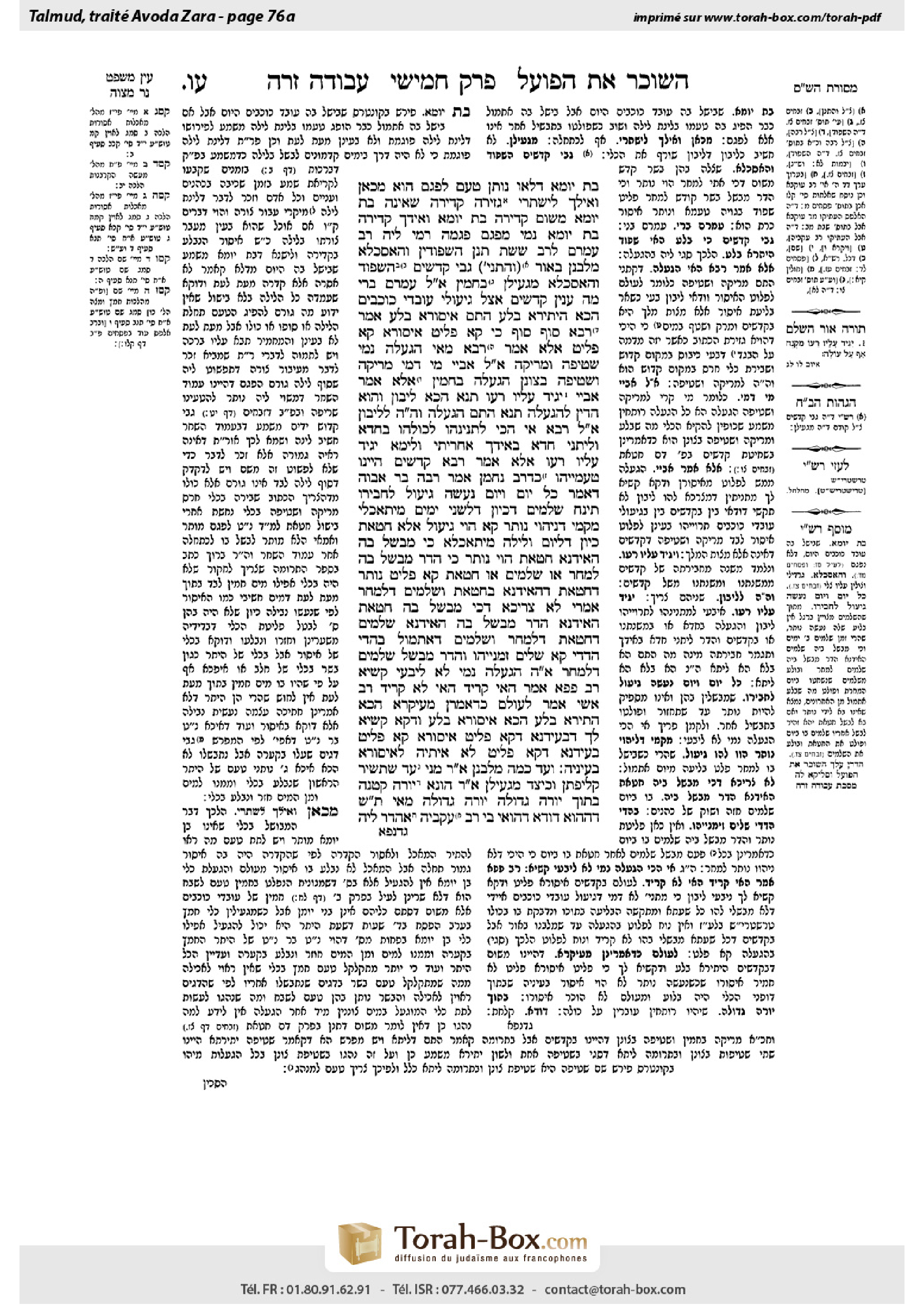
Avodah Zarah 76a: Talmud study for Daf Yomi
Study the Talmud for Daf Yomi with scanned pages, Hebrew text, English translations from Sefaria and AI-generated French translations.
Passage selection and English or AI-generated French translation are available where the scan has annotations. Daf Study is independent of Torah-Box and Sefaria.
Browse Avodah Zarah · עבודה זרה · All tractatesAvodah Zarah 76a text and translations
This page of Avodah Zarah includes the Aramaic text, an English translation and an AI-generated French translation, alongside the scan above.
עבודה זרה ע״ו א · Aramaic and Hebrew text
בַּת יוֹמָאּ, דְּלָאו נוֹתֵן טַעַם לִפְגָם הוּא.
מִכָּאן וְאֵילָךְ לִישְׁתְּרֵי! גְּזֵירָה קְדֵירָה שֶׁאֵינָהּ בַּת יוֹמָאּ מִשּׁוּם קְדֵירָה בַּת יוֹמָאּ.
וְאִידָּךְ? קְדֵירָה בַּת יוֹמָאּ נָמֵי מִפְגָּם פָּגְמָה.
רָמֵי לֵיהּ רַב עַמְרָם לְרַב שֵׁשֶׁת, תְּנַן: הַשַּׁפּוּדִין וְהָאַסְכָּלָא — מְלַבְּנָן בָּאוּר, וְהָתַנְיָא גַּבֵּי קָדָשִׁים: הַשַּׁפּוּד וְהָאַסְכָּלָא — מַגְעִילָן בְּחַמִּין!
אֲמַר לֵיהּ: עַמְרָם בְּרִי, מָה עִנְיַן קָדָשִׁים אֵצֶל גִּיעוּלֵי גוֹיִם? הָכָא הֶיתֵּירָא בָּלַע, הָתָם אִיסּוּרָא בָּלַע.
אָמַר רָבָא: סוֹף סוֹף כִּי קָא פָלֵיט אִיסּוּרָא קָא פָלֵיט, אֶלָּא אָמַר רָבָא: מַאי הַגְעָלָה? נָמֵי שְׁטִיפָה וּמְרִיקָה.
אֲמַר לֵיהּ אַבָּיֵי: מִי דָּמֵי? מְרִיקָה וּשְׁטִיפָה בְּצוֹנֵן, הַגְעָלָה בְּחַמִּין! אֶלָּא אָמַר אַבָּיֵי: יַגִּיד עָלָיו רֵעוֹ — תְּנָא הָכָא לִיבּוּן, וְהוּא הַדִּין לְהַגְעָלָה; תְּנָא הָתָם הַגְעָלָה, וְהוּא הַדִּין לְלִיבּוּן.
אֲמַר לֵיהּ רָבָא: אִי הָכִי, לִתְנִינְהוּ לְכוּלְּהוּ בַּחֲדָא, וְלִיתְנֵי חֲדָא בְּאִידַּךְ אַחֲרִיתִי, וְלֵימָא: ״יַגִּיד עָלָיו רֵעוֹ״!
אֶלָּא אָמַר רָבָא: קָדָשִׁים הַיְינוּ טַעְמַיְיהוּ, כִּדְרַב נַחְמָן אָמַר רַבָּה בַּר אֲבוּהּ, דְּאָמַר: כׇּל יוֹם וָיוֹם נַעֲשֶׂה גִּיעוּל לַחֲבֵירוֹ.
תִּינַח שְׁלָמִים, דְּכֵיוָן דְּלִשְׁנֵי יָמִים מִיתְאַכְלִי, מִקַּמֵּי דְּנִיהְוֵי נוֹתָר קָא הָוֵי גִּיעוּל. אֶלָּא חַטָּאת, כֵּיוָן דִּלְיוֹם וְלַיְלָה מִיתְאַכְלָא, כִּי מְבַשֵּׁל בַּהּ הָאִידָּנָא חַטָּאת — הָוֵי נוֹתָר, כִּי הָדַר מְבַשֵּׁל בַּהּ לִמְחַר אוֹ שְׁלָמִים אוֹ חַטָּאת, קָא פָלֵיט נוֹתָר דְּחַטָּאת דְּהָאִידָּנָא בְּחַטָּאת וּשְׁלָמִים דְּלִמְחַר!
אָמְרִי: לָא צְרִיכָא, דְּכִי מְבַשֵּׁל בַּהּ חַטָּאת הָאִידָּנָא, הָדַר מְבַשֵּׁל בַּהּ הָאִידָּנָא שְׁלָמִים.
דְּחַטָּאת דְּלִמְחַר, וּשְׁלָמִים דְּאֶתְמוֹל, בַּהֲדֵי הֲדָדֵי קָא שָׁלֵים זִמְנַיְיהוּ, וַהֲדַר מְבַשֵּׁל שְׁלָמִים דְּלִמְחַר.
אִי הָכִי, הַגְעָלָה נָמֵי לָא לִיבְעֵי! קַשְׁיָא.
רַב פָּפָּא אָמַר: הַאי קָרִיד, הַאי לָא קָרִיד.
רַב אָשֵׁי אָמַר: לְעוֹלָם כְּדַאֲמַרַן מֵעִיקָּרָא, הָכָא הֶתֵּירָא בָּלַע, הָכָא אִיסּוּרָא בָּלַע.
וּדְקָא קַשְׁיָא לָךְ, דִּבְעִידָּנָא דְּקָא פָלֵיט אִיסּוּרָא קָא פָלֵיט, בְּעִידָּנָא דְּקָא פָלֵיט לָא אִיתֵיהּ לְאִיסּוּרָא בְּעֵינֵיהּ.
וְעַד כַּמָּה מְלַבְּנָן? אָמַר רַבִּי מִנִּי: עַד שֶׁתַּשִּׁיר קְלִיפָּתָן. וְכֵיצַד מַגְעִילָן? אָמַר רַב הוּנָא: יוֹרָה קְטַנָּה בְּתוֹךְ יוֹרָה גְּדוֹלָה.
יוֹרָה גְּדוֹלָה, מַאי? תָּא שְׁמַע: דְּהָהוּא דּוּדָא דַּהֲוַאי בֵּי רַב עֲקַבְיָה, אַהְדַּר לַהּ.
Avodah Zarah 76a · English translation
that was used for cooking that same day by a gentile, as in such a case, it does not impart flavor to food cooked in it to the detriment of the mixture.
The Gemara asks: If so, from that point onward the pot should be permitted, as on the following day the taste of the non-kosher food imparted by the pot is already to the detriment of the food. The Gemara answers: There is a rabbinic decree that prohibits use of a pot that was not used by a gentile that same day, due to concern that one will use a pot used by a gentile that same day.
The Gemara comments: And according to the opinion of the other tanna, who holds that even if the imparted flavor is to the detriment of the permitted food nevertheless it is forbidden, even the flavor imparted by a pot that was used that same day is detrimental to the flavor of the food, and still the Torah deems it forbidden, which proves that if a forbidden substance imparts flavor to a permitted food to its detriment, the permitted food is forbidden.
§ Rav Amram raises a contradiction before Rav Sheshet: We learned in the mishna: With regard to the spits and the grill, one must heat them until white-hot in the fire. But it is taught in a mishna (Zevaḥim 97a) with regard to sacrificial meat: The spit and the grill that were used to roast sacrificial meat may not be used again after the time for eating that particular offering has passed, as the leftover taste of the offering in these utensils is forbidden, unless one purges them in hot water. Apparently, heating them until white-hot is unnecessary.
Rav Sheshet said to him: Amram, my son, what has the matter of sacrificial meat to do with vessels of gentiles that require purging? Here, in the case of sacrificial meat, the utensils absorbed a permitted food that subsequently became forbidden, and therefore purging in hot water is sufficient. There, in the case of utensils acquired from gentiles, the utensils absorbed a forbidden food, and so they must be heated until white-hot.
Rava disagreed, saying: Ultimately, even in the case of sacrificial meat, when it emits flavor, it emits a forbidden flavor, so what difference does it make that it was permitted when it was absorbed? Rather, Rava said: What is meant by the purging stated with regard to sacrificial meat? It means that besides heating it until white-hot, rinsing and scouring it are also required, as is the halakha with regard to any utensil used with sacrificial meat, as the verse states: “It shall be scoured and rinsed in water” (Leviticus 6:21).
Abaye said to him: Are rinsing and scouring comparable to purging? Scouring and rinsing are done in cold water, whereas purging is done in hot water. Therefore, this is not a valid interpretation of the term purging. Rather, Abaye said that the Mishna employs the style of: Its counterpart reveals about it (see Job 36:33), as follows: The Mishna taught here that the spit and the grill require heating until white-hot, and the same is true of purging, which is also required. The Mishna taught there that purging the spit and the grill is necessary, and the same is true of heating until white-hot.
Rava said to him: If so, let the Mishna teach all of these requirements in one of the places, and let it teach only one of them in the other, and then let us say that the Mishna employs the style of: Its counterpart reveals about it. The principle that one mishna supplements the other can apply when all of the information is stated in one of the two places, but not when each has only part of it.
Rather, Rava said that with regard to sacrificial meat, this is the reason that its utensils do not require heating until white-hot: It is in accordance with that which Rav Naḥman says that Rabba bar Avuh says, as he says: Each and every day constitutes purging for the other day, i.e., the previous day. Since the designated time for eating the meat of a peace-offering ends the day after it is sacrificed, using the utensils every day for an offering sacrificed on that day guarantees that the taste of every offering is expelled from the utensils before they become forbidden, by using them with fire on the following day. Therefore the utensils do not require special heating until white-hot in fire in order to become permitted for subsequent use.
The Gemara raises an objection: This works out well with regard to peace-offerings, as, since their meat may be eaten over two days, purging is achieved before they become leftover sacrificial meat, which is forbidden. But with regard to a sin-offering, since its meat may be eaten only over the course of a day and a night, when one cooks the meat of a sin-offering with the utensil now, it becomes leftover the next morning. And when one cooks with it again the next day, whether the meat of a peace-offering or a sin-offering, the utensil expels the leftover taste of the sin-offering sacrificed now into the meat of the sin-offering or peace-offering sacrificed the next day, and it should be forbidden.
The Sages say in response: It is not necessary to purge the utensil by heating it until white-hot even if it was used for the meat of a sin-offering; it is possible to avoid such a requirement, as when one cooks a sin-offering with the utensil now, he can then cook the meat of a peace-offering with the same utensil now, i.e., on the same day, and the taste of the sin-offering is consequently expelled from the utensil on that same day.
Then, when the taste of the peace-offering is absorbed, it creates a situation where the designated times for eating the meat of the sin-offering of the next day and the meat of the peace-offering of the previous day are complete simultaneously. It is therefore possible to use the utensil for cooking the meat of a sin-offering the next day without having to purge it from the taste of the previous day’s offerings. And one can then cook the meat of a peace-offering with the utensil the next day, thereby expelling from it the taste of the sin-offering of that day, and repeat this practice day after day.
The Gemara raises an objection: If so, if each day the utensil expels the taste of the sacrificial meat that has not become leftover, then purging it with boiling water is also unnecessary. Why, then, does the mishna require purging with boiling water? The Gemara comments: This poses a difficulty to Rava’s explanation.
Rav Pappa said that there is another resolution to the contradiction between mishnayot: In this case of a gentile’s spit and grill, because it is a utensil that is not in continual use, it becomes crusty and must be heated until white-hot; but that utensil used for sacrificial meat is in continual use, so it does not become crusty.
Rav Ashi said: Actually, the contradiction should be resolved as we said from the outset, as explained by Rav Sheshet: There, in the case of sacrificial meat, the utensils absorbed a permitted food that subsequently became forbidden, and therefore purging is sufficient. Here, in the case of utensils acquired from gentiles, the utensils absorbed a forbidden food, and so they must be heated until white-hot.
And as for that which poses a difficulty for you, that at the time that the utensil expels flavor, it expels the flavor of a forbidden food, the answer is that at the time it expels flavor, the forbidden food is nonexistent in its substantive form. Since the forbidden substance expelled from the utensil is not the forbidden food itself but only its flavor, it is treated leniently, and therefore the fact that it was permitted at the time it was absorbed in the utensil is taken into account.
§ Returning to the mishna, the Gemara asks: And how much does one heat utensils to make them white-hot? Rabbi Mani says: Until they shed their outer layer. And how does one purge utensils with boiling water? Rav Huna says: One immerses a small kettle inside a large kettle of boiling water.
The Gemara asks: What does one do with a large kettle? The Gemara suggests: Come and hear an answer from an incident involving a certain cauldron that was in the house of Rav Akavya and required purging. He surrounded it
Avodah Zarah 76a · Traduction française (IA)
celui qui avait été utilisé pour la cuisson le même jour par un non-juif, car dans ce cas, il ne transmet pas de goût à la nourriture cuite dans lui à l'inverse de la mixture.
La Guemara pose la question : Si c'est ainsi, à partir de ce moment, la marmite devrait être autorisée, car le lendemain le goût de la nourriture non-kosher transmis par la marmite est déjà à l'inverse de la nourriture. La Guemara répond : Il y a un décret rabbinique qui interdit l'utilisation d'une marmite qui n'a pas été utilisée par un non-juif le même jour, en raison de la crainte qu'on utilise une marmite utilisée par un non-juif le même jour.
La Guemara commente : Et selon l'opinion du tanna suivant, qui considère que même si le goût transmis est à l'inverse de la nourriture permise, elle est interdite, même le goût transmis par une marmite utilisée le même jour est à l'inverse de la nourriture, et pourtant la Torah considère qu'il est interdit, ce qui prouve que si une substance interdite transmet un goût à une nourriture permise à son inverse, la nourriture permise est interdite.
§ Rav Amram soulève une contradiction devant Rav Sheshet : Nous avons appris dans la Michna : Concernant les brochettes et la grille, il faut les chauffer jusqu'à ce qu'ils soient blancs au feu. Mais il est enseigné dans une autre Michna (Zevaḥim 97a) concernant la viande sacrificielle : Les brochettes et la grille utilisés pour cuire la viande sacrificielle ne peuvent pas être utilisés à nouveau après la période d'ingestion de cette offrande, car le goût résiduel de l'offrande dans ces ustensiles est interdit, à moins qu'on les nettoie à l'eau bouillante. Apparemment, chauffer jusqu'à ce qu'ils soient blancs n'est pas nécessaire.
Rav Sheshet dit à lui : Amram, mon fils, à quoi bon la viande sacrificielle dans l'affaire des ustensiles des non-juifs qui nécessitent un nettoyage ? Ici, dans le cas de la viande sacrificielle, les ustensiles ont absorbé une nourriture permise qui est ensuite devenue interdite, et par conséquent le nettoyage à l'eau bouillante suffit. Là, dans le cas des ustensiles achetés des non-juifs, les ustensiles ont absorbé une nourriture interdite, et par conséquent ils doivent être chauffés jusqu'à ce qu'ils soient blancs.
Rava s'est opposé, disant : Finalement, même dans le cas de la viande sacrificielle, quand elle émet un goût, elle émet un goût interdit, donc à quoi bon que ce soit permis lorsqu'il a été absorbé ? Plutôt, Rava a dit : De quoi parle le nettoyage mentionné concernant la viande sacrificielle ? Il signifie que, outre le chauffage jusqu'à ce qu'ils soient blancs, le rinçage et le nettoyage à l'eau froide sont également requis, comme c'est la halakha concernant tout ustensile utilisé avec la viande sacrificielle, car la Parashah dit : « Il sera nettoyé et rincé dans l'eau » (Lévitique 6:21).
Abaye dit à lui : Le rinçage et le nettoyage sont-ils comparables au purgatif ? Le nettoyage et le rinçage sont faits à l'eau froide, tandis que le purgatif est fait à l'eau bouillante. Par conséquent, cela n'est pas une interprétation valide du terme purgatif. Plutôt, Abaye dit que la Michna utilise le style de : Son homologue révèle à son sujet (comme dans Job 36:33), comme suit : La Michna enseigne ici que les brochettes et la grille nécessitent d'être chauffés jusqu'à ce qu'ils soient blancs, et la même chose est vraie pour le purgatif, qui est également requis. La Michna enseigne là que le purgatif des brochettes et de la grille est nécessaire, et la même chose est vraie pour le chauffage jusqu'à ce qu'ils soient blancs.
Rava dit à lui : Si c'est ainsi, la Michna devrait enseigner toutes ces exigences dans l'un des lieux, et enseigner seulement l'une d'entre elles dans l'autre, et alors disons que la Michna utilise le style de : Son homologue révèle à son sujet. Le principe selon lequel une Michna complète l'autre peut s'appliquer lorsque toutes les informations sont énoncées dans l'un des deux lieux, mais pas lorsque chaque lieu n'a que partie de l'information.
Plutôt, Rava dit que concernant la viande sacrificielle, c'est la raison pour laquelle ses ustensiles n'ont pas besoin d'être chauffés jusqu'à ce qu'ils soient blancs : C'est en conformité avec ce que Rav Naḥman dit que Rabba bar Avuh dit, comme il dit : Chaque jour constitue un purgatif pour le lendemain, c'est-à-dire le jour précédent. Puisque la période d'ingestion de la viande d'offrande de paix se termine le jour après qu'elle ait été sacrifiée, utiliser les ustensiles chaque jour pour une offrande sacrifiée ce jour-là garantit que le goût de chaque offrande est expulsé des ustensiles avant qu'ils ne deviennent interdits, en les utilisant avec le feu le lendemain. Par conséquent, les ustensiles n'ont pas besoin d'être chauffés spécialement jusqu'à ce qu'ils soient blancs au feu pour devenir permis à l'usage ultérieur.
La Guemara soulève une objection : Cela fonctionne bien concernant les offrandes de paix, car, puisque leur viande peut être mangée sur deux jours, le nettoyage est réalisé avant qu'elles ne deviennent de la viande résiduelle sacrificielle, qui est interdite. Mais concernant une offrande de péché, puisque sa viande peut être mangée uniquement sur la durée d'un jour et d'une nuit, quand on cuisine la viande d'une offrande de péché avec l'ustensile maintenant, elle devient résiduelle le lendemain matin. Et quand on cuisine avec lui à nouveau le lendemain, que ce soit la viande d'une offrande de paix ou d'une offrande de péché, l'ustensile expulse le goût résiduel de l'offrande de péché sacrifiée maintenant dans la viande de l'offrande de péché ou de paix sacrifiée le lendemain, et cela devrait être interdit.
Les Sages répondent : Il n'est pas nécessaire de nettoyer l'ustensile en le chauffant jusqu'à ce qu'il soit blanc même s'il a été utilisé pour la viande d'une offrande de péché ; il est possible d'éviter cette exigence, car quand on cuisine une offrande de péché avec l'ustensile maintenant, on peut ensuite cuisiner la viande d'une offrande de paix avec le même ustensile maintenant, c'est-à-dire le même jour, et le goût de l'offrande de péché est ainsi expulsé de l'ustensile ce même jour.
Puis, lorsque le goût du sacrifice de paix est absorbé, cela crée une situation où les moments désignés pour manger la viande du sacrifice expiatoire de la journée suivante et la viande du sacrifice de paix de la journée précédente sont simultanés. Il est donc possible d'utiliser l'ustensile pour cuire la viande d'un sacrifice expiatoire la journée suivante sans avoir à le nettoyer du goût des offrandes de la journée précédente. On peut alors cuire la viande d'un sacrifice de paix avec l'ustensile la journée suivante, expulsant ainsi le goût du sacrifice expiatoire de cette journée, et répéter cette pratique jour après jour.
Le Guemara soulève une objection : Si c'est ainsi, alors si chaque jour l'ustensile expulse le goût de la viande sacrée qui n'est pas devenue résidu, alors le nettoyage avec de l'eau bouillante n'est pas non plus nécessaire. Pourquoi, alors, la mishna exige-t-elle le nettoyage avec de l'eau bouillante ? Le Guemara commente : cela pose une difficulté pour l'explication de Rava.
Rav Pappa a dit qu'il existe une autre résolution à la contradiction entre les mishnayot : dans le cas de la salive et du grill d'un non-Juif, puisque c'est un ustensile qui n'est pas utilisé en permanence, il devient croûté et doit être chauffé jusqu'à devenir blanc ; mais cet ustensile utilisé pour la viande sacrée est utilisé en permanence, donc il ne devient pas croûté.
Rav Ashi a dit : En réalité, la contradiction devrait être résolue comme nous l'avons dit dès le début, comme l'explique Rav Sheshet : là, dans le cas de la viande sacrée, les ustensiles ont absorbé un aliment permis qui est ensuite devenu interdit, et donc le nettoyage est suffisant. Ici, dans le cas des ustensiles achetés auprès des non-Juifs, les ustensiles ont absorbé un aliment interdit, et donc ils doivent être chauffés jusqu'à devenir blancs.
Et concernant ce qui pose une difficulté pour vous, à savoir que lorsqu'un ustensile expulse un goût, il expulse le goût d'un aliment interdit, la réponse est que lorsqu'il expulse un goût, l'aliment interdit n'existe pas sous sa forme substantielle. Puisque la substance expulsée de l'ustensile n'est pas l'aliment interdit lui-même mais seulement son goût, il est traité avec indulgence, et donc le fait qu'il était permis lorsqu'il a été absorbé dans l'ustensile est pris en compte.
§ En revenant à la mishna, le Guemara demande : jusqu'à quel point doit-on chauffer les ustensiles pour les rendre blancs ? Rabbi Mani dit : jusqu'à ce qu'ils perdent leur couche externe. Et comment purge-t-on les ustensiles avec de l'eau bouillante ? Rav Huna dit : on plonge une petite marmite dans une grande marmite d'eau bouillante.
Le Guemara demande : que fait-on avec une grande marmite ? Le Guemara suggère : viens écouter une réponse tirée d'un incident concernant une marmite qui était chez Rav Akavya et qui nécessitait un nettoyage. Il l'a entourée
Traduction française générée par IA à partir de l’édition anglaise de Sefaria. Vérifie toujours un passage avec le texte source.
Text from Sefaria: William Davidson Edition - Vocalized Aramaic (CC BY NC); William Davidson Edition - English (CC BY NC).