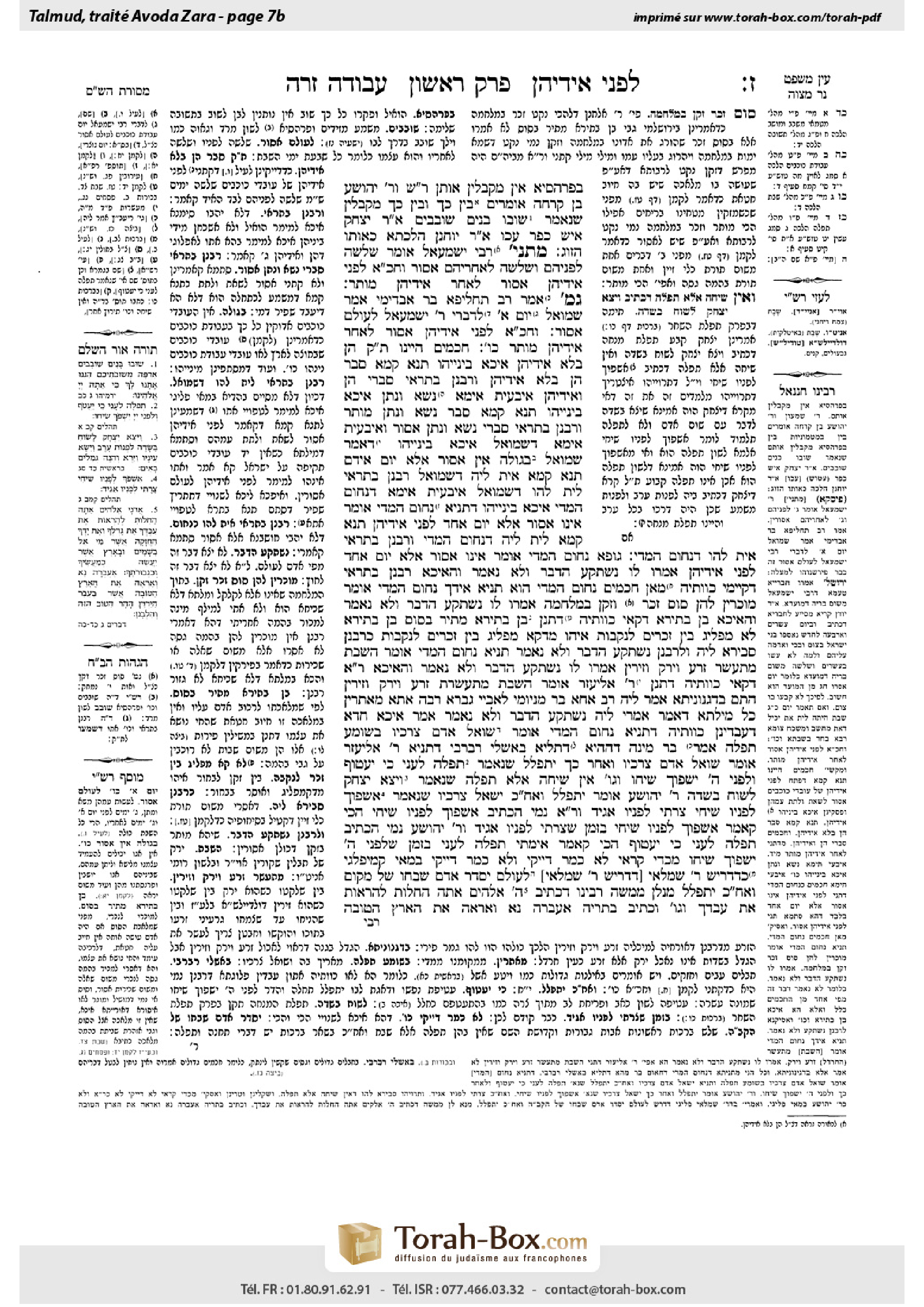
Avodah Zarah 7b: Talmud study for Daf Yomi
Study the Talmud for Daf Yomi with scanned pages, Hebrew text, English translations from Sefaria and AI-generated French translations.
Passage selection and English or AI-generated French translation are available where the scan has annotations. Daf Study is independent of Torah-Box and Sefaria.
Browse Avodah Zarah · עבודה זרה · All tractatesAvodah Zarah 7b text and translations
This page of Avodah Zarah includes the Aramaic text, an English translation and an AI-generated French translation, alongside the scan above.
עבודה זרה ז׳ ב · Aramaic and Hebrew text
בְּפַרְהֶסְיָא — אֵין מְקַבְּלִין אוֹתָן. רַבִּי שִׁמְעוֹן וְרַבִּי יְהוֹשֻׁעַ בֶּן קׇרְחָה אוֹמְרִים: בֵּין כָּךְ וּבֵין כָּךְ מְקַבְּלִין, שֶׁנֶּאֱמַר: ״שׁוּבוּ בָּנִים שׁוֹבָבִים״. אָמַר רַבִּי יִצְחָק אִישׁ כְּפַר עַכּוֹ אָמַר רַבִּי יוֹחָנָן: הִלְכְתָא כְּאוֹתוֹ הַזּוּג.
מַתְנִי׳ רַבִּי יִשְׁמָעֵאל אוֹמֵר: שְׁלֹשָׁה לִפְנֵיהֶם וּשְׁלֹשָׁה לְאַחֲרֵיהֶם — אָסוּר, וַחֲכָמִים אוֹמְרִים: לִפְנֵי אֵידֵיהֶן — אָסוּר, לְאַחַר אֵידֵיהֶן — מוּתָּר.
גְּמָ׳ אָמַר רַב תַּחְלִיפָא בַּר אַבְדִּימִי אָמַר שְׁמוּאֵל: נוֹצְרִי, לְדִבְרֵי רַבִּי יִשְׁמָעֵאל לְעוֹלָם אָסוּר.
וַחֲכָמִים אוֹמְרִים: לִפְנֵי אֵידֵיהֶן אָסוּר, לְאַחַר אֵידֵיהֶן מוּתָּר כּוּ׳. חֲכָמִים הַיְינוּ תַּנָּא קַמָּא! הֵן בְּלֹא אֵידֵיהֶן אִיכָּא בֵּינַיְיהוּ, תַּנָּא קַמָּא סָבַר: הֵן בְּלֹא אֵידֵיהֶן, וְרַבָּנַן בָּתְרָאֵי סָבְרִי: הֵן וְאֵידֵיהֶן.
אִיבָּעֵית אֵימָא: נָשָׂא וְנָתַן אִיכָּא בֵּינַיְיהוּ, תַּנָּא קַמָּא סָבַר: נָשָׂא וְנָתַן מוּתָּר, וְרַבָּנַן בָּתְרָאֵי סָבְרִי: נָשָׂא וְנָתַן אָסוּר.
וְאִיבָּעֵית אֵימָא: דִּשְׁמוּאֵל אִיכָּא בֵּינַיְיהוּ, דְּאָמַר שְׁמוּאֵל: בַּגּוֹלָה אֵין אָסוּר אֶלָּא יוֹם אֵידָם, תַּנָּא קַמָּא אִית לֵיהּ דִּשְׁמוּאֵל, רַבָּנַן בָּתְרָאֵי לֵית לְהוּ דִּשְׁמוּאֵל.
אִיבָּעֵית אֵימָא: דְּנַחוּם הַמָּדִי אִיכָּא בֵּינַיְיהוּ. דְּתַנְיָא, נַחוּם הַמָּדִי אוֹמֵר: אֵינוֹ אָסוּר אֶלָּא יוֹם אֶחָד לִפְנֵי אֵידֵיהֶן, תַּנָּא קַמָּא לֵית לֵיהּ דְּנַחוּם הַמָּדִי, וְרַבָּנַן בָּתְרָאֵי אִית לְהוּ דְּנַחוּם הַמָּדִי.
גּוּפָא, נַחוּם הַמָּדִי אוֹמֵר: אֵינוֹ אָסוּר אֶלָּא יוֹם אֶחָד לִפְנֵי אֵידֵיהֶן. אָמְרוּ לוֹ: נִשְׁתַּקַּע הַדָּבָר וְלֹא נֶאֱמַר. וְהָאִיכָּא רַבָּנַן בָּתְרָאֵי דְּקָיְימִי כְּוָותֵיהּ! מַאן חֲכָמִים? נַחוּם הַמָּדִי הוּא.
תַּנְיָא אִידַּךְ: נַחוּם הַמָּדִי אוֹמֵר: מוֹכְרִין לָהֶן סוּס זָכָר וְזָקֵן בַּמִּלְחָמָה. אָמְרוּ לוֹ: נִשְׁתַּקַּע הַדָּבָר וְלֹא נֶאֱמַר.
וְהָאִיכָּא בֶּן בְּתִירָא דְּקָאֵי כְּוָותֵיהּ, דִּתְנַן: בֶּן בְּתִירָא מַתִּיר בַּסּוּס. בֶּן בְּתִירָא לָא מְפַלֵּיג בֵּין זְכָרִים לִנְקֵבוֹת, אִיהוּ מִדְּקָא מְפַלֵּיג בֵּין זְכָרִים לִנְקֵבוֹת, כְּרַבָּנַן סְבִירָא לֵיהּ. וּלְרַבָּנַן נִשְׁתַּקַּע הַדָּבָר וְלֹא נֶאֱמַר.
תַּנְיָא [אִידַּךְ], נַחוּם הַמָּדִי אוֹמֵר: הַשֶּׁבֶת מִתְעַשֵּׂר זֶרַע וְיָרָק וְזִירִין. אָמְרוּ לוֹ: נִשְׁתַּקַּע הַדָּבָר וְלֹא נֶאֱמַר! וְהָאִיכָּא רַבִּי אֱלִיעֶזֶר דְּקָאֵי כְּוָותֵיהּ, דִּתְנַן: רַבִּי אֱלִיעֶזֶר אוֹמֵר: הַשֶּׁבֶת מִתְעַשֶּׂרֶת זֶרַע וְיָרָק וְזִירִין! הָתָם בִּדְגִנּוּנִיתָא.
אֲמַר לֵיהּ רַב אַחָא בַּר מִנְיוֹמֵי לְאַבָּיֵי: גַּבְרָא רַבָּה אֲתָא מֵאַתְרִין, כֹּל מִילְּתָא דְּאָמַר, אָמְרִי לֵיהּ: ״נִשְׁתַּקַּע הַדָּבָר וְלֹא נֶאֱמַר״. אֲמַר [לֵיהּ]: אִיכָּא חֲדָא דְּעָבְדִינַן כְּוָותֵיהּ, דְּתַנְיָא: נַחוּם הַמָּדִי אוֹמֵר: שׁוֹאֵל אָדָם צְרָכָיו בְּ״שׁוֹמֵעַ תְּפִלָּה״.
אֲמַר [לֵיהּ] בַּר מִינַּהּ דְּהַהִיא, דְּתַלְיָא בְּאַשְׁלֵי רַבְרְבֵי.
דְּתַנְיָא, רַבִּי אֱלִיעֶזֶר אוֹמֵר: שׁוֹאֵל אָדָם צְרָכָיו וְאַחַר כָּךְ יִתְפַּלֵּל, שֶׁנֶּאֱמַר: ״תְּפִלָּה לְעָנִי כִי יַעֲטֹף וְלִפְנֵי ה׳ יִשְׁפֹּךְ שִׂיחוֹ וְגוֹ׳״, אֵין שִׂיחָה אֶלָּא תְּפִלָּה, שֶׁנֶּאֱמַר: ״וַיֵּצֵא יִצְחָק לָשׂוּחַ בַּשָּׂדֶה״.
רַבִּי יְהוֹשֻׁעַ אוֹמֵר: יִתְפַּלֵּל, וְאַחַר כָּךְ יִשְׁאַל צְרָכָיו, שֶׁנֶּאֱמַר: ״אֶשְׁפֹּךְ לְפָנָיו שִׂיחִי צָרָתִי לְפָנָיו אַגִּיד״.
וְרַבִּי אֱלִיעֶזֶר נָמֵי, הָכְתִיב: ״אֶשְׁפֹּךְ לְפָנָיו שִׂיחִי״! הָכִי קָאָמַר: ״אֶשְׁפּוֹךְ לְפָנָיו שִׂיחִי״ — בִּזְמַן שֶׁצָּרָתִי לְפָנָיו אַגִּיד. וְרַבִּי יְהוֹשֻׁעַ נָמֵי, הָכְתִיב: ״תְּפִלָּה לְעָנִי כִי יַעֲטֹף״! הָכִי קָאָמַר: אֵימָתַי תְּפִלָּה לְעָנִי? בִּזְמַן שֶׁלִּפְנֵי ה׳ יִשְׁפּוֹךְ שִׂיחוֹ.
מִכְּדֵי קְרָאֵי לָא כְּמָר דָּיְיקִי וְלָא כְּמָר דָּיְיקִי, בְּמַאי קָמִיפַּלְגִי?
כִּדְדָרֵישׁ רַבִּי שִׂמְלַאי [דְּדָרֵישׁ רַבִּי שִׂמְלַאי]: לְעוֹלָם יְסַדֵּר אָדָם שִׁבְחוֹ שֶׁל מָקוֹם וְאַחַר כָּךְ יִתְפַּלֵּל, מְנָלַן? מִמֹּשֶׁה רַבֵּינוּ, דִּכְתִיב: ״ה׳ אֱלֹהִים אַתָּה הַחִלּוֹתָ לְהַרְאוֹת אֶת עַבְדְּךָ וְגוֹ׳״, וּכְתִיב בָּתְרֵיהּ: ״אֶעְבְּרָה נָּא וְאֶרְאֶה אֶת הָאָרֶץ הַטּוֹבָה״.
Avodah Zarah 7b · English translation
But if they performed their sins in public, society does not accept them. Rabbi Shimon and Rabbi Yehoshua ben Korḥa say: Both in this case, where they sinned in private, and in that case, where they sinned in public, society accepts them, as it is stated: “Return, you backsliding children, I will heal your backslidings” (Jeremiah 3:22). Rabbi Yitzḥak of the village of Akko says that Rabbi Yoḥanan says: The halakha is in accordance with the opinion of that pair, Rabbi Shimon and Rabbi Yehoshua ben Korḥa, i.e., penitents are accepted, regardless of whether they sinned in public or in private.
MISHNA: Rabbi Yishmael says: On the three days before the festivals of gentiles and on the three days after them, it is prohibited to engage in business with those gentiles. And the Rabbis say: It is prohibited to engage in business with them before their festivals, but it is permitted to engage in business with them after their festivals.
GEMARA: Rav Taḥlifa bar Avdimi says that Shmuel says: With regard to a Christian, according to the statement of Rabbi Yishmael it is always prohibited for a Jew to engage in business with him. Since his festival takes place every Sunday and the three days before and after Sunday constitute the entire week, one cannot engage in business with a Christian on any day of the week.
The mishna teaches: And the Rabbis say: It is prohibited to engage in business with them before their festivals, but it is permitted to engage in business with them after their festivals. The Gemara raises a difficulty: The statement of the Rabbis is identical to the statement of the first tanna in the mishna on 2a, who said that it is prohibited to engage in business with gentiles during the three days before their festival. The Gemara answers: The difference between them is with regard to the question of whether the three days includes only them, i.e., the three days, without their festival, or if the festival is counted as one of the three days. The first tanna holds that the three days is referring to them, the days preceding the festival, without their festivals, and the later Rabbis cited in this mishna hold that the three days include them and their festivals.
If you wish, say that the difference between the Rabbis and the first tanna is with regard to one who ignored this injunction and engaged in business with gentiles before their festival. The first tanna holds that if one engaged in business, it is permitted to derive benefit from the profits, and the later Rabbis hold that if one engaged in business, it is prohibited to derive benefit from the profits.
And if you wish, say that the difference between the Rabbis and the first tanna is with regard to the statement of Shmuel. As Shmuel says: In the Diaspora it is prohibited to engage in business with gentiles only on their festival day itself. The first tanna is of the opinion that the halakha is in accordance with the opinion of Shmuel, and the later Rabbis are not of the opinion that the halakha is in accordance with the opinion of Shmuel.
If you wish, say that the difference between the Rabbis and the first tanna is with regard to a statement of Naḥum the Mede. As it is taught in a baraita that Naḥum the Mede says: It is prohibited to engage in business with gentiles only on the day before their festival. The first tanna is not of the opinion that the halakha is in accordance with the opinion of Naḥum the Mede, and the later Rabbis are of the opinion that the halakha is in accordance with the opinion of Naḥum the Mede, as they do not mention how many days before the festival are included in the prohibition.
Having mentioned Naḥum the Mede’s opinion, the Gemara discusses the matter itself. Naḥum the Mede says: It is prohibited only on the day before their festival. The other Sages said to him: It would be best if this matter were lost and not stated, as it is not the halakha. The Gemara asks: But aren’t there the later Rabbis, who hold in accordance with his opinion? The Gemara answers: Who are these Rabbis? This is referring to Naḥum the Mede himself, but the other Sages disagree.
§ The Gemara cites additional statements of Naḥum the Mede. It is taught in another baraita that Naḥum the Mede says: Although it is prohibited to sell large livestock to gentiles, one may sell a male and elderly horse to them during a war, as it cannot be used for battle. The Sages said to him: It would be best if this matter were lost and not stated, as it is not the halakha.
The Gemara asks: But isn’t there ben Beteira, who holds in accordance with his opinion? As we learned in a mishna (14b): Ben Beteira permits selling a horse to gentiles. The Gemara answers: Since ben Beteira does not differentiate between male and female horses, and Naḥum the Mede does differentiate between male and female horses, it is clear that Naḥum the Mede holds in accordance with the opinion of the Rabbis, that one is generally not permitted to sell a horse to a gentile, only he permits it in this specific circumstance. And according to the opinion of the Rabbis, it would be best if this matter were lost and not stated.
The Gemara cites a similar dispute. It is taught in a baraita that Naḥum the Mede says: The dill plant is subject to tithes, whether it is used as a seed, or a vegetable, or a pod. The Sages said to him: It would be best if this matter were lost and not stated, as it is not the halakha. The Gemara asks: But isn’t there Rabbi Eliezer, who holds in accordance with his opinion? As we learned in a mishna (Ma’asrot 4:5) that Rabbi Eliezer says: The dill plant is subject to tithes whether it is used as a seed, or a vegetable, or a pod. The Gemara answers: There, Rabbi Eliezer is referring to the garden variety of dill, which is of such a high quality that its seeds, vegetable, and pods are eaten. By contrast, in the case of wild dill, only its seeds and vegetable are eaten, not the pods.
Apropos the discussion between Naḥum the Mede and the other Sages, Rav Aḥa bar Minyumi said to Abaye: A great man came from our place, i.e., from Media, and in response to every matter that he said, the Sages said to him that it would be best if this matter were lost and not stated. Do they wish to erase all the halakhot taught by the Sages of Media? Abaye said: There is one instance in which we act in accordance with his opinion, as it is taught in a baraita that Naḥum the Mede says: During the Amida prayer a person may request his personal needs that are not included in the standard formulation of the Amida prayer, in the blessing that ends: Who listens to prayer.
Rav Aḥa bar Minyumi said to Abaye: Apart from this halakha, i.e., this does not serve as proof that a statement of Naḥum the Mede was ever accepted by the other Sages, as this halakha is dependent on the dispute between great trees, i.e., great authorities, who expressed their opinions with regard to the halakha before Naḥum the Mede.
Rav Aḥa bar Minyumi elaborates: As it is taught in a baraita that Rabbi Eliezer says: A person should request his own needs first and afterward recite the Amida prayer, as it is stated: “A prayer of the afflicted, when he is faint and pours out siḥo before the Lord. O Lord, hear my prayer” (Psalms 102:1–2). These verses indicate that one first requests help concerning his afflictions and pains, and only afterward pours forth his siḥa. And siḥa means nothing other than prayer, as it is stated: “And Isaac went out to meditate [lasuaḥ] in the field” (Genesis 24:63).
Rabbi Yehoshua says: One should pray first and afterward request his own needs, as it is stated: “I pour out siḥi before Him, I declare before Him my trouble” (Psalms 142:3), which teaches that first one pours forth his siḥa, and only afterward speaks of his own troubles.
The Gemara asks: And according to Rabbi Eliezer as well, isn’t it written: “I pour out siḥi before Him, I declare before Him my trouble”? The Gemara answers: According to Rabbi Eliezer, this is what the verse is saying: I pour out my siḥa before Him when I have already declared before Him my trouble. The Gemara asks with regard to Rabbi Yehoshua’s opinion: And according to Rabbi Yehoshua as well, isn’t it written: “A prayer of the afflicted, when he is faint and pours out siḥo before the Lord”? The Gemara answers: According to Rabbi Yehoshua, this is what the verse is saying: When is there a prayer of the afflicted? When he has already poured out siḥo before the Lord, and now requests his own needs.
The Gemara notes: Now it is clear that the verses themselves do not fit precisely in accordance with the opinion of this Sage and do not fit precisely in accordance with the opinion of that Sage, as one verse indicates that prayer is recited before stating personal requests, while the other suggests that first one states personal requests and then prays. Evidently, the dispute between Rabbi Eliezer and Rabbi Yehoshua is not based on the verses, but depends on some other issue. Therefore, the Gemara asks: With regard to what principle do they disagree?
They disagree with regard to that which Rabbi Simlai taught. As Rabbi Simlai taught: A person should always set forth praise of God and only then pray for his own needs. From where do we derive this? We derive it from Moses our teacher, as it is written: “O Lord God, You have begun to show Your servant Your greatness, and Your strong hand; for what god is there in heaven or on earth, that can do according to Your works, and according to Your mighty acts?” (Deuteronomy 3:24). Here Moses praises God, and it is written afterward, in the following verse, that then Moses requested from God: “Let me go over, I pray You, and see the good land” (Deuteronomy 3:25).
Avodah Zarah 7b · Traduction française (IA)
Mais si ils ont commis leurs péchés en public, la société ne les accepte pas. Rabbi Shimon et Rabbi Yéhochoua ben Korkha disent : Dans ce cas-ci, où ils ont péché en privé, et dans celui-là, où ils ont péché en public, la société les accepte, car il est dit : « Retournez, enfants déviant, je guérirai vos déviations » (Jérémie 3:22). Rabbi Yitzhak de la ville d'Akko dit que Rabbi Yoḥanan dit : La halakha suit l'opinion de ce couple, Rabbi Shimon et Rabbi Yéhochoua ben Korkha, c'est-à-dire que les repentants sont acceptés, qu'ils aient péché en public ou en privé.
MICHNA : Rabbi Yishmael dit : Pendant les trois jours avant les fêtes des non-Juifs et les trois jours après, il est interdit d'entreprendre des affaires avec ces non-Juifs. Et les Rabbins disent : Il est interdit d'entreprendre des affaires avec eux avant leurs fêtes, mais il est permis d'entreprendre des affaires avec eux après leurs fêtes.
GUEMARA : Rav Tachlifa bar Avdimi dit que Shmuel dit : En ce qui concerne un chrétien, selon l'expression de Rabbi Yishmael, il est toujours interdit pour un Juif d'entreprendre des affaires avec lui. Puisque sa fête a lieu chaque dimanche et les trois jours avant et après dimanche constituent toute la semaine, on ne peut pas entreprendre des affaires avec un chrétien un jour de la semaine.
La mishna enseigne : Et les Rabbins disent : Il est interdit d'entreprendre des affaires avec eux avant leurs fêtes, mais il est permis d'entreprendre des affaires avec eux après leurs fêtes. La Guemara soulève une difficulté : L'expression des Rabbins est identique à celle du premier tanna de la mishna sur 2a, qui disait que c'était interdit d'entreprendre des affaires avec les non-Juifs pendant les trois jours avant leur fête. La Guemara répond : La différence entre eux est concernant la question de savoir si les trois jours incluent seulement eux, c'est-à-dire les trois jours, sans leur fête, ou si la fête est comptée comme l'un des trois jours. Le premier tanna considère que les trois jours font référence à eux, les jours précédant la fête, sans leur fête, et les Rabbins cités dans cette mishna considèrent que les trois jours incluent eux et leur fête.
Si vous le souhaitez, dites que la différence entre les Rabbins et le premier tanna est concernant celui qui a ignoré cette interdiction et a entrepris des affaires avec les non-Juifs avant leur fête. Le premier tanna considère que si l'on a entrepris des affaires, il est permis d'obtenir un bénéfice, et les Rabbins considèrent que si l'on a entrepris des affaires, il est interdit d'obtenir un bénéfice.
Et si vous le souhaitez, dites que la différence entre les Rabbins et le premier tanna est concernant l'expression de Shmuel. Comme Shmuel dit : Dans la Diaspora, il est interdit d'entreprendre des affaires avec les non-Juifs uniquement le jour de leur fête. Le premier tanna est de l'avis que la halakha suit l'opinion de Shmuel, et les Rabbins ultérieurs ne sont pas de l'avis que la halakha suit l'opinion de Shmuel.
Si vous le souhaitez, dites que la différence entre les Rabbins et le premier tanna est concernant la déclaration de Naḥum le Médé. Comme il est enseigné dans une baraïta que Naḥum le Médé dit : Il est interdit d'entreprendre des affaires avec les non-Juifs uniquement le jour avant leur fête. Le premier tanna n'est pas de l'avis que la halakha suit l'opinion de Naḥum le Médé, et les Rabbins ultérieurs sont de l'avis que la halakha suit l'opinion de Naḥum le Médé, car ils ne mentionnent pas combien de jours avant la fête sont inclus dans l'interdiction.
Ayant mentionné l'opinion de Naḥum le Médé, la Guemara discute la question elle-même. Naḥum le Médé dit : Il est interdit uniquement le jour avant leur fête. Les autres Sages lui dirent : Il serait préférable que cette question ne fût pas mentionnée, car elle n'est pas la halakha. La Guemara demande : Mais ne sont-ce pas les Rabbins ultérieurs qui suivent son opinion ? La Guemara répond : De qui s'agit-il ? Cela fait référence à Naḥum le Médé lui-même, mais les autres Sages sont d'avis contraire.
§ La Guemara cite d'autres déclarations de Naḥum le Médé. Il est enseigné dans une autre baraïta que Naḥum le Médé dit : Bien que ce soit interdit de vendre des bêtes de grande taille aux non-Juifs, on peut vendre un cheval mâle et âgé à eux pendant la guerre, car il ne peut être utilisé en combat. Les Sages lui dirent : Il serait préférable que cette question ne fût pas mentionnée, car elle n'est pas la halakha.
La Guemara demande : Mais n'y a-t-il pas ben Bétéira, qui suit son opinion ? Comme nous l'avons appris dans une mishna (14b) : ben Bétéira permet de vendre un cheval aux non-Juifs. La Guemara répond : Puisque ben Bétéira ne distingue pas entre les chevaux mâles et femelles, et que Naḥum le Médé distingue entre les chevaux mâles et femelles, il est clair que Naḥum le Médé suit l'opinion des Rabbins, qui considèrent que l'on n'est généralement pas autorisé à vendre un cheval à un non-Juif, mais qu'il le permet dans ce cas spécifique. Et selon l'opinion des Rabbins, il serait préférable que cette question ne fût pas mentionnée.
La Guemara cite un débat similaire. Il est enseigné dans une baraïta que Naḥum le Médé dit : La plante de cumin est soumise aux dîmes, qu'elle soit utilisée comme grain, légume ou gousses. Les Sages lui dirent : Il serait préférable que cette question ne fût pas mentionnée, car elle n'est pas la halakha. La Guemara demande : Mais n'y a-t-il pas Rabbi Eliezer, qui suit son opinion ? Comme nous l'avons appris dans une mishna (Ma'asrot 4:5) que Rabbi Eliezer dit : La plante de cumin est soumise aux dîmes qu'elle soit utilisée comme grain, légume ou gousses. La Guemara répond : Là, Rabbi Eliezer fait référence à la variété de cumin cultivé, qui est de telle qualité qu'on mange ses graines, légumes et gousses. En revanche, dans le cas du cumin sauvage, on ne mange que ses graines et légumes, pas ses gousses.
Concernant la discussion entre Naḥum le Mede et les autres Sages, Rav Aḥa bar Minyumi a dit à Abaye : Un grand homme est venu de notre lieu, c'est-à-dire de la Médie, et en réponse à chaque sujet qu'il a évoqué, les Sages lui ont répondu qu'il serait préférable que ce sujet ne soit pas mentionné. Veulent-ils effacer toutes les halakhot enseignées par les Sages de la Médie ? Abaye a dit : Il y a une seule instance où nous agissons selon son avis, comme il est enseigné dans une baraïta que Naḥum le Mede dit : Lors de la prière d'Amida, une personne peut demander ses besoins personnels qui ne sont pas inclus dans la formulation standard de la prière d'Amida, dans la bénédiction qui se termine par : Celui qui écoute la prière.
Rav Aḥa bar Minyumi a dit à Abaye : À l'exception de cette halakha, c'est-à-dire cela ne sert pas de preuve que l'avis de Naḥum le Mede ait jamais été accepté par les autres Sages, car cette halakha dépend du débat entre des grands maîtres, c'est-à-dire des grands autorités, qui ont exprimé leurs opinions concernant la halakha avant Naḥum le Mede.
Rav Aḥa bar Minyumi développe : Comme il est enseigné dans une baraïta que Rabbi Eliezer dit : Une personne devrait d'abord demander ses besoins personnels et ensuite réciter la prière d'Amida, comme il est écrit : « Une prière du misérable, lorsqu'il est épuisé et verse sa siḥo devant l'Éternel. O Éternel, écoute ma prière » (Psaumes 102:1–2). Ces versets indiquent qu'on commence par demander de l'aide concernant ses afflictions et ses douleurs, et ensuite on verse sa siḥa. Et siḥa ne signifie rien d'autre que la prière, comme il est écrit : « Et Isaac est sorti méditer [lasuaḥ] dans le champ » (Genèse 24:63).
Rabbi Yéhoshua dit : On devrait prier d'abord et ensuite demander ses besoins personnels, comme il est écrit : « Je verse ma siḥi devant Lui, je déclare devant Lui ma détresse » (Psaumes 142:3), ce qui enseigne que d'abord on verse sa siḥi, et ensuite on parle de ses propres difficultés.
La Guemara pose la question : Et selon Rabbi Eliezer également, n'est-il pas écrit : « Je verse ma siḥi devant Lui, je déclare devant Lui ma détresse » ? La Guemara répond : Selon Rabbi Eliezer, ce que le verset dit, c'est : Je verse ma siḥi devant Lui lorsque j'ai déjà déclaré devant Lui ma détresse. La Guemara pose la question concernant l'opinion de Rabbi Yéhoshua : Et selon Rabbi Yéhoshua également, n'est-il pas écrit : « Une prière du misérable, lorsqu'il est épuisé et verse sa siḥo devant l'Éternel » ? La Guemara répond : Selon Rabbi Yéhoshua, ce que le verset dit, c'est : Quand y a-t-il une prière du misérable ? Lorsqu'il a déjà versé sa siḥo devant l'Éternel, et maintenant il demande ses besoins personnels.
La Guemara note : Maintenant il est clair que les versets eux-mêmes ne s'alignent pas parfaitement avec l'avis de ce Sage et ne s'alignent pas parfaitement avec l'avis de cet autre Sage, car un verset indique que la prière est récitée avant d'énoncer les demandes personnelles, tandis que l'autre suggère que d'abord on énonce les demandes personnelles et ensuite on prie. Évidemment, le débat entre Rabbi Eliezer et Rabbi Yéhoshua ne repose pas sur les versets, mais dépend d'une autre question. Par conséquent, la Guemara pose la question : Sur quel principe se déroule leur débat ?
Ils se disputent sur ce que Rabbi Simlai a enseigné. Comme Rabbi Simlai a enseigné : Une personne devrait toujours commencer par l'hommage à Dieu et ensuite prier pour ses besoins personnels. D'où tirons-nous cela ? Nous le tirons de Moïse notre maître, comme il est écrit : « Seigneur, Dieu, tu as commencé à montrer à ton serviteur ta grandeur et ton puissant bras ; car quel dieu est-il au ciel ou sur la terre, qui peut faire selon tes œuvres et selon tes grandes actions ? » (Deutéronome 3:24). Ici Moïse loue Dieu, et il est écrit ensuite, dans le verset suivant, que Moïse a demandé à Dieu : « Laisse-moi traverser, je t'implore, et voir la bonne terre » (Deutéronome 3:25).
Traduction française générée par IA à partir de l’édition anglaise de Sefaria. Vérifie toujours un passage avec le texte source.
Text from Sefaria: William Davidson Edition - Vocalized Aramaic (CC BY NC); William Davidson Edition - English (CC BY NC).