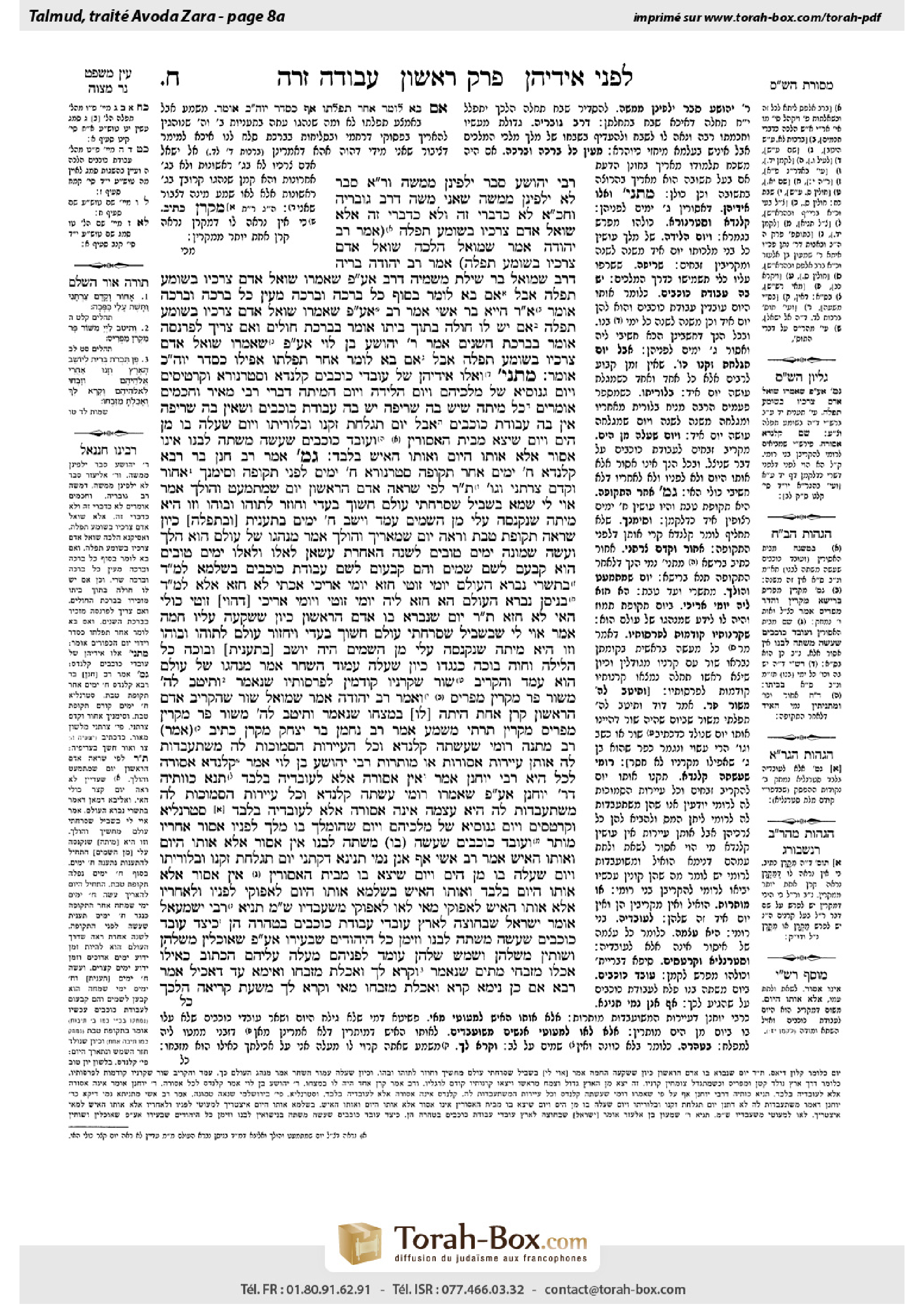
Avodah Zarah 8a: Talmud study for Daf Yomi
Study the Talmud for Daf Yomi with scanned pages, Hebrew text, English translations from Sefaria and AI-generated French translations.
Passage selection and English or AI-generated French translation are available where the scan has annotations. Daf Study is independent of Torah-Box and Sefaria.
Browse Avodah Zarah · עבודה זרה · All tractatesAvodah Zarah 8a text and translations
This page of Avodah Zarah includes the Aramaic text, an English translation and an AI-generated French translation, alongside the scan above.
עבודה זרה ח׳ א · Aramaic and Hebrew text
רַבִּי יְהוֹשֻׁעַ סָבַר: יָלְפִינַן מִמֹּשֶׁה, וְרַבִּי אֱלִיעֶזֶר סָבַר: לָא יָלְפִינַן מִמֹּשֶׁה, שָׁאנֵי מֹשֶׁה דְּרַב גּוּבְרֵיהּ. וַחֲכָמִים אוֹמְרִים: לֹא כְּדִבְרֵי זֶה וְלֹא כְּדִבְרֵי זֶה, אֶלָּא שׁוֹאֵל אָדָם צְרָכָיו בְּ״שׁוֹמֵעַ תְּפִלָּה״.
אָמַר רַב יְהוּדָה אָמַר שְׁמוּאֵל, הֲלָכָה: שׁוֹאֵל אָדָם צְרָכָיו בְּ״שׁוֹמֵעַ תְּפִלָּה״. אָמַר רַב יְהוּדָה בְּרֵיהּ דְּרַב שְׁמוּאֵל בַּר שִׁילַת מִשְּׁמֵיהּ דְּרַב: אַף עַל פִּי שֶׁאָמְרוּ שׁוֹאֵל אָדָם צְרָכָיו בְּשׁוֹמֵעַ תְּפִלָּה״, אֲבָל אִם בָּא לוֹמַר בְּסוֹף כׇּל בְּרָכָה וּבְרָכָה מֵעֵין כׇּל בְּרָכָה וּבְרָכָה — אוֹמֵר.
אָמַר רַב חִיָּיא בַּר אָשֵׁי אָמַר רַב: אַף עַל פִּי שֶׁאָמְרוּ שׁוֹאֵל אָדָם צְרָכָיו בְּ״שׁוֹמֵעַ תְּפִלָּה״, אִם יֵשׁ לוֹ חוֹלֶה בְּתוֹךְ בֵּיתוֹ — אוֹמֵר בְּבִרְכַּת חוֹלִים, וְאִם צָרִיךְ לְפַרְנָסָה — אוֹמֵר בְּבִרְכַּת הַשָּׁנִים.
אָמַר רַבִּי יְהוֹשֻׁעַ בֶּן לֵוִי: אַף עַל פִּי שֶׁאָמְרוּ: שׁוֹאֵל אָדָם צְרָכָיו בְּ״שׁוֹמֵעַ תְּפִלָּה״, אֲבָל אִם בָּא לוֹמַר אַחַר תְּפִלָּתוֹ, אֲפִילּוּ כְּסֵדֶר יוֹם הַכִּפּוּרִים — אוֹמֵר.
מַתְנִי׳ וְאֵלּוּ אֵידֵיהֶן שֶׁל גּוֹיִם — קָלֶנְדָּא, וּסְטַרְנוּרָא, וְקַרְטֵיסִים, וְיוֹם גְּנוּסְיָא שֶׁל מַלְכֵיהֶם, וְיוֹם הַלֵּידָה, וְיוֹם הַמִּיתָה, דִּבְרֵי רַבִּי מֵאִיר. וַחֲכָמִים אוֹמְרִים: כׇּל מִיתָה שֶׁיֵּשׁ בָּהּ שְׂרֵיפָה — יֵשׁ בָּהּ עֲבוֹדָה זָרָה, וְשֶׁאֵין בָּהּ שְׂרֵיפָה — אֵין בָּהּ עֲבוֹדָה זָרָה. אֲבָל יוֹם תִּגְלַחַת זְקָנוֹ וּבְלוֹרִיתוֹ, וְיוֹם שֶׁעָלָה בּוֹ מִן הַיָּם, וְיוֹם שֶׁיָּצָא מִבֵּית הָאֲסוּרִין, וְגוֹי שֶׁעָשָׂה מִשְׁתֶּה לִבְנוֹ — אֵינוֹ אָסוּר אֶלָּא אוֹתוֹ הַיּוֹם וְאוֹתוֹ הָאִישׁ בִּלְבַד.
גְּמָ׳ אָמַר רַב חָנָן בַּר רָבָא: קָלֶנְדָּא — שְׁמוֹנָה יָמִים אַחַר תְּקוּפָה, סְטַרְנוּרָא — שְׁמוֹנָה יָמִים לִפְנֵי תְּקוּפָה, וְסִימָנָךְ — ״אָחוֹר וָקֶדֶם צַרְתָּנִי וְגוֹ׳״.
תָּנוּ רַבָּנַן: לְפִי שֶׁרָאָה אָדָם הָרִאשׁוֹן יוֹם שֶׁמִּתְמַעֵט וְהוֹלֵךְ, אָמַר: אוֹי לִי! שֶׁמָּא בִּשְׁבִיל שֶׁסָּרַחְתִּי עוֹלָם חָשׁוּךְ בַּעֲדִי וְחוֹזֵר לְתוֹהוּ וָבוֹהוּ, וְזוֹ הִיא מִיתָה שֶׁנִּקְנְסָה עָלַי מִן הַשָּׁמַיִם. עָמַד וְיָשַׁב שְׁמוֹנָה יָמִים בְּתַעֲנִית [וּבִתְפִלָּה].
כֵּיוָן שֶׁרָאָה תְּקוּפַת טֵבֵת, וְרָאָה יוֹם שֶׁמַּאֲרִיךְ וְהוֹלֵךְ, אָמַר: מִנְהָגוֹ שֶׁל עוֹלָם הוּא. הָלַךְ וְעָשָׂה שְׁמוֹנָה יָמִים טוֹבִים. לְשָׁנָה הָאַחֶרֶת עֲשָׂאָן לְאֵלּוּ וּלְאֵלּוּ יָמִים טוֹבִים. הוּא קְבָעָם לְשֵׁם שָׁמַיִם, וְהֵם קְבָעוּם לְשֵׁם עֲבוֹדָה זָרָה.
בִּשְׁלָמָא לְמַאן דְּאָמַר: ״בְּתִשְׁרִי נִבְרָא הָעוֹלָם״, יוֹמֵי זוּטֵי חֲזָא, יוֹמֵי אֲרִיכֵי אַכַּתִּי לָא חֲזָא. אֶלָּא לְמַאן דְּאָמַר: ״בְּנִיסָן נִבְרָא הָעוֹלָם״, הָא חֲזָא לֵיהּ יוֹמֵי זוּטֵי וְיוֹמֵי אֲרִיכֵי! (דְּהָוֵי) זוּטֵי כּוּלֵּי הַאי לָא חֲזָא.
תָּנוּ רַבָּנַן: יוֹם שֶׁנִּבְרָא בּוֹ אָדָם הָרִאשׁוֹן, כֵּיוָן שֶׁשָּׁקְעָה עָלָיו חַמָּה, אָמַר: אוֹי לִי, שֶׁבִּשְׁבִיל שֶׁסָּרַחְתִּי עוֹלָם חָשׁוּךְ בַּעֲדִי, וְיַחְזוֹר עוֹלָם לְתוֹהוּ וָבוֹהוּ, וְזוֹ הִיא מִיתָה שֶׁנִּקְנְסָה עָלַי מִן הַשָּׁמַיִם. הָיָה יוֹשֵׁב בְּתַעֲנִית וּבוֹכֶה כׇּל הַלַּיְלָה, וְחַוָּה בּוֹכָה כְּנֶגְדּוֹ. כֵּיוָן שֶׁעָלָה עַמּוּד הַשַּׁחַר, אָמַר: מִנְהָגוֹ שֶׁל עוֹלָם הוּא. עָמַד וְהִקְרִיב שׁוֹר שֶׁקַּרְנָיו קוֹדְמִין לְפַרְסוֹתָיו, שֶׁנֶּאֱמַר: ״וְתִיטַב לַה׳ מִשּׁוֹר פָּר מַקְרִן מַפְרִיס״.
וְאָמַר רַב יְהוּדָה אָמַר שְׁמוּאֵל: שׁוֹר שֶׁהִקְרִיב אָדָם הָרִאשׁוֹן, קֶרֶן אַחַת הָיְתָה לוֹ בְּמִצְחוֹ, שֶׁנֶּאֱמַר: ״וְתִיטַב לַה׳ מִשּׁוֹר פָּר מַקְרִן מַפְרִיס״. ״מַקְרִין״ תַּרְתֵּי מַשְׁמַע! אָמַר רַב נַחְמָן בַּר יִצְחָק: ״מַקְרָן״ כְּתִיב.
אָמַר רַב מַתְנָה: רוֹמִי שֶׁעָשְׂתָה קָלֶנְדָּא, וְכׇל הָעֲיָירוֹת הַסְּמוּכוֹת לָהּ מִשְׁתַּעְבְּדוֹת לָהּ, אוֹתָן עֲיָירוֹת אֲסוּרוֹת אוֹ מוּתָּרוֹת? רַבִּי יְהוֹשֻׁעַ בֶּן לֵוִי אָמַר: קָלֶנְדָּא אֲסוּרָה לַכֹּל הִיא, רַבִּי יוֹחָנָן אָמַר: אֵין אֲסוּרָה אֶלָּא לְעוֹבְדֶיהָ בִּלְבָד.
תָּנָא כְּוָותֵיהּ דְּרַבִּי יוֹחָנָן: אַף עַל פִּי שֶׁאָמְרוּ, רוֹמִי עָשְׂתָה קָלֶנְדָּא, וְכׇל עֲיָירוֹת הַסְּמוּכוֹת לָהּ מִשְׁתַּעְבְּדוֹת לָהּ, הִיא עַצְמָהּ אֵינָהּ אֲסוּרָה אֶלָּא לְעוֹבְדֶיהָ בִּלְבָד.
סְטַרְנְלָיָא וּקְרָטֵסִים, וְיוֹם גְּנוּסְיָא שֶׁל מַלְכֵיהֶם, וְיוֹם שֶׁהוּמְלַךְ בּוֹ מֶלֶךְ — לְפָנָיו אָסוּר, אַחֲרָיו מוּתָּר. וְגוֹי שֶׁעָשָׂה (בּוֹ) מִשְׁתֶּה לִבְנוֹ — אֵין אָסוּר אֶלָּא אוֹתוֹ הַיּוֹם וְאוֹתוֹ הָאִישׁ.
אָמַר רַב אָשֵׁי: אַף אֲנַן נָמֵי תְּנֵינָא, דְּקָתָנֵי: יוֹם תִּגְלַחַת זְקָנוֹ וּבְלוֹרִיתוֹ, וְיוֹם שֶׁעָלָה בּוֹ מִן הַיָּם, וְיוֹם שֶׁיָּצָא בּוֹ מִבֵּית הָאֲסוּרִין — אֵין אָסוּר אֶלָּא אוֹתוֹ הַיּוֹם בִּלְבַד וְאוֹתוֹ הָאִישׁ.
בִּשְׁלָמָא ״אוֹתוֹ הַיּוֹם״ — לְאַפּוֹקֵי לְפָנָיו וּלְאַחֲרָיו, אֶלָּא ״אוֹתוֹ הָאִישׁ״ לְאַפּוֹקֵי מַאי? לָאו לְאַפּוֹקֵי מְשֻׁעְבָּדָיו? שְׁמַע מִינַּהּ.
תַּנְיָא, רַבִּי יִשְׁמָעֵאל אוֹמֵר: יִשְׂרָאֵל שֶׁבְּחוּצָה לָאָרֶץ עוֹבְדֵי עֲבוֹדָה זָרָה בְּטָהֳרָה הֵן, כֵּיצַד? גּוֹי שֶׁעָשָׂה מִשְׁתֶּה לִבְנוֹ וְזִימֵּן כׇּל הַיְּהוּדִים שֶׁבְּעִירוֹ, אַף עַל פִּי שֶׁאוֹכְלִין מִשֶּׁלָּהֶן וְשׁוֹתִין מִשֶּׁלָּהֶן, וְשַׁמָּשׁ שֶׁלָּהֶן עוֹמֵד לִפְנֵיהֶם, מַעֲלֶה עֲלֵיהֶם הַכָּתוּב כְּאִילּוּ אָכְלוּ מִזִּבְחֵי מֵתִים, שֶׁנֶּאֱמַר: ״וְקָרָא לְךָ וְאָכַלְתָּ מִזִּבְחוֹ״.
וְאֵימָא: עַד דְּאָכֵיל! אָמַר רָבָא: אִם כֵּן, נֵימָא קְרָא ״וְאָכַלְתָּ מִזִּבְחוֹ״, מַאי ״וְקָרָא לְךָ״? מִשְּׁעַת קְרִיאָה! הִלְכָּךְ,
Avodah Zarah 8a · English translation
Rabbi Yehoshua holds that we derive from the case of Moses that one should first praise God in prayer and only afterward issue personal requests. And Rabbi Eliezer holds that we do not derive from Moses how to act, since Moses is different, as his might is great, i.e., he knew how to pray to God in this order. And the Rabbis say: The halakha is not in accordance with the statement of this Sage, who says that one should issue personal requests before praying, nor is it in accordance with the statement of that Sage, who says that personal requests should follow prayer. Rather, a person requests his own needs in the blessing ending: Who listens to prayer. Therefore, when Naḥum the Mede stated that this is the halakha, he was merely concurring with the opinion of the Rabbis.
With regard to the halakhic ruling, Rav Yehuda says that Shmuel says: The halakha is that a person requests his own needs during the Amida prayer in the blessing ending: Who listens to prayer. Rav Yehuda, son of Rav Shmuel bar Sheilat, says in the name of Rav: Although the Sages said that a person requests his own needs in the blessing ending: Who listens to prayer, that is not the only option. Rather, if he wishes to recite at the conclusion of each and every blessing personal requests that reflect the nature of each and every blessing, he may recite them.
Similarly, Rav Ḥiyya bar Ashi says that Rav says: Although the Sages said that a person requests his own needs in the blessing ending: Who listens to prayer, if he has a sick person in his house he recites a special prayer for him during the blessing of the sick. And if he is in need of sustenance, he recites a request during the blessing of the years.
Rabbi Yehoshua ben Levi says: Although the Sages said that a person requests his own needs in the blessing ending: Who listens to prayer; but if one wishes to recite prayers and supplications after finishing his Amida prayer, even if his personal requests are as long as the order of the confession of Yom Kippur, he may recite them.
MISHNA: And these are the festivals of gentiles: Kalenda, Saturnalia, and Kratesis, and the day of the festival of their kings, and the birthday of the king, and the anniversary of the day of the death of the king. This is the statement of Rabbi Meir. And the Rabbis say: Every death that includes public burning is a festival that includes idol worship, and any death that does not include public burning is not a festival that includes idol worship. But in the case of the day of shaving his, i.e., a gentile’s, beard and his locks, and the day of his ascent from the sea, and the day that he left prison, and also in the case of a gentile who prepared a wedding feast for his son and celebrates on that day, engaging in business is prohibited only on that day and with that man.
GEMARA: Rav Ḥanan bar Rava says: When are these festivals celebrated? Kalenda is celebrated during the eight days after the winter solstice, and Saturnalia is celebrated during the eight days before the winter solstice. And your mnemonic to remember which festival is that the one that occurs after the solstice is mentioned first in the mishna, and the festival that takes place before the solstice is mentioned after, as in the verse: “You have hemmed me in behind and before, and laid Your Hand upon me” (Psalms 139:5), where the word “before” appears after the term “behind.”
With regard to the dates of these festivals, the Sages taught: When Adam the first man saw that the day was progressively diminishing, as the days become shorter from the autumnal equinox until the winter solstice, he did not yet know that this is a normal phenomenon, and therefore he said: Woe is me; perhaps because I sinned the world is becoming dark around me and will ultimately return to the primordial state of chaos and disorder. And this is the death that was sentenced upon me from Heaven, as it is written: “And to dust shall you return” (Genesis 3:19). He arose and spent eight days in fasting and in prayer.
Once he saw that the season of Tevet, i.e., the winter solstice, had arrived, and saw that the day was progressively lengthening after the solstice, he said: Clearly, the days become shorter and then longer, and this is the order of the world. He went and observed a festival for eight days. Upon the next year, he observed both these eight days on which he had fasted on the previous year, and these eight days of his celebration, as days of festivities. He, Adam, established these festivals for the sake of Heaven, but they, the gentiles of later generations, established them for the sake of idol worship.
The Gemara raises a difficulty: Granted, according to the one who says that the world was created in the month of Tishrei, one can understand why Adam believed that the days were becoming shorter as part of his punishment, as he saw the short days of the winter and had not yet seen the long days of summer. But according to the one who says that the world was created in the month of Nisan, he had already seen the difference between the short days and the long days, as the days in the month of Nisan become progressively longer with the passage of time. The Gemara answers: Although Adam had experienced short days, he had not seen days that were this short, as in the days before the winter solstice.
The Sages taught: On the day that Adam the first man was created, when the sun set upon him he said: Woe is me, as because I sinned, the world is becoming dark around me, and the world will return to the primordial state of chaos and disorder. And this is the death that was sentenced upon me from Heaven. He spent all night fasting and crying, and Eve was crying opposite him. Once dawn broke, he said: Evidently, the sun sets and night arrives, and this is the order of the world. He arose and sacrificed a bull whose horns preceded its hoofs in the order that they were created, as it is stated: “And it shall please the Lord better than a bullock that has horns and hoofs” (Psalms 69:32). This verse is referring to the one particular bull whose horns preceded its hoofs.
And Rav Yehuda says that Shmuel says: The bull that Adam the first man sacrificed had one horn in its forehead, as it is stated: “And it shall please the Lord better than a bullock that has horns [makrin] and hooves.” The Gemara raises a difficulty: Isn’t makrin plural, which indicates two horns? Rav Naḥman bar Yitzḥak says: Mikkeren is written, i.e., the letter yod is missing from the word, indicating that there was only one horn.
§ Rav Mattana says: Since Rome established the festival of Kalenda on a specific date, and all of the nearby towns are ruled by Rome, i.e., they pay their tax to Rome and provide its needs but do not themselves celebrate the festival, is it prohibited or permitted to engage in business transactions with the gentile residents of those towns? Rabbi Yehoshua ben Levi says: It is prohibited to engage in business during the time of the Kalenda with everyone. Rabbi Yoḥanan says: It is prohibited to engage in business only with its worshippers, whereas it is permitted to engage in business transactions with gentiles who do not celebrate the festival.
The Sage taught in a baraita in accordance with the opinion of Rabbi Yoḥanan: Although they said that Rome has established the festival of Kalenda and all of the nearby towns are ruled by Rome, it is prohibited to engage in business only with its worshippers.
The baraita continues: With regard to the festivals Saturnalia and Kratesis, and the day of the festival of their kings, and the day on which the king was crowned, the halakha is that before the festival it is prohibited to engage in business transactions, whereas after the festival it is permitted. But in the case of a gentile who prepared a feast for his son and celebrates on that day, engaging in business is prohibited only on that day itself and with that man.
Rav Ashi said: We learn in the mishna as well in accordance with Rabbi Yoḥanan’s statement that the prohibition applies only to gentiles who celebrate the festival, not to people who are ruled by them. As the mishna teaches: With regard to the day of shaving his beard and his locks, and the day of his ascent from the sea, and the day that he left prison, engaging in business is prohibited only on that day and with that man.
Rav Ashi explains the proof: Granted, the mishna specifies that the prohibition is limited to that day alone, in order to exclude the days before and after it. But when it states that the prohibition applies only to that man, what does the mishna exclude? Obviously the prohibition does not extend to all gentiles, as it is a personal festival. Doesn’t the mishna’s ruling serve to exclude those who are ruled by him? Therefore, conclude from the language of the mishna that a prohibition extends only to gentiles who celebrate the festival, not to those who are ruled by them.
It is taught in a baraita that Rabbi Yishmael says: Jews who are outside of Eretz Yisrael are considered to engage in idol worship in purity, i.e., unwittingly. How does this occur? In the case of a gentile who prepared a feast for the marriage of his son, and invited all of the Jews in his town, even though they eat of their own kosher food and drink of their own kosher beverages, and their own attendant stands before them, the verse ascribes guilt to them as though they ate of the offerings to the dead, i.e., idols, as it is stated: “And sacrifice to their gods, and they call you, and you eat of their sacrifice” (Exodus 34:15). Since Jews participate in a feast in which the gentile sacrifices offerings to his idol, it is as though they partook of the offering themselves.
The Gemara asks: But why not say that the verse is criticizing the Jews only once they eat from the sacrifice? Rava said: If that is what is meant, let the verse say only: And you eat of their sacrifice. What is meant by the additional phrase: “And they call you”? This indicates that the prohibition occurs from the time of the call. Therefore,
Avodah Zarah 8a · Traduction française (IA)
Rabbi Yéhoshua affirme que l'on peut tirer une conclusion du cas de Moïse selon lequel on doit d'abord louer Dieu dans la prière et ensuite formuler ses demandes personnelles. Rabbi Éléazar affirme que l'on ne peut tirer de Moïse une indication sur la manière d'agir, car Moïse est différent, car sa puissance est grande, c'est-à-dire qu'il savait prier Dieu dans cet ordre. Les Sages disent : La halakha ne suit pas la déclaration de ce Sage, qui affirme qu'on doit formuler ses demandes personnelles avant la prière, ni celle de ce Sage, qui affirme que les demandes personnelles doivent suivre la prière. Plutôt, une personne formule ses besoins personnels dans la berakha qui se termine par : Celui qui écoute la prière. Ainsi, lorsque Naḥum le Mède a dit que c'est la halakha, il n'était que d'accord avec l'opinion des Sages.
En ce qui concerne la décision halakhique, Rav Yéhuda dit que Shmuel dit : La halakha est que l'on formule ses besoins personnels pendant la prière Amida dans la berakha qui se termine par : Celui qui écoute la prière. Rav Yéhuda, fils de Rav Shmuel bar Sheilat, dit en nom de Rav : Bien que les Sages aient dit que l'on formule ses besoins personnels dans la berakha qui se termine par : Celui qui écoute la prière, cela n'est pas la seule option. Plutôt, si l'on souhaite réciter, à la fin de chaque berakha, des demandes personnelles qui correspondent à la nature de chaque berakha, l'on peut les réciter.
De même, Rav Ḥiyya bar Ashi dit que Rav dit : Bien que les Sages aient dit que l'on formule ses besoins personnels dans la berakha qui se termine par : Celui qui écoute la prière, si l'on a une personne malade à la maison, l'on récite une prière spéciale pour lui pendant la berakha des malades. Et si l'on a besoin de subsistance, l'on récite une demande pendant la berakha des années.
Rabbi Yéhoshua ben Levi dit : Bien que les Sages aient dit que l'on formule ses besoins personnels dans la berakha qui se termine par : Celui qui écoute la prière ; mais si l'on souhaite réciter des prières et des supplications après avoir terminé sa prière Amida, même si ses demandes personnelles sont aussi longues que l'ordre de la confession du Yom Kippour, l'on peut les réciter.
MICHNA : Et ces sont les fêtes des gentils : Kalenda, Saturnalia et Kratesis, et le jour de la fête de leurs rois, et le jour de l'anniversaire de la naissance du roi, et le jour de la mort du roi. C'est l'opinion de Rabbi Meir. Et les Sages disent : Tout décès qui inclut un brûlement public est une fête qui inclut l'idolâtrie, et tout décès qui ne comprend pas un brûlement public n'est pas une fête qui inclut l'idolâtrie. Mais dans le cas du jour de la rasaison de sa barbe et de ses cheveux, et du jour de son ascension de la mer, et du jour où il a quitté la prison, et aussi dans le cas d'un gentil qui a préparé un festin pour son fils et célèbre ce jour, l'activité commerciale est interdite uniquement ce jour et avec cette personne.
GUEMARA : Rav Hanan bar Rava dit : Quand ces fêtes sont célébrées ? Kalenda est célébrée pendant les huit jours après l'équinoxe hivernal, et Saturnalia est célébrée pendant les huit jours avant l'équinoxe hivernal. Et votre mnémotechnie pour se souvenir de quelle fête c'est celle qui se produit après l'équinoxe hivernal est mentionnée en premier dans la mishna, et la fête qui a lieu avant l'équinoxe hivernal est mentionnée après, comme dans la verset : « Vous m'avez enclos derrière et devant, et mis votre main sur moi » (Psaumes 139:5), où le mot « devant » apparaît après le terme « derrière ».
En ce qui concerne les dates de ces fêtes, les Sages ont enseigné : Lorsque Adam, le premier homme, a vu que la journée diminuait progressivement, car les jours deviennent plus courts du solstice d'automne jusqu'au solstice d'hiver, il ne savait pas encore que c'est un phénomène normal, et donc il a dit : Malheur à moi ; peut-être parce que j'ai péché, le monde devient sombre autour de moi et finira par retourner à l'état primitif de chaos et de désordre. Et c'est la mort que j'ai reçue du Ciel, comme il est écrit : « Et tu retourneras en poussière » (Genèse 3:19). Il s'est levé et a passé huit jours à jeûner et à prier.
Une fois qu'il a vu que la saison de Tévet, c'est-à-dire le solstice d'hiver, était arrivée, et qu'il a vu que la journée s'allongeait progressivement après le solstice, il a dit : Évidemment, les jours deviennent plus courts et puis plus longs, et c'est l'ordre du monde. Il est allé et a célébré une fête pendant huit jours. L'année suivante, il a observé à la fois ces huit jours où il avait jeûné l'année précédente et ces huit jours de sa célébration comme jours de festivités. Adam a établi ces fêtes pour le Ciel, mais les gentils des générations ultérieures les ont établis pour l'idolâtrie.
La Guemara soulève un problème : D'accord, selon celui qui dit que le monde a été créé en Tishrei, on peut comprendre pourquoi Adam croyait que les jours devenaient plus courts comme partie de sa punition, car il a vu les jours courts de l'hiver et n'avait pas encore vu les jours longs de l'été. Mais selon celui qui dit que le monde a été créé en Nisan, il avait déjà vu la différence entre les jours courts et les jours longs, car les jours du mois de Nisan deviennent progressivement plus longs avec le passage du temps. La Guemara répond : Bien que Adam ait vécu des jours courts, il n'avait pas vu des jours aussi courts que ceux avant le solstice d'hiver.
Les Sages ont enseigné : Le jour où Adam, le premier homme, a été créé, quand le soleil s'est couché sur lui, il a dit : Malheur à moi, car à cause de mon péché, le monde devient sombre autour de moi, et le monde retournera à l'état primitif de chaos et de désordre. Et c'est la mort que j'ai reçue du Ciel. Il a passé toute la nuit à jeûner et à pleurer, et Ève pleurait à côté de lui. Une fois que l'aube est apparue, il a dit : Évidemment, le soleil se couche et la nuit arrive, et c'est l'ordre du monde. Il s'est levé et a sacrifié un taureau dont les cornes précédaient ses sabots dans l'ordre de leur création, comme il est dit : « Et il plaira mieux à l'Éternel qu'un taureau qui a des cornes et des sabots » (Psaumes 69:32). Ce verset fait référence à ce seul taureau dont les cornes précédaient ses sabots.
Et Rav Yéhouda dit que Shmuel dit : Le taureau que Adam, le premier homme, a sacrifié avait un cornet sur son front, comme il est dit : « Et cela plaira à l'Éternel mieux qu'un taureau qui a des cornes [makrin] et des sabots. » La Guemara soulève une difficulté : N'est-ce pas que makrin est au pluriel, ce qui indique deux cornes ? Rav Naḥman bar Yitzḥak dit : Mikkeren est écrit, c'est-à-dire que la lettre yod manque du mot, ce qui indique qu'il n'y avait qu'une seule corne.
§ Rav Mattana dit : Puisque Rome a établi la fête des Kalenda sur une date spécifique, et que toutes les villes voisines sont soumises à Rome, c'est-à-dire qu'elles paient leurs impôts à Rome et satisfont ses besoins mais ne célèbrent pas elles-mêmes la fête, est-il interdit ou permis d'engager des transactions commerciales avec les habitants païens de ces villes ? Rabbi Yéhouda ben Levi dit : Il est interdit d'engager des transactions commerciales pendant la fête des Kalenda avec tout le monde. Rabbi Yoḥanan dit : Il est interdit d'engager des transactions commerciales uniquement avec ses adorateurs, tandis qu'il est permis d'engager des transactions commerciales avec les païens qui ne célèbrent pas la fête.
Le Sage a enseigné dans une baraïta conformément à l'opinion de Rabbi Yoḥanan : Bien qu'ils aient dit que Rome a établi la fête des Kalenda et que toutes les villes voisines sont soumises à Rome, il est interdit d'engager des transactions commerciales uniquement avec ses adorateurs.
La baraïta continue : En ce qui concerne les fêtes de Saturnalia et de Kratesis, et le jour de la fête de leurs rois, et le jour où le roi a été couronné, la halakha est que avant la fête, il est interdit d'engager des transactions commerciales, tandis qu'après la fête, il est permis. Mais dans le cas d'un païen qui a préparé un festin pour son fils et célèbre ce jour-là, l'engagement en transactions commerciales est interdit uniquement ce jour-là et avec cette personne.
Rav Ashi dit : Nous apprenons également dans la mishna conformément à l'opinion de Rabbi Yoḥanan que l'interdiction s'applique uniquement aux païens qui célèbrent la fête, pas aux personnes qui sont soumises à eux. Comme la mishna enseigne : En ce qui concerne le jour où il rasait sa barbe et ses cheveux, et le jour où il sortait de la mer, et le jour où il avait quitté la prison, l'engagement en transactions commerciales est interdit uniquement ce jour-là et avec cette personne.
Rav Ashi explique la preuve : Bien sûr, la mishna précise que l'interdiction est limitée à ce jour seul, afin d'exclure les jours précédents et suivants. Mais lorsqu'elle dit que l'interdiction s'applique uniquement à cette personne, que signifie la mishna ? Évidemment, l'interdiction ne s'étend pas à tous les païens, car il s'agit d'une fête personnelle. N'est-ce pas que la décision de la mishna sert à exclure ceux qui sont soumis à lui ? Par conséquent, concluez du langage de la mishna que l'interdiction s'applique uniquement aux païens qui célèbrent la fête, pas à ceux qui sont soumis à eux.
Il est enseigné dans une baraïta que Rabbi Yishmael dit : Les Juifs qui sont en dehors de la Terre d'Israël sont considérés comme participants à l'idolâtrie dans la pureté, c'est-à-dire sans le vouloir. Comment cela se produit-il ? Dans le cas d'un païen qui a préparé un festin pour le mariage de son fils, et qui a invité tous les Juifs de sa ville, même s'ils mangent de leur propre nourriture kasher et boivent leur propre boisson kasher, et leur propre serviteur est devant eux, la Sainte Écriture attribue la culpabilité à eux comme s'ils mangeaient des offrandes aux défunts, c'est-à-dire aux idoles, comme il est dit : « Et sacrifiez à leurs dieux, et qu'ils vous appellent, et vous mangerez de leur sacrifice » (Exode 34:15). Puisque les Juifs participent à un festin où le païen sacrifie des offrandes à son idole, cela est comme s'ils participaient eux-mêmes à l'offrande.
La Guemara pose la question : Mais pourquoi ne pas dire que la Sainte Écriture critique les Juifs seulement lorsqu'ils mangent de l'offrande ? Rava dit : Si c'est cela que l'on entend, que la Sainte Écriture dise seulement : Et vous mangerez de leur sacrifice. Que signifie la phrase supplémentaire : « Et ils vous appellent » ? Cela indique que l'interdiction commence dès l'appel. Par conséquent,
Traduction française générée par IA à partir de l’édition anglaise de Sefaria. Vérifie toujours un passage avec le texte source.
Text from Sefaria: William Davidson Edition - Vocalized Aramaic (CC BY NC); William Davidson Edition - English (CC BY NC).