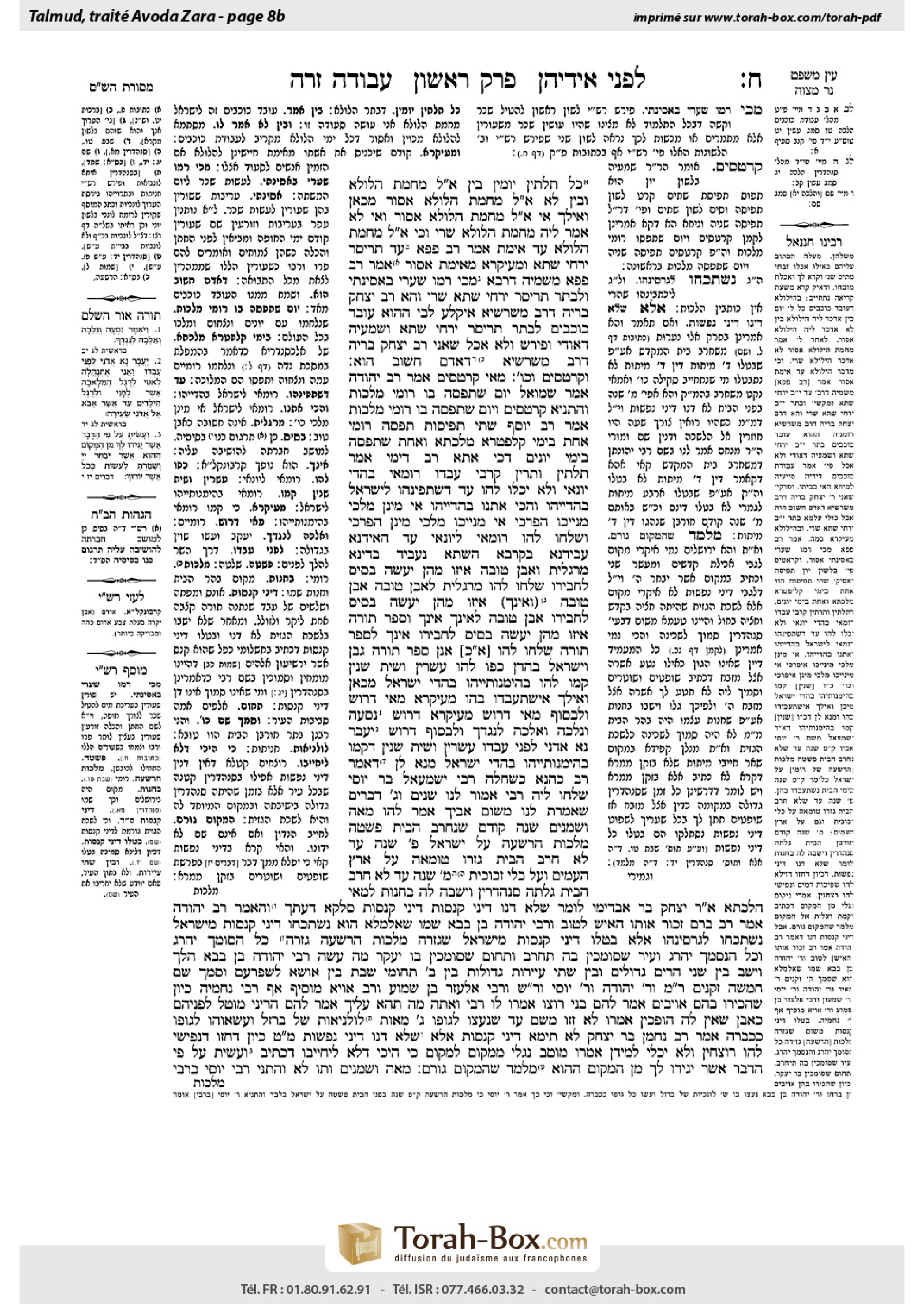
Avodah Zarah 8b: Talmud study for Daf Yomi
Study the Talmud for Daf Yomi with scanned pages, Hebrew text, English translations from Sefaria and AI-generated French translations.
Passage selection and English or AI-generated French translation are available where the scan has annotations. Daf Study is independent of Torah-Box and Sefaria.
Browse Avodah Zarah · עבודה זרה · All tractatesAvodah Zarah 8b text and translations
This page of Avodah Zarah includes the Aramaic text, an English translation and an AI-generated French translation, alongside the scan above.
עבודה זרה ח׳ ב · Aramaic and Hebrew text
כֹּל תְּלָתִין יוֹמִין, בֵּין אָמַר לֵיהּ מֵחֲמַת הִלּוּלָא וּבֵין לָא אָמַר לֵיהּ מֵחֲמַת הִלּוּלָא — אָסוּר, מִכָּאן וְאֵילָךְ, אִי אָמַר לֵיהּ מֵחֲמַת הִלּוּלָא — אָסוּר, וְאִי לָא אָמַר לֵיהּ מֵחֲמַת הִלּוּלָא — שְׁרֵי.
וְכִי אָמַר לֵיהּ מֵחֲמַת הִלּוּלָא, עַד אֵימַת? אָמַר רַב פָּפָּא: עַד תְּרֵיסַר יַרְחֵי שַׁתָּא. וּמֵעִיקָּרָא מֵאֵימַת אָסוּר? אָמַר רַב פָּפָּא מִשְּׁמֵיהּ דְּרָבָא: מִכִּי רָמוּ שְׂעָרֵי בַּאֲסִינְתֵּי.
וּלְבָתַר תְּרֵיסַר יַרְחֵי שַׁתָּא שְׁרֵי? וְהָא רַב יִצְחָק בְּרֵיהּ דְּרַב מְשַׁרְשְׁיָא אִיקְּלַע לְבֵי הָהוּא גּוֹי לְבָתַר תְּרֵיסַר יַרְחֵי שַׁתָּא, וְשַׁמְעֵיהּ דְּאוֹדִי, וּפֵירַשׁ וְלָא אֲכַל! שָׁאנֵי רַב יִצְחָק בְּרֵיהּ דְּרַב מְשַׁרְשְׁיָא, דְּאָדָם חָשׁוּב הוּא.
וּקְרָטֵסִים וְכוּ׳. מַאי קְרָטֵסִים? אָמַר רַב יְהוּדָה אָמַר שְׁמוּאֵל: יוֹם שֶׁתָּפְסָה בּוֹ רוֹמִי מַלְכוּת. וְהָתַנְיָא: קְרָטֵסִים וְיוֹם שֶׁתָּפְסָה בּוֹ רוֹמִי מַלְכוּת! אָמַר רַב יוֹסֵף: שְׁתֵּי תְּפִיסוֹת תָּפְסָה רוֹמִי, אַחַת בִּימֵי קְלֵפַּטְרָא מַלְכְּתָא, וְאַחַת שֶׁתָּפְסָה בִּימֵי יְוָנִים.
דְּכִי אֲתָא רַב דִּימִי אָמַר: תְּלָתִין וּתְרֵין קְרָבֵי עֲבַדוּ רוֹמָאֵי בַּהֲדֵי יַוְנָאֵי, וְלָא יְכַלוּ לְהוּ, עַד דְּשַׁתְּפִינְהוּ לְיִשְׂרָאֵל בַּהֲדַיְיהוּ, וְהָכִי אַתְנוֹ בַּהֲדַיְיהוּ: אִי מִינַּן מַלְכֵי — מִנַּיְיכוּ הִפַּרְכֵי, אִי מִנַּיְיכוּ מַלְכֵי — מִינַּן הִפַּרְכֵי.
וּשְׁלַחוּ לְהוּ רוֹמָאֵי לְיַוְנָאֵי: עַד הָאִידָּנָא עָבֵידְנָא בִּקְרָבָא, הַשְׁתָּא נַעֲבֵיד בְּדִינָא. מַרְגָּלִית וְאֶבֶן טוֹבָה, אֵיזוֹ מֵהֶן יֵעָשֶׂה בָּסִיס לַחֲבֵירוֹ? שְׁלַחוּ לְהוּ: מַרְגָּלִית לְאֶבֶן טוֹבָה.
אֶבֶן טוֹבָה וְאִינָךְ, אֵיזוֹ מֵהֶן יֵעָשֶׂה בָּסִיס לַחֲבֵירוֹ? אֶבֶן טוֹבָה לְאִינָךְ. אִינָךְ וְסֵפֶר תּוֹרָה, אֵיזוֹ מֵהֶן יֵעָשֶׂה בָּסִיס לַחֲבֵירוֹ? אִינָךְ לְסֵפֶר תּוֹרָה.
שְׁלַחוּ לְהוּ: [אִם כֵּן] אֲנַן סֵפֶר תּוֹרָה גַּבַּן וְיִשְׂרָאֵל בַּהֲדַן. כְּפוֹ לְהוּ עֶשְׂרִין וְשֵׁית שְׁנִין, קָמוּ לְהוּ בְּהֵימָנוּתַיְיהוּ בַּהֲדֵי יִשְׂרָאֵל, מִכָּאן וְאֵילָךְ אִישְׁתַּעְבַּדוּ בְּהוּ.
מֵעִיקָּרָא מַאי דְּרוּשׁ, וּלְבַסּוֹף מַאי דְּרוּשׁ? מֵעִיקָּרָא דְּרוּשׁ ״נִסְעָה וְנֵלֵכָה וְאֵלְכָה לְנֶגְדֶּךָ״, וּלְבַסּוֹף דְּרוּשׁ ״יַעֲבׇר נָא אֲדֹנִי לִפְנֵי עַבְדּוֹ״.
עֶשְׂרִין וְשֵׁית שְׁנִין דְּקָמוּ בְּהֵימָנוּתַיְיהוּ בַּהֲדֵי יִשְׂרָאֵל מְנָא לַן? דְּאָמַר רַב כָּהֲנָא: כְּשֶׁחָלָה רַבִּי יִשְׁמָעֵאל בַּר יוֹסֵי, שְׁלַחוּ לֵיהּ: רַבִּי! אֱמוֹר לָנוּ שְׁנַיִם וּשְׁלֹשָׁה דְּבָרִים שֶׁאָמַרְתָּ לָנוּ מִשּׁוּם אָבִיךָ.
אֲמַר לְהוּ: מֵאָה וּשְׁמֹנִים שָׁנָה קוֹדֶם שֶׁנֶּחֱרַב הַבַּיִת פָּשְׁטָה מַלְכוּת הָרְשָׁעָה עַל יִשְׂרָאֵל, שְׁמוֹנִים שָׁנָה עַד לֹא חָרַב הַבַּיִת גָּזְרוּ טוּמְאָה עַל אֶרֶץ הָעַמִּים וְעַל כְּלֵי זְכוּכִית, אַרְבָּעִים שָׁנָה עַד לֹא חָרַב הַבַּיִת גָּלְתָה סַנְהֶדְרִין וְיָשְׁבָה לָהּ בַּחֲנוּת.
לְמַאי הִלְכְתָא? אָמַר רַבִּי יִצְחָק בַּר אַבְדִּימִי: לוֹמַר, שֶׁלֹּא דָּנוּ דִּינֵי קְנָסוֹת. דִּינֵי קְנָסוֹת סָלְקָא דַּעְתָּךְ? וְהָאָמַר רַב יְהוּדָה אָמַר רַב: בְּרַם זָכוּר אוֹתוֹ הָאִישׁ לַטּוֹב, וְרַבִּי יְהוּדָה בֶּן בָּבָא שְׁמוֹ, שֶׁאִלְמָלֵא הוּא נִשְׁתַּכְּחוּ דִּינֵי קְנָסוֹת מִיִּשְׂרָאֵל! ״נִשְׁתַּכְּחוּ״? לִגְרְסִינְהוּ!
אֶלָּא בָּטְלוּ דִּינֵי קְנָסוֹת מִיִּשְׂרָאֵל, שֶׁגָּזְרָה מַלְכוּת הַרְשָׁעָה שְׁמָד עַל יִשְׂרָאֵל: כָּל הַסּוֹמֵךְ יֵהָרֵג, וְכׇל הַנִּסְמָךְ יֵהָרֵג, וְעִיר שֶׁסּוֹמְכִין בָּהּ תֵּחָרֵב, וּתְחוּם שֶׁסּוֹמְכִין בּוֹ יֵעָקֵר.
מָה עָשָׂה רַבִּי יְהוּדָה בֶּן בָּבָא? הָלַךְ וְיָשַׁב בֵּין שְׁנֵי הָרִים גְּדוֹלִים, וּבֵין שְׁתֵּי עֲיָירוֹת גְּדוֹלוֹת, בֵּין שְׁנֵי תְּחוּמֵי שַׁבָּת, בֵּין אוּשָׁא לִשְׁפַרְעָם, וְסָמַךְ שָׁם חֲמִשָּׁה זְקֵנִים: רַבִּי מֵאִיר וְרַבִּי יְהוּדָה וְרַבִּי יוֹסֵי וְרַבִּי שִׁמְעוֹן וְרַבִּי אֶלְעָזָר בֶּן שַׁמּוּעַ, וְרַב אַוְיָא מוֹסִיף: אַף רַבִּי נְחֶמְיָה.
כֵּיוָן שֶׁהִכִּירוּ בָּהֶם אוֹיְבִים, אָמַר לָהֶם: בָּנַי, רוּצוּ! אָמְרוּ לוֹ: רַבִּי, וְאַתָּה מָה תְּהֵא עָלֶיךָ? אָמַר לָהֶם: הֲרֵינִי מוּטָל לִפְנֵיהֶם כְּאֶבֶן שֶׁאֵין לָהּ הוֹפְכִין. אָמְרוּ: לֹא זָזוּ מִשָּׁם עַד שֶׁנָּעֲצוּ לְגוּפוֹ שְׁלֹשׁ מֵאוֹת לוּלְנִיאוֹת שֶׁל בַּרְזֶל, וַעֲשָׂאוּהוּ לְגוּפוֹ כִּכְבָרָה.
אָמַר רַב נַחְמָן בַּר יִצְחָק: לָא תֵּימָא דִּינֵי קְנָסוֹת, אֶלָּא שֶׁלֹּא דָּנוּ דִּינֵי נְפָשׁוֹת.
מַאי טַעְמָא? כֵּיוָן דַּחֲזוֹ דִּנְפִישִׁי לְהוּ רוֹצְחִין וְלָא יָכְלִי לְמֵידַן, אֲמַרוּ: מוּטָב נִגְלֵי מִמָּקוֹם לְמָקוֹם, כִּי הֵיכִי דְּלָא לִיחַיְּיבוּ.
דִּכְתִיב: ״וְעָשִׂיתָ עַל פִּי הַדָּבָר אֲשֶׁר יַגִּידוּ לְךָ מִן הַמָּקוֹם הַהוּא״, מְלַמֵּד שֶׁהַמָּקוֹם גּוֹרֵם.
מֵאָה וּשְׁמֹנִים, וְתוּ לָא? וְהָתָנֵי רַבִּי יוֹסֵי בְּרַבִּי:
Avodah Zarah 8b · English translation
during all the thirty days that follow the wedding celebration, if the gentile invites a Jew to a feast, whether he said to the Jew that the feast is due to the wedding celebration or whether he did not say to him that the feast is due to the wedding celebration, it is prohibited to attend, as it is assumed the festivity is part of the wedding celebration. From this point forward, if he said to him that the feast is due to the wedding celebration, it is prohibited to participate, but if he did not say to him that the feast is due to the wedding celebration, it is permitted to do so.
The Gemara asks: And in a case where he said to him that the feast is due to the wedding celebration, until when is the feast assumed to be connected to idol worship? Rav Pappa said: Until twelve months of the year have passed since the wedding. The Gemara asks: And initially, before the wedding, from when is it prohibited? Rav Pappa said in the name of Rava: From the time when they cast barley into the mortars [ba’asintei] to prepare beer for the wedding.
The Gemara asks: And after the twelve months of the year have passed since the wedding, is it always permitted to participate in a feast? But Rav Yitzḥak, son of Rav Mesharshiyya, happened to come to the house of a certain gentile after twelve months of the year had passed since his son’s wedding, and he heard the gentile giving thanks to his idol for the marriage of his son, and he withdrew from the feast and did not eat there. The Gemara answers: Rav Yitzḥak, son of Rav Mesharshiyya, is different, as he is an important person and therefore his presence caused the gentile to rejoice.
§ The mishna teaches: And Kratesis, and the day of the festival of their kings. The Gemara asks: What is the festival of Kratesis? Rav Yehuda said that Shmuel said: It commemorates the day when Rome seized control of an empire. The Gemara asks: But isn’t it taught in a baraita: Two festivals are Kratesis and the day when Rome seized control of an empire? This indicates that Kratesis and the day when Rome seized control of an empire are two separate festivals. Rav Yosef said: On two separate occasions Rome seized control of an empire. One occurred in the days of Queen Cleopatra, when they conquered Egypt, and one happened much earlier, when Rome seized control in the days of the Greeks.
The Gemara elaborates: As when Rav Dimi came from Eretz Yisrael he said: The Romans waged thirty-two battles with the Greeks but were unable to defeat them, until they formed a partnership with the Jewish people and finally vanquished the Greeks. And this is the condition that they stipulated with the Jewish people: If the kings come from among us, the governors [hiparkhei] will come from among you; and if the kings come from among you, the governors will come from among us.
And the Romans sent the following message to the Greeks: Until now, we attempted to resolve our conflict through fighting battles; now, let us settle the matter by means of judgment. In the case of a pearl and a precious stone, which one of them should serve as a base for the other? The Greeks sent them in response: The pearl should serve as the base for the precious stone, which has a greater value.
The Romans further inquired: If there was a precious stone and an onyx [innakh], a particularly valuable precious stone, which one of them should serve as a base for the other? The Greeks answered: The precious stone should serve as the base for the onyx. Once again, the Romans asked: In the case of an onyx and a Torah scroll, which one of them should be serve as a base for the other? The Greeks responded: The onyx should serve as the base for the Torah scroll.
The Romans sent this response to them: If that is so, then you should submit to us, as we have the Torah scroll with us, and the Jewish people are with us. The Romans are akin to the precious stone, and they are allied with the Jewish people who are akin to the onyx, and they possess the Torah scroll. The Romans therefore forced the Greeks to surrender and took over their world dominance. For twenty-six years the Romans stood faithfully with the Jewish people; from that point forward, they subjugated them.
The Gemara asks: Initially, when the Romans acted faithfully, what verse did they interpret, and ultimately, when they subjugated the Jews, what verse did they interpret? Initially, they interpreted the verse where Esau said to Jacob upon their meeting: “Let us take our journey, and let us go, and I will go before you” (Genesis 33:12). In this verse, Esau equates himself to Jacob, prefiguring the initial Roman treatment of the Jews. And ultimately, they interpreted the verse that recites Jacob’s response to Esau: “Let my lord, I pray you, pass over before his servant” (Genesis 33:14), demonstrating Jacob’s subjugation to Esau, and by extension that of the Jews to Rome.
The Gemara asks: With regard to the twenty-six years during which the Romans stood faithfully with the Jewish people, from where do we know that this was the case? The Gemara cites a proof. As Rav Kahana says: When Rabbi Yishmael, son of Rabbi Yosei, fell ill, the Sages sent the following message to him: Our teacher, tell us two or three statements that you once told us in the name of your father, Rabbi Yosei ben Ḥalafta, as we do not remember the statements precisely.
Rabbi Yishmael, son of Rabbi Yosei, said to them the following statements that were passed down to him by his father: One hundred and eighty years before the Second Temple was destroyed, the evil Roman Empire stretched forth over Israel and ruled over them. Eighty years before the Temple was destroyed, the Sages decreed impurity on the land of the nations and on glass vessels. Forty years before the Temple was destroyed, the Sanhedrin was exiled from the Chamber of Hewn Stone and sat in the store near the Temple Mount.
The Gemara asks: With regard to what halakha is it necessary to know where the Sanhedrin would convene? Rabbi Yitzḥak bar Avdimi said: It is necessary in order to say that they no longer judged cases of fines. The Gemara asks: Does it enter your mind that at this point the Sanhedrin no longer judged cases of fines? But doesn’t Rav Yehuda say that Rav says: Indeed [beram], that man will be remembered favorably, and Rabbi Yehuda ben Bava is his name, as had it not been for him the laws of fines would have been forgotten from among the Jewish people. The Gemara challenges that assertion: Would the laws of fines actually have been forgotten? Let the scholars study them, so they will not be forgotten.
Rather, his intention was to say that the laws of fines would have ceased to be implemented from among the Jewish people, as they would not have been able to adjudicate cases involving these halakhot due to a lack of ordained judges. This is because at one time the wicked kingdom of Rome issued decrees of religious persecution against the Jewish people with the aim of abolishing the chain of ordination and the authority of the Sages. They said that anyone who ordains judges will be killed, and anyone who is ordained will be killed, and the city in which they ordain the judges will be destroyed, and the areas around the boundary of the city in which they ordain judges will be uprooted. These measures were intended to discourage the Sages from performing or receiving ordination due to fear for the welfare of the local population.
What did Rabbi Yehuda ben Bava do? He went and sat between two large mountains, and between two large cities, and between two Shabbat boundaries: Between Usha and Shefaram, i.e., in a desolate place that was not associated with any particular city so that he would not endanger anyone not directly involved, and there he ordained five Elders, namely: Rabbi Meir, and Rabbi Yehuda, and Rabbi Shimon, and Rabbi Yosei, and Rabbi Elazar ben Shammua. And Rav Avya adds that Rabbi Neḥemya was also among those ordained.
When their enemies discovered them, Rabbi Yehuda ben Bava said to the newly ordained rabbis: My sons, run for your lives. They said to him: Our teacher, and what will be with you? Rabbi Yehuda ben Bava was elderly and unable to run. He said to them: In any case, I am cast before them like a stone that cannot be overturned; even if you attempt to assist me I will not be able to escape due to my frailty, but if you do not escape without me you will also be killed. People said about this incident: The Roman soldiers did not move from there until they had inserted three hundred iron spears [lulniot] into his body, making his body appear like a sieve pierced with many holes. It can be inferred from this episode that there were ordained judges who could hear cases of fines for many years after the destruction of the Temple, in contrast to Rabbi Yitzḥak bar Avdimi’s statement.
Rav Naḥman bar Yitzḥak says in explanation: Do not say that after the Sanhedrin was exiled from the Chamber of Hewn Stone they no longer judged cases of fines; rather, emend the statement to say that they no longer judged cases of capital law, as a court does not have the authority to hear capital cases when the Sanhedrin is not sitting in the Chamber of Hewn Stone.
The Gemara explains: What is the reason that the members of the Sanhedrin ceased to meet in their proper place and thereby ended the adjudication of capital cases? Once they saw that the murderers were so numerous and they were not able to judge them and punish them with death, they said: It is better that we should be exiled from the Chamber of Hewn Stone and move from place to place, so that offenders will not be deemed liable to receive the death penalty in a time period when the court does not carry out their sentences.
The Gemara explains why a court may not adjudicate capital cases once the Sanhedrin has left the Chamber of Hewn Stone. As it is written: “And you shall do according to the tenor of the sentence, which they shall declare to you from that place” (Deuteronomy 17:10). This verse teaches that it is the place where the Sanhedrin resides that causes the judgment to take place. In other words, if the Sanhedrin has abandoned its proper place, the Chamber of Hewn Stone, all courts must cease judging capital cases.
The Gemara returns to the earlier comment of Rabbi Yishmael in the name of his father Rabbi Yosei ben Ḥalafta, that the Roman Empire ruled over Israel one hundred and eighty years before the second Temple was destroyed. The Gemara asks: Did Rome rule over Israel for one hundred and eighty years before the destruction of the Temple and no more? But didn’t Rabbi Yosei the Great, i.e., Rabbi Yosei ben Ḥalafta himself, teach:
Avodah Zarah 8b · Traduction française (IA)
Pendant les trente jours suivant la célébration de mariage, si un gentil invite un Juif à un festin, que ce soit s'il a dit au Juif que le festin est lié au mariage ou s'il n'a pas dit qu'il est lié au mariage, il est interdit de participer, car on suppose que la fête fait partie de la célébration du mariage. À partir de ce moment, si on a dit au Juif que le festin est lié au mariage, il est interdit de participer, mais s'il n'a pas dit qu'il est lié au mariage, il est permis de participer.
La Guemara pose la question : Et dans un cas où il a dit que le festin est lié au mariage, jusqu'à quand est-il considéré comme lié à l'idolatry ? Rav Pappa dit : Jusqu'à ce que douze mois se soient écoulés depuis le mariage. La Guemara pose la question : Et initialement, avant le mariage, à partir de quand est-il interdit ? Rav Pappa dit en nom de Rava : À partir du moment où on verse du blé dans les mortiers [ba’asintei] pour préparer la bière pour le mariage.
La Guemara pose la question : Et après que douze mois se soient écoulés depuis le mariage, est-il toujours permis de participer à un festin ? Mais Rav Yitzḥak, fils de Rav Mesharshiyya, est venu chez un certain gentil après que douze mois se soient écoulés depuis le mariage de son fils, et il a entendu le gentil remercier son idole pour le mariage de son fils, et il s'est retiré du festin et n'a pas mangé là. La Guemara répond : Rav Yitzḥak, fils de Rav Mesharshiyya, est différent, car il est une personne importante et donc sa présence a causé la joie du gentil.
§ La Michna enseigne : Et Kratesis, et le jour du festival de leurs rois. La Guemara pose la question : Quel est le festival de Kratesis ? Rav Yehuda dit que Shmuel a dit : Il commémore le jour où Rome a pris le contrôle d'un empire. La Guemara pose la question : Mais n'est-il pas enseigné dans une baraïta : Deux festivals sont Kratesis et le jour où Rome a pris le contrôle d'un empire ? Cela indique que Kratesis et le jour où Rome a pris le contrôle d'un empire sont deux festivals distincts. Rav Yosef dit : Rome a pris le contrôle d'un empire deux fois. Une fois durant les jours de la reine Cléopâtre, lorsqu'ils ont conquis l'Égypte, et une autre fois bien plus tôt, lorsqu'elle a pris le contrôle durant les jours des Grecs.
La Guemara développe : Comme lorsque Rav Dimi est venu d'Eretz Yisrael, il a dit : Les Romains ont mené trente-deux batailles contre les Grecs mais n'ont pas réussi à les vaincre, jusqu'à ce qu'ils forment une alliance avec le peuple juif et finalement aient vaincu les Grecs. Et c'est la condition qu'ils ont stipulé avec le peuple juif : Si les rois viennent parmi nous, les gouverneurs [hiparkhei] viendront parmi vous ; et si les rois viennent parmi vous, les gouverneurs viendront parmi nous.
Et les Romains ont envoyé le message suivant aux Grecs : Jusqu'à présent, nous avons tenté de résoudre notre conflit par des batailles ; maintenant, résolvons cette question par la justice. Dans le cas d'une perle et d'une pierre précieuse, laquelle des deux devrait servir de base à l'autre ? Les Grecs ont répondu : La perle devrait servir de base à la pierre précieuse, qui a une valeur supérieure.
Les Romains ont encore interrogé : Si une pierre précieuse et un onyx [innakh], une pierre précieuse particulièrement précieuse, laquelle des deux devrait servir de base à l'autre ? Les Grecs ont répondu : La pierre précieuse devrait servir de base à l'onyx. À nouveau, les Romains ont demandé : Dans le cas d'un onyx et d'un rouleau de Torah, laquelle des deux devrait servir de base à l'autre ? Les Grecs ont répondu : L'onyx devrait servir de base au rouleau de Torah.
Les Romains ont envoyé cette réponse : Si c'est ainsi, alors vous devriez nous soumettre, car nous avons le rouleau de Torah avec nous, et le peuple juif est avec nous. Les Romains sont comme la pierre précieuse, et ils sont alliés avec le peuple juif, qui est comme l'onyx, et ils possèdent le rouleau de Torah. Les Romains ont donc forcé les Grecs à se soumettre et ont pris le contrôle du monde. Pendant vingt-six ans, les Romains ont été fidèles au peuple juif ; à partir de ce moment, ils ont soumis le peuple juif.
La Guemara pose la question : Initialement, quand les Romains agissaient fidèlement, quelle versette ont-ils interprétée, et finalement, quand ils ont soumis les Juifs, quelle versette ont-ils interprétée ? Initialement, ils ont interprété le verset où Esau a dit à Jacob lors de leur rencontre : « Laissons-nous partir, et allons, et je vais marcher devant toi » (Genèse 33:12). Dans ce verset, Esau égale lui-même à Jacob, préfigurant le traitement initial des Juifs par les Romains. Et finalement, ils ont interprété le verset qui rapporte la réponse de Jacob à Esau : « Que mon seigneur, je prie, passe avant son serviteur » (Genèse 33:14), démontrant la soumission de Jacob à Esau, et par extension celle des Juifs à Rome.
La Guemara pose la question : Concernant les vingt-six ans durant lesquels les Romains ont été fidèles au peuple juif, d'où savons-nous que c'était le cas ? La Guemara cite une preuve. Rav Kahana dit : Quand Rabbi Yishmael, fils de Rabbi Yosei, est tombé malade, les Sages ont envoyé le message suivant : Notre maître, dis-nous deux ou trois déclarations que tu as un jour transmises en notre nom par ton père, Rabbi Yosei ben Ḥalafta, car nous ne nous souvenons pas des déclarations avec précision.
Rabbi Yishmael, fils de Rabbi Yosei, a dit à eux les déclarations suivantes transmises par son père : Cent quatre-vingt ans avant la destruction du Second Temple, l'Empire romain s'est étendu sur Israël et a régné sur eux. Quatre-vingt ans avant la destruction du Temple, les Sages ont décrété l'impureté sur le pays des nations et sur les vases en verre. Quarante ans avant la destruction du Temple, le Sanhédrin a été exilé de la Chambre de pierre taillée et a siégé près du temple.
La Guemara pose la question : Pour quelle halakha est-il nécessaire de savoir où le Sanhédrin se réunissait ? Rabbi Yitzḥak bar Avdimi dit : C'est nécessaire afin de dire qu'ils ne jugeaient plus les affaires de sanctions. La Guemara pose la question : Est-ce que cela t'effleure qu'à ce moment-là le Sanhédrin ne jugeait plus les affaires de sanctions ? Mais ne dit pas Rav Yehuda que Rav dit : En effet [beram], cet homme sera souvenu favorablement, et le nom de Rabbi Yehuda ben Bava est le sien, car sans lui les lois des sanctions auraient été oubliées parmi le peuple juif. La Guemara conteste cette affirmation : Les lois des sanctions auraient-elles vraiment été oubliées ? Que les savants étudient ces lois, afin qu'elles ne soient pas oubliées.
En réalité, son intention était de dire que les lois des amendes auraient cessé d'être appliquées parmi le peuple juif, car ils n'auraient pas pu juger les affaires concernant ces halakhot en raison du manque de juges ordonnés. Cela est dû au fait qu'à une époque donnée, l'empire romain malveillant a émis des décrets de persécution religieuse contre le peuple juif, avec l'objectif d'abolir la chaîne d'ordination et l'autorité des Sages. Ils dirent que quiconque ordonnerait des juges serait tué, et quiconque serait ordonné serait tué, et la ville où ils ordonneraient les juges serait détruite, ainsi que les zones autour de la frontière de la ville où ils ordonneraient les juges seraient déracinées. Ces mesures avaient pour but de décourager les Sages de pratiquer ou de recevoir l'ordination en raison de la crainte pour la sécurité de la population locale.
Qu'avez fait Rabbi Yehuda ben Bava ? Il est allé s'installer entre deux grandes montagnes, entre deux grandes villes, et entre deux limites de Shabbat : entre Usha et Shefaram, c'est-à-dire dans un lieu désert non associé à aucune ville particulière afin de ne pas mettre en danger quiconque n'était pas directement impliqué, et là il a ordonné cinq Anciens, à savoir : Rabbi Meir, Rabbi Yehuda, Rabbi Shimon, Rabbi Yosei, et Rabbi Elazar ben Shammua. Et Rav Avya ajoute que Rabbi Néchemyah était également parmi ceux ordonnés.
Lorsque leurs ennemis les découvrirent, Rabbi Yehuda ben Bava dit aux nouveaux rabbins ordonnés : Mes fils, fuyez pour votre vie. Ils lui dirent : Notre maître, et que deviendra-t-il de vous ? Rabbi Yehuda ben Bava était âgé et incapable de fuir. Il leur dit : En tout cas, je suis placé devant eux comme une pierre qui ne peut être renversée ; même si vous tentez de m'aider, je ne pourrai pas m'enfuir en raison de ma faiblesse, mais si vous ne fuyez pas sans moi, vous serez également tués. On dit à propos de cet incident : Les soldats romains ne se sont pas éloignés de là jusqu'à ce qu'ils aient inséré trois cents lances [lulniot] dans son corps, faisant de son corps un tamis percé de nombreux trous. On peut en déduire de cet épisode qu'il y avait des juges ordonnés qui pouvaient juger les affaires de dommages pendant de nombreuses années après la destruction du Temple, contrairement à l'affirmation de Rabbi Yitzḥak bar Avdimi.
Rav Naḥman bar Yitzḥak dit en explication : N'entendez pas que, après que le Sanhédrin ait été expulsé de la Chambre de Pierre taillée, il ne jugeait plus les affaires de dommages ; plutôt, corrigez l'affirmation pour dire qu'ils ne jugeaient plus les affaires de peine capitale, car un tribunal n'a pas le pouvoir de juger des affaires capitales lorsque le Sanhédrin ne siège pas dans la Chambre de Pierre taillée.
La Guemara explique : Quelle est la raison pour laquelle les membres du Sanhédrin ont cessé de se réunir à leur lieu approprié et ont ainsi mis fin à l'adjudication des affaires capitales ? Une fois qu'ils ont vu que les meurtriers étaient si nombreux et qu'ils n'étaient pas capables de les juger et de les punir par la mort, ils ont dit : Il est préférable que nous soyons expulsés de la Chambre de Pierre taillée et que nous nous déplacions d'un lieu à un autre, afin que les coupables ne soient pas considérés comme dûs à recevoir la peine de mort lors d'une période où le tribunal ne met pas en œuvre ses sentences.
La Guemara explique pourquoi un tribunal ne peut plus juger des affaires capitales une fois que le Sanhédrin a quitté la Chambre de Pierre taillée. Comme il est écrit : « Et vous ferez selon la sentence qu'ils vous déclareront de ce lieu » (Deutéronome 17:10). Cette verset enseigne que c'est le lieu où le Sanhédrin réside qui provoque le jugement. En d'autres termes, si le Sanhédrin a abandonné son lieu approprié, la Chambre de Pierre taillée, tous les tribunaux doivent cesser de juger des affaires capitales.
La Guemara revient sur le commentaire de Rabbi Yishmael en nom de son père Rabbi Yosei ben Ḥalafta, que l'Empire romain régnait sur Israël cent quatre-vingt ans avant la destruction du deuxième Temple. La Guemara pose la question : Rome a-t-elle régné sur Israël pendant cent quatre-vingt ans avant la destruction du Temple et pas plus ? Mais ne dit pas Rabbi Yosei le Grand, c'est-à-dire Rabbi Yosei ben Ḥalafta lui-même, enseigner :
Traduction française générée par IA à partir de l’édition anglaise de Sefaria. Vérifie toujours un passage avec le texte source.
Text from Sefaria: William Davidson Edition - Vocalized Aramaic (CC BY NC); William Davidson Edition - English (CC BY NC).