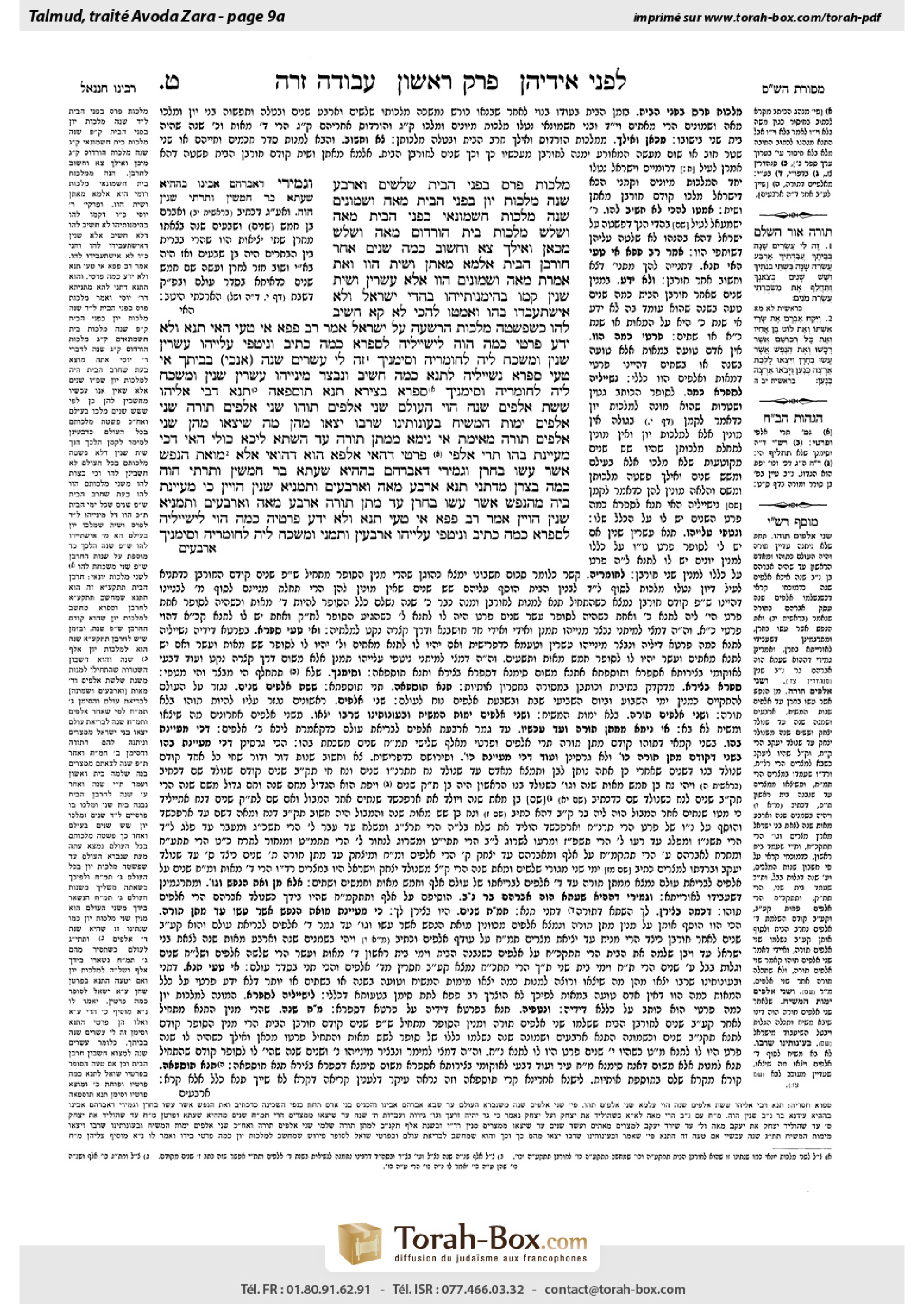
Avodah Zarah 9a: Talmud study for Daf Yomi
Study the Talmud for Daf Yomi with scanned pages, Hebrew text, English translations from Sefaria and AI-generated French translations.
Passage selection and English or AI-generated French translation are available where the scan has annotations. Daf Study is independent of Torah-Box and Sefaria.
Browse Avodah Zarah · עבודה זרה · All tractatesAvodah Zarah 9a text and translations
This page of Avodah Zarah includes the Aramaic text, an English translation and an AI-generated French translation, alongside the scan above.
עבודה זרה ט׳ א · Aramaic and Hebrew text
מַלְכוּת פָּרַס בִּפְנֵי הַבַּיִת שְׁלֹשִׁים וְאַרְבַּע שָׁנָה, מַלְכוּת יָוָן בִּפְנֵי הַבַּיִת מֵאָה וּשְׁמוֹנִים שָׁנָה, מַלְכוּת חַשְׁמוֹנַאי בִּפְנֵי הַבַּיִת מֵאָה וְשָׁלֹשׁ, מַלְכוּת בֵּית הוֹרְדוֹס מֵאָה וְשָׁלֹשׁ, מִכָּאן וְאֵילָךְ צֵא וַחֲשׁוֹב כַּמָּה שָׁנִים אַחַר חוּרְבַּן הַבַּיִת.
אַלְמָא מָאתַן וְשֵׁית הֲווֹ, וְאַתְּ אָמְרַתְּ מֵאָה וּשְׁמוֹנִים הֲווֹ! אֶלָּא עֶשְׂרִין וְשֵׁית שְׁנִין קָמוּ בְּהֵימָנוּתַיְיהוּ בַּהֲדֵי יִשְׂרָאֵל, וְלָא אִישְׁתַּעְבַּדוּ בְּהוּ, וְאַמְּטוּ לְהָכִי לָא קָא חָשֵׁיב לְהוּ כְּשֶׁפָּשְׁטָה מַלְכוּת הָרְשָׁעָה עַל יִשְׂרָאֵל.
אָמַר רַב פָּפָּא: אִי טָעֵי הַאי תַּנָּא, וְלָא יָדַע פְּרָטֵי כַּמָּה הֲוָה — לִישַׁיְּילֵיהּ לְסָפְרָא כַּמָּה כָּתֵיב, וְנִיטַפֵּי עֲלַיְיהוּ עֶשְׂרִין שְׁנִין, וּמַשְׁכַּח לֵיהּ לְחוּמְרֵיהּ, וְסִימָנָיךְ: ״זֶה לִּי עֶשְׂרִים שָׁנָה אָנֹכִי בְּבֵיתֶךָ״.
אִי טָעֵי סָפְרָא — נְשַׁיְּילֵיהּ לְתַנָּא כַּמָּה חָשֵׁיב, וּנְבַצַּר מִינַּיְיהוּ עֶשְׂרִין שְׁנִין, וּמַשְׁכַּח לֵיהּ לְחוּמְרֵיהּ. וְסִימָנָיךְ: סָפְרָא בְּצִירָא, תַּנָּא תּוֹסְפָאָה.
תָּנָא דְּבֵי אֵלִיָּהוּ: שֵׁשֶׁת אֲלָפִים שָׁנָה הָוֵי הָעוֹלָם, שְׁנֵי אֲלָפִים תּוֹהוּ, שְׁנֵי אֲלָפִים תּוֹרָה, שְׁנֵי אֲלָפִים יְמוֹת הַמָּשִׁיחַ, בַּעֲוֹנוֹתֵינוּ שֶׁרַבּוּ יָצְאוּ מֵהֶן מַה שֶּׁיָּצְאוּ מֵהֶן.
שְׁנֵי אֲלָפִים תּוֹרָה מֵאֵימַת? אִי נֵימָא מִמַּתַּן תּוֹרָה עַד הַשְׁתָּא, לֵיכָּא כּוּלֵּי הַאי, דְּכִי מְעַיְּינַתְּ בְּהוּ תְּרֵי אַלְפֵי פְּרָטֵי דְּהַאי אַלְפָּא הוּא דַּהֲוַאי.
אֶלָּא, מִ״וְּאֶת הַנֶּפֶשׁ אֲשֶׁר עָשׂוּ בְחָרָן״, וּגְמִירִי דְּאַבְרָהָם בְּהָהִיא שַׁעְתָּא בַּר חַמְשִׁין וְתַרְתֵּי הֲוָה.
כַּמָּה בָּצְרָן מִדְּתָנֵי תַּנָּא? אַרְבַּע מֵאָה וְאַרְבָּעִים וּתְמָנְיָא שְׁנִין הָוְיָין, כִּי מְעַיְּינַתְּ בֵּיהּ מֵ״הַנֶּפֶשׁ אֲשֶׁר עָשׂוּ בְחָרָן״ עַד מַתַּן תּוֹרָה — אַרְבַּע מְאָה וְאַרְבָּעִים וּתְמָנְיָא שְׁנִין הָוְיָין.
אָמַר רַב פָּפָּא: אִי טָעֵי תַּנָּא וְלָא יָדַע פְּרָטֵיהּ כַּמָּה הָוֵי — לִישַׁיְּילֵיהּ לְסָפְרָא כַּמָּה כְּתִיב, וְנִיטַפֵּי עֲלַיְיהוּ אַרְבְּעִין וְתַמְנֵי, וּמַשְׁכַּח לֵיהּ לְחוּמְרֵיהּ, וְסִימָנָיךְ:
Avodah Zarah 9a · English translation
The Persian Empire, which ruled the world before the construction of the Temple, continued to do so for 34 years in the presence of the Temple, i.e., after the Temple was built; the Greek Empire ruled for 180 years in the presence of the Temple; the Hasmonean dynasty ruled for 103 years in the presence of the Temple; and the Herodian dynasty likewise ruled for 103 years. From this point forward, you can go and calculate the date on which an event occurred by how many years it happened after the destruction of the Temple.
According to this statement of Rabbi Yosei, evidently when the Greek rule over the Jewish people ended and the Roman rule began it was 206 years before the Second Temple was destroyed, i.e., the two sets of one hundred and three years of the Hasmonean dynasty and the Herodian dynasty. But you said that when the Roman Empire stretched forth over Israel and ruled over them it was 180 years before the Temple was destroyed. This is not a contradiction, but rather, it proves that for 26 years the Romans stood faithfully with the Jewish people, honoring their agreement, and did not subjugate them. And therefore, Rabbi Yishmael, son of Rabbi Yosei, does not count these 26 years among the total years in which the evil Roman Empire stretched forth over Israel and ruled over them.
§ Apropos the above baraita, the Gemara relates that Rav Pappa said: If this tanna, i.e., one who dates years in reference to the destruction of the Temple, forgot and did not know the details of the date with regard to exactly how much time had passed since the destruction of the Temple, e.g., he remembered the century but could not recall the exact decade and year, let him ask a scribe who writes official documents how many years he writes when he dates the documents. The dating system of scribes uses as its starting point the beginning of the Greek rule, 380 years before the destruction of the Temple. And let him add 20 years to the number, and in this manner he will find his number [leḥumreih]. And your mnemonic to remember this is the verse: “These twenty years have I been in your house” (Genesis 31:41).
Similarly, if a scribe forgot the exact year, let him ask the tanna how much time he calculates has passed since the Temple’s destruction, and he should deduct from the number twenty years, and in this manner he will find his number. And your mnemonic to remember that the tanna adds twenty to the date of the scribe, whereas the scribe deducts twenty from the number of the tanna, is as follows: A scribe deducts, while a tanna adds on [tosfa’a]. This is a play on the phrase tanna tosfa’a, which also means to teach the Tosefta, the practice of a tanna.
In relation to the discussion on the calculation of years, the Gemara states that one of the Sages of the school of Eliyahu taught: The world is destined to exist for six thousand years. For two thousand years the world was waste, as the Torah had not yet been given. The next set of two thousand years are the time period of the Torah. The last set of two thousand years are the period designated for the days of the Messiah, but due to our many sins there are those years that have been taken from them, i.e., such and such years have already passed and have been taken from the two thousand years that are designated for the Messiah, and the Messiah has not yet arrived. Whenever a tanna taught this baraita, he would insert the number of years that was correct for his time.
The Gemara asks: With regard to the two thousand years of the time period of the Torah, from when are they counted? If we say that they started from the giving of the Torah until now, then there is not enough time for all of these years. As, when you examine the calculations, it is evident that from the creation of the world until the giving of the Torah there were two thousand years plus a part of this third thousand, as the Torah was given 2,448 years after the creation of the world. This would mean that the time period of the Torah encroaches upon the days of the Messiah.
Rather, the two-thousand-year time period of the Torah is counted from the time when it is stated about Abraham and Sarah: “And the souls that they had gotten in Haran” (Genesis 12:5), which is interpreted by the Sages as referring to the men and women who were brought closer to the Torah by Abraham and Sarah. Therefore, it was at this point that the Torah began to spread throughout the world. And it is learned as a tradition that at that time Abraham was fifty-two years old.
How many years are missing from the two thousand year period of the Messiah, if the period of the Torah that is taught by the tanna is counted from the giving of the Torah? There are 448 missing years. When you examine the calculation from the time when it is stated about Abraham and Sarah: “The souls that they had gotten in Haran,” until the time of the giving of the Torah, there are 448 years.
With regard to this baraita as well, Rav Pappa said: If a tanna meant to state that at his time such and such years were already lost from the two thousand years that are designated for the days of the Messiah, but he forgot and did not know the details of exactly how much time had passed, let him ask a scribe how many years he writes when he dates documents. And let him add forty-eight to the number, correcting for the century, and in this manner he will find his number. And your mnemonic for this is the verse:
Avodah Zarah 9a · Traduction française (IA)
L'Empire perse, qui régnait sur le monde avant la construction du Temple, a continué à régner pendant 34 ans en présence du Temple, c'est-à-dire après que le Temple eut été construit ; l'Empire grec a régné pendant 180 ans en présence du Temple ; la dynastie hasmonéenne a régné pendant 103 ans en présence du Temple ; et la dynastie hérodéenne l'a fait également pendant 103 ans. À partir de ce point, vous pouvez calculer la date à laquelle un événement s'est produit en fonction du nombre d'années écoulées depuis la destruction du Temple.
Selon cette déclaration du Rabbi Yosei, il est évident que lorsque la domination grecque sur le peuple juif s'est terminée et que la domination romaine a commencé, cela s'est produit 206 ans avant la destruction du Second Temple, c'est-à-dire les deux cent trois ans de la dynastie hasmonéenne et de la dynastie hérodéenne. Mais vous avez dit que lorsque l'Empire romain s'est étendu sur Israël et a régné sur eux, cela s'est produit 180 ans avant la destruction du Temple. Ce n'est pas une contradiction, mais plutôt une preuve que pendant 26 ans les Romains ont été fidèles au peuple juif, respectant leur accord, et n'ont pas soumis le peuple. Et par conséquent, le fils de Rabbi Yosei, Rabbi Yishmael, ne compte pas ces 26 ans parmi les années totales pendant lesquelles l'Empire romain s'est étendu sur Israël et a régné sur eux.
§ En rapport avec la baraïta mentionnée ci-dessus, le Guemara rapporte que Rav Pappa a dit : Si ce tanna, c'est-à-dire celui qui date les années en référence à la destruction du Temple, a oublié et ne connaît pas les détails de la date concernant exactement combien de temps avait passé depuis la destruction du Temple, par exemple s'il se souvient du siècle mais ne peut pas se rappeler l'exacte décennie et l'année, qu'il demande à un scribe qui écrit des documents officiels combien d'années il écrit lorsqu'il date les documents. Le système de datation des scribes commence à la fin de la domination grecque, à 380 ans avant la destruction du Temple. Et qu'il ajoute 20 ans au nombre, et ainsi il trouvera son nombre [leḥumreih]. Et votre mnémonique pour se souvenir de cela est la verset : « Ces vingt ans j'ai été chez vous » (Genèse 31:41).
De même, si un scribe a oublié l'année exacte, qu'il demande au tanna combien de temps il calcule depuis la destruction du Temple, et qu'il doive soustraire 20 ans au nombre, et ainsi il trouvera son nombre. Et votre mnémonique pour se souvenir que le tanna ajoute 20 à la date du scribe, tandis que le scribe soustrait 20 du nombre du tanna, est comme suit : le scribe soustrait, tandis que le tanna ajoute [tosfa’a]. C'est une jeu de mots sur la phrase tanna tosfa’a, qui signifie également enseigner la Tosefta, la pratique d'un tanna.
En rapport avec la discussion sur le calcul des années, la Guemara affirme que l'un des Sages de l'école d'Éliyahu a enseigné : Le monde est destiné à exister pendant six mille ans. Pour deux mille ans, le monde a été désert, car la Torah n'avait pas encore été donnée. Les deux mille prochains ans sont la période de la Torah. Les deux mille derniers ans sont la période désignée pour les jours du Messie, mais en raison de nos nombreux péchés, des années ont déjà été prises à cette période, c'est-à-dire telles et telle années ont déjà passé et ont été prises des deux mille ans désignés pour le Messie, et le Messie n'est pas encore arrivé. Lorsque un tanna a enseigné cette baraïta, il insérait le nombre d'années correct pour son époque.
La Guemara pose la question : En ce qui concerne les deux mille ans de la période de la Torah, depuis quand sont-ils comptés ? Si nous disons qu'ils commencent avec la donnation de la Torah jusqu'à présent, alors il n'y a pas assez de temps pour tous ces ans. En effet, lorsqu'on examine les calculs, il est évident que depuis la création du monde jusqu'à la donnation de la Torah, il y avait deux mille ans plus une partie de ce troisième mille, car la Torah a été donnée 2448 ans après la création du monde. Cela signifierait que la période de la Torah s'étend sur les jours du Messie.
Plutôt, la période de deux mille ans de la Torah est comptée depuis le moment où il est dit à propos d'Abraham et Sarah : « Et les âmes qu'ils avaient obtenues à Haran » (Genèse 12:5), ce qui est interprété par les Sages comme faisant référence aux hommes et femmes qui ont été rapprochés de la Torah par Abraham et Sarah. Ainsi, c'est à ce moment que la Torah a commencé à se propager dans le monde. Et il est appris comme une tradition que, à cette époque, Abraham avait cinquante-deux ans.
Combien d'années manquent à la période de deux mille ans du Messie, si la période de la Torah enseignée par le tanna est comptée depuis la donnation de la Torah ? Il manque 448 ans. Lorsqu'on examine le calcul depuis le moment où il est dit à propos d'Abraham et Sarah : « Les âmes qu'ils avaient obtenues à Haran », jusqu'au moment de la donnation de la Torah, il y a 448 ans.
En ce qui concerne cette baraïta également, Rav Pappa a dit : Si un tanna voulait dire que, à son époque, telles et telle années avaient déjà été perdues des deux mille ans désignés pour les jours du Messie, mais qu'il a oublié et ne connaissait pas les détails exacts du temps écoulé, qu'il demande à un scribe combien d'années il écrit lorsqu'il date les documents. Et qu'il ajoute quarante-huit au nombre, en corrigeant le siècle, et ainsi il trouvera son nombre. Et votre mnémonique pour cela est le verset :
Traduction française générée par IA à partir de l’édition anglaise de Sefaria. Vérifie toujours un passage avec le texte source.
Text from Sefaria: William Davidson Edition - Vocalized Aramaic (CC BY NC); William Davidson Edition - English (CC BY NC).