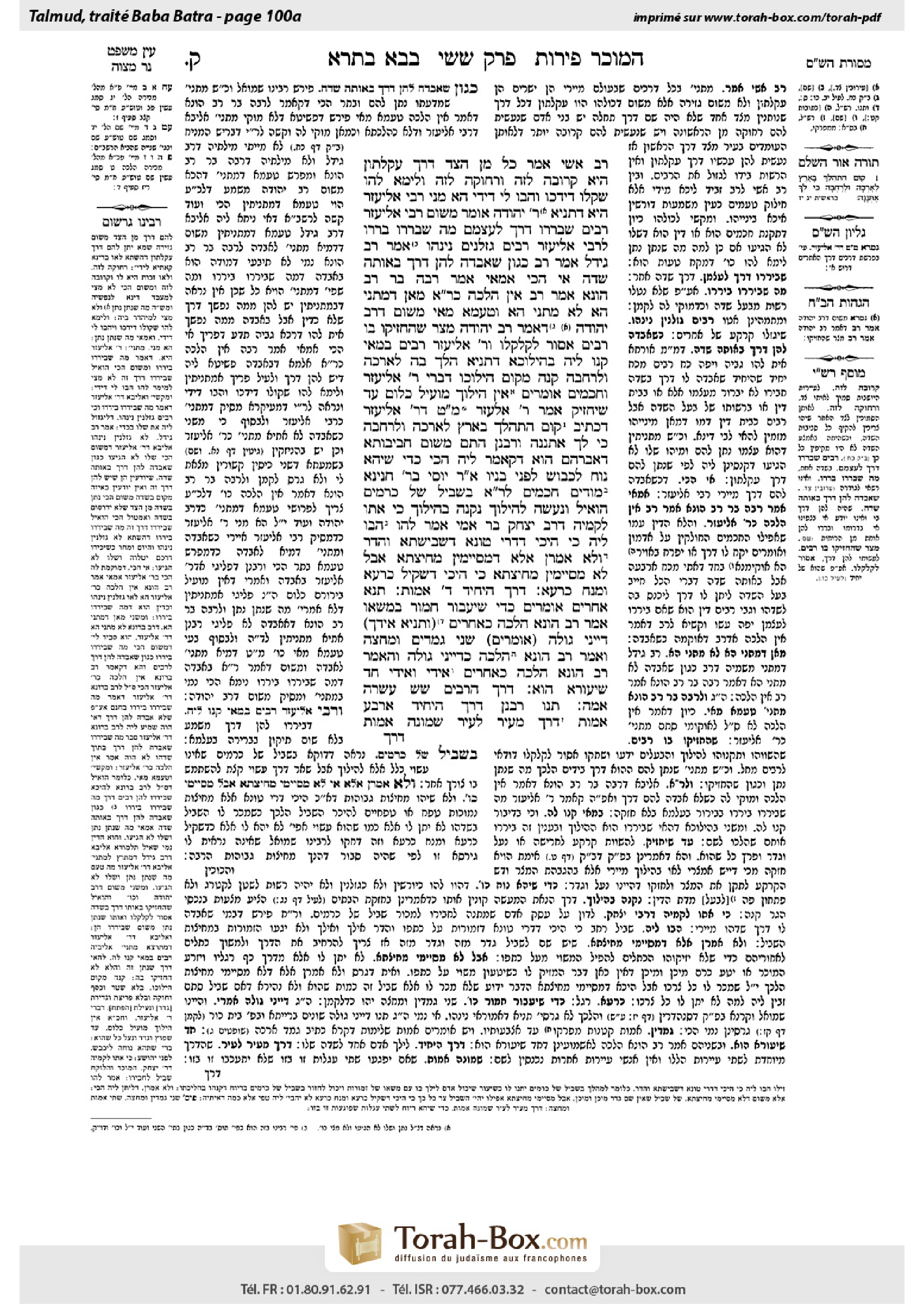
Bava Batra 100a: Talmud study for Daf Yomi
Study the Talmud for Daf Yomi with scanned pages, Hebrew text, English translations from Sefaria and AI-generated French translations.
Passage selection and English or AI-generated French translation are available where the scan has annotations. Daf Study is independent of Torah-Box and Sefaria.
Browse Bava Batra · בבא בתרא · All tractatesBava Batra 100a text and translations
This page of Bava Batra includes the Aramaic text, an English translation and an AI-generated French translation, alongside the scan above.
בבא בתרא ק׳ א · Aramaic and Hebrew text
רַב אָשֵׁי אָמַר: כׇּל מִן הַצַּד – דֶּרֶךְ עֲקַלָּתוֹן הִיא; קְרוֹבָה לָזֶה, וּרְחוֹקָה לָזֶה.
וְלֵימָא לְהוּ: שִׁקְלוּ דִּידְכוּ וְהַבוּ לִי דִּידִי! הָא מַנִּי – רַבִּי אֱלִיעֶזֶר הִיא. דְּתַנְיָא, רַבִּי יְהוּדָה אוֹמֵר מִשּׁוּם רַבִּי אֱלִיעֶזֶר: רַבִּים שֶׁבֵּרְרוּ דֶּרֶךְ לְעַצְמָם, מַה שֶּׁבֵּרְרוּ בֵּרְרוּ.
לְרַבִּי אֱלִיעֶזֶר – רַבִּים גַּזְלָנִים נִינְהוּ?! אָמַר רַב גִּידֵּל אָמַר רַב: כְּגוֹן שֶׁאָבְדָה לָהֶן דֶּרֶךְ בְּאוֹתָהּ שָׂדֶה.
אִי הָכִי, אַמַּאי אָמַר רַבָּה בַּר רַב הוּנָא אָמַר רַב: אֵין הֲלָכָה כְּרַבִּי אֱלִיעֶזֶר? מַאן דְּמַתְנֵי הָא לָא מַתְנֵי הָא.
וְטַעְמָא מַאי? מִשּׁוּם דְּרַב יְהוּדָה – דְּאָמַר רַב יְהוּדָה: מֶצֶר שֶׁהֶחֱזִיקוּ בּוֹ רַבִּים – אָסוּר לְקַלְקְלוֹ.
וְרַבִּי אֱלִיעֶזֶר – רַבִּים בְּמַאי קָנוּ לֵיהּ? בְּהִילּוּכָא. דְּתַנְיָא: הִלֵּךְ בָּהּ לְאׇרְכָּהּ וּלְרׇחְבָּהּ – קָנָה מְקוֹם הִילּוּכוֹ, דִּבְרֵי רַבִּי אֱלִיעֶזֶר. וַחֲכָמִים אוֹמְרִים: אֵין הִילּוּךְ מוֹעִיל כְּלוּם, עַד שֶׁיַּחְזִיק.
אָמַר רַבִּי אֶלְעָזָר, מַאי טַעְמָא דְּרַבִּי אֱלִיעֶזֶר? דִּכְתִיב: ״קוּם הִתְהַלֵּךְ בָּאָרֶץ לְאׇרְכָּהּ וּלְרׇחְבָּהּ, כִּי לְךָ אֶתְּנֶנָּה״. וְרַבָּנַן – הָתָם מִשּׁוּם חַבִּיבוּתָא דְאַבְרָהָם הוּא דְּקָאָמַר לֵיהּ הָכִי, כְּדֵי שֶׁיְּהֵא נוֹחַ לִכְבּוֹשׁ לִפְנֵי בָנָיו.
אָמַר רַבִּי יוֹסֵי בְּרַבִּי חֲנִינָא: מוֹדִים חֲכָמִים לְרַבִּי אֱלִיעֶזֶר בִּשְׁבִיל שֶׁל כְּרָמִים, הוֹאִיל וְנַעֲשָׂה לְהִילּוּךְ – נִקְנֶה בְּהִילּוּךְ.
כִּי אֲתוֹ לְקַמֵּיהּ דְּרַב יִצְחָק בַּר אַמֵּי, אֲמַר לְהוּ: הַבוּ לֵיהּ כִּי הֵיכִי דְּדָרֵי טוּנָא דִשְׁבִישָׁתָא וְהָדַר. וְלָא אֲמַרַן אֶלָּא דִּמְסַיְּימִין מְחִיצָתָא, אֲבָל לָא מְסַיְּימִין מְחִיצָתָא – כִּי הֵיכִי דְּשָׁקֵיל כַּרְעָא וּמַנַּח כַּרְעָא.
דֶּרֶךְ הַיָּחִיד אַרְבַּע אַמּוֹת. תָּנָא, אֲחֵרִים אוֹמְרִים: כְּדֵי שֶׁיַּעֲבוֹר חֲמוֹר בְּמַשָּׂאוֹ. אָמַר רַב הוּנָא: הֲלָכָה כַּאֲחֵרִים. וְתַנְיָא אִידַּךְ, דַּיָּינֵי גוֹלָה אוֹמְרִים: שְׁנֵי גַמָּדִים וּמֶחֱצָה. וְאָמַר רַב הוּנָא: הֲלָכָה כְּדַיָּינֵי גוֹלָה. וְהָאָמַר רַב הוּנָא: הֲלָכָה כַּאֲחֵרִים! אִידֵּי וְאִידֵּי חַד שִׁיעוּרָא הוּא.
דֶּרֶךְ הָרַבִּים שֵׁשׁ עֶשְׂרֵה אַמָּה. תָּנוּ רַבָּנַן: דֶּרֶךְ הַיָּחִיד – אַרְבַּע אַמּוֹת. דֶּרֶךְ מֵעִיר לְעִיר – שְׁמוֹנֶה אַמּוֹת.
Bava Batra 100a · English translation
Rav Ashi said: Any alternative path on the side of the original path is considered a circuitous route, as it is close for this person and it is far for that person. While some will benefit from the change, it will be detrimental to others. Therefore, one may never exchange a public path for an alternative path.
§ The mishna teaches that if a field owner provides an alternative thoroughfare through his field for the public to use, the public may use both thoroughfares. The Gemara suggests: But let him say to them: Take your original thoroughfare back and give me my thoroughfare that I provided you. The Gemara answers: In accordance with whose opinion is this mishna? It is in accordance with the opinion of Rabbi Eliezer, as it is taught in a baraita that Rabbi Yehuda says in the name of Rabbi Eliezer: If the public selected a thoroughfare through a privately owned field for themselves even without gaining the permission of the field owner, that which they selected, they selected, and they have the right to use it.
The Gemara asks: According to the opinion of Rabbi Eliezer, are the members of the public entitled to be robbers? Why should they be permitted to appropriate land from a private owner? Rav Giddel said that Rav said: Rabbi Eliezer refers only to a case where the public lost a thoroughfare in that field, e.g., the field was plowed over and the original course of the thoroughfare is not known. In such a case, the public has the right to determine the course anew.
The Gemara asks: If so, why does Rabba bar Rav Huna say that Rav says that the halakha is not in accordance with the opinion of Rabbi Eliezer? His reasoning seems valid. The Gemara answers: The one who teaches this, i.e., that Rabbi Eliezer is referring to a case where a thoroughfare was lost, does not teach that, i.e., that Rav rules against Rabbi Eliezer. There is a dispute as to what Rav said.
The Gemara asks: And according to Rabba bar Rav Huna, what is the reason the field owner cannot reclaim the alternative thoroughfare that he gave to the public? The Gemara answers: It is due to the statement of Rav Yehuda, as Rav Yehuda says: With regard to a strip of land that serves as a border between two strips of land that the public took possession of as a public thoroughfare, it is prohibited to destroy it for them, i.e., prevent people from using it. Accordingly, in the case of the mishna, where the field owner actually provided the public with a thoroughfare, he may certainly not take it back.
The Gemara asks: And according to Rabbi Eliezer, through what means does the public acquire the thoroughfare they choose? The Gemara answers: By means of walking on the thoroughfare, as it is taught in a baraita: If one walked along a field’s length and its breadth, he has acquired the area inside where he walked, as walking is an effective act of acquisition; this is the statement of Rabbi Eliezer. And the Rabbis say that by itself, walking is not effective at all to acquire a field, and it is not acquired until he takes possession of it using a legal act of acquisition.
Rabbi Elazar said: What is the reasoning of Rabbi Eliezer? As it is written that after God promised Abraham Eretz Yisrael, He instructed him: “Arise, walk through the land, its length and its breadth; for I will give it to you” (Genesis 13:17), in order that Abraham should thereby acquire the land. And the Rabbis, how do they interpret this verse? They hold that there, in Genesis, it was due to God’s love of Abraham that he said to him to do this, in order that it would be easy for his descendants to conquer the land. His walking was to demonstrate the divine promise and thereby emphasize his descendants’ claim to the land, but it did not effect acquisition of it.
Rabbi Yosei, son of Rabbi Ḥanina, says: The Rabbis concede to Rabbi Eliezer with regard to a path that passes through vineyards that since the path is made only for walking on it, it can be acquired by means of walking on it.
The Gemara relates an incident involving the allocation of a path through a vineyard: When people came before Rav Yitzḥak bar Ami for judgment with regard to the width of a path through a vineyard that someone had purchased, he said to them: Give him a path wide enough so that one can carry a load [tuna] of vine branches [dishvishta] along it and is able to turn around while holding them. The Gemara comments: And we said this only in a case where the sides of the path are bounded by a fence, which would physically prevent a person from carrying a load of vine branches that are wider than the path, and therefore, if necessary, the path must be widened by breaking down the fence. But where the sides are not bound by a fence, a person carrying a load of vine branches will not be prevented from passing along it. Consequently, he needs only to be given a path wide enough so that he can lift up one foot and place it in front of the other foot.
§ The mishna teaches: The standard width of a private path is four cubits. It is taught in a baraita: Aḥerim say: A private path is wide enough so that a donkey can pass on it with his load. Rav Huna says: The halakha is in accordance with the opinion of Aḥerim. And it is taught in another baraita: The judges of the exile say that the standard width is two and a half cubits. And Rav Huna says: The halakha is in accordance with the opinion of the judges of the exile. The Gemara asks: But doesn’t Rav Huna say: The halakha is in accordance with the opinion of Aḥerim? The Gemara resolves the contradiction: This definition and that definition are one and the same measure.
The mishna teaches: The standard width of a public thoroughfare is sixteen cubits. The Sages taught in a baraita: The standard width of a private path is four cubits. The standard width of a road that goes from city to city is eight cubits.
Bava Batra 100a · Traduction française (IA)
Rav Ashi a dit : Tout chemin alternatif sur le côté du chemin original est considéré comme un chemin détourné, car il est proche pour cette personne et loin pour celle-ci. Bien que certains en bénéficient, cela sera préjudiciable à d'autres. Par conséquent, on ne peut jamais échanger un chemin public contre un chemin alternatif.
§ La mitsva enseigne que si un propriétaire de champ fournit un chemin alternatif à travers son champ pour que le public l'utilise, le public peut utiliser les deux chemins. La Guemara suggère : Mais qu'il dise à eux : Revenez à votre chemin original et donnez-moi mon chemin que j'ai fourni à vous. La Guemara répond : Selon l'opinion de qui est cette mitsva ? C'est selon l'opinion de Rabbi Eliezer, comme il est enseigné dans une baraïta que Rabbi Yehuda dit en nom de Rabbi Eliezer : Si le public a choisi un chemin à travers un champ privé sans l'autorisation du propriétaire, ce qu'ils ont choisi, ils l'ont choisi, et ils ont le droit d'en utiliser.
La Guemara pose la question : Selon l'opinion de Rabbi Eliezer, les membres du public ont-ils le droit d'être des voleurs ? Pourquoi devraient-ils être autorisés à s'approprier un terrain d'un propriétaire privé ? Rav Giddel a dit que Rav a dit : Rabbi Eliezer fait référence uniquement à un cas où le public a perdu un chemin dans ce champ, par exemple, le champ a été labouré et le cours original du chemin n'est plus connu. Dans ce cas, le public a le droit de déterminer le cours à nouveau.
La Guemara pose la question : Si c'est ainsi, pourquoi Rabba bar Rav Huna affirme-t-il que Rav dit que la halakha ne suit pas l'opinion de Rabbi Eliezer ? Son raisonnement semble valide. La Guemara répond : Celui qui enseigne cela, c'est-à-dire que Rabbi Eliezer fait référence à un cas où un chemin a été perdu, ne dit pas cela, c'est-à-dire que Rav s'oppose à l'opinion de Rabbi Eliezer. Il y a un débat sur ce que Rav a dit.
La Guemara pose la question : Et selon Rabba bar Rav Huna, pourquoi le propriétaire du champ ne peut-il pas récupérer le chemin alternatif qu'il a donné au public ? La Guemara répond : C'est en raison de la déclaration de Rav Yehuda, comme Rav Yehuda dit : Concernant une bande de terre servant de frontière entre deux bandes de terre que le public a pris possession d'un chemin public, il est interdit de le détruire pour eux, c'est-à-dire d'empêcher les gens d'en utiliser. Ainsi, dans le cas de la mitsna, où le propriétaire du champ a effectivement fourni au public un chemin, il ne peut certainement pas le reprendre.
La Guemara pose la question : Et selon Rabbi Eliezer, par quel moyen le public acquiert-il le chemin qu'il choisit ? La Guemara répond : Par le moyen de marcher sur le chemin, comme il est enseigné dans une baraïta : Si l'on marche le long de la longueur et de la largeur d'un champ, on acquiert la zone où l'on marche, car marcher est un acte efficace d'acquisition ; c'est l'opinion de Rabbi Eliezer. Et les Rabbins disent que par lui-même, marcher n'est pas efficace du tout pour acquérir un champ, et il n'est acquis qu'une fois qu'on l'acquiert par un acte légal d'acquisition.
Rabbi Elazar a dit : Quel est le raisonnement de Rabbi Eliezer ? Comme il est écrit que, après que Dieu a promis à Abraham la Terre d'Israël, Il lui a dit : « Lève-toi, marche dans la terre, sa longueur et sa largeur ; car je te la donnerai » (Genèse 13:17), afin que Abraham acquière ainsi la terre. Et les Rabbins, comment interprètent-ils cette verset ? Ils considèrent que là, dans Genèse, c'était par l'amour de Dieu pour Abraham qu'Il lui a dit cela, afin que cela soit facile pour ses descendants de conquérir la terre. Sa marche était pour démontrer la promesse divine et ainsi souligner la revendication de ses descendants à la terre, mais cela n'a pas eu d'effet d'acquisition.
Rabbi Yosei, fils de Rabbi Ḥanina, dit : Les Rabbins reconnaissent à Rabbi Eliezer concernant un chemin passant par des vignobles, car le chemin est fait uniquement pour marcher dessus, il peut être acquis par le moyen de marcher dessus.
La Guemara rapporte un incident concernant l'allocation d'un chemin à travers un vignoble : Lorsque des gens se sont présentés devant Rav Yitzḥak bar Ami pour un jugement concernant la largeur d'un chemin à travers un vignoble que quelqu'un avait acheté, il a dit à eux : Donnez-lui un chemin suffisamment large pour qu'il puisse transporter un chargement de branches de vigne et qu'il puisse se retourner en les tenant. La Guemara commente : Et nous avons dit cela uniquement dans le cas où les côtés du chemin sont limités par un mur, ce qui empêcherait physiquement une personne de transporter un chargement de branches de vigne plus large que le chemin, et donc, si nécessaire, le chemin doit être élargi en démolissant le mur. Mais où les côtés ne sont pas limités par un mur, une personne transportant un chargement de branches de vigne ne sera pas empêchée de passer. Par conséquent, il lui suffit de lui donner un chemin suffisamment large pour qu'il puisse lever un pied et le placer devant l'autre.
§ La mitsva enseigne : La largeur standard d'un chemin privé est de quatre coudées. Il est enseigné dans une baraïta : Aḥerim disent : Un chemin privé est suffisamment large pour qu'un âne puisse y passer avec son chargement. Rav Huna dit : La halakha suit l'opinion d'Aḥerim. Et il est enseigné dans une autre baraïta : Les juges de l'exil disent que la largeur standard est de deux et demi coudées. Et Rav Huna dit : La halakha suit l'opinion des juges de l'exil. La Guemara pose la question : Mais ne dit-on pas que Rav Huna dit : La halakha suit l'opinion d'Aḥerim ? La Guemara résout la contradiction : Cette définition et celle-ci sont la même mesure.
La mitsna enseigne : La largeur standard d'un chemin public est de seize coudées. Les Sages ont enseigné dans une baraïta : La largeur standard d'un chemin privé est de quatre coudées. La largeur standard d'une route allant d'une ville à une autre est de huit coudées.
Traduction française générée par IA à partir de l’édition anglaise de Sefaria. Vérifie toujours un passage avec le texte source.
Text from Sefaria: William Davidson Edition - Vocalized Aramaic (CC BY NC); William Davidson Edition - English (CC BY NC).